Tom Christenson
Professor of Philosophy (1936-2013); Founding Editor of Intersections
Capital University
-
 Article
The Vocation of Intersections on its Twentieth Birthday
Jason A. Mahn, Robert D. Haak, Tom Christenson
No. 43 · Spring 2016
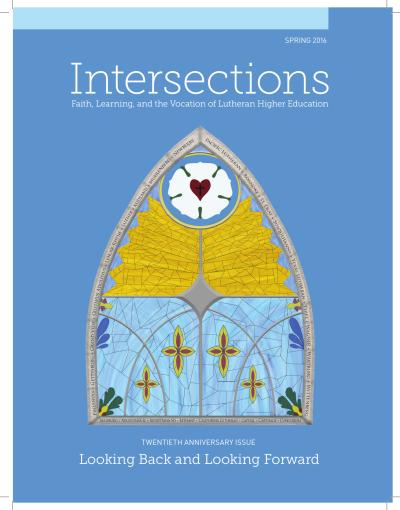
The three editors of Intersections — Bob Haak, Jason Mahn, and Tom Christenson (in spirit, following his death in 2013) — trace the twenty-year vocation of the journal itself: its 1996 birth at Capital University; its coming-of-age years of debate over institutional markers, two-kingdoms theology, and Lutheran identity; the ascendancy of “education for vocation” as the central marker of Lutheran higher education; and its ongoing identity in relation to a changing ELCA and to the broader cultural conversation about purpose, wholeness, and the vocation of higher education.
-
 Article
Point / Counterpoint: What It Means to be a "College of the Church"
Robert Benne, Tom Christenson
No. 28 · Fall 2008
Moderated by Wartburg College pastor Larry Trachte and introduced by Kathryn Kleinhans, this Wartburg campus conversation between Robert Benne (Roanoke College) and Thomas Christenson (Capital University) probes what it means to be a college of the church—Benne emphasizing ethos, vocation, and the Christian intellectual tradition over against secularization and generic education, and Christenson lifting up persistent vocational questions, the gift of difference, and induction into a community of discourse—and finds large common ground around hiring for mission, pedagogy that asks deep questions, and the courage to claim a living religious tradition while inviting everyone to the banquet.
-
 Article
Education as a Christian (Lutheran) Calling
Tom Christenson
No. 21 · Summer 2005
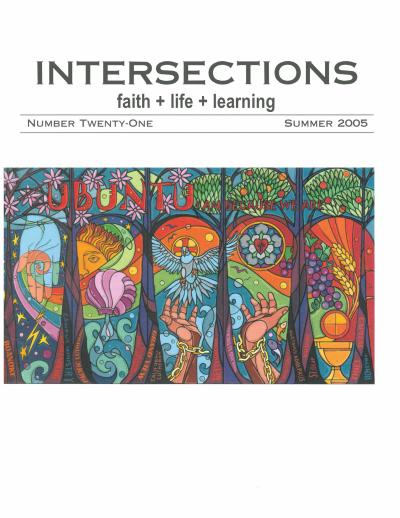
Christenson opens with an imaginative reconstruction of early Christian communities as radically egalitarian, pacifist, communitarian gatherings within the Roman Empire and argues that such communities are natural homes for the educational vocation. Naming two temptations for contemporary Christian higher education—the parochial Bible school and “Generic U”—he uses his friend Sig Rauspern’s tree metaphor to insist that a university is Christian in its trunk and roots rather than in grafted-on branches. Drawing on Wendell Berry, Jacob Bronowski, Walter Wink, Douglas John Hall, and his own Gift and Task of Lutheran Higher Education, he names faithful criticism, engaged suspiciousness, simul justus et peccator, and a fallible, love-related Lutheran epistemology as the particular gifts Lutherans bring to the Christian educational calling.
-
Editorial
From the Editor
Tom Christenson
No. 21 · Summer 2005
In his valedictory letter as outgoing editor, Christenson recounts the 1994 origins of Intersections, when he took the idea to Naomi Linnell and Jim Unglaube at DHES and persuaded the council of presidents to launch the journal on a shoestring with printing paid by DHES and everything else by Capital University. He summarizes the issue’s contents—papers from the 2004 Vocation of a Lutheran College Conference plus two commissioned pieces from former DHES directors Bob Sorensen and Leonard Schulze—and thanks the student copy editors and Capital’s presidents and provosts who sustained the publication.
-
 Book Review
Review of Educating for Shalom: Essays on Christian Higher Education
Tom Christenson
No. 20 · Fall 2004
Christenson reviews Nicholas Wolterstorff’s Educating for Shalom: Essays on Christian Higher Education (Eerdmans, 2004), edited by C.W. Joldersma and G.G. Stronks. After recounting his own early prejudice against Wolterstorff’s Reason Within the Bounds of Religion and his subsequent conversion through Art in Action, he focuses on two threads: Wolterstorff’s expansive reading of shalom—not merely peace but justice, community, communal responsibility, and delight—as the overall goal of Christian collegiate education, and the influence of Abraham Kuyper’s claim of “privileged cognitive access” for Christian inquirers, which Wolterstorff demonstrates rather than declares.
-
Editorial
From the Editor
Tom Christenson
No. 20 · Fall 2004
Christenson introduces an issue featuring “young and old, angry and encouraging, prophetic and hopeful” voices unified by the assumption that Christians engaged in thinking and educating will ask hard questions: how to raise concerns about militarism and the new American “imperialism,” what a Lutheran law school will say about training a new generation of attorneys, and what Lutheran colleges communicate to undergrads about vocation. Such faithful criticism, he argues, is part of who Lutheran institutions are.
-
 Editorial
From the Editor
Tom Christenson
No. 19 · Summer 2004
Christenson reflects on the scarcity of time in over-committed academic lives and posts a tongue-in-cheek help-wanted advertisement for his own successor as editor. He introduces the issue’s four authors as “three friends and one new acquaintance” whose work addresses Lutheran higher education, the significance of Paul Ricoeur, the implications of being a reformation community, and the perils of teaching ethics.
-
 Editorial
From the Editor
Tom Christenson
No. 18 · Fall 2003
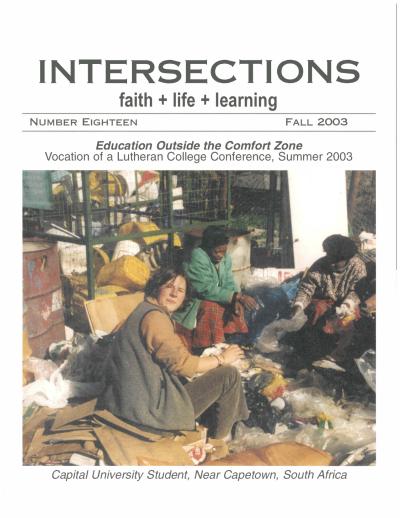
Christenson draws on a ten-year alumni survey at Capital University showing that students most often credit practica, internships, travel-study, and service-learning—not classroom hours—as the places they best learned the university’s stated outcomes, and introduces this issue’s papers from the Summer 2003 Vocation of a Lutheran College Conference on education and global outreach.
-
 Editorial
From the Editor
Tom Christenson
No. 17 · Summer 2003
Christenson introduces the four essays by participants in the first Lutheran Academy of Scholars as fruit of the “genuine conversation” that emerges when specialists set aside their lecturers’ podiums to speak as human beings, and welcomes the issue’s additional “Intersections first”—a response to a response to a review—continuing the conversation between Baird Tipson and Robert Benne about the paradigm of Lutheran higher education.
-
 Editorial
From the Editor
Tom Christenson
No. 16 · Winter 2003
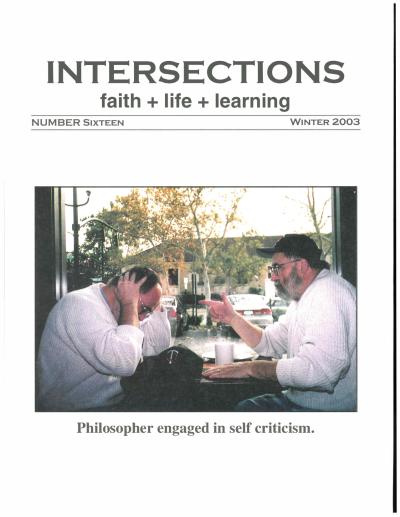
Christenson previews this issue’s papers from the Vocation of a Lutheran College Conference—Curt Thompson on “the Lutheran knot,” Carol Gilbertson on the creative dimensions of language, Bruce Heggen on theological vocabulary in the state university, Susan Poppe on the boundaries of campus freedom, and Sig Royspern’s oracular gems—welcomes Robert Benne’s response to the previous issue as a sign that Intersections is becoming a locus of continuing conversation, and confesses his reluctant consent to appear on the cover.
-
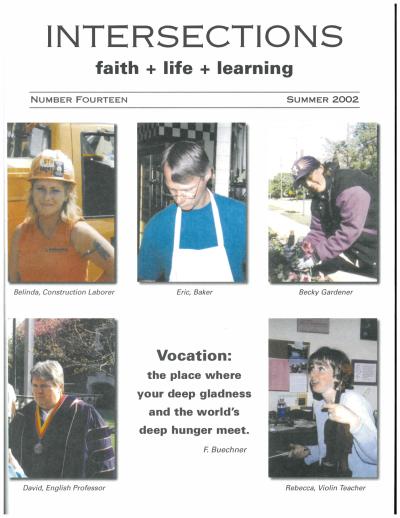 Reflection
Discerning Vocation: Personal Recollections
Tom Christenson
No. 14 · Summer 2002
Christenson recalls growing up two blocks from Concordia College, Moorhead, where his father—known to students as “Doc”—was the steam engineer, and afternoon wanderings past walrus-moustached biologists, Harpo-Marx-haired theologians, and a math professor who wrote proofs with one hand and erased them with the other. He came to see the campus as “an asylum for child-like minds building towers of intellectual blocks and then knocking them down,” and traces his philosophical bent back to a high school physics teacher who, asked why Bernoulli’s principle was true, finally growled, “Christenson, you’re nothing but a damn philosopher.”
-
Editorial
From the Editor
Tom Christenson
No. 14 · Summer 2002
Christenson argues that whether or not the conversation is funded by the “Lilly lottery,” vocation should just be part of who we are and what we do at ELCA colleges, and proposes three low-cost conversations—among faculty (twenty dollars of wine, in vino veritas), with students throughout their four years, and with alumni—explaining why this issue is deliberately “fatter” than usual and inviting feedback on other single-topic issues.
-
 Book Review
Richard T. Hughes: How Christian Faith Can Sustain the Life of the Mind
Tom Christenson
No. 13 · Winter 2002
Christenson reviews Richard Hughes’s How Christian Faith Can Sustain the Life of the Mind (Eerdmans, 2001), which argues, drawing on Tillich’s notion of “religion breaking through its own particularity,” that faith is a means to the open pursuit of truth rather than its enemy. Christenson reads the argument as a natural fit for a Lutheran tradition of semper reformanda but notes Luther’s own dogmatism toward fellow reformers, and wishes Hughes had drawn a sharper line between an absolute truth that relativizes all human truths and a postmodern abandonment of truth altogether. The book was the most-cited title at the November meeting of North American Lutheran academic officers.
-
 Editorial
From the Editor
Tom Christenson
No. 15 · Winter 2002
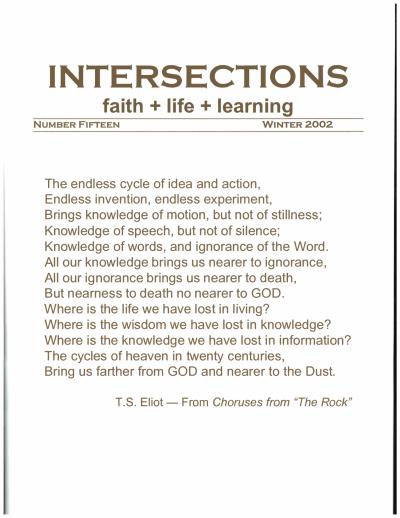
Christenson introduces an issue of varied voices—bishops and university presidents, philosophers and poets, students and their teachers—and defends the T. S. Eliot cover selection (“Where is the wisdom we have lost in knowledge?”) against the charge of being too depressing, arguing with cover artist Ida that Lutherans are realists about human accomplishments and that there is a huge difference between optimism and hope.
-
Editorial
From the Editor
Tom Christenson
No. 13 · Winter 2002
Christenson previews a varied issue—Darrell Jodock’s Bernhardson inaugural lecture, Ernie Simmons’ Valparaiso conference talk on student/parent attitudes, two South Africa travel pieces by Brian Wallace and Corin Wesner, and reviews of Richard Hughes’s and Robert Benne’s recent books—and tells the story of “the church lady from hell,” a mid-fifties returning student who condemned everyone in the class with “God and I think…,” to ask what a religious tradition without a sense of humor would look like.
-
 Editorial
From the Editor
Tom Christenson
No. 12 · Summer 2001
Christenson introduces three pieces from the summer 2000 Vocation of a Lutheran College Conference at Dana College—noting that Leonard Schulze was asked to keynote before becoming executive director of DHES—and recommends Peter C. Hodgson’s God’s Wisdom: Toward a Theology of Education and Douglas Sloan’s Faith and Knowledge: Mainline Protestantism and American Higher Education for their accounts of how faith and knowledge have been dissociated in modern higher education and what it might take to recover their connection.
-
 Editorial
From the Editor
Tom Christenson
No. 11 · Spring 2001
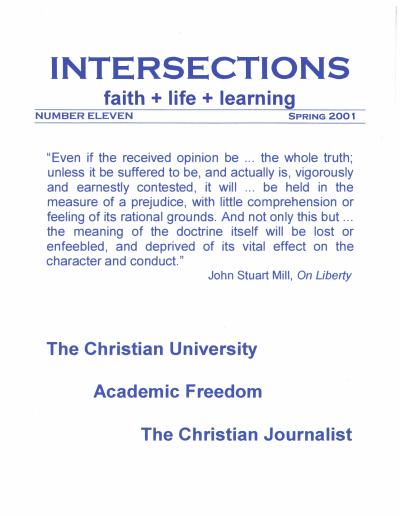
Christenson explains that this issue “borrows everything from other sources”—Richard Hughes’s talk at Pepperdine president Andrew K. Benton’s inauguration, Nicholas Wolterstorff’s and Storm Bailey’s essays from the AAUP’s Academe, and Catherine McMullen’s Concordia talk—and defends the blatant borrowing as appropriate to faculty work, hoping new faculty will find in these pieces a corrective to common misconceptions about faith-related education and academic freedom.
-
 Editorial
From the Editor
Tom Christenson
No. 10 · Fall 2000
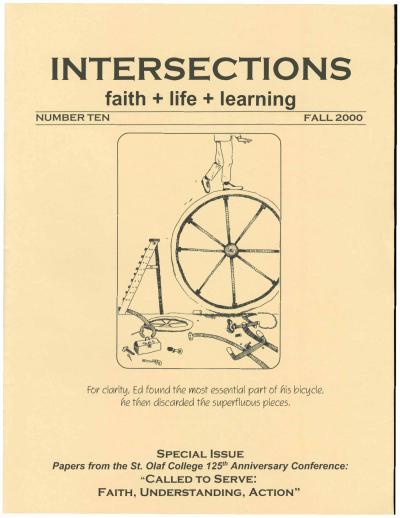
Christenson recommends the St. Olaf 125th-anniversary volume Called to Serve—edited by Pamela Schwandt with Gary de Krey and L. DeAne Lagerquist—particularly Walter Sundberg’s “What Does It Mean To be Lutheran?” and Darrell Jodock’s “The Lutheran Tradition and the Liberal Arts College.” He notes that the volume’s biographical sketches of Lars Boe, F. Melius Christiansen, Ole Rolvaag, Emil Ellingson, Agnes Larson, John Berntsen, Arne Flaten, and Howard and Edna Hong show, against an outsourcing age, that the life of an institution like St. Olaf is the committed life of the people who work there.
-
 Editorial
From the Editor
Tom Christenson
No. 9 · Summer 2000
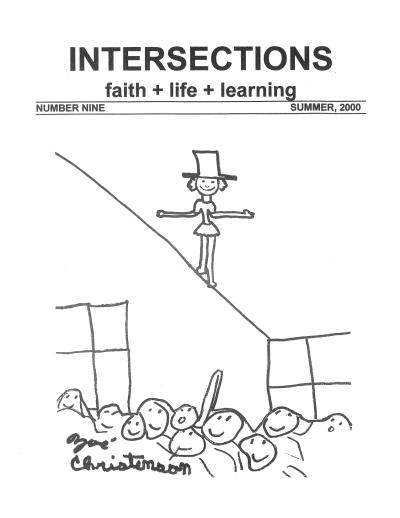
Christenson introduces a varied issue: the VonDohlen / Ratke discussion of the two kingdoms doctrine, Rachel Hammond’s “real gem” of a talk on her time in Ecuador (with an invitation to send contributions to the Home for Perpetual Hope orphanage via her home church in Oberlin, Ohio), Chuck Huff’s essay on the effect of liberal learning on the practice of psychology, and John Reumann’s reflection on a scholarly life lived between academy and church—and notes that the cover artist is his eight-year-old daughter Zoé, whose post-circus drawing of a balancing act struck him in light of Reumann’s opening line.
-
 Editorial
From the Editor
Tom Christenson
No. 8 · Winter 2000
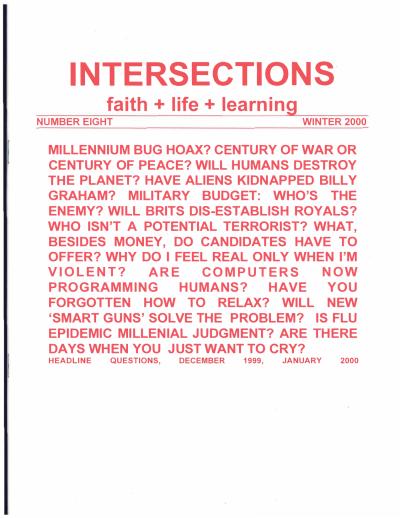
Christenson marks the eighth edition of Intersections, expresses gratitude to the ELCA Division for Higher Education and Schools and especially to the soon-retiring Bob Sorenson for backing the journal, the Vocation of a Lutheran College Conferences, and the Lutheran Academy of Scholars, and introduces an issue that gathers analyses and arguments from both insiders to Lutheran theology and outsiders, from veterans of the institutions and recent arrivals—voices that together remind us that what is and what ought to be need to inform each other.
-
 Editorial
From the Editor
Tom Christenson
No. 7 · Summer 1999
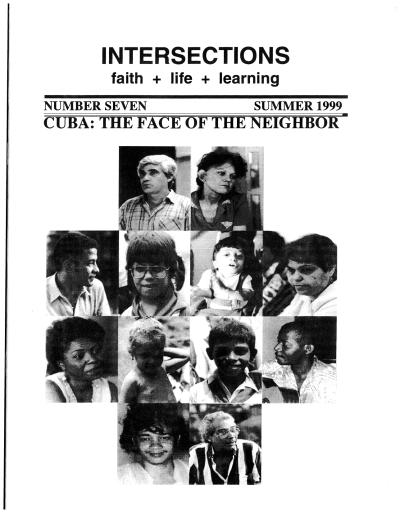
Christenson introduces the issue’s contents—papers from the 1998 Vocation conference by Cheryl Ney and Robert Scholz, a response by Jennifer Sacher Wiley, an interview with four Capital University faculty about Cuba, a meditation by St. Olaf senior Erik Haaland, and the journal’s first letter to the editor—and commends the Mount Mary College volume Wagering on Transcendence as a model of a faculty community sustained by Friday-afternoon conversation over a glass of wine.
-
 Article
Learning and Teaching as an Exercise in Christian Freedom
Tom Christenson
No. 6 · Winter 1999
Christenson, the 1998 Wittenberg keynote, argues that what makes our institutions Lutheran is not the percentage of Lutherans served or employed, ethnic celebration, or self-conscious difference, but a theologically informed vision of the educational task framed by the linked ideas of gift, freedom, and vocation. Drawing on Joe Sittler, Wendell Berry, David Orr, Harold Kushner, John Updike, Frederick Buechner, and Luther’s On the Freedom of a Christian, he reframes the liberal arts as four “liberating arts”—critical/deconstructive, embodying/connecting, melioristic/creative, and arts of enablement and change—and closes with his mother’s “end-of-the-month soup” as an image of vocation in a particular place.
-
Editorial
From the Editor
Tom Christenson
No. 6 · Winter 1999
Christenson explains that three of the five papers from the 1998 Wittenberg Vocation of a Lutheran College conference appear here (with Robert Scholz and Cheryl Ney to follow in the next issue), passes on Andy Sheppard’s “Books for Belarus” appeal from Southwestern College, and reflects on Douglas John Hall’s The End of Christendom and the Future of Christianity—its claim that disengagement from cultural dominance is the prerequisite for faithful re-engagement, and its retrieval of Christ’s metaphors of “a little salt, a little yeast, a little light” as a possible session topic for a future VLC Conference.
-
 Editorial
From the Editor
Tom Christenson
No. 5 · Summer 1998
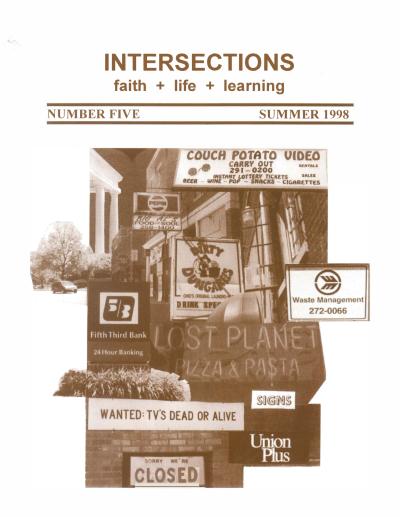
Christenson introduces the issue as an illustration of the diversity of interests Intersections aims for, surveys the contents (Lagerquist on method, Mori on art and ritual, Baer on falling walls, Bergendoff as memorial, Funk and Powell in dialogue), urges readers to send in “your good stuff,” asks for distribution feedback, and closes with a sabbatical-year reading list—Kieran Egan, Robert Coles, Daniel Kemmis, David W. Gill, Sallie McFague, Roger Scruton, E.M. Adams, Freeman Dyson, Colamosca and Wolman, Gribbin and Goodwin, van Wyk, Wislawa Szymborska, and Flannery O’Connor.
-
 Editorial
From the Editor
Tom Christenson
No. 4 · Winter 1998
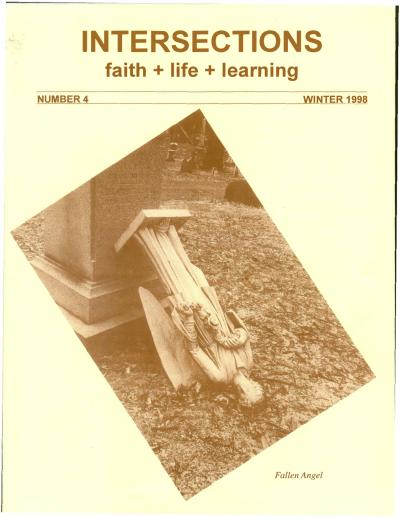
Christenson thanks the departing Jim Unglaube, recommends Ronald A. Wells’s Keeping Faith: Embracing the Tensions in Christian Higher Education (Eerdmans) as both an interesting collection of essays and a model worth imitating at ELCA institutions, previews the issue’s pieces by Richard Hughes, Carl Skrade and Spencer Porter, Gregory Clark, and Karla Bohmbach, and introduces three new features of the journal: “What I Have Learned” (an essay by a senior or emeritus faculty member, inaugurated by Richard Ylvisaker), “Reviews” (initiated by Karla Bohmbach), and a “Bulletin Board” for cross-campus announcements.
-
 Editorial
From the Editor
Tom Christenson
No. 3 · Summer 1997
Christenson explains that this issue breaks from the first two issues’ single-focus pattern to feature three principal papers on the environment, the education of desire, and hiring and personnel policies, plus two poems and a piece of reflective bemusement. He then commends George Marsden’s The Outrageous Idea of Christian Scholarship (Oxford, 1997) and challenges Lutheran scholars to articulate how the particulars of their faith inform their scholarship—in conversation with Calvinist work like Nicholas Wolterstorff’s Reason Within the Bounds of Religion and Art in Action—rather than remaining silently complicit in the view that faith has no place in the academy.
-
 Editorial
From the Editor
Tom Christenson
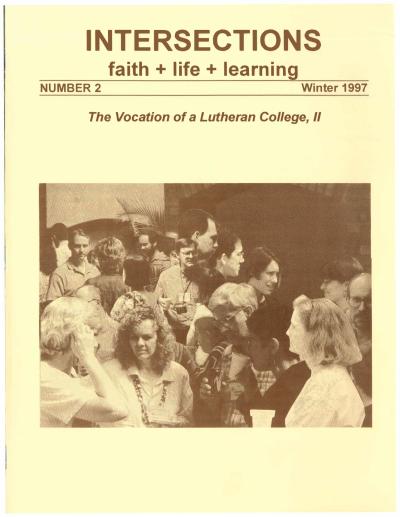
No. 2 · Winter 1997
Christenson opens with an invitation for reader submissions to balance the conference-paper format of the first two issues, then asks how college and universities can turn students positively toward learning. Drawing on Aristotle’s claim that study is loved for its own sake (which students greet with disbelieving laughter) and Neil Postman’s The End of Education, he argues that students lack narratives within which learning makes sense and proposes four Lutheran mega-narratives—stewardship of creation, the freedom of the Christian, the sacramental presence of the transcendent in the concrete and ordinary, and vocation—that could inspire learning at the 28 ELCA colleges and universities.
-
 Editorial
From the Editor
Tom Christenson
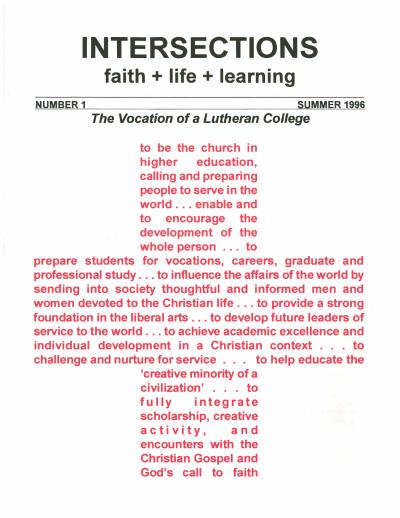
No. 1 · Summer 1996
Christenson, feeling like a proud parent, welcomes readers to the inaugural issue and acknowledges three people without whom the publication would still be just an idea: Naomi Linnel of the ELCA office for Higher Education and Schools, publisher Jim Unglaube, and Capital University president Josiah Blackmore. He invites readers’ reactions, suggestions, and active involvement as editors, reviewers, authors, artists, and critics in shaping the dialogue across the ELCA college and university family.
-
Endings and Beginnings: Some Reflections on the ELCA and Higher Education in the Last Decade
No. 21 · Summer 2005
The Summer 2005 issue is transitional—Tom Christenson’s final issue as founding editor before handing off to Bob Haak, and a turning point as the ELCA Division for Higher Education and Schools folds into a larger unit. W. Robert Sorensen and Leonard G. Schulze reflect on DHES. From the 2004 Vocation of a Lutheran College Conference at Carthage, Loren J. Anderson explores public witness in the Pacific Northwest’s “None Zone”; Harvard Stevens Jr. preaches on Proverbs; Pamela K. Brubaker examines money, sex, and power; Christenson closes on education as Christian calling.
-
Number Twenty
No. 20 · Fall 2004
The Fall 2004 issue gathers voices—“young and old, angry and encouraging, prophetic and hopeful”—around the Lutheran tradition of faithful criticism. Carl Skrade’s “Mars, Mammon—and Other Options” probes American militarism under the second Bush administration and proposes just-war principles and Matthew 5:43–48 as the Christian alternative. Steven C. Bahls argues law schools must teach students to distinguish vocation from career. Eric Childers profiles six students at Concordia, Lenoir-Rhyne, and Muhlenberg. Tom Christenson closes with a review of Wolterstorff’s Educating for Shalom.
-
Academic Vocation: What the Lutheran University has to Offer
No. 19 · Summer 2004
The Summer 2004 issue of Intersections features work from the Lutheran Academy of Scholars in Higher Education. Wendy McCredie grounds an academic vocation for the Lutheran university in the dialogical tension between bonds of faith and openness to the neighbor. Mark C. Mattes draws on Ricoeur’s hermeneutics to defend dual citizenship in Athens and Jerusalem. Thomas W. Martin reflects on the dark side of the Reformation myth. Ned Wisnefske argues that fear of “the Ought” underwrites contradictory faculty objections to moral formation. Tim Knopp closes with the poem “Unpossible.”
-
Education Outside the Comfort Zone
No. 18 · Fall 2003
The Fall 2003 “Education Outside the Comfort Zone” issue gathers papers from the 2003 Vocation of a Lutheran College Conference on global outreach. Christopher M. Thomforde offers six theses on global education grounded in Psalm 24; Kathryn Wolford of Lutheran World Relief reads economic globalization through mercy and justice; Janet E. Rasmussen describes Pacific Lutheran’s “Global Education Continuum” and its partnerships in Trinidad, China, and Namibia; Bishop Munib A. Younan offers a Palestinian Christian theology of incarnation, grace, and the cross as a foundation for just peace and interfaith dialogue.
-
What's Faith Got To Do With It?
No. 17 · Summer 2003
The Summer 2003 issue gathers papers from the first Lutheran Academy of Scholars in Higher Education, a Harvard Divinity seminar under Ronald Thiemann themed “What’s Faith Got to Do with It?” Pamela Brubaker describes teaching Christian ethics as moral discourse in a religiously diverse classroom; Jim Huffman traces his journey from Christian exclusivism to pluralism; Diane Scholl reads Winthrop and The Scarlet Letter against Ezekiel’s dry bones; Bruce Reichenbach applies the exclusivist/inclusivist/pluralist taxonomy to Lutheran higher education. Caitlin McHugh offers a poem, and Baird Tipson continues his conversation with Robert Benne.
-
Number 16, Winter 2003
No. 16 · Winter 2003
The Winter 2003 issue celebrates the new Lilly Endowment vocational-exploration grants awarded to nine ELCA colleges, drawing on the eighth Vocation of a Lutheran College Conference. Curtis Thompson frames Lutheran identity as a dialectical “knot in the stomach” held by the theology of the cross. Carol Gilbertson honors “the Word” through chapel talks and poems. Bruce Allen Heggen argues the theology of the cross teaches hope even in the secular university. Susan O’Shaughnessy Poppe reads the Samaritan Woman alongside The Vagina Monologues; Sig Royspern offers fourteen oracular questions; Robert Benne defends Lutheran intellectual engagement.
-
Vocation: Faith + Life + Learning
No. 14 · Summer 2002
A single-topic Summer 2002 issue on vocation drawn from the 2001 conference. Darrell Jodock reads Putnam’s Bowling Alone alongside Luther’s ethic and the new Gustavus Center for Vocational Reflection. Marcia Bunge maps eight “doorways” through Valparaiso’s Lilly grant. Richard Rouse tracks “Paths Unknown.” John P. Trump’s play “Holy Odors” argues digging up old bones can be as holy a call as ministry. Karla Bohmbach traces her vocation as a feminist biblical scholar; Don Braxton reviews Alister McGrath’s Glimpsing the Divine.
-
Marks of an ELCA College
No. 15 · Winter 2002
The Winter 2002 “Marks of an ELCA College” issue gathers bishops, presidents, philosophers, poets, and students on what it means for a college to be Lutheran. Bishop Stanley Olson’s lead essay names eight “marks of an ELCA college” and surveys all twenty-eight ELCA mission statements against them. Gregg Muilenberg argues non-Lutheran faculty feel welcome only when invited into the faith-and-reason struggle. Mary Theresa Hall and Cora Lazor read Thiel’s mission alongside Bacon and Newman, Don Braxton defends “honesty of mind,” and Baird Tipson reviews Dovre’s The Future of Religious Colleges.
-
Opening Lines
No. 13 · Winter 2002
The Winter 2002 issue, themed around Lutheran humor and identity, draws from the 2001 Vocation of a Lutheran College Conference at Valparaiso. Ernest L. Simmons names community, mentoring, and faith-values integration as the three areas where the Lutheran “two-handed” theology equips ELCA colleges to respond to the Millennial Generation. Darrell Jodock’s Bernhardson chair lecture develops humor, community, and freedom. Brian Wallace and Corin Wesner contribute travel reflections from post-apartheid South Africa. The issue closes with reviews of Hughes’s How Christian Faith Can Sustain the Life of the Mind and Benne’s Quality With Soul.
-
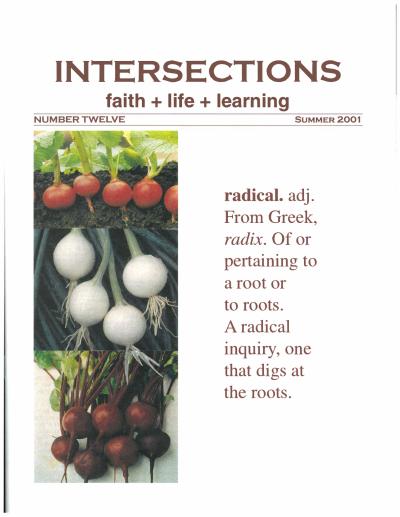
Number 12
No. 12 · Summer 2001
The Summer 2001 issue of Intersections gathers papers from the sixth Vocation of a Lutheran College Conference at Dana College. Leonard Schulze defines teaching as paradoxical “servant leadership” and closes with ten Wittenberg-style theses. L. DeAne Lagerquist places the twenty-eight ELCA colleges in American higher education and proposes five characteristic practices engendering gratitude, wisdom, freedom, and humility. Ruth Henricks calls colleges and social ministry to front-line leadership at a church threshold. A. Joseph Everson borrows “a river runs through it” to image California Lutheran’s six commitments.
-
Number 11
No. 11 · Spring 2001
The Spring 2001 issue of Intersections gathers four pieces on Christian higher education, academic freedom, and journalism as Christian vocation. Richard Hughes argues Christian particularity is itself the foundation for diversity and academic freedom; Nicholas Wolterstorff offers eight considerations on academic freedom in religiously based institutions; Storm Bailey argues religious commitment serves academic goals; and Catherine McMullen, surveying 1998 in American journalism, argues journalism is a Lutheran vocation—“a Christian cobbler makes good shoes, not poor shoes with little crosses on them.”
-
Number 10
No. 10 · Fall 2000
This Fall 2000 special issue gathers papers from the St. Olaf 125th Anniversary Conference, “Called to Serve: Faith, Understanding, Action.” Paul J. Dovre meditates through T.F. Gullixson’s pioneer woman who “turned her face to the west wind.” Robert Benne names four inadequate theologies of Christian higher education and three marks of an adequate one. David J. O’Brien surveys Catholic justice and peace education since Vatican II; Shirley Hershey Showalter traces the Mennonite tradition and Goshen’s Study-Service Term. Student Matt Peterson closes with a homily on vocation as becoming, not doing.
-
Number 9
No. 9 · Summer 2000
The Summer 2000 issue of Intersections opens with a two-kingdoms discussion: Richard VonDohlen argues the doctrine as recently invoked walls theology off from the disciplines, and David Ratke responds with a defense grounded in Luther’s writings on temporal authority. Capital student Rachel Hammond gives a chapel talk on five months in Guayaquil during the sucre’s collapse. Chuck Huff’s Mellby Lecture argues virtue is cultivated through community and small choices rather than fairy-tale heroism. John Reumann reflects on a half century of “serving two masters” between academy and church.
-
Number 8
No. 8 · Winter 2000
The Winter 2000 issue takes up the 1999 Vocation of a Lutheran College Conference question: “Integrity and Fragmentation: Can the Lutheran Center Hold?” Robert Benne proposes an “intentional, robust pluralism” for colleges that have lost a center; Philip Nordquist traces Lutheran higher education “from pietism to paradox”; Florence Amamoto, a Buddhist “inside outsider” at Gustavus, argues diversity and integrity belong together. Sig Royspern offers “Things That Renew Hope,” Kathy Fritz turns to 1 Corinthians 12 amid crisis at Newberry, and Daisybelle Thomas-Quinney offers “a view from the other side” from Thiel.
-
Number 7
No. 7 · Summer 1999
The Summer 1999 “Cuba: The Face of the Neighbor” issue continues papers from the 1998 Vocation of a Lutheran College Conference. Cheryl L. Ney argues for “sustainable science practice” rooted in empathy; Robert Scholz responds to Christenson’s “Freedom of a Christian” as a musician, critiquing taped accompaniments and TV evangelism; Jennifer Sacher Wiley offers Unitarian Universalist reflections on a more inclusive “little Christ.” Four Capital faculty recount a 1998 Cuba trip, Erik Haaland meditates on a Band Chapel service, and the journal’s first letter to the editor closes the issue.
-
Number 6
No. 6 · Winter 1999
The Winter 1999 issue of Intersections gathers papers from the 1998 Vocation of a Lutheran College Conference at Wittenberg. Tom Christenson’s keynote frames the Lutheran educational task by gift, freedom, and vocation, proposing four “liberating arts.” Ryan La Hurd reads Luther’s two kingdoms onto the institution, distinguishing the “imagined” from the “real” college of budgets. Pamela M. Jolicoeur searches for “the words” in California’s religious marketplace; David Wee meditates on being “wise about others”; Kevin Griffith closes with two poems.
-
Number 5
No. 5 · Summer 1998
The Summer 1998 issue of Intersections gathers diverse essays at the intersection of faith, life, and learning. L. DeAne Lagerquist traces four Lutheran themes underwriting her work as a historian of women in the ALC; Kyoko Mori reflects on the redemptive role of imperfection in art and writing. A memorial publishes excerpts from Conrad Bergendoff’s 1990 Augustana library address, alongside Elizabeth Baer’s chapel homily on walls and the F3 tornado that struck Gustavus on March 29. A Discussion pairs Robert W. Funk on the historical Jesus with a response by Mark Allan Powell defending myth as poetry.
-
Number 4
No. 4 · Winter 1998
The Winter 1998 issue of Intersections marks James M. Unglaube’s farewell as Publisher and introduces new features. Richard Hughes argues Lutheranism’s dialectical sensibility uniquely suits the academy’s pluralistic search for truth. Spencer Porter and Carl Skrade offer a wry “Skeptical Theologian’s Dictionary”; Gregory A. Clark calls Christian colleges to abandon dialectical neutrality, with a response from Karla G. Bohmbach. Richard Ylvisaker inaugurates “What I Have Learned,” Preisinger and Braxton respond to Santmire on the two kingdoms, and Bohmbach reviews Buford’s In Search of a Calling.
-
Number 3
No. 3 · Summer 1997
The Summer 1997 issue of Intersections gathers essays on the environment, the education of desire, and hiring policies. H. Paul Santmire offers three mandates for the Lutheran college’s care for the earth; Gregg Muilenburg argues the core of Christian education is the education of Christian desire. A discussion on mission and hiring pairs Bruce Reichenbach for “critical mass” hiring, Wendy J. McCredie for “creative education,” and Harry Jebsen on the “moving target” of church and curriculum. Gary Fincke offers two poems; Chuck Huff closes with “Confessions of a Collaborator.”
-
Number 2
No. 2 · Winter 1997
The Winter 1997 issue of Intersections—“The Vocation of a Lutheran College, II”—features Walter R. Bouman’s lead essay naming five continuing themes of the Lutheran tradition (biblical, catholic, evangelical, sacramental, world-affirming), with responses from Steven Paulson, Kimberly and Jon-David Hague, Jane Hokanson Hawks, Ben Huddle, and Chuck Huff probing Lutheran praxis, curriculum, mentoring, and campus “outsiders.” Brian Forry Wallace offers two poems, and Baird Tipson closes with a focus on Wittenberg University’s “American” Lutheran heritage.
-
Number 1
No. 1 · Summer 1996
The inaugural Summer 1996 issue of Intersections launches the journal alongside the first Vocation of a Lutheran College Conference at Capital University. Mark Schwehn’s keynote “The Future of Lutheran Higher Education” frames the Christian university around the pursuit of truth and liberal learning, with responses from Marsha Heck, Kurt Keljo, Thomas Templeton Taylor, John Rehl, Florence Amamoto, and Sandra C. Looney probing moral action, witness, secularization, and lived Lutheran identity.