Why I Became a Professor
I grew up just two blocks from the college campus where my father worked. He was not on the faculty. In spite of that many of the students called him “Doc.” He was a steam engineer given the responsibility of keeping the showers hot, the radiators warm, the whole place running. As a child I enjoyed visiting him in the “boiler room,” his place of work. I liked the pungent smell of hot steel and the machinery of the pumps. Besides, there was always coffee, donuts and a small circle of folks in conversation.
Often after school I would stop in to see my dad and hang around until he was ready to walk home from work. On many of those days I would spend the hour between four and five in the afternoon wandering around campus, peeking into rooms, labs and offices. I remember the vacated classrooms, remnants of lessons left on their chalkboards. There I came upon traces of worlds described in foreign tongues, in Greek and Latin, in German and French, in the calculi of math and physics, and very often in English terms that weren’t part of my elementary school vocabulary. I remember the smells and sights of the laboratories—formaldehyde and skeletons and all sorts of glass apparati and organic and inorganic chemicals. The art department also had its identifying smells, sometimes clay, sometimes oil paints. It was fun to look in from week to week to see works in process. But of most interest to me were the faculty and staff who were still around in the late afternoon. There was a biology prof with a giant moustache who looked like a walrus. A theology prof with Harpo Marx hair had two desks in his office that he paced between. There was a music prof who was about 6′10″ tall with reddish blond hair, a giraffe-like neck, and a high counter-tenor voice. There was the librarian who regarded my looking at books with suspicion, guarding them as if they were her very own. The art professor would say to me every time I’d peek into his space, “I like to draw pictures. Do you draw pictures?” There was the professor of mathematics who had a blackboard in her office. As I watched through her open door she wrote proofs with her right hand and erased them immediately with her left. There was a very near sighted man who paced the hallway of his building with his nose almost touching the slim volume he held open in his hand. On the cover was only one word, “Novalis.” I found all these characters simultaneously fascinating and frightening.
For me walking through those nearly deserted buildings was like a trip to wonder-land. It was a world of unreality in a way, a journey into world of imagination, into an intellectual play-space. But most of all it was a bedlam of weird folks. People who, though in adult bodies, seemed to be child spirits arrested in their development who were “confined” to this institution to play out their days. The college campus was, from my point of view, a kind of menagerie for the mentally sharp but developmentally retarded. It was a place where people seemed to be happily institutionalized in ways that removed them from the cares of the ordinary world. That gave them all the time they wanted to pursue their peculiar interests. Like a zoo, it was a great place for a kid to visit, but I then thought, not a place a normal person would want to reside.
But as I advanced through my teen years, through high school and then college I came to discover that, in fact, I was not a normal person at all. Many of my peers, and a few of my parents’ friends, started pointing out to me that I was weird. I had a high school teacher who even told me I was the weirdest person he had ever met. When I came, finally, to accept the truth of what they said I was relieved to know that there was a place for me and people like me. So after the appropriate induction and certification I moved in, and except for a few years when I was sprung to the outside world, I have remained happily confined here ever since. I am very thankful there are such places as colleges and universities, places where people can pass there lives drawing pictures, studying the sex-life of waterfowl, learning and perfecting the grammar of a no longer spoken language, reading the works of a single author over and over again, teaching a complete fiction like economics as if it were reality, teaching mice and rats to do tricks, blowing a horn. An asylum for child-like minds building towers of intellectual blocks and then knocking them down, that’s where I belong. It’s that sense of fit that makes me a professor.
Why I am a Philosopher
When I was a junior in high school I took a class in physics. Well into the class our teacher, who always wore brown suits, was introducing to us Bernoulli’s principle—that faster moving fluids (such as air) have a lower pressure than slower moving or stationary fluids. This principle is exemplified by the fact that smoke exits the window of a moving car, that an airplane wing has lift, that we can sail a sailboat into the wind, etc. After hearing all of this I raised my hand and asked the teacher why this was so. He said, with a sense of satisfaction, “Because of Bernoulli’s principle.” I then asked, “But why is Bernoulli’s principle true?” He said, “Because faster moving fluids have a lower pressure than slower moving fluids.” I looked around the room for reinforcement but found everyone else was busy writing down what he said, making sure to get the spelling of “Bernoulli” right. But I was still puzzled. His answer had not really advanced my understanding so I said, “And this is true because ---?” “Because of Bernoulli’s principle,” he replied, now obviously agitated by what must have seemed like my unrelenting stupidity. I paused for a while considering whether I shouldn’t give up and be silent. But finally I blurted, “Is ‘because of Bernoulli’s principle’ really an answer at all? Isn’t it just a name for our ignorance?”
At that point he gave me an angry look and growled, “Christenson, you’re nothing but a damn philosopher.”
He was, as it turned out, correct. At that time I did not know what a philosopher was, but I could sense from his tone and the accompanying adjective that it was not a particularly good thing to be. I won’t argue the virtues of philosophy here, but I have usually seen my inclination towards philosophy as a gift, but occasionally I understand that everyone else does not see it that way. I continue to this day being puzzled by what others take to be significant knowledge. I have over the years compiled a fairly long list of things that we parade as knowledge that seem to me to be “names for our ignorance.” But calling or curse, whichever way I look at it, I know this twist of mind is something I am stuck with. One of my colleagues recently introduced me as “an unrepentant philosopher.” I am guilty as charged.
-
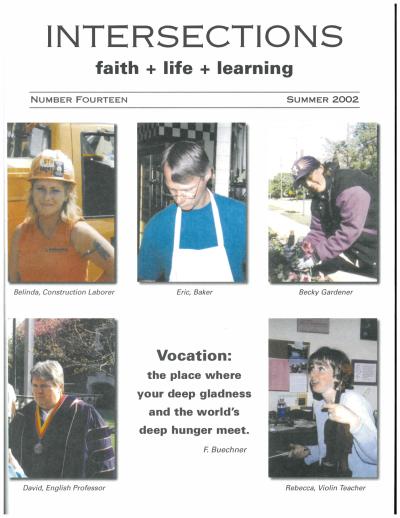 Editorial
From the Publisher
Arne Selbyg
Writing on behalf of the publisher, Sue Edison-Swift names vocation as one of the precious gifts Lutheran theology offers education, reflects on her first ELCA Vocation of a Lutheran College conference, and asks readers to gift future issues of Intersections with feedback—notes on what they read and skipped, and how they ended up with a copy.
-
Editorial
From the Editor
Tom Christenson
Christenson argues that whether or not the conversation is funded by the “Lilly lottery,” vocation should just be part of who we are and what we do at ELCA colleges, and proposes three low-cost conversations—among faculty (twenty dollars of wine, in vino veritas), with students throughout their four years, and with alumni—explaining why this issue is deliberately “fatter” than usual and inviting feedback on other single-topic issues.
-
Article
Vocational Discernment: A Comprehensive College Program
Darrell Jodock
Jodock, whose Gustavus Adolphus was one of twenty colleges to receive a Lilly “Theological Exploration of Vocation” grant in 2000, defines vocation not as occupation but as a self-understanding that nests the self in community. Reading Robert Putnam’s Bowling Alone on the collapse of secondary communities alongside Luther’s ethic of community benefit and five Lutheran principles (graciousness, Christian freedom, community, God active in the world, the theology of the cross), he walks through Gustavus’s three-level design—a definition of vocation open to other faith traditions, “middle principles” drawn from Sharon Parks’s Common Fire, and a long menu of programs coordinated by a new Center for Vocational Reflection—hoping that, in the language of Holocaust studies, graduates will be “resisters” and “rescuers” rather than bystanders.
-
Article
Renewing a Sense of Vocation at Lutheran Colleges and Universities: Insights from a Project at Valparaiso University
Marcia Bunge
Bunge, director of the process for writing Valparaiso’s nearly two-million-dollar Lilly grant on the Theological Exploration of Vocation, argues that contemporary culture’s reduction of vocation to either paid work or self-fulfillment requires Lutheran institutions to renew attention to a rich theological concept rooted in Luther’s expansion of vocation beyond the priesthood. She outlines eight low-cost “doorways”—caring adults, prayer, worship leadership, music and the arts, service, cross-cultural experience, church camps and wilderness, study and reflection—and describes Valparaiso’s two-program structure: a Campus-Wide Program weaving vocation into Freshman Core Courses and chapel life, and a Church Vocations Program for students considering full-time ministry. She closes with four troubling questions for any institution carrying out such a grant: what faith traditions can learn from one another, how to involve parents, whether faculty and staff have space to reflect on their own vocations, and whether daily institutional practices—family policies, treatment of low-paid staff, environmental responsibility, obligations to the wider community—actually reflect a commitment to love of neighbor.
-
Article
Martin Luther, Vocation, and Church Colleges: Nurturing Future Leaders for Faith and Community
Richard W. Rouse
Rouse, citing Arne Selbyg’s statistic that thirteen of sixteen newly elected ELCA bishops graduated from a Lutheran college (and 49 of 65 in the new Conference of Bishops), argues that ELCA colleges are training grounds for future church and community leaders because of Luther’s doctrine of the priesthood of all believers and his distinction between vocation and station—the basis of PLU’s motto “educating for lives of service, inquiry, leadership, and care.” He describes “Paths Unknown: Where is God Leading Me?” a Western Mission Cluster collaboration of California Lutheran, Luther Seminary, Pacific Lutheran Theological Seminary, PLU, and Trinity Lutheran College that used a dedicated web site (godleading.com), a January-February 2001 online virtual forum reaching over 300 participants in 40 states and Canada and Mexico, and one-day interactive video workshops featuring Trump’s play “Holy Odors,” and reports LECNA’s Reclaiming Lutheran Student Project findings on teaching, community, and faith integration at Lutheran schools.
-
Article
Holy Odors
John P. Trump
A one-act play by John P. Trump, premiered at Pacific Lutheran University, in which Maggie, a senior studying Reformation history in the library stacks, falls asleep over the Apology of Augsburg and dreams a 16th-century pickled-herring merchant—Herr Leonard Kopp, the man who smuggled Katie von Bora and eight other nuns out of the convent—into existence to argue that her call to archaeology (“digging up old bones”) is as holy as ordained ministry, with Luther’s joke that the church burns incense to insulate priests from the “holy odors” (not holy orders) of everyday life.
-
Article
Of Fathers and Feminism: How One Lutheran Woman Came to a Vocation
Karla G. Bohmbach
Bohmbach, a recently tenured Susquehanna University feminist biblical scholar one month shy of forty, traces her vocation back through a Vacation Bible School injury, an LCMS upbringing in which only men could preach or preside, her father’s contradictory message that she could do anything while modeling a church that limited women, St. Olaf’s revelation of a Lutheran female face, and a Duke graduate seminar on the History of Feminist Thought with Carol Meyers. Her published feminist work on biblical daughters and on the concubine of Judges 19 is read alongside Kathleen Norris’s account of word-bombardment in church, Michel Tournier on childhood as “ardent confusion,” and her own recent participation as both student and teacher in an Authorized Lay Worship Leaders Program.
-
Book Review
Alister McGrath: Glimpsing the Divine: The Search for Meaning in the Universe
Don Braxton
Braxton reviews Alister McGrath’s Glimpsing the Divine (Eerdmans, 2002), commending its twelve articulate, lavishly photographed meditations as a fine introduction to Western spirituality but criticizing its conservative neo-Barthian confessionalism, its Eurocentric treatment of non-Western traditions as “taillights” to Christianity’s “headlights,” its one-sided host-guest engagement with the natural sciences, and its metaphysical dualism. In a section added for ministerial readers, he contrasts McGrath’s self-contained confessionalism with H. Richard Niebuhr’s call to respond to all things as if to God’s actions upon us, and argues that in an era of rival fundamentalisms exclusivity must become a thing of the past.
-
 Article
The Vocation of Intersections on its Twentieth Birthday
Jason A. Mahn, Robert D. Haak, Tom Christenson
No. 43 · Spring 2016
The three editors of Intersections — Bob Haak, Jason Mahn, and Tom Christenson (in spirit, following his death in 2013) — trace the twenty-year vocation of the journal itself: its 1996 birth at Capital University; its coming-of-age years of debate over institutional markers, two-kingdoms theology, and Lutheran identity; the ascendancy of “education for vocation” as the central marker of Lutheran higher education; and its ongoing identity in relation to a changing ELCA and to the broader cultural conversation about purpose, wholeness, and the vocation of higher education.
-
 Article
Point / Counterpoint: What It Means to be a "College of the Church"
Robert Benne, Tom Christenson
No. 28 · Fall 2008
Moderated by Wartburg College pastor Larry Trachte and introduced by Kathryn Kleinhans, this Wartburg campus conversation between Robert Benne (Roanoke College) and Thomas Christenson (Capital University) probes what it means to be a college of the church—Benne emphasizing ethos, vocation, and the Christian intellectual tradition over against secularization and generic education, and Christenson lifting up persistent vocational questions, the gift of difference, and induction into a community of discourse—and finds large common ground around hiring for mission, pedagogy that asks deep questions, and the courage to claim a living religious tradition while inviting everyone to the banquet.
-
 Article
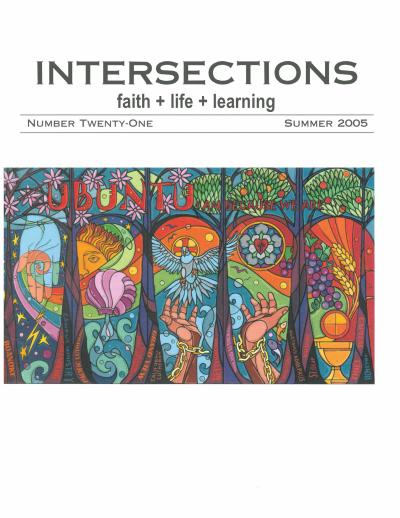
Education as a Christian (Lutheran) Calling
Tom Christenson
No. 21 · Summer 2005
Christenson opens with an imaginative reconstruction of early Christian communities as radically egalitarian, pacifist, communitarian gatherings within the Roman Empire and argues that such communities are natural homes for the educational vocation. Naming two temptations for contemporary Christian higher education—the parochial Bible school and “Generic U”—he uses his friend Sig Rauspern’s tree metaphor to insist that a university is Christian in its trunk and roots rather than in grafted-on branches. Drawing on Wendell Berry, Jacob Bronowski, Walter Wink, Douglas John Hall, and his own Gift and Task of Lutheran Higher Education, he names faithful criticism, engaged suspiciousness, simul justus et peccator, and a fallible, love-related Lutheran epistemology as the particular gifts Lutherans bring to the Christian educational calling.
-
Editorial
From the Editor
Tom Christenson
No. 21 · Summer 2005
In his valedictory letter as outgoing editor, Christenson recounts the 1994 origins of Intersections, when he took the idea to Naomi Linnell and Jim Unglaube at DHES and persuaded the council of presidents to launch the journal on a shoestring with printing paid by DHES and everything else by Capital University. He summarizes the issue’s contents—papers from the 2004 Vocation of a Lutheran College Conference plus two commissioned pieces from former DHES directors Bob Sorensen and Leonard Schulze—and thanks the student copy editors and Capital’s presidents and provosts who sustained the publication.
-
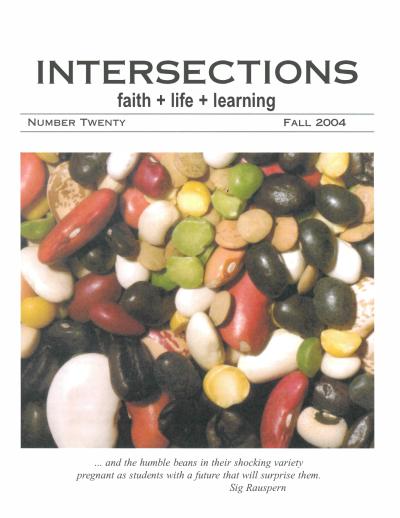 Editorial
From the Editor
Tom Christenson
No. 20 · Fall 2004
Christenson introduces an issue featuring “young and old, angry and encouraging, prophetic and hopeful” voices unified by the assumption that Christians engaged in thinking and educating will ask hard questions: how to raise concerns about militarism and the new American “imperialism,” what a Lutheran law school will say about training a new generation of attorneys, and what Lutheran colleges communicate to undergrads about vocation. Such faithful criticism, he argues, is part of who Lutheran institutions are.
-
Book Review
Review of Educating for Shalom: Essays on Christian Higher Education
Tom Christenson
No. 20 · Fall 2004
Christenson reviews Nicholas Wolterstorff’s Educating for Shalom: Essays on Christian Higher Education (Eerdmans, 2004), edited by C.W. Joldersma and G.G. Stronks. After recounting his own early prejudice against Wolterstorff’s Reason Within the Bounds of Religion and his subsequent conversion through Art in Action, he focuses on two threads: Wolterstorff’s expansive reading of shalom—not merely peace but justice, community, communal responsibility, and delight—as the overall goal of Christian collegiate education, and the influence of Abraham Kuyper’s claim of “privileged cognitive access” for Christian inquirers, which Wolterstorff demonstrates rather than declares.
-
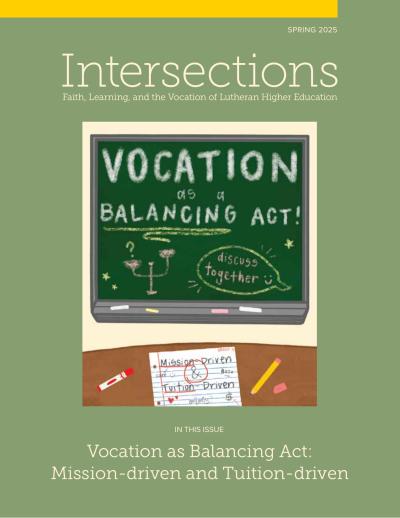 Editorial
From the Editor
Colleen Windham-Hughes
No. 61 · Spring 2025
5 min audio
Windham-Hughes uses Fred Rogers’ neighborhood as a living embodiment of a Lutheran understanding of vocation — seeing dignity in each person, offering one’s gifts generously, and trusting that the well-being of the neighborhood is intrinsically connected to the well-being of every neighbor.
-
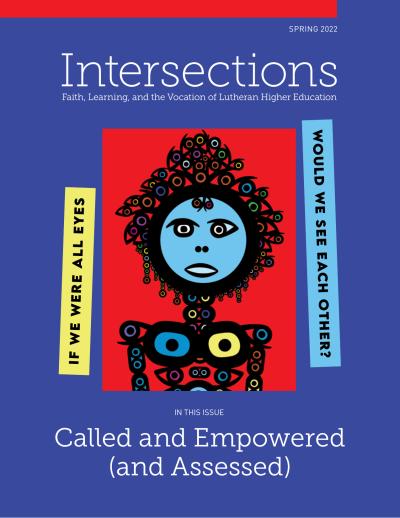 Editorial
From the Incoming Editor
Colleen Windham-Hughes
No. 55 · Spring 2022
Windham-Hughes introduces herself as incoming editor by reclaiming the root of assess — “to sit by” — and committing to the question “What does this mean?” as she sits with readers in the worth of our work and the universality of vocation.
-
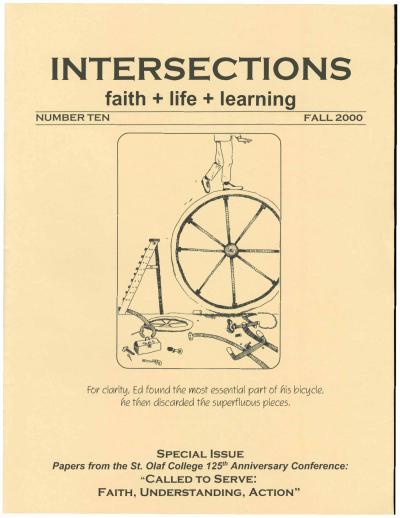 Editorial
From the Publisher
Arne Selbyg
No. 10 · Fall 2000
Selbyg explains that, while Intersections usually publishes papers from the annual Vocation of a Lutheran College conferences, this issue gathers presentations from a St. Olaf 125th-anniversary conference—a companion to the volume Called to Serve edited by Pamela Schwandt—because the theology and educational perspectives behind them apply to any Lutheran college and clarify what makes ELCA church-related colleges excellent institutions for students of any faith.
-
 Editorial
From the Publisher
Arne Selbyg
No. 27 · Spring 2008
Selbyg, retiring this summer as Director for ELCA Colleges and Universities, reflects on his decade serving as spokesperson between the church and its twenty-eight colleges and universities, and argues that the link between the colleges and the church has grown stronger over the last ten years — sustained by supportive church leaders like Presiding Bishop Mark Hanson, the annual Vocation of a Lutheran College conference, and a Lutheran theology of higher education whose principles (questioning authority, returning to the sources, including the excluded, serving the neighbor) remain a strong basis for operating colleges and universities in the twenty-first century.
-
 Article
Sojourners in a Pluralistic Land: The Promise and Peril of Christian Higher Education
Randall Balmer
No. 25 · Spring 2007
Balmer, a Barnard scholar of American evangelicalism reared in evangelical parsonages and formed at Trinity College in the Chicago suburbs, defends public education even as he champions Christian higher education as a “halfway house” for students moving from religious subculture into a pluralistic world. Drawing on his own undergraduate experience, his books Mine Eyes Have Seen the Glory and Thy Kingdom Come, and a chastening visit to Patrick Henry College, he names three perils of Christian higher education—the Scylla of secularism (intellectual arrogance allergic to piety), the Charybdis of sectarianism (intellectual dishonesty as exemplified by intelligent design’s special pleading), and insularity—and prescribes mentors, primary sources, internships outside the subculture, and a broader, intergenerational pluralism on campus.
-
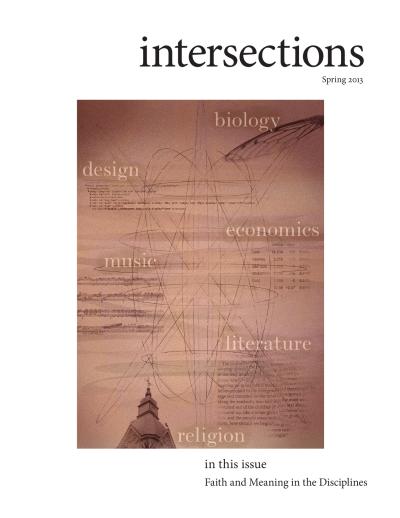 Editorial
From the Editor
Jason A. Mahn
No. 37 · Spring 2013
Mahn introduces the issue’s six essays as parallel attempts—from poetry, economics, choral music, biology, religion, and Lutheran higher education—to resist our culture’s fact-value split, and uses Augustana’s Fritiof Fryxell, a 1922 biology and English graduate who began teaching just as the Scopes Trial ignited, to illustrate how church-related colleges have long held faith and disciplinary inquiry together.