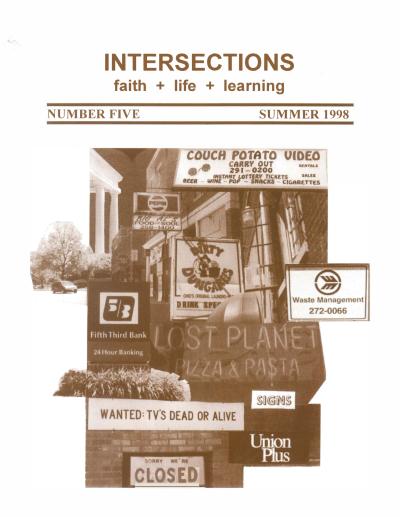
This issue of Intersections illustrates the great diversity of interests and points of view we intend for all our issues. DeAne Lagerquist’s essay is a wonderful example of the intersection idea, exploring the connection between faith orientation, academic methodology, and personal outlook. The essay by Kyoko Mori explores the dimensions of art (and its contrast with ritual) with some vivid examples from her own experience. Elizabeth Baer, disclaiming any gift of prophecy, explores the metaphor of falling walls within academia and the role that chapel plays in doing that. The talk by Conrad Bergendoff is included here as a memorial to him. We had originally been in contact with him to write a “What I Have Learned” column for this issue. His passing last December made us value these earlier words of his all the more. Our thanks to David Crowe for facilitating and editing the text of that talk. The “Discussion” section of this issue features a provocative essay by Robert W. Funk, the founder of the Jesus Seminar, and an engaging response by Mark Powell, himself a prolific author on New Testament texts and issues. We’re sure these essays will generate further discussion in our pages.
As I have talked with the editors of other journals I have discovered that I do not have the problem that most of them have. They have the problem of receiving many more manuscripts than they can possibly use. Consequently the time between when someone submits an article and when it finally appears in print can be, in the case of some publications, years. As I said, we do not have that problem. Though the quality of submissions to Intersections has been excellent, the quantity has been “just barely enough.” So, what I’m urging is, send us your good stuff! I know there are more excellent chapel talks, excellent essays, excellent poems, excellent reviews, responses, and excellent works of art that should be shared in these pages. Share your gifts!
We hear occasionally that there are problems with the distribution of Intersections on the campuses. We’ve heard stories of boxes unopened, copies undistributed, and of people who want copies who haven’t got them. If that is so on your campus, please write and let us know. At present we have the name of one person on each campus who has agreed to be our distributor. If we’ve got the wrong person, or are routing it the wrong way, or are not sending enough copies to your campus please let us know. The most successful distributions we’ve heard about are at faculty meetings, where we’ve been told “they go like hot cakes.”
In the past I have used this note from the editor to recommend some good books. This past year has been a sabbatical year for me (a whole year of Saturdays!) so I have a list of good books to recommend, all of which are non-specialized enough to be pursued by the intelligent reader. I hope you find time to read some of them.
Best books recommended by colleagues:
- Kieran Egan, The Educated Mind: How Cognitive Tools Shape Our Understanding. (1997, Univ. Of Chicago).
- Robert Coles, The Call of Stories: Teaching and the Moral Imagination. (1989, Houghton Mifflin).
Best books found while browsing:
- Daniel Kemmis (The Mayor of Missoula, Montana), The Good City and the Good Life. (1995, Houghton Mifflin).
- David W. Gill, editor, Should God Get Tenure? Essays on Religion & Higher Education. (1997, Eerdmans).
- Sallie McFague, Super Natural Christians: How We Should Love Nature. (1997, Augsburg Fortress).
Best books in my own field:
- Roger Scruton, An Intelligent Person’s Guide to Philosophy. (1996, Allen Lane / Penguin).
- E.M. Adams, A Society Fit for Human Beings. (1997, SUNY).
Best books recommended by my kids:
- Freeman Dyson, Imagined Worlds. (1997, Harvard).
- Anne Colamosca & William Wolman, The Judas Economy: The Triumph of Capitalism and the Betrayal of Work. (1997, Addison Wesley).
Best picture books:
- John Gribbin & Simon Goodwin, Origins: Our Place in Hubble’s Universe. (1997, Overlook Press).
- Gary van Wyk, African Painted Houses: Basotho Dwellings of South Africa. (1998, Harry N. Abrams, publ.).
Best poetry:
- Wislawa Szymborska, View with a Grain of Sand: Selected Poems. (1995, Harcourt Brace).
Best fiction:
- Rereading Flannery O’Connor, The Complete Stories. (1971, Noonday Press).
If you have such a list, share it with us!
Tom Christenson
Capital University
-
 Editorial
From the Publisher
W. Robert Sorensen
Sorenson frames Intersections and the Vocation of a Lutheran College Conference as vehicles for widening the scope of inquiry that the separation of mind from spirit has curtailed, citing Ernest Boyer on probing “the deep places of the mind and the deep longings of the human spirit.” He previews an announcement at the 1998 conference of the Conrad Bergendoff Series—named for the late scholar and former Augustana College president—whose first volume, by Ernest Simmons of Concordia College, will support an Academy of Scholars in Lutheran Higher Education.
-
Article
You Don't Seem Angry: Methodological Confessions Of A Lutheran Lay-Woman
L. DeAne Lagerquist
Lagerquist, opening from a colleague’s 1981 observation about her M.A. thesis on four female abolitionists, traces her path from feminist historian and battered women’s shelter advocate through the University of Chicago’s obsession with method to a more self-conscious account of her own. The method grows out of four Lutheran themes—original sin (caution and humility), the eighth commandment against bearing false witness (generosity and forgiveness), the neighbor as “little Christ” (cooperative interpretation), and vocation (interpretation as calling, located alongside feeding the hungry and visiting the lonely)—and shapes her ongoing work on a history of Lutherans in the United States with a plot about learning to live with diversity.
-
Article
Redemption Through Imperfection
Kyoko Mori
Mori, drawing on a visit to the Philadelphia Museum of Art with a friend, contrasts Marcel Duchamp’s Étant donnés—a peephole work whose mysterious motion sweeps every viewer into a shared, perpetual performance—with the static, glass-encased Liberty Bell as parody of spiritual experience. She extends the contrast into a meditation on rituals (comfort and consolation) versus art (truth, however painful), and on writing as a redemptive process that moves from orderly first drafts toward chaos and deeper, frightening truth—closing with master potters who skewed each finished vessel slightly so that art and decoration could be told apart. Parts are excerpted from Polite Lies (Holt 1997).
-
Reflection
A Community That Connects
Conrad Bergendoff
Excerpts from Conrad Bergendoff’s 1990 address at the opening of Augustana’s new library, prepared by David Crowe and published here as a memorial after Bergendoff’s death in December 1997. Bergendoff—Augustana class of 1915, president 1936–1962—recounts eighty years of Augustana memories, insists that “size is pretty much within you, not outside of you,” traces the institution’s bonds to Uppsala from 1860 (and the 1910 visit of the Rector Magnificat), and celebrates Augustana’s graduates “in practically every part of the world” as evidence that a small school can have a universal output.
-
Reflection
Walls: Talk At Gustavus Adolphus College
Elizabeth Baer
Baer’s September 11, 1997 Gustavus Adolphus chapel homily on Joshua 6 turns from the trumpets to the walls—Robert Frost’s “Mending Walls,” the walls of the Warsaw ghetto in Vladka Meed’s On Both Sides of the Wall and Margaret Zassenhaus’s Walls, the Berlin Wall coming down in 1989—and then to the autobiographical, intertextual discourse of Gustavus chapel itself as a place where misunderstandings come down. An author’s note added after the March 29 F3 tornado reports the closing line (“LET’S MAKE THOSE WALLS COME TUMBLING DOWN”) as eerily prescient: roofs, windows, and 90% of campus trees were lost, but the Chapel walls and the eternal flame in the red glass lantern stood firm.
-
Article
The Quest Of The Historical Jesus: Problem & Promise
Robert W. Funk
Funk, founder of the Jesus Seminar, frames the quest as the search for reliable data amid twenty-two ancient gospels and as a confrontation among three “parties”—the Jesus Party, the Apostolic Party, and the Bible Party. He surveys the Seminar’s 1985–1998 work (The Five Gospels, The Acts of Jesus, the color-coded reports), defends the synoptics over John, the priority of Mark, the Sayings Gospel Q and the Gospel of Thomas, and argues that a recovered Jesus—a teacher of a trust ethic, celebration, a kingdom without social barriers, a society without brokers, without cult rituals—may serve as catalyst for a sweeping third-millennium reformation that purges the “clogged arteries” of institutional Christianity.
-
Response
Beyond Data: The Poetry of Faith — A Response to Robert W. Funk
Mark Allan Powell
Powell, professor of New Testament at Trinity Lutheran Seminary, responds to Funk not as a New Testament scholar (Meier, Raymond Brown, and others can rehearse those debates) but as a Christian and a pastor. He challenges Funk’s closing implication that the institutional church’s “only function” is to protect Christian privilege (citing the ELCA’s 28 colleges, 1378 early childhood centers, AIDS hospices, and more), questions the suspicion of “derivative” faith, and proposes that piety is to theology what poetry is to prose—arguing, against Funk and with Marcus Borg, for a wholistic faith that holds history and myth, data and devotion, head and heart together.
-
 Article
The Vocation of Intersections on its Twentieth Birthday
Jason A. Mahn, Robert D. Haak, Tom Christenson
No. 43 · Spring 2016
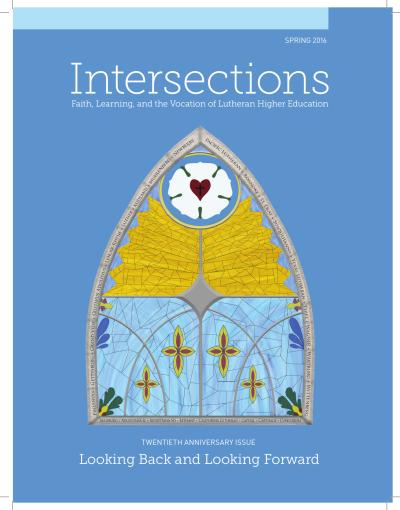
The three editors of Intersections — Bob Haak, Jason Mahn, and Tom Christenson (in spirit, following his death in 2013) — trace the twenty-year vocation of the journal itself: its 1996 birth at Capital University; its coming-of-age years of debate over institutional markers, two-kingdoms theology, and Lutheran identity; the ascendancy of “education for vocation” as the central marker of Lutheran higher education; and its ongoing identity in relation to a changing ELCA and to the broader cultural conversation about purpose, wholeness, and the vocation of higher education.
-
 Article
Point / Counterpoint: What It Means to be a "College of the Church"
Robert Benne, Tom Christenson
No. 28 · Fall 2008
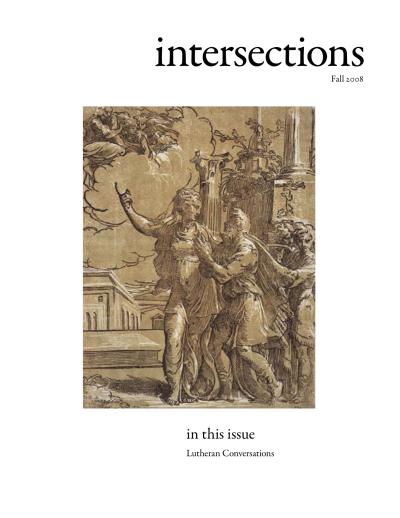
Moderated by Wartburg College pastor Larry Trachte and introduced by Kathryn Kleinhans, this Wartburg campus conversation between Robert Benne (Roanoke College) and Thomas Christenson (Capital University) probes what it means to be a college of the church—Benne emphasizing ethos, vocation, and the Christian intellectual tradition over against secularization and generic education, and Christenson lifting up persistent vocational questions, the gift of difference, and induction into a community of discourse—and finds large common ground around hiring for mission, pedagogy that asks deep questions, and the courage to claim a living religious tradition while inviting everyone to the banquet.
-
 Article
Education as a Christian (Lutheran) Calling
Tom Christenson
No. 21 · Summer 2005
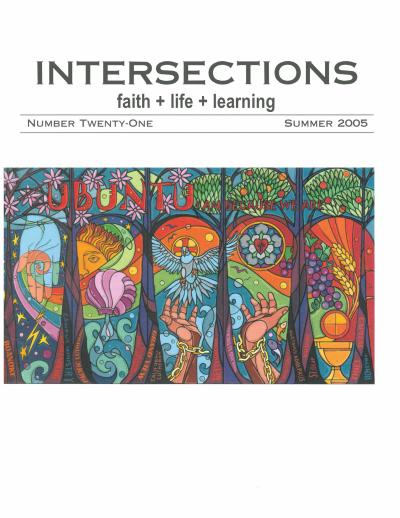
Christenson opens with an imaginative reconstruction of early Christian communities as radically egalitarian, pacifist, communitarian gatherings within the Roman Empire and argues that such communities are natural homes for the educational vocation. Naming two temptations for contemporary Christian higher education—the parochial Bible school and “Generic U”—he uses his friend Sig Rauspern’s tree metaphor to insist that a university is Christian in its trunk and roots rather than in grafted-on branches. Drawing on Wendell Berry, Jacob Bronowski, Walter Wink, Douglas John Hall, and his own Gift and Task of Lutheran Higher Education, he names faithful criticism, engaged suspiciousness, simul justus et peccator, and a fallible, love-related Lutheran epistemology as the particular gifts Lutherans bring to the Christian educational calling.
-
Editorial
From the Editor
Tom Christenson
No. 21 · Summer 2005
In his valedictory letter as outgoing editor, Christenson recounts the 1994 origins of Intersections, when he took the idea to Naomi Linnell and Jim Unglaube at DHES and persuaded the council of presidents to launch the journal on a shoestring with printing paid by DHES and everything else by Capital University. He summarizes the issue’s contents—papers from the 2004 Vocation of a Lutheran College Conference plus two commissioned pieces from former DHES directors Bob Sorensen and Leonard Schulze—and thanks the student copy editors and Capital’s presidents and provosts who sustained the publication.
-
 Book Review
Review of Educating for Shalom: Essays on Christian Higher Education
Tom Christenson
No. 20 · Fall 2004
Christenson reviews Nicholas Wolterstorff’s Educating for Shalom: Essays on Christian Higher Education (Eerdmans, 2004), edited by C.W. Joldersma and G.G. Stronks. After recounting his own early prejudice against Wolterstorff’s Reason Within the Bounds of Religion and his subsequent conversion through Art in Action, he focuses on two threads: Wolterstorff’s expansive reading of shalom—not merely peace but justice, community, communal responsibility, and delight—as the overall goal of Christian collegiate education, and the influence of Abraham Kuyper’s claim of “privileged cognitive access” for Christian inquirers, which Wolterstorff demonstrates rather than declares.
-
Editorial
From the Editor
Tom Christenson
No. 20 · Fall 2004
Christenson introduces an issue featuring “young and old, angry and encouraging, prophetic and hopeful” voices unified by the assumption that Christians engaged in thinking and educating will ask hard questions: how to raise concerns about militarism and the new American “imperialism,” what a Lutheran law school will say about training a new generation of attorneys, and what Lutheran colleges communicate to undergrads about vocation. Such faithful criticism, he argues, is part of who Lutheran institutions are.
-
 Article
"We're Looking for a College—Not a Vocation": Articulating Lutheran Higher Education to Prospective Students and Parents Seeking Relevance
Karl Stumo, Tom Crady
No. 38 · Fall 2013
Drawing on Sallie Mae and UCLA enrollment data, the websites of competitor institutions, and candid voices from the field, Crady and Stumo describe a recruitment landscape in which yield rates have collapsed, discount rates have soared, and the word “Lutheran” often presents an obstacle until it is patiently unpacked. They survey mission language at Augsburg, PLU, Gustavus, and Wartburg and argue that strategic message development is the only way for ELCA schools to make vocation and Lutheran identity “credible, relevant, differentiating, and compelling” to prospective families.
-
 Response
Disputatio Pro Quo? The Search for Lutheran Education
Jon-David Hague, Kimberly Hague
No. 2 · Winter 1997
Kimberly and Jon-David Hague—both Luther College graduates completing graduate studies at Berkeley and Boston University respectively—respond to Bouman by offering Luther’s curriculum reform at Wittenberg University in the spring of 1518, only months after the 95 theses, as a model of the Lutheran voice in higher education. Inspired by humanistic principles, Luther introduced lectures on classical authors and the first instruction in Greek and Hebrew, giving students the tools to encounter scripture directly rather than receive dictated doctrine. The spirit of that reform—providing students with every possible tool while acknowledging that an instructor’s perspective is neither ultimate authority nor final word—remains useful for the search for Lutheran academia today.
-
 Article
Vocation Outside of Career: Discovering Purpose through Comics
María Evelia Emerson
No. 53 · Spring 2021
Emerson recounts building an Augustana Vocational Discernment course around G. Willow Wilson’s Ms. Marvel series, using Kamala Khan’s juggling of family, friendship, faith, and superhero identity to help sophomores see vocation as not what they do for a living but how they want to live.
-
 Book Review
Post-Secular Religion on Campus: Conversing with Jacobsen and Jacobsen
L. DeAne Lagerquist
No. 39 · Spring 2014
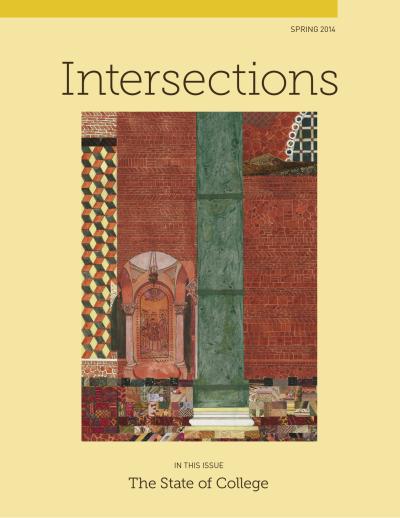
Lagerquist guides readers through Douglas and Rhonda Hustedt Jacobsen’s No Longer Invisible: Religion in University Education and its companion volumes, unpacking the authors’ three-act story of campus religion (Protestant, Privatized, Pluriform), their three-by-two framework of historic/public/personal religion in belief and behavior, and the six questions they pose for campus conversations. She lifts up interfaith etiquette and vocation as especially fruitful zones for Lutheran campuses.
-
 Reflection
Why All This Talk About Vocation?
Madyson Ray
No. 56 · Fall 2022
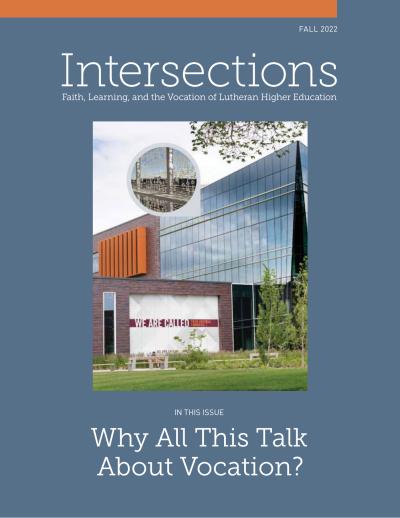
Ray, a junior at Midland University and the only student attendee at the 2022 conference, reflects on four workshops — on teaching womanist thought, on supporting student-athletes, on resistance to the word “vocation,” and on vocational reflection — and brings home concrete ideas including a women’s-history scavenger hunt and semester-long vocational reflections.
-
 Editorial
From the Publisher
Arne Selbyg
No. 14 · Summer 2002
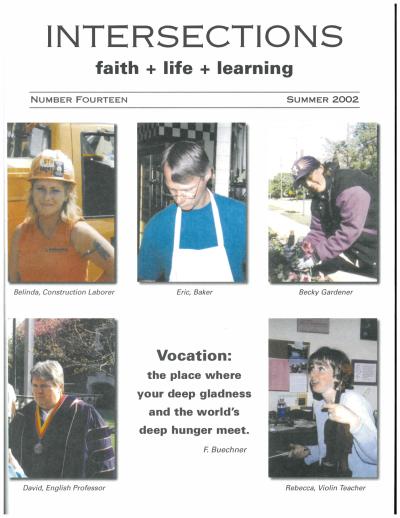
Writing on behalf of the publisher, Sue Edison-Swift names vocation as one of the precious gifts Lutheran theology offers education, reflects on her first ELCA Vocation of a Lutheran College conference, and asks readers to gift future issues of Intersections with feedback—notes on what they read and skipped, and how they ended up with a copy.