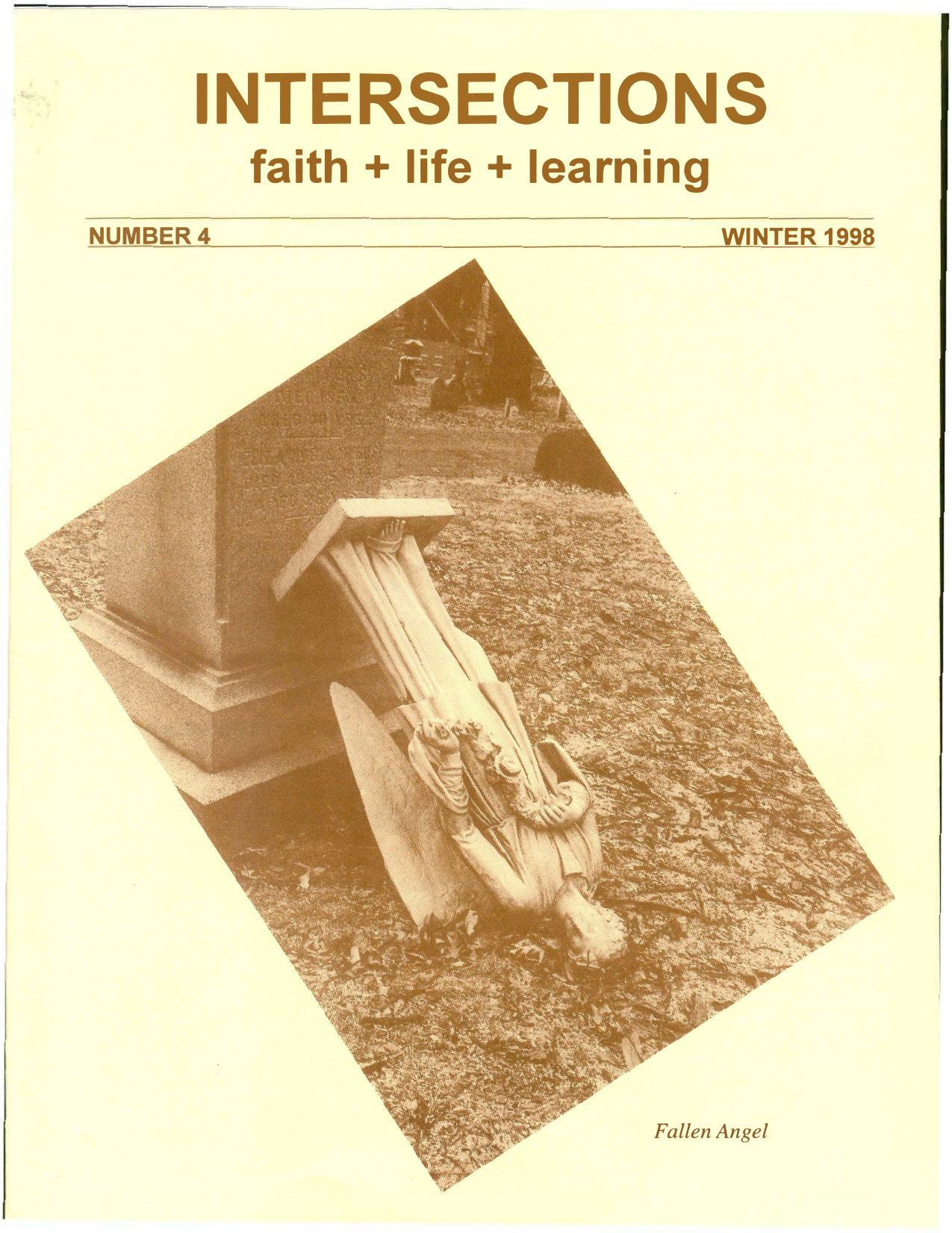
Number 4
The Winter 1998 issue of Intersections marks James M. Unglaube’s farewell as Publisher and introduces new features. Richard Hughes argues Lutheranism’s dialectical sensibility uniquely suits the academy’s pluralistic search for truth. Spencer Porter and Carl Skrade offer a wry “Skeptical Theologian’s Dictionary”; Gregory A. Clark calls Christian colleges to abandon dialectical neutrality, with a response from Karla G. Bohmbach. Richard Ylvisaker inaugurates “What I Have Learned,” Preisinger and Braxton respond to Santmire on the two kingdoms, and Bohmbach reviews Buford’s In Search of a Calling.
Editors
Articles in this Issue
-
 Editorial
The Vocation of a Lutheran College: Some Transitional Thoughts
James M. Unglaube
Unglaube offers final reflections on thirty years in Lutheran higher education as he leaves the ELCA Division for Higher Education and Schools to join Carthage College, his alma mater. He recalls colleague Richard Solberg’s influence, the closing of Upsala College in 1995, the Higher Education and Namibia program shared with Naomi Linnell, the growth of endowments from $70 million to $1 billion in 25 years, and the Vocation of a Lutheran College project he credits Paul Dovre with inspiring. He likens the twenty-eight ELCA colleges to flowers on a rose bush—same Lutheran tradition, each blossom different—requiring constant nurture if the partnership between church and college is to thrive.
-
Editorial
From the Editor
Tom Christenson
Christenson thanks the departing Jim Unglaube, recommends Ronald A. Wells’s Keeping Faith: Embracing the Tensions in Christian Higher Education (Eerdmans) as both an interesting collection of essays and a model worth imitating at ELCA institutions, previews the issue’s pieces by Richard Hughes, Carl Skrade and Spencer Porter, Gregory Clark, and Karla Bohmbach, and introduces three new features of the journal: “What I Have Learned” (an essay by a senior or emeritus faculty member, inaugurated by Richard Ylvisaker), “Reviews” (initiated by Karla Bohmbach), and a “Bulletin Board” for cross-campus announcements.
-
Article
Our Place in Church-Related Higher Education in the United States
Richard Hughes
Adapting his 1997 Vocation of a Lutheran College Conference address, Hughes asks how the Lutheran heritage can sustain the life of the mind in church-related higher education. He compares Reformed, Mennonite, and Catholic traditions in turn—the Reformed integration of faith and learning around a Christian worldview, the Mennonite priority of discipleship over cognition, and the Catholic sacramental affirmation of the secular as bridge—before arguing that the Lutheran heritage’s particular gifts (justification by grace, theology of the cross, two kingdoms, paradoxical sensibility, vocation, and openness to ambiguity) uniquely support rigorous inquiry, genuine pluralistic conversation, and critical analysis. Drawing on Arthur Holmes, John Howard Yoder, Mark Schwehn, Alasdair MacIntyre, and Lutheran writers including Bob Benne and Tom Christenson, Hughes contends that Lutheran finitude grounds an unusually open and self-critical academic posture.
-
Article
The Skeptical Theologian's Dictionary
Carl Skrade, Spencer Porter
Porter and Skrade offer selections from a mock-lexicon of theological terms: answer, church, faith, God, grace, hope, justification, love, prayer, sin, soul, and theology, among others. Each entry begins with a standard definition and then unsettles it—answer reminds the reader that in theology and poetry the questions matter more than their answers; church alternates between “the mystical Body of Christ” and ordinary human gatherings whose machinery often obscures the gospel; God is the One whose name we are told not to take in vain and yet whose name we keep using; prayer is communion with God yet often degenerates into a list of demands. The form’s irony exposes the gap between the language of theology and its lived realities—a sober, witty corrective for Lutheran classrooms and chapels alike.
-
Article
The University in the City of God: Beyond Dialectics and Rhetoric
Gregory A. Clark
Clark, drawing on Alasdair MacIntyre’s Three Rival Versions of Moral Enquiry, distinguishes the preliberal, liberal, and postliberal university and argues that the liberal university’s pretense of dialectical neutrality has masked a particular rhetoric of its own. Following John Milbank’s Theology and Social Theory, he holds that every philosophy and institution is finally a rhetoric and that the church’s task is not to win on the secular university’s terms but to proclaim and embody an alternative city. The Christian college, then, should give up the apologetic pose of meeting secular reason halfway and instead practice the rhetoric of the gospel: a proclamation of Jesus, an enactment of Christian friendship and peace, and a willingness to be vulnerable to the violence of the world as Jesus was vulnerable to his own. Clark commends this stance to colleges related to the church.
-
Article
A God of Peace and Love? Reflections From a Biblical Scholar
Karla G. Bohmbach
Bohmbach responds to Gregory Clark’s call to proclaim Jesus on Lutheran campuses with biblical-scholar reservations. Israel’s sacred texts also include the herem ban, the conquest narratives, and a God who fights for Israel; the Christian canon includes the apocalyptic violence of Revelation. To proclaim Jesus is therefore to proclaim a particular and contested figure within a tradition that has its own internal violence—not a generic God of peace and love. Bohmbach asks what it would mean for staff, administrators, and teachers on a college campus to take seriously the Jesus who made himself vulnerable to the violence of his world, even to the point of suffering for it, and whether Lutheran colleges are prepared for such a vocation.
-
Article
What I Have Learned: Maybe Plato Was Right
Richard Ylvisaker
Inaugurating the new “What I Have Learned” column, Ylvisaker reflects on a career of teaching philosophy at Luther College and offers four hard-won “preliminary examples” in which Plato turned out to be more right than fashionable criticism allowed: (1) communities are not necessarily better off by becoming more diverse—diversity needs a unity of purpose if it is to enrich rather than fragment; (2) politics, to be more than a struggle for power by competing interests, must rest on a moral basis that transcends those interests; (3) the much-derided body-soul dualism contains a measure of truth about the cognitive and moral limitations of embodied life; and, deepest of all, (4) reason itself depends on a community of discourse in which doctrinaire pronouncement gives way to disciplined inquiry. Athens and Jerusalem, he concludes, should meet at the college of the church.
-
Article
A Response to Paul Santmire: The Lutheran Liberal Arts College and Care for the Earth
Arthur A. Preisinger
Preisinger commends much of Paul Santmire’s earlier essay—the critique of the “back-to-nature” cult, the call for a holistic environmental ethos, the suggestion of a cosmic liturgical praxis—but takes issue with Santmire’s reading of classical Lutheran social ethics. He argues that the two kingdoms doctrine was not a systematic Lutheran treatise (the term itself became common only in the 1930s), that the doctrine’s misuse by some twentieth-century German theologians does not condemn its proper use, and that the South African Council of Churches actually deployed the doctrine (correctly interpreted) against apartheid. Drawing on Karl Hertz, Ulrich Duchrow, Tom Strieter, and F. Edward Cranz, Preisinger defends the doctrine as complementary duality—left hand and right hand of God, governances to be distinguished but never separated—and concludes with Bill Lazareth that the skeletons in the Lutheran closet are not Luther but departures from Luther.
-
Article
A Response to Paul Santmire
Don Braxton
Braxton appreciates the dialectical structure of Santmire’s mandates—“skeletons in our closets and riches in our own vaults”—and reads it as a faithful expression of the Lutheran tradition of Paul, Augustine, and Luther. He argues that Santmire is on target in warning against premature flight to non-Christian traditions for environmental wisdom (theoretical sensitivity does not translate into ecological behavior in practice), and that classical Lutheran social ethics has too often been quietistic. But Lutheran ethics at its best is dialectical, not dualistic—recognizing the interpenetration of church and world, Law and Gospel, eschatological Kingdom and present realities, as in Hegel, Ritschl, Bonhoeffer, Reinhold Niebuhr, and Larry Rasmussen. Braxton commends environmental responsibility, social criticism of unsustainable practices, and a liturgical practice of resistance to instrumentalism as appropriate next steps for Lutheran liberal arts colleges, especially Capital University.
-
Book Review
In Search of a Calling: The College's Role in Shaping Identity
Karla G. Bohmbach
Bohmbach reviews Thomas O. Buford’s In Search of a Calling: The College’s Role in Shaping Identity (Mercer University Press, 1995), which diagnoses a meaning-crisis among college students and traces two historical aspects of “calling”: the biblical, communitarian aspect rooted in the Hebrew Bible and the practical, individualistic aspect rooted in the Renaissance. She praises Buford’s reconstruction of imago dei as imagination rather than copy of God’s rationality, his broad disciplinary range (biblical studies, theology, educational psychology, business management), and his identification of the tension between freedom and limitation as the field of calling. She is sharply critical, however, of his final chapter’s wariness of canon-revisionists and multiculturalists, his caricature of “special-interest groups,” and his presumption of a homogeneous student body—a presumption that, she argues, never matched American college reality and matches it less today.