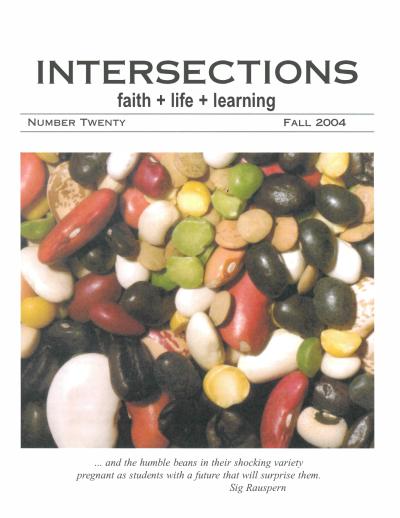
This issue of INTERSECTIONS once again features a variety of voices: young and old, angry and encouraging, prophetic and hopeful. All embody the same assumption—that Christians engaged in thinking and educating will ask hard questions and look at things in new ways. How does a Christian raise concerns about militarism and the new “imperialism” the U.S. is manifesting around the world? What issues will a Lutheran law school raise about the training of a new generation of attorneys? What will Lutheran colleges communicate to their undergrads about vocation and what difference will this end up making to them? I like these questions and think they are part of who we are as Lutheran institutions. If we are faithful to such questions we show how the Lutheran tradition of faithful criticism is alive in our midst.
Tom Christenson
-
 Editorial
From the Publisher
Arne Selbyg
Selbyg reports that during 2004 a task force appointed by the ELCA Division for Church in Society has been laying the groundwork for a Social Statement on Education, with a draft to be debated in congregations and educational forums in 2006 and considered for adoption at the 2007 Churchwide Assembly. He urges Lutheran educators to obtain and study the new Task Force study document from the Division for Church in Society and submit their reactions so that the drafters know what those with ties to Lutheran educational institutions think is important.
-
Article
Mars, Mammon—and Other Options
Carl Skrade
In a wide-ranging public lecture from a Capital University Philosophy and Religion department series on “The Empire, Its Religions, and Some Alternatives,” Skrade distinguishes the military from militarism (using Oxford and Chalmers Johnson definitions), catalogs evidence of contemporary U.S. militarism—budget allocations, arms sales, the military-academic complex, post-1945 interventions, overseas bases, and Bush-era profiteering through Bechtel and Halliburton—and traces its roots in resource greed, racism, right-wing religiosity, and Augustinian incurvatus in se ipsum. After surveying the financial and human costs through testimony from Jonathan Shay’s Achilles in Vietnam, Samuel Hynes’s The Soldier’s Tale, Dalton Trumbo’s Johnny Got His Gun, and Staff Sergeant Jimmy Massey, he applies Vincent Ferraro’s seven principles of just war to Gulf II, reads Matthew 5:43-48 as a call to indiscriminate care, and proposes a www.religiousleft.org website to host a Christian alternative to Mars and Mammon.
-
Article
Leading Students to Distinguish Between Career and Vocation: Reflections from a Lutheran Law School
Steven C. Bahls
Bahls, writing as former dean of the Capital University Law School, argues that most law students and many legal educators confuse vocation with career—asking “what kind of lawyer do you want to be?” rather than “who do I want to be?” Drawing on John O. Mudd’s five attributes of a well-prepared lawyer and Susan Daicoff’s empirical research on lawyer dissatisfaction and the “amoral professional role,” he turns to Ernest L. Simmons’s and Darrel Jodock’s articulations of Luther’s understanding of vocation and proposes five steps—reflection, assessment, vision, integrative thinking, and reassessment—along with explicit leadership from law school deans, engagement of career services offices, and leadership within the profession (illustrated by Capital’s joint venture with the Columbus Bar Association).
-
Article
Luther's Theology of Learning: Discovering the Vocation of Today's Small Lutheran Liberal Arts College
Eric Childers
In an excerpt from his Wake Forest University Divinity School senior thesis, Childers profiles six students hand-picked by presidents and chaplains at Concordia College (Moorhead), Lenoir-Rhyne College, and Muhlenberg College—Nathan Gossai, Amy Nelson, Alison Schmidt, Ryan Sigmon, Julie Christianson, and Jeffrey Slotterback—as a living testament to Luther’s theology of learning. He then draws on Solberg, Mark R. Schwehn (in Paul J. Dovre’s The Future of Religious Colleges), Robert Benne, Ernest Simmons, Mark Noll, Richard Hughes, and James Burtchaell to argue that Lutheran colleges have not yet fully articulated their own theology of education and that their vocation is to embrace, engage, and galvanize a Lutheran tradition of learning rooted in the liberal arts, Scripture, the Confessions, and confident ecumenism.
-
Book Review
Review of Educating for Shalom: Essays on Christian Higher Education
Tom Christenson
Christenson reviews Nicholas Wolterstorff’s Educating for Shalom: Essays on Christian Higher Education (Eerdmans, 2004), edited by C.W. Joldersma and G.G. Stronks. After recounting his own early prejudice against Wolterstorff’s Reason Within the Bounds of Religion and his subsequent conversion through Art in Action, he focuses on two threads: Wolterstorff’s expansive reading of shalom—not merely peace but justice, community, communal responsibility, and delight—as the overall goal of Christian collegiate education, and the influence of Abraham Kuyper’s claim of “privileged cognitive access” for Christian inquirers, which Wolterstorff demonstrates rather than declares.
-
 Article
The Vocation of Intersections on its Twentieth Birthday
Jason A. Mahn, Robert D. Haak, Tom Christenson
No. 43 · Spring 2016
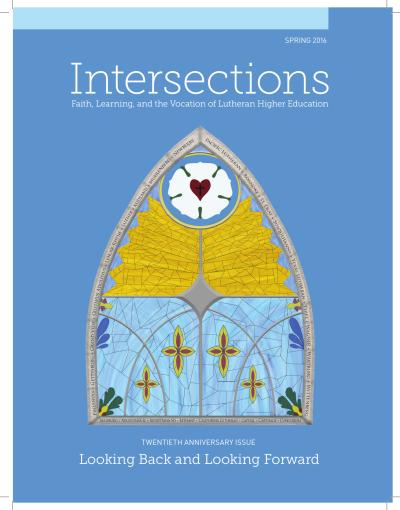
The three editors of Intersections — Bob Haak, Jason Mahn, and Tom Christenson (in spirit, following his death in 2013) — trace the twenty-year vocation of the journal itself: its 1996 birth at Capital University; its coming-of-age years of debate over institutional markers, two-kingdoms theology, and Lutheran identity; the ascendancy of “education for vocation” as the central marker of Lutheran higher education; and its ongoing identity in relation to a changing ELCA and to the broader cultural conversation about purpose, wholeness, and the vocation of higher education.
-
 Article
Point / Counterpoint: What It Means to be a "College of the Church"
Robert Benne, Tom Christenson
No. 28 · Fall 2008
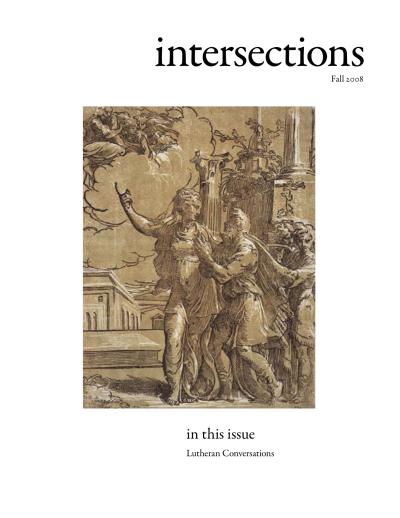
Moderated by Wartburg College pastor Larry Trachte and introduced by Kathryn Kleinhans, this Wartburg campus conversation between Robert Benne (Roanoke College) and Thomas Christenson (Capital University) probes what it means to be a college of the church—Benne emphasizing ethos, vocation, and the Christian intellectual tradition over against secularization and generic education, and Christenson lifting up persistent vocational questions, the gift of difference, and induction into a community of discourse—and finds large common ground around hiring for mission, pedagogy that asks deep questions, and the courage to claim a living religious tradition while inviting everyone to the banquet.
-
 Article
Education as a Christian (Lutheran) Calling
Tom Christenson
No. 21 · Summer 2005
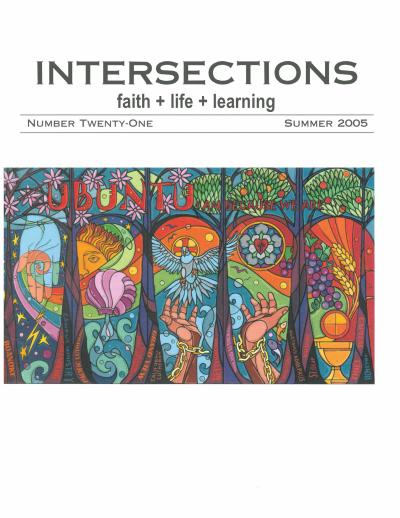
Christenson opens with an imaginative reconstruction of early Christian communities as radically egalitarian, pacifist, communitarian gatherings within the Roman Empire and argues that such communities are natural homes for the educational vocation. Naming two temptations for contemporary Christian higher education—the parochial Bible school and “Generic U”—he uses his friend Sig Rauspern’s tree metaphor to insist that a university is Christian in its trunk and roots rather than in grafted-on branches. Drawing on Wendell Berry, Jacob Bronowski, Walter Wink, Douglas John Hall, and his own Gift and Task of Lutheran Higher Education, he names faithful criticism, engaged suspiciousness, simul justus et peccator, and a fallible, love-related Lutheran epistemology as the particular gifts Lutherans bring to the Christian educational calling.
-
Editorial
From the Editor
Tom Christenson
No. 21 · Summer 2005
In his valedictory letter as outgoing editor, Christenson recounts the 1994 origins of Intersections, when he took the idea to Naomi Linnell and Jim Unglaube at DHES and persuaded the council of presidents to launch the journal on a shoestring with printing paid by DHES and everything else by Capital University. He summarizes the issue’s contents—papers from the 2004 Vocation of a Lutheran College Conference plus two commissioned pieces from former DHES directors Bob Sorensen and Leonard Schulze—and thanks the student copy editors and Capital’s presidents and provosts who sustained the publication.
-
 Editorial
From the Editor
Tom Christenson
No. 19 · Summer 2004
Christenson reflects on the scarcity of time in over-committed academic lives and posts a tongue-in-cheek help-wanted advertisement for his own successor as editor. He introduces the issue’s four authors as “three friends and one new acquaintance” whose work addresses Lutheran higher education, the significance of Paul Ricoeur, the implications of being a reformation community, and the perils of teaching ethics.
-
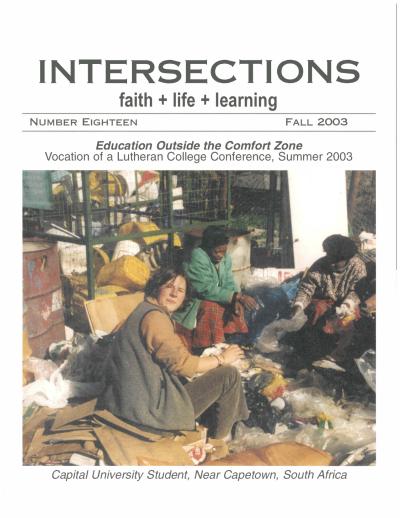 Editorial
From the Editor
Tom Christenson
No. 18 · Fall 2003
Christenson draws on a ten-year alumni survey at Capital University showing that students most often credit practica, internships, travel-study, and service-learning—not classroom hours—as the places they best learned the university’s stated outcomes, and introduces this issue’s papers from the Summer 2003 Vocation of a Lutheran College Conference on education and global outreach.
-
 Article
An Apostolate of Hope
David L. Tiede
No. 32 · Spring 2010
Tiede argues that the vocation of a Lutheran college is to be “an apostolate of hope” oriented by three metrics of our time: 12,000 (the Dow), 350 (parts per million of CO2), and $1.25 (the daily income of 1.4 billion people in extreme poverty). Drawing on Darrell Jodock’s “third path” for church-related colleges, Larry Rasmussen’s Batalden lectures, Mark Tranvik, Douglas John Hall, Bill McKibben, Stephen Privett, Peter Singer, and Augsburg’s Center for Global Education, he proposes that justification by faith, critical pluralism, stewardship of God’s earth, and love and justice for our students together prepare wise leaders to renew the future.
-
 Article
Staff Governance at St. Olaf College, Northfield, MN
Don Ezra Cruz Plemons
No. 58 · Fall 2023
Cruz Plemons describes how staff at St. Olaf, in the wake of a decade of difficult events, have built a three-year, glacier-paced effort toward a Staff Governance model — through affinity groups, the Council for Equity and Inclusion, and the Task Force to Confront Structural Racism — that gives staff a voice alongside faculty and students.
-
 Article
The Divide Within (Not Between) Liberal Arts and Professional Education
Lake Lambert
No. 24 · Fall 2006
Lambert, then Board of Regents Chair in Ethics at Wartburg College and Project Director for the “Discovering and Claiming our Callings Initiative,” argues that the real divide in higher education runs not between the liberal arts and the professions but within each — between teaching that forms students for callings and teaching that merely transmits content or credential. He calls Lutheran colleges to recover, across both liberal arts and professional disciplines, a shared commitment to vocational formation grounded in the Lutheran tradition.
-
 Editorial
From the Editor
Tom Christenson
No. 11 · Spring 2001
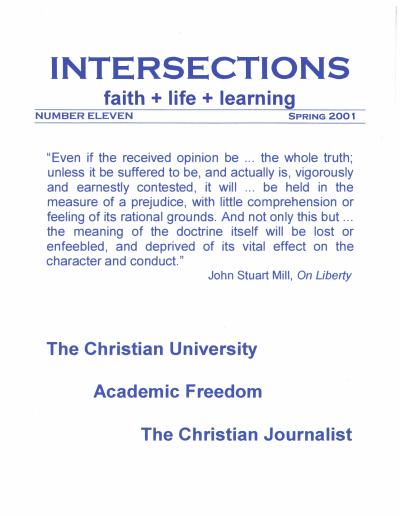
Christenson explains that this issue “borrows everything from other sources”—Richard Hughes’s talk at Pepperdine president Andrew K. Benton’s inauguration, Nicholas Wolterstorff’s and Storm Bailey’s essays from the AAUP’s Academe, and Catherine McMullen’s Concordia talk—and defends the blatant borrowing as appropriate to faculty work, hoping new faculty will find in these pieces a corrective to common misconceptions about faith-related education and academic freedom.
-
 Article
"Our Calling in Education": An Educator's Perspective
Cheryl Budlong
No. 23 · Summer 2006
Budlong, Professor of Education at Wartburg College, asks educators to reexamine their ‘mental models’ of what education itself means in light of the rapidly expanding literature on how young people learn. Drawing on Malcolm Gladwell, Eric Jensen, Ruby Payne, Judith Harris, Robert Slavin, and the AACTE’s Leading a Profession retrospective on the AACTE agenda 1980–2005, she calls on Lutheran educators to articulate vocation intentionally in their classrooms and to ground curricular and pedagogical reform in Wartburg’s focus on Discovering our Calling.
-
 Editorial
From the Editor
Jason A. Mahn
No. 48 · Fall 2018
Mahn recounts how a participant’s probing questions at the 2018 Vocation of a Lutheran College Conference turned “civil discourse” from an innocuous theme into a contested one — and previews essays that variously urge listening and common ground, or speaking truthfully even when those words sound angry.