The Vocation of Intersections on its Twentieth Birthday
Jason A. Mahn
Augustana College
Robert D. Haak
Augustana College
Tom Christenson
Capital University
Intersections No. 43 · Spring 2016
Can a journal have a calling?
Certainly a journal, especially one for and by a particular community, has a life of its own. Intersections was conceived through the loving interaction of various individuals. Tom Christenson, the journal’s first editor, gave it birth, but only with the midwifery of those from the Division for Higher Education and Schools of the ELCA (as it was then so-called), and of an editorial board and other key “stakeholders” in what Mark Wilhelm has described as the vocation “movement” within Lutheran Higher education.1 The lifespan of Intersections thus far has included its birth, a period of coming of age, and the emergence of a mature, if still emerging, identity—along with the identity of the Lutheran higher education, which the journal underscores and investigates. In the summer of 2016, Intersections turns twenty years old. That is about the time that a young person in the North American context enters into adulthood—or at least into a long and messy (but no less formative) period of “emerging adulthood.” Will those twenty years comprise the bulk of the lifespan of this journal? We think it has many more good years ahead of it.
So, Intersections has a life—but does it also have a calling? Well, yes, and in three ways. First, insofar as a vocation means to be summoned for a purposeful and meaningful life, the life of this journal has been “vocational” indeed. When one reads the early purpose statements, editorials, and publisher’s comments, one can see just how well-defined the journal’s mission was, and also how little that central purpose has changed over the past twenty years. And yet, second, like a life that is perpetually open to new pleas, needs, and responsibilities, Intersections has entered into different conversations—responding to different voices—throughout its two decades. It has changed and has been changed, as has anyone constantly discerning her or his vocation. Third, and perhaps most important, Intersections has existed not primarily to perpetuate itself or for the satisfaction of its editors (three over the years), publishers (four to date) or contributors (over 200). Just as the called life is one that is constantly matching one’s own passions and gifts with the needs of the community, Intersections has been in the business of service. Like the biology and English professors, chaplains, college presidents, board members, academic deans, admissions councilors, and occasional bishops who write for it and read it, Intersections goes beyond self-satisfaction as a criterion for good work. Good work—including that which has fallen between these covers—arises from the joy of being gifted and blossoms in service of a wounded and redeemable world.
In what follows I (Jason Mahn) will incorporate the words of others, especially of Tom Christenson and Bob Haak, second editor of Intersections, to portray something of the life of Intersections and its ongoing calling on this, its twentieth birthday.
A Journal is Born
In the spring of 1996—just 8 years after the mammoth merger of various ethnic Lutheran bodies to form the Evangelical Lutheran Church in America (ELCA)—Tom Christenson sent out a “Birth Announcement” to the then 28 colleges and universities affiliated with the ELCA. Here is part of what it said:
We are pleased to announce the birth of a new publication. It will be called Intersections: Faith+Life+Learning. Why do we need such a publication?
At some recent conferences I’ve had a chance to talk with faculty colleagues from other ELCA colleges. From them I have heard comments such as these: “Many of the faculty at my institution don’t even know we’re church-related. To say nothing of knowing what that means.” “Is being church-related anything more than a public relations device?” “Most of the faculty at my college are afraid of our church-connectedness. They assume it implies another Inquisition and want nothing to do with it.” “I didn’t realize that we had any ‘sister colleges’ or that I had colleagues beyond my institution who were asking some of the same questions that I do.” “The Lutheran connection at our college is very vague, mostly because no one seems to know exactly what it means.” “Somebody ought to do us the big favor of articulating what it means to be a Lutheran college. The question, at our school, is most often met with a kind of bemused silence.” It is in response to this lack of awareness, this vagueness, this sense of disconnection, that Intersections hopes to speak. (Christenson, No. 21, 2).
In Summer of 1996, the Division for Higher Education and Schools of the ELCA published the first issue with James Unglaube, the Director of Colleges and Universities within the ELCA Division for Higher Education and Schools, serving as Publisher, Tom Christenson as Editor, and the Lilly Endowment as an additional financial supporter. Tom wrote in his first editorial that he was “feeling like a proud parent.” He noted that the publication had been “talked about, hoped for, planned for, and worked on for what seems like a long time now.” He expressed his hope “that all those who read it will celebrate with those of us who have been in attendance at its birth” (Christenson, No. 1, 2).
Many who took the lead in “birthing” this journal and shaping it in early years remain leaders in our ongoing conversation about the vocation of Lutheran higher education. One thinks of Mark Schwehn (Valparaiso), who wrote the lead article in that first issue, or L. DeAne Lagerquist (St. Olaf), who served on the editorial board from the start, published in it frequently, and, beginning in 2004, also directed the Lutheran Academy of Scholars. Both Ernie Simmons (Concordia) and Darrell Jodock (Gustavus) first contributed essays in 2002 and have steered the “vocation movement” in Lutheran higher education ever since. College presidents and former presidents contributed institution-wide perspectives early on, including Baird Tipson (Wittenberg), and especially Paul Dovre (Concordia), who first came up with the idea of the Vocation of a Lutheran College “project” (Unglaube 2). Institutional leaders, such as Augsburg’s President Paul Pribbenow, have been equally invaluable in recent years.
Coming of Age
At the Vocation of a Lutheran College Conference and in the pages of this journal, most every “conversation” about what it means to be a Lutheran college or university has been irenic, constructive, and generative of further conversation. However, that does not mean that there has been a lack of serious debate. Especially in recent years, contributors have used Intersections to resist and reconfigure leading assumptions about the state of college today—assumptions that college is essentially for credentialing and employment (Intersections, Fall 2013), that colleges are leaving students “academically adrift” and graduates “lost in transition” (Spring 2014),2 or that robust commitment to a college’s church-relatedness competes with full-bodied openness to religious and ethnic “others” (Spring 2011; Fall 2014; forthcoming Fall 2016).3
Contributors have also raised critical questions about what they take to be a too-easy alignment of what the Lutheran tradition means by vocation and what “the world” means by a successful career or person. Writing of a dominant American culture that forms so many of us into individualism, narcissism, consumerism, “disposability rather than conservation,” and careerism, Samuel Torvend (Pacific Lutheran) recently pondered whether Lutheran “education for vocation” reinforces rather than resists such powerful cultural norms:
I sometimes wonder if the vocation of a Lutheran college has become the calling to serve as the unwitting accomplice is such cultural formation. That is, I have begun to think that the vocation of a Lutheran college has become the calling to serve as the unwitting accomplice in the acceptance of the status quo in which, ironically, we hope our students might discover their passion, their calling, their deep commitments.
And if this is so, how easy it will be to snuff out and smother that first gift of Lutheran education—that capacity to ask deep troubling questions of what you and I, our disciplines, our expertise, or our trustees might take for granted, consider normal, even sacrosanct. (Torvend 16)
Marcia Bunge (then at Valparaiso, now Gustavus Adolphus) raised similar cautions in 2002:
Because out culture glorifies individualism and self-fulfillment, speaking about vocation can also sometimes be a way of simply adding a spiritual gloss to a subjective sense of self-fulfillment. Here, one’s vocation is what one does, whether paid or not, to find personal meaning and happiness. In this cultural context…there is little room for reflection on the relation of work to one’s faith, to family life, to civic and environmental responsibilities, or to God’s care and redemption of the world. (Bunge 12)
Invoking one’s vocation threatens to become nothing more than “a convenient rubber stamp of approval on our lives or institutions” (16). To resist this temptation, Bunge suggest a number of strategies to Lutheran colleges and universities, including learning from Mennonite and other faith traditions that emphasize discipleship—the conviction that one’s deepest calling is to follow Christ—as well as from the Catholic tradition, with its disciplines of meditation, spiritual direction, and other practices of “listen[ing] to the One who calls us” (16).
Without such critical comments—that is, comments that are both essential and self-searching—Intersections might have denigrated into a cheerleader for Lutheran Colleges and Universities. Instead, it has become a primary venue for understanding, interrogating, debating, strengthening, as well as celebrating the overlapping missions and Lutheran identities of our schools.
Perhaps influenced by Tom Christenson’s philosophical training, earlier conversations included a good deal of criticism (and self-criticism—see Figure 2 picturing Tom Christenson engaged in such.) The most long-lasting debates largely centered on whether and how a “Christian worldview” makes a difference for learning on our campuses. (At times these exchanges would span multiple issues; in the summer of 2003, for example, Baird Tipson responded to Robert Benne’s response to Tipson’s review of a book by Paul Dovre!) Some took on what they understood as failure of nerve by those invoking Luther’s “two kingdoms doctrine” and the “promiscuous use of the concept of paradox” in the Lutheran intellectual tradition (VonDohlen). They questioned whether carefully demarcating a civic realm or “kingdom of this world” apart from the kingdom of the gospel could do anything other than uncritically accept the finality of so-called secular reason or keep understandings of God securely confined to “personal opinions.” How much epistemological ground—frameworks by which we know what is true—could be ceded to secular departments (including religion departments) and still be called a Lutheran school (see also Benne, “Response”)?
Another central (and related) debate characterized much of the first decade of Intersections. Does the designation “Lutheran” depend at least in part on a sufficient number of Lutherans studying, teaching, and administering at our colleges and universities? Robert Benne (now Professor Emeritus at Roanoke College) insisted—sometimes solitarily—that Lutheran institutional identity does in fact depend on a critical mass of individuals identifying as Lutheran. According to Benne, the diversity understandably sought on our campuses should include affirmative action for Lutheran employees:
We should aim at an intentional, robust pluralism, a pluralism in which the college guarantees that the perspectives of Lutheran Christianity are represented in all the departments and divisions of the college. The Lutheran vision may no longer be the paradigm that organizes the college’s life, if ever it was, but it can be intentionally represented among the many voices representing other perspectives. (Benne, “Integrity” 10)
This particular argument seems to have stalled out at best. It slowly gave way to Lutheran understandings of education for vocation—as opposed to the two kingdoms, “paradox,” or a certain threshold of numbers of Lutheran faculty members or board members—as the central marker of Lutheran institutional identities. As Mark Wilhelm describes in the present issue, education for vocation is distinctively, decidedly Lutheran, and yet does not require individual educators to be thus.
The Summer of 2002 cover of Intersections included the famous definition of vocation by Frederick Buechner: “the place where your deep gladness and the world’s hunger meet” (Buechner 95). In Winter of 2003, Arne Selbyg commented that, if someone did a words count of the articles published in Intersections, “vocation” would certainly be in the top three. He also says—perhaps with a dash of retrospective determination—that Intersections grew out of the very effort to make “vocation” a central concept at ELCA colleges and universities (Selbyg 2). With multi-million dollar grants arriving on eight ELCA college campuses from the Lilly Endowment for “Programs for the Theological Exploration of Vocation,” there were additional reasons to lift up education for vocation as what Lutheran colleges and universities have always been about. Yet already in 2001 the ELCA Churchwide Assembly had called for a social statement on education, a statement whose very title (“Our Calling in Education”) underscores vocation as the aim of education “that develops personal gifts and abilities and serves the common good” (ELCA 1). It was only natural that ELCA colleges and universities would position themselves as uniquely forming Lutheran and non-Lutheran students for such meaningful and needed work.
Ever Emerging Adulthood
In 2005, in his last editorial before handing over the editor “position” (service? volunteer opportunity? labor of love?) to Bob Haak, Tom Christenson characterized the conversation about the identity of Lutheran colleges and universities as having matured significantly:
Of course, people at our colleges and universities still have questions about Lutheran identity and its implications, but now they are aware that they are not asking these questions all by themselves and they have some resources for addressing them, resources provided in some part by the annual Vocation of a Lutheran College Conference and by Intersections. Our purpose was to encourage and facilitate such discussions, to create a larger sense of community among the ELCA institutions, and to share the best thinking that we were able to bring to this matter. I think we have succeeded in that enterprise. (Christenson, No. 21, 3)
Despite the past tense of this last sentence, the “success” of Intersections clearly does not depend on people no longer having “questions about Lutheran identity and its implications.”
“Intersections more self-consciously became an ongoing, open-ended, and increasingly multi-vocal conversation.”
In fact, Intersections more self-consciously became an ongoing, open-ended, and increasingly multi-vocal conversation in the decade to come. Besides one surprisingly agreeable “Point/Counterpoint” exchange between Tom Christenson and Robert Benne over “what it means to be a ‘College of the Church,’” there were few formal arguments that would take place within the journal. The tone was much more conversational, not so much in the sense of being relaxed or informal, but in terms of being constructive, deliberative, and open to new perspectives.
Besides bringing a new, more professional “look and feel” to the journal (Haak, No. 22, 4), Bob also devoted individual issues to particular themes, as the Vocation of a Lutheran College Conference had begun doing around 2003. The first two issues were devoted to subjects that arose from ELCA Task Forces weighing in on human sexuality (Spring 2006) and Lutheran commitments to education (Summer 2006). While these conversations between the ELCA church and its colleges and universities would not always be so direct, “the church” and “the college” do seem to emerge as distinctive conversation partners in the past 10 years. Mark Hanson, then the Presiding Bishop of the ELCA, noted that Lutheran colleges and universities often “lead way” when it comes to “reach[ing] out in mission for the sake of the world” (Hanson 5). Hanson even positions colleges as something of an intermediary between the church and the world, to the benefit of both:
The colleges and universities of this church have a vocation to call us to stand outside of ourselves so we might be engaged together, reaching out in mission for the sake of the world. I am grateful to God for these schools and their unquenchable curiosity, faith, moral discernment and engagement in mission. (Hanson 5)
Comments such as these suggest that Lutheran colleges and universities were increasingly institutions that should not just respond to the church’s initiatives or directives. The ELCA’s colleges and universities should take a leading role in developing their mission.
Bob’s second editorial reflects this very sentiment:
As we define our place in the academic world for our selves and our institutions, to one degree or another we look to the resources that our Lutheran heritage provides. We look for the guidance of the church, not to dictate who we are and what we do, but to inform the sorts of conversations that might take place on our campuses. (Haak, No. 23, 4).
Shifting Church-College Relations
There were also many changes on both sides of the relationship. On the collegiate side, market and economic forces drastically affected two of the 28 original schools; Waldorf College had to sell to a for-profit company in January of 2010 and Dana College had to close its doors in July of that same year. As Florence Amamoto describes in her essay in this anniversary issue, economic pressures also have often taken focus away from Lutheran identity and education for vocation for the remaining 26 schools.
On the ecclesial side, major restructuring of the ELCA church-wide organization also influenced, and perhaps complicated, the relationship. When the ELCA was formed in 1988, six divisions represented the whole of the church’s national and international work, and one was the Division for Higher Education and Schools (DHES; previously named the Division for Education). One of the three departments—with its own director and small staff— within that Division was the Department for Colleges and Universities. The world’s second largest Lutheran church thus gave “high visibility to the place of education in the life of this church” (Sorensen 4). In 2005, the ELCA was streamlined and restructured; the Division for Higher Education and Schools folded into the broader Division for Vocation and Education—essentially merging with the Division for Ministry (5-6). While some, such as Bob Sorenson (Executive Director of the DHES until his retirement in 2000), wondered in 2005 whether the restructuring would separate the work of the church from the work of colleges and universities (6), others, such as Leonard Schulze (Executive Director following Sorenson and until 2004) argued that the new “Vocation and Education” name and mission would better align the work of colleges and congregations and would foreground the theological rationale for their shared work. Schulze appreciates the ascendency of “vocation” in particular. According to him, “there is no single concept that is more important to our understanding of why the church must be involved in education and why education is crucial for the continuing vitality of the church” (Schulze 11).
Whether or not such restructurings strengthened or weakened the relationship between congregations and colleges, they certainly complicated it—at least in the eyes of newcomers to either. Mark Wilhelm, who assumed the position of publisher of Intersections three years earlier as Associate Executive Director of the Vocation and Education Unit and leader of its working group for “Educational Partnerships and Institutions” (Wilhelm, No, 28, 2), announced in 2011 that the Vocation and Education unit had ceased to exist as of February, 2011. Mark would continue to work with colleges and universities, but as only one of his four chief responsibilities (Wilhelm, No. 33, 2). Folded twice into broader units and with significant reductions in human resources, the ELCA now needed Lutheran colleges and universities to take the lead in their relationship with the church. Most recently, college presidents have done so by forming a new Network for ELCA colleges and universities in collaboration with the ELCA’s churchwide organization to promote their shared identity and the mission of the ELCA in higher education.4 While the relationships with one another and with the church were and will continue to be complex, Lutheran colleges are claiming a primary role in directing the mission of the ELCA in higher education.
“While the relationships with one another and with the church were and will continue to be complex, Lutheran colleges are claiming a primary role in directing the mission of the ELCA in higher education.”
“Education for vocation” is part of what holds 26 distinctive identities together and to the mission of the church. Bob Haak, now viewing these connections from his position as Dean of Hiram College, which is affiliated with the Christian Church, Disciples of Christ tradition, maintains that conversations about vocation and the education of whole persons in the service of whole communities is needed now more than ever. Indeed, the fragmentation of individuals and communities that contributors to Intersections talked about twenty years ago has now become something of the norm. Lutheran colleges have a message that sees and confronts this sort of shattering of people, communities, and the world. It is a message and a work that is more important than ever—not just for us as Lutheran institutions of higher education but for our whole culture.
The Hiram Connect program is built on the concepts of vocation that were cultivated at Augustana (Rock Island, Illinois). But after more than four years at Hiram, Bob knows that those who do not identify as Lutheran also clearly resonate with the idea of vocation. In personal correspondence, he says this about a movement rooted in the Lutheran intellectual tradition but now branching throughout higher education:
I can report that what we had hoped for 20 and 10 and 5 years ago is happening in many places. The word [about purpose and wholeness] that we believed would speak to the whole culture does in fact work just that way. Whether that word to the world has the label “Lutheran” attached to it is less important than the message of wholeness and good news that is spread throughout the fragments of our culture. We can and must be communities that help mend this shattered world.
Identity in Relation
One might compare the ongoing conversation in Intersections and the fluctuating identities of ELCA colleges and universities recorded therein to a third—and still rare—cultural trajectory available to today’s late adolescence and “emerging adults.” The majority of college graduates today are “individualists”; through their 20s they will primarily seek personal satisfaction, robust social lives (often without long-term commitments), and ample leisure consumption. Another third or so of college graduates find themselves in “traditionalist” trajectories. They find stable work, start families, join religious or civic organizations, and otherwise live out—sometimes unreflectively—the stories and expectations of those who have raised them (Clydesdale 52-53; 219-23). Church-related colleges can follow these very trajectories. For much of their institutional lives, Lutheran colleges and universities have lived out the expectations and stories of “mother church.” The possibility of thoroughly secularizing, or retaining only a “historical” connection to the Lutheran church, has become a real possibility, perhaps even a temptation, in recent years as well. Just as college graduates can sever ties to the domestic, religious, and civic communities that birthed them, colleges can and do become “independent,” “free” from what is seen as the anachronistic authority of the church.
If the conversations in Intersections count as evidence, most of our colleges and universities seem to be carving a third way forward, one that corresponds to a small minority of college graduates who find themselves—or rather intentionally put themselves—on an “interdependent” trajectory. Rather than step into predetermined roles or try desperately to resist every script, these young people forge stable and resilient identities through conversation and by committing to and helping to create particular communities. They develop what Tim Clydesdale calls grounded idealism and purposeful grit (Clydesdale 222-23). So also with Lutheran colleges and universities: Over the past 20 years, they have come into their own identities, increasingly clear about their distinctive purpose and meaning. They have done so beside and with the broader church, not by rejecting it.
In his final editorial, Bob again portrays Intersections and the vocation movement within Lutheran higher education as open-ended conversations, ones that build identity without gating it in:
The joy [of thinking and working on issues of vocation] is to remember the powerful voices that have driven this conversation, and to recognize that fresh... voices are entering the dialogue. It is clear that the power of these ideas enlivens and refreshes this conversation even as the people involved change. That is surely the work of the Spirit among us…. And the ideas still are important. Who are these Lutherans and what sort of schools are these?... How do we see students in ways that treat them as whole people living in community and in a world that matters? How do we relate to others in conversation about these issues, especially those who don’t seem to be like us? And the questions continue—questions that are crucial for our survival today as institutions…(Haak, no. 34. 4)
Just as Lutheran colleges and universities are maturing, developing grit, and coming to name their grounded idealism about what it means to educate for vocation, so too has Intersections become neither the child of Christenson, Haak, Mahn, nor that of Unglaube, Selbyg, Sorenson, Schulze, or Wilhelm, but a journal with life and legs of its own. As Bob wrote after the death of Tom Christenson on February 8, 2013, Intersections “was born in the twinkle of an idea in Tom’s mind and brought to life through his hard work. He saw Intersections mature and take on a life independent of him—but always with his watchful eye and careful guidance” (Haak, “We Remember,” 31).
It is difficult to know whether this twentieth birthday of Intersections marks its middle age, its waning years, or perhaps the infancy of a life still to fully unfold. However many years this journal should last, it has been—and will be—a rich and rewarding conversation. May Intersections continue to provide a platform for educators at Lutheran colleges and universities to reflect on their vocations, the vocations of their students, and the vocation of Lutheran higher education.
Endnotes
1. See Mark Wilhelm’s essay in the present issue of Intersections. See also Ernie Simmons’s remarks about these early developments in his essay in this issue.
2. References are to books by Arum and Roksa and Christian Smith, et al., as listed below.
3. All past issues of Intersections are now available online: digitalcommons.augustana.edu/intersections
4. See “From the Publisher” in the present issue for more details.
Works Cited
Arum, Richard and Josipa Roksa. Academically Adrift: Limited Learning on College Campuses. Chicago: University of Chicago Press, 2010.
Benne, Robert. “Integrity and Fragmentation: Can the Lutheran Center Hold?” Intersections 8 (Winter 2000): 4-10.
———. “Response to Bishop Olson and President Tipson.” Intersections 16 (Winter 2003): 34-36.
Benne, Robert and Thomas Christenson. “Point/Counterpoint: What it Means to be a ‘College of the Church.’” Intersections 28 (Fall 2008): 12-20.
Buechner, Fredrick. Wishful Thinking: A Theological ABC. New York: Harper and Row, 1973.
Christenson, Tom. “From the Editor.” Intersections 1 (Summer 1996): 2.
———. “From the Editor.” Intersections 21 (Summer 2005): 2-3.
Clydesdale, Tim. The Purposeful Graduate: Why College Must Talk to Students about Vocation. Chicago: University of Chicago Press, 2015.
Evangelical Lutheran Church in America (ELCA). “Our Calling in Education,” Aug. 10, 2007. http://download.elca.org/ELCA%20Resource%20Repository/EducationSS.pdf?_ga=1.79549972.1292554358.1407466505
Haak, Robert D. “From the Editor.” Intersections 22 (Spring 2006): 4-5.
———. “From the Editor.” Intersections 23 (Summer 2006): 4-5.
———. “We Remember…We Remember…” Intersections 37 (Spring 2013): 31.
Hanson, Mark S. “Colleges Lead Way: Curiosity, Faith, Discernment, Mission are Key.” Intersections 28 (Fall 2008): 5.
Schultz, Leonard G. “The Church in Education? Education in the Church? Ten Theses on Why These Questions Still Matter.” Intersections 21 (Sumer 2005): 7-13.
Selbyg, Arne. “From the Publisher.” Intersections 16 (Winter 2003): 2-3.
Smith, Christian, Kari Christoffersen, Hilary Davidson, and Patricia Snell Herzog, Lost in Transition: The Dark Side of Emerging Adulthood. New York: Oxford University Press, 2011.
Sorensen, W. Robert. “Changes.” Intersections 21 (Summer 2005): 4-6.
Torvend, Samuel. “‘Greed is an Unbelieving Scoundrel’: The Common Good as Commitment to Social Justice.” Intersections 42 (Fall 2105):11-17.
Unglaube, James M. “The Vocation of a Lutheran College: Some Transitional Thoughts.” Intersections 3 (Winter 1998): 2.
VonDohlen, Richard. “A Fifth Teat on a Cow: The Irrelevance of the Lutheran Doctrine of the Two Kingdoms for Academic Life; A Response to Hughes, LaHurd, Ratke et al.” Intersections 9 (Summer 2000): 2-9.
Wilhelm, Mark. “From the Publisher.” Intersections 28 (Fall 2008): 2.
———. “From the Publisher.” Intersections 33 (Spring 2011): 2.
-
 Editorial
From the Publisher
Mark Wilhelm
Wilhelm announces the new Network of ELCA Colleges and Universities — established in 2015 and convened for its first Board of Directors meeting in February 2016 — as a missional collaboration between the churchwide organization and the twenty-six ELCA colleges and universities, replacing former churchwide units lost to budget reductions and offering a stronger, more viable vision of Lutheran higher education.
-
Editorial
From the Editor
Jason A. Mahn
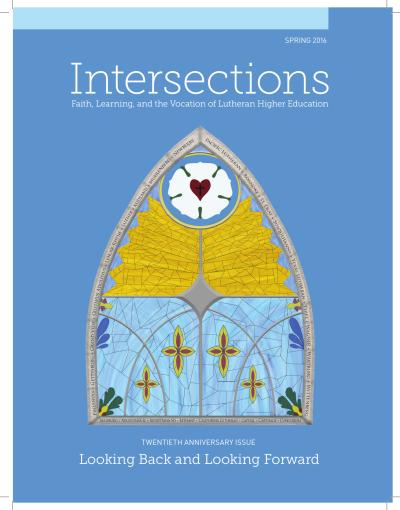
Mahn introduces the twentieth anniversary issue of Intersections, recalling its 1996 birth at Capital University “in the twinkle of an idea” in the mind of founding editor Tom Christenson, and previewing essays by Wilhelm, Amamoto, Kleinhans, Glass Perez, and Simmons that together look back at twenty years of the journal and forward to its work in the decades to come.
-
Article
The Vocation Movement in Lutheran Higher Education
Mark Wilhelm
Wilhelm offers a brief history of the “vocation movement” in ELCA higher education, arguing that it arose as Lutheran leaders moved beyond institutional markers (percentages of Lutheran students, faculty, and board members) and the collapse of ethnic, separatist Lutheranism to re-ground their schools’ identity in a 500-year-old intellectual tradition that educates the whole person for vocation and the common good — an educational ideal open to persons of any religious or non-religious conviction.
-
Article
Diversity and Dialogue: Twenty Years and Counting
Florence D. Amamoto
Twenty years after her essay “Diversity and Dialogue” in the first issue of Intersections, Amamoto returns to Gustavus Adolphus College to reflect on what has changed and what has not: rising numbers of students of color and international students, faculty turnover and increased publication pressures, the disappearance of the Center for Vocational Reflection, and the renewed importance of articulating Gustavus’s Swedish Lutheran heritage and inclusive sense of community in a tuition-dependent, cost-cutting environment.
-
Article
Distinctive Lutheran Contributions to the Conversation about Vocation
Kathryn A. Kleinhans
Kleinhans surveys the recent resurgence of vocation talk in American higher education — from Frederick Buechner’s widely quoted definition to Lilly Endowment’s PTEV grants and the CIC’s NetVUE Scholarly Resources Project — and uses her chapter in At This Time and In This Place: Vocation and Higher Education to highlight distinctively Lutheran emphases: vocation grounded in creation rather than redemption, the given-ness of multiple simultaneous callings, and a frank acknowledgment of the constraints and “dark side” of vocation.
-
Article
Moving Forward by Looking Back: Lutheran Vocation as Foundation for Interfaith Ministry
Kristen Glass Perez
Recounting how Augustana students mentored her into the role of presider at a campus vigil following the 2012 Sikh Temple of Wisconsin shooting, Glass Perez proposes that interfaith understanding become a mode of praxis for the twenty-first century Lutheran college. Drawing on Engaging Others, Knowing Ourselves and Interfaith Youth Core’s leadership practices, she urges ELCA schools to develop a common language linking interfaith engagement to vocational exploration and to the wider mission of the church.
-
Article
Semper Reformanda: Lutheran Higher Education in the Anthropocene
Ernest L. Simmons
Simmons enumerates the ELCA initiatives over the past twenty years that have helped Lutheran higher education retrieve a Christian understanding of vocation, then argues that the looming reality of human-caused climate change — the geological epoch of the Anthropocene — now requires Lutheran liberal arts education to prepare students for “planetary citizenship” as sustainability leaders, drawing on the classical Trivium, Luther’s panentheism, and a quantum-physics-inflected theology of divine entanglement and hope.
-
 Article
Vocation at Full Stretch: Reflections on Follow Your Bliss and Other Lies about Calling and its Use among College Students
Jason A. Mahn
No. 61 · Spring 2025
43 min audio
Mahn engages Bonnie Miller-McLemore’s Follow Your Bliss and Other Lies about Calling as required reading in a sophomore religion course, showing how her categories of missed, blocked, conflicted, fractured, unexpected, and relinquished callings empower young adults to perceive embodied, unplanned, and often painful dimensions of life as essential parts of vocation — and help close the gap between mission-driven and tuition-driven realities.
-
 Article
On Recruiting Diverse Students, Rooted in Mission
Eric Rowell, Jason A. Mahn
No. 59 · Spring 2024
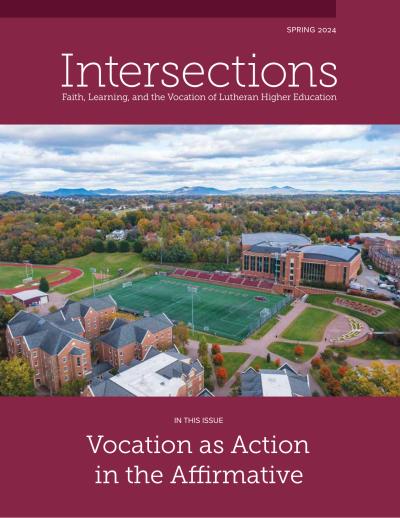
Jason Mahn interviews Eric Rowell, Assistant Director of Admissions and Diversity Outreach at Augustana College, about how recruiting students from a wide variety of backgrounds — rooted in Augustana’s Lutheran commitment to vocation and educating across difference — remains essentially unchanged in the wake of the Supreme Court’s 2023 decisions on affirmative action.
-
 Book Review
Assessing the Value of Liberal Arts: A Review of The Evidence Liberal Arts Needs, by Richard A. Detweiler
Robert D. Haak
No. 55 · Spring 2022
Haak reviews Richard A. Detweiler’s The Evidence Liberal Arts Needs, in which the former president of the Great Lakes Colleges Association analyzes 240 college mission statements and interviews more than 1,000 graduates to argue that liberal arts educational experiences have a measurable impact on adult lives of consequence, inquiry, and accomplishment — and invites NECU institutions into a further conversation about how Detweiler’s methodology applies to Lutheran higher education.
-
Editorial
From the Outgoing Editor
Jason A. Mahn
No. 55 · Spring 2022
Mahn closes out a decade of editing Intersections, passes the duties to Colleen Windham-Hughes, gives thanks to Mark Wilhelm and Augustana College, and introduces an issue largely drawn from comments by Lutheran faculty, staff, and administrators at the 2022 NetVUE national gathering.
-
 Editorial
From the Editor
Jason A. Mahn
No. 54 · Fall 2021
Mahn introduces the “Called to Place” theme of the 2021 VLHE Conference, arguing that Lutheran higher education’s emphasis on vocation must be grounded in particular geographies and embodied communities — for, as Wallace Stegner put it, “If you don’t know where you are, you don’t know who you are.”
-
 Reflection
Shelter in Place: Reflections from March 22, 2020
Jason A. Mahn
No. 53 · Spring 2021
On the fourth Sunday of Lent in 2020, Mahn meditates on the etymology of “shelter” (from shield) and on an email from a former student in Boston whose mutual-aid organizing models a Lutheran understanding of vocation: the upending of ego by divine love that frees us, finally, to see and serve the neighbor.
-
 Editorial
From the Publisher
Arne Selbyg
No. 23 · Summer 2006
Selbyg features articles based on presentations at the 2005 Vocation of a Lutheran College conference focused on the upcoming ELCA Social Statement on Education, and urges members of the ELCA higher-education community to download the first draft (“Our Calling in Education”) from the ELCA website and submit feedback to the Task Force on Education before the October 15 deadline. He worries that the sexuality social statement on a 2009 timeline will draw more attention than the education statement, but reminds readers that, for Martin Luther and for those who work in Lutheran higher education, education is as important as sex.
-
 Editorial
From the Publisher
Mark Wilhelm
No. 33 · Spring 2011
Wilhelm notes that while the ELCA’s vocation in higher education remains vibrant, the landscape of churchwide leadership has shifted dramatically with the dissolution of the Vocation and Education unit, and expresses appreciation for the faculty and staff at ELCA colleges and universities who have stepped up to sustain the network during this time of transition.
-
 Reflection
On Sharing the Sacred Sauna
Rosemary Radford Ruether
No. 30 · Fall 2009
Reprinted from the National Catholic Reporter (August 1968), Ruether’s reflection from her time as a theologian on the faculty of Holden Village describes Lutheran community life in the mountains of northern Washington from a Catholic perspective — finding more catholicity in this Lutheran retreat than in many Roman Catholic communities — and culminates in a celebration of the Holden sauna as “the new sacrament, the new fellowship, the new theology.”
-
 Article
Leadership in Lutheran Key at a Time of Pandemics
Deanna Thompson
No. 52 · Fall 2020
Thompson draws on Luther’s theology of the cross and Shelly Rambo’s theology of trauma to sketch a Lutheran model of leadership for a season of pandemics — one that is attentive to pain, responsive to need, and intentionally nourished by food, friends, and deep conversation.
-
 Editorial
From the Editor
Robert D. Haak
No. 25 · Spring 2007
Haak frames the issue around the question of what holds the twenty-eight ELCA colleges together amid their geographic, economic, and theological diversity, introducing Mark Hanson’s address to the assembled college presidents, Randall Balmer’s outsider perspective on the commonalities of Christian liberal arts, José Marichal and Pamela Brubaker on diversity rooted in community and globe, Storm Bailey’s argument that being Lutheran is precisely what makes us embrace diversity, and Jaime Schillinger’s St. Olaf chapel reflection on the formative power of worship and liturgy.
-
 Reflection
Calling and Learning: On Losing and Then Finding Myself
Rachel Hammond
No. 9 · Summer 2000
Hammond, a Capital University junior who spent two semesters studying in Guayaquil, Ecuador, recounts watching the sucre collapse from 10,500 to 29,000 per dollar between September and January, the overthrow of President Jamil Mahuad, the freezing of bank accounts over $4,000, the threatened eruption of the volcano at Baños, and her work at an orphanage that needed only $6.81 to feed a child for a month—and calls her fellow students, in light of Elie Wiesel’s warning that indifference is the enemy, to recognize their education as a gift and a responsibility to speak for those who cannot speak for themselves.