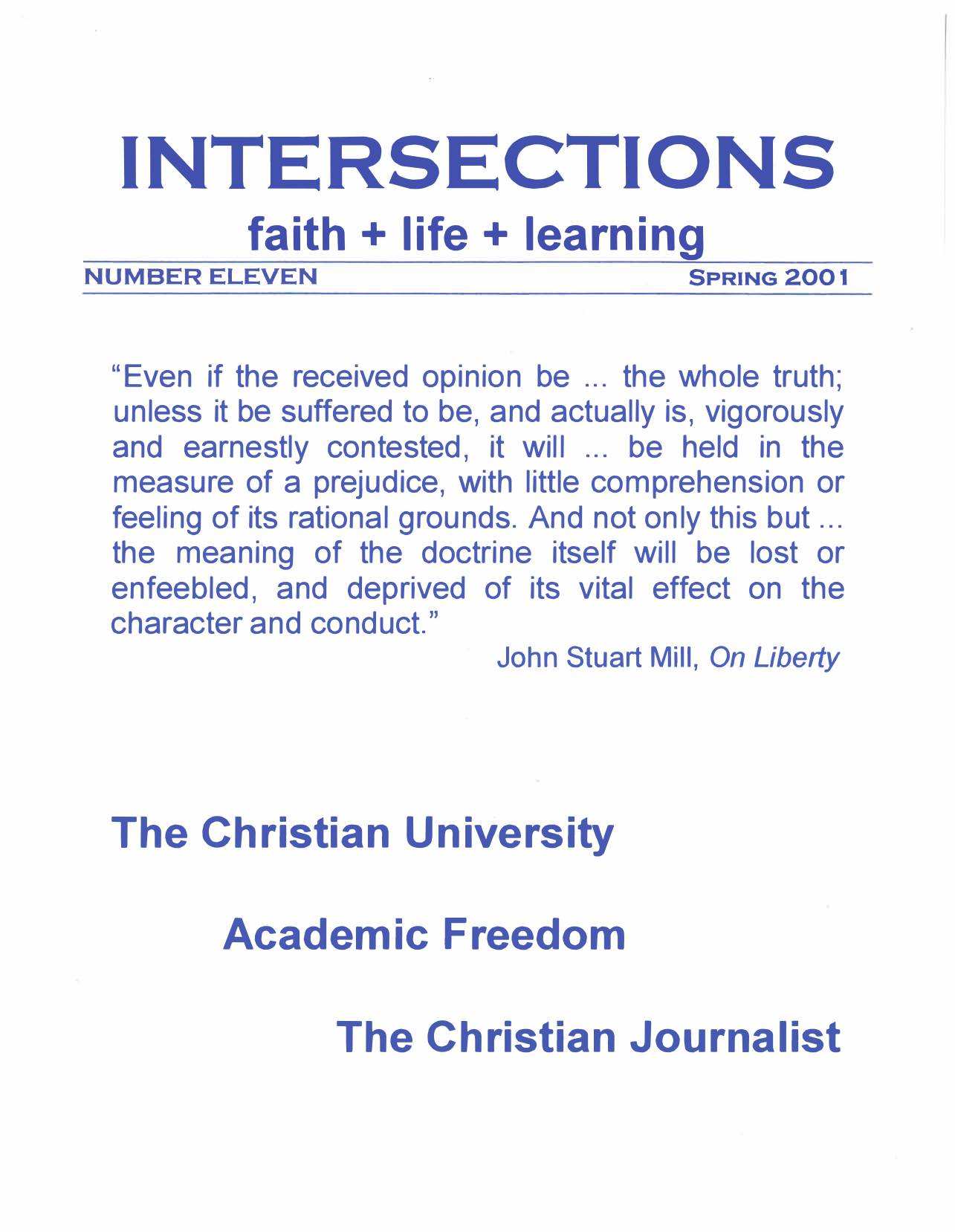
Number 11
The Spring 2001 issue of Intersections gathers four pieces on Christian higher education, academic freedom, and journalism as Christian vocation. Richard Hughes argues Christian particularity is itself the foundation for diversity and academic freedom; Nicholas Wolterstorff offers eight considerations on academic freedom in religiously based institutions; Storm Bailey argues religious commitment serves academic goals; and Catherine McMullen, surveying 1998 in American journalism, argues journalism is a Lutheran vocation—“a Christian cobbler makes good shoes, not poor shoes with little crosses on them.”
Editors
Articles in this Issue
-
 Editorial
From the Publisher
Arne Selbyg
Selbyg admits that promoting Lutheran colleges and universities can feel Sisyphean—clueless faculty or staff, fundraising treadmills, students and parents treated poorly by admissions, pastors with no sense of the colleges’ mission—but reports that alumni satisfaction surveys, ELCA-college faculty seminars, an engaging bishop, Ernie Simmons’s Lutheran Higher Education: An Introduction, and renewed reader interest in Intersections all show the stone is not at the bottom of the hill.
-
Editorial
From the Editor
Tom Christenson
Christenson explains that this issue “borrows everything from other sources”—Richard Hughes’s talk at Pepperdine president Andrew K. Benton’s inauguration, Nicholas Wolterstorff’s and Storm Bailey’s essays from the AAUP’s Academe, and Catherine McMullen’s Concordia talk—and defends the blatant borrowing as appropriate to faculty work, hoping new faculty will find in these pieces a corrective to common misconceptions about faith-related education and academic freedom.
-
Article
The Idea of a Christian University
Richard Hughes
Hughes’s lecture at the inauguration of Andrew K. Benton as the seventh president of Pepperdine argues that a Pepperdine-wide “strategy of community-wide conversation,” carried by the new Pepperdine University Center for Faith and Learning, can sustain the school as a Christian university by leaning into the paradox of Christian particularity rather than around it. Drawing on the incarnation, the Matthew 5 and Luke 14 teachings of Jesus, the Quaker and Cane Ridge (Joseph Thomas) abolition traditions, Galatians 2 and Romans 8, and Luther’s simul Justus et peccator as the gospel that frees the scholar to be wrong, to doubt, and to confess “Lord I believe; help thou mine unbelief,” he mines the Churches of Christ heritage—Alexander Campbell, Barton W. Stone, and John Rogers of Carlisle, Kentucky—as a unity-and-freedom tradition that grounds both diversity and academic freedom.
-
Article
Ivory Tower or Holy Mountain? Faith and Academic Freedom
Nicholas Wolterstorff
Wolterstorff defines infringement of academic freedom as impairing a faculty member’s standing on account of the ideological content of her position, argues that academic freedom (like free speech) is “duly qualified” rather than absolute, and offers eight considerations bearing on religiously based institutions: Weber’s differentiation of Wissenschaft, religious pluralism within a liberal polity, the vitality of American civil society, a decentralized educational system, the “holistic” character of much American religion, the post-Kuhnian collapse of classical foundationalism and of the “generically human” academy, the fact that ideas matter, and the personhood violated by infringement (the desecration of an image of God). He concludes that the private sector offers wider academic freedom than the public, that religious qualifications are not inherently inappropriate (any more than St. John’s Great Books commitment), but that religiously based colleges too often apply them unjustly—arbitrarily, secretly, without recourse—and that the AAUP’s best service is model codes of procedure.
-
Article
Uneasy Partners? Religion and Academics
Storm Bailey
Bailey, a philosopher at Luther College, takes up the reflex of describing church-related colleges as “pretty good in spite of the religion” and argues instead that religious commitment serves academic goals on three fronts: service as central academic purpose (Richard Hughes on Mennonite colleges in Models of Christian Higher Education), educational community (Plato’s dialogues, Parker Palmer, and Mark Schwehn’s Exiles from Eden), and integration of knowledge across disciplines against Nelson and Watt’s “entrepreneurial disciplinarity.” He then defends academic freedom on Christian grounds by drawing on Mill’s On Liberty argument from fallibilism, the centrality of epistemic weakness in the Christian tradition, and Wolterstorff’s claim that to infringe academic freedom is to desecrate an image of God—making personal and institutional religious commitment a foundation, not a foe, of the liberal academic ideal.
-
Article
Can a Christian Be a Journalist?
Catherine McMullen
McMullen recounts how Ernie Mancini’s alumni-program invitation forced her to articulate what a print-journalism major at Concordia might be, then surveys the annus horribilus of 1998—Chiquita and the Cincinnati Enquirer, CNN/Time’s retracted Tailwind story, Patricia Smith and Mike Barnicle fired at the Boston Globe, Stephen Glass at The New Republic, and Matt Drudge and the White House scandal—before contrasting Concordia’s liberal-arts approach with Pat Robertson’s Regent University, whose “Christian journalism” produces one-sided vampire-cult stories and graduates who conclude journalism is no place for a Christian. Drawing on Richard Baker’s The Christian as a Journalist, Tom Christenson on the “law of niceness,” Ernie Simmons, Harmon Smith and Louis Hodges on Christian ethics, Robert Benne’s Lutheran four orders and his “Christian cobbler makes good shoes, not poor shoes with little crosses on them,” Mel Mencher, Robert Bugeja, Walter Cronkite, Pete Hamill, Jeremy Iggers, David Remnick, the Northwestern Death Row exoneration of Dennis Williams, Verneal Jimerson, and William Rainge, and Pulitzer citations for Katherine Boo, Eric Newhouse, George Dohrman, and Mark Schoofs, she argues that journalism is a Lutheran vocation and that Christian cobblers—and Christian journalists—make good shoes.