Richard T. Hughes: How Christian Faith Can Sustain the Life of the Mind
Intersections No. 13 · Winter 2002
Richard T. Hughes, How Christian Faith Can Sustain the Life of the Mind. Eerdmans Publishing, Grand Rapids, MI; 2001.
Richard Hughes’ book addresses a number of vital and engaging questions, questions about pedagogy, about the difference between preaching and teaching, about the place of tragedy and death in the learning/teaching context, etc. But the main thrust of the book is to argue that the Christian faith is not only compatible with an open pursuit of the truth, but that faith is a means to such a pursuit, that faith can sustain the life of the mind. Hughes begins, I think rightly, by addressing what he calls a “stereotypical assumption” about faith; that it is dogmatic, close-minded and inclined to thinking of teaching as indoctrination. I think Hughes would have done well to talk more about the sources of this stereotype and why, in spite of many of our best efforts, it is so common. I frequently hear people talk about our Lutheran institutions saying things like this: “They are faith-based, but surprisingly open to diverse points of view.” “They require religion courses, but don’t try to convert you to a particular religious point of view.” “They have chapel, but don’t require attendance, and they actually encourage people to practice their own religions even when they are not Christians.” The unspoken text of all such comments is “Contrary to normal expectation here are religious people and institutions that are open-minded, questioning, and who create an open, non-coercive space for learning. Certainly they can’t be very serious about their faith claims!”
Hughes locates this requisite openness in what, quoting Tillich, he identifies as “religion breaking through its own particularity.” Using as example, the Bible, Hughes explains:
The Bible points us not to itself, but rather to the infinite God whose understanding no human being can fathom and who stands in judgement on all our claims that somehow we have captured ultimate truth. …. Can the Bible, viewed in these terms, sustain the life of the mind? It can indeed, for if the Bible points beyond itself to the infinite God, we have no choice but to search for truth. …when we view ourselves in relation to God, we understand how abysmally ignorant we really are. [34-35]
For Lutherans, of course, this should not be a new argument. How else, we might ask, should a tradition grounded in reformation, i.e. in an act of faithful criticism, be related to the truth? How else should the call “semper reformanda” be understood if not as the claim that all our forms and formulations are in need of continual critique and rethinking? Yet Lutherans have been dogmatic and close-minded. Luther himself, at the same time that he plead for an open hearing and debate of his views, condemned most unsympathetically the views of many of his contemporaries including fellow reformers. So this temptation, to argue from the absoluteness of God to the absoluteness of our own view of God, is not just something that has beset others.
Hughes raises the issue whether openness and a commitment to hearing a diversity of voices doesn’t lead to relativism. He asserts that it does not, that we needn’t end up accepting every view on the grounds of universal toleration, but he does not map out that border territory very clearly. Perhaps another chapter was needed, one in which he could explain or model the difference between a commitment to an absolute truth that transcends (and relativizes?) all human truths, and a post-modern abandonment of the idea of truth altogether. Even better, it would be interesting to have seen what the difference would be between the community of discourse in two institutions focused on these differing paradigms. My guess is that most Lutheran institutions currently find themselves navigating that border, and not the border between affirmation and dogmatism, that may be more focal in other traditions.
While Hughes does not just address institutions like ours, he does raise issues which we need to be talking about. At the November meeting of academic officers of North American Lutheran colleges and universities, Hughes’ book was the one most frequently cited. So we know that such conversation has already begun, and we hope that it will continue and be broadened.
-
 Editorial
From the Publisher
Arne Selbyg
Selbyg reports that Executive Director Leonard Schulze has challenged the ELCA Division for Higher Education and Schools to develop a comprehensive communications plan reaching high school students, college students, parents, pastors, and journalists, and invites Intersections readers to review the redesigned elcacolleges.org website, the “FREE STUFF” brochures, the journal’s advertisements in The Lutheran and related publications, Ernie Simmons’ new Augsburg-Fortress book Lutheran Higher Education: An Introduction, and the ELCA video magazine Mosaic—and to send in their own ideas.
-
Editorial
From the Editor
Tom Christenson
Christenson previews a varied issue—Darrell Jodock’s Bernhardson inaugural lecture, Ernie Simmons’ Valparaiso conference talk on student/parent attitudes, two South Africa travel pieces by Brian Wallace and Corin Wesner, and reviews of Richard Hughes’s and Robert Benne’s recent books—and tells the story of “the church lady from hell,” a mid-fifties returning student who condemned everyone in the class with “God and I think…,” to ask what a religious tradition without a sense of humor would look like.
-
Article
The Lutheran Theological Tradition and Recruiting Lutheran Students
Ernest L. Simmons
Simmons opens with an Abraham-and-Isaac “Windows 98” joke to illustrate the dialectic of faith and learning, then argues that in a new market era of limited religious background, intentional mission and marketing go together. Drawing on Levine and Cureton’s When Hope and Fear Collide for the Millennial Generation born in 1982 and Tom Beaudoin’s Virtual Faith for their GenX parents, he reads “Reclaiming Lutheran Students” survey results showing 86% strong community at ELCA colleges versus 54% at flagship publics and 61% alumni mentoring versus 39%. He then develops three areas where the Lutheran tradition uniquely equips its colleges—community, mentoring and vocation, and the integration of faith and values—using Luther’s “two kingdoms” image of the “Left Hand” (reason) and “Right Hand” (faith) of God, with academic freedom as a product of Ahlstrom’s “Critical Current” in the tradition, and closes with three challenges: recruiting and retaining mentoring faculty, educating church leaders, and reaching potential students and parents.
-
Article
Freedom, Humor, and Community: A Lutheran Vision for Higher Education
Darrell Jodock
Jodock’s inaugural lecture for the Bernhardson chair at Gustavus Adolphus develops three interlocking themes drawn from the Lutheran tradition as a deeper grounding for the liberal arts college than contemporary American assumptions. A sense of humor rests on Luther’s discovery that God takes the initiative—Luther could call himself a beggar, joke about the epistle of James, and credit Wittenberg beer for the Reformation—and underwrites the freedom of inquiry that John Updike traces to Grace Lutheran Sunday School in Shillington. Community, grounded in Augsburg Confession VII and Luther’s 1524 letter to the German city councils, makes the college a community of discourse pursuing wisdom rather than “the same old blockheads.” Freedom is both “freedom from” and “freedom for,” illustrated by Nechama Tec’s Polish Holocaust rescuers and by Jodock’s Holocaust-class corporate role-play in which students voted to build a factory in a death camp rather than risk losing their board seats—a vivid case for educating toward “a passion for justice.”
-
Reflection
Truth, Reconciliation, and Redemption in South Africa
Brian Forry Wallace
Wallace, a 24-year veteran political science professor at Capital University, recounts five weeks of post-apartheid peace-building travel-study with students living south of Cape Town—visiting townships, schools, day-care centers, a children’s AIDS hospital, Robben Island, and Nelson Mandela’s cell—and offers vivid sketches of his student companions Amy, Brian, Meghan, Karrie, Patrick, Meredith, Cheryl, Corin, Debbie, April, and Audra. He concludes that these students—atheists and agnostics and Buddhists and Methodists and Baptists, headed for social work, nursing, teaching, ministry, and parenthood—embody vocation by responding to a voice that calls them out of themselves to be present and to heal in this world, and that they are his link to the redemption of a lost and broken soul.
-
Reflection
Sweet on My Lips
Corin Wesner
A passage from Wesner’s travel journal during the same South Africa workshop. Walking into a wood-and-tin shack church where raindrops fall on already-soaked carpet and the service is in Xhosa, she remembers her painted, carpeted home church and her adolescent argument with her mother about wearing a dress to worship, and finds herself engulfed in warmth as the few women sing—welcomed by a stranger’s smile and opened up.
-
Book Review
Robert Benne: Quality With Soul: How Six Premier Colleges and Universities Keep Faith With Their Religious Traditions
Joy Schroeder
Schroeder reviews Robert Benne’s Quality With Soul (Eerdmans, 2001), which assesses the secularization documented by James T. Burtchaell’s The Dying of the Light and names six “bright lights” that resist it: Calvin, Wheaton, Baylor, Notre Dame, Valparaiso, and St. Olaf. Benne argues that piety alone or “generic Christianity” is insufficient—a school’s specific denominational intellectual tradition must permeate mission statements, classroom, and chapel, sustained by a critical mass of identifying faculty (he proposes a 2:1 ratio and at least one-third communicant membership), a first-rate theology department as “trustworthy guardian,” and visionary presidential and board leadership. Schroeder flags the under-representation of student and faculty voices but commends the book as required reading for presidents, board members, and faculty seminars at church-related institutions.
-
 Article
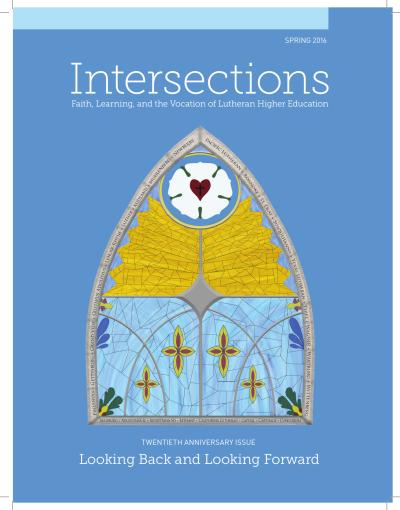
The Vocation of Intersections on its Twentieth Birthday
Jason A. Mahn, Robert D. Haak, Tom Christenson
No. 43 · Spring 2016
The three editors of Intersections — Bob Haak, Jason Mahn, and Tom Christenson (in spirit, following his death in 2013) — trace the twenty-year vocation of the journal itself: its 1996 birth at Capital University; its coming-of-age years of debate over institutional markers, two-kingdoms theology, and Lutheran identity; the ascendancy of “education for vocation” as the central marker of Lutheran higher education; and its ongoing identity in relation to a changing ELCA and to the broader cultural conversation about purpose, wholeness, and the vocation of higher education.
-
 Article
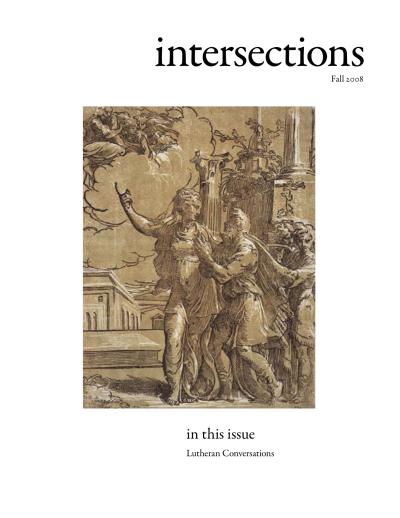
Point / Counterpoint: What It Means to be a "College of the Church"
Robert Benne, Tom Christenson
No. 28 · Fall 2008
Moderated by Wartburg College pastor Larry Trachte and introduced by Kathryn Kleinhans, this Wartburg campus conversation between Robert Benne (Roanoke College) and Thomas Christenson (Capital University) probes what it means to be a college of the church—Benne emphasizing ethos, vocation, and the Christian intellectual tradition over against secularization and generic education, and Christenson lifting up persistent vocational questions, the gift of difference, and induction into a community of discourse—and finds large common ground around hiring for mission, pedagogy that asks deep questions, and the courage to claim a living religious tradition while inviting everyone to the banquet.
-
 Article
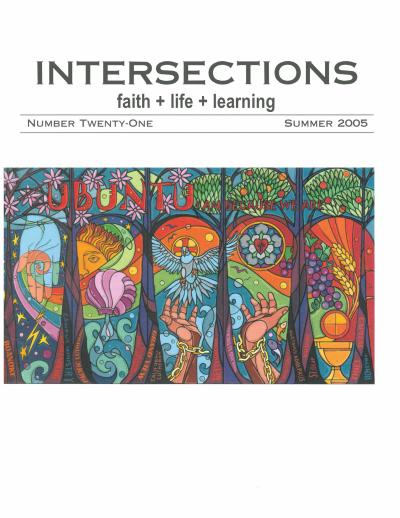
Education as a Christian (Lutheran) Calling
Tom Christenson
No. 21 · Summer 2005
Christenson opens with an imaginative reconstruction of early Christian communities as radically egalitarian, pacifist, communitarian gatherings within the Roman Empire and argues that such communities are natural homes for the educational vocation. Naming two temptations for contemporary Christian higher education—the parochial Bible school and “Generic U”—he uses his friend Sig Rauspern’s tree metaphor to insist that a university is Christian in its trunk and roots rather than in grafted-on branches. Drawing on Wendell Berry, Jacob Bronowski, Walter Wink, Douglas John Hall, and his own Gift and Task of Lutheran Higher Education, he names faithful criticism, engaged suspiciousness, simul justus et peccator, and a fallible, love-related Lutheran epistemology as the particular gifts Lutherans bring to the Christian educational calling.
-
Editorial
From the Editor
Tom Christenson
No. 21 · Summer 2005
In his valedictory letter as outgoing editor, Christenson recounts the 1994 origins of Intersections, when he took the idea to Naomi Linnell and Jim Unglaube at DHES and persuaded the council of presidents to launch the journal on a shoestring with printing paid by DHES and everything else by Capital University. He summarizes the issue’s contents—papers from the 2004 Vocation of a Lutheran College Conference plus two commissioned pieces from former DHES directors Bob Sorensen and Leonard Schulze—and thanks the student copy editors and Capital’s presidents and provosts who sustained the publication.
-
 Editorial
From the Editor
Tom Christenson
No. 20 · Fall 2004
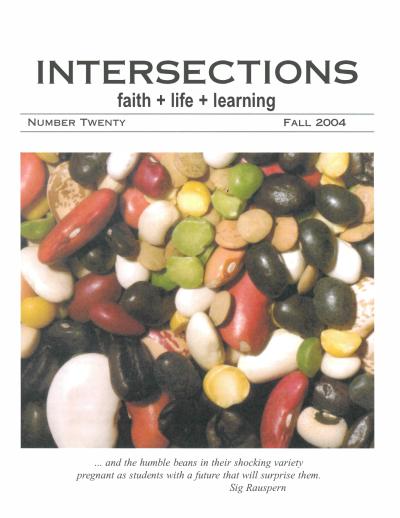
Christenson introduces an issue featuring “young and old, angry and encouraging, prophetic and hopeful” voices unified by the assumption that Christians engaged in thinking and educating will ask hard questions: how to raise concerns about militarism and the new American “imperialism,” what a Lutheran law school will say about training a new generation of attorneys, and what Lutheran colleges communicate to undergrads about vocation. Such faithful criticism, he argues, is part of who Lutheran institutions are.
-
Book Review
Review of Educating for Shalom: Essays on Christian Higher Education
Tom Christenson
No. 20 · Fall 2004
Christenson reviews Nicholas Wolterstorff’s Educating for Shalom: Essays on Christian Higher Education (Eerdmans, 2004), edited by C.W. Joldersma and G.G. Stronks. After recounting his own early prejudice against Wolterstorff’s Reason Within the Bounds of Religion and his subsequent conversion through Art in Action, he focuses on two threads: Wolterstorff’s expansive reading of shalom—not merely peace but justice, community, communal responsibility, and delight—as the overall goal of Christian collegiate education, and the influence of Abraham Kuyper’s claim of “privileged cognitive access” for Christian inquirers, which Wolterstorff demonstrates rather than declares.
-
 Editorial
From the Publisher
Arne Selbyg
No. 12 · Summer 2001
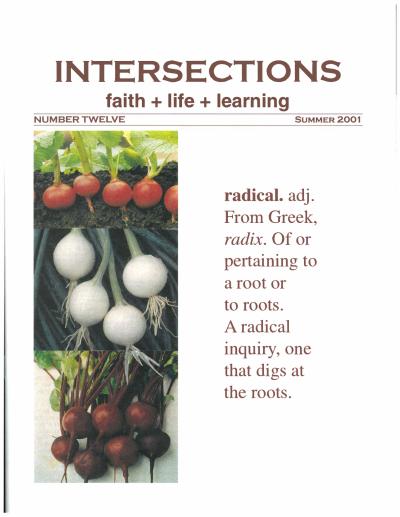
Selbyg reports that the Lutheran Brotherhood Foundation and the Lilly Endowment have funded the Lutheran Academy of Scholars, which since 1999 has gathered ten to twelve Lutheran scholars at Harvard for two-week summer seminars under Ronald Thiemann (themes: “Finding Our Voice—Christian Faith and Critical Vision” in 1999–2000 and “The Lutheran Public Intellectual: Faith, Reason and the Arts” in 2001), and announces that the academy will move to Berkeley in 2002 under Ted Peters to take up the intersection of faith and science.
-
 Article
Sustaining Sustainability
Baird Tipson
No. 36 · Fall 2012
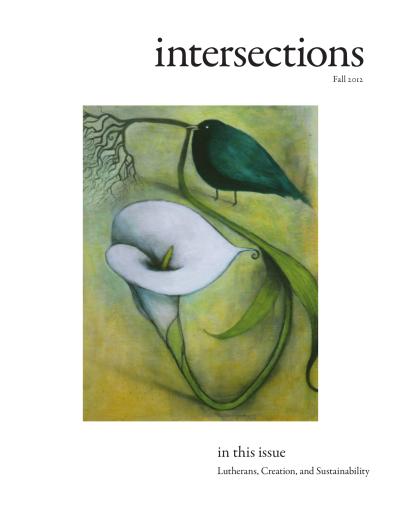
Tipson—former Provost of Gettysburg College, President of Wittenberg University, and President of Washington College—reads Romans 12:2 (“be not conformed to this world…”) against Victor Ferrall’s Liberal Arts at the Brink and the contemporary financial reality of small Lutheran colleges. He tells three case-study stories from Washington College’s Center for the Environment and Society—the Chino Farms partnership, the Chesapeake Semester, and the acquisition of the work boat Callinectes—to show how presidents must engage “the world” to secure resources for sustainability work without being conformed to it.
-
 Article
Vocation and Dharma throughout Life's Stages: A Hindu Perspective
Vidya Thirumurthy
No. 47 · Spring 2018
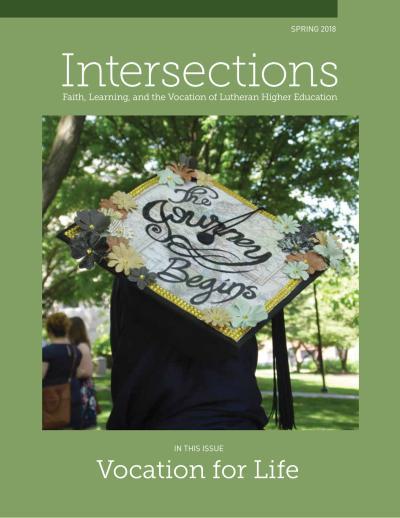
Thirumurthy traces her own attempt as a Hindu faculty member at Pacific Lutheran University to grasp the Lutheran concept of vocation, finding in the Bhagavad Gita’s teaching on dharma — duty fulfilled without expectation of reward — an equivalent that, like vocation, varies across the four stages of life and calls individuals to transform others through selfless service.
-
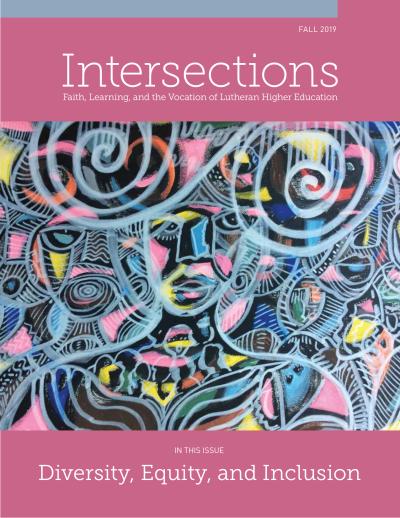 Article
The Perils and Promise of Privilege
Guy Nave
No. 50 · Fall 2019
Nave argues that privilege is always used in one of two ways — to preserve privilege by promoting inequity, or to challenge privilege by promoting diversity, inclusion, and equity — and uses examples from Indianapolis Catholic schools, Martin Luther, and equity-mindedness research to call Lutheran institutions to address the racist practices and policies that reproduce whiteness on their campuses.
-
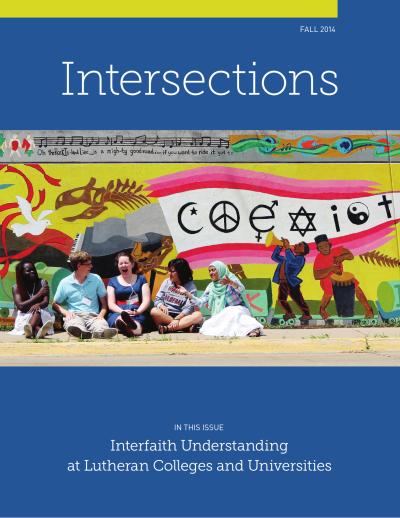 Article
Vocational Re-Formation for a Multi-Religious World
Elizabeth Eaton
No. 40 · Fall 2014
ELCA Presiding Bishop Elizabeth Eaton frames vocational formation for a multi-religious world as one of the most significant challenges facing the church and the liberal arts today, calling ELCA colleges and universities to live into Darrell Jodock’s “third path” that is both deeply rooted and dialogical.
-
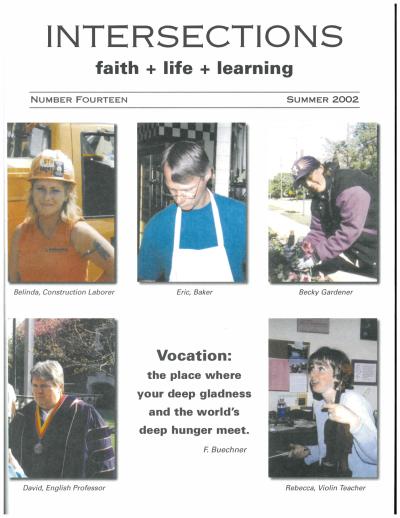 Article
Of Fathers and Feminism: How One Lutheran Woman Came to a Vocation
Karla G. Bohmbach
No. 14 · Summer 2002
Bohmbach, a recently tenured Susquehanna University feminist biblical scholar one month shy of forty, traces her vocation back through a Vacation Bible School injury, an LCMS upbringing in which only men could preach or preside, her father’s contradictory message that she could do anything while modeling a church that limited women, St. Olaf’s revelation of a Lutheran female face, and a Duke graduate seminar on the History of Feminist Thought with Carol Meyers. Her published feminist work on biblical daughters and on the concubine of Judges 19 is read alongside Kathleen Norris’s account of word-bombardment in church, Michel Tournier on childhood as “ardent confusion,” and her own recent participation as both student and teacher in an Authorized Lay Worship Leaders Program.