I. Christians in the Empire
Let us exercise, for the moment, our historical imaginations. We are living in one of the larger Mediterranean cities of the Roman Empire in the first centuries of the common era. This Roman world is diverse and pluralistic. In the cities we see people from Persia and Northern Europe and Africa. We hear hundreds of languages spoken, and daily hear about and see religious diversity of all sorts. Yet functionally everyone pays some kind of homage to the emperor, learning his language, paying his taxes, using his coinage, obeying his laws.
All of the political power, economic power and military might have a single focus, Rome and the person of the emperor. If we are a colonial people, we may not be happy about Rome, but we at least recognize that it calls the shots. Anyone who would wish for themselves a flourishing and successful life will finally have to plug in to the imperial power source. Rebellions occasionally occur but are short lived. Cynics mouth off but have little else to offer. Religious cults spring up constantly—most offer some kind of escape from the harsh realities of life in the empire.
We have heard about this group who call themselves Christians. They gather in people’s homes or any space available to realize what they call basileia tou theou, the present reign of God. They follow the person and teachings of someone called Jesus, a Judean whom the Roman authorities crucified, whom these followers claim was raised from death. The stories they tell about him are quite unbelievable, yet unashamedly bold and wonderful.
What makes these Christians different and interesting is how they come together as a community. The distinctions that play such a large part in the normal world: whether one is free or slave, wealthy or poor, Roman or non-Roman, well or diseased, law maker or law breaker, even whether one is male or female, none of these things matter to the Christians. All that counts for status in the Roman world is counted for nothing in their midst. People who come there are invited to forget their past, to become as one people. They practice a kind of washing that makes them “die and be born again.” Some of the most disreputable people come together there: prostitutes, peasants, lepers, Roman toadies. When someone hears that a Christian group is meeting nearby the common response is “there goes the neighborhood.” It’s like a recovery group, a start over group, a new life group. They are radically egalitarian, radically pacifist, radically communitarian, radically welcoming and radically forgiving of each other. It’s a rather scary concept, but that’s what makes them interesting.
II. Rethinking Church
I wanted us to take that little imaginative historical journey to get a little different view of what it might mean to be the church, the community of the Spirit. When we think about the word “church,” at least in our present historical context, we are most likely to think institutionally. Often we envision a steepled building in some nice neighborhood, where very respectable people gather and run education programs in the hope that their children will also grow up to be nice and respectable. This pursuit of niceness and respectability is not completely innocent. These people avoid issues that require serious self-examination or that require challenging the status quo. Wendell Berry writes, “… modern Christianity has [as a consequence] become willy-nilly the religion of the state and the economic status quo. Because it has been so exclusively dedicated to incanting anemic souls into Heaven, it has been made the tool of much earthly villainy.”
So, in thinking through what a Christian program in higher education might look like we need first to do some adventuresome thinking about who these Christians were, who we are as Christians, and what kind of thing church is.
May I be so bold as to attempt an answer to that latter question. The church is a community:
- sharing and celebrating and stewarding giftedness—in nature, in persons, in bread and wine, in renewed life.
- oriented to the paradigmatic figure of Jesus, the crucified one.
- called to challenge the grip of dominant paradigms of power, wealth, control and status.
- called to be suspicious of and critique all the world’s claims to ultimacy, to recognize and name the sources of illusion and fear.
- called by the deep needs of others, to realize a love that leads beyond a preoccupation with self.
- engaged in the continuing, open-ended project of realizing God’s governance of the world.
Christians are called into such communities; in fact, we are all called to be such communities. Moreover we are called to serve the needs of the world by being such communities.
My question to all of us—How could such a community help but be a place of serious discussion, a place of liberated learning, a place of Spirit, a place for the transforming of persons and the imagining of new worlds for new persons? If this isn’t a community with an educational vocation then I don’t know what one looks like.
III. Called to Education
So, if I am right, that the enterprise of education is a natural calling for a Christian community, what should the realization of such a calling look like, in the U.S. at this point in history? That is, to what sort of educational endeavor are we called?
There are two temptations for contemporary American Christian higher education. One is to become a parochial, doctrinaire, narrowly moralistic Bible School. This is an alternative but not a live option for most of us. The other temptation is to become a generic secular college or university. [Note, please, that I’m not saying there are only two options. In our rush to avoid being the former, we often fall into the trap of assuming that we must, therefore, be the latter. What I am arguing is that we should be neither. Both are temptations.] I think the latter temptation is a live option for many of us, and therefore it’s the temptation I want to focus on today.
I recently talked with a former student of mine. He’s just been employed by a recently-founded Buddhist university located in the East Bay area of California. He moved there from a position at Montana State where he had taught for five years. I was fascinated to hear about this new institution and what it was like to teach there. Here’s what he had to say: “It’s very much the same as Montana State. The biggest difference is that more of the students here are of Asian ancestry, there’s no school of agriculture, no football team, and, unlike MSU which was spread out over hundreds of acres, this University is completely located in two eight story buildings. Otherwise it’s exactly the same; the same generic departments, the same generic subjects, taught by the same generic academic types, to the same generic university students.”
When I heard that, I let out an anguished wail. I asked, “Isn’t there anything that goes on there that indicates it’s a Buddhist university?” He responded, “There’s a meditation room on the top floor of my building, and they offer Tai Chi classes to staff at lunch everyday. But from what I hear even the state schools do that out here. After all, this is California.”
From my point of view, though this institution may be a financial (and academic) success, this story is a tragedy. What is there in Buddhism that calls them to recreate another generic university? Particularly when the Buddhists have so much to offer that the world so desperately needs. That’s why the fact that the Buddhist founders recreated an East Bay version of Montana State is a tragedy—because of what it is, because of what it could have been, and because of what we, in this culture at this time, need it to be.
But of course exactly the same thing can be said about Christians. What an incredible tragedy if Christians engaged in education simply end up reproducing Generic U. This is particularly so if you believe, as I do, that Christians have so much to offer that the world so desperately needs. Yet, if we think of a college or university as a collection of generic disciplines, where generic professors teach generic subjects, then I think that is what we end up with.
At this point, you will want to know exactly what it is I am proposing. If a Christian (or Buddhist) university should not be just a collection of generic disciplines, then what should it be?
The problem is not solved just by adding a department of Christian (or Buddhist) studies, though as I will indicate, that might be a step in the right direction.
The problem is not solved by adding a chapel or worship time and venue, though that too might be a step in the right direction.
The problem is not solved by adding a whole mess (or some quota) of Christians to the faculty, though that too might be a step in the right direction.
None of these is sufficient because they simply add something to Generic U. Christian U then becomes Generic U plus chapel, or Generic U plus courses about Christianity, or Generic U plus a certain quota of Christians.
My friend, Sig Rauspern, likes to compare an educational institution to a tree. It has many branches of knowledge. Some produce interesting leaves, some flowers, some fruit, some are pretty much bare. But a tree is always more than that. It’s also a trunk (the place where all those branches hold together) and a root system. We tend, in academe, to focus all our attention on the branches, pay little attention to the trunk, and no attention to the roots. The temptations we just talked about seem to me to be Generic U plus a few new branches grafted on. My point is that a university is Christian because of the character of its trunk and roots, not because of any new department, or administrative office, or chapel that might be added on.
What I would hope of such an institution is that the ways of inquiring, the ways of understanding the tasks of teaching and learning, the ways of being a community would be shaped in some deep and essential way by the founding tradition. Thus, though economics is pursued at Christian U, it is pursued in deep dialogue with a point of view that sees the world not as the possession of humans, but sees us as stewards of a gift, not owners of a piece of property, that sees flourishing life as the measure of wealth, not wealth as the measure of flourishing life. Business courses may be taught at Christian U, but they include occasions for discussion of how the Christian idea of vocation changes our understanding of business success. How is business pursued by persons who realize that the bottom line is always something more than numbers? That accounting must take account of how well the needs of people are served? How is management taught by persons who have good reason to see the artificiality of the management/labor distinction? By persons who see each other as essentially brothers and sisters?
Biology will certainly be pursued at Christian U but pursued by those who stand in deep wonder and appreciation at the world, called to steward it rather than those who are determined to conquer and control it. Law may be learned at Christian U as well but it will be studied in a context tempered by the critical ideas of justice and mercy and service. There may be a military officer training program at Christian U, but no student should pass through it without considering what Walter Wink has called “Jesus Third Way” of responding to violence. Every student should have studied the debates about the possibility of just war and should have read Bonhoeffer on discipleship. Even religion may be taught at Christian U, but it will be informed by Jesus story, usually called “The Good Samaritan,” one point of which is that being religious is not always the answer and sometimes is the problem. In all of these cases the dialogue that ensues should shape both how the inquiry is pursued, how it is taught and what is taught, the kinds of assignments students receive, but mostly the kinds of discussions that are focal, the things faculty and students spend their time arguing about, the deep issues we all wrestle with.
The second point to make is that a Christian college/university is a place that takes seriously the fact that what one learns ends up influencing the person one becomes. Generic secular universities tend to deny or avoid this fact. Christian universities need to explicitly recognize that they teach subjects, but also, and at the same time, they teach human beings. We need to be clear that a person may be profoundly changed while studying astrophysics, agriculture, nursing, and music. Christian U is unashamedly and deliberately a place of human transformation, human growth; it offers an educational paradigm that is paideutic. It is a place where it makes very good sense to talk about faculty as mentors as well as instructors. Recent studies on collegiate learning show us that it is such transformative learning that really sticks.
Now perhaps you understand why I said that chapel services, the number of Christians on hand, and a faculty that teaches about Christianity might be “steps in the right direction.” They are in the right direction if they end up influencing the quality and quantity of serious dialogue that takes place there. If economists and biologists and business and law faculty are more likely to engage the tradition seriously because of the presence of faculty teaching about Christianity, then it is a step in the right direction. Yet I think we can all imagine a situation where it wouldn’t be.
IV. The Lutheran Contribution
Until now I have been talking about Christian communities and their call to engage in learning communities. But I haven’t specifically mentioned Lutherans. There are two reasons: i) Lutherans never intended to be anything but Christians—Christian reformers. That there are Lutherans is an historical fact, but had they succeeded in their argument for reform, there would not be. ii) The most important things that Lutherans have to offer are truths they share with other Christians.
But in spite of that I do think that Lutherans bring some particular emphases to the Christian educational calling. I will only mention some of these things here.
1. Lutherans should practice something that Luther embodied so well but that the world understands so poorly: faithful criticism. Luther was extremely critical of the Church, some parts of the ecclesiastical tradition, the political order, his theological opponents, and himself. Yet in all these cases his critique was not meant to tear down but to reform. His love and faithfulness took the form of being critical, of calling the Church back to some things it had lost sight of.
Luther was suspicious of many things: ecclesiastical authority, philosophy, theology, ethics, princes, peasants, and even reformers. Yet in every case his suspiciousness was not cynical but thoroughly engaged. He was involved in these enterprises even as he was suspicious of them. These two ideas, faithful criticism and engaged suspiciousness, are two peculiarly Lutheran habits of mind. The world needs both of them as much, if not more, than it ever has.
2. Luther had two theological ideas that played an important role in his thinking: a) that we are simul justus et peccator, i.e. at the same time (and in the same way?) both saints and sinners; b) the theology of the cross. These two ideas together (should) have kept Lutherans over the years from becoming too enamored of ecclesiastical or theological chauvinism, i.e. that they have got it wrong and we have got it right; that we have nothing to learn from them; that they are children of darkness, and we are children of light.
Lutherans believe in ecclesia semper reformanda, that the church is always in need of reformation. We have not arrived, we are not the specially sanctified brethren, and our temptation to think so is the best proof that we are not. These theological ideas or attitudes have profound implications for how we pursue learning, how we value the voices of “outsiders,” how we welcome criticism, why teachers are also in continual need of learning, and why Lutheran theology is so bold, so varied, and so argumentative. It also explains why we envision the successful Lutheran academy as a place of lively dialogue, not as a place to disseminate a univocal world view.
3. Such theological roots are a reason for Lutherans to have a particularly honest, holistic, yet amazingly hopeful view of what it means to be human. This view is one of our gifts, one we are called to share because the world badly needs to hear another view than the one that dominates our age. Douglas John Hall sees Christians (and in fact all of humanity) as engaged in a struggle. “It is a struggle,” he writes, “for a new image of what it means to be human.” We are living in a time that has seen the intellectual reduction of reality and the human. Academe has played a large part in that reductionism.
This last year we had a U.S. poet laureate on our campus, Robert Pinsky. He read some poems and talked a bit about the public importance of poetry. Though there were a couple hundred students present to hear him, there were only about a dozen faculty representing, at most, five departments. I leaned over to a psychology colleague and asked her, “What do you think accounts for the small number of faculty?” She responded, “Some of our specialties encourage a shrunken humanity.” I have to admit that her metaphor stuck with me more vividly than any of Pinsky’s did.
The daughter of a colleague wrote about her university professors:
My professors are knowledgeable as long as one stays in their field of expertise. Some are even academically famous… But as persons they are a great disappointment. When I have asked them questions that relate learning to larger issues or relate learning to life… I find them to be less mature than I am! I get the impression that they have never asked themselves these questions at all, and consequently have never answered them.
Is that what we have learned in the process of becoming academic specialists—to shrink ourselves to fit the narrow boxes our disciplines demand? Is that the un-announced curriculum of academe—to come away with a diminished sense of reality and of ourselves? One of the things that excites me about the prospect of Christian (and particularly Lutheran) higher education is that we have something better to offer, something that the world desperately needs and that we have the freedom to give. Imagine an education that enlarges both one’s view of the world and the self that inhabits it!
4. These Lutheran gifts—faithful criticism, a rich theological tradition informing an honest, holistic and hopeful view of humanity—these things also influence the way we approach human knowing; they suggest what I have dared to call a Lutheran epistemology. They provide us with a rich, love-related, answerable and fallible approach to knowing. This approach to knowing ought to challenge the paradigms of knowing built into many of our disciplines. It ought to challenge the temptation toward reductionism, challenge the facile distinctions between objective and subjective, facts and values, and challenge the caricatures and phobias that shape so much academic thinking.
In my book, The Gift and Task of Lutheran Higher Education, I delineate eight “epistemic stances” that I believe characterize a Lutheran epistemology:
- Wonder
- Open-ness
- Connectedness
- Freedom
- Critical Faithfulness
- Service/Vocation
- Engaged Suspiciousness
- Hope
I don’t want to talk about all of these now—but perhaps an example shows how they cluster to make a difference.
Jacob Bronowski in the old TV series, The Ascent of Man, said, “There seems to be a kind of knowing that actually closes the mind.” In one of the final episodes of the series Bronowski is seen squatting near a shallow pond of water. As he speaks the camera pulls back slowly to show the context. He says:
This is the concentration camp and crematorium at Auschwitz. This is where people were turned into numbers. Into this pond were flushed the remains of four million people. And that was not done by gas. It was done by arrogance. It was done by dogma. It was done by ignorance. When people believe they have absolute knowledge… this is how they behave. This is what men do when they aspire to be gods … when the loud voice of their answers drowns out the voice of the questions.
Totalitarianism, whether in its overtly political or more subtle varieties, is what occurs when a limited vision no longer recognizes its own limits. It is a theory, or discipline, or technique gone crazy. We have just lived through a century filled with examples of such insanity. Are we sure there won’t be more?
To a humanity frequently suffering from such insanity Wendell Berry offers a warning:
We have to act on the basis of what we know, and what we know is incomplete. We keep learning more… but the mystery surrounding our life is not significantly reducible. And so the question of how to act in ignorance is paramount. … If we lack the cultural means to keep incomplete knowledge from becoming the basis of arrogant and dangerous behavior, then the intellectual disciplines themselves become dangerous.
Douglas John Hall refers to the dominant modern view of the human-as-knower by the term “mastery,” the assumption that in knowing the world we humans were coming to master it. He writes:
… the concept of mastery contained an enormous lie from the outset. We simply are not masters…just at the point where human mastery [in the technological sense] has become a real possibility, the world shows terrible evidence of our lack of wisdom and goodness. It does not require great powers of observation or insight for anyone today to draw the conclusion that the self-appointed masters of the world have almost ruined it.
How do we, as inquirers and sharers of knowledge, proceed with these three warnings ringing in our ears? We proceed the opposite of arrogantly, the opposite of reductionistically,—I would say we proceed critically and self-critically, humbly, suspiciously, subjecting our knowing to the critique of service, care, open to wonder, answerable to all, including future generations, who will be affected.
Imagine the exciting and fertile discussions that would ensue if we could get all of our colleagues to dialogue about this new paradigm of knowing.
V. Conclusion
What I hope is that faculty who have recently come to teach at our institutions, when they are asked by their friends, “So what’s it like to teach at a Christian (Lutheran) college/university?” will not have to answer, as my former student did, “Oh it’s just like Generic U.” I would be ever so pleased if, instead, they were compelled to answer:
“I have come to question a whole bunch of assumptions I came with—assumptions about what it means to be human, about which distinctions are essential and which are artificial, about what agendas shape my discipline and the ways I have thought about knowledge and teaching & learning. I have come to recognize and challenge the ultimacies our own culture (and academic culture) presents to us and to our students. I have been pushed to ask these questions by my colleagues, by my students, by opportunities for discussion sponsored by my department, my school, my university. This has been an immense learning year for me. Not only am I a better (economist, psychologist, philosopher, professor of law) for having come here. I am also a larger, more multi-dimensional person. These Lutherans really take education seriously. This is a great place for a learner to be.”
-
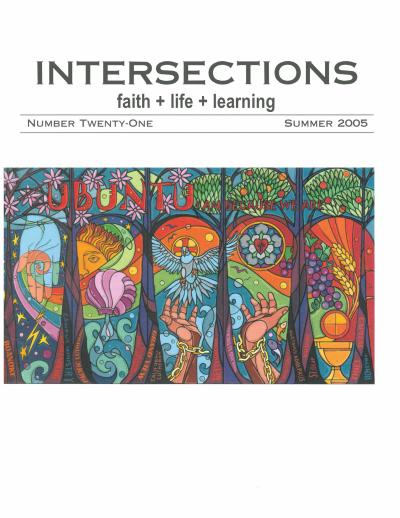 Editorial
From the Publisher
Arne Selbyg
Selbyg notes that ELCA colleges and universities have remained more loyal to the church than the institutions of many other denominations and announces that with this issue Tom Christenson’s nine-year service as editor of Intersections comes to an end, with Bob Haak of Augustana College in Rock Island assuming the editorship and institutional support shifting from Capital to Augustana.
-
Editorial
From the Editor
Tom Christenson
In his valedictory letter as outgoing editor, Christenson recounts the 1994 origins of Intersections, when he took the idea to Naomi Linnell and Jim Unglaube at DHES and persuaded the council of presidents to launch the journal on a shoestring with printing paid by DHES and everything else by Capital University. He summarizes the issue’s contents—papers from the 2004 Vocation of a Lutheran College Conference plus two commissioned pieces from former DHES directors Bob Sorensen and Leonard Schulze—and thanks the student copy editors and Capital’s presidents and provosts who sustained the publication.
-
Article
Changes
W. Robert Sorensen
Writing as former executive director of the Division for Higher Education and Schools, Sorensen places the DHES within the threefold movement of Luther’s Reformation—university, church, and individual piety—and recounts how the Division cohered its work with colleges, universities, campus ministries, and schools around Joseph Sittler’s definition of education as “movement into a larger world.” Drawing on Huston Smith’s “primordial tradition,” the Namibian student program, work in India and Palestine, and the Bergendoff series of publications, he raises a twofold concern about the proposed merger of DHES into a Division for Vocation and Education: whether the new structure will signal the core significance of education in the heritage and life of the church, and whether it can carry forward the effectiveness and scope of DHES’ work.
-
Article
The Church in Education? Education in the Church? Ten Theses on Why These Questions Matter
Leonard G. Schulze
Writing in the months before the August 2005 Churchwide Assembly that will decommission DHES, Schulze frames his vision for the division as ten Lutheran-style theses, each followed by Luther’s catechetical question “What does this mean?” He argues that critical thinking and moral deliberation are in the Lutheran gene pool; that Luther’s devotion to learning was an expression of Christian vocation; that the rise of the research university and the binary public meaning of “evangelical” have marginalized church-related colleges; that DHES has been wrongly perceived as marginal; and that the reformed concept of vocation must drive the soon-to-be-created program unit for Vocation and Education. An appendix reproduces the 2005 DHES strategic planning overview.
-
Article
Private University, Public Witness: Life in the "None Zone"
Loren J. Anderson
Drawing on sixteen years at Concordia College in Moorhead and twelve at Pacific Lutheran University, Anderson contrasts the Lutheran heartland with the Pacific Northwest’s “None Zone”—Patricia Killen and Mark Silk’s name for the country’s least churched region—and argues that a faithful Lutheran witness is possible in this changing context. He proposes five callings for the colleges—an academic program shaped by both educational philosophy and Lutheran theology, vibrant campus communities of faith and learning, inclusiveness and ecumenical outreach, global vision, and vocational exploration—and closes by sketching PLU’s shift toward “partnership” congregations and a new Center of Religion, Culture and Society in the Western United States.
-
Reflection
Finding Words That Matter (Proverbs 1:20-21; 4:10-13)
Harvard Stevens Jr.
In a brief homiletic reflection on Proverbs, Stevens addresses Lutheran educators as “merchants of wisdom” competing with a crowded contemporary marketplace of internet, cable TV, and rap music alongside “Hedonism 101,” “Advanced Voyeurism,” and “Pure Escapism.” Recounting an evening with a Carthage student poetry club, he shares the poem wisdom whispered to him there and offers thanks for the high calling to teach “words that matter.”
-
Poem
Sprigs of Mint
Caitlin McHugh
McHugh meditates on three light green mint stalks dying in a plastic cup of water in her window frame’s shadow, drawing a parallel between the neglected mint, the “tainted papers” of her unread journals, and the time that both holds her back and drives her forward.
-
Article
Money, Sex and Power: An Exploration of Some Controversial Issues in the Public Witness of the Church
Pamela K. Brubaker
Brubaker explores two controversial issues in the church’s public witness—homosexuality and economic life—and the challenges they present for both church and college. Drawing on Beverly Harrison, Elizabeth Bounds, Ron Thiemann, Linell Cady, Marcia Bunge, Richard Hughes, Darrell Jodock, Ernest Simmons, Karen Bloomquist, Garth Kasimu Baker-Fletcher, and Larry Rasmussen, and on episodes at California Lutheran University around “Harmony Week” and Bishop Paul Egertson’s participation in Anita Hill’s ordination, she argues that colleges related to the ELCA are called to educate for “critical citizenship” by hosting rigorous, bold, and unfettered debate—including debate over the neo-liberal globalism that she names a form of economic fundamentalism.
-
 Article
The Vocation of Intersections on its Twentieth Birthday
Jason A. Mahn, Robert D. Haak, Tom Christenson
No. 43 · Spring 2016
The three editors of Intersections — Bob Haak, Jason Mahn, and Tom Christenson (in spirit, following his death in 2013) — trace the twenty-year vocation of the journal itself: its 1996 birth at Capital University; its coming-of-age years of debate over institutional markers, two-kingdoms theology, and Lutheran identity; the ascendancy of “education for vocation” as the central marker of Lutheran higher education; and its ongoing identity in relation to a changing ELCA and to the broader cultural conversation about purpose, wholeness, and the vocation of higher education.
-
 Article
Point / Counterpoint: What It Means to be a "College of the Church"
Robert Benne, Tom Christenson
No. 28 · Fall 2008
Moderated by Wartburg College pastor Larry Trachte and introduced by Kathryn Kleinhans, this Wartburg campus conversation between Robert Benne (Roanoke College) and Thomas Christenson (Capital University) probes what it means to be a college of the church—Benne emphasizing ethos, vocation, and the Christian intellectual tradition over against secularization and generic education, and Christenson lifting up persistent vocational questions, the gift of difference, and induction into a community of discourse—and finds large common ground around hiring for mission, pedagogy that asks deep questions, and the courage to claim a living religious tradition while inviting everyone to the banquet.
-
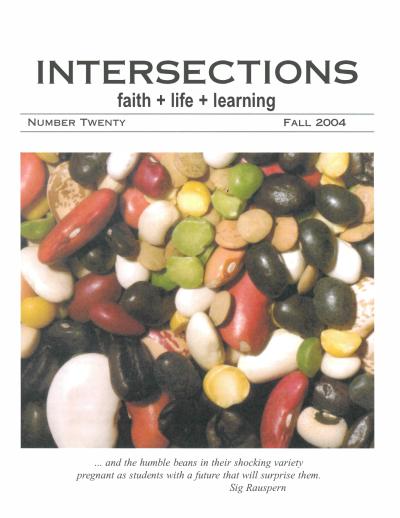 Book Review
Review of Educating for Shalom: Essays on Christian Higher Education
Tom Christenson
No. 20 · Fall 2004
Christenson reviews Nicholas Wolterstorff’s Educating for Shalom: Essays on Christian Higher Education (Eerdmans, 2004), edited by C.W. Joldersma and G.G. Stronks. After recounting his own early prejudice against Wolterstorff’s Reason Within the Bounds of Religion and his subsequent conversion through Art in Action, he focuses on two threads: Wolterstorff’s expansive reading of shalom—not merely peace but justice, community, communal responsibility, and delight—as the overall goal of Christian collegiate education, and the influence of Abraham Kuyper’s claim of “privileged cognitive access” for Christian inquirers, which Wolterstorff demonstrates rather than declares.
-
Editorial
From the Editor
Tom Christenson
No. 20 · Fall 2004
Christenson introduces an issue featuring “young and old, angry and encouraging, prophetic and hopeful” voices unified by the assumption that Christians engaged in thinking and educating will ask hard questions: how to raise concerns about militarism and the new American “imperialism,” what a Lutheran law school will say about training a new generation of attorneys, and what Lutheran colleges communicate to undergrads about vocation. Such faithful criticism, he argues, is part of who Lutheran institutions are.
-
 Editorial
From the Editor
Tom Christenson
No. 19 · Summer 2004
Christenson reflects on the scarcity of time in over-committed academic lives and posts a tongue-in-cheek help-wanted advertisement for his own successor as editor. He introduces the issue’s four authors as “three friends and one new acquaintance” whose work addresses Lutheran higher education, the significance of Paul Ricoeur, the implications of being a reformation community, and the perils of teaching ethics.
-
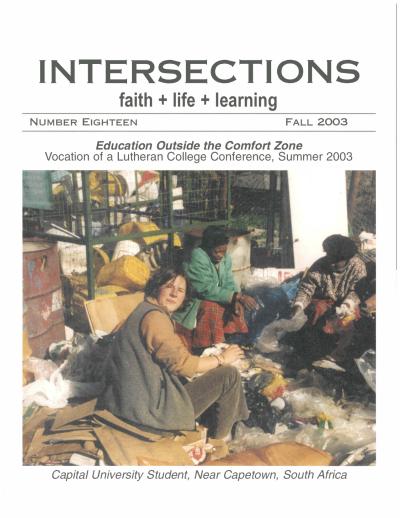 Editorial
From the Editor
Tom Christenson
No. 18 · Fall 2003
Christenson draws on a ten-year alumni survey at Capital University showing that students most often credit practica, internships, travel-study, and service-learning—not classroom hours—as the places they best learned the university’s stated outcomes, and introduces this issue’s papers from the Summer 2003 Vocation of a Lutheran College Conference on education and global outreach.
-
 Editorial
From the Editor
Robert D. Haak
No. 27 · Spring 2008
Haak frames the issue around the question of why Lutherans engage the world rather than retreat from it, locating the answer in the doctrines of creation and incarnation, and introduces essays by Erwin on globalism, Carlsen on local community engagement, Marty on multiple callings, and Mattes on the Grundtvigian heritage at Grand View. He also bids farewell to publisher Arne Selbyg, noting the fittingness of the Adinkra (“farewell”) cloth on the cover of this final issue under Selbyg’s leadership.
-
 Article
How Mister Rogers’ Neighborhood Reminds Us About Work
Than Oo
No. 61 · Spring 2025
5 min audio
Drawing on a Season 15 arc of Mister Rogers’ Neighborhood in which residents redirect pool funds to fix a plumbing problem, Oo finds in Fred Rogers’ vocation-honoring storytelling a reminder that limited resources are an invitation to creativity, perseverance, and optimism in higher education.
-
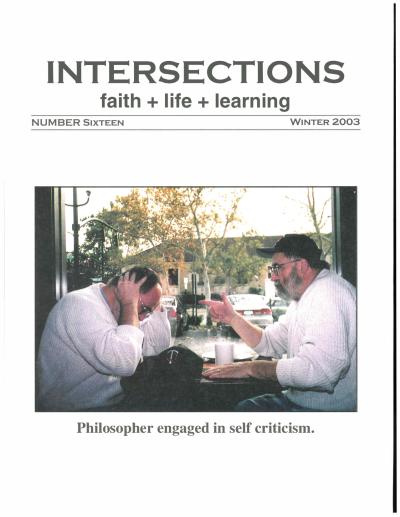 Article
The Impropriety of Jesus' Teaching: The Woman at the Well and The Vagina Monologues
Susan M. O'Shaughnessy
No. 16 · Winter 2003
O’Shaughnessy Poppe dedicates her message to those who worked to put on Eve Ensler’s The Vagina Monologues against administrative resistance and reads the Samaritan woman at Jacob’s well alongside the testimony of a Bosnian rape survivor whose story Ensler asked to tell, arguing that the “impropriety” of Jesus—his scandalous recognition of those silenced by sexism, racism, war, custom, and the church—is the model for the mission of a college of the church to defend academic freedom and to break the chains of oppression by inflicting discomfort on the proper and pure.
-
 Article
Leading from Within: Peer-Learning Consultations to Explore Our Callings and Campus Capacities for Leadership
Chris Johnson
No. 41 · Spring 2015
Johnson reframes vocational leadership as “soul work” that calls for the deep mind as much as the conscious one, and offers two practices — deep listening and a modified Quaker clearness consultation — as ways for campus colleagues to listen one another into existence. Drawing on Sharon Daloz Parks, Marshall Ganz, Parker Palmer, and Mary Rose O’Reilley, he invites readers to map their stories of self, us, and now.
-
 Editorial
From the Publisher: Staying Connected
Mark Wilhelm
No. 38 · Fall 2013
Wilhelm frames Intersections as a tool for maintaining relationships among leaders in ELCA higher education, welcomes the journal’s new editorial advisory board, and points readers toward the 2014 Vocation of a Lutheran College conference at Augsburg and a special interfaith understanding conference at Augustana with Eboo Patel and Presiding Bishop Elizabeth Eaton.
-
 Editorial
From the Editor
Jason A. Mahn
No. 54 · Fall 2021
Mahn introduces the “Called to Place” theme of the 2021 VLHE Conference, arguing that Lutheran higher education’s emphasis on vocation must be grounded in particular geographies and embodied communities — for, as Wallace Stegner put it, “If you don’t know where you are, you don’t know who you are.”