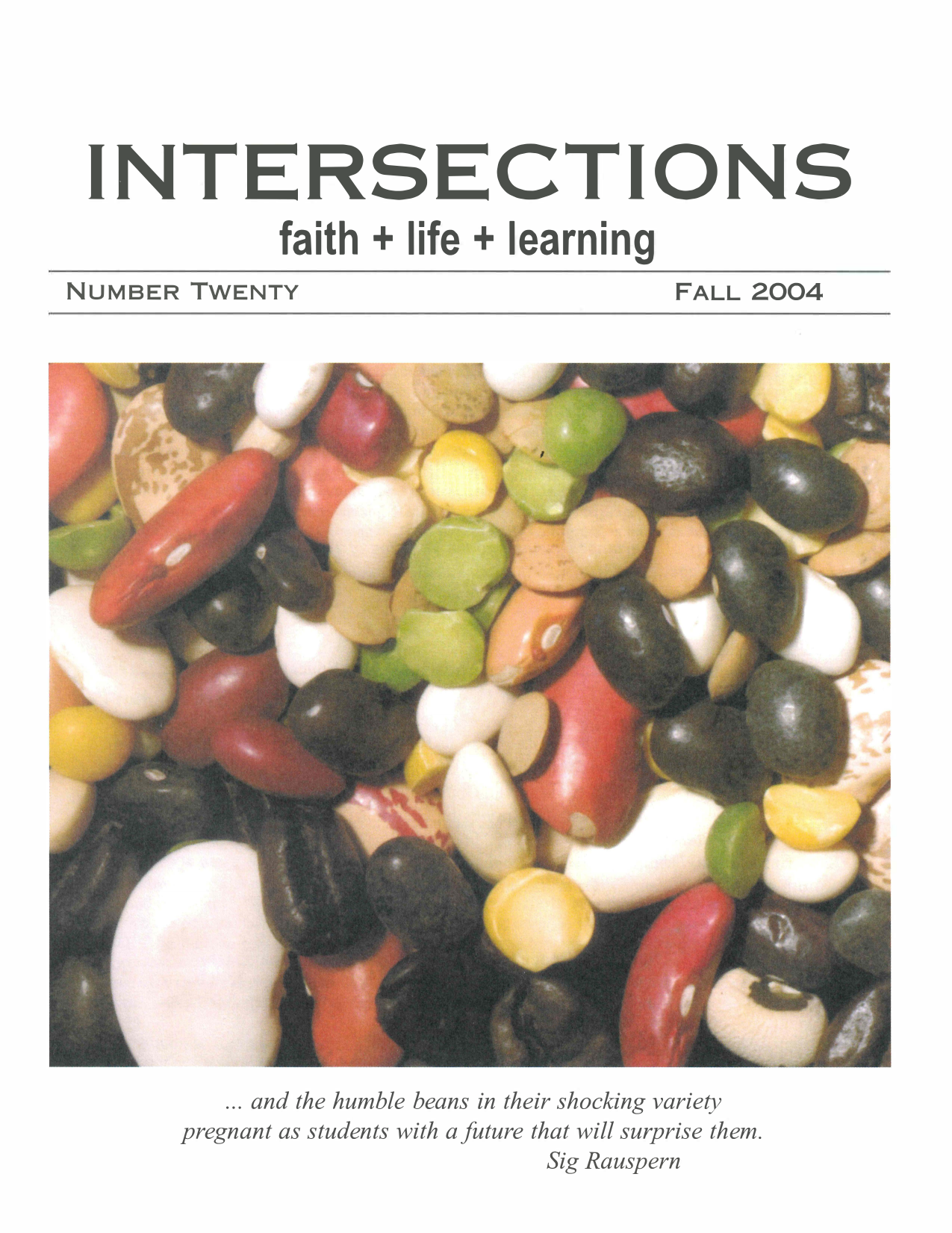
Number Twenty
The Fall 2004 issue gathers voices—“young and old, angry and encouraging, prophetic and hopeful”—around the Lutheran tradition of faithful criticism. Carl Skrade’s “Mars, Mammon—and Other Options” probes American militarism under the second Bush administration and proposes just-war principles and Matthew 5:43–48 as the Christian alternative. Steven C. Bahls argues law schools must teach students to distinguish vocation from career. Eric Childers profiles six students at Concordia, Lenoir-Rhyne, and Muhlenberg. Tom Christenson closes with a review of Wolterstorff’s Educating for Shalom.
Editors
Articles in this Issue
-
 Editorial
From the Publisher
Arne Selbyg
Selbyg reports that during 2004 a task force appointed by the ELCA Division for Church in Society has been laying the groundwork for a Social Statement on Education, with a draft to be debated in congregations and educational forums in 2006 and considered for adoption at the 2007 Churchwide Assembly. He urges Lutheran educators to obtain and study the new Task Force study document from the Division for Church in Society and submit their reactions so that the drafters know what those with ties to Lutheran educational institutions think is important.
-
Editorial
From the Editor
Tom Christenson
Christenson introduces an issue featuring “young and old, angry and encouraging, prophetic and hopeful” voices unified by the assumption that Christians engaged in thinking and educating will ask hard questions: how to raise concerns about militarism and the new American “imperialism,” what a Lutheran law school will say about training a new generation of attorneys, and what Lutheran colleges communicate to undergrads about vocation. Such faithful criticism, he argues, is part of who Lutheran institutions are.
-
Article
Mars, Mammon—and Other Options
Carl Skrade
In a wide-ranging public lecture from a Capital University Philosophy and Religion department series on “The Empire, Its Religions, and Some Alternatives,” Skrade distinguishes the military from militarism (using Oxford and Chalmers Johnson definitions), catalogs evidence of contemporary U.S. militarism—budget allocations, arms sales, the military-academic complex, post-1945 interventions, overseas bases, and Bush-era profiteering through Bechtel and Halliburton—and traces its roots in resource greed, racism, right-wing religiosity, and Augustinian incurvatus in se ipsum. After surveying the financial and human costs through testimony from Jonathan Shay’s Achilles in Vietnam, Samuel Hynes’s The Soldier’s Tale, Dalton Trumbo’s Johnny Got His Gun, and Staff Sergeant Jimmy Massey, he applies Vincent Ferraro’s seven principles of just war to Gulf II, reads Matthew 5:43-48 as a call to indiscriminate care, and proposes a www.religiousleft.org website to host a Christian alternative to Mars and Mammon.
-
Article
Leading Students to Distinguish Between Career and Vocation: Reflections from a Lutheran Law School
Steven C. Bahls
Bahls, writing as former dean of the Capital University Law School, argues that most law students and many legal educators confuse vocation with career—asking “what kind of lawyer do you want to be?” rather than “who do I want to be?” Drawing on John O. Mudd’s five attributes of a well-prepared lawyer and Susan Daicoff’s empirical research on lawyer dissatisfaction and the “amoral professional role,” he turns to Ernest L. Simmons’s and Darrel Jodock’s articulations of Luther’s understanding of vocation and proposes five steps—reflection, assessment, vision, integrative thinking, and reassessment—along with explicit leadership from law school deans, engagement of career services offices, and leadership within the profession (illustrated by Capital’s joint venture with the Columbus Bar Association).
-
Article
Luther's Theology of Learning: Discovering the Vocation of Today's Small Lutheran Liberal Arts College
Eric Childers
In an excerpt from his Wake Forest University Divinity School senior thesis, Childers profiles six students hand-picked by presidents and chaplains at Concordia College (Moorhead), Lenoir-Rhyne College, and Muhlenberg College—Nathan Gossai, Amy Nelson, Alison Schmidt, Ryan Sigmon, Julie Christianson, and Jeffrey Slotterback—as a living testament to Luther’s theology of learning. He then draws on Solberg, Mark R. Schwehn (in Paul J. Dovre’s The Future of Religious Colleges), Robert Benne, Ernest Simmons, Mark Noll, Richard Hughes, and James Burtchaell to argue that Lutheran colleges have not yet fully articulated their own theology of education and that their vocation is to embrace, engage, and galvanize a Lutheran tradition of learning rooted in the liberal arts, Scripture, the Confessions, and confident ecumenism.
-
Book Review
Review of Educating for Shalom: Essays on Christian Higher Education
Tom Christenson
Christenson reviews Nicholas Wolterstorff’s Educating for Shalom: Essays on Christian Higher Education (Eerdmans, 2004), edited by C.W. Joldersma and G.G. Stronks. After recounting his own early prejudice against Wolterstorff’s Reason Within the Bounds of Religion and his subsequent conversion through Art in Action, he focuses on two threads: Wolterstorff’s expansive reading of shalom—not merely peace but justice, community, communal responsibility, and delight—as the overall goal of Christian collegiate education, and the influence of Abraham Kuyper’s claim of “privileged cognitive access” for Christian inquirers, which Wolterstorff demonstrates rather than declares.