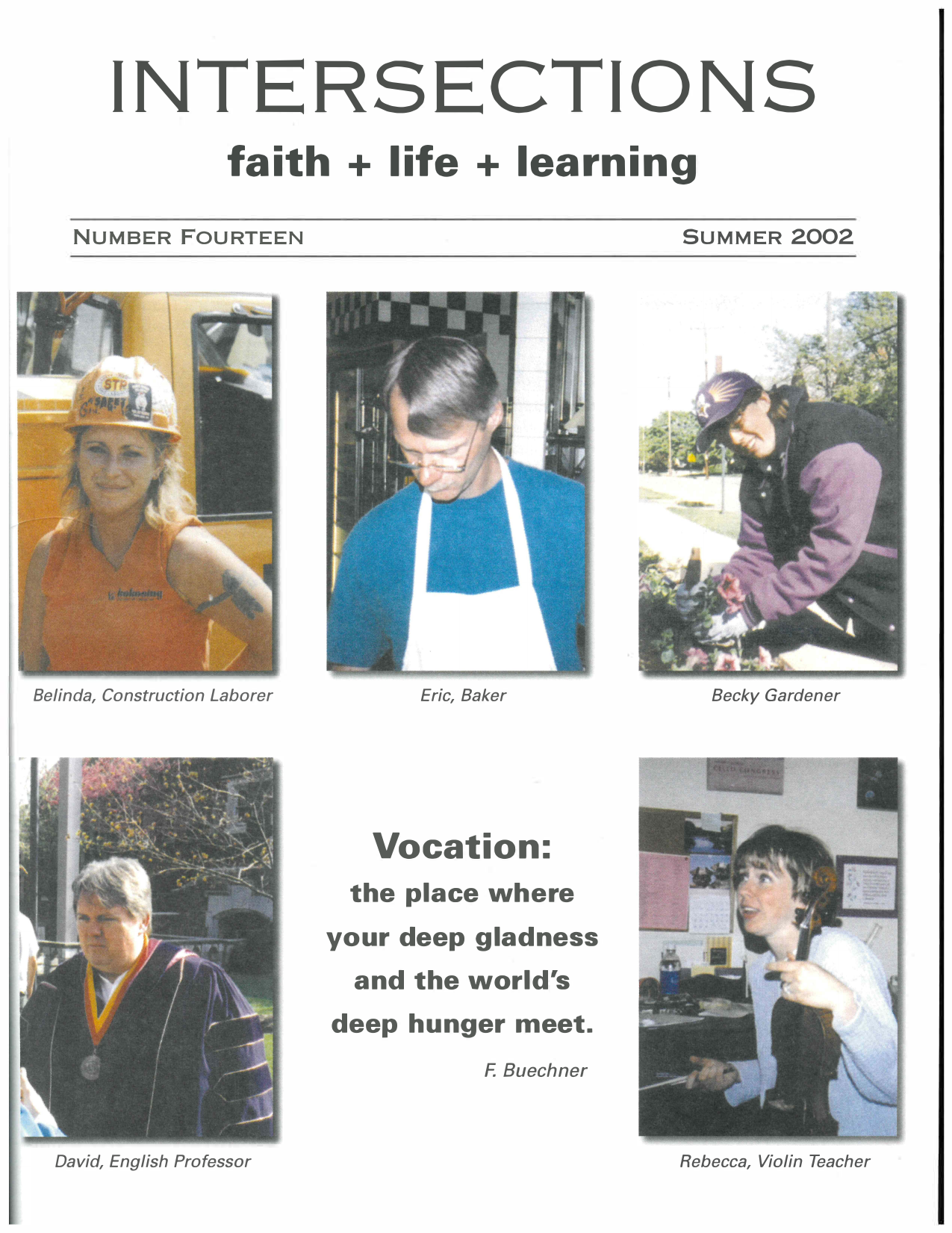
Vocation: Faith + Life + Learning
A single-topic Summer 2002 issue on vocation drawn from the 2001 conference. Darrell Jodock reads Putnam’s Bowling Alone alongside Luther’s ethic and the new Gustavus Center for Vocational Reflection. Marcia Bunge maps eight “doorways” through Valparaiso’s Lilly grant. Richard Rouse tracks “Paths Unknown.” John P. Trump’s play “Holy Odors” argues digging up old bones can be as holy a call as ministry. Karla Bohmbach traces her vocation as a feminist biblical scholar; Don Braxton reviews Alister McGrath’s Glimpsing the Divine.
Editors
Articles in this Issue
-
 Editorial
From the Publisher
Arne Selbyg
Writing on behalf of the publisher, Sue Edison-Swift names vocation as one of the precious gifts Lutheran theology offers education, reflects on her first ELCA Vocation of a Lutheran College conference, and asks readers to gift future issues of Intersections with feedback—notes on what they read and skipped, and how they ended up with a copy.
-
Editorial
From the Editor
Tom Christenson
Christenson argues that whether or not the conversation is funded by the “Lilly lottery,” vocation should just be part of who we are and what we do at ELCA colleges, and proposes three low-cost conversations—among faculty (twenty dollars of wine, in vino veritas), with students throughout their four years, and with alumni—explaining why this issue is deliberately “fatter” than usual and inviting feedback on other single-topic issues.
-
Article
Vocational Discernment: A Comprehensive College Program
Darrell Jodock
Jodock, whose Gustavus Adolphus was one of twenty colleges to receive a Lilly “Theological Exploration of Vocation” grant in 2000, defines vocation not as occupation but as a self-understanding that nests the self in community. Reading Robert Putnam’s Bowling Alone on the collapse of secondary communities alongside Luther’s ethic of community benefit and five Lutheran principles (graciousness, Christian freedom, community, God active in the world, the theology of the cross), he walks through Gustavus’s three-level design—a definition of vocation open to other faith traditions, “middle principles” drawn from Sharon Parks’s Common Fire, and a long menu of programs coordinated by a new Center for Vocational Reflection—hoping that, in the language of Holocaust studies, graduates will be “resisters” and “rescuers” rather than bystanders.
-
Article
Renewing a Sense of Vocation at Lutheran Colleges and Universities: Insights from a Project at Valparaiso University
Marcia Bunge
Bunge, director of the process for writing Valparaiso’s nearly two-million-dollar Lilly grant on the Theological Exploration of Vocation, argues that contemporary culture’s reduction of vocation to either paid work or self-fulfillment requires Lutheran institutions to renew attention to a rich theological concept rooted in Luther’s expansion of vocation beyond the priesthood. She outlines eight low-cost “doorways”—caring adults, prayer, worship leadership, music and the arts, service, cross-cultural experience, church camps and wilderness, study and reflection—and describes Valparaiso’s two-program structure: a Campus-Wide Program weaving vocation into Freshman Core Courses and chapel life, and a Church Vocations Program for students considering full-time ministry. She closes with four troubling questions for any institution carrying out such a grant: what faith traditions can learn from one another, how to involve parents, whether faculty and staff have space to reflect on their own vocations, and whether daily institutional practices—family policies, treatment of low-paid staff, environmental responsibility, obligations to the wider community—actually reflect a commitment to love of neighbor.
-
Article
Martin Luther, Vocation, and Church Colleges: Nurturing Future Leaders for Faith and Community
Richard W. Rouse
Rouse, citing Arne Selbyg’s statistic that thirteen of sixteen newly elected ELCA bishops graduated from a Lutheran college (and 49 of 65 in the new Conference of Bishops), argues that ELCA colleges are training grounds for future church and community leaders because of Luther’s doctrine of the priesthood of all believers and his distinction between vocation and station—the basis of PLU’s motto “educating for lives of service, inquiry, leadership, and care.” He describes “Paths Unknown: Where is God Leading Me?” a Western Mission Cluster collaboration of California Lutheran, Luther Seminary, Pacific Lutheran Theological Seminary, PLU, and Trinity Lutheran College that used a dedicated web site (godleading.com), a January-February 2001 online virtual forum reaching over 300 participants in 40 states and Canada and Mexico, and one-day interactive video workshops featuring Trump’s play “Holy Odors,” and reports LECNA’s Reclaiming Lutheran Student Project findings on teaching, community, and faith integration at Lutheran schools.
-
Article
Holy Odors
John P. Trump
A one-act play by John P. Trump, premiered at Pacific Lutheran University, in which Maggie, a senior studying Reformation history in the library stacks, falls asleep over the Apology of Augsburg and dreams a 16th-century pickled-herring merchant—Herr Leonard Kopp, the man who smuggled Katie von Bora and eight other nuns out of the convent—into existence to argue that her call to archaeology (“digging up old bones”) is as holy as ordained ministry, with Luther’s joke that the church burns incense to insulate priests from the “holy odors” (not holy orders) of everyday life.
-
Article
Of Fathers and Feminism: How One Lutheran Woman Came to a Vocation
Karla G. Bohmbach
Bohmbach, a recently tenured Susquehanna University feminist biblical scholar one month shy of forty, traces her vocation back through a Vacation Bible School injury, an LCMS upbringing in which only men could preach or preside, her father’s contradictory message that she could do anything while modeling a church that limited women, St. Olaf’s revelation of a Lutheran female face, and a Duke graduate seminar on the History of Feminist Thought with Carol Meyers. Her published feminist work on biblical daughters and on the concubine of Judges 19 is read alongside Kathleen Norris’s account of word-bombardment in church, Michel Tournier on childhood as “ardent confusion,” and her own recent participation as both student and teacher in an Authorized Lay Worship Leaders Program.
-
Reflection
Discerning Vocation: Personal Recollections
Tom Christenson
Christenson recalls growing up two blocks from Concordia College, Moorhead, where his father—known to students as “Doc”—was the steam engineer, and afternoon wanderings past walrus-moustached biologists, Harpo-Marx-haired theologians, and a math professor who wrote proofs with one hand and erased them with the other. He came to see the campus as “an asylum for child-like minds building towers of intellectual blocks and then knocking them down,” and traces his philosophical bent back to a high school physics teacher who, asked why Bernoulli’s principle was true, finally growled, “Christenson, you’re nothing but a damn philosopher.”
-
Book Review
Alister McGrath: Glimpsing the Divine: The Search for Meaning in the Universe
Don Braxton
Braxton reviews Alister McGrath’s Glimpsing the Divine (Eerdmans, 2002), commending its twelve articulate, lavishly photographed meditations as a fine introduction to Western spirituality but criticizing its conservative neo-Barthian confessionalism, its Eurocentric treatment of non-Western traditions as “taillights” to Christianity’s “headlights,” its one-sided host-guest engagement with the natural sciences, and its metaphysical dualism. In a section added for ministerial readers, he contrasts McGrath’s self-contained confessionalism with H. Richard Niebuhr’s call to respond to all things as if to God’s actions upon us, and argues that in an era of rival fundamentalisms exclusivity must become a thing of the past.