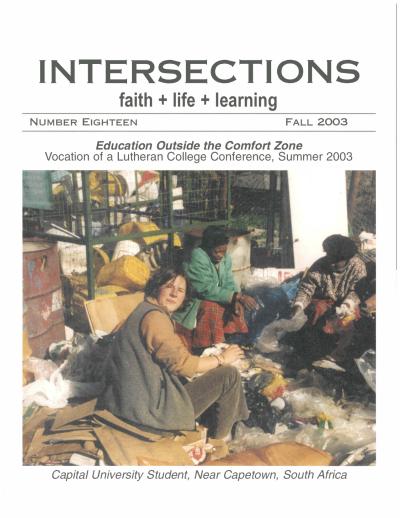
Two years ago I oversaw the creation and mailing out of a questionnaire for ten-year alumni/alumnae of the university where I teach. We asked them a number of questions including asking them to rank the importance of our stated learning goals, asking them to assess the kind of job the university had done in teaching these goals, and where, if at all, they had learned the skills, attitudes and knowledge the goals talked about. Many of the outcomes of the questionnaire were surprising. One of the surprising patterns of response was the large numbers of students who said that they learned these essential skills, attitudes and knowledge in programs and experiences they had outside the classroom and outside the domain (physically speaking) of the university. These things had been learned best, or most thoroughly, or most memorably, in practica, internships, travel-study occasions, service-learning projects, or in unprogrammed intersections between their lives, their part-time jobs, and their classroom studies.
The responses to this questionnaire taught us at least two things: 1) to take off-campus experiences more seriously as part of the learning agenda of students; 2) to see that learning matters most that coincides with the personal development of students.
Last summer’s Vocation of a Lutheran College Conference focused on education and global outreach, as all the papers in this issue of INTERSECTIONS testify. Global study programs, particularly those that are service-connected or where students get to live with the native populations, are life-changing. I only wish every one of our students could have such experiences.
Tom Christenson
October, 2003
-
 Editorial
From the Publisher
Arne Selbyg
Selbyg reports that the ELCA Church Council’s new strategic directions include the charge to “assist this church to bring forth and support faithful, wise, and courageous leaders whose vocations serve God’s mission in a pluralistic world,” and assures readers that Intersections, the Vocation of a Lutheran College conferences, and related programs will remain among the tools by which the churchwide organization reaches its strategic goals.
-
Article
"The Earth is the Lord's And the Fullness Thereof": Six Theses Regarding Global Education at the Colleges of the Church
Christopher M. Thomforde
Thomforde surveys the breadth of global education across ELCA colleges—Susquehanna, Bethany, St. Olaf, Luther’s international students, Concordia’s language villages—and then frames its future around six theses: global education is a theological enterprise that teaches the First Commandment through dialog, wonder, and disillusionment; it necessitates coming to terms with “the stranger” and “hospitality” (drawing on Diana Eck); it is in, for, and against the world; it nurtures vocation and forms L. DeAne Lagerquist’s “cosmopolitan citizens”; it requires sympathetic engagement of faculty, staff, and administration in the spirit of pioneers like Ansgar Sovik; and it calls the ELCA colleges to exercise the gift of administration to bring greater clarity and collective coordination to the portfolio of programs offered across the twenty-eight institutions.
-
Article
Service Beyond the Comfort Zone
Kathryn Wolford
Wolford names economic globalization and the growth of civil society as the two issues shaping Lutheran World Relief’s mission, illustrating with the Guatemalan storekeeper undercut by subsidized “gringo” chickens, fair-trade coffee and chocolate campaigns, and Charles Onyango-Obbo’s warning about anti-terrorism laws in fragile African democracies. Drawing on Darrell Jodock, Art Simon, and the Good Samaritan, she frames the global vocation of Lutheran colleges as inviting students past comfort zones of race, class, ethnicity, and ideas through service-learning that links mercy and justice, and closes with a concrete LWR partnership invitation including site visits, internships, fair-trade campus campaigns, and the “A Place for Peace in Colombia” advocacy program.
-
Article
Educating for Peace: 21st Century Models for Thinking Globally and Acting Locally
Janet E. Rasmussen
Rasmussen opens with a rabbinic story about the one-step distance between East and West and describes Pacific Lutheran University’s four-phase “Global Education Continuum”—Introductory, Exploratory, Participatory, Integrative—developed with Teagle Foundation support and grounded in Perry, Bennett, and Musil. She illustrates intentional global/local partnership through three case studies: Barbara Temple-Thurston’s Trinidad-and-Salishan initiative; the China Partners Network with the Amity Foundation, Good Samaritan Hospital, and PLU’s Wang Center; and Ann Kelleher’s three-institution “Norway in Namibia” partnership with Hedmark University College, the University of Namibia, NAMAS, and the Ondao mobile schools for the Himba people. She closes with Daloz, Keen, Keen, and Parks’s Common Fire research and Lee Knefelkamp’s call to be “communities of peace.”
-
Article
The Search for a Just Peace in a Globalized World
Munib A. Younan
Younan, Lutheran Bishop in Jerusalem, grounds Palestinian Christian identity in Incarnation theology and a Lutheran theology of grace and the cross, then surveys the Evangelical movement’s nineteenth-century legacy in the Middle East—the 1864 Arabic Bible, ELCJ schools, women’s ordination, and the Middle East Council of Churches. Engaging Edward Said’s critique of Samuel Huntington, he calls for international and local mutual-recognition agreements (including the Jerusalem Lutheran-Anglican agreement and a Lutheran-Reformed agreement in the Middle East), four marks of interfaith dialogue, and a sharp distinction between Lutheran “Evangelical” identity and the Dispensationalist evangelistic Right whose Israel-Palestine scenarios he names a heresy. He closes by proposing concrete scholarship, faculty exchange, and sabbatical partnerships between U.S. Lutheran colleges and the ELCJ’s churches, schools, and Dar al-Kalima Lutheran Academy.
-
 Article
The Vocation of Intersections on its Twentieth Birthday
Jason A. Mahn, Robert D. Haak, Tom Christenson
No. 43 · Spring 2016
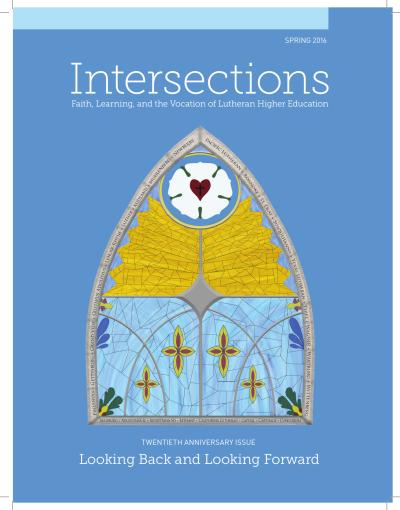
The three editors of Intersections — Bob Haak, Jason Mahn, and Tom Christenson (in spirit, following his death in 2013) — trace the twenty-year vocation of the journal itself: its 1996 birth at Capital University; its coming-of-age years of debate over institutional markers, two-kingdoms theology, and Lutheran identity; the ascendancy of “education for vocation” as the central marker of Lutheran higher education; and its ongoing identity in relation to a changing ELCA and to the broader cultural conversation about purpose, wholeness, and the vocation of higher education.
-
 Article
Point / Counterpoint: What It Means to be a "College of the Church"
Robert Benne, Tom Christenson
No. 28 · Fall 2008
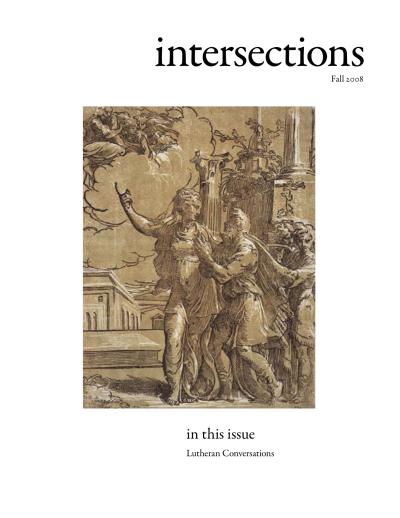
Moderated by Wartburg College pastor Larry Trachte and introduced by Kathryn Kleinhans, this Wartburg campus conversation between Robert Benne (Roanoke College) and Thomas Christenson (Capital University) probes what it means to be a college of the church—Benne emphasizing ethos, vocation, and the Christian intellectual tradition over against secularization and generic education, and Christenson lifting up persistent vocational questions, the gift of difference, and induction into a community of discourse—and finds large common ground around hiring for mission, pedagogy that asks deep questions, and the courage to claim a living religious tradition while inviting everyone to the banquet.
-
 Article
Education as a Christian (Lutheran) Calling
Tom Christenson
No. 21 · Summer 2005
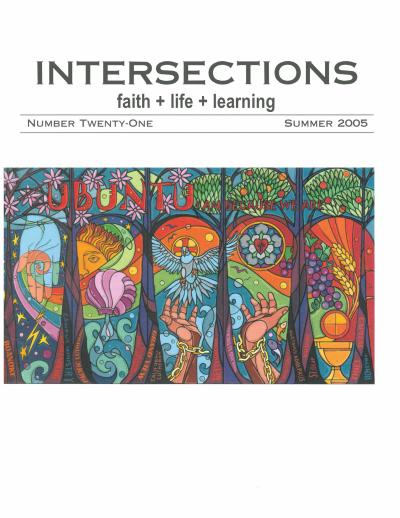
Christenson opens with an imaginative reconstruction of early Christian communities as radically egalitarian, pacifist, communitarian gatherings within the Roman Empire and argues that such communities are natural homes for the educational vocation. Naming two temptations for contemporary Christian higher education—the parochial Bible school and “Generic U”—he uses his friend Sig Rauspern’s tree metaphor to insist that a university is Christian in its trunk and roots rather than in grafted-on branches. Drawing on Wendell Berry, Jacob Bronowski, Walter Wink, Douglas John Hall, and his own Gift and Task of Lutheran Higher Education, he names faithful criticism, engaged suspiciousness, simul justus et peccator, and a fallible, love-related Lutheran epistemology as the particular gifts Lutherans bring to the Christian educational calling.
-
Editorial
From the Editor
Tom Christenson
No. 21 · Summer 2005
In his valedictory letter as outgoing editor, Christenson recounts the 1994 origins of Intersections, when he took the idea to Naomi Linnell and Jim Unglaube at DHES and persuaded the council of presidents to launch the journal on a shoestring with printing paid by DHES and everything else by Capital University. He summarizes the issue’s contents—papers from the 2004 Vocation of a Lutheran College Conference plus two commissioned pieces from former DHES directors Bob Sorensen and Leonard Schulze—and thanks the student copy editors and Capital’s presidents and provosts who sustained the publication.
-
 Book Review
Review of Educating for Shalom: Essays on Christian Higher Education
Tom Christenson
No. 20 · Fall 2004
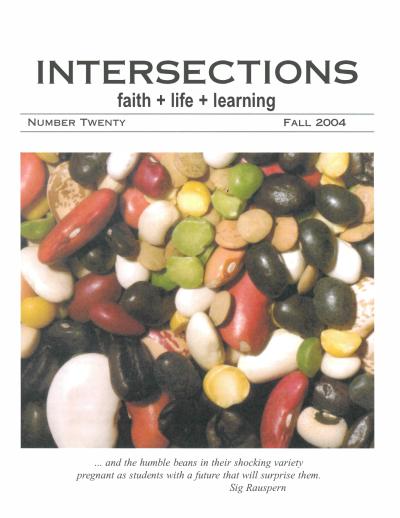
Christenson reviews Nicholas Wolterstorff’s Educating for Shalom: Essays on Christian Higher Education (Eerdmans, 2004), edited by C.W. Joldersma and G.G. Stronks. After recounting his own early prejudice against Wolterstorff’s Reason Within the Bounds of Religion and his subsequent conversion through Art in Action, he focuses on two threads: Wolterstorff’s expansive reading of shalom—not merely peace but justice, community, communal responsibility, and delight—as the overall goal of Christian collegiate education, and the influence of Abraham Kuyper’s claim of “privileged cognitive access” for Christian inquirers, which Wolterstorff demonstrates rather than declares.
-
Editorial
From the Editor
Tom Christenson
No. 20 · Fall 2004
Christenson introduces an issue featuring “young and old, angry and encouraging, prophetic and hopeful” voices unified by the assumption that Christians engaged in thinking and educating will ask hard questions: how to raise concerns about militarism and the new American “imperialism,” what a Lutheran law school will say about training a new generation of attorneys, and what Lutheran colleges communicate to undergrads about vocation. Such faithful criticism, he argues, is part of who Lutheran institutions are.
-
 Article
The Idea of a Christian University
Richard Hughes
No. 11 · Spring 2001
Hughes’s lecture at the inauguration of Andrew K. Benton as the seventh president of Pepperdine argues that a Pepperdine-wide “strategy of community-wide conversation,” carried by the new Pepperdine University Center for Faith and Learning, can sustain the school as a Christian university by leaning into the paradox of Christian particularity rather than around it. Drawing on the incarnation, the Matthew 5 and Luke 14 teachings of Jesus, the Quaker and Cane Ridge (Joseph Thomas) abolition traditions, Galatians 2 and Romans 8, and Luther’s simul Justus et peccator as the gospel that frees the scholar to be wrong, to doubt, and to confess “Lord I believe; help thou mine unbelief,” he mines the Churches of Christ heritage—Alexander Campbell, Barton W. Stone, and John Rogers of Carlisle, Kentucky—as a unity-and-freedom tradition that grounds both diversity and academic freedom.
-
 Article
Making Diversity Matter: Inclusion is the Key
Monica Smith
No. 50 · Fall 2019
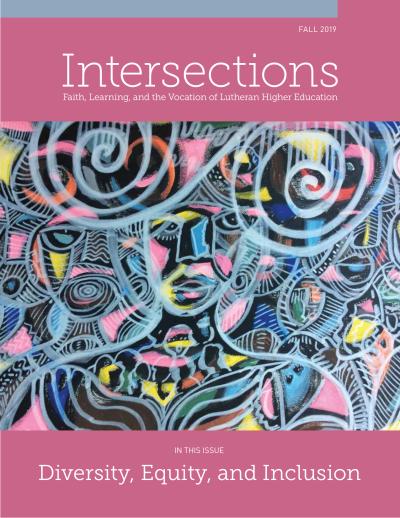
Smith, Augustana’s inaugural Vice President for Diversity, Equity and Inclusion, frames the work of a Chief Diversity Officer as that of a disrupter and argues that while diversity in higher education is already happening, inclusion is a choice — one requiring a fundamental institutional transformation that diversifies faculty and staff, infuses diversity into the curriculum, invests in professional development, and draws on senior leadership to dismantle barriers.
-
Article
Distinctive Lutheran Contributions to the Conversation about Vocation
Kathryn A. Kleinhans
No. 43 · Spring 2016
Kleinhans surveys the recent resurgence of vocation talk in American higher education — from Frederick Buechner’s widely quoted definition to Lilly Endowment’s PTEV grants and the CIC’s NetVUE Scholarly Resources Project — and uses her chapter in At This Time and In This Place: Vocation and Higher Education to highlight distinctively Lutheran emphases: vocation grounded in creation rather than redemption, the given-ness of multiple simultaneous callings, and a frank acknowledgment of the constraints and “dark side” of vocation.
-
 Article
Affirming, Entrusting, and Acting: A Baptismal Grounding of Affirmative Action in Lutheran Higher Education
Peter Carlson Schattauer
No. 60 · Fall 2024
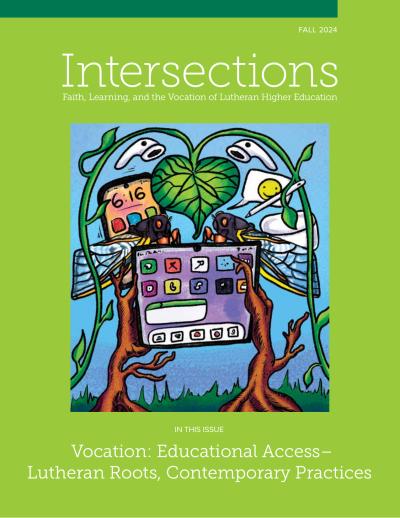
Schattauer draws on the Lutheran baptism liturgy — where the gathered assembly publicly affirms what it is for and is entrusted with responsibilities for justice and peace — to argue that NECU institutions create truly inclusive communities by affirming commitments, naming responsibilities, and acting in ways that embody both.
-
 Article
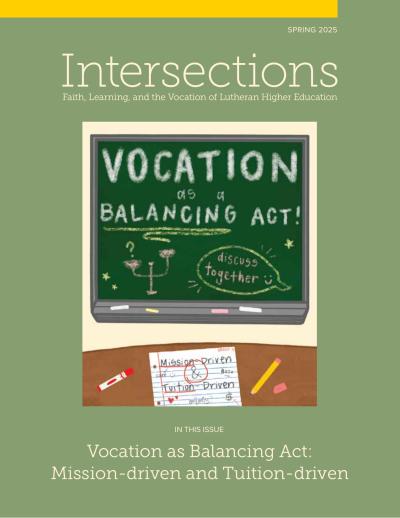
Vocation at Full Stretch: Reflections on Follow Your Bliss and Other Lies about Calling and its Use among College Students
Jason A. Mahn
No. 61 · Spring 2025
43 min audio
Mahn engages Bonnie Miller-McLemore’s Follow Your Bliss and Other Lies about Calling as required reading in a sophomore religion course, showing how her categories of missed, blocked, conflicted, fractured, unexpected, and relinquished callings empower young adults to perceive embodied, unplanned, and often painful dimensions of life as essential parts of vocation — and help close the gap between mission-driven and tuition-driven realities.
-
 Article
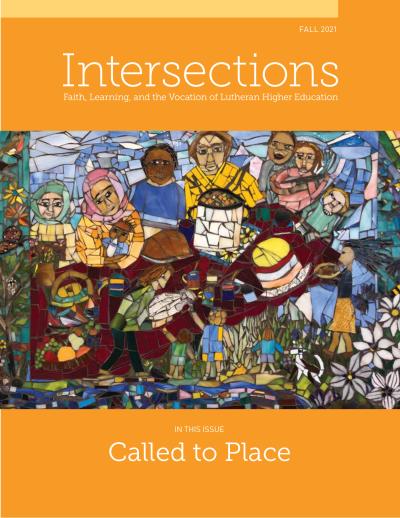
Just Communities: From Liberal Arts in Prison to Racial Healing over Zoom
Monica Smith
No. 54 · Fall 2021
Smith showcases how Augustana College’s commitment to social justice extends into the Quad Cities through two initiatives: the Augustana Prison Education Program at East Moline Correctional Center, and Racial Healing conversations developed through the Truth, Racial Healing and Transformation framework.