I. Posing the Question
“More than half the work is done when we have put the question right.”
—Sig Royspem
What is the Vocation of a Lutheran College/University? I want to both pose this question and at least begin to answer it. But before I do the latter I want to move us away from certain natural but unhelpful ways we might have of thinking about this. The question frequently gets formulated as “What is Lutheran about Lutheran higher education?” The phrasing of the question in this way frequently takes us off in some un-fruitful directions. I’d like to talk about those briefly at the outset.
What is Lutheran about Lutheran higher education?
1) It is not essentially an education program for Lutherans. It is fine and excellent if it serves Lutherans. It isn’t that we should chase Lutherans away. But we are not Lutheran institutions in proportion to the percentage of Lutherans we serve. When we do well what we can do best I believe we serve most, if not all, of our neighbors well, not just Lutherans.
2) It is not essentially an education program by Lutherans. It is fine and excellent that there are Lutheran faculty, administrators and secretaries and steam engineers working on our campuses, and our task may be made easier by their presence (or not), but we are not Lutheran institutions in proportion to the percentage of Lutherans we employ.
3) We are not Lutheran in proportion to the ways in which we are ethnically Lutheran. It is fine that we celebrate a variety of ethnicities on our campuses, whether that be German or Scandinavian or Finn or (perhaps in the future) Namibian or Korean or whatever. I think it would be good to maintain those identities even if the students and staff of those institutions no longer represent those ethnicities in large numbers. I think it’s great that students from Detroit who go to Suomi learn about sauna and sisu! I think it’s great that the large number of Asian students at Capital learn to eat brats and kraut and dance to a polka band. These things are great, but they are not what make us essentially Lutheran institutions.
4) We are not Lutheran primarily in the ways we are different from others. Our differences may be obvious in some cases and not in others. The problem here is not with being different, but with taking difference as the defining essence. That’s what frequently happens when marketing becomes management. If we begin with the question, “How will we be different?” we will end up in the wrong place just as much as if we begin with the question, “How can we be like everyone else?” As someone at one of these earlier conferences so beautifully put it, “We should be concerned to be essentially Lutheran, and not worry about being distinctively Lutheran.” I believe if the “essential” part is taken as primary, the “distinctiveness” part will more than look after itself. I once heard Willem de Kooning say to a bunch of aspiring painters, “Be true to your self, your subject and your paint — and eventually your style will emerge. The artist who sets out in search of a distinctive style always ends up being a phony.”
So, if those aren’t the best ways to pursue the question, what is a better place to start? Consider this: I’ll bet that if you think of the half-dozen or so faculty who most thoroughly embody and “carry” the Lutheran-ness at your institutions (the people who are caretakers of the tradition) you will find that some of them aren’t Lutheran. I know many of these faculty — the Calvinist who in his loyal criticism calls the institution to be as well founded in its tradition as his Calvinist alma mater is in its tradition — the Catholic professor who feels genuinely blessed to be teaching at a Lutheran institution and enthusiastically shares her excitement and understanding of the place with her students — the Evangelical and Baptist professors who continually challenge their students and colleagues to boldly state what they believe, who read Luther in order to engage the tradition in argument — the Jewish professor who confesses that his faith is taken more seriously at his Lutheran institution than he ever was at Brandeis or the state university where he previously taught — the Buddhist professor who admits a deepening of her appreciation of her own tradition through her dialogue with colleagues at a Lutheran college.
How is this possible? What is this odd thing, “Lutheran-ness,” that makes something like this possible? My conclusion is that it has to be something communicatable, something learnable, something that a sensitive, perceptive and concerned person can catch onto whether or not it is literally “their tradition.” What can this be?
II. Proposing an Answer
My answer is that what makes our institutions Lutheran is a vision of the educational task itself that is informed by a tradition of theological themes or principles as well as embodied in practice. Mistaken assumptions that we often make about the nature of “religious” education make us look for evidence of our Lutheran-ness in the frosting and the decorations. I believe that it’s in the cake itself. We are Lutheran by means of our educational vision, a theologically informed orientation that manifests itself in what we do as we learn and teach together and our understanding of why we do it.
I think this is what Joe Sittler intended when he said:
Any effort properly to specify the central and perduring task of the Church-related college must pierce through and below the statements of purpose that often characterize public pronouncements…. The Church is engaged in the task of education because it is dedicated to the truth…. If its proposals, memories, promises, proclamations, are not related to the truth, it should get out of the expensive business of education…. If [our] commitment to the faith is not one with [our] commitment to the truth, no multiplication of secondary consolations… will suffice to sustain that commitment for [our] own integrity.
In weaving, it’s usually what weavers call the woof or weft of the weaving that carries the color, the texture and the distinctive pattern of the weaving. That’s what makes any collection of institutions here as wonderfully different as they are. But it’s the warp that holds the whole thing together, that makes it a weaving at all. The “for whom”, the “by whom”, the “where”, and “the ethnic roots” of our institutions make them different weavings. We should celebrate those differences. But I think there’s a common warp to all of us. We were, after all, cut from the same loom. We should celebrate that commonality. I think that’s why we gather together in these conferences; to celebrate our differences and to recollect what we have in common.
Now this common theological orientation may not be so obvious to us, who are part of this tradition, as it to some of our friends and colleagues elsewhere in higher education. During this last year I have been invited to speak to conferences of Catholic educators, Baptist professors, and to a conference of presidents, provosts and deans of south-eastern Baptist institutions. Why would these people want to hear from a Lutheran educator, I asked myself. Well, my attendance at these gatherings has been a real education — for me.
Many, if not most, Catholic institutions were historically founded by communities of monks and nuns. The presence of these communities has traditionally solved the problem of “the Catholic identity” of these institutions. I once interviewed for a position at such an institution and I asked the faculty what it meant to them that they were part of a Catholic institution. Over and over again the lay faculty said to me, “We don’t have to worry about the religious character of the place, they [the brothers or sisters] take care of that.” Now, however, those religious orders are dying out. At many institutions the founding religious community is now a community of the aged and infirm. At many places there are two or three people left who are part of that supporting (and defining) community. They are concerned about this. So the question they have for us is, “How do we transfer the defining essence of our institution over to the lay faculty and administrators who really make the place go? How do you Lutherans do it? Will you show us how?”
The Baptists are going through a similar crisis. The Baptist identity of colleges and universities across the nation has traditionally been guaranteed de jure by their being owned by the Baptist conventions of their respective states. As these legal ownership ties are being severed these institutions are asking, “How can we still be a Baptist university if we are no longer owned by the convention? How do you Lutherans do it? Will you show us how?”
What I learned this year is how gifted, as Lutheran institutions, we are. Yet it’s a gift many of us have not noticed that we had. This is a gift most of have under-valued, and a gift many of us, perhaps, have not yet un-wrapped. Others have noticed our giftedness, and are asking us to share what we may not be aware we had. So, how do we do it? What is our vision? What is the warp that holds us all together? That’s the question I want to try to answer in what follows.
III. The Theological Tradition and Its Informing Vision
Previous speakers at these conferences have generated some lists of things that characterize the Lutheran tradition and its informing vision for higher learning and they have done that very well. So last winter when DeAne Lagerquist proposed that I keynote this session she said, “Don’t do what’s already been done. Don’t try to talk about everything, just talk about Christian freedom and its implications for our institutions.” That sounded like a good idea, but I have discovered that it’s a very difficult task. In order to talk about the idea I want to focus on, Christian freedom, one needs to see how this notion is situated among other concepts. But I am going to resist the temptation to do systematic theology here. I only want to “frame” the idea of Christian freedom by speaking briefly about two other crucial concepts: the idea of gift or giftedness, and the idea of vocation. It is freedom’s location between these two ideas that makes it a peculiarly Christian understanding of freedom in the Lutheran tradition.
A. Gift & Being Gifted
I teach gifted students and I teach with gifted colleagues in a context of many gifts. Now I know what we usually mean when we talk about being gifted. There are special gifts: some have the gift for music, some the gift for mathematics, some the gift for repairing things, some the gift of imagination, etc. But there are also gifts that we all share, gifts we could realize if only we’d unwrap them, value them, develop them, and celebrate them. For such gifts I like to use the Shaker phrase, “Simple Gifts.” What do you suppose would happen if we erected a large sign on our campuses that said, for example, “Wittenberg University, School for the Simply Gifted”?
A Christian encounters all of life and all of creation as a gift. This can make a great deal of difference. We’ve probably all been at the birthday parties of the two children I am going to describe: The first greedily opens present after present, paying no attention and giving no care to those already opened, finds no joy in them, never says thanks nor pays attention to what came from whom, always expecting that the next acquisition will be the one that fulfills, bursts into tantrum and tears when the last one is opened. The second child thoroughly enjoys, carefully uses, perhaps even savors, what is received, is genuinely thankful to the giver and though excited by the wonder of a new gift celebrates each to the delight of all those present. Which child would you rather give a gift to? Which child are we in the receiving of our gifts?
How does one teach science if one sees the cosmos and our own powers of intelligence as a gift? How excited can one get looking through a microscope or telescope? How does someone informed by the idea of gift teach a Bach chorale, or a favorite author? There were teachers I had in college who opened the same gifts in the presence of students semester after semester, in some cases the gift was swamp ecology, in other cases the dialogues of Plato, the pre-Columbian history of the Americas, or the poetry of Rilke. In each case these teachers were as excited as kids, not at finding what was in there (they had a pretty good idea about that already) but they were excited at our coming to discover what was in there. The classroom was a potlatch, a celebration of gifts, giving, opening and receiving. A celebration of gifts and giftedness!
How do we approach and encounter a world given as gift? 1) With wonder and delight, i.e. as a world with depth, not as a world reduced to the dimensions of human manipulation. 2) With thanksgiving. 3) As caretaker and steward. 4) With an attitude of sharing, as part of what may be appropriately called a gift economy. 5) With celebration. What we’ve just described here has another name, “sacrament,” which we could do worse than to understand as giftedness realized, shared and celebrated. In such a way education can become, as Nicholas Wolterstorff has said, “a eucharistic act.”
For Christians, of course, Christ is the paradigm of gift and giver, gift realized as God with us in person, the reign of God among us. What’s it like to realize this gift? St. Paul calls it redemption, but he also calls it freedom, “For freedom Christ has set us free,” he writes in Galatians. Freedom, for a Christian, is not our natural condition, nor is it an earned achievement. It requires a death, even a crucifixion, and a resurrection to occur. Christian freedom, being a gift, needs a response (and consequently a response-ability). That is to say our freedom, being a gift, makes a call to us to which our lives are the response. There, the connection has been made explicit; gift — freedom — vocation.
B. Freedom
There are many mistakes the modern world has made (and continues to make) but one of the most serious and far reaching, I believe, is a misunderstanding of freedom. Just consider these two contrasting ideas of freedom: a) Being bound by nothing, connected to nothing, I make myself who I want to be, from nothing. Since I have no one to please but myself, my whole life is devoted to the fulfilling of my “preferences.” Like a store manikin my identity and value is determined by what I have. I shop therefore I am. Since there are always new things to buy the possibilities for recreating myself are endless. Since there is nothing (besides myself) to give the world (or myself) value, the world frequently becomes boring, irrelevant, and I go from one extreme thrill to another — seeking to jolt myself into existence. The most common reason given by teens for violence: “It was something to do!” The most common response from their parents: “But we get over eighty channels on cable?”
But consider an alternative view of freedom: b) Being called by those to whom I am connected, I discover myself as I discover what I love, care about, care for, am connected to. Hearing the call of others’ needs and the call of truth, justice, love, beauty, I am en-couraged and en-livened. I become who I am in the context of the call I have received. In place of a freedom that says: “What shall I buy today?” we have a freedom that can say, “Here I stand, I can do no other.” Such freedom depends on vocation. As Luther put it, “We exist by being called by God. And we exist only so long as God continues to address us.”
Martin Luther interpreted freedom in his famous treatise, On the Freedom of the Christian:
A Christian is a perfectly free lord of all, subject to none. A Christian is a perfectly dutiful servant of all, subject to all. —— Freed from the vain attempt to justify him [her] self… [the Christian] should be guided in all his [her] works by this thought alone… considering nothing but the need and advantage of his [her] neighbor. —— This is a truly Christian life. Here faith is truly active through love, that is it finds expression in the works of the freest service, cheerfully and lovingly done….
What would a college or university informed by such an understanding of freedom look like? What does this freedom mean? What are we thus freed from? What are we thus freed to?
1. Luther understood freedom as the consequence of grace, i.e of God’s gift. Thus we are freed from the necessity to work our own salvation. We are freed from trying to climb the staircase to God’s love. God came all the way down. This also means that we are freed from the captivity of the hierarchical dualisms one usually finds in religions and it means we are freed to be fully human. We have no need to transcend the bodily in service of some “higher” spiritual realm, we have no need to deny the secular to serve the sacred, we have no need to depart the natural to serve the super-natural. Luther was adamant that we are called to serve where we are, in the stations in which we find ourselves, thoroughly embodied, concrete, earthen and particular. This freedom to be fully human also implies that we are freed to be eating, drinking, excreting, sexual, working, sweating, hoping, fearing, crying, nurturing, and thinking beings. Piety, by this view, is not a denial of part of our own reality so much as an embracing of all of it. We come before God not pure and unspotted but in our honest wholeness. Rabbi Harold Kushner in his book, How Good Do We Have To Be? offers the following commentary:
My candidate for the most important word in the Bible occurs in Genesis 17:1, when God says to Abraham, “Walk before me and be tamim.” The King James Bible translates it as “perfect”; the RSV takes it to mean “blameless,”…. Contemporary scholars take the word to mean something like “whole hearted.” My own study of the verse leads me to conclude that what God wants from Abraham, and by implication from us, is not perfection but integrity…. That, I believe, is what God asks of Abraham. Not “Be perfect,” not “Don’t ever make a mistake,” but “Be whole.” [169-170, 180]
As a consequence of this freedom there is no part of ourselves that we may not embrace because it is “lower” or “unclean” in some phony pious sense. So when we do our work we may work thoroughly engaged, alienated neither by the dirtiness of hauling garbage, the chaos of teaching fifth grade, the smell of a nursing home, nor the mess of politics. This also implies that we are freed from the power of our self constructed and self-maintained hierarchies. So we may be called to be women, not “not quite men,” to be children, not “not quite adults,” to be students, not “not quite careered,” to be secretaries, not “not quite CEO’s,” to be custodians, not “not quite clergy,” to be even (pace Luther) philosophers, not “not quite theologians.”
Most important perhaps, for the life of our colleges and universities, we are freed to engage the problems of the world by the use of the very fallible but still useful tools to be found in our academic disciplines. We have no need to become a one dimensional “bible college” because we are free to become engaged inquirers and learners in biology, psychology, economics, history, nursing, etc. There are no writers whose thoughts we must avoid thinking about, no books we need to consider banning, no theories we must dismiss without thorough examination. We can learn from Marx about new dimensions of human slavery and liberation, we can learn from Nietzsche a suspicion of religious and moral motivation, just as Jesus’ hearers learned the meaning of neighbor from the example of the otherwise despised Samaritan. There is also no authority we may not question, no ignorance we may not admit, and no doubt that we need to silence. Why? Because our salvation is not worked by such efforts since it is not worked by us at all.
This freedom is what distinguishes education in the Lutheran sense from “religious education” that we commonly find in some other contexts. Where people see education as a means or evidence of salvation or sanctification it frequently ends up being an indoctrination that is frightened, closed, authoritarian, and defensive. Education informed by the freedom of the Christian can be, by contrast, bold, open, multi-dimensional, dialogical and engaging. Education, informed by freedom, is not afraid of the largeness, the darkness, the inexplicable mystery of the world. A religious view without freedom tends to reduce the world, to shrink it to one that confirms the opinion of the believer and does not open one to challenge.
In last December’s issue of The Christian Century, James Schaap wrote a provocative article about the difficulty of being an avowedly Christian writer. A reviewer of one of his novels told him she had liked his novel a good deal even though she’d thought she wouldn’t when the review was assigned to her. “Why does your novel say the word ‘Christian’ on the back cover?” she asked him. “Now nobody is going to read it.” The same novel was reviewed in the newsletter of the Christian Booksellers Association. That reviewer did not recommend it since it included references to characters who were homosexual, adulterous and drug users. No bookstore that was a member of the CBA carried the book because it did not pass their standards for sanitized subject matter and inoffensive language. Among other writers the CBA will not carry are Flannery O’Connor (offensive language and despicable characters, too much violence) John Updike, Wendell Berry, Doris Betts, Madeleine L’Engle, and Larry Woiwode. Schaap comments that the only “offensive” book the CBA carries is the Bible.
God help us when the word “Christian” has come to mean “inoffensive,” “sanitized,” “asexual,” or when Christian writers can only write about nice folks, in nice towns, doing nice things for nice reasons, in nice language. The freedom of the Christian is, among other things, a freedom from the suffocating and nauseating law of niceness. It is a freedom to see the truth and tell it. John Updike has written:
God is the God of the living, though many of his priests and executors, to keep order and force the world into a convenient mold, will always want to make him the God of the dead, the God who chastises life and forbids and says No…. [As a Christian writer] I have felt free to describe life as accurately as I could, with especial attention to human erosions and betrayals. What small faith I have has given me what artistic courage I have. My theory was that God already knows everything and cannot be shocked. And only truth is useful. Only truth can be built upon.
2. We are freed to serve the world by being skeptical of and challenging all worldly claims to ultimacy. We are called, in other words, to recognize idols when we see them. We can recognize them, in part because we know as well as anyone what it is to be tempted by them and by the power they can have over us. We call attention to them not as problems that “they” have that “we” are now going to condemn and correct, but as things we are all tempted by and whose influence we have fallen under. But the freeing power of the gospel should also have shown us that they are false ultimacies, i.e that they truly are idols.
Certainly materialism in all its modes is one such idol in our society. How many of us have felt the temptation of believing that we are valuable for what we have, for what possessions are ours? How frequently do all other concerns take a back seat to economic progress? How tempting is the idea that having more will bring us happiness and fulfillment? For how many is success defined by income and consumption? David Orr states the issue very boldly in his book, Earth in Mind:
The plain fact is that the planet does not need more successful people. But it does desperately need more peacemakers, healers, restorers, storytellers, and lovers of every kind. It needs people who live well in their places. It needs people of moral courage… And these qualities have little to do with success as our culture defines it.
So many students are convinced that education serves only to get a job, and that a job serves only to earn money, and that earning money serves only the end of copious and conspicuous consumption. Why is this so widely believed? For many it’s believed because it is a story convincingly told daily in all the media. We are informed about what human excellence is mainly by people who are trying to sell us something. For many students it is their story because they have never heard any other story or because they have never heard anyone challenge it. May our students encounter voices like Wendell Berry:
So I have met the economy in the road, and I am expected to yield it right of way. But I will not get over…. I see it teaching my students to give themselves a price before they can realize in themselves a value. Its principle is to waste and destroy the living substance of the world and the birthright of posterity for monetary profit that is the most flimsy and useless of human artifacts.
A Christian college/university informed by Luther’s interpretation is free to challenge this and other pervasive “ultimacies.” We are also called in this freedom to embody some viable alternatives, for we educate much more persuasively by what we do in our institutions than only by what we say in them. We are called to explore what Christian freedom implies for a community of inquirers, not only in regard to curriculum and campus policies but also in regard to the economic, social and political life of our institutions. Realizing the liberation of the gospel we become aware of the bondage we work on each other. Having been rescued from alienation we are aware of the fault lines of alienation in our own midst. We are thus called not only to be honest critics but also to become communicators, peace makers, healers, enablers of community and bearers of hope.
Just as the freedom of the Christian articulated above, frees us to something beyond “religious education,” in the restricted sense, so the freedom articulated here frees us to do something that secular institutions have a hard time doing, i.e. being skeptical of the ultimacies ruling in the culture and embodying genuine alternatives to them. We serve the real need of the neighbor, in this case the wider culture, not by following the dominant voices in it nor by worshiping at all of its altars. Our colleges and universities are not excellent stewards of their gifts insofar as they succeed in being like all other institutions in the culture, nor insofar as they teach, research or publish more brilliantly, nor even for being more caring and friendly, but insofar as they create a space within which the liberating truth can be heard in freedom.
We, as academics, may feel ourselves to have been freed from some of the culture’s ultimacies only to have become worshipers at the shrine of other, more specifically academic ultimacies. I know many academics who are willing to think critically about anything except the assumptions and methodologies of their own disciplines or sub-disciplines. But the freedom of the Christian realized in our thinking ought to make such idolatry obvious to us as well. Our scientists ought to be free enough to recognize and critique the ends that “value free science” serves. Our artists ought to be free enough to recognize and critique the agendas of institutions that rank the arts and artists. Whom does the idea of “the high arts” or “the fine arts” serve? Whose work is demeaned by it? Our law professors ought to be free enough to recognize and critique the way in which their profession serves itself more frequently than it serves the ends of justice. Our economists ought to be free enough to recognize and critique what the international market economy has done to many working families. And so also for the rest of us, no matter what our disciplinary allegiance is.
If you need a good example of the way our disciplines both facilitate and limit inquiry read Robert Coles’ account of his psychiatric internship and the difficulty he had learning to see his patients without the diagnostic categories his teachers had taught him so well. I can’t think of a better narrative about the way a discipline can trap and limit a mind and the way a good teacher can liberate one from it than the first chapters of Coles’ book, The Call of Stories: Teaching and the Moral Imagination.
3. It is my belief that Christian freedom also implies something specific for the priorities of our learning and teaching. Many Christian colleges emphasize the liberal arts. I wish to make an argument here for a slightly different way of looking at things. As you will see it is not so much a new set of things we ought to teach as it is a new agenda for the way we teach what we do. I refer to this agenda as the liberating arts, i.e. the arts of embodied freedom. I wish to identify four sub-groups within this general category. I will explain and illustrate each briefly.
The Critical/Deconstructive Arts. These are the studies by which we learn critical thinking, come to recognize our own and others’ presuppositions, learn to articulate our assumptions as well as work out the implications of our thinking. Until one realizes the assumptions one operates with, and recognizes alternatives, one cannot really be said to be choosing or acting freely. A student responded to an essay in one of my classes by saying: “I really hate it when people push their ideas on me.” I responded, “Then you must get very upset watching advertising on TV.” Her response was, “Oh no! They don’t push that on me. Those are things I think already.”
Examples: Sister Alice Lubin’s course at St. Elizabeth’s College on The Victorian Novel. In the process of this class the students not only come to identify the roles and rules that apply to women (and men) in the world of the Victorian novel, but come to identify by contrast the roles and rules that apply to gendered life in our own society as well. The outcome is definitely a liberation, for the forces that daily pressure young women and men to specific roles and behavior can surface, can be articulated, can be seen in the light of day, and be considered with a new degree of freedom. A second example is a course my oldest son took at St. Olaf College (sorry, I do not know the instructor). In this course students did an analysis of local and national news broadcasts, posing questions about the different ways stories were told, what kinds of things got priority, and how all of this was related to the sales of ad time for such programs. The students got to interview producers, some national news anchors by conference phone, and media critics and representatives from alternative media in this process. They all came away realizing that the news is not just a ‘given’ but that it is very intentionally scripted and prioritized to convey particular kinds of messages and to avoid others. The passion with which my son communicated his response to this course was evidence of the level of critical thinking that had been enabled there.
The Embodying/Connecting Arts: So much of the learning we subject students to in the university is completely disconnected from meaningful action. Yet many times we have heard students say after returning from an internship or work experience, “I learned more in those weeks than I learned in the three preceding semesters.” The embodying arts connect learning to doing, deciding, and to the becoming of the student.
Examples: The service learning semester at Goshen college, or the field focused learning experiences of nursing students at my own university. Students not only learn their own disciplines with a sense of urgency in such situations, they come to know themselves as well. They uncover fears, prejudices, things in their preparation that need more work, and new potentialities in themselves. They learn that knowing something one can actually do is more freeing than merely knowing about a whole host of things. The musician who can play one instrument has more freedom than the dilettante who has heard them all but can play none.
The Melioristic/Creative Arts: There is more than one model of creativity. Let me illustrate with the example of my mother who was, I believe, a creative cook. But she wasn’t creative in the way some cooks are: seeing a recipe in Gourmet, going to the market to buy all the ingredients, following the recipe to gustatorial paradise. She was creative in a different way. I remember her often, particularly as we got on toward the end of the month, making what we called, “end of the month soup.” She would go to the refrigerator, ponder what she saw and say, “Now, what can we make out of this.” By the way, this image is so firm in my mind that when I hear about God creating the universe I think of my mother looking out on what is “without form and void” saying, “Now, what can we make out of this.” This image not only informs my idea of creation but shapes my understanding of redemption as well. God looks into the end of the month refrigerator that is my life and says, “What can we make out of this mess?”
Arts are melioristic that avoid the optimism/pessimism binges we are all so good at, asking not, “How would I like the world ideally to be?” but asking instead, “Can we make something good out of what we are given?” Such arts need to be practiced in the classroom by middle school teachers, at home by husbands, wives, parents and children, at work by managers and employees, in public by citizens and politicians. We learn such arts in concrete problem-solving situations, where wishing for some far off ideal or wishing we could start over are not open options. It is the art of making the best of what’s left of the present semester rather than planning for the naively hopeful next one, a fantasy both students and faculty are expert at.
Examples: What can be learned from a year’s commitment in a communal living arrangement? From raising and caring for a pet through its whole life? From conversations with spouses, parents, teachers, politicians? We can learn about the compromises they have had to make in order to make things work. As teachers we can design problem-solving modules where the problem must be solved with the materials at hand. Meliorism can be learned from a few lessons in cooking or mending or auto repair from a frugal parent.
The Arts of Enablement and Change: One of the courses I teach enrolls almost exclusively seniors. Many times I have read in their journals comments like these: “I think I’ve gotten a good education, but in some ways I feel disabled by it.” “I’ve learned a lot of great ideas but they’re pretty impractical. I’ve learned how to think critically. I know a lot of things that are wrong. But after all, you can’t change the world.” One student wrote: “People of my generation are like a bunch of intelligent robots. We understand the world, we understand what’s wrong with it, yet we feel like we can’t help but continue to contribute to what’s wrong with it. It’s like we are programmed to be tragic figures or addicts, seeing the problem but not being able to act on what we know.”
This may strike some of us older folks as peculiar, for we know that there have been incredible changes in this century, in the last thirty years, even in the last decade. Yet we can understand the problems these students cite because we too know it is much easier to complain about how awful things are than to make a continuing effort toward making things better. We all know the passive helplessness behind the words, “Why don’t they do something about it?” Crime, a culture of violence, environmental problems, lowering expectations and performances in schools, these are all problems we know in a first hand way, yet we suppose that these are problems to be solved only by persons on the far side of the TV screen, the people who make the news, not by folks like us who merely watch it. Yet only a little reflection reveals to us that this too is a learned response. How can we unlearn it?
Examples: By making our own educational institutions, at least, an arena where learners can practice the arts of change. By making sure students meet community persons who are involved in change at all levels, including law-makers, inventors, members of twelve-step programs, protestors, intervenors and effective teachers. If change is not possible education is the most tragic of all human enterprises. We should make sure that our institutions honor at least one significant change agent every year.
These “liberating arts” can, and in fact should, be taught in all disciplines. They would make a fine core to a goal-focussed general studies requirement. They might spur a lot of creative thinking on the part of faculty and certainly would provoke a lot of argument. Luther would approve of both. I think that a place that took such an education in freedom seriously would be a fun and invigorating place to learn and to teach.
C. Vocation
Here are three images, metaphors to regard playfully:
* There is no recipe for communion bread or communion wine. So we may, on biting in, discover whole wheat, egg hallah, French baguette, or Finnish limpa, or on drinking the cup discover a Beaujolais nouveau or this week’s Thunderbird special. Sacrament is always the sacred embodied in the particular, and, I believe, the more particular the better. Grandma’s sugar buns and grandpa’s rutabaga wine will do just fine.
* Martin Buber relates the story of a man, let’s call him Scholem Gerschwitz, being taught by his rabbi: The rabbi says, “When you come into the presence of the creator of the universe he will not ask you, ‘Why weren’t you another Moses?’ But he will ask you, why weren’t you Scholem Gerschwitz?”
* Remember again my mother and her question as she looked into the refrigerator, “Now, what can we make out of this?”
What can we learn from these images about the Vocation of a Lutheran College/University? I think we can learn at least three things, maybe more.
1) There is no generic recipe for such an institution. We should not strive to be generically Lutheran, nor do we serve well by striving to be “all things to all people.”
2) Though we have much to learn from each other, we should not ask, “Why isn’t Wittenburg more like Wartburg? Why isn’t Capital more like Concordia?” I once knew a philosophy professor who couldn’t quite get over the fact that he was teaching at North Dakota State rather than at Harvard. So acting out a form of academic denial he prepared his lectures and chose the texts he would have if he had been at Harvard. He did not understand his students, and needless to say, they did not understand him. He could not figure out why he was not promoted. “After all,” he said, “I was working up to a very high standard of excellence.” I know the temptations of wishing we were more like some other institutions: when I taught in Minnesota the temptation was to be another Carleton or Macalister. In Ohio, we yearn to be another Kenyon or Oberlin. I have done this as well as you. But let me tell you, this is not the direction we should go.
3) We should not ask, “What kind of college or university would you create if you could go to the store and buy all the right ingredients?” We should not ask, “What kind of institution would you create if you could create one ex nihilo?” This is a Dean’s dream, I know. Instead we should open the door of our own refrigerators and ask, “Now what kind of university can we make out of this?” Our refrigerators contain our particular students, our particular faculty, our particular administrators, our physical plant, our location, and the challenges and opportunities that each of these bring. We must know ourselves, know our limits and our potentialities, know our histories and the visions for our futures. The colleges and universities I admire the most are not the most prestigious, but the ones that have found a way to serve their particular students, with their particular needs, in their particular place, and do it well.
III. Bringing It All Together
Frederick Buechner defines vocation like this: “The kind of work God calls you to is the kind of work a) that you need most to do and b) that the world most needs to have done…. The place God calls you to is the place where your own deep gladness and the world’s deep hunger meet.”
Here is some good news: we are freed to know and to serve both of these needs. Freed to be “a perfectly free lord of all, subject to none” we are therefore freed to be “a perfectly dutiful servant” seeing the deep needs of the world and working in service of our actual neighbor and actual neighborhood.
So, now we are in a position to re-address the question with which we began: “What is the vocation of a Lutheran college or university?” Realizing God’s gifts and ourselves as gifted, we are freed to boldly engage (in our fallible way) and to tell the whole truth. We are freed to make end-of-the-month soup with the stuff in our own refrigerators, in service of the deep needs of the world and to the greater glory of God.
Works Cited
Berry, Wendell. “Discovery and Hope,” in A Continuous Harmony [Harcourt Brace Jovanovich, New York, 1972] p. 180.
Buechner, Frederick. Wishful Thinking: A Theological ABC. [Harper & Row, New York, 1973] p. 95.
Coles, Robert. The Call of Stories: Teaching and the Moral Imagination [Houghton Mifflin, New York, 1989].
Kushner, Harold. How Good Do We Have To Be? A New Understanding of Guilt and Forgiveness [Little, Brown & Co. 1996] pp. 169-170, 180.
Luther, Martin. Three Treatises [Fortress Press, Philadelphia, 1970] pp. 277, 301-302.
Orr, David. Earth in Mind [Island Press, Washington, DC, 1994] p. 12.
Schaap, James Calvin. “On truth, fiction and being a Christian writer,” Christian Century, [December 17, 1997] pp. 1188 ff.
Sittler, Joseph. “Church Colleges and the Truth,” Faith, Learning and the Church College: Addresses by Joe Sittler [Northfield, St. Olaf College, 1989] p. 27.
Updike, John. Self Consciousness: Memoirs [Fawcett Crest, New York, 1989] p. 243.
Wolterstorff, Nicholas. “Should the Work of Our Hands Have Standing in the Christian College?” Keeping Faith: Embracing the Tensions in Christian Higher Education, Eerdmans, Grand Rapids, MI, 1997] pp. 140 ff.
-
 Editorial
From the Publisher
Arne Selbyg
Selbyg reports on the work of the Division of Higher Education and Schools to focus what makes Lutheran colleges and universities distinctive, recaps the 1998 Vocation of a Lutheran College conference at Wittenberg, previews the 1999 Susquehanna conference on “Identity and Fragmentation: Can the Lutheran Center hold?” (inspired by Yeats’s vision of the Second Coming), commends Ernest Simmons’s Lutheran Higher Education: An Introduction for Faculty (Augsburg Fortress, 1998), and announces a new NEH/NSF-style initiative called “The Lutheran Academy of Scholars in Higher Education.”
-
Editorial
From the Editor
Tom Christenson
Christenson explains that three of the five papers from the 1998 Wittenberg Vocation of a Lutheran College conference appear here (with Robert Scholz and Cheryl Ney to follow in the next issue), passes on Andy Sheppard’s “Books for Belarus” appeal from Southwestern College, and reflects on Douglas John Hall’s The End of Christendom and the Future of Christianity—its claim that disengagement from cultural dominance is the prerequisite for faithful re-engagement, and its retrieval of Christ’s metaphors of “a little salt, a little yeast, a little light” as a possible session topic for a future VLC Conference.
-
Response
Of Imaginary Cows and a White Toy Sheep: The Freedom of a Christian College
Ryan La Hurd
La Hurd, president of Lenoir-Rhyne and a former Thiel English professor and Augsburg academic dean, responds to Christenson by insisting (with Robert Kegan’s story of Tommy’s imaginary cattle farm) that a college is composed of people but is not itself a person, and so cannot share in Luther’s freedom of the Christian. Drawing on Benedict Anderson’s Imagined Communities, Lewis Hyde’s The Gift, George Marsden, Mark Schwehn, Jacques Barzun, and the Pew Higher Education Roundtable, he distinguishes the “imagined college” (the gift-economy realm of teaching and the alma mater) from the “real college” (the commodity-economy realm of fund-raising, deferred maintenance, and federal aid reconciliation that does not have such freedom)—and ends with Pablo Neruda’s “Childhood and Poetry” and the marvelous white toy sheep offered through a hole in a fence.
-
Response
Finding the Words: The Trouble of Being California Lutheran University
Pamela M. Jolicouer
Jolicoeur, provost and vice president for academic affairs at California Lutheran, recounts the marketing problem of a university whose middle name is Lutheran in a Southern California religious landscape where the operative modifier is “Christian” (Pepperdine, Azusa Pacific) and tests Christenson’s three themes against her own “alumni magazine test”—the Jesuit standard set by Santa Clara. She concludes that freedom, gift, and vocation, though not uniquely Lutheran, are the words she can actually use: with prospective faculty, with the constituent church bodies who pressed for “Christian” in the new CLU mission statement (compromise: “rooted in the Lutheran tradition of Christian faith…”), and with the “C student” alumna headed for a Ph.D. in psychology whose consciousness of her own gifts had evaporated.
-
Reflection
Otherwise
David Wee
Wee’s September 3, 1997 St. Olaf Opening Convocation address takes its title from Jane Kenyon’s “Otherwise” and asks why we gather: to celebrate the gifts of life, place, companionship, and the work we love, and to become “otherwise”—wise about the others in our midst. He honors his own St. Olaf teachers (Ditmanson, Shaw, Stiehlow, Jordahl, Paulson, Meyer, Hove, Clausen, Larson, Jorstad) and the gruff Latvian stamp scholar Gus Eglas and Sherlock Holmes expert Randy Cox, draws Huck Finn’s “All right, then, I’ll go to hell” and Flannery O’Connor’s grandmother into a single argument, and closes on Tim Lull’s expectation that a Lutheran college campus should display contentment, courage, and cheerfulness as a family member faces day-six post-bone-marrow-transplant—“the first day of the rest of your life.”
-
Poem
Poetry: Rituals for an Uninvented Religion / On the Recently Discovered Mass Grave of Mice
Kevin Griffith
Two poems by Kevin Griffith of Capital University: “Rituals for an Uninvented Religion,” a seven-part liturgical bestiary of made-up customs (lead-filling cups in June, masks for the dying, two bottom-feeding August fish, wax grave markers with wicks, the leap-day child, and the carnival-free day of judgment), and “On the Recently Discovered Mass Grave of Mice,” prompted by New Zealand shepherds’ uncovering of 300,000 mouse skeletons, on the bones “each light as a child’s first question” and the “graveyard rush” we share with the good flock.
-
 Article
The Vocation of Intersections on its Twentieth Birthday
Jason A. Mahn, Robert D. Haak, Tom Christenson
No. 43 · Spring 2016
The three editors of Intersections — Bob Haak, Jason Mahn, and Tom Christenson (in spirit, following his death in 2013) — trace the twenty-year vocation of the journal itself: its 1996 birth at Capital University; its coming-of-age years of debate over institutional markers, two-kingdoms theology, and Lutheran identity; the ascendancy of “education for vocation” as the central marker of Lutheran higher education; and its ongoing identity in relation to a changing ELCA and to the broader cultural conversation about purpose, wholeness, and the vocation of higher education.
-
 Article
Point / Counterpoint: What It Means to be a "College of the Church"
Robert Benne, Tom Christenson
No. 28 · Fall 2008
Moderated by Wartburg College pastor Larry Trachte and introduced by Kathryn Kleinhans, this Wartburg campus conversation between Robert Benne (Roanoke College) and Thomas Christenson (Capital University) probes what it means to be a college of the church—Benne emphasizing ethos, vocation, and the Christian intellectual tradition over against secularization and generic education, and Christenson lifting up persistent vocational questions, the gift of difference, and induction into a community of discourse—and finds large common ground around hiring for mission, pedagogy that asks deep questions, and the courage to claim a living religious tradition while inviting everyone to the banquet.
-
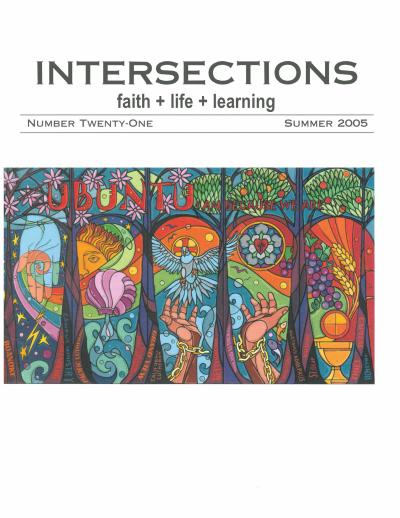 Article
Education as a Christian (Lutheran) Calling
Tom Christenson
No. 21 · Summer 2005
Christenson opens with an imaginative reconstruction of early Christian communities as radically egalitarian, pacifist, communitarian gatherings within the Roman Empire and argues that such communities are natural homes for the educational vocation. Naming two temptations for contemporary Christian higher education—the parochial Bible school and “Generic U”—he uses his friend Sig Rauspern’s tree metaphor to insist that a university is Christian in its trunk and roots rather than in grafted-on branches. Drawing on Wendell Berry, Jacob Bronowski, Walter Wink, Douglas John Hall, and his own Gift and Task of Lutheran Higher Education, he names faithful criticism, engaged suspiciousness, simul justus et peccator, and a fallible, love-related Lutheran epistemology as the particular gifts Lutherans bring to the Christian educational calling.
-
Editorial
From the Editor
Tom Christenson
No. 21 · Summer 2005
In his valedictory letter as outgoing editor, Christenson recounts the 1994 origins of Intersections, when he took the idea to Naomi Linnell and Jim Unglaube at DHES and persuaded the council of presidents to launch the journal on a shoestring with printing paid by DHES and everything else by Capital University. He summarizes the issue’s contents—papers from the 2004 Vocation of a Lutheran College Conference plus two commissioned pieces from former DHES directors Bob Sorensen and Leonard Schulze—and thanks the student copy editors and Capital’s presidents and provosts who sustained the publication.
-
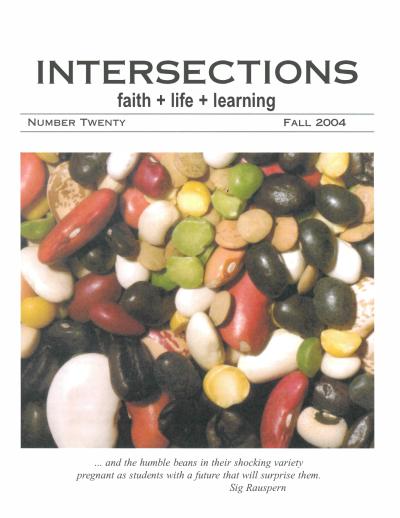 Editorial
From the Editor
Tom Christenson
No. 20 · Fall 2004
Christenson introduces an issue featuring “young and old, angry and encouraging, prophetic and hopeful” voices unified by the assumption that Christians engaged in thinking and educating will ask hard questions: how to raise concerns about militarism and the new American “imperialism,” what a Lutheran law school will say about training a new generation of attorneys, and what Lutheran colleges communicate to undergrads about vocation. Such faithful criticism, he argues, is part of who Lutheran institutions are.
-
Book Review
Review of Educating for Shalom: Essays on Christian Higher Education
Tom Christenson
No. 20 · Fall 2004
Christenson reviews Nicholas Wolterstorff’s Educating for Shalom: Essays on Christian Higher Education (Eerdmans, 2004), edited by C.W. Joldersma and G.G. Stronks. After recounting his own early prejudice against Wolterstorff’s Reason Within the Bounds of Religion and his subsequent conversion through Art in Action, he focuses on two threads: Wolterstorff’s expansive reading of shalom—not merely peace but justice, community, communal responsibility, and delight—as the overall goal of Christian collegiate education, and the influence of Abraham Kuyper’s claim of “privileged cognitive access” for Christian inquirers, which Wolterstorff demonstrates rather than declares.
-
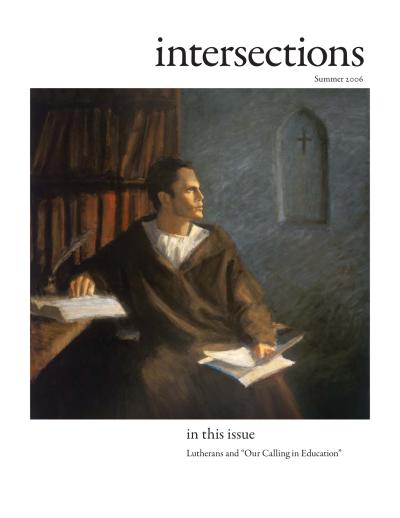 Editorial
From the Editor
Robert D. Haak
No. 23 · Summer 2006
Haak previews the issue’s four essays by Marcia Bunge, Paul Dovre, Samuel Torvend, and Cheryl Budlong — each engaging the ELCA Task Force on Education’s study document and first draft of the social statement on Lutheran education — and invites readers to bring their distinctive voices as professional educators at Lutheran institutions into the conversation before the October 15 deadline. He also invites submissions to Intersections and directs readers to LauraOMelia@augustana.edu to be added to the direct mailing list.
-
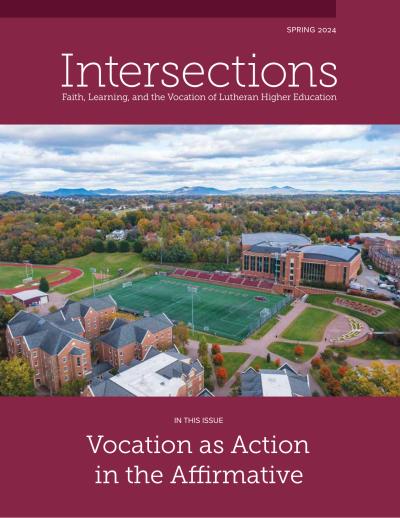 Article
Low-Hanging Fruit, Moonshots, and Coffee: Dreaming Big Within and Beyond Our Limitations
Jeremy Myers
No. 59 · Spring 2024
Myers shares the process used by Augsburg’s Christensen Center for Vocation to help teams move from a shared experience to next steps — an Ignatian-rooted Awareness Examen followed by naming low-hanging fruit, moonshots, and the coffee conversations that build the coalition to make it all happen.
-
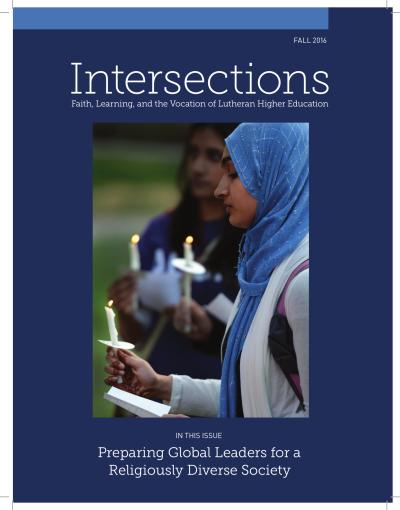 Article
Laboratories for Living in a Diverse World
Elizabeth Eaton
No. 44 · Fall 2016
Presiding Bishop Elizabeth Eaton argues that ELCA colleges and universities are called to be laboratories for living in a religiously diverse world. Reflecting on the decline of Christian privilege, the ELCA’s ecumenical and inter-religious work, and her own experience addressing the Islamic Society of North America, she offers three questions about partnerships, formation, and institutions as platforms for new collaborations.
-
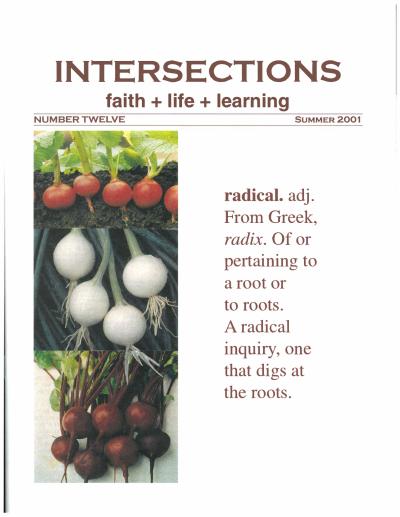 Article
Perspectives on Institutional Service: All Hands on Deck
Ruth Henricks
No. 12 · Summer 2001
Henricks, President and CEO of Lutheran Family Services of Nebraska, uses Annie Dillard’s image of Christians tourist-like on Deck C to call colleges and social ministry organizations to “all hands on deck” in a church standing at a threshold of shifting demographics—a growing rich-poor gap, a coming Hispanic majority, an aging baby-boom, dual-career families, contingency workers, and for-profit Lockheed Martin-style competitors entering human services. Drawing on Foster McCurley, Andrew Grove’s Only the Paranoid Survive, Justo Gonzales’s Manana, Arthur Becker, Bob Bacher, David Tiede, and the ELCA constitution, she argues that SMOs and colleges are the “hands” of the body of Christ and asks whether we have courage to require Spanish, partner ecumenically, cut services to Caucasian clients, and lead the church from the front rather than the rear.
-
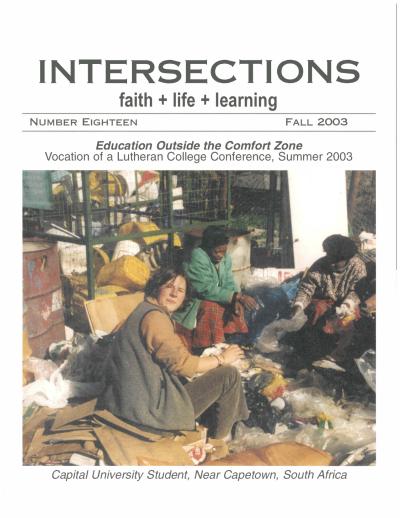 Editorial
From the Publisher
Arne Selbyg
No. 18 · Fall 2003
Selbyg reports that the ELCA Church Council’s new strategic directions include the charge to “assist this church to bring forth and support faithful, wise, and courageous leaders whose vocations serve God’s mission in a pluralistic world,” and assures readers that Intersections, the Vocation of a Lutheran College conferences, and related programs will remain among the tools by which the churchwide organization reaches its strategic goals.
-
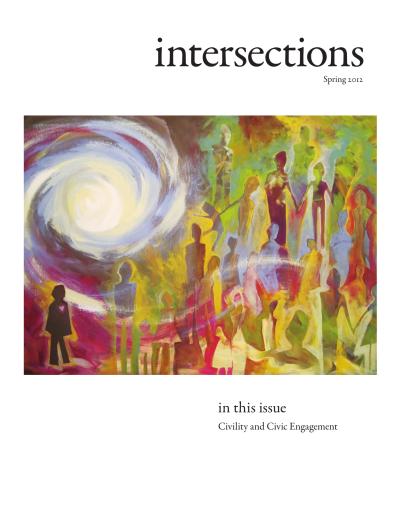 Editorial
From the Publisher
Mark Wilhelm
No. 35 · Spring 2012
Wilhelm describes the “four-legged stool” supporting ELCA higher education—the annual Vocation of a Lutheran College Conference, the Lutheran Academy of Scholars, the Thrivent Fellows program, and Intersections—and argues that the conversation about Lutheran mission and identity must now be extended beyond college and university personnel to the larger church and community before the gains of a generation are lost.