Number 7
The Summer 1999 “Cuba: The Face of the Neighbor” issue continues papers from the 1998 Vocation of a Lutheran College Conference. Cheryl L. Ney argues for “sustainable science practice” rooted in empathy; Robert Scholz responds to Christenson’s “Freedom of a Christian” as a musician, critiquing taped accompaniments and TV evangelism; Jennifer Sacher Wiley offers Unitarian Universalist reflections on a more inclusive “little Christ.” Four Capital faculty recount a 1998 Cuba trip, Erik Haaland meditates on a Band Chapel service, and the journal’s first letter to the editor closes the issue.
Editors
Articles in this Issue
-
 Editorial
From the Publisher
Arne Selbyg
Selbyg celebrates the popularity of the previous issue—the first to draw on papers from the annual “Vocation of a Lutheran College” conference—and announces a new Lutheran Brotherhood Foundation grant that will fund the inaugural Lutheran Academy of Scholars in Higher Education, a two-week seminar at Harvard led by Ronald Thiemann on “Finding Our Voice: Christian Faith and Critical Vision.”
-
Editorial
From the Editor
Tom Christenson
Christenson introduces the issue’s contents—papers from the 1998 Vocation conference by Cheryl Ney and Robert Scholz, a response by Jennifer Sacher Wiley, an interview with four Capital University faculty about Cuba, a meditation by St. Olaf senior Erik Haaland, and the journal’s first letter to the editor—and commends the Mount Mary College volume Wagering on Transcendence as a model of a faculty community sustained by Friday-afternoon conversation over a glass of wine.
-
Article
Rooting Science in Empathy: Growing Towards a Sustainable Science Practice for the 21st Century
Cheryl L. Ney
Ney, a DNA biochemist turned feminist science educator at Capital University, traces her own search for the “grounding” of teaching from Ernest Boyer’s scholarship of teaching through Cathleen Loving’s Scientific Theory Profile, Evelyn Fox-Keller’s critiques of science as “truly masculine philosophy” and her biography of Barbara McClintock (“A Feeling for the Organism”), and Arnold Pacey’s definition of science as a web of technical, organizational, and cultural practice. Drawing on the Dutch Science Shops, the Loka Institute’s community-based research, and academic service learning, she calls for “sustainable science practice” rooted in empathy and asks whether Lutheran institutions have the courage to claim an institutional freedom of vision rather than reduce themselves to preparation for the job market.
-
Article
How Can We Keep From Singing?
Robert Scholz
Scholz, professor of music at St. Olaf, responds to Tom Christenson’s “Freedom of a Christian” by walking through his own Nunc dimittis for the St. Olaf Christmas Festival, an Elderhostel choir of singers aged 60 to 95, and the four liberating arts (enablement and change, melioristic, embodying, and critical) as they shape conducting, composition, and music education. He defends the fine arts and folk traditions over “contemporary Christian” soft pop-rock and taped accompaniments, citing Luther’s preface to Georg Rhau’s Symphoniae iucundae and the family of God’s need to interact in song against the virtual community of TV evangelism and the Crystal Cathedrals of the air.
-
Reflection
Some Personal Reflections on the ELCA Vocation of a Lutheran College Conference, 1998
Jennifer Sacher Wiley
Sacher Wiley, a Unitarian Universalist with one Jewish parent and a first-year music faculty member at Susquehanna, reflects on common-ness and other-ness at the 1998 conference—Tom Christenson’s weaver’s warp and Charles Ives’s essay on American music—and proposes four markers of group identity. Against the fear of secularization expressed by some attendees, she suggests that “Christian” might be defined less by belief in Christ as Savior than by living a vocation as Jesus lived, with Cheryl Ney offered as an example of a “working prophet,” or “little Christ,” regardless of specific belief in the Trinity.
-
Article
The Face of the Neighbor: An Interview with Four Capital University Faculty About Their Recent Visit to Cuba
Brian Forry Wallace, Michael Yosha, Reg Dyck, Susan Narita
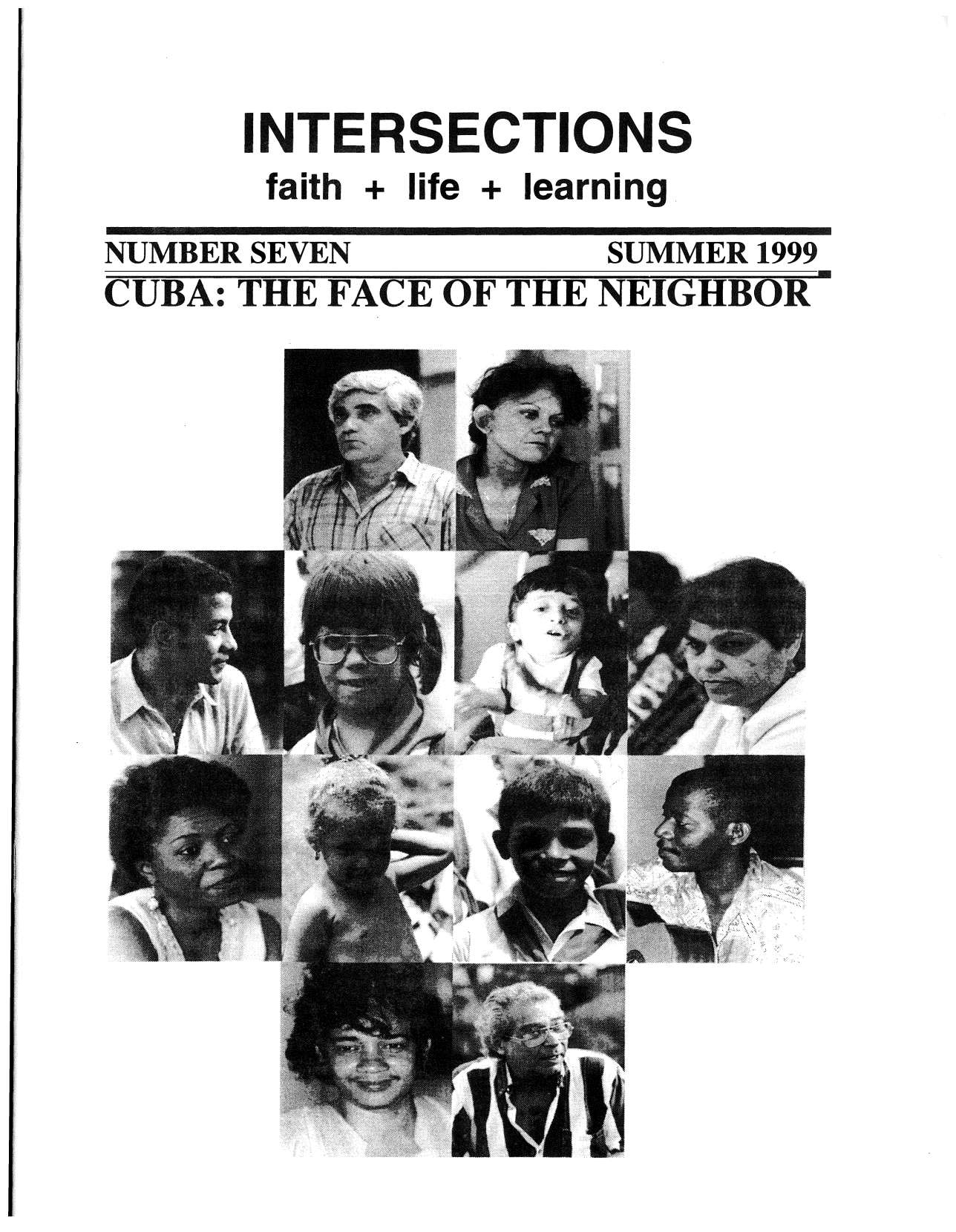
Four Capital University faculty—political scientist Brian Wallace (returning to Cuba a third time after the 1994 boat lift), English professor Reg Dyck, ESL teacher Susan Narita, and political scientist Michael Yosha—recount their summer 1998 trip with Pastors for Peace, describing Cuban priorities of education, health care, and military (in that order), the cultural richness of Havana from sixteenth-century cloisters to Miramar, the Cuban Foreign Service’s vision of a Scandinavian-style democratic socialism, the counter-productive U.S. embargo (including its effect on kidney dialysis machines), Castro’s 1991 reconciliation with religious communities, and a recurrent image of a little girl named Marguerite singing at a school for amputee and terminally ill children. The interview was conducted by Capital senior Jessica Brown and Tom Christenson.
-
Reflection
Meditation—Band Chapel Service, St. Olaf College
Erik Haaland
Haaland, a St. Olaf senior, offers a brief Band Chapel meditation that defines art as “the expression of what is deeply human through the manipulation of the physical world” and defends worship—architecture, stained glass, music, eloquence—as an art form requiring our best and most sincere efforts. When the God we worship and the salvation we proclaim do not seem near, artful worship offers not propositions but something real and tangible to hold on to.
-
Institutional Focus
Letters to the Editor
The journal’s first letter to the editor: Pastor John L. Vaswig of Spokane, a Pacific Lutheran University alumnus and member of the PLU Board of Regents, writes after reading James Tunstead Burtchaell’s The Dying Light: The Disengagement of Colleges and Universities from Their Christian Churches to ask whether church-related institutions, in their effort to be open and tolerant, have abandoned a compelling word of hope and forgiveness in Jesus Christ.