What adjective should we use to talk about this issue? It’s thicker than usual, in case you hadn’t noticed, and it has more pieces than usual. But I hesitate to call it “fat” because that suggests that it has unnecessary overages, which it doesn’t. Should we choose “weighty”? That suggests verbiage both long and dense as well as important. I doubt that’s what we want to say either. Perhaps “muscular”? Someone once referred to my physique as “well-developed.” I appreciated their kind efforts at euphemism. People used to use the word “fleshy.” Incarnationists, particularly Lutherans, should have little quarrel with that. So here we go once again, fleshing out our thoughts for sharing.
This issue contains both some of the papers shared at last summer’s Vocation of a Lutheran College Conference as well as two papers commissioned by Intersections from persons who have been at the heart of the ELCA’s efforts at higher education, the two directors of the Division for Higher Education and Schools, Robert Sorenson and Leonard Schulze. We thought it was appropriate to hear from them at this point in time, when the ELCA is considering restructuring and re-prioritizing the offices that oversee higher education in the church.
Arne Selbyg insisted that I use this letter as a kind of valedictory, since I am stepping down as editor of Intersections. This is the last issue that I will edit. The editorship will be passed to Bob Haak at Augustana, Rock Island. I wish him well and I’m extremely happy that Intersections will continue under his leadership and the support of Augustana College. Our thanks are due to Bob and the leadership at Augustana for picking up the ball and moving it on down the field.
When I first took the idea for this publication to Naomi Linnell and then to Jim Unglaube at DHES in 1994, they were both interested in the prospect but somewhat skeptical about its practicality. I think they figured it was a momentary enthusiasm (I’ve been known to have such) that would soon be replaced by something new. I didn’t quit hounding them about it, and they finally agreed to take a proposal to the council of presidents. The presidents showed some enthusiasm for the idea, even if not for paying for it. And so the project was launched on a shoestring, where it’s been hanging ever since. DHES agreed to pay for the printing, and Josiah Blackmore, then president at Capital University, agreed to pay for everything else. Subsequent presidents here have continued that commitment.
We sent out a “Birth Announcement” in the spring of 1996. Here’s part of what it said:
We are pleased to announce the birth of a new publication. It will be called Intersections: Faith+Life+Learning. … Why do we need such a publication?
At some recent conferences I’ve had a chance to talk with faculty colleagues from other ELCA colleges. From them I have heard comments such as these: “Many of the faculty at my institution don’t even know we’re church related, to say nothing of knowing what that means.” “Is being church related anything more than a public relations device?” “Most of the faculty at my college are afraid of our church connectedness. They assume it implies another Inquisition and want nothing to do with it.” “I didn’t realize that we had any ‘sister colleges’ or that I had colleagues beyond my institution who were asking some of the same questions that I do.” “The Lutheran connection at our college is very vague, mostly because no one seems to know exactly what it means.” “Somebody ought to do us the big favor of articulating what it means to be a Lutheran college. The question, at our school, is most often met with a kind of bemused silence.” … It is in response to this lack of awareness, this vagueness, this sense of disconnection, that Intersections hopes to speak.
Of course people at our colleges and universities still have questions about Lutheran identity and its implications, but now they are aware that they are not asking these questions all by themselves and they have some resources for addressing them, resources provided in some part by the annual Vocation of a Lutheran College Conference and by Intersections. Our purpose was to encourage and facilitate such discussion, to create a larger sense of community among the ELCA institutions, and to share the best thinking that we were able to bring to this matter. I think we have succeeded in that enterprise. Just recently I was asked to be of help in completing a bibliography of resources for a university’s Lutheran identity study. It was interesting to see that almost a third of the readings included in the bibliography were pieces that had been published in Intersections. Not infrequently I get an e-mail from colleges requesting copies of particular back issues to be used to facilitate campus discussions about vocation, tenure, academic freedom, service learning, etc. I am happy when such things occur. It means that somebody is reading and that a discussion somewhere is being informed by this publication.
There are some things I wish we had been able to do better. I guess I pass this list along to Bob Haak in the hope that he may be able to improve the publication in ways I was not able to. 1) I wish I had been better able to use the board of editors. That group had potential but was under-utilized. That was my fault, not theirs. 2) I wish I had been able to get more offerings of poetry and art from people at other institutions. Very often I had to call on the considerable talents of colleagues here at Capital for art or poems to fill out an issue. 3) The same can be said for essays and homilies and reflections from colleagues around the league. The journal survives not only on financial support but on the gift economy of shared ideas. That being said I do need to boast that over the 21 issues we’ve done so far, we’ve published pieces from persons at 20 of the 28 ELCA colleges and universities as well as from 10 institutions outside that group. I think that’s mighty fine, and I hope it continues. Send your ideas and proposals to Bob Haak. Let’s keep him and his editorial assistants busy.
There are three people in particular whom I wish to thank for their work on Intersections. They are the students who have worked as copy editors with me over these years. They are: Jessica Brown, Marissa Cull, and Caitlin McHugh. Intersections would have been a mess without their work. Together we learned how to format and edit an issue and get it ready for the printer. My thanks also to the presidents and provosts at Capital University who over the years have supported the publication with money, facilities, and encouragement. And to all others who have been help and support in this process a heartfelt thank you.
Tom Christenson
-
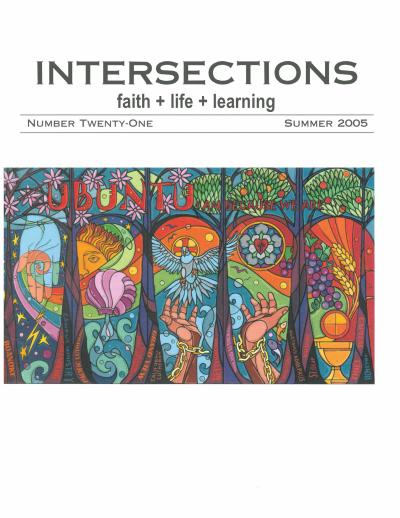 Editorial
From the Publisher
Arne Selbyg
Selbyg notes that ELCA colleges and universities have remained more loyal to the church than the institutions of many other denominations and announces that with this issue Tom Christenson’s nine-year service as editor of Intersections comes to an end, with Bob Haak of Augustana College in Rock Island assuming the editorship and institutional support shifting from Capital to Augustana.
-
Article
Changes
W. Robert Sorensen
Writing as former executive director of the Division for Higher Education and Schools, Sorensen places the DHES within the threefold movement of Luther’s Reformation—university, church, and individual piety—and recounts how the Division cohered its work with colleges, universities, campus ministries, and schools around Joseph Sittler’s definition of education as “movement into a larger world.” Drawing on Huston Smith’s “primordial tradition,” the Namibian student program, work in India and Palestine, and the Bergendoff series of publications, he raises a twofold concern about the proposed merger of DHES into a Division for Vocation and Education: whether the new structure will signal the core significance of education in the heritage and life of the church, and whether it can carry forward the effectiveness and scope of DHES’ work.
-
Article
The Church in Education? Education in the Church? Ten Theses on Why These Questions Matter
Leonard G. Schulze
Writing in the months before the August 2005 Churchwide Assembly that will decommission DHES, Schulze frames his vision for the division as ten Lutheran-style theses, each followed by Luther’s catechetical question “What does this mean?” He argues that critical thinking and moral deliberation are in the Lutheran gene pool; that Luther’s devotion to learning was an expression of Christian vocation; that the rise of the research university and the binary public meaning of “evangelical” have marginalized church-related colleges; that DHES has been wrongly perceived as marginal; and that the reformed concept of vocation must drive the soon-to-be-created program unit for Vocation and Education. An appendix reproduces the 2005 DHES strategic planning overview.
-
Article
Private University, Public Witness: Life in the "None Zone"
Loren J. Anderson
Drawing on sixteen years at Concordia College in Moorhead and twelve at Pacific Lutheran University, Anderson contrasts the Lutheran heartland with the Pacific Northwest’s “None Zone”—Patricia Killen and Mark Silk’s name for the country’s least churched region—and argues that a faithful Lutheran witness is possible in this changing context. He proposes five callings for the colleges—an academic program shaped by both educational philosophy and Lutheran theology, vibrant campus communities of faith and learning, inclusiveness and ecumenical outreach, global vision, and vocational exploration—and closes by sketching PLU’s shift toward “partnership” congregations and a new Center of Religion, Culture and Society in the Western United States.
-
Reflection
Finding Words That Matter (Proverbs 1:20-21; 4:10-13)
Harvard Stevens Jr.
In a brief homiletic reflection on Proverbs, Stevens addresses Lutheran educators as “merchants of wisdom” competing with a crowded contemporary marketplace of internet, cable TV, and rap music alongside “Hedonism 101,” “Advanced Voyeurism,” and “Pure Escapism.” Recounting an evening with a Carthage student poetry club, he shares the poem wisdom whispered to him there and offers thanks for the high calling to teach “words that matter.”
-
Poem
Sprigs of Mint
Caitlin McHugh
McHugh meditates on three light green mint stalks dying in a plastic cup of water in her window frame’s shadow, drawing a parallel between the neglected mint, the “tainted papers” of her unread journals, and the time that both holds her back and drives her forward.
-
Article
Money, Sex and Power: An Exploration of Some Controversial Issues in the Public Witness of the Church
Pamela K. Brubaker
Brubaker explores two controversial issues in the church’s public witness—homosexuality and economic life—and the challenges they present for both church and college. Drawing on Beverly Harrison, Elizabeth Bounds, Ron Thiemann, Linell Cady, Marcia Bunge, Richard Hughes, Darrell Jodock, Ernest Simmons, Karen Bloomquist, Garth Kasimu Baker-Fletcher, and Larry Rasmussen, and on episodes at California Lutheran University around “Harmony Week” and Bishop Paul Egertson’s participation in Anita Hill’s ordination, she argues that colleges related to the ELCA are called to educate for “critical citizenship” by hosting rigorous, bold, and unfettered debate—including debate over the neo-liberal globalism that she names a form of economic fundamentalism.
-
Article
Education as a Christian (Lutheran) Calling
Tom Christenson
Christenson opens with an imaginative reconstruction of early Christian communities as radically egalitarian, pacifist, communitarian gatherings within the Roman Empire and argues that such communities are natural homes for the educational vocation. Naming two temptations for contemporary Christian higher education—the parochial Bible school and “Generic U”—he uses his friend Sig Rauspern’s tree metaphor to insist that a university is Christian in its trunk and roots rather than in grafted-on branches. Drawing on Wendell Berry, Jacob Bronowski, Walter Wink, Douglas John Hall, and his own Gift and Task of Lutheran Higher Education, he names faithful criticism, engaged suspiciousness, simul justus et peccator, and a fallible, love-related Lutheran epistemology as the particular gifts Lutherans bring to the Christian educational calling.
-
 Article
The Vocation of Intersections on its Twentieth Birthday
Jason A. Mahn, Robert D. Haak, Tom Christenson
No. 43 · Spring 2016
The three editors of Intersections — Bob Haak, Jason Mahn, and Tom Christenson (in spirit, following his death in 2013) — trace the twenty-year vocation of the journal itself: its 1996 birth at Capital University; its coming-of-age years of debate over institutional markers, two-kingdoms theology, and Lutheran identity; the ascendancy of “education for vocation” as the central marker of Lutheran higher education; and its ongoing identity in relation to a changing ELCA and to the broader cultural conversation about purpose, wholeness, and the vocation of higher education.
-
 Article
Point / Counterpoint: What It Means to be a "College of the Church"
Robert Benne, Tom Christenson
No. 28 · Fall 2008
Moderated by Wartburg College pastor Larry Trachte and introduced by Kathryn Kleinhans, this Wartburg campus conversation between Robert Benne (Roanoke College) and Thomas Christenson (Capital University) probes what it means to be a college of the church—Benne emphasizing ethos, vocation, and the Christian intellectual tradition over against secularization and generic education, and Christenson lifting up persistent vocational questions, the gift of difference, and induction into a community of discourse—and finds large common ground around hiring for mission, pedagogy that asks deep questions, and the courage to claim a living religious tradition while inviting everyone to the banquet.
-
 Book Review
Review of Educating for Shalom: Essays on Christian Higher Education
Tom Christenson
No. 20 · Fall 2004
Christenson reviews Nicholas Wolterstorff’s Educating for Shalom: Essays on Christian Higher Education (Eerdmans, 2004), edited by C.W. Joldersma and G.G. Stronks. After recounting his own early prejudice against Wolterstorff’s Reason Within the Bounds of Religion and his subsequent conversion through Art in Action, he focuses on two threads: Wolterstorff’s expansive reading of shalom—not merely peace but justice, community, communal responsibility, and delight—as the overall goal of Christian collegiate education, and the influence of Abraham Kuyper’s claim of “privileged cognitive access” for Christian inquirers, which Wolterstorff demonstrates rather than declares.
-
Editorial
From the Editor
Tom Christenson
No. 20 · Fall 2004
Christenson introduces an issue featuring “young and old, angry and encouraging, prophetic and hopeful” voices unified by the assumption that Christians engaged in thinking and educating will ask hard questions: how to raise concerns about militarism and the new American “imperialism,” what a Lutheran law school will say about training a new generation of attorneys, and what Lutheran colleges communicate to undergrads about vocation. Such faithful criticism, he argues, is part of who Lutheran institutions are.
-
 Editorial
From the Editor
Tom Christenson
No. 19 · Summer 2004
Christenson reflects on the scarcity of time in over-committed academic lives and posts a tongue-in-cheek help-wanted advertisement for his own successor as editor. He introduces the issue’s four authors as “three friends and one new acquaintance” whose work addresses Lutheran higher education, the significance of Paul Ricoeur, the implications of being a reformation community, and the perils of teaching ethics.
-
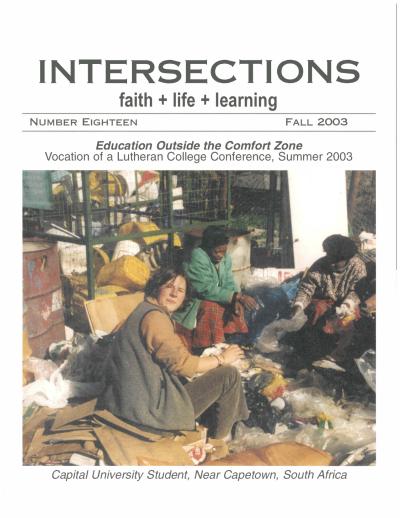 Editorial
From the Editor
Tom Christenson
No. 18 · Fall 2003
Christenson draws on a ten-year alumni survey at Capital University showing that students most often credit practica, internships, travel-study, and service-learning—not classroom hours—as the places they best learned the university’s stated outcomes, and introduces this issue’s papers from the Summer 2003 Vocation of a Lutheran College Conference on education and global outreach.
-
 Editorial
From the Publisher
Mark Wilhelm
No. 48 · Fall 2018
Wilhelm frames the issue by reflecting on the Letter of James and the Lutheran tradition of “calling a thing what it is” — arguing that the standards of academic discourse, deeply rooted in Lutheran insistence on frankness and honesty alongside concern for the common good, give NECU institutions a solid platform for sustaining honest but not hateful discourse about divisive issues.
-
 Article
"We're Looking for a College—Not a Vocation": Articulating Lutheran Higher Education to Prospective Students and Parents Seeking Relevance
Karl Stumo, Tom Crady
No. 38 · Fall 2013
Drawing on Sallie Mae and UCLA enrollment data, the websites of competitor institutions, and candid voices from the field, Crady and Stumo describe a recruitment landscape in which yield rates have collapsed, discount rates have soared, and the word “Lutheran” often presents an obstacle until it is patiently unpacked. They survey mission language at Augsburg, PLU, Gustavus, and Wartburg and argue that strategic message development is the only way for ELCA schools to make vocation and Lutheran identity “credible, relevant, differentiating, and compelling” to prospective families.
-
 Article
The Literature of Spiritual Reflection and Social Action
Shirley Hershey Showalter
No. 10 · Fall 2000
Showalter, president of Goshen College, opens with Garrison Keillor’s “Singing with the Lutherans” and Walter Sundberg’s account of the Anabaptist “radical reformers” to locate Mennonite identity in a theology of suffering, humility, narrative, and song—tracing it through John S. Coffman’s 1904 “The Spirit of Progress,” Harold S. Bender’s 1944 “Anabaptist Vision,” John Howard Yoder’s The Politics of Jesus, and J. Lawrence Burkholder. She uses her Senior Seminar “Pedagogy of the Holy Spirit” reading of Viktor Frankl’s Man’s Search for Meaning, Madeleine L’Engle’s “Be a namer” and Walter Wink on the angels of institutions, and a Goshen Study-Service Term (SST) journal entry by student David Roth returning from Haiti—closing with two poems by Sarah Klassen—to argue for naming as the redemptive practice of church-related education.
-
 Article
From Pietism to Paradox: The Development of a Lutheran Philosophy of Education
Philip Nordquist
No. 8 · Winter 2000
Nordquist traces a four-decade personal and institutional journey from the “Protestant triumphalism” and aggressive moralism of S. C. Eastvold’s 1950s Pacific Lutheran through the 1960 Ditmanson–Hong–Quanbeck volume The Christian Faith and the Liberal Arts, Gordon Lathrop’s 1972 PLU donor address grounding the university in two-kingdoms theology, the ALC’s 1975 Concordia workshop with Bill Narum, Bob Bertram, Harris Kaasa, and Sydney Ahlstrom’s case for the “critical” tradition over the scholastic and pietistic, the 1976 LCA statement distinguishing “Christian” from “church-related” education, and Richard Hughes’s 1997 Carthage address. He concludes that dialectical (two kingdoms) theology, Christian humanism alongside professional studies (the New American College model), Luther’s commitment to universal compulsory education, environmental and civic responsibility, and academic freedom together constitute the bequest of the Reformation—“Christ and culture in paradox” remains the best approach to education he knows.
-
 Article
Rooted and Open as Resource for Expanding Opportunities on Your Own Campus
Katherine A. Tunheim, Marcia Bunge
No. 49 · Spring 2019
Bunge and Tunheim describe how Gustavus Adolphus College has paired Rooted and Open with its own companion volume Rooted in Heritage, Open to the World — in board workshops, new-faculty orientation, and classroom assignments — and survey several Network-wide opportunities (the Vocation of a Lutheran College Conference, the LECNA Fellows Program, the Association of Lutheran College Faculties, the Tuition Exchange Program, and international partnerships) that give the common calling tangible institutional form.
-
 Article
The Divide Within (Not Between) Liberal Arts and Professional Education
Lake Lambert
No. 24 · Fall 2006
Lambert, then Board of Regents Chair in Ethics at Wartburg College and Project Director for the “Discovering and Claiming our Callings Initiative,” argues that the real divide in higher education runs not between the liberal arts and the professions but within each — between teaching that forms students for callings and teaching that merely transmits content or credential. He calls Lutheran colleges to recover, across both liberal arts and professional disciplines, a shared commitment to vocational formation grounded in the Lutheran tradition.