Review of Educating for Shalom: Essays on Christian Higher Education
Intersections No. 20 · Fall 2004
Nicholas Wolterstorff—Educating for Shalom: Essays on Christian Higher Education. Edited by C.W. Joldersma & G.G. Stronks (Grand Rapids, MI: Eerdmans, 2004).
I first began reading Nick Wolterstorff in the late 1970s when I was introduced to his Reason Within the Bounds of Religion by a colleague at Concordia College. I have to admit that my first reaction to his work was rather negative. Wolterstorff was making an argument and coming at questions of epistemology and scholarship in ways that I had never encountered before. I couldn’t imagine that Christian scholarship, as he described it, could possibly produce anything much of interest. A few years later, therefore, I was reluctant to travel down to St. Olaf College to hear him lecture on a Christian view of the arts. Though I had been interested in the ways Christians incorporate the arts in the life of faith, I couldn’t imagine there being anything like a Christian aesthetic nor a Christian view of the arts. What came to mind was a kind of theoretical justification for the kind of art one finds in “Christian bookstores,” and I was quite sure I didn’t want anything to do with it.
I had established a prejudice, reinforced by a caricature. Had it not been for the prodding of another Concordia colleague I might still be living with both. I am extremely thankful for that colleague and all others along the way who have rescued me from such sink-holes of self-constructed and self-reinforced ignorance. I heard Wolterstorff’s lectures, ended up buying the two books that he subsequently published on these topics and reviewed both of them. One of them, his Art in Action, I have used many times since in courses I have offered on the philosophy of art.
When I saw this new book of essays by Wolterstorff, Educating for Shalom, I knew immediately that I wanted to review it. Some of the essays included here I had read when they were published elsewhere. But many were new to me.
Two of the essays that I wish to recommend to your reading have a very particular focus: one on the issue of academic freedom at religiously based colleges and universities; a second on the question, “Should the work of our hands have standing in a Christian college?” The first is one of the most sensible approaches to academic freedom I have ever read, the second poses the question about the relation of the life of the mind to the work of our hands. It initiates reflection toward a philosophy of work.
But most of the essays collected here cluster around the nature of Christian higher education. They seek to answer questions such as: Christian education is education for what? Meant to serve the world how? That relates faith and scholarship how? Shaping the character of students how? I cannot in a review explain completely Wolterstorff’s answers to all these questions. So I will focus on two things. The first is the meaning and importance of the conception that appears in the title, Shalom. The second is the influence of Abraham Kuyper in shaping the reformed approach to higher education that has influenced Wolterstorff so much.
Shalom
Wolterstorff poses the question, “What should be the overall goal of Christian collegiate education?” He goes on to answer:
There is in the Bible a vision of what it is that God want’s for God’s human creatures—a vision of what constitutes human flourishing…. The vision is not that of disembodied individual contemplation of God; thus it is not the vision of heaven, if that is what one takes heaven to be. It is the vision of shalom— a vision first articulated in the poetic and prophetic literature of the Old Testament, but prominent in the New Testament as well under the rubric of eirene, peace. (p. 22-23)
I think Wolterstorff raises an interesting question here. What is the overall biblical picture of the life to which humans are called? We do not usually read the scriptures with such an encompassing question in mind. Some might wonder whether the Bible, being the odd anthology it is, presents such a vision. Wolterstorff believes that it does and that vision is shalom.
Wolterstorff is not satisfied to translate shalom as “peace” as is usually done. He argues that the idea also contains the idea of justice, community, communal responsibility and delight. He argues that the Bible shows us God calling humans to a life manifesting all of these dimensions. This is a rich, multi-dimensional concept that should inform not only the what of a college curriculum but its how as well. He argues that a Christian college should be a place where students not only learn about such things but where they learn to practice them. Obviously one of the focal ideas here is justice and responsible action. Wolterstorff has addressed how we should educate in and toward both of them. One of the chapters in this volume is titled, “Teaching for Justice: On Shaping How Students Are Disposed to Act,” and the title of one of his earlier books is Educating for Responsible Action. One of the sections of Wolterstorff’s Art in Action is on the role of the arts in taking delight.
A later chapter of the present book returns to the concept of shalom. Wolterstorff writes:
To be human is to be that place in creation where God’s goodness finds its answer in gratitude. I see Christian learning as fundamentally an act of gratitude to God…. Shalom is human flourishing in all its dimensions. My suggestion is that Christian learning contributes to our human flourishing, and that it is, in that way an eirenic act on the part of the community at the same time that it is a eucharistic act. (p. 258)
Abraham Kuyper and His Influence
I have to admit that, though I had often enough heard my Calvinist friends quote Kuyper and refer reverently to him, I did not have a very complete understanding of his thought nor of the contribution he had made to Dutch Reformed Calvinism and to Wolterstorff’s scholarly output. Having some understanding of Kuyper, I now see why Wolterstorff has approached many questions in the way he has, particularly his understanding of Christian scholarship and epistemology.
I will try to briefly paraphrase Wolterstorff’s presentation of Kuyper’s argument in order that we might go on to examine it further. Please remember that what you have here are Kuyper’s thoughts at third remove. I bother to do this only because I hope that others will read both Wolterstorff and Kuyper because of what they find here.
1. Wolterstorff sees Kuyper who published his most influential work in the 1890s as a “post-modern thinker born out of season.” Kuyper maintained that inquiry cannot take place without being informed by some operative belief system. There is no such thing as inquiry generically considered but always inquiry shaped by some assumptions, some agenda, some basic beliefs.
2. It is an unrealistic expectation, therefore, that all rational inquirers will eventually reach a consensus. Pluralism and disagreement are, therefore, a natural outcome. Yet we are inclined to see truth in our own views and to see falsehood in the views of others. This, Kuyper believes, is a manifestation of sin which runs through all our projects of knowing.
3. Just as sin can effect the enterprise of knowing, so can God’s work of salvation. Those in whom God works rebirth (palingenesis) He also creates, as it were, a new mind. Kuyper writes: “And the fact that there are two kinds of people occasions of necessity the fact of two kinds of life and consciousness of life, and of two kinds of science…” (p. 218).
4. Consequently we should expect that Christian inquirers in the disciplines will have different views than are typically held by non-Christians.
5. Rather than viewing religious beliefs as prejudices that any inquirer ought to shed or at least bracket in the process of pursuing a discipline, Kuyper invites us to see Christian belief as a particular gift which may inform our awareness of the world in positive ways. This leads him to assert, in Wolterstorff’s phrase, “a privileged cognitive access” for inquirers gifted by the Spirit with Christian faith.
6. This does not imply, Wolterstorff maintains, that every Christian scientist will do better work than every non-Christian one. It only means that the Christian has an advantage, a way of looking at the world informed by Christian belief.
I think that these provocative thoughts are worth pursuing. We very often see things because of the particularity of experience and belief that others lacking those gifts cannot see. Thus we have had to learn to see injustice through the experience of black people and women, we’ve been led to see environmental destruction by indigenous tribal people, we’ve been led to see dimensions of slavery by Marxists, and dimensions of brutality by feminists, etc. There is no reason to think that Christians might not be able to see dimensions and aspects of reality that others miss. But at the same time I don’t find any reason to think that the Christians in these examples are exclusively nor peculiarly gifted. Can we conclude any more than that they, too, bring their gifts to the table? Should we conclude, perhaps, that the richest picture of reality is one that finds room for the largest variety of voices? Should this lead us to an intentionally pluralistic approach to education rather than a peculiarly Christian one or peculiarly Calvinist one?
Wolterstorff seems to find himself suspended somewhere between the “privileged access” view that Kuyper articulates and the pluralistic one suggested above. I believe many of Wolterstorff’s books are attempts to show (rather than explicitly argue for) what insights the “privileged access” of the Christian inquirer might reveal. Thus while Wolterstorff makes no claims to privileged access to the truth about justice, peace, education, the arts, he does want to demonstrate that an inquirer operating from a viewpoint informed by Christian beliefs will have surprising, wise and eye-opening truths to share. This is what I believe Wolterstorff, through his scholarly efforts in all these areas, has been doing all along. He has not declared the peculiar value of the Christian scholar so much as he has shown it. He is the best example of a fruitful Christian scholar that I know.
-
 Editorial
From the Publisher
Arne Selbyg
Selbyg reports that during 2004 a task force appointed by the ELCA Division for Church in Society has been laying the groundwork for a Social Statement on Education, with a draft to be debated in congregations and educational forums in 2006 and considered for adoption at the 2007 Churchwide Assembly. He urges Lutheran educators to obtain and study the new Task Force study document from the Division for Church in Society and submit their reactions so that the drafters know what those with ties to Lutheran educational institutions think is important.
-
Editorial
From the Editor
Tom Christenson
Christenson introduces an issue featuring “young and old, angry and encouraging, prophetic and hopeful” voices unified by the assumption that Christians engaged in thinking and educating will ask hard questions: how to raise concerns about militarism and the new American “imperialism,” what a Lutheran law school will say about training a new generation of attorneys, and what Lutheran colleges communicate to undergrads about vocation. Such faithful criticism, he argues, is part of who Lutheran institutions are.
-
Article
Mars, Mammon—and Other Options
Carl Skrade
In a wide-ranging public lecture from a Capital University Philosophy and Religion department series on “The Empire, Its Religions, and Some Alternatives,” Skrade distinguishes the military from militarism (using Oxford and Chalmers Johnson definitions), catalogs evidence of contemporary U.S. militarism—budget allocations, arms sales, the military-academic complex, post-1945 interventions, overseas bases, and Bush-era profiteering through Bechtel and Halliburton—and traces its roots in resource greed, racism, right-wing religiosity, and Augustinian incurvatus in se ipsum. After surveying the financial and human costs through testimony from Jonathan Shay’s Achilles in Vietnam, Samuel Hynes’s The Soldier’s Tale, Dalton Trumbo’s Johnny Got His Gun, and Staff Sergeant Jimmy Massey, he applies Vincent Ferraro’s seven principles of just war to Gulf II, reads Matthew 5:43-48 as a call to indiscriminate care, and proposes a www.religiousleft.org website to host a Christian alternative to Mars and Mammon.
-
Article
Leading Students to Distinguish Between Career and Vocation: Reflections from a Lutheran Law School
Steven C. Bahls
Bahls, writing as former dean of the Capital University Law School, argues that most law students and many legal educators confuse vocation with career—asking “what kind of lawyer do you want to be?” rather than “who do I want to be?” Drawing on John O. Mudd’s five attributes of a well-prepared lawyer and Susan Daicoff’s empirical research on lawyer dissatisfaction and the “amoral professional role,” he turns to Ernest L. Simmons’s and Darrel Jodock’s articulations of Luther’s understanding of vocation and proposes five steps—reflection, assessment, vision, integrative thinking, and reassessment—along with explicit leadership from law school deans, engagement of career services offices, and leadership within the profession (illustrated by Capital’s joint venture with the Columbus Bar Association).
-
Article
Luther's Theology of Learning: Discovering the Vocation of Today's Small Lutheran Liberal Arts College
Eric Childers
In an excerpt from his Wake Forest University Divinity School senior thesis, Childers profiles six students hand-picked by presidents and chaplains at Concordia College (Moorhead), Lenoir-Rhyne College, and Muhlenberg College—Nathan Gossai, Amy Nelson, Alison Schmidt, Ryan Sigmon, Julie Christianson, and Jeffrey Slotterback—as a living testament to Luther’s theology of learning. He then draws on Solberg, Mark R. Schwehn (in Paul J. Dovre’s The Future of Religious Colleges), Robert Benne, Ernest Simmons, Mark Noll, Richard Hughes, and James Burtchaell to argue that Lutheran colleges have not yet fully articulated their own theology of education and that their vocation is to embrace, engage, and galvanize a Lutheran tradition of learning rooted in the liberal arts, Scripture, the Confessions, and confident ecumenism.
-
 Article
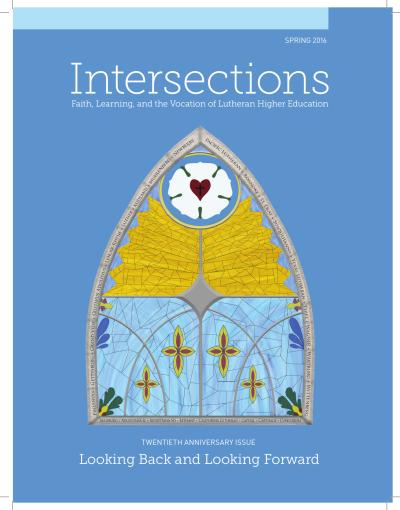
The Vocation of Intersections on its Twentieth Birthday
Jason A. Mahn, Robert D. Haak, Tom Christenson
No. 43 · Spring 2016
The three editors of Intersections — Bob Haak, Jason Mahn, and Tom Christenson (in spirit, following his death in 2013) — trace the twenty-year vocation of the journal itself: its 1996 birth at Capital University; its coming-of-age years of debate over institutional markers, two-kingdoms theology, and Lutheran identity; the ascendancy of “education for vocation” as the central marker of Lutheran higher education; and its ongoing identity in relation to a changing ELCA and to the broader cultural conversation about purpose, wholeness, and the vocation of higher education.
-
 Article
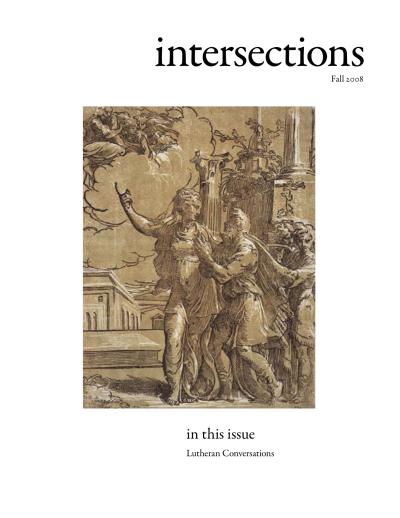
Point / Counterpoint: What It Means to be a "College of the Church"
Robert Benne, Tom Christenson
No. 28 · Fall 2008
Moderated by Wartburg College pastor Larry Trachte and introduced by Kathryn Kleinhans, this Wartburg campus conversation between Robert Benne (Roanoke College) and Thomas Christenson (Capital University) probes what it means to be a college of the church—Benne emphasizing ethos, vocation, and the Christian intellectual tradition over against secularization and generic education, and Christenson lifting up persistent vocational questions, the gift of difference, and induction into a community of discourse—and finds large common ground around hiring for mission, pedagogy that asks deep questions, and the courage to claim a living religious tradition while inviting everyone to the banquet.
-
 Article
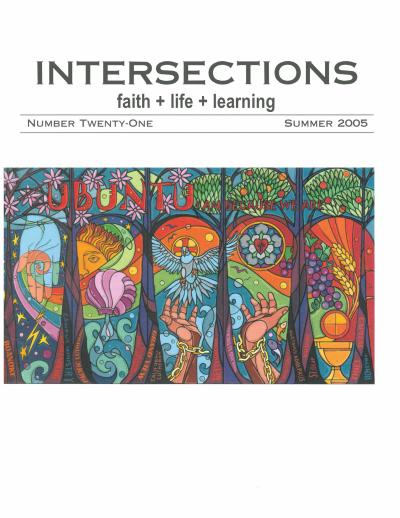
Education as a Christian (Lutheran) Calling
Tom Christenson
No. 21 · Summer 2005
Christenson opens with an imaginative reconstruction of early Christian communities as radically egalitarian, pacifist, communitarian gatherings within the Roman Empire and argues that such communities are natural homes for the educational vocation. Naming two temptations for contemporary Christian higher education—the parochial Bible school and “Generic U”—he uses his friend Sig Rauspern’s tree metaphor to insist that a university is Christian in its trunk and roots rather than in grafted-on branches. Drawing on Wendell Berry, Jacob Bronowski, Walter Wink, Douglas John Hall, and his own Gift and Task of Lutheran Higher Education, he names faithful criticism, engaged suspiciousness, simul justus et peccator, and a fallible, love-related Lutheran epistemology as the particular gifts Lutherans bring to the Christian educational calling.
-
Editorial
From the Editor
Tom Christenson
No. 21 · Summer 2005
In his valedictory letter as outgoing editor, Christenson recounts the 1994 origins of Intersections, when he took the idea to Naomi Linnell and Jim Unglaube at DHES and persuaded the council of presidents to launch the journal on a shoestring with printing paid by DHES and everything else by Capital University. He summarizes the issue’s contents—papers from the 2004 Vocation of a Lutheran College Conference plus two commissioned pieces from former DHES directors Bob Sorensen and Leonard Schulze—and thanks the student copy editors and Capital’s presidents and provosts who sustained the publication.
-
 Editorial
From the Editor
Tom Christenson
No. 19 · Summer 2004
Christenson reflects on the scarcity of time in over-committed academic lives and posts a tongue-in-cheek help-wanted advertisement for his own successor as editor. He introduces the issue’s four authors as “three friends and one new acquaintance” whose work addresses Lutheran higher education, the significance of Paul Ricoeur, the implications of being a reformation community, and the perils of teaching ethics.
-
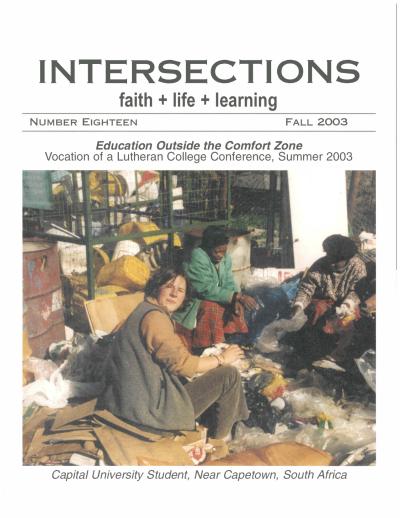 Editorial
From the Editor
Tom Christenson
No. 18 · Fall 2003
Christenson draws on a ten-year alumni survey at Capital University showing that students most often credit practica, internships, travel-study, and service-learning—not classroom hours—as the places they best learned the university’s stated outcomes, and introduces this issue’s papers from the Summer 2003 Vocation of a Lutheran College Conference on education and global outreach.
-
 Article
Why Did the Chicken Cross the Road? A Homily on Liminality and Vocation
Lori Brandt Hale
No. 45 · Spring 2017
Drawing on Wes Moore’s The Other Wes Moore, Warren St. John’s Outcasts United, Victor Turner’s anthropology of liminality, and Dietrich Bonhoeffer’s poem “Who Am I?”, Hale considers how Hmong, Muslim, Latinx, LGBTQ+, non-traditional, and other students live in “double liminal” spaces — and asks whether liminality might itself be a place of transformation in conversations about vocation.
-
Editorial
From the Publisher
Mark Wilhelm
No. 43 · Spring 2016
Wilhelm announces the new Network of ELCA Colleges and Universities — established in 2015 and convened for its first Board of Directors meeting in February 2016 — as a missional collaboration between the churchwide organization and the twenty-six ELCA colleges and universities, replacing former churchwide units lost to budget reductions and offering a stronger, more viable vision of Lutheran higher education.
-
Editorial
From the Editor
Jason A. Mahn
No. 45 · Spring 2017
Mahn introduces “Education in the Age of Trump” by recounting a difficult academic year on his own campus — the Augustana “chalking” incident, a Latinx Unidos rally, and post-election conversations with marginalized students and quietly conservative Trump supporters alike — and frames the issue’s essays as careful (re)imaginings of the vocation of Lutheran higher education in an anxious political climate.
-
 Editorial
From the Incoming Editor
Colleen Windham-Hughes
No. 55 · Spring 2022
Windham-Hughes introduces herself as incoming editor by reclaiming the root of assess — “to sit by” — and committing to the question “What does this mean?” as she sits with readers in the worth of our work and the universality of vocation.
-
 Editorial
From the Publisher
Mark Wilhelm
No. 41 · Spring 2015
Wilhelm celebrates the leadership of ELCA colleges and universities within American higher education — from presidential service in major higher-education agencies to recognized leadership in global education and interfaith understanding — and lifts up the health of the ELCA network of schools as a church-related community that maintains shared identity while living as good citizens of the larger academy.
-
 Book Review
The Prophetic Vocation and the Nature(s) of College: Reimagining College with Jim Farrell
Peder Jothen
No. 39 · Spring 2014
Jothen reads the late Jim Farrell’s The Nature of College as a prophetic critique of the dual nature(s) of college—its socio-cultural “normal” and its ecological habitat—and argues that Farrell’s call to model an “Anthropocene Responsibility” resonates with the prophetic dimension of Lutheran higher education. He proposes a re-imagined “About St. Olaf” that names vocation, ecological dependence, and personal involvement as the operative goods of college.