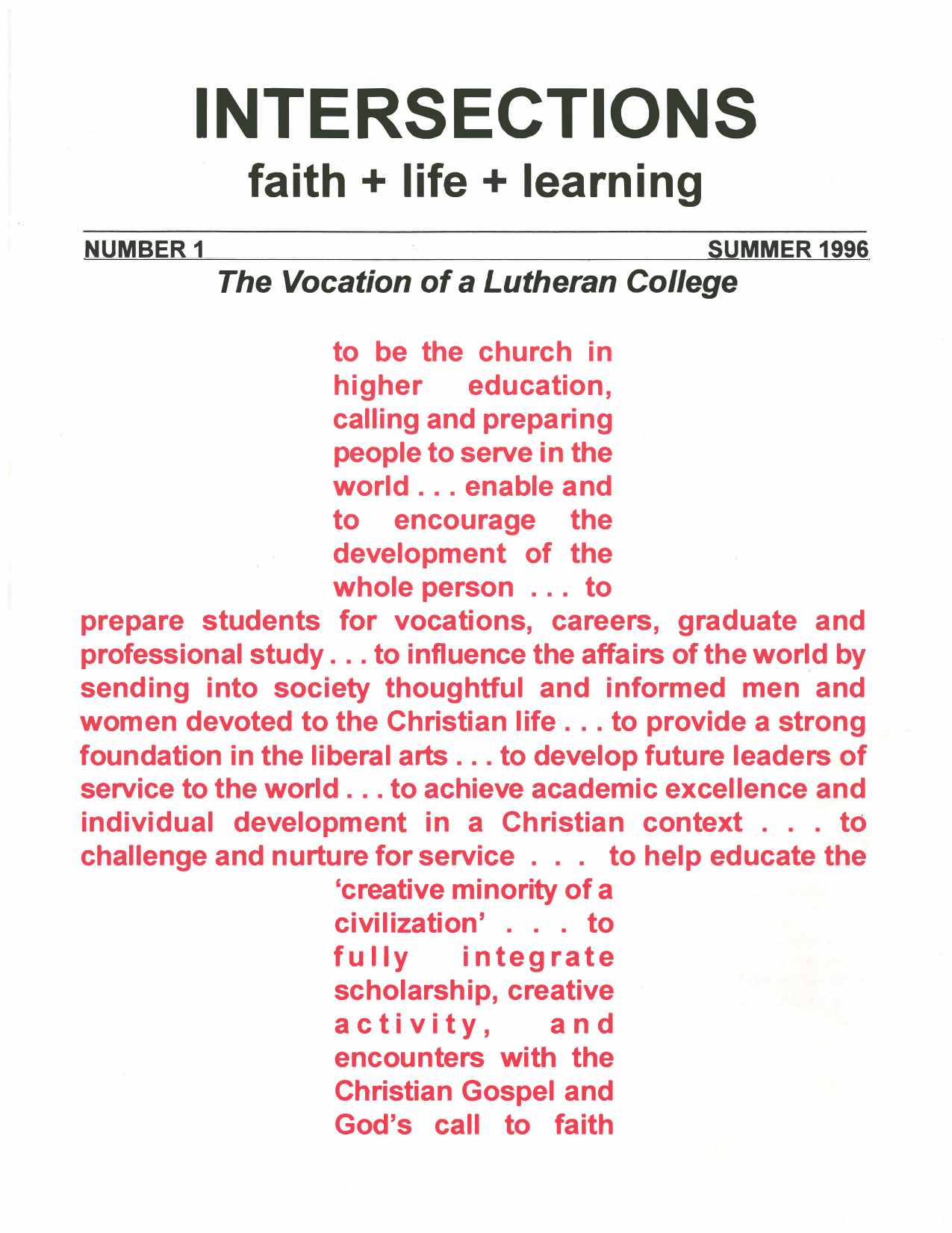
Number 1
The inaugural Summer 1996 issue of Intersections launches the journal alongside the first Vocation of a Lutheran College Conference at Capital University. Mark Schwehn’s keynote “The Future of Lutheran Higher Education” frames the Christian university around the pursuit of truth and liberal learning, with responses from Marsha Heck, Kurt Keljo, Thomas Templeton Taylor, John Rehl, Florence Amamoto, and Sandra C. Looney probing moral action, witness, secularization, and lived Lutheran identity.
Editors
Articles in this Issue
-
 Editorial
From the Publisher
James M. Unglaube
Unglaube welcomes readers to the inaugural issue of Intersections, crediting Editor Tom Christenson and Capital University, and announces the new annual Vocation of a Lutheran College Conference whose continuing dialogue the journal exists to enhance. He gives thanks to the Lilly Endowment for a sizable grant supporting the 1996 conference, campus dialogues, and the birth of the publication.
-
Editorial
From the Editor
Tom Christenson
Christenson, feeling like a proud parent, welcomes readers to the inaugural issue and acknowledges three people without whom the publication would still be just an idea: Naomi Linnel of the ELCA office for Higher Education and Schools, publisher Jim Unglaube, and Capital University president Josiah Blackmore. He invites readers’ reactions, suggestions, and active involvement as editors, reviewers, authors, artists, and critics in shaping the dialogue across the ELCA college and university family.
-
Article
The Future of Lutheran Higher Education
Mark Schwehn
Schwehn’s keynote, framed against Otto Paul Kretzmann’s October 1940 inaugural at Valparaiso, organizes itself around four topics: the idea of a Christian University (Lutheran schools as a tributary of the Christian intellectual tradition, voices in a conversation in the spirit of H. Richard Niebuhr and Alasdair MacIntyre rather than phases of James Burtchaell’s devolutionary scheme); the pursuit of truth (against Foucauldian reduction of truth to power, with Hilary Putnam, toward a cruciform discipleship that discovers truth ambulando); the critique of knowledge (developing Christian theories of knowing in conversation with Benne, Lotz, Wolterstorff, LeClerc, and Augustine); and Christianity and liberal learning (objectivity refurbished as Thomas Haskell’s ascetic self-discipline, and the recovery of texts that have claims upon us).
-
Response
"Whose Future?" or "Social Justice and the Lutheran Academy?"
Marsha Heck
Heck argues that the future of Lutheran higher education lies less in defining Lutheran distinctiveness than in moral action grounded in face-to-face relationships with others. Drawing on David Lotz’s two-kingdoms theology of citizenship, Ernest Simmons’s relational reading of Luther, Arthur Preisinger’s indictment of the German Lutheran misreading of two kingdoms during the Third Reich, Starla Stensaas of Dana College, and Paulo Freire’s dialectic of empowerment, she calls Lutheran colleges to integrate moral reflection with moral action—to move students’ muscles against what is not true as well as to feel truths in their bones.
-
Response
Knowing and a Tradition to be Known
Kurt Keljo
Keljo, University Pastor at Capital, embraces Schwehn’s vocational call but challenges his epistemological framing. We are called to bear witness to the Truth more than to pursue it; truth and power need not be dissociated when power is understood cruciform-ly as love and service; alongside objectivity, a case can be made from the tradition for connected knowing (image of God, idolatry, repentance, Incarnation). Christians offer not a particular epistemology but a foundation for epistemology—a tradition to be known. He closes with James Fowler’s four marks of the “public church”: particularly Christian, prepared for pluralism, balancing intimacy with public engagement, and unafraid of ideological pluralism in confident, nondefensive civility.
-
Response
Lutheran Colleges: The Context for the Conversation
Thomas Templeton Taylor
Taylor of Wittenberg engages Schwehn’s first argument by sketching the institutional predicament of Lutheran colleges through three converging forces: the collapse of differences among old-line Protestant groups in the wake of ELCA-era ecumenism (with Robert Wuthnow); the secularization of American higher education described by George Marsden; and the post-war decline of liberal arts colleges under pressure to professionalize. The result is an “in-between stage” in which Lutheran colleges retain rhetoric without substance. Following Richard John Neuhaus’s “Eleven Theses,” he argues that, for a time at least, Lutheran colleges’ institutional affiliations must remain actively Lutheran if they are to remain in any sense Christian.
-
Response
Renewing Our Journey: Some Thoughts on Pursuing the Truth
John Rehl
Rehl, a Capital University graduate pursuing doctorates in theology at Chicago and in economics at Wisconsin, takes up Schwehn’s invitation to think again on the nature of truth. He sets aside truth as information, as object, and as mere words; recasts the church-related college’s task as a renewed emphasis on classroom teaching (Kierkegaard’s teacher as midwife) and on brave, articulate professors. He calls for moral education in courage, discipline, patience, and love, illustrates the costs of the fact-value split with examples from economics, and argues that we honor Lutheran heritage not by preserving it as a museum piece but by testing it—Luther’s theology of the cross over a theology of glory—and by preparing students for a world of Untruth, strengthened (with Julian of Norwich) by the promise that they will not be overwhelmed.
-
Institutional Focus
Diversity and Dialogue: Gustavus Adolphus College
Florence D. Amamoto
Amamoto, a third-generation Japanese-American Buddhist who teaches American literature at Gustavus Adolphus and regularly attends daily chapel, writes as an “inside outsider.” Engaging Schwehn’s closing call to refurbish the Lutheran college, she argues that church-related colleges are vitally important to society, that “refurbishing” must take up diversity, and describes how Lutheranism is manifest at Gustavus: Christ Chapel as the highest point on campus, the ecumenical chapel program led for thirty years by Chaplain Richard Elvee, the Nobel Conferences that pair scientists with philosophers and theologians, the First-term Seminar and Tuesday Conversations, the India study-abroad program organized by Deane Curtin, and the Sponberg Chair in Ethics. She names the pressures of money, secularization, and the publications-driven push for “excellence” that threaten this creative tension.
-
Institutional Focus
Continuing the Dialogue: Augustana College
Sandra C. Looney
Looney describes Augustana College, Sioux Falls, debating and renaming its values—Christian, Liberal Arts, Community, Excellence, Service—under the leadership of religion professor Dr. Arthur Olsen and the T’N’T (“Through Thick and Thin”) committee, in the wake of ELCA Region III’s “What Does It Mean to be a College of the Church?” conversations. She describes Augustana’s 56% Lutheran student body, daily 10 a.m. chapel, dual Christmas Vespers in Our Savior’s Lutheran Church and St. Joseph’s Cathedral, the Capstone classes on moral and aesthetic issues, and the ongoing work of enlarging Augustana’s conversation to include Native American, Jewish, and Islamic voices.