An Invitation
Those of you who read the first issue of INTERSECTIONS and have this one in hand probably recognize a pattern, Both of these first two issues have much the same format: 1) a lead essay previously delivered at a Vocation of Lutheran College Conference and 2) several responses. The question therefore naturally arises, will all issues of INTERSECTIONS look like this? The answer is no, definitely not.
While we plan to devote one issue each year specifically to continuing the dialogue initiated at these conferences, we also intend another issue which is more open-ended, open-textured, and shaped by the kinds of essays, reviews, poems and/or other artwork you, our readers, send us. We’d be particularly interested in getting letters about things we’ve already published, things that may have inspired, puzzled or upset you. The idea is to engender engaged discussion. We hope, in fact, to receive so much good stuff from you to necessitate publishing more than twice a year. We aren’t presently set up to do that, but it would be a nice problem to have.
Thus far a trickle of interesting manuscripts have begun to come in. We are in process of planning an exciting summer issue which will be sent out to your campuses first thing in September. So please write us and share your good work with us and thereby with your fellow faculty / administrators at the other ELCA colleges and universities.
Turning Toward Learning
Every semester I have a class of about 30 seniors read some selections from Aristotle’s Nichomachean Ethics. What they read includes the following sentences: “Learning and study [theoria] seem to be the only activities which are loved primarily for their own sake. For while we derive an advantage from practical pursuits beyond the action itself, from study we derive nothing beyond the activity of learning.” These sentences never fail to draw a response, usually a disbelieving hoot of laughter. But frequently a student will say, “Not only is study useful for other ends, but that’s the only reason that it’s pursued at all. No one would study just for the sake of learning. It’s not like it’s pleasurable or something. If I didn’t think the diploma would get me a job, I wouldn’t be studying at all.” At this point we usually have an interesting discussion about how an otherwise intelligent Hellene like Aristotle could have gotten this so wrong.
I am not the only person who has noticed that many students are not well disposed toward learning for its own sake. Many faculty colleagues (at my own and other institutions) testify to an array of facts: a) Students rarely pursue a reference or a suggestion to read something in addition to what is assigned. b) Even assigned material may be skipped if “it won’t be on the test.” c) Faculty are, consequently, spending more and more time “policing assignments.” I, for example, find it necessary to have my students turn in daily reading reports on assigned reading. Failing to require this I find only about 1/5 of my students will read the assignments in a timely manner. d) Faculty who require substantial amounts of work from students (even in traditionally high-pressure majors like pre-med) are frequently blamed, negatively evaluated, and even verbally assaulted for expecting the quantity and quality of work they do. e) There is an alarming increase in cheating, plagiarism and academic dishonesty across the country. Frequently students respond to the “inconvenience” of being caught and punished by saying: “After all, I just wanted the grade, not to really learn that stuff.”
Faculty gatherings over lunch or coffee often turn toward complaining about the lack of learning motivation in students. The problem is, of course, that our complaining about it does nothing toward addressing the problem. So my focal question is: “What can a college/university do to help turn students in a positive way toward learning?” I will not claim that it’s a problem that can be “solved” or eradicated because the sources of it lie so deep in our culture. By the time students arrive in college the attitude may already be quite firmly set. But the question is: “What can we do to help turn students toward learning?”
Neil Postman, in his recent book, The End of Education, argues that this alienation toward learning takes place as commonly as it does because young people across our country lack a set of narratives within which the efforts of learning make sense. Postman writes, “Without a narrative, life has no meaning, Without meaning, learning has no purpose. Without a purpose, schools are houses of detention, not attention. This is what my book is about.” There are publicly espoused narratives that make sense of getting a diploma: “getting a good job,” i.e., one that will support a high-consumption lifestyle, and there are narratives within which educational reform may make sense: “Keeping the US competitive in world markets.” But, he notes, there are few, if any, narratives that connect the effort and discipline required for learning to a larger story or sense of purpose that students relate to.
Postman goes on to argue for organizing education around five “mega-narratives” that he thinks would make sense to college-age learners and inspire the effort required for learning.
Spaceship Earth - How can we learn to live sustainably and well in a world with finite resources?
The Fallen Angel - The investigation and acceptance of our history as an error prone species combined with a serious effort to learn from our own mistakes.
The American Experiment - The serious re-posing of Lincoln’s question, whether a government of the people, by the people and for the people can long endure.
Word Weavers/World Makers - Learning how the creation of a language also constructs a world.
The Appreciation of Diversity - Learning to appreciate racial, cultural, ethnic, and linguistic diversity and learning to savor the richness of a pluralistic culture.
The discussion of any one of these could, I am sure, occasion lively debate among any faculty group. But I list them here not to discuss each so much as to appropriate Postman’s general idea. I believe that there is merit in Postman’s suggestion that many students today lack narratives in terms of which learning makes sense and has meaning. Postman suggests that those of us who teach in institutions embedded in a religious context do not have this problem. He suggests that education in a religious context automatically solves this problem since it naturally provides religious mega-narratives that motivate and inspire learning. I only wish this were so, but I think Postman here has overstated the case.
Each of the 28 ELCA colleges and universities has a mission statement. A quick reading of our college catalogues reveals, however, that they are, for the most part, general, vague, and innocuous. They are frequently statements designed to imply little and offend no one. But even in cases where the mission statements are fairly well-focussed and memorable one comes away from the reading of the catalogue with the feeling that there is little, if any, implicit connectedness between mission statement and academic program. So, the question is, how can we expect students to be inspired to learn by our mega-narratives when the faculty, administrators and trustees of our institutions are so little inspired by them?
Even in cases where there may be a close match between mission narratives and program we may fall short of Postman’s ideal if we fail to make the connection explicit to each generation of faculty we hire and each generation of students we admit. How clear are we about the narratives that shape what we do and why we do it? Do we simply suppose that because people have read the catalogue that this connection is clear and obvious? Do we assume that the same statements that may have inspired learning and teaching at our institutions in the past continue to do so today? Do any students and faculty come to our institution because of its informing mega-narrative? Like all good philosophers, I have more questions here than I have answers. But sometimes questions can be informing and provocative too.
I want to pose a challenge to all of us who work at education within the Lutheran tradition. The first part of the challenge is to identify some of the mega-narratives which may be of particular salience to Lutheran Christians. Here are some that occur to me: a) An exploration of the meaning of stewardship, particularly the stewardship of creation. b) An exploration of the freedom of the Christian and its implications for learning. c) The implications of sacrament; that the transcendent is present in, with and under the concrete and ordinary. d) An exploration of vocation as it applies to career, our responsibility in and to our society, and to the vocation of being a student as well. I am willing to bet you can think of others at least as interesting.
While I think it would be a mistake for all of us to list all of these as informing mega-narratives (since no institution could programmatically do justice to all of them) it would be refreshing to see some of us take some (or at least one) of them seriously. An institution explicitly inspired by the freedom of the Christian or by the dimensions and implications of stewardship would, I think, be an inspiring and interesting place to be. What would be discouraging and dispiriting, on the other hand, would be to be part of an institution that lists all these things in its mission statement but uses the statement merely as a cover letter for business as usual.
Tom Christenson
Capital University
January, 1997
-
 Editorial
From the Publisher
James M. Unglaube
Unglaube reports on the second annual Vocation of a Lutheran College conference of August 1996, where Walter Bouman of Trinity Lutheran Seminary addressed “What is Lutheran; What is the Lutheran Tradition” (biblical, catholic, evangelical, sacramental, world-affirming—the world “received, enjoyed, served as God’s Gift”). He previews presentations by Wendy McCredie of Texas Lutheran and Baird Tipson of Wittenberg on how the Lutheran tradition is embodied in its colleges, and Bob Vogel’s challenge in “Coherence—And Now what?” that the tradition comes to life in how faculty give expression to their beliefs and values in the classroom and with colleagues.
-
Article
Lutheran Tradition: Five Continuing Themes
Walter R. Bouman
Bouman of Trinity Lutheran Seminary identifies five themes central to the Lutheran theological tradition (understood through Alasdair MacIntyre’s account of tradition as “an historically extended, socially embodied argument”): biblical (a non-oppressive authority for the Bible rooted in the gospel rather than in scholastic inerrancy, against the backdrop of Luther’s 1517 challenge to Tetzel and the post-Enlightenment marginalization of theology); catholic (continuity with the Book of Concord and the three ancient creeds, with Luther’s “Christology from below” recovering a Jewish rather than Hellenistic understanding of God, revived by Tillich, Pannenberg, Forde, and Jenson); evangelical (justification by faith as the answer to mortality’s radical question); sacramental (Word, Eucharist, and Baptism as Christ’s presence from the future of God’s consummated Reign); and world-affirming (creation as gift, vocation as God’s work in every calling, and stewardship of the ecological crisis).
-
Response
“My Wife, We Have Not Come to the End of All Our Trials, but a Measureless Labor Yet”: The Lutheran Argument in Colleges
Steven Paulson
Paulson of Concordia College responds to Bouman by invoking Penelope’s unreasonable patience for Odysseus and asking whether Bouman’s five “principles” deliver the “continuities of conflict” that MacIntyre’s account of a living tradition demands. He argues that the proper Lutheran “continuity of conflict” is the praxis of proclamation—Christ crucified as “a stumbling block to Jews and folly to Gentiles”—which is given outside the institution’s walls and which colleges and universities, as socially embodied arguments, “can’t like” because it places truth beyond their control. The Lutheran problem, he concludes, is not the Enlightenment or Post-Modernism but the “old Adam,” the Odysseus still unsure of his identity.
-
Response
Disputatio Pro Quo? The Search for Lutheran Education
Jon-David Hague, Kimberly Hague
Kimberly and Jon-David Hague—both Luther College graduates completing graduate studies at Berkeley and Boston University respectively—respond to Bouman by offering Luther’s curriculum reform at Wittenberg University in the spring of 1518, only months after the 95 theses, as a model of the Lutheran voice in higher education. Inspired by humanistic principles, Luther introduced lectures on classical authors and the first instruction in Greek and Hebrew, giving students the tools to encounter scripture directly rather than receive dictated doctrine. The spirit of that reform—providing students with every possible tool while acknowledging that an instructor’s perspective is neither ultimate authority nor final word—remains useful for the search for Lutheran academia today.
-
Response
Feeling at Home: Dimensions of Faculty Life
Jane Hokanson Hawks
Hawks of Midland Lutheran College responds to Bouman by reflecting on her path from a Lutheran childhood through the BSN at St. Olaf and thirteen years at four non-church-related institutions to her present home at Midland, where teaching at a Lutheran institution finally feels “right.” Bouman’s framing of the five themes as the Lutheran argument about what it means to be human helped her ad-hoc committee articulate the spiritual role in Midland’s new faculty mentoring program (recently funded by the Lilly Foundation), and grounds her work as a nurse educator confronting the daily humanness of grief, joy, ethical dilemmas, and care across cultural and religious difference.
-
Response
“You Shall Know the Truth, and the Truth Will Set You Free”: A Scientist’s Response
Ben Huddle
Huddle of Roanoke College proposes adding a sixth theme to Bouman’s five—the scientific method—as a tool for knowing the Truth not available to Luther but central to twentieth- and twenty-first-century learning. Diagramming the continuous cycle of observations, laws, theories, and predictions, he argues that scientists must be ethical and that scholars in other fields must understand the scientific method (lest environmentalists ignore the Second Law of Thermodynamics). A Lutheran college, he concludes, should treasure both the religious and the scientific tradition: stifling either loses meaning or significance, and the Lutheran tradition is therefore biblical, catholic, evangelical, sacramental, scientific, and world-affirming.
-
Response
On the Outside Looking Out: A Personal and Social Psychological Response
Chuck Huff
Huff of St. Olaf—a self-described “Metho-Bap-terian” from the South educated at Bob Jones University—offers a personal response to Bouman’s themes (welcoming the rejection of biblical inerrancy, the distinction between gospel and scripture in the homosexuality debate, the gospel-in-the-creeds reading that releases him from Hellenistic conundrums, and the recasting of justification by faith as meaning rather than insurance policy) and a social-psychological response in which a planned study of campus social networks at St. Olaf was discontinued when preliminary interviews revealed that everyone—storied Lutherans, secular faculty, feminists, fundamentalists—felt like outsiders. Continuing the tradition requires constructing a conversation that is thoughtful, fair, inclusive, charitable, focussed, and still true to the tradition.
-
Poem
Two Poems: The Advent Carol / The Madonna of Dohany Street
Brian Forry Wallace
Two poems by Brian Forry Wallace of Capital University: “The Advent Carol,” a litany of the babies who were not adored—the Jewish baby shot with a Luger, the Black child hanged from a tree, the female messiah tossed into a river, the Tutsi infant cut by machetes, the Japanese newborn incinerated by atom bombs, the Chinese baby crushed by Japanese bombs, the aborted Mary’s child—ending with the baby “whom we do not understand, cannot feed, whom we kill”; and “The Madonna of Dohany Street,” on a Holocaust photograph in a Budapest museum of a dead mother and her dead Christ-child daughter in the former ghetto, in which annunciation, nativity, adoration, and crucifixion are seen together in a single instant.
-
Institutional Focus
Embodying the Tradition: The Case of Wittenberg University
Baird Tipson
Tipson, President of Wittenberg University, locates Wittenberg in the “American” strain of Ohio Lutheranism founded in 1845 under Ezra Keller (a Pennsylvania College and Gettysburg Seminary graduate and disciple of Samuel Simon Schmucker), with English-language preaching, financial support from the pan-Protestant New England Society, Presbyterians on the Board, and an Episcopalian teaching Latin. He names two ongoing challenges—remaining authentically Lutheran while welcoming a pluralistic student body (just under a quarter are Lutheran in a primary service area that is 5% Lutheran), and making the tradition clear and compelling to non-Lutheran or lukewarm Lutheran students—and presents the five things every Wittenberg graduate should be able to do (respond to the human condition; recognize, define, and solve problems; develop a sense of vocation; assume servant-leadership; take moral responsibility) as authentic expressions of the Gospel and of the university’s ELCA relationship.
-
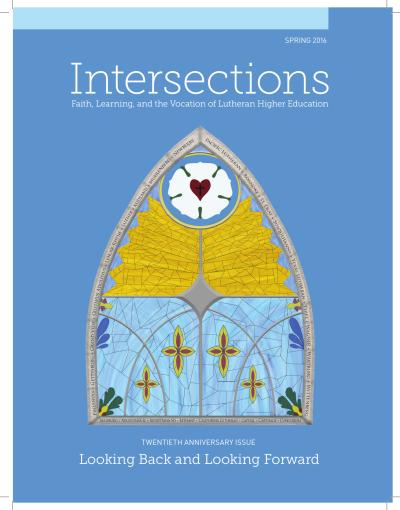 Article
The Vocation of Intersections on its Twentieth Birthday
Jason A. Mahn, Robert D. Haak, Tom Christenson
No. 43 · Spring 2016
The three editors of Intersections — Bob Haak, Jason Mahn, and Tom Christenson (in spirit, following his death in 2013) — trace the twenty-year vocation of the journal itself: its 1996 birth at Capital University; its coming-of-age years of debate over institutional markers, two-kingdoms theology, and Lutheran identity; the ascendancy of “education for vocation” as the central marker of Lutheran higher education; and its ongoing identity in relation to a changing ELCA and to the broader cultural conversation about purpose, wholeness, and the vocation of higher education.
-
 Article
Point / Counterpoint: What It Means to be a "College of the Church"
Robert Benne, Tom Christenson
No. 28 · Fall 2008
Moderated by Wartburg College pastor Larry Trachte and introduced by Kathryn Kleinhans, this Wartburg campus conversation between Robert Benne (Roanoke College) and Thomas Christenson (Capital University) probes what it means to be a college of the church—Benne emphasizing ethos, vocation, and the Christian intellectual tradition over against secularization and generic education, and Christenson lifting up persistent vocational questions, the gift of difference, and induction into a community of discourse—and finds large common ground around hiring for mission, pedagogy that asks deep questions, and the courage to claim a living religious tradition while inviting everyone to the banquet.
-
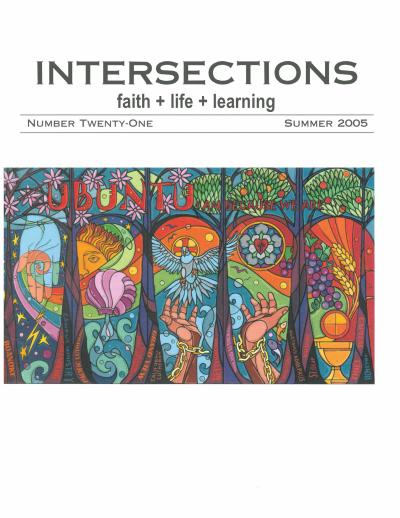 Article
Education as a Christian (Lutheran) Calling
Tom Christenson
No. 21 · Summer 2005
Christenson opens with an imaginative reconstruction of early Christian communities as radically egalitarian, pacifist, communitarian gatherings within the Roman Empire and argues that such communities are natural homes for the educational vocation. Naming two temptations for contemporary Christian higher education—the parochial Bible school and “Generic U”—he uses his friend Sig Rauspern’s tree metaphor to insist that a university is Christian in its trunk and roots rather than in grafted-on branches. Drawing on Wendell Berry, Jacob Bronowski, Walter Wink, Douglas John Hall, and his own Gift and Task of Lutheran Higher Education, he names faithful criticism, engaged suspiciousness, simul justus et peccator, and a fallible, love-related Lutheran epistemology as the particular gifts Lutherans bring to the Christian educational calling.
-
Editorial
From the Editor
Tom Christenson
No. 21 · Summer 2005
In his valedictory letter as outgoing editor, Christenson recounts the 1994 origins of Intersections, when he took the idea to Naomi Linnell and Jim Unglaube at DHES and persuaded the council of presidents to launch the journal on a shoestring with printing paid by DHES and everything else by Capital University. He summarizes the issue’s contents—papers from the 2004 Vocation of a Lutheran College Conference plus two commissioned pieces from former DHES directors Bob Sorensen and Leonard Schulze—and thanks the student copy editors and Capital’s presidents and provosts who sustained the publication.
-
 Book Review
Review of Educating for Shalom: Essays on Christian Higher Education
Tom Christenson
No. 20 · Fall 2004
Christenson reviews Nicholas Wolterstorff’s Educating for Shalom: Essays on Christian Higher Education (Eerdmans, 2004), edited by C.W. Joldersma and G.G. Stronks. After recounting his own early prejudice against Wolterstorff’s Reason Within the Bounds of Religion and his subsequent conversion through Art in Action, he focuses on two threads: Wolterstorff’s expansive reading of shalom—not merely peace but justice, community, communal responsibility, and delight—as the overall goal of Christian collegiate education, and the influence of Abraham Kuyper’s claim of “privileged cognitive access” for Christian inquirers, which Wolterstorff demonstrates rather than declares.
-
Editorial
From the Editor
Tom Christenson
No. 20 · Fall 2004
Christenson introduces an issue featuring “young and old, angry and encouraging, prophetic and hopeful” voices unified by the assumption that Christians engaged in thinking and educating will ask hard questions: how to raise concerns about militarism and the new American “imperialism,” what a Lutheran law school will say about training a new generation of attorneys, and what Lutheran colleges communicate to undergrads about vocation. Such faithful criticism, he argues, is part of who Lutheran institutions are.
-
 Article
Practicing Hope: The Charisms of Lutheran Higher Education
Martha E. Stortz
No. 32 · Spring 2010
Stortz names four charisms—theological gifts of identity rather than commodities—that Lutheran higher education brings to a culture of fear: semper reformanda as flexible, responsive institutions; the freedom of a Christian as simul justus et peccator critical inquiry that holds opposites in creative tension; regard for the other as “neighbor” rather than friend or alien; and the priesthood of all believers as a public, civic calling to know the poor. Drawing on Augustine, George Lindbeck, Patricia Killen, James Clifford, Earl Shorris, Carter Lindberg, and Augsburg’s Center for Global Education, she argues that immersion trips, neighbor-regard, and welfare reform witness that the gift Lutherans bring is hope grounded in Christ in you, the hope of glory.
-
 Editorial
From the Publisher
Mark Wilhelm
No. 39 · Spring 2014
Wilhelm interrogates the widely used phrase “the model is broken,” arguing that it blames the victim, masks the demographic and public-funding pressures actually facing ELCA higher education, and distracts from the work of modifying—rather than discarding—a model of educating the whole person that has successfully adjusted across the centuries.
-
 Article
Ivory Tower or Holy Mountain? Faith and Academic Freedom
Nicholas Wolterstorff
No. 11 · Spring 2001
Wolterstorff defines infringement of academic freedom as impairing a faculty member’s standing on account of the ideological content of her position, argues that academic freedom (like free speech) is “duly qualified” rather than absolute, and offers eight considerations bearing on religiously based institutions: Weber’s differentiation of Wissenschaft, religious pluralism within a liberal polity, the vitality of American civil society, a decentralized educational system, the “holistic” character of much American religion, the post-Kuhnian collapse of classical foundationalism and of the “generically human” academy, the fact that ideas matter, and the personhood violated by infringement (the desecration of an image of God). He concludes that the private sector offers wider academic freedom than the public, that religious qualifications are not inherently inappropriate (any more than St. John’s Great Books commitment), but that religiously based colleges too often apply them unjustly—arbitrarily, secretly, without recourse—and that the AAUP’s best service is model codes of procedure.
-
 Reflection
The Importance of Connection
Alex Piedras
No. 58 · Fall 2023
Piedras reflects on the 2023 “So that We, Too, May Flourish” Conference at Augsburg as a refreshing space for a weary DEI advocate — surfacing burnout, the Talking Circle on Indigenous Issues, and Dr. Monica Smith’s Racial Healing Circle as opportunities to recharge the soul and build authentic connections for the long journey.
-
 Article
Critical Engagement in Public Life: Listening to Luther's Troubling Questions
Samuel Torvend
No. 35 · Spring 2012
Torvend narrates the medieval “spiritual/temporal” division and the neo-platonic devaluation of the body that shaped the world into which Luther was born, then traces the disruptive questions Paul’s letters provoked in Luther: about indulgences, the two estates, vocation, and the public reach of baptism. He argues that Luther’s reform — expressed in Kirchenordnungen, social welfare reform, public schools, and writings on lobbyists, usury, and monopolies — carries a “genetic encoding” of public engagement that Lutheran colleges should reclaim against the temptations of holy apathy and Christian nationalism.
-
 Article
Where Your Feet are Standing: Institutional Engagement and Place
Melissa Maxwell-Doherty
No. 54 · Fall 2021
Maxwell-Doherty draws on Cal Lutheran’s Hispanic-Serving Institution designation and its location on Chumash, Fernandino Tataviam, and Ohlone lands to ask how the university’s mission might shift if it depended on where its students are standing — not just where the institution sits.