Endings and Beginnings: Some Reflections on the ELCA and Higher Education in the Last Decade
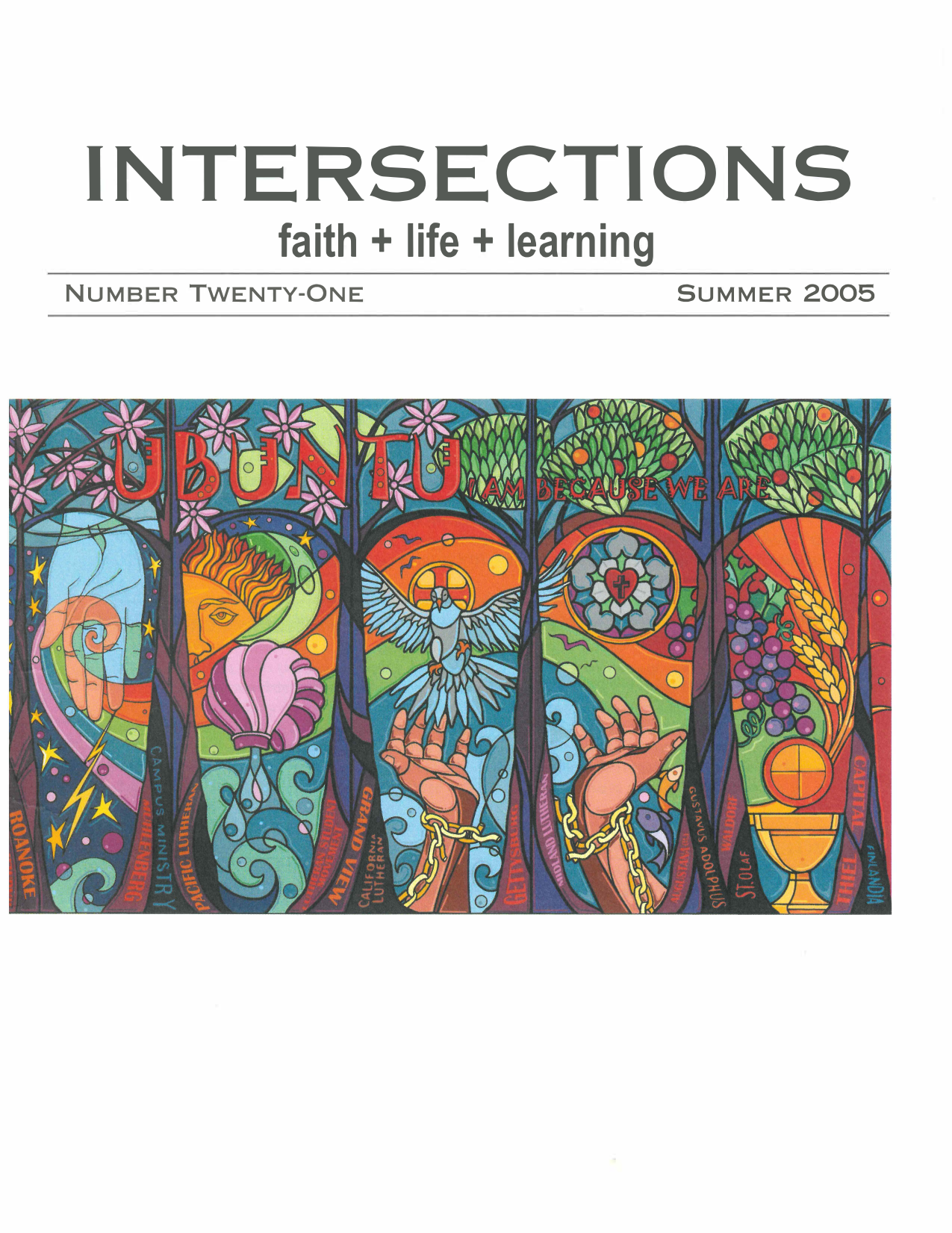
The Summer 2005 issue is transitional—Tom Christenson’s final issue as founding editor before handing off to Bob Haak, and a turning point as the ELCA Division for Higher Education and Schools folds into a larger unit. W. Robert Sorensen and Leonard G. Schulze reflect on DHES. From the 2004 Vocation of a Lutheran College Conference at Carthage, Loren J. Anderson explores public witness in the Pacific Northwest’s “None Zone”; Harvard Stevens Jr. preaches on Proverbs; Pamela K. Brubaker examines money, sex, and power; Christenson closes on education as Christian calling.
Editors
Articles in this Issue
-
 Editorial
From the Publisher
Arne Selbyg
Selbyg notes that ELCA colleges and universities have remained more loyal to the church than the institutions of many other denominations and announces that with this issue Tom Christenson’s nine-year service as editor of Intersections comes to an end, with Bob Haak of Augustana College in Rock Island assuming the editorship and institutional support shifting from Capital to Augustana.
-
Editorial
From the Editor
Tom Christenson
In his valedictory letter as outgoing editor, Christenson recounts the 1994 origins of Intersections, when he took the idea to Naomi Linnell and Jim Unglaube at DHES and persuaded the council of presidents to launch the journal on a shoestring with printing paid by DHES and everything else by Capital University. He summarizes the issue’s contents—papers from the 2004 Vocation of a Lutheran College Conference plus two commissioned pieces from former DHES directors Bob Sorensen and Leonard Schulze—and thanks the student copy editors and Capital’s presidents and provosts who sustained the publication.
-
Article
Changes
W. Robert Sorensen
Writing as former executive director of the Division for Higher Education and Schools, Sorensen places the DHES within the threefold movement of Luther’s Reformation—university, church, and individual piety—and recounts how the Division cohered its work with colleges, universities, campus ministries, and schools around Joseph Sittler’s definition of education as “movement into a larger world.” Drawing on Huston Smith’s “primordial tradition,” the Namibian student program, work in India and Palestine, and the Bergendoff series of publications, he raises a twofold concern about the proposed merger of DHES into a Division for Vocation and Education: whether the new structure will signal the core significance of education in the heritage and life of the church, and whether it can carry forward the effectiveness and scope of DHES’ work.
-
Article
The Church in Education? Education in the Church? Ten Theses on Why These Questions Matter
Leonard G. Schulze
Writing in the months before the August 2005 Churchwide Assembly that will decommission DHES, Schulze frames his vision for the division as ten Lutheran-style theses, each followed by Luther’s catechetical question “What does this mean?” He argues that critical thinking and moral deliberation are in the Lutheran gene pool; that Luther’s devotion to learning was an expression of Christian vocation; that the rise of the research university and the binary public meaning of “evangelical” have marginalized church-related colleges; that DHES has been wrongly perceived as marginal; and that the reformed concept of vocation must drive the soon-to-be-created program unit for Vocation and Education. An appendix reproduces the 2005 DHES strategic planning overview.
-
Article
Private University, Public Witness: Life in the "None Zone"
Loren J. Anderson
Drawing on sixteen years at Concordia College in Moorhead and twelve at Pacific Lutheran University, Anderson contrasts the Lutheran heartland with the Pacific Northwest’s “None Zone”—Patricia Killen and Mark Silk’s name for the country’s least churched region—and argues that a faithful Lutheran witness is possible in this changing context. He proposes five callings for the colleges—an academic program shaped by both educational philosophy and Lutheran theology, vibrant campus communities of faith and learning, inclusiveness and ecumenical outreach, global vision, and vocational exploration—and closes by sketching PLU’s shift toward “partnership” congregations and a new Center of Religion, Culture and Society in the Western United States.
-
Reflection
Finding Words That Matter (Proverbs 1:20-21; 4:10-13)
Harvard Stevens Jr.
In a brief homiletic reflection on Proverbs, Stevens addresses Lutheran educators as “merchants of wisdom” competing with a crowded contemporary marketplace of internet, cable TV, and rap music alongside “Hedonism 101,” “Advanced Voyeurism,” and “Pure Escapism.” Recounting an evening with a Carthage student poetry club, he shares the poem wisdom whispered to him there and offers thanks for the high calling to teach “words that matter.”
-
Poem
Sprigs of Mint
Caitlin McHugh
McHugh meditates on three light green mint stalks dying in a plastic cup of water in her window frame’s shadow, drawing a parallel between the neglected mint, the “tainted papers” of her unread journals, and the time that both holds her back and drives her forward.
-
Article
Money, Sex and Power: An Exploration of Some Controversial Issues in the Public Witness of the Church
Pamela K. Brubaker
Brubaker explores two controversial issues in the church’s public witness—homosexuality and economic life—and the challenges they present for both church and college. Drawing on Beverly Harrison, Elizabeth Bounds, Ron Thiemann, Linell Cady, Marcia Bunge, Richard Hughes, Darrell Jodock, Ernest Simmons, Karen Bloomquist, Garth Kasimu Baker-Fletcher, and Larry Rasmussen, and on episodes at California Lutheran University around “Harmony Week” and Bishop Paul Egertson’s participation in Anita Hill’s ordination, she argues that colleges related to the ELCA are called to educate for “critical citizenship” by hosting rigorous, bold, and unfettered debate—including debate over the neo-liberal globalism that she names a form of economic fundamentalism.
-
Article
Education as a Christian (Lutheran) Calling
Tom Christenson
Christenson opens with an imaginative reconstruction of early Christian communities as radically egalitarian, pacifist, communitarian gatherings within the Roman Empire and argues that such communities are natural homes for the educational vocation. Naming two temptations for contemporary Christian higher education—the parochial Bible school and “Generic U”—he uses his friend Sig Rauspern’s tree metaphor to insist that a university is Christian in its trunk and roots rather than in grafted-on branches. Drawing on Wendell Berry, Jacob Bronowski, Walter Wink, Douglas John Hall, and his own Gift and Task of Lutheran Higher Education, he names faithful criticism, engaged suspiciousness, simul justus et peccator, and a fallible, love-related Lutheran epistemology as the particular gifts Lutherans bring to the Christian educational calling.