It was a joy to be part of the working group and writing team that helped compose Rooted and Open and that helped spark conversation among the Network presidents in June of 2017. At that gathering, I was asked to talk about that word “calling” and its Latin-derived alternate, “vocation.” Why do we talk so much about the vocation of a Lutheran college or university? Why is the subtitle of Rooted and Open, and the primary description of its contents, about NECU’s “common calling”? Why, according to the shortest encapsulation of what characterizes these 27 institutions, are our graduates first and foremost persons who are “called and empowered”?1
I begin this essay by reviewing how and why education-for-vocation, that is, our common calling to educate students for their own multiple vocations, has become something of a leitmotif, a central organizing principle, for the diverse missions (or institutional vocations) of our 27 schools. Rehearsing and embracing this decades-old development depends on clearly distinguishing the identity of a Lutheran college or university from the religious affiliations of the people who populate it. I then come to terms with a second distinction that structures the whole of Rooted and Open—that between the educational priorities (strategic plans, campus-wide initiatives, etc.) of our schools and the Lutheran theological soil out of which such priorities grow. I’ll conclude by raising some friendly critiques of Darrell Jodock’s central architectural metaphor of a bridge’s pillars and footings, especially in light of Rooted and Open’s own suggestive imagery.
Individual Lutherans and Institutional Vocations
As Mark Wilhelm describes, “education-for-vocation” or what he calls “the vocation movement” was not always front and center of discussions about what it means to be a Lutheran institution (Wilhelm 59-63). In fact, 50 or even 30 years ago, there was very little discussion about what it actually meant to be a Lutheran college or university. A Lutheran college or university was simply assumed to be a place where Lutheran students went to be educated by Lutheran faculty members, who in turn were overseen by a Lutheran provost and president. Now for some (including for some of our alumni) this period entailed a kind of golden age of Lutheran higher education. Certainly there was no debate or doubt about what it meant to be a Lutheran college or university—it was quite simply a campus that had a majority of individual Lutherans on it. But notice that the designation “Lutheran” can mean very little here. It marks the church membership or self-identity of individuals on a campus, but it tells us next to nothing about what the institution as a whole is, and, even less, about what it does and is called to be.
“A Lutheran college or university was simply assumed to be a place where Lutheran students went to be educated by Lutheran faculty members, who in turn were overseen by a Lutheran provost and president.”
All of this changes when, in the latter part of the twentieth century, Lutheran institutions diversified along with most every other mainline church-related college. I follow Peter Berger in saying “diversified” or “pluralized” rather than “secularized” because the latter assumes a loss of religious identity, which simply has not happened historically (Matthews 152-53). On our campuses, there certainly was a decrease in the percentage of individuals who identify as Lutheran. Our Lutheran students (at Augustana College, the percentage hovers somewhere in the low teens) now have classmates and professors who identify as Jews and Muslims and secular humanists and neo-pagans and as “nones” (that is, none of the above—those who identity with no particular religious tradition—which may in fact be another distinctive posture of faith2).
This rapid diversification of individuals on our campuses was worrisome for many. The first and understandable reaction of many Lutheran schools was to try to hold onto a certain percentage of Lutheran students or Lutheran faculty or Lutheran board members. As long as we didn’t fall below a certain threshold, we could assure ourselves that we were Lutheran. You can see how easily this strategy could backfire. Besides having to revise downward that percentage of select individuals who need to be Lutheran as demographics change, this strategy of marking the “Lutheranness” of an institution by way of the individuals populating it, when taken alone, threatens to overlook and overshadow the more meaningful and relevant ways that a college—as a college—can be decidedly and effectively Lutheran. Couldn’t the college be Lutheran, couldn’t its mission be Lutheran, regardless of the religious affiliations of the individuals advancing that mission?
“Couldn’t the college be Lutheran, couldn’t its mission be Lutheran, regardless of the religious affiliations of the individuals advancing that mission?”
Taking all of this as a positive opportunity, some 30-some years ago our institutions began a serious and sustained conversation with one another about what “Lutheran” means when we are talking about the identity and mission of a college—what it is and it does. It is a long and ongoing conversation, but in recent years there has emerged something of a consensus around “education for vocation” as a helpful way to talk about our institutional identities and common calling.
I write here of our institutional Lutheran “missions” and “identities.” According to David Cunningham, Director of the Network for Vocation in Undergraduate Education (NetVUE), language of institutional callings or vocations may be more felicitous. He notes that the word mission (from the Latin missio) connotes a “sending.” An institution’s mission implies a push from behind—a trajectory established by those who founded the college or university, originally set its goal, and thus propel the rest of us toward it. Institutional vocation, by contrast, connotes a pull from and into the future. The discernment of an institution’s calling entails more than a recognition or recovery of its mission (but, I would add, certainly not less). It also entails listening to voices—Cunningham references the rising level of student protests in academic institutions over the last several years (264)—that can help pull the college or university into what it is yet to become. Discerning institutional vocation is an open-ended, dialectical process that attends to future possibilities in addition to present realities and past objectives (Cunningham 258-66).
Cultivating a Common Calling
As I have suggested above, “education-for-vocation” has slowly but surely become the primary way that we have come to name our individual institutional vocations, as well as the common calling of the Network of ELCA Colleges and Universities (NECU).
What is meant by “education-for-vocation”? At best, NECU institutions educate not exclusively or primarily to secure employment, to develop a “life of the mind,” or even for citizenship and to cultivate civil discourse and civic virtues, as important as each of these is. Lutheran institutions principally educate students so that they can discern the material and spiritual needs of other human and nonhuman creatures and then respond with committed service and out of a sense of gratitude. In the Christian tradition, such service is patterned after the life of Jesus, whose solidarity with a broken world brought salvation and healing to it.
Language of vocation is deeply rooted in Lutheran thought and practice. Before Martin Luther, only nuns, monks, and priests had vocations. For Luther, all persons are called to meaningful work—especially work that serves the common good and leads to the flourishing of another, whom Luther called “the neighbor.” Educating students so that they can discern their calling, their needed place in a needful world, is deeply Lutheran stuff.
At the same time, “calling” and “vocation” are not the exclusive property of Lutherans or even Christians. Rather, out of the depths of their own theological traditions, Lutheran colleges and universities educate Lutherans, other Christians, people from other religious traditions, and the nonaffiliated for lives of responsible, grateful service so that the world God created and redeems might also flourish. Neither do the faculty, staff, and administrators who educate for vocation need to be Lutheran. Indeed, some of the most intentional and effective educators advancing their institution’s callings hail from very different religious and nonreligious traditions. Perhaps not personally identifying with Lutheranism makes them more discerning and proactive as they link their own commitments to the calling of the college.
“Perhaps not personally identifying with Lutheranism makes them more discerning and proactive as they link their own commitments to the calling of the college.”
Those teaching and learning on our campuses live out their callings whenever they match their own passions and capabilities—their sense of being gifted—with the real needs of the world. They teach and learn in order to respond, to be helpful, and to care. Lutheran colleges and universities live out their callings when they help form their students and educators for vocation. In short, our collective institutional vocation is to educate for vocation.
Educational Fruits and Lutheran Roots
A quick examination of Rooted and Open reveals a three-part structure reflecting the central markings of Lutheran higher education and those who have become marked by it.3 Our common calling is to prepare our students to be “called and empowered—to serve the neighbor—so that all may flourish.” Less obvious is an important distinction within each of these three sections. Each begins with certain “educational priorities” shared by our institutions. Our schools are called to offer “an excellent education, rooted in the liberal arts, that engenders freedom of inquiry and prepares [our students] for meaningful work.” They all called to support students as they “discern their gifts and hone their skills so that they are able to contribute capably, confidently and courageously to the needs of a world that desperately needs them.” Finally, they are called toward the flourishing of the whole person and attention to the common good (NECU).
After each of these educational priorities is further unpacked, the document turns to the ways each is grounded theologically within the tradition of Lutheran thought and practice. Our calling to educational excellence and intellectual humility is grounded in Lutheran claims about the radical mystery of God and the “freedom of a Christian.” Our commitment to education for vocation, and to service, justice, and advocacy, is grounded theologically in God’s unmerited love and concern for all, which inspires those so graced to respond with gratitude and service to and beside others. Our calling toward the common good and commitment to the whole person is grounded theologically in the incarnation of God, the holiness of the everyday, and in a bold hope for the salvation (from salus—the healing) of all creation.
In the present volume of Intersections, both Marty Stortz and Colleen Windham-Hughes unpack these three educational priorities and their theological roots more fully than I am able to do here. The point I want to make is that, just as the distinction between a Lutheran institutional mission (or vocation) and the religious identities of individuals advancing it allows for the inclusion of a diverse group of allies and advocates for that mission, so too this distinction between educational priorities and their theological groundings ensures that the priorities can be advanced by educators who do not personally ascribe to the theology.
Augustana’s own articulation of what it means to be Lutheran also makes this distinction between educational priorities (or what we call our “faith commitments”) and the particular theology that grounds them. The bulk of Augustana’s Five Faith Commitments lists and exemplifies our commitments to interfaith engagement, social justice, spiritual exploration, the reasoned examination of faith, and vocational discernment. Christian language is used sparingly throughout these descriptions of our institutional commitments, Lutheran language even less so, and “Jesus” is not mentioned once (to the chagrin of a few who would want Augustana to be more confessionally Christian). And yet, the “Theological Context” that precedes the actual commitments ends with some rather robust theological claims:
Martin Luther believed that God is revealed in unlikely places — including a barn in Bethlehem and on a cross outside Jerusalem. Having learned to be surprised by this, members of Augustana enter into interfaith engagement with curiosity, anticipation, and wonder.
Luther understood Christian freedom to be comprised of both freedom from having to save oneself, as well as freedom for a life of service to neighbors in need. Augustana College is called to social justice out of a sense of liberation and gratitude.
Christians put worship of God at the center of their lives. Luther democratized worship, put the Bible in the hands of everyday Christians, and considered beautiful music to go hand in hand with prayer. Augustana commits to spiritual exploration out of these sensibilities.
As both pastor and professor, Luther called faith a “living, busy, and active thing.” Out of this spirit and the Christian quest for “faith seeking understanding,” Augustana commits to ongoing reasoned examination of faith.
Finally, the Lutheran reform movement understood God to call not only church leaders, but every person to work according to their giftedness and the world’s needs. Out of this understanding, Augustana educates for vocation and supports vocational discernment. (Augustana College)
In the terms of Darrell Jodock, the “distinction between educational priorities and theological values is crucial if a college is to follow a third path” (“Diverse Society” 12). By not distinguishing its theological groundings from its educational priorities, more “sectarian” schools fail to incorporate into its mission those who do not ascribe to their particular religious tradition, while for more “secular” (or “non-sectarian”) schools the educational priorities are only grounded in themselves, so to speak (12). By contrast, a third-path Lutheran college or university is both rooted and open precisely by distinguishing the particular Lutheran tradition that nourishes its priorities from the priorities themselves, which all are invited to nurture.
Tending to the Vocation of Lutheran Higher Education
No image has done more for sustaining conversation and commitment to Lutheran institutional vocation than that of Darrell Jodock’s “third path” (“Vocation” 5-6). In his essay from this issue of Intersections, he couples that path analogy with a second metaphor from civil engineering—that of bridges and bridge-building (“Diverse Society” 11-12). Distinguishing the daily activities of students and educators from the long-term planning and priorities of the college is like distinguishing the deck of a bridge from the pillars supporting it. And yet those educational pillars/priorities must in turn be distinguished from what secures them—the footings of the bridge, composed of a deeply anchored Lutheran theological tradition.
The analogy works well in imagining important distinctions. Still, I want to offer some appreciative critiques in order that the structural analogies not overshadow what Rooted and Open alternatively suggests—namely, that our institutions are more like well-rooted and widely branching plants than the products of human engineering. I have three interconnected reasons for my preference for analogies taken from botany and horticultural.
Growing in Two Directions
First, while bridges are built quite literally from the ground (or river bottom) up, most plants continue to grow downward while they also grow upward and outward. The deck-pillar-footings analogy suggests a one way column of dependence. The decking depends on the pillars and the pillars on the footing, but the reverse is not true.
By contrast, as a single organism, a healthy plant depends on conditions both above and below the ground. Plant and roots are interconnected; each grows along with the other. It would seem that a healthy Lutheran college or university is like that. Not only do roots sunk deeply in Lutheran belief and practice nourish the institution’s educational priorities, which in turn sustain the daily work of students and their educators, but also new directions and developments of the college frequently necessitate a “re-rooting” of the tradition, a conscious re-conception and reemployment of “Lutheran,” a widening and deepening of what that identity means, precisely so the contemporary initiatives can be grounded.
“New directions and developments of the college frequently necessitate a ‘re-rooting’ of the tradition, a conscious re-conception and reemployment of ‘Lutheran,’ a widening and deepening of what that identity means, precisely so the contemporary initiatives can be grounded.”
According to Wilhelm, this is exactly what happened when, 30-some years ago, education-for-vocation began to get “reclaimed” as a central tenet of Lutheran higher education (Wilhelm 63-66). The tradition’s understanding of vocation had to be retrieved and reconceived; our institutions had to grow downward, to deliberately name and nurture our Lutheran institutional identities, precisely in order to sustain schools that were quickly diversifying, growing outward.
The same is true of my college’s Five Faith Commitments. It was only in 2004, after the rapid religious pluralization of educators and students within Augustana, that the then new president, Steve Bahls, and the Board of Trustees articulated and affirmed Augustana’s faith commitments. And it wasn’t until 2014, when the Five Faith Commitments were updated and revised, that the above robust theological claims were added. While deep roots allow for wide branches and abundant fruit, the reverse is also true. The growing inclusivity of institutions also necessitates a constant re-rooting.
Identity and Inclusion
The second reason for preferring the plant metaphor is closely related. Recall the value of considering an institution’s vocation in addition to its mission and identity, according to Cunningham. Whereas an identity (from idem = to be the same) is by definition self-consistent, and a mission propels one from the past along a certain trajectory, an institution that is radically open to new constituents and new callings means that it can and should grow and change into the future. Indeed, to do so is to become what it is called to be.
I worry that Jodock’s engineering metaphor fails to capture this forward looking, open-ended process, especially given that Jodock himself has reservations about the perceived inflexibility of a college’s inherited “identity” (“Diverse Society” 15n2). While much of a bridge is engineered to sway in the wind, the footings are built not to move. Many consider the Lutheran “foundations” of an institution in much the same way. This assumption then suggests that increasing diversity and openness of an institution is in competition with the college’s foundational identity and mission, which otherwise “anchor” it, preventing it from moving too far from the spot. By contrast, to consider the vocation of a college as naturally both rooted and open helps us take leave of forced tradeoffs between identity and inclusion. Jodock’s third path—as truly a third option and not some middle “balance” between sectarian rootedness and secular openness—is best supported with organic images that take diversity and distinctiveness as mutually constitutive.
Tending the Garden
Finally, plants better than bridges help imagine the necessary work of all educators as they tend to the institutional calling. To liken Lutheran theology to the footings of a bridge means that one can claim or point to or appreciate its foundational role. And yet, beyond major repair jobs (a major overhaul of mission statements? founding a new institution?), it is unclear how one nurtures the “Lutheranness” on a daily basis. Jodock explains why Lutheran footings matter; he urges us to “claim” them, to “give attention” to them, to “honor” them, and to “take them seriously” (“Diverse Society” 14-15). I agree with Jodock that doing so will connect us to the past and so help alleviate anxieties about the future.
“Our care for the tradition is exactly that—a kind of care, a nurturing and tending rather than technique or procedure, one that often takes longer than we expect before we see the fruits of our labor, one that sometimes surprises us with flourishing beyond all expectations.”
But if Lutheran colleges and universities are more like plants than like structures, the work of each of us gains some nuance and purpose. Domestic plants require tending. It is not enough to learn about and appreciate them; they must be planted, watered, pruned, picked, nurtured, and otherwise cultivated. What is more, our daily work of nurturing another living organism can never be completely planned in advance and executed with maximal efficiency. (Large scale industrial agriculture has attempted this; the overuse of fossil fuels and the loss of topsoil and biodiversity is part of the result.) Rather, our care for the tradition is exactly that—a kind of care, a nurturing and tending rather than technique or procedure, one that often takes longer than we expect before we see the fruits of our labor, one that sometimes surprises us with flourishing beyond all expectations.4
Intersecting Root Systems
I leave you with a final image that points us again to the common calling of the Network of ELCA Colleges and Universities. One of my favorite places is a grove of young aspen trees that spans both sides of the foot trail that leads from Holden Village to Hart Lake in the Cascade Mountains. I learned in college that the world’s largest organism (or at least the heaviest) is a grove of quaking aspens found on the Colorado Plateau in south central Utah. Aspens only look like individual trees nestled closely together. The trees are actually shoots off the same root system. The whole grove is one organism.
The 27 NECU institutions are discrete organizations with their own distinctive identities, different ways of tending to their “Lutheranness,” and alternative lists of faith commitments. But I think it is also true that, digging deep below the surface, we would find interconnected roots if not a whole intricate root system sustaining the whole Network. Rooted and Open has it that “the world needs our graduates.” In order to faithfully and innovatively educate them to be called and empowered to serve the neighbor so that all may flourish, we certainly need one another as well.
Endnotes
1. See “Network” below. According to Rooted and Open, the shortest expression for our common institutional vocation is to equip students to be “called and empowered—to serve the neighbor—so that all may flourish.”
2. See compelling musings by John Eggen about what he calls “the faithful nones” in this issue of Intersections.
3. See the reflections of Marty Stortz in this issue of Intersections regarding the “re-inscription” of Rooted and Open’s characteristics from marking our institutions to primarily marking the students (I would add, also educators) therein.
4. My understanding of vocation as fragile enterprises that require “passive dispositions” such as patient nurture owes much to the philosophical perspective of Martha Nussbaum. See Bill Moyers’s interview with Nussbaum as excerpted by Popova, below, as well my explicit reliance on Nussbaum in Mahn, “The Conflicts in Our Callings.”
Works Cited
Augustana College. Five Faith Commitments. Accessed 15 April 2019, https://www.augustana.edu/about-us/president/commitments
Cunningham, David S. “Colleges Have Callings, Too: Vocational Reflection at the Institutional Level.” Vocation Across the Academy: A New Vocabulary for Higher Education, edited by David S. Cunningham, Oxford UP, 2017. 249-271.
Jodock, Darrell. “In a Diverse Society, Why Should Lutheran Colleges/Universities Claim their Theological Roots?” Intersections 49 (Spring 2019): 10-16.
_______. “Vocation of the Lutheran College and Religious Diversity.” Intersections 33 (Spring 2011): 5-12.
Mahn, Jason A. “The Conflicts in Our Callings: The Anguish (and Joy) of Willing Several Things.” Vocation Across the Academy: A New Vocabulary for Higher Education, edited by David S. Cunningham, Oxford UP, 2017. 44-66.
Matthews, Charles. “An Interview with Peter Berger,” The Hedgehog Review 8.1–2 (Spring/Summer 2006): 152–61.
Network of ELCA Colleges and Universities. “Rooted and Open: The Common Calling of the Network of ELCA Colleges and Universities.” Accessed 15 April 2019, http://download.elca.org/ELCA%20Resource%20Repository/Rooted_and_Open.pdf?_ga=2.254180808.1158413343.1555894056-509733955.1555894056
Popova, Maria. “Philosopher Martha Nussbaum on How to Live with Our Human Fragility.” Brainpickings. Accessed 15 April 2019, https://www.brainpickings.org/2014/03/14/martha-nussbaum-bill-moyers-world-of-ideas/
Wilhelm, Mark. “The Vocation Movement in Lutheran Higher Education,” The Vocation of Lutheran Higher Education, edited by Jason A. Mahn, Lutheran University Press, 2016. 59-66.
-
 Institutional Focus
About Rooted and Open: The Common Calling of the Network of ELCA Colleges and Universities
An institutional framing piece introducing Rooted and Open — NECU’s statement on Lutheran identity in higher education — with a roster of the faculty working group and writing team and an orientation to the essays in this special issue.
-
Institutional Focus
About the Cover and Artist
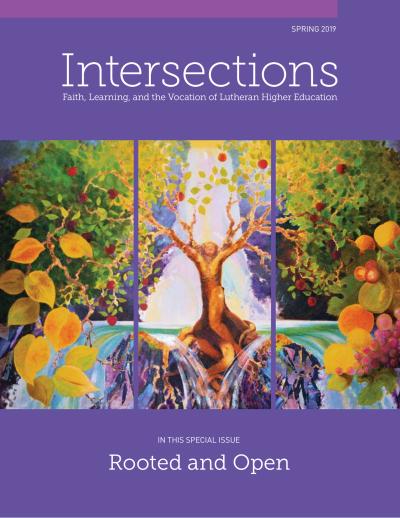
Kristen Gilje, a Bellingham, Washington artist who spent nine years as Artist in Residence at Holden Village, recounts the “Tree of Life” she painted for the Holden Village 1999 summer theme and the unexpected interpretation Lapidary Fred offered of Yggdrasol, Prometheus, the Druid Tree Spirit, and the crucifix all at once.
-
Article
Rooted and Open: Background, Purpose, and Challenges
Mark Wilhelm
Wilhelm traces Rooted and Open’s seventy-year backstory — from Conrad Bergendoff’s 1948 call for a Lutheran philosophy of education through the recovery of the vocation tradition — and describes the document’s process, purpose as a teaching and study resource, and the embodiment, contextual, and cultural challenges it implies for NECU institutions.
-
Article
In a Diverse Society, Why Should Lutheran Colleges/Universities Claim their Theological Roots?
Darrell Jodock
Jodock develops his “third path” account of the Lutheran college — neither sectarian nor non-sectarian but both rooted and open — analogizing the college to a bridge whose deck of daily activities rests on pillars of shared educational priorities, which in turn rest on theological footings; he then answers six common objections to claiming Lutheran roots and explains why those footings still matter.
-
Article
Marked by Lutheran Higher Education
Martha E. Stortz
Stortz offers an “operating manual” to Rooted and Open by tracing how the writing team moved from descriptive marks of the institutions to aspirational verbs that mark people — “called and empowered, to serve the neighbor, so that all may flourish” — and shows how each mark generates educational priorities theologically grounded in the radical mystery of God, the wild generosity of God, and the God who became one of us.
-
Article
Deep Roots, Big Questions, Bold Goals
Colleen Windham-Hughes
Adapted from a presentation to the California Lutheran University Board of Regents, Windham-Hughes reads the title Rooted and Open as both reaching back into the Lutheran tradition and opening forward into a shared future, then unpacks the document’s “called and empowered — to serve the neighbor — so that all may flourish” through the lenses of freedom of inquiry as a third path, vocation-centered education, radical hospitality, and civil discourse oriented toward the common good.
-
Article
Rooted and Open as Resource for Expanding Opportunities on Your Own Campus
Katherine A. Tunheim, Marcia Bunge
Bunge and Tunheim describe how Gustavus Adolphus College has paired Rooted and Open with its own companion volume Rooted in Heritage, Open to the World — in board workshops, new-faculty orientation, and classroom assignments — and survey several Network-wide opportunities (the Vocation of a Lutheran College Conference, the LECNA Fellows Program, the Association of Lutheran College Faculties, the Tuition Exchange Program, and international partnerships) that give the common calling tangible institutional form.
-
Article
"Faithful Nones" and the Importance of a Rooted and Open Pedagogy
John Eggen
Drawing on a student survey from his D.Min. thesis at Midland University, Eggen identifies a distinctive subset of religious “nones” — the “faithful nones” — who reject institutional religion yet retain substantive beliefs and practices, and argues that the non-binary, third-path pedagogy commended by Rooted and Open is uniquely positioned to engage a generation that has disambiguated faith, religion, and spirituality.
-
Article
Finding Flourishing: Teaching Self-Care as Course Content
Emily Kahm
Kahm argues that teaching self-care, self-awareness, and stress-coping as explicit classroom content embodies the “radical hospitality” of Rooted and Open and supports vocational formation against a consumerist culture, then offers concrete classroom techniques — a one-to-five energy check-in, ninety-second silence exercises, and full-day spiritual practices — that can be adapted across disciplines at NECU institutions.
-
 Article
Vocation at Full Stretch: Reflections on Follow Your Bliss and Other Lies about Calling and its Use among College Students
Jason A. Mahn
No. 61 · Spring 2025
43 min audio
Mahn engages Bonnie Miller-McLemore’s Follow Your Bliss and Other Lies about Calling as required reading in a sophomore religion course, showing how her categories of missed, blocked, conflicted, fractured, unexpected, and relinquished callings empower young adults to perceive embodied, unplanned, and often painful dimensions of life as essential parts of vocation — and help close the gap between mission-driven and tuition-driven realities.
-
 Article
On Recruiting Diverse Students, Rooted in Mission
Eric Rowell, Jason A. Mahn
No. 59 · Spring 2024
Jason Mahn interviews Eric Rowell, Assistant Director of Admissions and Diversity Outreach at Augustana College, about how recruiting students from a wide variety of backgrounds — rooted in Augustana’s Lutheran commitment to vocation and educating across difference — remains essentially unchanged in the wake of the Supreme Court’s 2023 decisions on affirmative action.
-
 Editorial
From the Outgoing Editor
Jason A. Mahn
No. 55 · Spring 2022
Mahn closes out a decade of editing Intersections, passes the duties to Colleen Windham-Hughes, gives thanks to Mark Wilhelm and Augustana College, and introduces an issue largely drawn from comments by Lutheran faculty, staff, and administrators at the 2022 NetVUE national gathering.
-
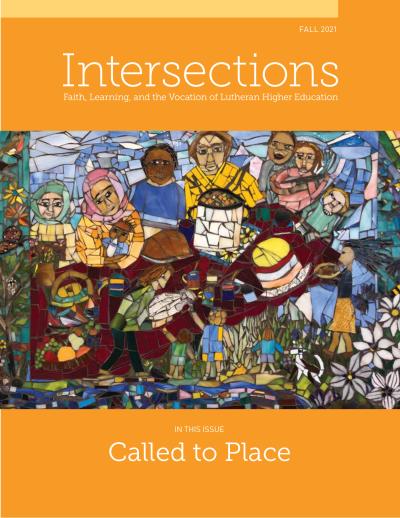 Editorial
From the Editor
Jason A. Mahn
No. 54 · Fall 2021
Mahn introduces the “Called to Place” theme of the 2021 VLHE Conference, arguing that Lutheran higher education’s emphasis on vocation must be grounded in particular geographies and embodied communities — for, as Wallace Stegner put it, “If you don’t know where you are, you don’t know who you are.”
-
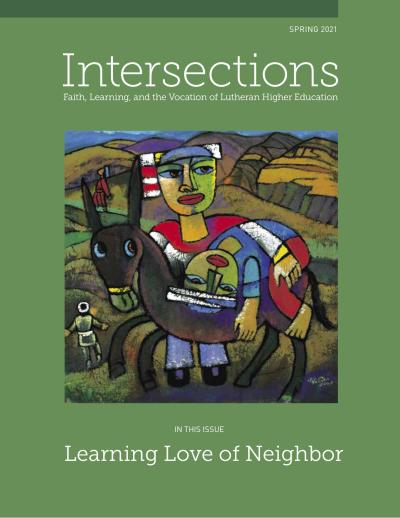 Reflection
Shelter in Place: Reflections from March 22, 2020
Jason A. Mahn
No. 53 · Spring 2021
On the fourth Sunday of Lent in 2020, Mahn meditates on the etymology of “shelter” (from shield) and on an email from a former student in Boston whose mutual-aid organizing models a Lutheran understanding of vocation: the upending of ego by divine love that frees us, finally, to see and serve the neighbor.
-
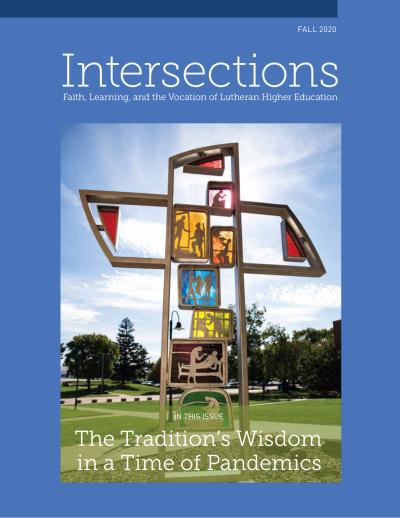 Editorial
From the Editor
Jason A. Mahn
No. 52 · Fall 2020
Mahn narrates a year of crisscrossing pandemics — Covid-19, economic collapse, partisan politics, and the long pandemic of white supremacy revealed anew by the murder of George Floyd — and argues that Lutheran liberal arts schools, by educating for vocation, are uniquely poised to help students respond with character and capable callings.
-
 Article
Money, Sex and Power: An Exploration of Some Controversial Issues in the Public Witness of the Church
Pamela K. Brubaker
No. 21 · Summer 2005
Brubaker explores two controversial issues in the church’s public witness—homosexuality and economic life—and the challenges they present for both church and college. Drawing on Beverly Harrison, Elizabeth Bounds, Ron Thiemann, Linell Cady, Marcia Bunge, Richard Hughes, Darrell Jodock, Ernest Simmons, Karen Bloomquist, Garth Kasimu Baker-Fletcher, and Larry Rasmussen, and on episodes at California Lutheran University around “Harmony Week” and Bishop Paul Egertson’s participation in Anita Hill’s ordination, she argues that colleges related to the ELCA are called to educate for “critical citizenship” by hosting rigorous, bold, and unfettered debate—including debate over the neo-liberal globalism that she names a form of economic fundamentalism.
-
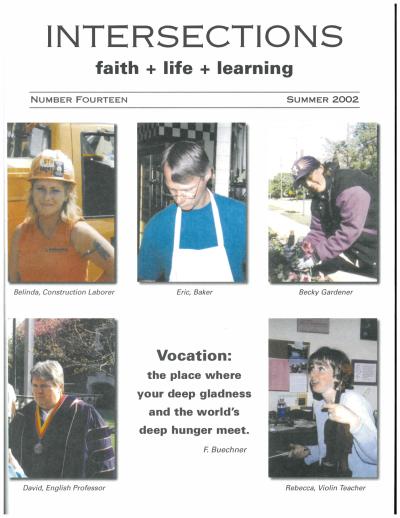 Article
Holy Odors
John P. Trump
No. 14 · Summer 2002
A one-act play by John P. Trump, premiered at Pacific Lutheran University, in which Maggie, a senior studying Reformation history in the library stacks, falls asleep over the Apology of Augsburg and dreams a 16th-century pickled-herring merchant—Herr Leonard Kopp, the man who smuggled Katie von Bora and eight other nuns out of the convent—into existence to argue that her call to archaeology (“digging up old bones”) is as holy as ordained ministry, with Luther’s joke that the church burns incense to insulate priests from the “holy odors” (not holy orders) of everyday life.
-
 Article
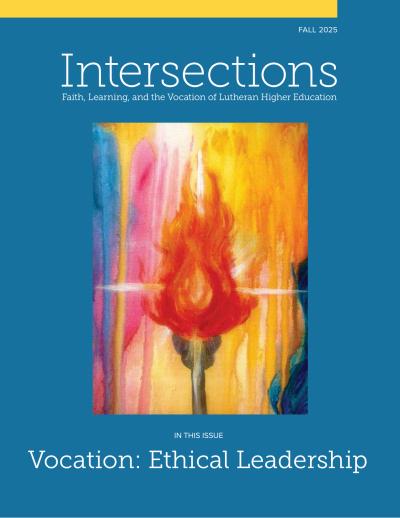
Ethical Leadership for a Changing World: A Shared Calling from Cradle to Career
Cory Newman, Janelle Rozek Hooper
No. 62 · Fall 2025
5 min audio
Hooper and Newman recount how an ELCA Barna survey on early childhood education sparked the realization at VLHE 2025 that ELCA colleges and the 1,200 Lutheran schools and early learning centers share identical challenges — and an untapped potential to form ethical leaders across the full educational continuum from cradle to career.
-
 Editorial
From the Editor
Jason A. Mahn
No. 42 · Fall 2015
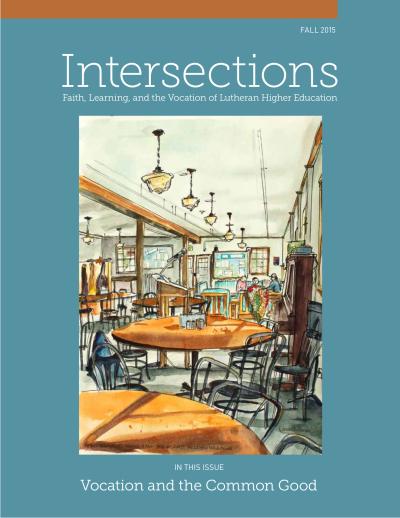
Mahn introduces the “Vocation and the Common Good” issue by asking what is left of “the commons” in an age of privatized goods and education-as-commodity, and frames church-related colleges — with their stubborn vocabulary of “liberal arts,” “collegiate,” and “calling” — as among the least fully-privatized resources left in American life.
-
Article
Vocation and the Common Good
Mark Wilhelm
No. 42 · Fall 2015
Wilhelm argues that ELCA colleges and universities are Lutheran not by ethnic culture or institutional checklists but because they stand in a 500-year-old intellectual tradition that educates for vocation. He draws out two insights from that tradition — a common walk of life shared across callings, and a humility about claims to know the good — to ground the schools’ commitment to prepare students for the common good.
-
 Article
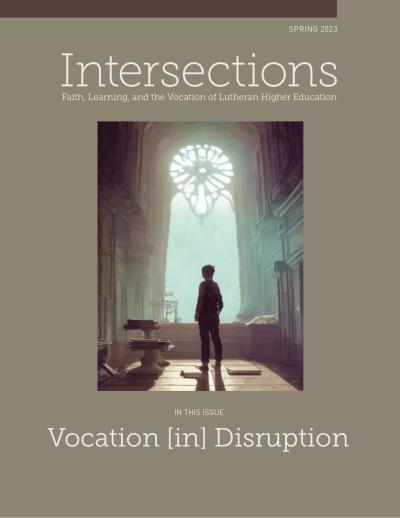
Where Disruption and Vocation Meet: One Path Toward Teaching Reproductive Justice in Challenging Times
Lena R. Hann
No. 57 · Spring 2023
Hann recounts how a missed math class in her first college term led her into volunteer work at a feminist abortion clinic and ultimately a career in public health, and describes how she designed and taught a Reproductive Justice immersive term course at Augustana College through the disruptions of COVID-19, George Floyd’s murder, and the Dobbs decision.