"Faithful Nones" and the Importance of a Rooted and Open Pedagogy
Intersections No. 49 · Spring 2019
I must start by admitting how new I am to the experience and tradition of NECU schools. I grew up in a Lutheran home with a strong Lutheran tradition on both sides of my family. I also grew up in an age of discovery, and my journey through college was just that. I was not of the generation who went to a “school of the church” and the liberal arts seemed impractical to a future engineer. A NECU school was not even on my radar. I attended a state school and graduated with my degree in engineering. Following seminary, I would serve in Bolivia leading a non-profit and later in Omaha as an ELCA Pastor.
All of that is to say that I am very new to the Lutheran higher-education world. My knowledge of NECU was limited to the reports I would read and hear at our synod assembly. I knew of Midland University and had physically been on campus but that was about it. That changed a little over two years ago when I began my work at Midland University in the development office. Then my journey of exploration of Lutheran higher education began as I sought to understand what made this school “Lutheran.” At the same time, I was to begin researching for my D.Min. thesis. I boldly (but mostly naively) selected institutional religious identity as my area of research.
I was exposed to a variety of perspectives of institutional identity in working with alumni, meeting students, and developing relationships with faculty and staff. They all pointed towards some definition of what it meant to them that Midland was a Lutheran school, but these descriptions were as though describing landscape beyond a horizon yet unseen. Within the writings of Intersections and those by Robert Benne, Tom Christenson, and Darrell Jodock, I found a robust conversation about Lutheran theology, pedagogy, and vocation and some important frameworks.
My research sought out to discover something definitive within the perspectives and practices of our Lutheran students, but the data simply didn’t support this. I felt a little like I spent two years to describe what I didn’t find. As I spent time reflecting on my thesis I realized I was looking for distinction among groups while data was hinting at a distinctive group altogether—the “faithful nones”—and the implications of their particular form of religiosity. Understanding this group forced me to reflect on how we understand faith, religion, and spirituality. I read the recently released Rooted and Open and realized that many of our students are already living into a perspective on religiosity that our institutions seek to embrace.
There are two outcomes of this research that hold important insights for Lutheran education, which I explore in this article. First, I explore here a group I call the “faithful nones” and highlight the need for a deeper understanding of faith, religion, and spirituality that moves beyond a binary understanding of identity as religious or secular. Second, I explore how and why students express a desire to grow in their faith through an experience of diversity. Both of these research findings emphasize the importance of the educational approach outlined in Rooted in Open, which is well suited to engage students with a differentiated view of religion, faith, and spirituality.
The Faithful Nones
A significant portion of my research (see Eggen in works cited) was a student survey of a broad student population (N=277). This survey evaluated student demographics along with several practices and perspectives of students. These data were used to explore several areas of student practices and perspectives within the context of a Lutheran school. One of the most significant outcomes of these data is the subsequent exploration of students who self-identified as “nones”—those not affiliated with any particular religious tradition. This led to a deeper appreciation for the nuanced religiosity of the “nones,” which in turn challenges monolithic portrayals of this group as unbelieving or secularists.
“The answers of the ‘faithful nones’ suggest that self-identifying as a ‘none’ does not entail the absence of an identity, but rather the presence of a particular and meaningful religious identity correlated with traditional faith practices and beliefs.”
This emerging understanding led me to view a group of these individuals as a distinctively different group. I refer to them as “faithful nones.” This group embraces faith, spirituality, and religion as differentiated concepts; they have a more defined separation of religion and faith than what is traditionally assumed.
My examination of the “faithful nones” begins with an analysis of how respondents selected and rated their religious identity. There is a unique subset of students who responded to questions about religious identity and faith in a way which seemed to indicate that “none” meant something positive and substantive to them. I have traditionally understood an identity of “none” to be more of a negation of religious identity rather than a positively defined group. The answers of the “faithful nones” suggest that self-identifying as a “none” does not entail the absence of an identity, but rather the presence of a particular and meaningful religious identity correlated with traditional faith practices and beliefs.
“None” as Religious Identity
The first element of my study is the student’s religious identity, where students were invited to select from one of nineteen options, one of which was “none” but also included “agnostic,” “atheist,” “non-denominational,” and “other Christian.” A religious identity of “none” was selected by 14.5 percent (n=42) of students. What was surprising was how some respondents answered this later question: “How strong is your religious identity?” I anticipated that those self-identified as “nones” would select the option for “no religious identity.” However, less than one-half of “nones” selected this option, while 51.9 percent (n=26) of nones rated their religious identity with some level of strength.
I initially struggled to understand these results, assuming they were likely errors, or an anomaly. My worldview did not include seeing “none” as someone’s individual religious expression. I assumed that those with individual religious expression would select atheist, agnostic, or possibly “other Christian” to indicate belief without affiliation. Yet the nones declined these options. At first, I thought that perhaps this was because of the negative societal perception of being atheist or agnostic in a small Midwest community. Or perhaps it was just a mistake in interpreting the data. After further discussion and subsequent exploration of the data, I found exactly the opposite.
Conversations with my own students help in this reconsideration considerably. It was the final week of a Christian thought class where we spent time discussing American civil religion, “Moralistic Therapeutic Deism” (Smith and Denton), and perspectives on being “spiritual but not religious.” We concluded this discussion by reflecting together on the relationship between religion, faith, and spirituality. I shared the concept of how it appeared from my own study that a number of students considered that being “none” was their religious identity while also expressing some Christian beliefs. This group of students, including some planning to go into ministry, were completely unsurprised by these results. They found it very natural that someone would name their particular religious identity “none” and hold to some traditional Christian beliefs. Being “none” isn’t the absence of a religious identity, it is these students’ identity. The students found no contraction in identifying as a “none” and holding either deistic or Christian beliefs. This conversation alluded to a differentiated understanding of their belief system and their identity which disambiguated religion and faith.
“Being ‘none’ isn’t the absence of a religious identity, it is these students’ identity.”
The Beliefs of Faithful Nones
This conversation with my students led me to a secondary review of the survey data. I wanted to better understand how nones responded to questions about traditionally Christian beliefs, given that the nones held a set of values and practices which, in many ways, are not too dissimilar from the espoused beliefs of many church members. Nearly half of the nones, 48.3 percent (n=19), indicated a practice of prayer, and 14.6 percent (n=6) reportedly prayed daily or weekly. A majority hold a view of the Bible similar to many mainline denominations with 60 percent (n=25) selecting “the Bible is the inspired word of God but not everything should be taken literally, word for word” as their perspective on the Bible. Over one-third, 39 percent (n=16), indicated they believe in God with half of those respondents having some doubts and half indicating they have no doubts about their belief in God. Finally, over one-quarter of nones, 26.8 percent (n=11), said that “Jesus was the Son of God who was raised from the dead” best reflected their beliefs about Christ.
These general views, prayer practices, understandings of the Bible as the inspired word of God, and believing in God and in Jesus are aligned with a mainline protestant belief system. The prevalence of these views grows when the group is narrowed to those who consider “none” as a religious identity—that is, when the group is narrowed to those who both select “none” as their religious identity but who do not select “no religious identity” when asked to rate the strength of that identity. Within this subset (N=42), 76 percent (n=19) believe in life after death, 68 percent (n=17) indicate some level of prayer life, 68 percent (n=17) see the Bible as the inspired word of God, 52 percent (n=13) express a belief in God, and 40 percent (n=10) believe that Jesus is the Son of God. These results suggest an understanding of “nones” who hold some traditionally Christian beliefs, practice an internally focused spiritual life, and yet still have limited engagement in organized religion and worship attendance. Individual faith and religious identity are even more differentiated than what is traditionally understood.
Disambiguating Faith, Religion, and Spirituality
In recent years there has been increasing awareness of the disambiguation of religion and spirituality, yet “faith” seems to many to be synonymous with either. This can be found in discussions of what it means to be “spiritual but not religious.” Those who critique an emphasis on spirituality believe that religious traditions, communities, and institutions are needed to sustain faith, while the other group believes that individual spirituality is the best expression of faith. In a conversation around what it means to be “spiritual but not religious” a group of my students responded with an immediate, instinctual retort that many previous generations were “more religious than spiritual.” It seems that both groups believe that their emphasis on religion or spirituality better bears and expresses “faith.”
“Understanding the ‘faithful nones’ calls for a shift that further disambiguates faith from both spirituality and religion.”
Understanding the “faithful nones” calls for a shift that further disambiguates faith from both spirituality and religion. In particular, the “faithful nones” call for an understanding of faith, religion, and spirituality which challenges a traditional paradigm that places an expression of faith subservient to that of religious identity or spirituality. A differentiation between faith, spirituality, and religion as three independent elements calls for a more profound understanding of all three. A differentiated understanding of the three would call for a more concrete definition of “religion” as a communal expression of faith that is based in culture and rituals, of “faith” as a personal set of beliefs in a higher power, and of “spirituality” as personal practices contributing to self-understanding and in support of their belief.
When I proposed these definition to my students, they expressed strong agreement for them and for the idea that these are not codependent. For these students, and as expressed in the survey by the “faithful nones,” religion, faith, and spirituality are independent of one another. They may be intersecting, but certainly they should be seen as three clearly differentiated phenomena.
I am helped here by the work of Peter Berger, In The Many Altars of Modernity, Berger explores what it means to live in an age of plurality. Berger begins to explore a multifaceted understanding of what he simply refers to as faith. Berger differentiates two elements of religion, an individual and communal expression, as “faith as based on individual choice rather than on fate or the accident of birth” and “faith as institutionalized in the form of the voluntary association” (Berger 49). He also explores a shift in how individuals engage in the communal expression of religion. Berger reminds us of the functional nature through which most individuals engage in religion. He also reminds us that people tend to pick and choose elements such as “people who claim to believe in the teachings of the Catholic Church also believe in reincarnation.” This is something I have certainly seen in my own experience as a pastor. Congregational members saw no conflict in being a Lutheran and going to a psychic. Congregation members may go to worship at one church, small group at another, and a parenting group at a third. Berger writes about this as a characteristic of living in a pluralistic age: “pluralism means that individuals put together their religious beliefs like a child uses LEGO pieces to construct an idiosyncratic edifice” (Berger 57).
The point in these examples is to remind us that a traditional framework of religion—where “religion” encompasses a set of individual beliefs, a theological framework, communal practices, and collective identity—is no longer the reality through which most individuals view religion. For many today, there is now significant division between an “internalized religion” and “community religious practices.” (What I refer to as “faith” mirrors what Berger alludes to as the individualized religion, and my term “religion” would resemble his community religious practices.) What is clear is that Berger sees disambiguation between individual and communal religion in the age of plurality. For those engaging in religious practices, the outward, communal religion looks not to be something that must be adopted wholesale, but rather like a toolbox from which helpful elements might serve an individual’s expression.
One more component of Berger’s work gets us back to the issue of Lutheran higher education. In his introduction, Berger discusses the historical differentiation between societal functions which have been divided up into church, state, economy, education, and so forth. He reminds the reader of what he considers a basic sociological concept: “If it is to function in society, every institution must have a correlate in consciousness. Therefore if a differentiation has occurred between religious and other institutions in society, this differentiation must also be manifested in the consciousness of individuals” (Berger x). This becomes a foundational point for exploring how individuals begin to live this same type of plurality in their own lives. If, for example, the economy is a different institution than religion, then an individual has both an economic framework but also a religious framework for making decisions. If the principle that a societal institution must have a correlate in consciousness holds true, then the reverse may also be true, namely that a conscious understanding might have an institutional correlate. As we have seen, in the case of the “faithful nones,” the consciousness has made a shift in understanding faith, religion, and spirituality to be independent realities. Have societal institutions matched this differentiation?
Faithful Nones and Higher Education
We don’t live in a secular age; we live in an age of plurality and one of those pluralisms is secularism. This is not an all-or-nothing proposition, but a proposition which is repeatedly played out in the lives of individuals every day through a variety of social institutions. One aspect of the age of plurality is the internalized division between faith, spirituality, and religion; each is a separate decision and influences subsequent decisions in a different way. This is how it is possible for a student to be a faithful none. The institutional expression of religion and rituals has become secularized for them. They are a “none.” Yet their internal belief in a higher power is not secularized; they have a positive, substantive religious identity and express beliefs. Thus, in response to a question they likely see as relating to institution identification, they answer “none,” but this lack of identifying with institutional religion does not preclude the possibility of individual belief.
Perhaps this should not be so surprising for those of us in Lutheran higher education. For many years now the exploration of Lutheran identity in higher education has rejected a bifurcated approach to institutional religious identity. Christenson wrote of the “fallacy of the exclusive disjunction” (Christenson 12), whereby institutions see only possibilities of being a secular institution or a rigid, fundamental institution. Darrell Jodock likewise argues for a “third path” which “takes seriously both its religious heritage and religious and other forms of inclusiveness” (Jodock 24).
These perspectives are fully embodied, and perhaps foundational to, Rooted and Open as well: “Neither sectarian nor secular, NECU colleges and universities take a third path of being rooted in the Lutheran intellectual and educational traditions while being open to others.” This sense of rootedness, along with the Lutheran tradition of humility, allows for a pedagogical approach that invites others to explore religion. In other words, what we might call a Lutheran pedagogy is uniquely situated to teach others how to think religiously by teaching a religion without presumptively teaching it as the religion. Lutheran pedagogy brings with it a certain humility and inherent openness that seems to be the sort of approach readily engaged by a generation of students seeking religion outside of institutional definitions. NECU’s humility may even entail an openness to understanding religion and faith in a new way.
“Lutheran pedagogy brings with it a certain humility and inherent openness that seems to be the sort of approach readily engaged by a generation of students seeking religion outside of institutional definitions.”
Rooted and Open is thus well positioned to engage the distinctive realities of faith, spirituality, and religion as experienced by our students. Our institutional identities are more than religious (rooted) or secular (open)—but they are not less. Embracing our Lutheran identity does not mean we reject secularism or pluralism, because we are also not sectarian, even when the “sect” is Christianity.
On some of our campuses, there seems to be an assumed claim that having a religious identity on campus is a deterrent to enrollment—that being an institution of faith is unattractive to a generation of secularists. That assumption relies on a sectarian understanding of Christianity, and Rooted and Open reminds us that that is not who we are. What my own research suggest is that sectarian understandings are not what students in the age of plurality want either. They don’t want to adopt wholesale a religion, nor to ignore religion, but rather to learn how to think religiously and spiritually. The perspectives of students call for plurality rather than secularism and an ability to teach religious understanding through a religion without teaching it as the religion. Rooted and Open properly positions religion and faith as a meaningful and necessary element of the educational experience without making it the point of that experience. It embraces a non-binary approach to religion and faith which stands well equipped to engage a new generation of students who are also navigating their own way through a pluralistic religious landscape and a rather complex understanding of personal faith.
Conclusions
What is clear is that the framework of Generation Z rejects the binary notion of being secular or religious. The type of educational environment they seek is neither absent of religiosity nor defined by a narrow view of religion. This matches their own personal lives, where binary understandings of secularism and religion simply do not fit within their frameworks or their experiences. That’s not how they understand religion, spirituality, and faith. They too seek a “third path” which both disambiguates and integrates their personal belief system, religious expression, and personal spirituality.
The fundamental nature of Rooted and Open is one that invites this type of understanding. It does not require rigid belief systems or personal religious expressions, nor does it reject the importance of them. This framework moves beyond space for dialog and demands religious dialog as a part of the learning process itself. It invites others to “build religious literacy” not in a way of building one’s own set of values, but by inviting an introspective understanding of faith and religion that leads to an actualized religious identity. Neither absent religion nor defined by a religion, the pedagogy of Rooted and Open is one which embraces core beliefs without requiring or expecting the institutionalization of these beliefs and the exclusion of others. A Lutheran pedagogy is one in which our faith is only enhanced through the inclusion of others, while the Lutheran heritage is one that continues to invite reflection on the meaning and value of institutionalized religion.
Works Cited
Berger, Peter L. The Many Altars of Modernity: Toward a Paradigm for Religion in a Pluralist Age. De Gruyter, 2014.
Christenson, Tom. The Gift and Task of Lutheran Higher Education. Augsburg Fortress, 2004.
Eggen, John. “Definitively Lutheran?: An Exploration of Definitive Lutheran Characteristics in Higher Education” (2018). Luther Seminary Doctor of Ministry Thesis. Accessed 15 April 2019, https://digitalcommons.luthersem.edu/dmin_theses/35/
Jodock, Darrell. “Vocation of the Lutheran College and Religious Diversity.” Intersections 33 (Spring 2011): 5-12.
Network of ELCA Colleges and Universities. “Rooted and Open: The Common Calling of the Network of ELCA Colleges and Universities.” Accessed 15 April 2019, http://download.elca.org/ELCA%20Resource%20Repository/Rooted_and_Open.pdf?_ga=2.254180808.1158413343.1555894056-509733955.1555894056
Smith, Christian with Melinda Lundquist Denton. Soul Searching: The Religious and Spiritual Lives of American Teenagers. Oxford, 2005.
-
 Institutional Focus
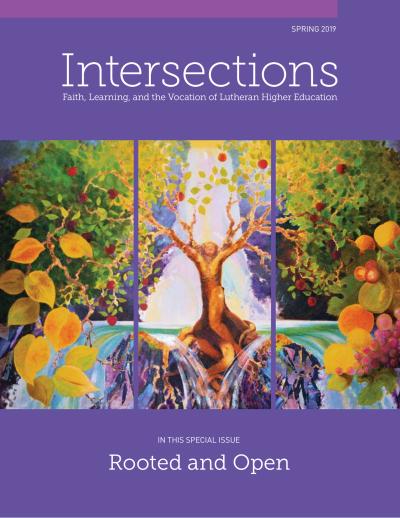
About Rooted and Open: The Common Calling of the Network of ELCA Colleges and Universities
An institutional framing piece introducing Rooted and Open — NECU’s statement on Lutheran identity in higher education — with a roster of the faculty working group and writing team and an orientation to the essays in this special issue.
-
Institutional Focus
About the Cover and Artist
Kristen Gilje, a Bellingham, Washington artist who spent nine years as Artist in Residence at Holden Village, recounts the “Tree of Life” she painted for the Holden Village 1999 summer theme and the unexpected interpretation Lapidary Fred offered of Yggdrasol, Prometheus, the Druid Tree Spirit, and the crucifix all at once.
-
Article
Rooted and Open: Background, Purpose, and Challenges
Mark Wilhelm
Wilhelm traces Rooted and Open’s seventy-year backstory — from Conrad Bergendoff’s 1948 call for a Lutheran philosophy of education through the recovery of the vocation tradition — and describes the document’s process, purpose as a teaching and study resource, and the embodiment, contextual, and cultural challenges it implies for NECU institutions.
-
Article
In a Diverse Society, Why Should Lutheran Colleges/Universities Claim their Theological Roots?
Darrell Jodock
Jodock develops his “third path” account of the Lutheran college — neither sectarian nor non-sectarian but both rooted and open — analogizing the college to a bridge whose deck of daily activities rests on pillars of shared educational priorities, which in turn rest on theological footings; he then answers six common objections to claiming Lutheran roots and explains why those footings still matter.
-
Article
Roots and Shoots: Tending to Lutheran Higher Education
Jason A. Mahn
Mahn revisits why “education-for-vocation” has become a leitmotif for the 27 NECU schools, distinguishes institutional vocation from individuals’ religious identities and educational priorities from their theological grounding, and offers a friendly critique of Jodock’s bridge metaphor: Lutheran colleges grow in two directions like plants — deep roots and wide branches alike require constant tending.
-
Article
Marked by Lutheran Higher Education
Martha E. Stortz
Stortz offers an “operating manual” to Rooted and Open by tracing how the writing team moved from descriptive marks of the institutions to aspirational verbs that mark people — “called and empowered, to serve the neighbor, so that all may flourish” — and shows how each mark generates educational priorities theologically grounded in the radical mystery of God, the wild generosity of God, and the God who became one of us.
-
Article
Deep Roots, Big Questions, Bold Goals
Colleen Windham-Hughes
Adapted from a presentation to the California Lutheran University Board of Regents, Windham-Hughes reads the title Rooted and Open as both reaching back into the Lutheran tradition and opening forward into a shared future, then unpacks the document’s “called and empowered — to serve the neighbor — so that all may flourish” through the lenses of freedom of inquiry as a third path, vocation-centered education, radical hospitality, and civil discourse oriented toward the common good.
-
Article
Rooted and Open as Resource for Expanding Opportunities on Your Own Campus
Katherine A. Tunheim, Marcia Bunge
Bunge and Tunheim describe how Gustavus Adolphus College has paired Rooted and Open with its own companion volume Rooted in Heritage, Open to the World — in board workshops, new-faculty orientation, and classroom assignments — and survey several Network-wide opportunities (the Vocation of a Lutheran College Conference, the LECNA Fellows Program, the Association of Lutheran College Faculties, the Tuition Exchange Program, and international partnerships) that give the common calling tangible institutional form.
-
Article
Finding Flourishing: Teaching Self-Care as Course Content
Emily Kahm
Kahm argues that teaching self-care, self-awareness, and stress-coping as explicit classroom content embodies the “radical hospitality” of Rooted and Open and supports vocational formation against a consumerist culture, then offers concrete classroom techniques — a one-to-five energy check-in, ninety-second silence exercises, and full-day spiritual practices — that can be adapted across disciplines at NECU institutions.
-
 Article
Lutheran Tradition: Five Continuing Themes
Walter R. Bouman
No. 2 · Winter 1997
Bouman of Trinity Lutheran Seminary identifies five themes central to the Lutheran theological tradition (understood through Alasdair MacIntyre’s account of tradition as “an historically extended, socially embodied argument”): biblical (a non-oppressive authority for the Bible rooted in the gospel rather than in scholastic inerrancy, against the backdrop of Luther’s 1517 challenge to Tetzel and the post-Enlightenment marginalization of theology); catholic (continuity with the Book of Concord and the three ancient creeds, with Luther’s “Christology from below” recovering a Jewish rather than Hellenistic understanding of God, revived by Tillich, Pannenberg, Forde, and Jenson); evangelical (justification by faith as the answer to mortality’s radical question); sacramental (Word, Eucharist, and Baptism as Christ’s presence from the future of God’s consummated Reign); and world-affirming (creation as gift, vocation as God’s work in every calling, and stewardship of the ecological crisis).
-
 Article
What's in a Name?
Matthew J. Marohl
No. 40 · Fall 2014
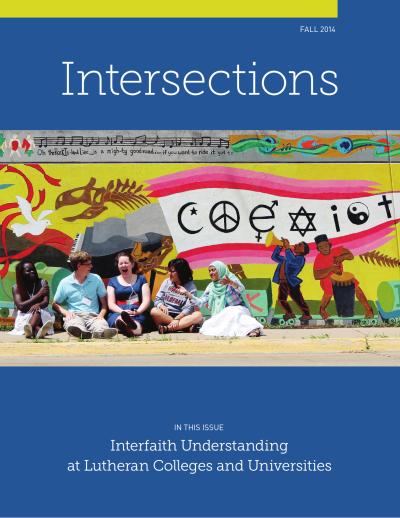
St. Olaf College Pastor Matt Marohl tells the story of designing The Undercroft’s prayer and meditation room with a campus meditation group whose members began as “Matt” and ended — as their mutual respect grew — calling him “Pastor Matt,” a counterintuitive movement toward a more formal address that signals what intentional Lutheran-Christian hospitality looks like in practice.
-
 Editorial
From the Editor
Robert D. Haak
No. 28 · Fall 2008
Haak frames the issue around “Lutheran conversations,” centered on the exchange between Robert Benne and Tom Christenson at Wartburg College’s ongoing campus conversation about what it means to be a “college of the church,” alongside Mark Wilhelm’s historical and social context, Lake Lambert’s sermon, and Bishop Mark Hanson’s short piece reprinted from The Lutheran—and points readers to the Lutheran Academy of Scholars seminar at Harvard as a place to continue the conversation.
-
 Reflection
Shelter in Place: Reflections from March 22, 2020
Jason A. Mahn
No. 53 · Spring 2021
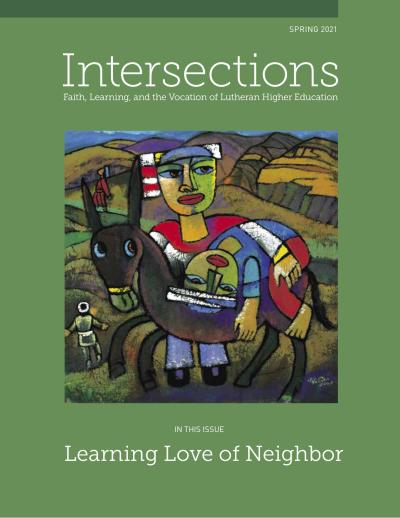
On the fourth Sunday of Lent in 2020, Mahn meditates on the etymology of “shelter” (from shield) and on an email from a former student in Boston whose mutual-aid organizing models a Lutheran understanding of vocation: the upending of ego by divine love that frees us, finally, to see and serve the neighbor.
-
 Editorial
From the Publisher
Arne Selbyg
No. 7 · Summer 1999
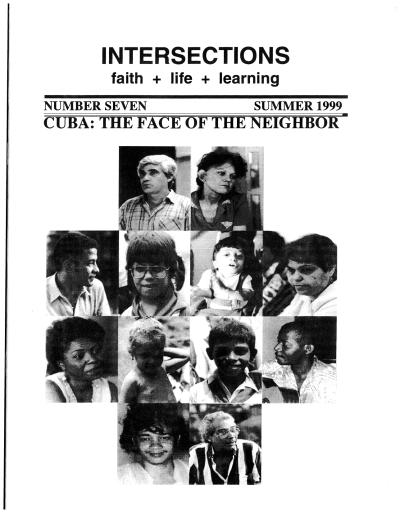
Selbyg celebrates the popularity of the previous issue—the first to draw on papers from the annual “Vocation of a Lutheran College” conference—and announces a new Lutheran Brotherhood Foundation grant that will fund the inaugural Lutheran Academy of Scholars in Higher Education, a two-week seminar at Harvard led by Ronald Thiemann on “Finding Our Voice: Christian Faith and Critical Vision.”
-
Editorial
From the Publisher
Mark Wilhelm
No. 28 · Fall 2008
Wilhelm introduces himself as the new Director for Colleges and Universities and publisher of Intersections, thanks his predecessor Arne Selbyg, and previews an issue devoted to the aims and purposes of Lutheran higher education—reflections from Presiding Bishop Mark Hanson, two pieces from Wartburg College’s fall 2008 campus conversation about being a college of the church (his own essay and the Benne/Christenson dialogue), and a sermon by Lake Lambert III preached in the Castle Church in Wittenberg.