On the day that my intro-level students turn in their major research paper, they come to class to find the lights dimmed and white noise playing in the background. At this point in the term, the indicators of their stress and exhaustion are obvious—many are visibly moving slower, collapsing into desks and staring into space rather than talking to their classmates. Students who wore impeccable makeup at the start of term have often dropped that routine; others who always came to class well-dressed are now prioritizing comfort in sweatpants and loose shirts. Many carry oversized cups of coffee. A few, to be blunt, do not smell their best.
Professors, administrators, or professionals working at colleges and universities find this sight to be as expected as sunrise and as predictable as the seasons. We see our students sacrificing sleep, hygiene, and hobbies as the term winds up, and most of us accept this as part of the college experience. Yet, as conversations about the mental health of our students continue to mount in our professional space, and as we provide difficult and sometimes inconvenient emotional labor for our students who are anxious, struggling, and fearful, we may come to the conclusion that it is not always ideal to leave students to whatever coping and self-care practices they have cobbled together over 18-20 years of life experience. This is part of the reason for my aforementioned dimly lit classroom towards the end of term; when students are stretched nearly to breaking, I have found great value in teaching self-care and stress-coping practices to students directly. Moreover, I find that doing so affirms the Lutheran commitment to “radical hospitality” and creates space for the “holistic education of mind, body and spirit” (Network) in a setting where the development of the mind is often prioritized above other formative needs.
Here and throughout, I use “self-care,” “self-awareness,” and “coping” at different points to talk about the facets of what I consider to be one overarching skill set—that of recognizing one’s deeply felt needs and finding ways to prioritize meeting those needs. This includes the more obvious physiological needs (for hydration, food, sleep, and hygiene) as well as the less apparent but highly relevant mental and emotional needs (for companionship, silence, and a sense of direction and purpose, among others) of college students. Academic work on the subject tends to come from the social sciences and often uses the term “mindfulness” to indicate a specific type of self-awareness or meditation technique. While these studies are limited, overall they indicate that introducing mindfulness in spaces of higher learning tends to be associated with less stress in the lives of college students. (See Kaiseler, Martin, Ramasubramanian, and Dvořáková in Works Cited for some recent, small-scale examples of introducing mindfulness to young adults and adults and its association with reduced self-reported stress.)
While mindfulness is a helpful term, I avoid using it because it tends to denote specific meditative practices; I prefer broader terminology to remind readers that teaching self-care, self-awareness, and better stress-coping skills need not take the shape of focused meditation. Indeed, I would argue that such learning will be more effective when professors find ways to mesh self-care with the particulars of the discipline and content that they teach; this will look markedly different in a philosophy class versus a biology class.
“Learning will be more effective when professors find ways to mesh self-care with the particulars of the discipline and content that they teach.”
In the first section of this essay, I take some time to explore why teaching self-care as course content, alongside and integrated into the regular subject content of introductory college courses, is a worthwhile practice for college professors at NECU schools to explore. While I will speak directly to a particular audience—specifically, professors at Lutheran colleges and universities who teach introductory-level courses to “traditional” college students—I anticipate and intend that this information be useful to those in a variety of student-related positions beyond that subset. The second portion of this essay is dedicated to discussing specific self-awareness and self-care exercises that can be integrated into a variety of types of classes and why I have found them effective both in encouraging self-care skills and for excellent pedagogy in the Lutheran tradition.
Why?
Asking busy professors to integrate even more content into what are typically already jam-packed introductory courses is no small task. Rightly, then, we spend time here discussing the significance of this integration through the lens of Lutheran higher educational values as evinced by the new document, Rooted and Open: The Common Calling of the Network of ELCA Colleges and Universities. We will also give some context to the particulars of the lives of many traditional college students to argue that teaching self-care and coping directly is an effective and pedagogically beneficial use of classroom time.
As Rooted and Open states, “Vocation-centered education equips students to understand how the world, human beings, and communities function, as well as what they need to be personally fulfilled and healthy.” Service to others and care of self are understood here as intimately linked; if we assume that personal fulfillment and a healthy life are composed of more than financial security and the trappings of a consumerist culture, we must create space for students to discern what that feels like. Is fulfillment the same as feeling busy and important, or does it come from feeling deeply connected to others? Is health about only physical wellbeing, or does it extend into the sense of feeling supported and balanced in one’s emotional and mental life? Many sources of potential fulfillment are highly communal; by helping students tap into their inner worlds, we encourage them to see how they are related to the world around them in the truest sense of vocation.
“Is fulfillment the same as feeling busy and important, or does it come from feeling deeply connected to others?”
Vocation-centered education also comes with some understanding of “what one will do with one’s life,” even though the answers to that question tend to be far more numerous and varied than explicitly career-focused students might expect. Anyone who has taught first-years and sophomores knows of the common, sometimes frantic dance of major-switching as students realize that their carefully laid, parentally-approved plans to become a doctor, teacher, lawyer, or accountant are not matching up to their interests and aptitudes now that they have begun higher-level learning. Hard work and determination is not always enough to yield good grades and comprehension, and this can come as a surprise and a blow to students who are used to high achievement. Inculcating a greater sense of self-awareness and self-care can aid students in realizing when their intended vocational path is unrealistic and can help them bridge the gap between losing part of their anticipated identity and reaching into new spaces to explore where their energy and aptitude are better directed.
Teaching self-care can also function as a demonstration of the “radical hospitality” of Lutheran higher education, a sense of welcome and belonging that is described in Rooted and Open. Welcome entails being shaped by “a community of caring mentors and colleagues” wherein students are able “to re-assess the familiar and consider new options.” When I first began crafting self-awareness activities to use in class, I was primarily focused on using them as a vehicle for course content; it wasn’t until students began to reflect on their experiences in assignments that I noticed how much they considered these activities to be evidence of my values. They took my insistence that we talk about self-care as a sign that I was invested in them, that I cared whether they were doing well or not. Like most liberal arts professors, I have always cared about my students’ wellbeing, but taking the time in class session to ask about it demonstrated this priority in a unique way. By teaching self-care in the classroom, professors can ally with students and equip them to work through significant stressors in their lives. Self-care within classrooms lives out this mission of hospitable mentorship in a way that benefits more students than any one educator can serve during office hours.
This hospitable environment, in my experience, does indeed prompt students to “re-assess the familiar” by communicating that self-care is worthwhile enough to teach and discuss at the academic level. Pedagogy-conscious professors may be familiar with the concept of an “implicit curriculum,” that which we teach subliminally with our structures, and the “null curriculum,” that which is not taught (which implies that it is not important or not appropriate to teach) (Eisner 97). When we spend time in class reviewing a concept or lecturing over particular material, we are not just communicating the content itself as part of our explicit curriculum; we are also implicitly signaling that we value this content, so much so that we are giving it special time and attention. Teaching self-care and self-awareness comes packaged with the message: “This is important and you should know how to do it.” Especially for students who view foregoing sleep or proper meals as a sort of academic martyrdom that demonstrates how serious and determined they are to get good grades, this new spin on the curriculum pushes back on the idea that destructive self-sacrifice is praiseworthy. They are given space to re-assess whether their all-nighters are indeed producing the outcomes they want, or if they are participating in practices that “look like” being a good student while not actually boosting the quality of their work.
“When students observe us regularly walking into the classroom overtired and overburdened, disinterested in their questions or mental states, they begin to absorb the idea that this is what appropriate professional life looks like. Fortunately, the inverse is also true.”
Finally, integrating self-care content with course content allows professors to model our insights about the proper balance of our professional, personal, and other vocations. Rooted and Open asserts, “The essential relationality of Lutheran theology believes that individuals flourish only as they are embedded in larger communities, families, civic spaces and ecosystems that are also empowered to flourish.” Professors know that balancing personal life with teaching, grading, committee work, advising, and research is difficult. If we don’t pay attention to ourselves and our own boundaries, our work and mental lives suffer. When students observe us regularly walking into the classroom overtired and overburdened, disinterested in their questions or mental states, they begin to absorb the idea that this is what appropriate professional life looks like. Fortunately, the inverse is also true.
Many of us have fought hard to establish the boundaries that keep us healthy and sane; teaching self-care is one way we can proudly share what we have learned. Personally, any time I introduce a self-care related activity in the classroom, I also participate, knowing that I cannot reasonably expect my students to take these practices seriously if I do not. Prioritizing these activities for students also forces the professor—still overburdened and busy and trying to find equilibrium—to reflect on the state of her or his own attempted balance. Teaching self-care to students makes us re-teach it to ourselves, ideally resulting in professors who are more in touch with their mental and emotional realities and thus better, more reflective teachers, able to better be part of the empowered and life-giving community that we hope our students experience.
“Self-care does not make sense in a consumerist mindset unless it results in greater productivity, but self-care makes excellent sense in light of vocational formation because it holds the standard that all people are inherently worthy of being well.”
The Lutheran tradition has been formed around the powerful Christian idea that human beings are worthy not because of what we do, but because of what and who we are. Embedded in this theological concept is “a freedom from false ideas about earning one’s own worthiness” (Network), a powerful counter-message to a consumerist culture and to anxious students who attach great value to their eventual earning potential. Self-care does not make sense in a consumerist mindset unless it results in greater productivity, but self-care makes excellent sense in light of vocational formation because it holds the standard that all people are inherently worthy of being well. This insight is not and should not be exclusive to those who claim a Christian identity. From this conviction flows the gratitude that inspires our students to want not only a good life for themselves, but a good life for the whole of humanity and creation. It is not enough as educators in Lutheran-related schools to teach our subjects, however well; our broader goal is to improve the lives of the students we have so that they will, in turn, create a better world for those around them.
How?
As a religion professor, I have certain advantages in being able to integrate self-care content and connect it back to specific course content (e.g., a lesson on meditation as a common spiritual practice in Christianity lends itself to constructing in-class or extra credit opportunities for students to try sitting in silence). However, most of my favorite and most effective self-care activities could just as easily be used in classes of any type. Below I offer a few outlines for self-care content or activities and explore some of the related pedagogical benefits that can result.
The technique I use most frequently and regularly adapt is a simple “one to five” rating system; I open many classes by asking how my students are feeling energy-wise, and they respond by holding up between one and five fingers, one meaning “mostly asleep” and five meaning “ready to take on the world.” In these few seconds, I am asking students to consider, recognize, label, and express a part of their internal, mental state. This technique can easily be reframed to have them rate their level of stress, how well they understood the readings for the day, or how prepared they feel for an upcoming exam or paper. Being able to rate one’s feelings in a numerical fashion may not be an explicit self-care practice that reduces stress, but it is a crucial first step in developing the self-awareness that students will need to use when considering how to cope with stress. Used consistently at the beginning of class, students begin to “check in” with themselves out of habit whether prompted or not.
This practice takes less than a minute and is useful even beyond the intent to give students practice at self-reflection and to demonstrate the value of hospitality. A teacher can, at a glance, gather data on their students’ mental state and adapt the lecture, discussion, or activity of the day to be more pedagogically effective. For example, if I see a low-energy room, I will typically make students leave their seats to gather in small groups rather than having them cluster up where they are sitting because the physical movement helps keep them awake and engaged. However, I have found that even if the energy (or stress level, or comprehension) does not match my intended process for the class, I can help students bridge the gap by acknowledging that there is a mismatch and explaining how they can still engage. For example: “I know that it’s harder to get a lively discussion going when so many of you are sleep-deprived, so keep your response papers in front of you so you can remember what questions or reactions you had.” Or: “It looks like a lot of you are on high ebb, but we have a lot of content that I have to get through in lecture—use that energy to take really detailed notes and I’ll give you a stretch break midway through.” Such explanations express hospitality by signaling respect for the students as complex human persons without interrupting the flow of the class.
Another highly successful self-care technique I have used is one that requires students to sit in silence for 90 seconds. This is a strategy I developed after recognizing that while talking about self-care is important, it can be difficult to convince overburdened, overcommitted students that they have enough time to be good to themselves and, perhaps more importantly, that they are permitted to take that time despite the other obligations and stressors demanding their attention. In short, my students were not attempting much self-care unless I “forced” them to do so by making it an in-class activity. I precede this practice by discussing multitasking and monotasking and the potential for anxiety reduction after a short time period of trying to focus on only one thing. I facilitate this technique by giving students something different to do each time we practice it; this could be done by verbally articulating a new strategy each time, or by passing around a bowl filled with slips of paper explaining a unique 90-second activity. These slips of paper have suggestions ranging from simple body-scanning, finger-stretching, or deep breathing to mentally singing one’s favorite song, thinking of something one is looking forward to doing later that day, or focusing on a pretty color one sees in the room. Students have often communicated to me that their favorites are the tasks that tell them to get up and go to the bathroom to wash their hands or that remind them to rehydrate—extremely simple assignments that they might not otherwise think of as self-care.
I find this technique especially effective at communicating that self-care is easily integrated into one’s daily life and should not be viewed as another “chore” that students should add to their increasingly long to-do lists. This activity also helps detach self-care from performative or culturally-approved practices that can become as much about showing off to others as treating oneself well. (Working out and eating an exacting diet can fall into this category since both are regularly touted in United States culture as being evidence of self-discipline.) This tactic is also self-contained, short, and low-commitment; if students are asked to doodle for 90 seconds and don’t feel any differently afterwards than they did before, they have learned that this particular practice might not be effective for them. Along the same lines, students gain a sense that self-care can and does work differently for other people and even for themselves, depending on the day. Beyond these practicalities, my experience has been that students find the “random chance” aspect fun and entertaining, and sometimes are able to transition into a more positive frame of mind simply because I suggested that it might happen if they take a moment to mentally switch gears. This practice offers a different sense of what we mean when we talk about formation of mind, body, and spirit; focusing one’s mental energy in one place can make the body feel differently, just as recognizing the sensations of one’s body can quiet the mind. Having the entire room full of students enact unique self-care practices all at once, before and after which they often show neighbors what their “assignment” was for that 90 seconds, can inculcate a sense of community that is inherent in spirituality.
“This practice offers a different sense of what we mean when we talk about formation of mind, body, and spirit; focusing one’s mental energy in one place can make the body feel differently, just as recognizing the sensations of one’s body can quiet the mind.”
Finally, integrating self-care practices can take the form of larger-scale assignments that mesh well with other course content, especially those that might require sustained focus or demand that students not use technology for a set period of time. In my religion courses, I introduce the topic of meditation and retreats as common threads in most major religious traditions and then invite students to try out these practices for extra credit on their own time by taking a four-hour retreat from socializing and technology or by practicing meditation for fifteen minutes daily for a week. After noticing that the students who were most likely to avail themselves to these extra credit opportunities were also often those who had the fewest demands on their non-class time, I also integrated a Spiritual Practices Day as a full class period where students were briefly introduced to spiritually-related or self-care practices from a variety of religious traditions (modified so that they can comfortably be used by those of any or no religious affiliation). These have included meditation with affirmations/mantras, using prayer beads, tracing a finger labyrinth, and drawing mandalas, among other practices.
In both extra credit and classroom occasions, students are required to turn in a short write-up of their experiences to ensure that they reflect upon their “before and after” state and comment on whether they would try such activities again. While I typically have one or two students in any given class who are unable to break out of a production-oriented mindset and become anxious and frustrated at being forced to “do nothing,” a clear majority of students in my courses express that they have learned something about taking breaks from their complicated lives. The takeaways are diverse. Some students gain clarity about what skill sets they can develop for coping while others come to the realization that switching their phones off for several hours tends to decrease their stress level. But the intended result for each student is some sort of greater self-knowledge packaged with a practice they can attempt when they notice their stress becoming less manageable.
I prioritize these larger experiences because they communicate the possibility (or necessity) of taking a step back from one’s life for short periods of time and demonstrate to students that “doing nothing” for awhile can have marked benefits to their mental and emotional health. Students who struggled to get into a focused state in 90 seconds of quiet often have an easier time when they are trying for a more sustained period of time, especially as I caution them that the first five or so minutes tend to be the most difficult as they transition between mindsets and that, if they stick with the practice, the remaining 20 or 30 minutes tend to fly by. Learners who are also athletes, artists, and gamers already have some sense of how this “flow” state works because they experience it in their own lives by pushing through the first few minutes of practicing until their mind and body begin to operate in sync and distractions fade. Making this connection explicitly, prior to beginning a long-running practice, can help students find familiarity and lessen their initial nervousness. These periods of forced non-production again tie into the Lutheran concept that humans are worthwhile not because of what they do, but because of what and who they are. One does not need to “earn” the right to relax or feel well.
Constructing assignments or class days around these focused self-care structures might be easier for professors who teach in the humanities—for example, requiring daily pages or writing retreats in a creative writing course, or full, focused, uninterrupted conversations to practice a foreign language without the aid of translation technology in language courses. Social sciences might make good use of introspective assignments as well, especially in classes that revolve around research, since self-awareness of one’s biases is crucial to producing reliable research; asking a student to bracket their prior experiences or thoughts about their subject of research encourages introspection. I have also seen science courses, especially those focused on environmentalism and/or the natural world, helpfully incorporate excursions or hikes that put students in new and unfamiliar space. Adding in small components of self-reflection before and after (e.g., “How does it feel to you to be in a prairie setting? Did you spend a lot of time outdoors as a child? How do you see this experience relating to your coursework?”) could launch contextually helpful discussions about how humans see themselves in relationship to the creatures, landscapes, and processes they study scientifically. Professors might choose to explicitly frame these activities as promoting self-awareness and developing self-care skill, but much of the same pedagogical and mind/body/spirit benefit will occur even without such explanation. These thoughts are preliminary of course; individual professors are the best equipped to explore how self-awareness and self-care practices can be integrated into existing assignments or class time.
Conclusion
One of the most challenging parts of teaching, in my experience, is wondering if students were actually impacted by my classes. Do they retain any of this information I painstakingly lay out for them? Did they actually make progress on critical thinking, or have they just figured out how to make their papers sound that way? I have found the same struggle inherent in teaching self-care; I can provide the content and the opportunity, but sometimes I am surprised by who does and does not take advantage. Even so, I have enough moments that affirm this strategy to feel confident that it is worth my and their time. One boisterous and lively student described experiencing silence for four hours as “life changing.” At the end of my last spring term, a quiet student came to my office after the last day of class just to tell me that his best friend had died a few months ago and that the 90-second reflections we did in class were the only times each week that he “felt okay” for a little while. By teaching self-care, I find a space to balance my job in teaching course content with my job of equipping students for a life outside the classroom, and I am grateful to be in a Lutheran context that sees those goals as interrelated.
“By teaching self-care, I find a space to balance my job in teaching course content with my job of equipping students for a life outside the classroom, and I am grateful to be in a Lutheran context that sees those goals as interrelated.”
While teaching self-care and coping in the classroom need not be an exclusively Lutheran approach to growing in mind, body, and spirit in the college setting, professors in Lutheran settings can use these practices in the classroom to demonstrate their own and their institution’s commitment to holistic learning and to reap pedagogical rewards with their introductory-level students. By displaying radical hospitality and encouraging students to think vocationally, professors can become allies with students to help them develop critical thinking and self-awareness that is useful both academically and personally. Additionally, professors can use these opportunities to check their own self-care practices, extending this hospitality to themselves and peers in hopes of crafting a healthier, more robust institutional community. This essay is meant only to begin a conversation that will reap its fullest benefits in context with each NECU institution’s own mission and vision.
Works Cited
Dvořáková, Kamila, et al. “Promoting Healthy Transition to College through Mindfulness Training with First-Year College Students: Pilot Randomized Controlled Trial.” Journal of American College Health, 65.4 (May/June 2017): 259-67.
Eisner, Elliot W. The Educational Imagination: On the Design and Evaluation of School Programs. 3rd Edition. Prentice Hall, 2002.
Kaiseler, Mariana, et al. “The Relationship between Mindfulness and Life Stress in Student-Athletes: The Mediating Role of Coping Effectiveness and Decision Rumination.” Sport Psychologist, 31.3 (Sept. 2017): 288-98.
Martin, Moira. “Mindfulness and Transformation in a College Classroom.” Adult Learning, 29.1 (Feb. 2018): 5-10.
Network of ELCA Colleges and Universities. “Rooted and Open: The Common Calling of the Network of ELCA Colleges and Universities.” Accessed 15 April 2019, http://download.elca.org/ELCA%20Resource%20Repository/Rooted_and_Open.pdf?ga=2.254180808.1158413343.1555894056-509733955.1555894056
Ramasubramanian, Srividya. “Mindfulness, Stress Coping and Everyday Resilience among Emerging Youth in a University Setting: A Mixed Methods Approach.” International Journal of Adolescence & Youth, 22.3 (Sept. 2017): 308-21.
-
 Institutional Focus
About Rooted and Open: The Common Calling of the Network of ELCA Colleges and Universities
An institutional framing piece introducing Rooted and Open — NECU’s statement on Lutheran identity in higher education — with a roster of the faculty working group and writing team and an orientation to the essays in this special issue.
-
Institutional Focus
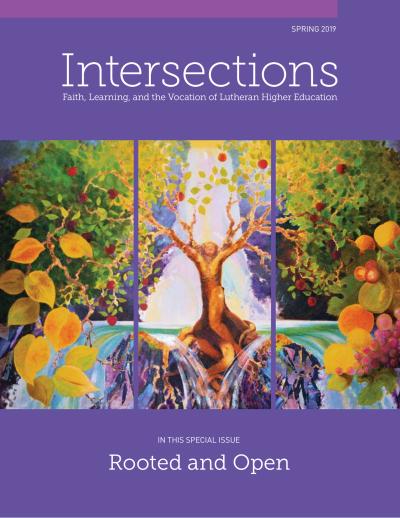
About the Cover and Artist
Kristen Gilje, a Bellingham, Washington artist who spent nine years as Artist in Residence at Holden Village, recounts the “Tree of Life” she painted for the Holden Village 1999 summer theme and the unexpected interpretation Lapidary Fred offered of Yggdrasol, Prometheus, the Druid Tree Spirit, and the crucifix all at once.
-
Article
Rooted and Open: Background, Purpose, and Challenges
Mark Wilhelm
Wilhelm traces Rooted and Open’s seventy-year backstory — from Conrad Bergendoff’s 1948 call for a Lutheran philosophy of education through the recovery of the vocation tradition — and describes the document’s process, purpose as a teaching and study resource, and the embodiment, contextual, and cultural challenges it implies for NECU institutions.
-
Article
In a Diverse Society, Why Should Lutheran Colleges/Universities Claim their Theological Roots?
Darrell Jodock
Jodock develops his “third path” account of the Lutheran college — neither sectarian nor non-sectarian but both rooted and open — analogizing the college to a bridge whose deck of daily activities rests on pillars of shared educational priorities, which in turn rest on theological footings; he then answers six common objections to claiming Lutheran roots and explains why those footings still matter.
-
Article
Roots and Shoots: Tending to Lutheran Higher Education
Jason A. Mahn
Mahn revisits why “education-for-vocation” has become a leitmotif for the 27 NECU schools, distinguishes institutional vocation from individuals’ religious identities and educational priorities from their theological grounding, and offers a friendly critique of Jodock’s bridge metaphor: Lutheran colleges grow in two directions like plants — deep roots and wide branches alike require constant tending.
-
Article
Marked by Lutheran Higher Education
Martha E. Stortz
Stortz offers an “operating manual” to Rooted and Open by tracing how the writing team moved from descriptive marks of the institutions to aspirational verbs that mark people — “called and empowered, to serve the neighbor, so that all may flourish” — and shows how each mark generates educational priorities theologically grounded in the radical mystery of God, the wild generosity of God, and the God who became one of us.
-
Article
Deep Roots, Big Questions, Bold Goals
Colleen Windham-Hughes
Adapted from a presentation to the California Lutheran University Board of Regents, Windham-Hughes reads the title Rooted and Open as both reaching back into the Lutheran tradition and opening forward into a shared future, then unpacks the document’s “called and empowered — to serve the neighbor — so that all may flourish” through the lenses of freedom of inquiry as a third path, vocation-centered education, radical hospitality, and civil discourse oriented toward the common good.
-
Article
Rooted and Open as Resource for Expanding Opportunities on Your Own Campus
Katherine A. Tunheim, Marcia Bunge
Bunge and Tunheim describe how Gustavus Adolphus College has paired Rooted and Open with its own companion volume Rooted in Heritage, Open to the World — in board workshops, new-faculty orientation, and classroom assignments — and survey several Network-wide opportunities (the Vocation of a Lutheran College Conference, the LECNA Fellows Program, the Association of Lutheran College Faculties, the Tuition Exchange Program, and international partnerships) that give the common calling tangible institutional form.
-
Article
"Faithful Nones" and the Importance of a Rooted and Open Pedagogy
John Eggen
Drawing on a student survey from his D.Min. thesis at Midland University, Eggen identifies a distinctive subset of religious “nones” — the “faithful nones” — who reject institutional religion yet retain substantive beliefs and practices, and argues that the non-binary, third-path pedagogy commended by Rooted and Open is uniquely positioned to engage a generation that has disambiguated faith, religion, and spirituality.
-
 Article
The Church in Education? Education in the Church? Ten Theses on Why These Questions Matter
Leonard G. Schulze
No. 21 · Summer 2005
Writing in the months before the August 2005 Churchwide Assembly that will decommission DHES, Schulze frames his vision for the division as ten Lutheran-style theses, each followed by Luther’s catechetical question “What does this mean?” He argues that critical thinking and moral deliberation are in the Lutheran gene pool; that Luther’s devotion to learning was an expression of Christian vocation; that the rise of the research university and the binary public meaning of “evangelical” have marginalized church-related colleges; that DHES has been wrongly perceived as marginal; and that the reformed concept of vocation must drive the soon-to-be-created program unit for Vocation and Education. An appendix reproduces the 2005 DHES strategic planning overview.
-
 Reflection
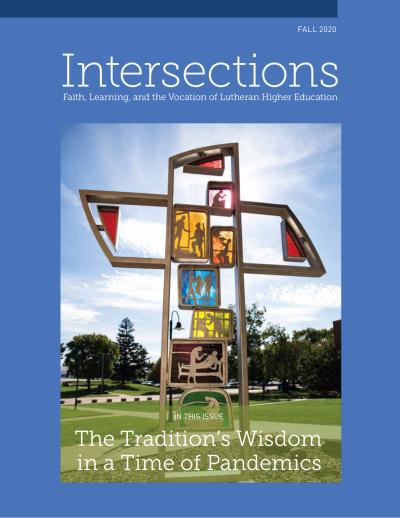
The Long Pilgrimage of 2020-21
Kara Baylor
No. 52 · Fall 2020
Drawing on Martha Stortz’s definition of pilgrimage as “intentional dislocation, for the sake of transformation, where the body teaches the soul,” Baylor invites students and educators worn out by the 2020-21 academic year to ask what is essential, to listen to what their bodies are telling their souls, and to be more open to the transformations the dislocation might still yield.
-
 Article
Professing Religion
John D. Barbour
No. 37 · Spring 2013
Barbour reflects on the vocation of a Professor of Religion at St. Olaf College, asking when and how a teacher should disclose personal faith in the classroom. Drawing on his graduate teachers Anthony C. Yu and Langdon Gilkey, and on Augustine’s Confessions, Dorothy Day, Malcolm X, C. S. Lewis, and Kathleen Norris, he argues that teaching autobiography invites teaching autobiographically—and that professing religion is finally a matter of how one believes, not just what.
-
 Editorial
From the Publisher
Mark Wilhelm
No. 31 · Winter 2010
Wilhelm traces his decades-long enthusiasm for the Lutheran doctrine of vocation from his St. Olaf days reading Luther’s Open Letter to the German Nobility, notes Parker Palmer’s lecture-circuit ministry and Mark C. Taylor’s reflections on calling, and argues that ELCA colleges should claim vocation as the defining mark of Lutheran higher education—yet warns that vocation risks becoming “the program du jour” rather than a permanent hallmark.
-
 Editorial
From the Editor
Robert D. Haak
No. 27 · Spring 2008
Haak frames the issue around the question of why Lutherans engage the world rather than retreat from it, locating the answer in the doctrines of creation and incarnation, and introduces essays by Erwin on globalism, Carlsen on local community engagement, Marty on multiple callings, and Mattes on the Grundtvigian heritage at Grand View. He also bids farewell to publisher Arne Selbyg, noting the fittingness of the Adinkra (“farewell”) cloth on the cover of this final issue under Selbyg’s leadership.
-
 Article
Finding the Miracle in the Intersection of Mission and Limitations: Lessons from Latin America
Kat Peters
No. 61 · Spring 2025
14 min audio
Peters draws on her time interning with Lutheran World Relief and leading a study abroad program in Central America — including a Costa Rican women’s farm cooperative whose ecotourism project was “unprofitable” but life-giving — to argue that the intersection of God’s preference for struggle and God’s desire for abundant life is itself the miracle higher education can claim amid scarcity.