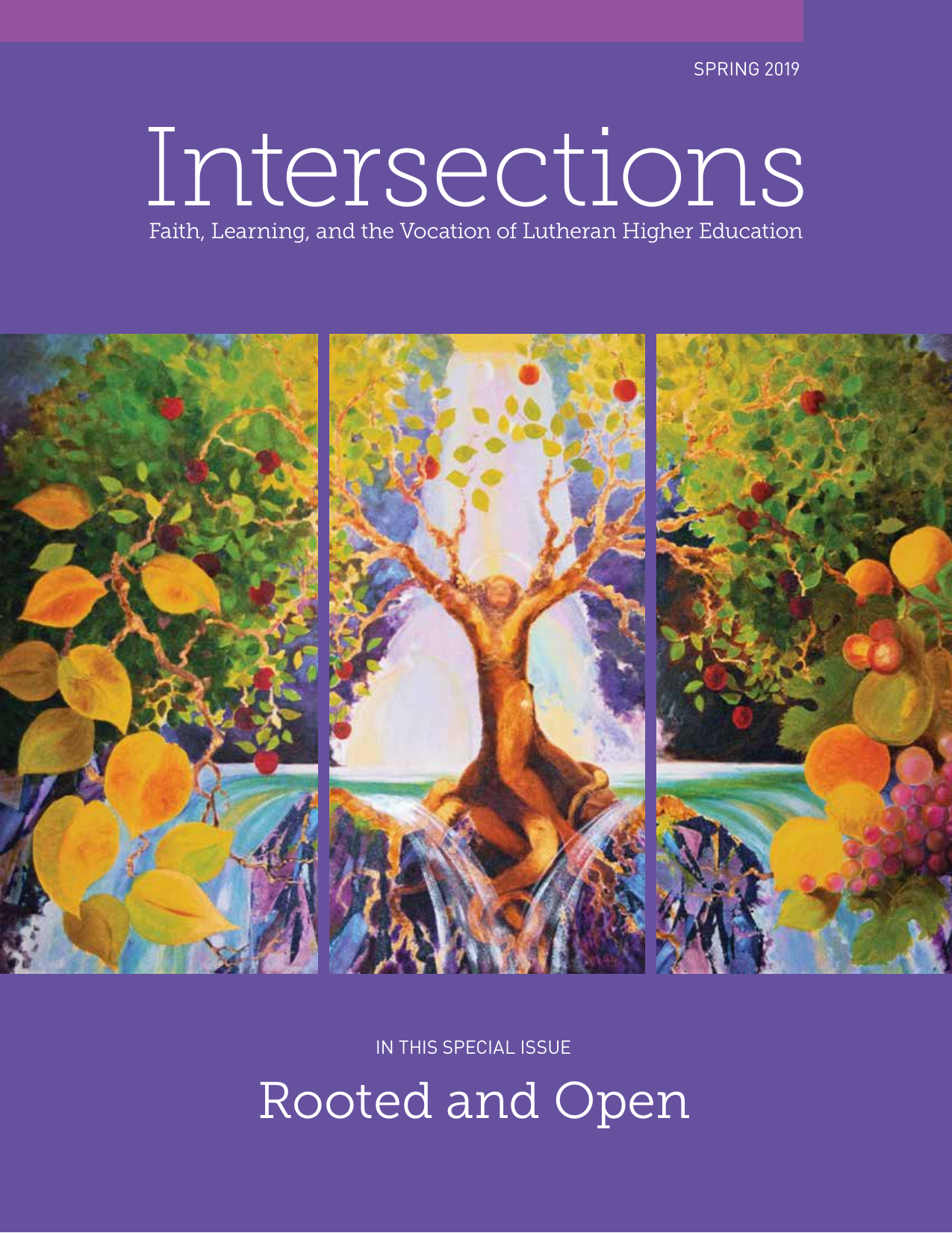
Rooted and Open
A special issue of Intersections dedicated to Rooted and Open: The Common Calling of the Network of ELCA Colleges and Universities, the statement on Lutheran identity in higher education unanimously adopted by NECU presidents in January 2018. Writing-team members Mark Wilhelm, Darrell Jodock, Jason A. Mahn, and Martha E. Stortz offer the “third path” rationale and account for how the “marks” inscribe both institutions and people. Further essays by Colleen Windham-Hughes, Marcia J. Bunge, Kathi Tunheim, John Eggen, and Emily S. Kahm bring Rooted and Open to life on campus.
Editors
Articles in this Issue
-
 Institutional Focus
About Rooted and Open: The Common Calling of the Network of ELCA Colleges and Universities
An institutional framing piece introducing Rooted and Open — NECU’s statement on Lutheran identity in higher education — with a roster of the faculty working group and writing team and an orientation to the essays in this special issue.
-
Institutional Focus
About the Cover and Artist
Kristen Gilje, a Bellingham, Washington artist who spent nine years as Artist in Residence at Holden Village, recounts the “Tree of Life” she painted for the Holden Village 1999 summer theme and the unexpected interpretation Lapidary Fred offered of Yggdrasol, Prometheus, the Druid Tree Spirit, and the crucifix all at once.
-
Article
Rooted and Open: Background, Purpose, and Challenges
Mark Wilhelm
Wilhelm traces Rooted and Open’s seventy-year backstory — from Conrad Bergendoff’s 1948 call for a Lutheran philosophy of education through the recovery of the vocation tradition — and describes the document’s process, purpose as a teaching and study resource, and the embodiment, contextual, and cultural challenges it implies for NECU institutions.
-
Article
In a Diverse Society, Why Should Lutheran Colleges/Universities Claim their Theological Roots?
Darrell Jodock
Jodock develops his “third path” account of the Lutheran college — neither sectarian nor non-sectarian but both rooted and open — analogizing the college to a bridge whose deck of daily activities rests on pillars of shared educational priorities, which in turn rest on theological footings; he then answers six common objections to claiming Lutheran roots and explains why those footings still matter.
-
Article
Roots and Shoots: Tending to Lutheran Higher Education
Jason A. Mahn
Mahn revisits why “education-for-vocation” has become a leitmotif for the 27 NECU schools, distinguishes institutional vocation from individuals’ religious identities and educational priorities from their theological grounding, and offers a friendly critique of Jodock’s bridge metaphor: Lutheran colleges grow in two directions like plants — deep roots and wide branches alike require constant tending.
-
Article
Marked by Lutheran Higher Education
Martha E. Stortz
Stortz offers an “operating manual” to Rooted and Open by tracing how the writing team moved from descriptive marks of the institutions to aspirational verbs that mark people — “called and empowered, to serve the neighbor, so that all may flourish” — and shows how each mark generates educational priorities theologically grounded in the radical mystery of God, the wild generosity of God, and the God who became one of us.
-
Article
Deep Roots, Big Questions, Bold Goals
Colleen Windham-Hughes
Adapted from a presentation to the California Lutheran University Board of Regents, Windham-Hughes reads the title Rooted and Open as both reaching back into the Lutheran tradition and opening forward into a shared future, then unpacks the document’s “called and empowered — to serve the neighbor — so that all may flourish” through the lenses of freedom of inquiry as a third path, vocation-centered education, radical hospitality, and civil discourse oriented toward the common good.
-
Article
Rooted and Open as Resource for Expanding Opportunities on Your Own Campus
Katherine A. Tunheim, Marcia Bunge
Bunge and Tunheim describe how Gustavus Adolphus College has paired Rooted and Open with its own companion volume Rooted in Heritage, Open to the World — in board workshops, new-faculty orientation, and classroom assignments — and survey several Network-wide opportunities (the Vocation of a Lutheran College Conference, the LECNA Fellows Program, the Association of Lutheran College Faculties, the Tuition Exchange Program, and international partnerships) that give the common calling tangible institutional form.
-
Article
"Faithful Nones" and the Importance of a Rooted and Open Pedagogy
John Eggen
Drawing on a student survey from his D.Min. thesis at Midland University, Eggen identifies a distinctive subset of religious “nones” — the “faithful nones” — who reject institutional religion yet retain substantive beliefs and practices, and argues that the non-binary, third-path pedagogy commended by Rooted and Open is uniquely positioned to engage a generation that has disambiguated faith, religion, and spirituality.
-
Article
Finding Flourishing: Teaching Self-Care as Course Content
Emily Kahm
Kahm argues that teaching self-care, self-awareness, and stress-coping as explicit classroom content embodies the “radical hospitality” of Rooted and Open and supports vocational formation against a consumerist culture, then offers concrete classroom techniques — a one-to-five energy check-in, ninety-second silence exercises, and full-day spiritual practices — that can be adapted across disciplines at NECU institutions.