Here’s a story of which we cannot see the ending.
The story begins in mid-March, after a novel coronavirus (SARS-CoV-2) reached American shores, and it became clear that this was serious—really, really serious. Restaurants and shops closed down. Most of our NECU schools told their students not to return to classes after spring break; instead, school would move online. States mandated their residents to stay at home unless their work was deemed essential. A shortage of toilet paper in early March gave way to a shortage of morgues by the end of April. People taped construction paper hearts to their windows and left thank you notes and hand sanitizer for UPS workers. Sports disappeared. Flattening the curve, social distancing, six feet apart, and sheltering-in-place became household terms.
Interwoven with this crisis in personal and public health was the hemorrhaging of the economy. By the end of July, the GDP had plummeted to almost two-thirds of its previous annual rate. The U.S. unemployment rate, which averages at about 5.75 percent since World War II, skyrocketed to almost 15 percent in April. While Covid-19 seemed, at least at first, not to discriminate between its victims, the pandemic-driven recession, like the coronavirus itself, immediately targeted the most vulnerable. Grocery store and fast food workers deemed “essential” wondered whether that really meant “disposable.”
Then, the divisions became politicized. The debate over how and whether to reopen the economy started to fall along partisan lines, with maskless libertarians protesting shelter-in-place orders and demanding their right to work, as mask-shaming liberals boycotted businesses that neglected safety precautions. The pandemic-driven recession is certainly a symptom of Covid-19, but treating it can worsen the disease. States in the Sun Belt who reopened aggressively around Memorial Day soon saw a spike in cases and shut back down by the Fourth of July.
Some now wonder whether a global capitalistic economy, with safety nets for few and the exploitation of many, primarily experiences the effect of the health crisis or is something closer to its cause.
While the epidemic outbreak and economic meltdown happened in lockstep, a third pandemic broke out later in the summer, surprising many with its force and speed. Many of us who, in the words of Ta-Nehisi Coates, “believe ourselves white” responded to the belated news reports of Ahmaud Arberry’s murder on February 23 much like we had responded to early reports of the coronavirus outbreak in Wuhan, China—with interest in and mild concern for something affecting other people. The same was true for Breonna Taylor’s death on March 13 by the Louisville Police Department. But when George Floyd died under the knee of Minneapolis police officer Derek Chauvin on May 25, our nation’s long-time pandemic of police brutality and systemic racism fully presented itself to all America. An accompanying outbreak of uprisings, vigils, and protests hit Minneapolis and spread throughout the world. In, with, and under the pandemic of Covid-19 is the equally deadly pandemic of police brutality, widespread white supremacy, and the mass incarcerations and executions of Black America.
Taking institutionalized racism alongside an extractive economy, partisan politics, and global contagion, it becomes difficult to sort out the primary disease from symptoms and underlying conditions. Is this one pandemic or many? If the latter, they certainly feed off one another. We know, for example, that higher contraction and death rates of Black, Brown, and Native Americans correlates in turn with insufficient health care, untreated chronic preconditions, the working conditions of essential/disposable workers, and other structural sins.
It matters how we tell this story. To be liberally educated means to be able to critically examine such stories, to hear them with critical and self-critical ears. Who are the heroes, and what are their flaws? Who is villainized? Is redemption and healing still open to them? What kind of story is this? Whose interests does it serve? Who gets to tell it?
Actually, the ability to critically investigate the stories we tell is only half of what it means to be liberally educated. The other half involves the ability to tell stories and thus to make meaning in the first place. Liberal arts colleges, especially those that are church-related, want our students to form character as well as acquire skills. To form and know your character is to come to know yourself as a character in a larger story. It is to find yourself in a story that you did not create but can fully own and narrate. It is to understand yourself and your world as having a plot, meaning, and purpose—above and beyond the random incidences and coincidences that too often decide how we live. This is another way of saying that Lutheran liberal arts schools educate for vocation. They want students to form the kinds of selves and live the kinds of lives that are attuned to—and can capably respond to—the needs and callings of others.
So, the story of our Lutheran schools must be a story about responsibility, about the ability to respond to the unbidden call to educate in unprecedented ways, and to do so through multiple, crisscrossing pandemics. That’s not easy, to say the least. And yet, with our lives stripped down—very few sports and musical ensembles (if any) on campus, fewer off-campus parties (we hope), real conversations with exhausted students dropping into our virtual office hours—this may be the right moment to reflect on why each of us is here. In this long and painful time, we might just hear a still, small voice reminding us of the larger purposes of education and the crucial importance of our commonplace callings.
-
 Editorial
From the Publisher
Mark Wilhelm
Wilhelm argues that the “hackneyed” expressions of higher education — “you are not just a number,” “the college experience,” “risen to the challenge” — tell the simple truth about NECU institutions even as the Covid-19 pandemic has pushed budgets, employees, and campus life to the breaking point.
-
Article
A New Image for an Ancient Call: Lutheran Higher Education Amidst Pandemics Today
Caryn Riswold
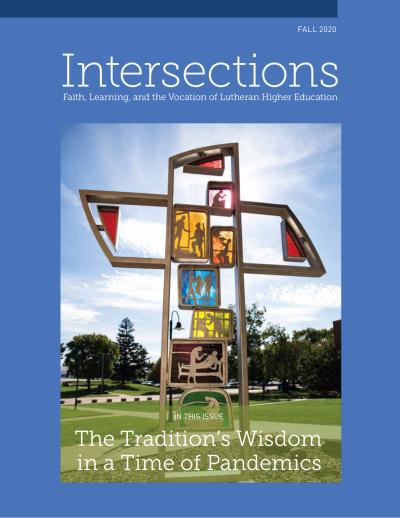
Pairing Wartburg’s Lebenskreuz sculpture with the Matthew 25 acts of mercy and the commitments of Rooted and Open, Riswold reads the calls to feed the hungry, welcome the stranger, and care for the sick as urgent summons for Lutheran higher education in a year of overlapping pandemics — and as a call to dismantle the structures that produced them.
-
Article
Learning from Luther on Covid-19
Carl Hughes
Reading Martin Luther’s 1527 treatise “Whether One May Flee from a Deadly Plague,” Hughes finds practical and spiritual guidance for a pandemic age: serve the neighbor, follow medical experts, honor those whose vocations put them at risk, and trust that even when we fail, God will not abandon the community.
-
Article
Radical Hospitality on Haunted Grounds: Anti-Racism in Lutheran Higher Education
Krista E. Hughes
Writing from Newberry College’s campus on land once home to the Cherokee and within a day’s drive of Mother Emanuel A.M.E., Hughes argues that NECU’s call to “practice radical hospitality” demands that predominately white institutions open themselves to the hauntings of racism — pursuing belonging rather than mere welcome, and risking kenotic transformation of institutional identity itself.
-
Article
Activism, Justice, and the Danger of Silence
Dezi Gillon
In conversation with Jason Mahn, Augustana College alumnux Dezi Gillon traces the call to action they felt as a Black student organizing for Black Lives Matter on a predominately white campus — through seminary, art, spirituality, and restorative justice work — and warns white professors that staying silent “actually speaks volumes.”
-
Article
Leadership in Lutheran Key at a Time of Pandemics
Deanna Thompson
Thompson draws on Luther’s theology of the cross and Shelly Rambo’s theology of trauma to sketch a Lutheran model of leadership for a season of pandemics — one that is attentive to pain, responsive to need, and intentionally nourished by food, friends, and deep conversation.
-
Article
Through Truth to Freedom—by Way of Reconciliation
Paul C. Pribbenow
Reflecting on Augsburg’s 150th-anniversary motto “Through truth to freedom,” Pribbenow argues that in a season of three pandemics — pandemic illness, economic collapse, and the racial sin laid bare by the murder of George Floyd — higher education’s most authentic work is to educate for truth and freedom by way of confession and reconciliation.
-
Article
Finding Purpose in Chaos: Reflection In and Beyond the Public Health Classroom
Lena R. Hann
When the pandemic hit her new public health professionalism course, Hann recalibrated her teaching from the “how” of professional preparation to the “why” of vocational reflection — and recounts how Augustana public health students and alumni found purpose in the chaos through food banks, disaster response, palliative care, and research on health inequities.
-
Reflection
The Long Pilgrimage of 2020-21
Kara Baylor
Drawing on Martha Stortz’s definition of pilgrimage as “intentional dislocation, for the sake of transformation, where the body teaches the soul,” Baylor invites students and educators worn out by the 2020-21 academic year to ask what is essential, to listen to what their bodies are telling their souls, and to be more open to the transformations the dislocation might still yield.
-
Article
Called to Flourish: An Ethic of Care
Mindy Makant
Drawing on Lenoir-Rhyne’s core value of Care, Glennon Doyle’s Untamed, Darrel Jodock’s “Gift and Calling,” and Luther’s plague-era practice of opening his home to the sick, Makant argues that flourishing is interdependent — that self-care is a means to extending care, and that an ethic of care is the meaningful, transformative work to which Lutheran liberal arts education is called.
-
Article
Called to the Moment: A New Vocation for Lutheran Colleges
W. Kent Barnds
After a derecho ravaged Iowa in August 2020 and Pastor Katy Warren preached on 1 Peter 4, Barnds watched line workers, neighbors, and Augustana colleagues simply show up where they were needed — and proposes that the true vocation of a Lutheran college may be making the case for “meeting immediate need with a deep willingness” alongside the longer work of vocational discernment.
-
 Article
Vocation at Full Stretch: Reflections on Follow Your Bliss and Other Lies about Calling and its Use among College Students
Jason A. Mahn
No. 61 · Spring 2025
43 min audio
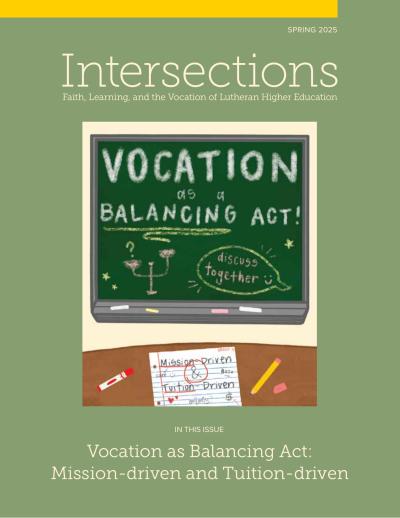
Mahn engages Bonnie Miller-McLemore’s Follow Your Bliss and Other Lies about Calling as required reading in a sophomore religion course, showing how her categories of missed, blocked, conflicted, fractured, unexpected, and relinquished callings empower young adults to perceive embodied, unplanned, and often painful dimensions of life as essential parts of vocation — and help close the gap between mission-driven and tuition-driven realities.
-
 Article
On Recruiting Diverse Students, Rooted in Mission
Eric Rowell, Jason A. Mahn
No. 59 · Spring 2024
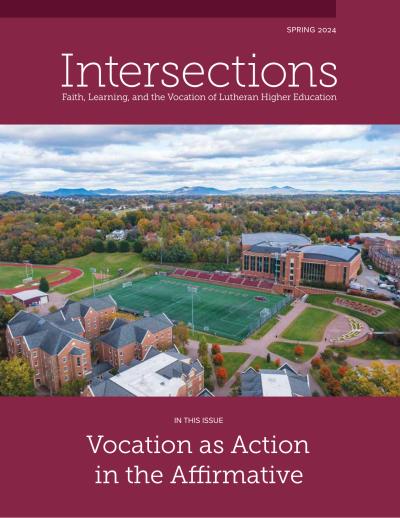
Jason Mahn interviews Eric Rowell, Assistant Director of Admissions and Diversity Outreach at Augustana College, about how recruiting students from a wide variety of backgrounds — rooted in Augustana’s Lutheran commitment to vocation and educating across difference — remains essentially unchanged in the wake of the Supreme Court’s 2023 decisions on affirmative action.
-
 Editorial
From the Outgoing Editor
Jason A. Mahn
No. 55 · Spring 2022
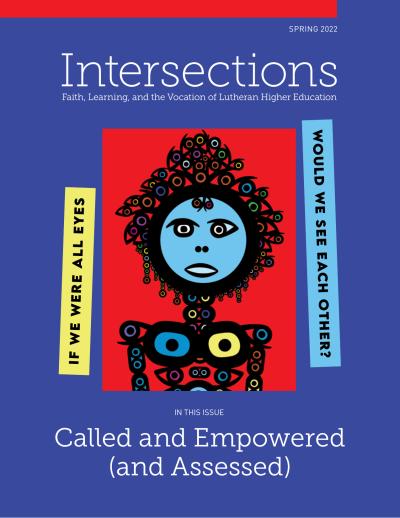
Mahn closes out a decade of editing Intersections, passes the duties to Colleen Windham-Hughes, gives thanks to Mark Wilhelm and Augustana College, and introduces an issue largely drawn from comments by Lutheran faculty, staff, and administrators at the 2022 NetVUE national gathering.
-
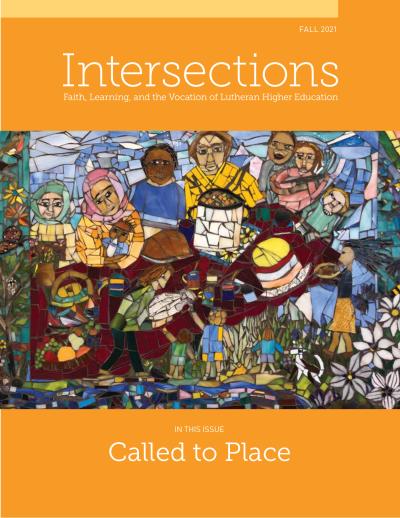 Editorial
From the Editor
Jason A. Mahn
No. 54 · Fall 2021
Mahn introduces the “Called to Place” theme of the 2021 VLHE Conference, arguing that Lutheran higher education’s emphasis on vocation must be grounded in particular geographies and embodied communities — for, as Wallace Stegner put it, “If you don’t know where you are, you don’t know who you are.”
-
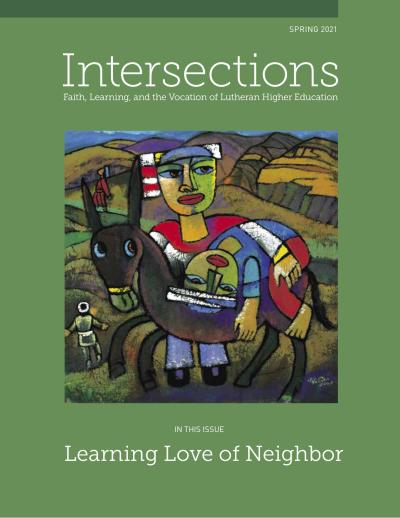 Reflection
Shelter in Place: Reflections from March 22, 2020
Jason A. Mahn
No. 53 · Spring 2021
On the fourth Sunday of Lent in 2020, Mahn meditates on the etymology of “shelter” (from shield) and on an email from a former student in Boston whose mutual-aid organizing models a Lutheran understanding of vocation: the upending of ego by divine love that frees us, finally, to see and serve the neighbor.
-
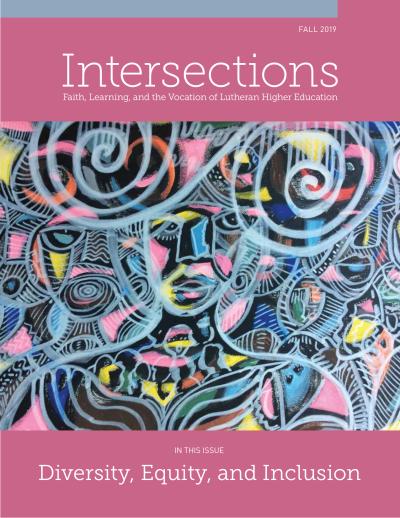 Editorial
From the Editor
Jason A. Mahn
No. 50 · Fall 2019
Mahn opens with Lenny Duncan’s observation that the ELCA is 96 percent white — the whitest denomination in the U.S. — and asks how teachers and administrators at historically, predominantly, and persistently white institutions can turn from white privilege and white supremacy toward spaces where people of color thrive and white people are re-formed into antiracist allies.
-
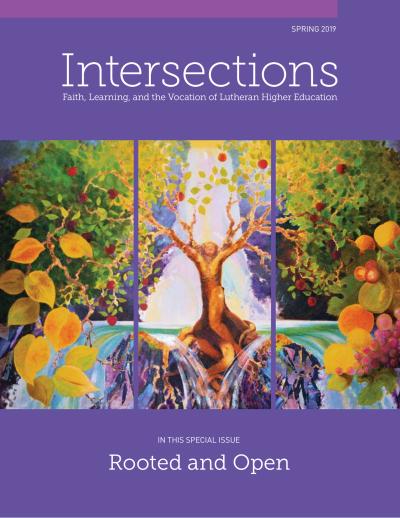 Article
Rooted and Open: Background, Purpose, and Challenges
Mark Wilhelm
No. 49 · Spring 2019
Wilhelm traces Rooted and Open’s seventy-year backstory — from Conrad Bergendoff’s 1948 call for a Lutheran philosophy of education through the recovery of the vocation tradition — and describes the document’s process, purpose as a teaching and study resource, and the embodiment, contextual, and cultural challenges it implies for NECU institutions.
-
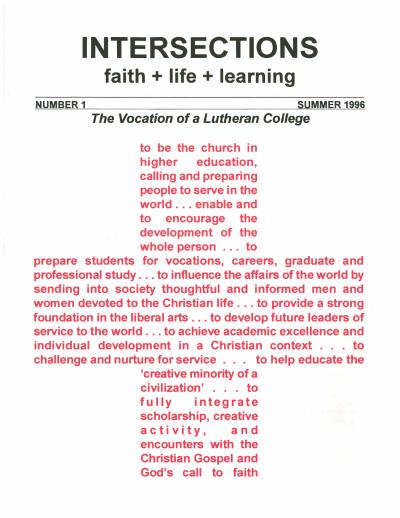 Response
Knowing and a Tradition to be Known
Kurt Keljo
No. 1 · Summer 1996
Keljo, University Pastor at Capital, embraces Schwehn’s vocational call but challenges his epistemological framing. We are called to bear witness to the Truth more than to pursue it; truth and power need not be dissociated when power is understood cruciform-ly as love and service; alongside objectivity, a case can be made from the tradition for connected knowing (image of God, idolatry, repentance, Incarnation). Christians offer not a particular epistemology but a foundation for epistemology—a tradition to be known. He closes with James Fowler’s four marks of the “public church”: particularly Christian, prepared for pluralism, balancing intimacy with public engagement, and unafraid of ideological pluralism in confident, nondefensive civility.
-
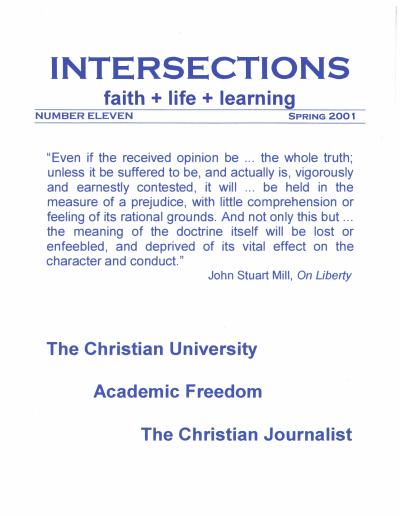 Editorial
From the Editor
Tom Christenson
No. 11 · Spring 2001
Christenson explains that this issue “borrows everything from other sources”—Richard Hughes’s talk at Pepperdine president Andrew K. Benton’s inauguration, Nicholas Wolterstorff’s and Storm Bailey’s essays from the AAUP’s Academe, and Catherine McMullen’s Concordia talk—and defends the blatant borrowing as appropriate to faculty work, hoping new faculty will find in these pieces a corrective to common misconceptions about faith-related education and academic freedom.
-
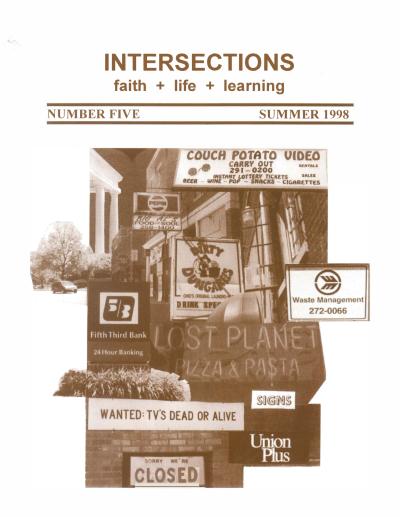 Editorial
From the Publisher
W. Robert Sorensen
No. 5 · Summer 1998
Sorenson frames Intersections and the Vocation of a Lutheran College Conference as vehicles for widening the scope of inquiry that the separation of mind from spirit has curtailed, citing Ernest Boyer on probing “the deep places of the mind and the deep longings of the human spirit.” He previews an announcement at the 1998 conference of the Conrad Bergendoff Series—named for the late scholar and former Augustana College president—whose first volume, by Ernest Simmons of Concordia College, will support an Academy of Scholars in Lutheran Higher Education.
-
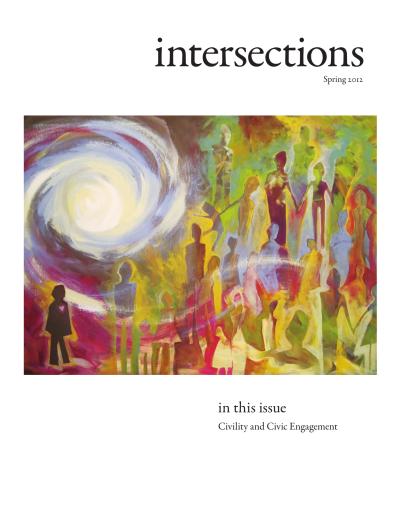 Article
Hospitality is Not Enough: Claims of Justice in the Work of Colleges and Universities
Paul C. Pribbenow
No. 35 · Spring 2012
Pribbenow argues that Augsburg’s incarnational motto — “And the Word became flesh” — grounds a calling beyond hospitality to justice. Drawing on Stephen Carter on civility, Letty Russell on just hospitality, Henri Nouwen, Parker Palmer, Michael Sandel, Bonhoeffer, Niebuhr, and Teresa of Avila, he describes four components of Augsburg’s practice: education “off the main road,” co-created common life, abundance over entitlement, and the anchor-institution model in which colleges become economic and civic partners with their neighborhoods.
-
 Article
Women Presidents in Higher Education: How They Experience Their Calling
Aimee Goldschmidt, Gary McLean, Katherine A. Tunheim
No. 42 · Fall 2015
Drawing on in-depth interviews with fifteen women college presidents and a transformative-learning-theory framework, Tunheim, McLean, and Goldschmidt trace a three-stage journey — identifying, interpreting, and pursuing the call — and ask what the language of vocation contributes to the preparation and mentoring of women leaders in higher education.