Vocation at Full Stretch: Reflections on Follow Your Bliss and Other Lies about Calling and its Use among College Students
Intersections No. 61 · Spring 2025
Bonnie Miller-McLemore, emeritus professor of religion, psychology, and culture at Vanderbilt University, has written a book about calling at full stretch. As the title, Follow Your Bliss and Other Lies about Calling, suggests, Miller-McLemore first and foremost stretches the concept of calling beyond all the farm-style kitchen décor and boardroom posters featuring inspirational one-liners meant to keep us happy and productive; follow your bliss. Do what you love and you’ll never work a day in your life. Seize the day. Live with no regrets. For her, we are called not only to the work we love, the plans we make, and the opportunities we seize, but also to all the unchosen, unpaid, unexpected, and often painful circumstances, relationships, and obligations that interrupt our plan-making and summon us to respond.
The book also stretches the concept of calling past those years in early adulthood usually reserved for vocational discernment. Previously, Miller-McLemore participated in a study of vocation across the lifespan at the Collegeville Institute and edited (with Kathleen Calahan) the book, Calling All Year’s Good: Christian Vocation Across the Lifespan (Eerdmans, 2017). In this latest book, she likewise addresses vocational complexities that may not show up for a 20-year-old, but will be dealt with by most of us at one time or another.
In Miller-McLemore’s terms, we must give up the overwrought, once-and-for-all understandings of vocation as “something ordained and special that we and only we are meant to do or something we’re divinely given and compelled to follow.”1 That idea leads us “to think that we can (or must) find the perfectly fitting job, the one-and-only special life partner, the ideally balanced life, the one-time summons from God” (14). Such deluded expectations are not only untrue, they also “distort life’s fuller, richer realities” (15). To live one’s callings at full stretch entails learning to “live well with grief, lament, anger, frustration, fatigue, disappointment, sacrifice, vulnerability, limitations, closure, mortality and finitude” (14)—in short, all that one does not and would not choose, and yet that which also makes possible a life well lived. This “shadow side” or “dark side” of one’s callings is not primarily an obstacle to be overcome, as some positive psychologists and other social scientific accounts of calling sometimes suggest. It is part of what makes life full, meaningful, and precious.
In short, Miller-McLemore claims that one must follow one’s blisters as well as one’s bliss (15). And she emphasizes the bodily nature of those blisters. They surface (sometimes literally) in moments of pregnancy, childbirth, and miscarriages, in making a living to feed hungry children, in aging, becoming dependent on others, and while facing death. To live one’s calling at full stretch means that we live as creatures fully embodied. Our vocations not only include a life of the mind with its intentions and choices but also our lives as whole, vulnerable creatures who offer and receive care for one another.
“To live one’s callings at full stretch entails learning to ‘live well with grief, lament, anger, frustration, fatigue, disappointment, sacrifice, vulnerability, limitations, closure, mortality and finitude’ (14)—in short, all that one does not and would not choose, and yet that which also makes possible a life well lived.”
Some blisters commonly surface early in life. College students know the need to make difficult decisions to pursue one major or career and not another, and the closed doors, second-guessing, and regret that inevitably follow. Learning to live with unexpected callings (say, the birth of a child with disabilities), or callings that need to be given up (for many, during the time of retirement) won’t necessarily be at the top of mind for younger adults. Yet, Miller-McLemore makes it clear that life’s “normal” course is never normative; people can experience the blisters alongside the bliss in any stage of life. So while she organizes the book beginning with callings familiar to young adults, moves to those common in middle age, and ends with those ordinarily experienced in the “third act,” she notes that “these dilemmas cross boundaries, and in each case, people can experience the callings and their related hardships at any time in life” (12).
After receiving an early, signed copy of the book from the author (thank you, Bonnie!), I read it, learned from it, and quickly assigned it as required reading in my Fall 2024 course, “Christian Theology and Contemporary Social Issues.” I shaped the third and final unit of that course around Follow Your Bliss and asked students to make “substantial use” of it in their final class paper. After sketching the broad contours of the book, I’ll return to this course and my students’ work with the book, testing its ability to connect with young persons who haven’t yet had many of the experiences narrated so beautifully therein. I’ll conclude with some words about what I have learned from reading and teaching this book about the need to think honestly about vocation among students needing to secure good jobs and within a college needing their tuition dollars.
From Decisions to Departures and Everything Between
The book’s first two chapters on “missed callings” and “blocked callings” treat experiences familiar to traditional age college students. In the first, Miller-McLemore emphasizes an overlooked theme in Frost’s poem, “The Road Not Taken,” namely, that we can and should look back on missed callings “with a sigh” (24). That is, we should allow ourselves to feel regret and grieve all the callings we couldn’t answer, callings that were cut off by our own necessary decisions (to de-cide literally means to “cut off”). Still, “somewhere ages and ages hence” (Frost again), the path we did choose might show itself as l good, redeemable, and at any rate our own. Experiences named in the second chapter will be most familiar to minority students, women, and others who have been directed toward certain vocations for which they are “capable” and away from those “above” them. The trick here is to be able to distinguish the normal limits that characterize everyone’s life (Chapter 1) from barriers unjustly imposed by privileged individuals or unjust social structures on the marginalized, which should be dismantled rather than accepted (Chapter 2).
Chapters 3 and 4 deal with callings typical of one’s middle years. Whereas missed and blocked callings stem from the challenge of not being able to do as much as one wants, whether by natural limits or structural sin, “conflicted callings” (Chapter 3) spring from the demand to do far too much. Any parent, but especially mothers, feel the precariousness of juggling the vocation of parenthood alongside paid work, care for aging adults, participation in church, fidelity to friends, and the need somehow to eat, shower, and maybe even poop in peace. As with blocked calling, Miller-McLemore here attends to the cultural and political systems that unequally distribute this hardship. Women have, often without other options, staffed the unpaid and undervalued “second shift” of cleaning, cooking, and caretaking—in fact, still 38 percent more of it than men, even when the woman is also the primary breadwinner (70-71). The goal, according to Miller-McLemore, is not to find an elusive “right balance,” which is next to impossible and often leads to exploitation and burnout. Rather, we must be honest about priorities, level patriarchal hierarchies, and become more comfortable with mediocrity in much of what we do.
“That is, we should allow ourselves to feel regret and grieve all the callings we couldn’t answer, callings that were cut off by our own necessary decisions.”
Chapter 4, “Fractured Callings,” which takes its subtitle from the Apostle Paul: “I do not do the good I want,” stands out from the others in scope and tone. Miller-McLemore herself reflects on the difficulty of writing about, and even naming, failed or mistaken callings, which Christians have (perhaps misleadingly) labeled sin. To me, the challenge here relates to that of discerning between missed and blocked callings. “Fracture,” like sin, names the harm we enact, but also the brokenness affecting us before any decision on our part. Miller-McLemore writes about divorce and other painful breaks that people tragically choose and from which they suffer. She beckons readers (and herself) toward introspection, responsibility, and even confession (when appropriate), but does so without flattening fragility into fault and blaming those who are also victims. Most importantly and pastorally, she ends the chapter by witnessing to the healing, forgiveness, learning, and grace that often follows from these more difficult moments in our lives.
Unexpected callings (Chapter 7) can interrupt and reconfigure any part of one’s life, but the author here focuses on those new, unexpected callings that emerge exactly because previous callings have been fulfilled so well. Strange but true: a life of responsibilities upheld and duties discharged gets you a lot more of the same. One will, almost by definition, never be done. Miller-McLemore writes of step-parenting as a “quintessential example” (119) of these expanding responsibilities of older adults.
The book ends, appropriately enough, with the callings we must “relinquish” at the end of our careers, our commitments, and our finite lives. Miller-McLemore here again calls for grief and room to lament. She notes, too, that our dominant culture is rather bad at letting go, especially with a vision of “the good life” that only tracks upward progress toward a telos, the goal pursued, never reckoning with the terminus, the final halt. Perhaps because relinquishing and lamenting is just so counter-cultural, the last chapter also feels the most Christian to me. She writes of the end of life as the time that many of us can stop counting the however-many habits of highly successful people, notice the transience and ultimate meaninglessness of much that we try to accomplish, accept grace and so become free to return to our fundamental calling to love God and the neighbor.
The short summary of the book above doesn’t do justice to Miller-McLemore’s reflective, personal, nuanced, and often funny voice throughout. The book brims with stories of people’s missed, blocked, conflicted, fractured, unexpected, and relinquished callings, and how they work their way through them. Some stories are taken from other books, but many are about the author or the people she knows and loves. I am somewhere in the middle third of a normal lifespan, and I relate to almost all of these accounts of the dark sides of calling, either because I have already experienced them, know people who have, or see them coming all too soon. (Even Miller-McLemore’s seemingly trite ponderings about how to relinquish an extensive academic library that she has built up over her career evokes some existential anxiety on my part. Does my life’s work finally matter? Will I even be able to give away my heavily annotated three-in-one volume of Tillich’s Systematic Theology?) But what about my students, most of whom are only now embarking on the second quarter of their lives? Can a book stretching vocation into the shadows and throughout the lifespan be meaningful and helpful to them?
Teaching and Learning from the Book
As I mentioned above, I chose to assign Follow Your Bliss as the central text of the final unit of a course that serves primarily sophomore students fulfilling their one “religion requirement.” The first unit of that course paired a short book on sin and salvation, Speaking of Sin, by Barbara Brown Taylor, with recent theological cases for reforming our criminal justice system in order to move from retributive to restorative justice. In the second unit, students read Timothy Beal’s When Time is Short: Finding Our Way in the Anthropocene, which proposes a realistic “creaturely theology” for a human species that perpetually denies death but might now be irreversibly headed toward our own extinction. While I didn’t notice the resonance between these texts and themes when I made the syllabus, re-reading Follow Your Bliss alongside the students allowed me to hear echoes of Taylor in the ways Miller-McLemore writes about fractured callings, as well as Beal’s call for “palliative hope” in Miller-McLemore’s invitation to “cultivate hearts capable of living with indeterminacy, ambiguity, and conclusions” (29).
The prompt for the students’ final project asked them to draw from texts and conversations over the course of the term, including a “Story Corps” interview2 that they conducted with a family member or mentor about their religious/spiritual lives and vocations. Students were asked to convey their understanding of calling as a concept, and to grapple with their own past, present, and anticipated callings, making use of Miller-McLemore’s book in the process. Having read and responded to their final essays, I have good evidence to conclude that this book on the whole of life’s callings, and one that lifts up their shadow sides, is especially meaningful and helpful to young adults who too often assume (often with our help) that vocations are to be planned by looking immediately ahead rather than borne while attending to the whole of one’s limited life.
Finding Language for Experiences
Not surprisingly, many of my students analyzed the idea of calling and made sense of their own vocations through Miller-McLemore’s “missed” and “blocked” categories. One student wrote of loving math when she was young, but also feeling called to work with children. She described feeling physically ill when she had to decide on a major, and even after making a decision (for speech-language pathology), “there is still a pit in [her] stomach about not pursuing a degree in accounting.” Miller-McLemore helped her understand that these feelings, however painful, are inevitable and normal. They come not because she made a wrong decision but because she made a decision, and so necessarily cut away other options. The student vows to acknowledge but not cling to regret, which will allow her “to live [her] life without such a large weight on [her] shoulders.”
Another student admitted to struggling with decision-making even when it comes to things like deciding what to eat for dinner. When it comes to larger decisions, like her recent decision to transfer out of Augustana in order to save money by enrolling in a college while living at home, “the inner conflict intensifies.” Indeed, the student finds the idea that any decision cuts away a multitude of possibilities “terrifying.” About Miller-McLemore on missed callings, the student then wrote:
It was beneficial for me to hear how Miller-McLemore suggests we navigate these missed callings. She suggests that we must acknowledge the loss while also finding balance by holding onto hope. It’s essential to accept the grief of lost possibilities, but also to recognize that “saying no to one way in life allows us to say yes to another” (quoting Miller McLemore 40).
I read these words at about the same time the student was handing in her dorm room keys. I think that her reflections on the pain and possibilities related to missed callings helped her make the move with the freedom that comes with accepting loss, or what Beal describes as palliative hope.3
The student transferring from Augustana also wrote about blocked callings. She was unable to continue her studies at Augustana because the rising costs of education (and life), coupled with the flattened wages of her working-class family, impeded her pursuit of that path. Other students also used language from Chapter 2 to describe the hardships they faced. One student described his decision to go to college as a way through limits imposed by his family: “My relationship with my mother was particularly strained,” he wrote. “She wanted me to be something that I was not.” The student describes his first and most authentic vocation: “the calling to learn—a calling to take control of my life.” Other students wrote of the socio-political obstructions faced by their parents. One daughter of Mexican immigrants describes her father, the youngest child of eight, who dropped out of school at an early age. He was and is interested in art, music, and sports, and really talented at them, too (according to his proud daughter). However, the “narrow minded ideas of my grandparents [prevented him from] pursuing work outside of a ‘man’s job.’” Her mother, too, was “practically forced” to go to cosmetology school by societal and familial expectations; she never became the “great psychologist she once dreamed of.” Miller-McLemore writes of callings that remain blocked throughout a person’s life, but which the next generation can take up and live out in new and courageous ways (63). This student confirmed that her parents’ blocked callings have influenced her own, discussing both the pressure and the pride of being a first-generation college student.
“Miller-McLemore writes of callings that remain blocked throughout a person’s life, but which the next generation can take up and live out in new and courageous ways (63). This student confirmed that her parents’ blocked callings have influenced her own, discussing both the pressure and the pride of being a first-generation college student.”
Conflicted callings were also commonly experienced by students, especially female students who resonated with Miller-McLemore’s descriptions. One student described her callings as a student, daughter, older sister, athlete, employee, and volunteer, all of which “demand [her] time, attention, care, and energy” (Quoting Miller-McLemore 67). Another student finds herself conflicted about attention to schoolwork versus attention to family. Indeed, she writes matter-of-factly: “Currently, while I write this paper, my grandfather is in the hospital and although my parents have assured me that he is alright, a part of me feels like I am turning my back on my family because I am not there to support him.” She also takes heed of Miller-McLemore’s advice about prioritization and acceptance of limits: “I know that when I finish my work at school, I will be able to go and see my grandfather and support him through his recovery.”
Finding Experiences for Language
Some of the most remarkable stories told would not have come up without Miller-McLemore’s category of “unexpected” callings. A junior transfer student earlier had told me that she spent two years at a community college before coming to Augustana, but hadn’t disclosed the backstory, until the final paper:
My experience of an unexpected calling happened when my mom passed when I was in high school. I originally planned to go to a university right away after graduating from high school. However, I ended up staying home for the first two years and attending community college in order to help my dad and grandma who was living with us. I also got to heal from the passing of my mom with my family together rather than apart.
The student concluded this paragraph by saying that these events “sometimes make me feel behind my peers [at Augustana] because I haven’t had as much time to think and reflect on what I want to do or feel called to do with my life.” In my comments back to her, I wrote that I hoped Miller-McLemore’s book would help her to see that this painful unexpected calling is itself a powerful part of her vocation rather than a setback or obstacle that she must overcome.
The student who included “big sister” in her list of conflicting callings noted that when she interviewed her father about his vocation, he never mentioned anything about unexpected callings. But, she writes, “the more I thought about it, I found one that affected our whole family.” She tells the story about her father’s sister, who had a baby about 12 years ago and could not care for the child after she relapsed into drug addiction. The student’s family fostered the child for four months and then adopted her. According to the student, “my family and I did not expect this, but we were called to take care of this child and give her the attention she deserves…She became a huge part of my life and I can’t imagine her not being my sister.”
“Beyond simply giving a name to the experience, the book enables students to include in their vocations all that they undergo and bear, and not only what they plan for and choose.”
While I don’t want to psychologize these students or guess at why they tell the stories they do, it is worth questioning whether 20-year-olds would have talked about the conflicts between being called to care for family and attention to oneself or one’s career, as many older women experience, or about the unexpected callings that follow the death of a parent or the birth of a child, as many older adults also experience, if it were not for Miller-McLemore’s description of callings in these terms. Without her descriptions of callings at full stretch—especially those that take full account of pregnancy, miscarriage, birth, (dis)ability, aging, and death and so fully honor our embodiment in the world, I’m not sure these experiences would register as important parts of the students’ called lives. Beyond simply giving a name to the experience, the book enables students to include in their vocations all that they undergo and bear, and not only what they plan for and choose. A “narrative” or “postliberal” theologian, one who believes that language not only names experience but also helps shape it, might add that Follow Your Bliss not only gives new names for these students’ experiences, but also actually enables them to experience these events as callings, and to live into them as such.
Football, Housework, and Evocations of “God’s Will”
“Relinquished callings,” common as they are at the end of one’s career or life, seem least relevant to my college students. Indeed, few of them wrote about learning to put down work and responsibilities that have hitherto shaped their lives. However, one football player, who sat in the back of the class with his teammates, waxed philosophical about the finite vocations of student-athletes. He wrote of his father’s paid vocation as a football coach and his own early desire to play sports and (at least as important) to be a part of a team. From age three, he retrieved the tee after kickoffs at high school football games and later took on the role of ball-boy. He notes that to an outsider, these early experiences may seem inconsequential; for him, though, they were a “way to do a service for those I considered to be as close as brothers.”
He then wonders whether playing football in college hasn’t taken away from his academics. Surprisingly, given that he calls teammates “brothers,” he doesn’t feel as though football “provides a service to my community.” But he plays, in part, “to make my father proud.” He cannot at this time “step away from a game that has shaped the man I am today.” Yet, notably, he does recognize that there will be an end and that it is coming soon:
Still, looking at my call to play football, I know at some point I will not be able to keep playing football and will have to relinquish that calling. . . . [The way Miller-McLemore] wrestles with what to do after her own retirement resonates with me. This makes me think about my future, in particular, two years from now when I’ll “retire” from playing football. I must think about what new callings will follow in place of this one, but I am unsure of what [they will be]. This shows how I have been struggling to come to terms with my limited life in football.
I think the last sentence would have been equally, perhaps more “existentially,” true even without the last two words, “in football.” If Miller-McLemore helps me to see just how consequential questions about what to do with my used books are, the student helps me to appreciate his vocation as an athlete, and how putting that down will be necessary and painful, but may also help him to “find new opportunities to love God and neighbor” (151).
Interestingly, none of my students explicitly used Miller-McLemore’s category of “fractured callings” to describe their own or loved ones’ lives. This isn’t surprising, given the religious weight of brokenness and sin, coupled with the academic setting of our work. Still, one student who earlier visited me during office hours to discuss non-literalist interpretations of the Bible, which were new to her, wrote about her conservative Christian mother’s callings and, in so doing, negotiated the complex relations between personal choice, God’s will, and sinful social structures. The student’s mother told her during the Story Corps interview that she was “called to be a wife and mother [because] that’s what women were created [by God] to do” In the final paper, the student wonders whether her mother’s perceived calling was really from God, or whether it issued from sinful, patriarchal social structures that blocked her mom from pursuing other things. The student decided that she could not untangle the issue. Like her mother, she also feels called to “being a wife and mother” as well as “having a pottery studio in a shed out in the backyard.” The question for her is not, first of all, whether those callings come from God and/or a patriarchal social structure, but why such vocations are “often overlooked and deemed less important in comparison to paid work.” Like Miller-McLemore, she recognized that religious language evoking God’s will can function as ideological justification or divine “sanction” (14) for systems that are unjust. And yet, also like Miller-McLemore, the student suggests that the alternative to such religious rationalizations is not to do away with religion, but to understand it as embodied, socially contextualized, fallible, and important.
“The question for her is not, first of all, whether those callings come from God and/or a patriarchal social structure, but why such vocations are ‘often overlooked and deemed less important in comparison to paid work.’”
Admittedly, simpler understandings of “higher callings” or “God’s will” were also common in these student papers. Despite Miller-McLemore’s robust theological language, the students interpreted the book as an endorsement of secular accounts of vocation, as with this comment from the student who wrote of her immigrant parents’ blocked calling:
Miller-McLemore’s portrayal of blocked callings shifted my understanding of calling in religious terms to more secular terms. I respect that some people believe God or a higher power controls their life but we can’t deny the other controlling or even determining external factors. Miller-McLemore highlights the social injustices or inequalities that lead to missed opportunities, mainly experienced by minorities.
Could attention to these “determining external factors” shift the student’s understanding of calling not (only) to more secular terms, but also to deeper and more nuanced—or even more Christian—understandings of God’s “will”?4 Even the student readying himself to give up football associated this with a nonreligious vocation, even though Miller-McLemore portrays relinquished callings in explicitly Christian terms. According to the student-athlete: “This coming to terms with limited time is what I think is the secular point of calling. This is very different from the religious point of calling, which is to better the world around us.”
These students join Miller-McLemore in recognizing the danger of religious rationalizations, but not the place of more nuanced and faithful religious discernment. By contrast, at least one student evoked God’s will as an endorsement of his aspirations. Having been unable to become a professional race car driver, he now “plan[s] on giving my children the opportunity to race, if I am wealthy enough, and if one or more [of them] share my passion.” The student “intended on financing” this dream deferred to his children by becoming an “investment banker, one of the highest paying jobs in all of finance.” He has since decided on accounting, a career that should “provide [him] with enough income to meet [his] aggressive saving/investment goals.” He’s done well in his accounting classes, having “been gifted with high information retention and an innate ability to analyze everything,” and so does “not doubt that these God-given skills were handed to [him] for a reason.” He also recently received an internship offer from Deloitte, “the top accounting firm in the world.” The student surmises that “seeing as how I got the internship, I like to believe this is what God is calling me to do.”
To be fair, the student also made a case for how CPAs are needed not only so that their kids can drive race cars, but also to ensure that financial systems remain in good keeping, which in turn helps maintain “the beauty, integrity, and orderliness of the world”—a good description of Lutheran understandings of calling as rooted in God’s creation.5 Still, in my comments back to the student, I asked him to consider times when what happens in our lives or in history does not straightforwardly point to the will of God, and when evocations of that will can function to justify decisions and ambitions that may or may not be good and just. I have also written in my own end-of-semester reflections about the need to carve more time to discuss the complex and subtle nature of divine callings the next time I teach this class and book.
Lies About Calling at Mission- and Tuition-Driven Colleges
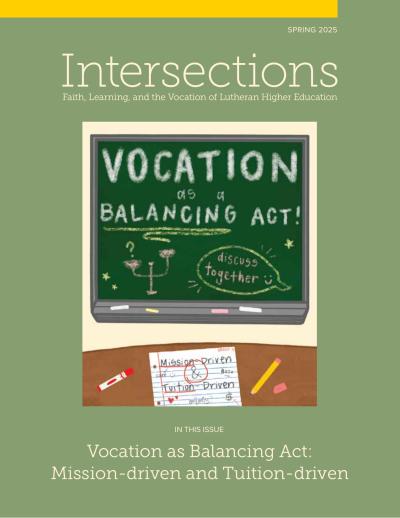
As my reflections above indicate, I find this book incredibly helpful and thoughtful. Readers, including traditional college-age readers, are empowered to think of vocation in wide and deep ways. They are able to perceive the embodied, unplanned, and often painful dimensions of their lives as essential parts of their calling rather than distractions to be overlooked or obstacles to be overcome. They are thus able to live vocationally—with reflection, courage, and seasoned hope—throughout their limited lives.
To conclude these reflections, I want to note the value of this book for those working or learning at a Lutheran liberal arts college that is both mission-driven and tuition-driven. Too many of us at places like Augustana College continue to talk about vocation in ways that make it look unrelated to the real-world realities of today’s students. Linked with personal meaning, fulfillment, and a transcendent sense of purpose, vocation can sound like a luxury—something offered to white, upper-middle-class students of yesterday but hardly available for the average college student today. Here, vocation is associated with the liberal arts, that with a “free life of the mind,” and each is distinguished from the realities and necessities of the real world. “First gen” and domestic students of color, who aim to survive college and obtain a measure of upward mobility, and international students, who often come to the U.S. to pursue careers in healthcare, engineering, or computer programming, can think of vocation (if they think of it at all) as something for “traditional” students. Educators concerned with access and retention of historically marginalized students often find Augustana’s commitment to “offering a challenging education that develops the qualities of mind, spirit and body necessary for students to discern their life’s calling of leadership and service”6 to be incongruous with, if not tone-deaf to, more pressing needs.7
“Too many of us at places like Augustana College continue to talk about vocation in ways that make it look unrelated to the real-world realities of today’s students. Linked with personal meaning, fulfillment, and a transcendent sense of purpose, vocation can sound like a luxury—something offered to white, upper-middle-class students of yesterday but hardly available for the average college student today.”
Miller-McLemore’s book, by contrast, emphasizes that callings are deeply grounded in lived experiences, and thus must “possess a materiality and practicality often overlooked in more theoretical treatments” (5). In light of this, the transfer student worrying whether to spend more time on her religion paper or visit her grandfather in the hospital, or the first gen student feeling both pride and pressure to take advantage of the opportunities from which her immigrant parents were blocked, and maybe even the student who decides to major in accounting so that his kids can live out dreams that he could not—all these students are negotiating “deeply relational and communal callings” that are “shaped within and controlled by our intimate relationships and social contexts” (4). While most college classrooms don’t have Follow Your Bliss! posters hanging on classroom walls, educators do tell their own lies about calling. We (including me) have advised students to “major in whatever you want and you can worry about making a living later”—as though the campus bubble inoculates students from the worries of the “real world.”
But Follow Your Bliss and Other Lies about Calling cuts in the other direction as well. Too often, in honoring the lived realities of college students, we flatten the breadth and depth of bodily needs to the need to make money. In doing so, we conflate vocation with career. We assume that it is “undecided” students who should do some vocational discernment in order to decide on a career and major. Vocational discernment thereby can sometimes sound like it is a precursor to career readiness, a sort of remedial help for less ambitious students or those with commitment issues. When vocation is directly and exclusively linked to the choice of career (and choice of career with choice of major), we untruthfully overlook all the other realities that college students experience or for which they should be preparing, for example, the negotiation of the competing demands of work and parenting, or the decision whether to accept a promotion that moves you further from an aging parent. Miller-McLemore even includes this most real reality: “How does one die gracefully at the end of a life well lived?” (148).
Miller-McLemore rightfully attends to the need to earn a living. But she also extends “the real world” to include paid and unpaid vocations, some experienced now and others awaiting us, those we choose and those we can only bear as faithfully and gracefully as we can. She thus proves more realistic than even the most anxious parents interrogating their children about why they are majoring in classics. As such, the book can help colleges and universities close the gap between the idealistic language of their mission statements and the realities of shrinking middle-class and tuition-dependent institutions. That gap is best closed not by striking a happy balance between traditional liberal arts and “practical” programs, as some “liberal-arts-plus” institutions attempt to do. It closes by including within the highest goals of higher education the formation of students capable of faithfully responding to their many callings—some planned, many others unexpected and difficult. We need to retain spaces on our campuses and in our curricula (for example, in a one required religion course!) where students and educators can reflect honestly about the bliss and blisters of their lives. This book is an invaluable resource toward that end.
Endnotes
1. Bonnie J. Miller-McLemore, Follow Your Bliss and Other Lies About Calling (Oxford UP, 2024), 14. Subsequent quotations from Miller-McLemore’s book will be given in parentheses.
2. I adapted this assignment from my colleague Mark Safstrom, who uses it in his own section of Augustana’s “Reasoned Examination of Faith” requirement. Our versions borrow questions and interview ideas from Story Corps, Inc. See https://storycorps.org/participate/great-questions/
3. Timothy Beal, When Time is Short: Finding Our Way in the Anthropocene (Beacon, 2022), 65-74.
4. While I need to think more about this, I wonder whether Miller-McLemore’s case that bodily experiences of loss and limit should deepen our understanding of calling (which has been too dependent on a person’s volition, plans, and decisions) shouldn’t also change the way we think about the “will of God” that people of faith try to discern and follow. Christians, at least, believe that “God’s will” cannot be faithfully discerned apart from the embodied life, death, and resurrection of the incarnate Jesus who lives according to and so reflects the will of God.
5. The student here references my chapter, “You: Radicalizing Life’s Calling,” in Radical Lutherans / Lutheran Radicals, ed. Jason A. Mahn (Cascade, 2017), 135-38.
6. Augustana’s Mission Statement. Available at: https://www.augustana.edu/about-us/mission
7. This paragraph draws from my chapter, “The Value(s) of Lutheran Liberal Arts in a Neoliberal Age,” in Called to Reckon: Re-placing History and Reclaiming Mission at a Midwestern College, ed. Jane E. Simonsen, forthcoming from Southern Illinois University Press.
-
 Editorial
From the Publisher
Lamont Anthony Wells
5 min audio
Wells introduces So That All May Belong: Lutheran Roots for Diversity, Equity, Inclusion, and Justice as a theological and institutional articulation of NECU’s commitments, and previews four accompanying essays that frame vocation as a societal responsibility rooted in justice and not solely an individual pursuit.
-
Editorial
From the Editor
Colleen Windham-Hughes
5 min audio
Windham-Hughes uses Fred Rogers’ neighborhood as a living embodiment of a Lutheran understanding of vocation — seeing dignity in each person, offering one’s gifts generously, and trusting that the well-being of the neighborhood is intrinsically connected to the well-being of every neighbor.
-
Institutional Focus
So That All May Belong: Lutheran Roots for Diversity, Equity, Inclusion, and Justice
Altheia Richardson, Angie Hambrick, Caryn Riswold, Colleen Windham-Hughes, Deanna Thompson, Marcia Bunge, Robert Clay
22 min audio
The full NECU statement grounds DEIJ work in Luther’s 16th-century reforms and Lutheran theological claims about the image of God, equal dignity, and the limits of human knowing — offering definitions, Lutheran roots, and calls to action for diversity, equity, inclusion, and justice, with belonging as the outcome of DEIJ at work.
-
Institutional Focus
Scriptures That Inspire Work for Diversity, Equity, Inclusion, and Justice
Altheia Richardson, Angie Hambrick, Caryn Riswold, Colleen Windham-Hughes, Deanna Thompson, Marcia Bunge, Robert Clay
9 min audio
A companion list of biblical verses — from Genesis 1:27 and Galatians 3:28 to Micah 6:8 and Luke 4:18-19 — that grounded NECU’s drafting of So That All May Belong, organized by the four DEIJ commitments and offered as an invitation to share other texts that ground and sustain the work.
-
Institutional Focus
So That All May Belong: Lutheran Roots for Diversity, Equity, Inclusion, and Justice [abridged]
Altheia Richardson, Angie Hambrick, Caryn Riswold, Colleen Windham-Hughes, Deanna Thompson, Marcia Bunge, Robert Clay
8 min audio
A condensed version of the NECU statement that consolidates Lutheran theological grounding for DEIJ and a single combined call to action for Lutheran colleges and universities — offered as a shareable summary alongside the complete document.
-
Article
How Mister Rogers’ Neighborhood Reminds Us About Work
Than Oo
5 min audio
Drawing on a Season 15 arc of Mister Rogers’ Neighborhood in which residents redirect pool funds to fix a plumbing problem, Oo finds in Fred Rogers’ vocation-honoring storytelling a reminder that limited resources are an invitation to creativity, perseverance, and optimism in higher education.
-
Reflection
Ecotones of Faith
Tracy Paschke-Johannes
7 min audio
Paschke-Johannes draws on the ecological metaphor of the ecotone — the life-teeming transitional space between two ecosystems — to claim that we are not called to minister in the world of the past or one fifty years hence, but to nurture the kairos moments God is creating in the freshwater-to-saltwater present.
-
Article
Finding the Miracle in the Intersection of Mission and Limitations: Lessons from Latin America
Kat Peters
14 min audio
Peters draws on her time interning with Lutheran World Relief and leading a study abroad program in Central America — including a Costa Rican women’s farm cooperative whose ecotourism project was “unprofitable” but life-giving — to argue that the intersection of God’s preference for struggle and God’s desire for abundant life is itself the miracle higher education can claim amid scarcity.
-
 Article
On Recruiting Diverse Students, Rooted in Mission
Eric Rowell, Jason A. Mahn
No. 59 · Spring 2024
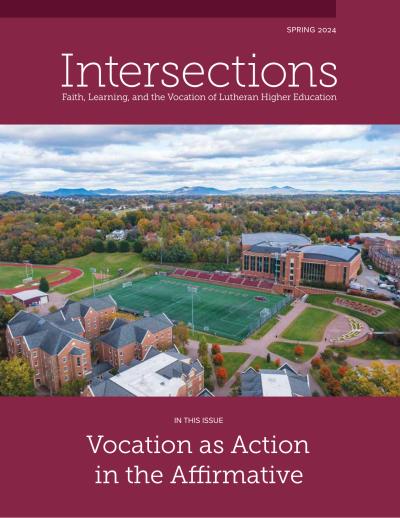
Jason Mahn interviews Eric Rowell, Assistant Director of Admissions and Diversity Outreach at Augustana College, about how recruiting students from a wide variety of backgrounds — rooted in Augustana’s Lutheran commitment to vocation and educating across difference — remains essentially unchanged in the wake of the Supreme Court’s 2023 decisions on affirmative action.
-
 Editorial
From the Outgoing Editor
Jason A. Mahn
No. 55 · Spring 2022
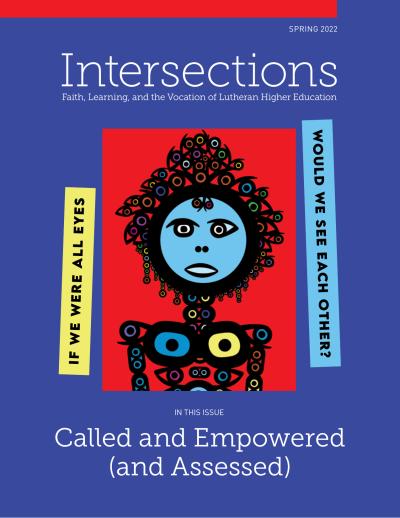
Mahn closes out a decade of editing Intersections, passes the duties to Colleen Windham-Hughes, gives thanks to Mark Wilhelm and Augustana College, and introduces an issue largely drawn from comments by Lutheran faculty, staff, and administrators at the 2022 NetVUE national gathering.
-
 Editorial
From the Editor
Jason A. Mahn
No. 54 · Fall 2021
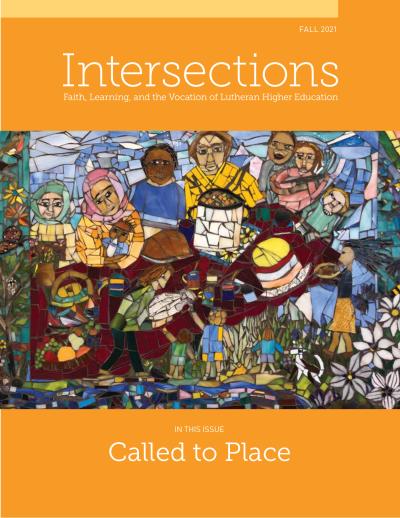
Mahn introduces the “Called to Place” theme of the 2021 VLHE Conference, arguing that Lutheran higher education’s emphasis on vocation must be grounded in particular geographies and embodied communities — for, as Wallace Stegner put it, “If you don’t know where you are, you don’t know who you are.”
-
 Reflection
Shelter in Place: Reflections from March 22, 2020
Jason A. Mahn
No. 53 · Spring 2021
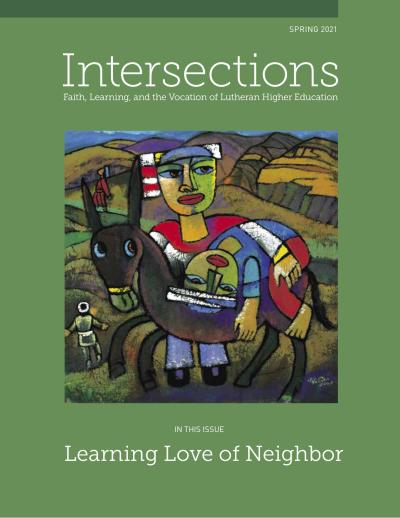
On the fourth Sunday of Lent in 2020, Mahn meditates on the etymology of “shelter” (from shield) and on an email from a former student in Boston whose mutual-aid organizing models a Lutheran understanding of vocation: the upending of ego by divine love that frees us, finally, to see and serve the neighbor.
-
 Editorial
From the Editor
Jason A. Mahn
No. 52 · Fall 2020
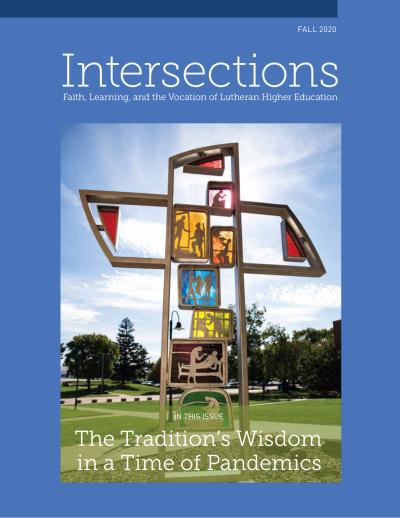
Mahn narrates a year of crisscrossing pandemics — Covid-19, economic collapse, partisan politics, and the long pandemic of white supremacy revealed anew by the murder of George Floyd — and argues that Lutheran liberal arts schools, by educating for vocation, are uniquely poised to help students respond with character and capable callings.
-
 Editorial
From the Editor
Jason A. Mahn
No. 50 · Fall 2019
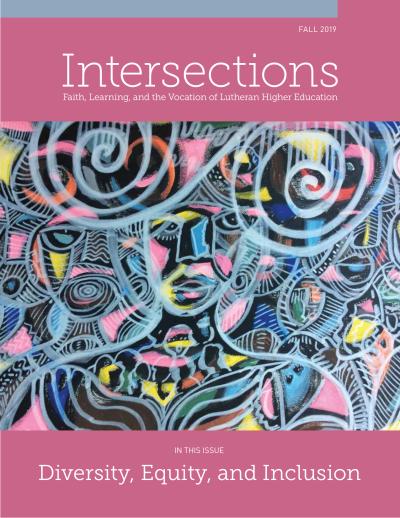
Mahn opens with Lenny Duncan’s observation that the ELCA is 96 percent white — the whitest denomination in the U.S. — and asks how teachers and administrators at historically, predominantly, and persistently white institutions can turn from white privilege and white supremacy toward spaces where people of color thrive and white people are re-formed into antiracist allies.
-
 Editorial
From the Publisher
Mark Wilhelm
No. 32 · Spring 2010
Wilhelm invites readers to enjoy or revisit the presentations from the 2009 Vocation of a Lutheran College Conference, then reflects on the Higher Learning Commission’s denial of Dana College’s request to transfer accreditation to a for-profit purchaser—an event that effectively ended Dana’s sale and prompted ELCA colleges and universities to welcome Dana students and faculty—and argues that the irreversible entry of for-profit operators into liberal arts education gives the Lutheran community further reason to continue the conversation about the vocation of a Lutheran college.
-
Article
Team Culture is Key to Success: Learning from Student-Athletes
Colleen Windham-Hughes
No. 59 · Spring 2024
On a December weekend in “Championship City” Salem, Virginia, both California Lutheran’s Women’s Soccer Team and St. Olaf College’s Men’s Soccer Team won NCAA Division III national titles. Windham-Hughes talks with coaches, faculty mentors, and student-athletes about how off-the-field team culture — built on trust, relationships, and shared why — translates onto the pitch and into liberal arts and sciences education.
-
 Editorial
From the Editor
Tom Christenson
No. 5 · Summer 1998
Christenson introduces the issue as an illustration of the diversity of interests Intersections aims for, surveys the contents (Lagerquist on method, Mori on art and ritual, Baer on falling walls, Bergendoff as memorial, Funk and Powell in dialogue), urges readers to send in “your good stuff,” asks for distribution feedback, and closes with a sabbatical-year reading list—Kieran Egan, Robert Coles, Daniel Kemmis, David W. Gill, Sallie McFague, Roger Scruton, E.M. Adams, Freeman Dyson, Colamosca and Wolman, Gribbin and Goodwin, van Wyk, Wislawa Szymborska, and Flannery O’Connor.
-
 Article
Civic Engagement and Faith Perspectives
William O'Brochta
No. 63 · Spring 2026
15 min audio
Guest editor William O’Brochta introduces the section by overviewing the ELCA’s call to civic engagement, recapping the Fall 2025 Civic Engagement and Faith Perspectives conference at Texas Lutheran University, and previewing the participant essays that follow.
-
 Article
Writing Toward the Night Complete: Teaching and Working at the Public, Secular Institution
Bruce Allen Heggen
No. 16 · Winter 2003
Heggen, Lutheran Campus Ministry pastor and adjunct English professor at the University of Delaware, builds on a freshman’s essay closing line—“All in all our night was complete”—to argue that even in the secular public university one can “teach hope” as a critical principle by drawing on Douglas John Hall’s Heideggerian distinction between calculative and meditative thought, the Frankfurt School’s instrumental versus substantialist reason, Luther’s theology of the cross, Parker Palmer’s “obedience to truth,” bell hooks, Lionel Basney, Shelley Shaver, and Donald Sheehan’s Frost Place “principle of compassion.” The classroom and Lutheran campus ministry together can become “communities of memory and hope” that, like the artist student’s Fourth of July, hold together danger, people getting together, explosions, and lots of fun.
-
Article
Bringing Core Values to Life through Civic Engagement
Austin Trantham
No. 63 · Spring 2026
5 min audio
Trantham shows how Saint Leo University’s Benedictine Core Values shape his civic engagement work — from advising a “Why Vote?” campaign and Constitution Day panels to engaging students in the Unify Challenge for respectful cross-institutional discourse.