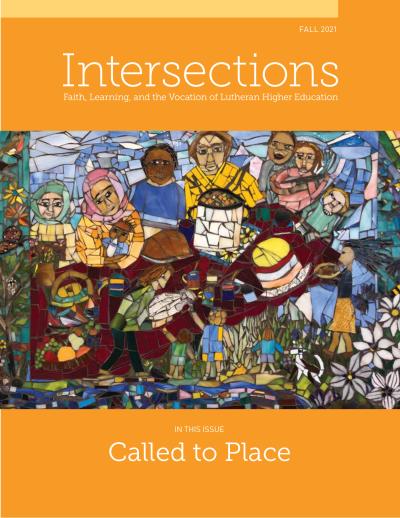
The theme of the 2021 Vocation of Lutheran Higher Education conference, hosted by Augsburg University, was “Called to Place: Community-Responsive Education.” Presentations and conversations over four days took stock of the importance of particular settings, including the physical and cultural geographies of campuses and the surrounding communities, for the deep learning of our students, and for us as educators. Participants considered how local landscapes and neighborhoods shape the missions, identities, and institutional callings of our schools, along with the individual vocations of those so emplaced, including our central callings to become anti-racisit as we work toward the belonging of all.
In my opening address, I emphasized the importance of the everyday, quite literal sense of “place” and “neighbor” and “neighborhood.” In a world that is digitally interconnected virtually everywhere, but where our students and sometimes we ourselves increasingly feel rootless, alienated, without a sense of home and real belonging—indeed, in a world where an increasing number of our students grieve the loss of home, either because they have migrated (by choice or by force) from other places, or have been displaced and marginalized through racial and economic powers—we need to think creatively about how actual physical geographies and the particular, embodied people inhabiting them are essential to understanding oneself and one’s meaning and purpose and place in the world.
We need to think creatively about how actual physical geographies and the particular, embodied people inhabiting them are essential to understanding oneself and one’s meaning and purpose and place in the world.
The foundational NECU document, Rooted and Open, describes the “common calling” of our network of 27 Lutheran colleges and universities. Despite this shared work, the document notes that each school also has its own particular intuitional calling, which responds to its particular location. It claims that “Lutheran higher education calls students beyond the rewards of upward mobility and financial security so that their lives will also be attentive to people who need them most and places that call out for healing” (6). More centrally, Rooted and Open makes the bold claim that our students are “called and empowered—to serve the neighbor—so that all may flourish.”
Of course, this attention to vocation or calling is not absolutely unique to Lutheran higher education. Beyond NECU you have NetVUE, the Network of Vocation in Undergraduate Education, a looser consortium of almost 300 schools that also identifies education-for-vocation as of central importance to independent, especially church-related, colleges and universities.
But what is distinctive, if not unique, is what Lutheran schools emphasize when they educate for vocation, how they do so in particular ways, and why particular geographical and cultural landscapes here matter. Let me try to explain.
In some more secular contexts, vocation is likened to the meanings, purposes, and passions of individuals. It’s said that, when one finds one’s true calling, a job will become work that one would do for free. Careers become callings when they tap into individual’s deepest commitments and draw forth their deepest passions.
This emphasis on the individual’s passions and feeling of purposefulness is frequently (and rightfully) tempered by colleges and universities that value their religious-affiliations—whether Lutheran, Jesuit, Presbyterian, Jewish, or something else. According to them, an individual’s sense of her capabilities and interests, her gifts and passions, take the form of callings when and only when they become responsive to the needs of others. In the words of Frederick Buechner, vocation is where your own deep gladness meets the world’s deep hunger. Without becoming responsive to what the world needs of you, you might have ample ambition and career opportunities, but you do not yet have a calling.
Lutheran higher education, at best, goes one step further. It is aware of all the ways that “the world’s hunger” or “the needs of the world” can also become abstract and vacuous—at best ciphers for, and at worst ideological justifications of, what turns out to be individual ambition after all. For example, if I’m gifted in developing flavors of e-cigarettes that appeal to minors, I am probably able to justify the “need” for that work insofar as it grows an industry, creates jobs, maybe even respects the decision-making capabilities of 13 year-old “consumers.”
We can see here how “the world’s need” can mean just about anything whenever people wants to justify their ambition by calling it a vocation. Even more abstract and vacuous than “need” are appeals to “the world.” Indeed, in a late-industrial capitalist economy driven by consumer spending, “the world” can become almost synonymous with “the Market” (another abstraction—and one often deified).
If we are to guard against such abstractions and self-justifications, we must understand “the world’s need” in particular ways. It is never simply the theoretical need of an abstract world. Rather, it must be what, for example, particular small business owners in a particular Cedar-Riverside neighborhood in Minneapolis need from Augsburg University as an anchor institution. Or (in my own context), what particular Spanish-speaking tutoring programs in the Floreciente neighborhood need from Augustana students and educators. Or what the Driftless landscape of Northeaster Iowa and the town of Decorah needs from Luther’s College’s initiatives in renewable energy.
‘What’ and ‘who’ questions also depend on questions of place: Where are you? Where do you come from?’
Many if not most students at NECU institutions are by now familiar with the idea of vocation or of being called to purposeful work in the world. They learn that the question, “What are you going to do?” is preceded by the question “Who are you?” or, “What is your story?” What I am trying to suggest here is that “what” and “who” questions also depend on questions of place: Where are you? Where do you come from? Which particular communities sustain you and how do you become grateful and responsive to them? Where—quite literally—are you heading? In other words, in order to discern both personal identity and the purposeful work to which one is called, students and those who teach them need a sense of the places and peoples that serve and are served by them. In the words of Wallace Stegner, “If you don’t know where you are, you don’t know who you are.”
There are at least 27 different ways that NECU institutions are at work engaging surrounding places and communities and otherwise educating our students for a sense of rootedness and belonging. This issue of Intersections showcases some powerful examples, which I commend to you and others in your place.
-
 Article
Where Your Feet are Standing: Institutional Engagement and Place
Melissa Maxwell-Doherty
Maxwell-Doherty draws on Cal Lutheran’s Hispanic-Serving Institution designation and its location on Chumash, Fernandino Tataviam, and Ohlone lands to ask how the university’s mission might shift if it depended on where its students are standing — not just where the institution sits.
-
Article
Community-Building On Campus and Beyond
Krista E. Hughes
Hughes describes Newberry College’s effort to build a “culture of community” that mirrors South Carolina’s demographics while reckoning with the institution’s founding ties to slavery — and names the challenges and promising city-college collaborations that shape this ongoing work.
-
Article
Just Communities: From Liberal Arts in Prison to Racial Healing over Zoom
Monica Smith
Smith showcases how Augustana College’s commitment to social justice extends into the Quad Cities through two initiatives: the Augustana Prison Education Program at East Moline Correctional Center, and Racial Healing conversations developed through the Truth, Racial Healing and Transformation framework.
-
Reflection
Caught in a Place Between Caesar and God
Darrel D. Colson
Colson reflects on his anguish, as Wartburg’s president, over an Iowa law that prevents him from requiring student COVID-19 vaccinations — reading Luther’s “Whether One May Flee From a Deadly Plague” alongside the conflict between obeying the law and serving neighbor.
-
Article
Hospitality to the Wild
Laura M. Hartman
Drawing on research with a Wild Ones Native Landscaping chapter and Marilyn Matevia’s ethic of “creature comfort,” Hartman argues that Christian hospitality must extend to non-human animals and plants — and asks whether college campuses can foster not just human diversity but biodiversity.
-
Article
Return to Purpose: Learning in an Age of Collapse
Ahmed Afzaal
Afzaal argues that the cascading crises facing higher education are not temporary glitches but symptoms of planetary and civilizational collapse — and that colleges must embrace “double-loop” learning and return to a shared sense of purpose if they are to help humanity descend gradually rather than catastrophically.
-
 Article
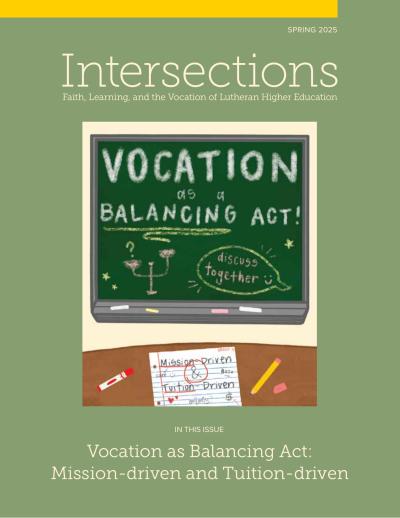
Vocation at Full Stretch: Reflections on Follow Your Bliss and Other Lies about Calling and its Use among College Students
Jason A. Mahn
No. 61 · Spring 2025
43 min audio
Mahn engages Bonnie Miller-McLemore’s Follow Your Bliss and Other Lies about Calling as required reading in a sophomore religion course, showing how her categories of missed, blocked, conflicted, fractured, unexpected, and relinquished callings empower young adults to perceive embodied, unplanned, and often painful dimensions of life as essential parts of vocation — and help close the gap between mission-driven and tuition-driven realities.
-
 Article
On Recruiting Diverse Students, Rooted in Mission
Eric Rowell, Jason A. Mahn
No. 59 · Spring 2024
Jason Mahn interviews Eric Rowell, Assistant Director of Admissions and Diversity Outreach at Augustana College, about how recruiting students from a wide variety of backgrounds — rooted in Augustana’s Lutheran commitment to vocation and educating across difference — remains essentially unchanged in the wake of the Supreme Court’s 2023 decisions on affirmative action.
-
 Editorial
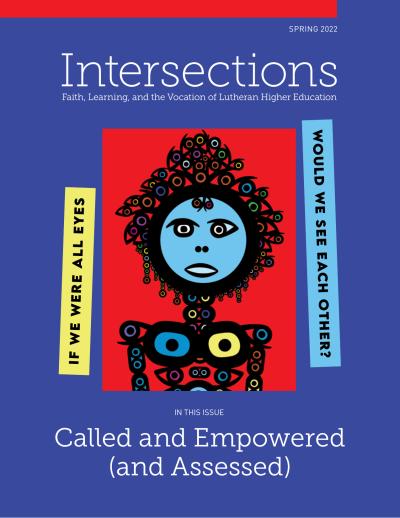
From the Outgoing Editor
Jason A. Mahn
No. 55 · Spring 2022
Mahn closes out a decade of editing Intersections, passes the duties to Colleen Windham-Hughes, gives thanks to Mark Wilhelm and Augustana College, and introduces an issue largely drawn from comments by Lutheran faculty, staff, and administrators at the 2022 NetVUE national gathering.
-
 Reflection
Shelter in Place: Reflections from March 22, 2020
Jason A. Mahn
No. 53 · Spring 2021
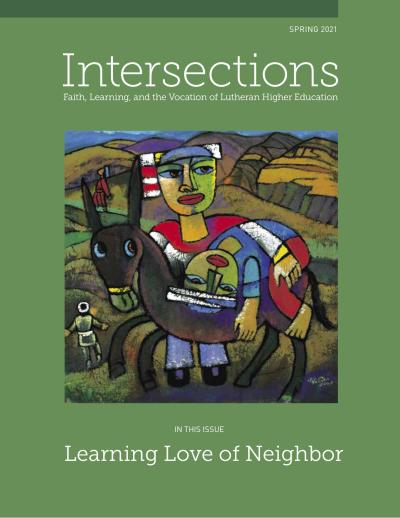
On the fourth Sunday of Lent in 2020, Mahn meditates on the etymology of “shelter” (from shield) and on an email from a former student in Boston whose mutual-aid organizing models a Lutheran understanding of vocation: the upending of ego by divine love that frees us, finally, to see and serve the neighbor.
-
 Editorial
From the Editor
Jason A. Mahn
No. 52 · Fall 2020
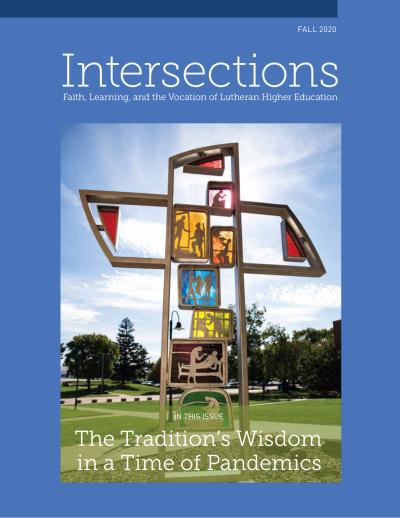
Mahn narrates a year of crisscrossing pandemics — Covid-19, economic collapse, partisan politics, and the long pandemic of white supremacy revealed anew by the murder of George Floyd — and argues that Lutheran liberal arts schools, by educating for vocation, are uniquely poised to help students respond with character and capable callings.
-
 Editorial
From the Editor
Jason A. Mahn
No. 50 · Fall 2019
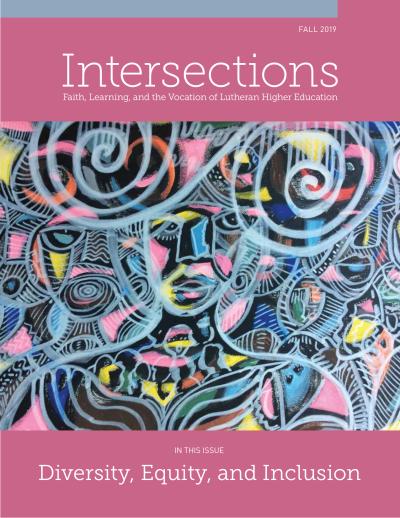
Mahn opens with Lenny Duncan’s observation that the ELCA is 96 percent white — the whitest denomination in the U.S. — and asks how teachers and administrators at historically, predominantly, and persistently white institutions can turn from white privilege and white supremacy toward spaces where people of color thrive and white people are re-formed into antiracist allies.
-
Article
(Re)Defining Vocation: Gladly Challenging a Vocational Giant
Andrew Tucker
No. 53 · Spring 2021
Tucker challenges Frederick Buechner’s famous definition of vocation as “where your deep gladness and the world’s deep hunger meet,” arguing that gladness reflects a privileged perspective and proposing instead that vocation be defined as “any meaningful, life-giving work you do for the world.”
-
 Article
Can a Christian Be a Journalist?
Catherine McMullen
No. 11 · Spring 2001
McMullen recounts how Ernie Mancini’s alumni-program invitation forced her to articulate what a print-journalism major at Concordia might be, then surveys the annus horribilus of 1998—Chiquita and the Cincinnati Enquirer, CNN/Time’s retracted Tailwind story, Patricia Smith and Mike Barnicle fired at the Boston Globe, Stephen Glass at The New Republic, and Matt Drudge and the White House scandal—before contrasting Concordia’s liberal-arts approach with Pat Robertson’s Regent University, whose “Christian journalism” produces one-sided vampire-cult stories and graduates who conclude journalism is no place for a Christian. Drawing on Richard Baker’s The Christian as a Journalist, Tom Christenson on the “law of niceness,” Ernie Simmons, Harmon Smith and Louis Hodges on Christian ethics, Robert Benne’s Lutheran four orders and his “Christian cobbler makes good shoes, not poor shoes with little crosses on them,” Mel Mencher, Robert Bugeja, Walter Cronkite, Pete Hamill, Jeremy Iggers, David Remnick, the Northwestern Death Row exoneration of Dennis Williams, Verneal Jimerson, and William Rainge, and Pulitzer citations for Katherine Boo, Eric Newhouse, George Dohrman, and Mark Schoofs, she argues that journalism is a Lutheran vocation and that Christian cobblers—and Christian journalists—make good shoes.
-
Article
Forming the Division for Access, Equity & Belonging at Susquehanna University
Amy Davis, Dena Salerno, María L. O. Muñoz, Nina Mandel, Scott Kershner
No. 59 · Spring 2024
Five Susquehanna University colleagues trace the institution’s 166-year arc from a Missionary Institute founded to remove barriers to education through the formation of a new Division for Access, Equity & Belonging in 2023, arguing that access rooted in Lutheran origins must continue to drive policy revision, infrastructure, and belonging for minoritized communities today.
-
 Response
Response to Mark Wilhelm: Adopting the Framework of ‘Because’ and ‘Therefore’
Paul C. Pribbenow
No. 56 · Fall 2022
Pribbenow describes how Augsburg University responded to its dramatic demographic transformation (from 18% to nearly 70% BIPOC entering students over sixteen years) by adopting an institutional vocational statement and a simple “because/therefore” framework for translating particular Lutheran theological convictions into institutional programs, policies, and practices.
-
 Article
Mentoring in the Academy: Of Gurus, Coaches, and Sponsors
Faith Wambura Ngunjiri
No. 41 · Spring 2015
Ngunjiri urges faculty, staff, and administrators in faith-based institutions to assemble a “personal board of directors” of mentors — connectors, sponsors, taskmasters, motivators, dreamers, sages, and proofers — and reflects on how race and gender complicate mentoring in predominantly white, male-led ELCA institutions, where women and minorities must reach out to build the “cloud of witnesses” they need to thrive.
-
 Article
A Lutheran Call for Educator Flourishing
Krista E. Hughes
No. 58 · Fall 2023
Hughes argues that without educator flourishing there is no student flourishing, traces how an exploitative “passion tax” can distort vocation, and offers seven Lutheran “third-way” value pairings — including Metrics/Grace, Efficiency/Kairos, and DEI/Priesthood of All Believers — to reframe institutional success at NECU campuses.