In Mark Wilhelm’s keynote address, he offered a three core insights from his years serving as the Executive Director of the Network of ELCA Colleges and Universities (NECU). First, that vocation is not simply an aspect of centers, curricular and co-curricular at our NECU institutions. Vocation is the foundational and distinctive shared mission of all our colleges and universities that shapes and is shaped by our unique contexts and curricular emphases. As the NECU shared vision document Rooted and Open states, an education in Lutheran Higher Education is an education with a shared purpose. It educates students who are: “Called and empowered to serve the neighbor so that all may flourish” (3). This empowerment and vision is the vocation of our institutions themselves. Our various mission statements emerge from this common vocation that is carried out in every discipline and every co-curricular aspect of our campuses. Thus Mark Wilhelm claimed that vocation is the most central and most foundational center for Lutheran Higher Education. At the same time, this shared vocation is necessarily carried out in distinct and unique ways that are shaped by our institutional contexts.
Rooted and Open offers that a Lutheran Higher Education endeavors to “1. Shape character, 2. Invite vocational discernment and 3. Build religious literacy” (2). It pushes “beyond careerism” and allows students to “gain fluency in the language of meaning and purpose” (2). Wilhelm was advancing his observation that vocation is the overall mission of Lutheran Higher Education rather than an aspect of it. In the context of my institution of Pacific Lutheran University (PLU), I find Wilhelm’s idea a helpful reorientation. When discussing curriculum, for example, faculty conversation often circles back to ask how we are engaging students in the second commitment— inviting vocational discernment—over the course of their education. Are there particular classes or departments who are primarily responsible for this? Courses within the Humanities are usually targeted to address vocation. At this, many Humanities faculty push back that language courses or courses in writing or logic do not automatically connect to vocation. Further complicating matters, other divisions, colleges or pre-professional programs often comment that their courses are bound by discipline-specific content and cannot devote course time to vocational discernment. Most faculty feel ill-equipped by their discipline or academic training to engage students on the topic of vocation altogether. But here is where Wilhelm’s comments can interrupt this rather unfruitful conversation: vocation and mission are inextricably intertwined at NECU institutions. And every discipline is engaged in serving the mission of its institution and faculty are most likely required in hiring, promotion and tenure processes to explain how their teaching, service and scholarship align with the mission of the institution.
Consider this example from my own institution that may share similarities with your own. PLU’s mission statement is the following: “PLU seeks to educate students for lives of thoughtful inquiry, service, leadership and care — for other people, for their communities and for the Earth.” And, to intentionally repeat, NECU’s shared vocational mission is educate students who are: “Called and empowered to serve the neighbor so that all may flourish” (3). In order to accomplish these missions, we build curricular and co-curricular opportunities for students to do this wisely. In the context of Lutheran Higher Education, this vocation entails an education in the liberal arts, global contexts, diversity and sustainability, and the academic study of religion. Along with Wilhelm, I would argue that our mission statements in Lutheran Higher Education are indeed vocations or callings into the world and that these shape the form of our total institutional projects in unique ways, depending on context. We are not looking for ways to “shoe horn” in vocational reflection. We are asking each discipline and all faculty to explicitly engage students in reflecting on how their disciplinary work and overall education connects to the mission of our individual colleges and universities or the mission described in Rooted and Open.
Each discipline and faculty member will approach this broader sense of institutional mission as vocation uniquely. What does it mean to “flourish?” And how do we assure that “all” are given the opportunity? What does “care” and “service” mean and how does one avoid patronizing, colonial or patriarchal assumptions that turn “care” into a tool of coercion? How can human interests and planetary ecological interests live together? What are one’s own individual gifts and needs and how do these connect to the needs of others and the earth? To what communities and individuals do you hold yourself and your education accountable? While we may not address every related question in each discipline, surely we all touch on some mission-based bigger questions that, quite simply, are vocational discernment regarding individual and communal calling.
In his second and third points, Wilhelm offered reflections on “things we have avoided or minimized despite the existence of resources in the Lutheran intellectual tradition”: 1) Diversity, Equity, Inclusion and Justice (DEIJ) and; 2) Acknowledging multiple constituencies and multiple vocations within our NECU colleges and universities even as we share a common vocation within Lutheran Higher Education. He offered “It has been too easy to forget that this common calling or vocation is lived out in specific places and contexts, resulting in a rich diversity of institutionally specific missions.”
In my response to Wilhelm at the conference, I offered that a lens informed by intersectionality brings our attention to individual, communal and even institutional identities and how these exist within multiple gifts and challenges that inform the collective and individual work of students, staff, faculty and administrators. Every context and every individual—and thus each NECU institution—is shaped by unique social, racial, economic, and regional factors. The common vocation of NECU institutions to educate “so that all may flourish” will be shaped by the insights, questions and challenges that our unique contexts and identities we bring to that mission—on institutional and individual levels.
In our current educational context, some of our NECU institutions struggle to connect and explain how commitments to DEIJ are inextricably necessary to Lutheran Higher Education. Commitment to education that serves the good of all and inclusive education was the focus of Lutheran Higher Education from its very beginnings. The Reformer Martin Luther sought to provide public access for all to education. And this education was to foster wise, just and caring people within society and the family. It was a holistic education focused on the arts, faith, sciences, humanities —all aspects of the total human being—so that one can envision new models for greater justice and care for individuals and their communities. Today, books like Patrick Reyes’ The Purpose Gap: Empowering Communities of Color to Find Meaning and Thrive (2021), invite us to reflect on structural obstacles to thriving and how one can create space for new conditions to foster empowerment for the most marginalized.
Vocational reflection, if conceived as individuals contemplating their own individual and precious lives alone, can appear to be only a matter of privilege. Indeed, questioning this connection between vocation and privilege is widely discussed on my own campus. This is a fault, partly, of focusing on vocational material that highlights individual reflection (often men, mostly white, almost always economically privileged) on one’s own vocation. While students, faculty and staff at our educational institutions need space for such reflection—not attended to by much of our culture—it needs to be accompanied, again, by intersectional awareness and discussion. One’s own path in the world, and discerning its direction, is inextricably woven into complicated and sometimes nutritious relational networks.
Vocational reflection is not just for the elite or privileged. In fact, in my responses to Wilhelm’s plenary speech, I offered that privilege often can mask or negate the pressing need for vocational reflection. When the world is simply handed to you, no matter what you do, there is little impetus to discern who you are and what the world needs from you. For students of marginalized identities, vocational reflection can literally be a matter of survival. For example, a queer-identifying student may need to develop a strong enough sense of self, connection and purpose to leave “home,” breaking ties with family and communities of origin just to survive. From working with students and vocation, I have also had many conversations with students from marginalized communities who struggle to reconcile their own gifts and longings with the expectations from their communities or family. These are deep, painful vocational questions of wise students but they are not made from positions of privilege. I am distressed that assumptions that vocation or vocational reflection is a matter of privilege erase the incredibly difficult work these students do to carve a purposeful path for themselves in the world. Deep reflection on DEIJ as it impacts our students and their communities is inherent to vocational discernment that leads to survival and, ideally, flourishing.
-
 Editorial
From the Editor: Why All This Talk About Vocation?
Colleen Windham-Hughes
Windham-Hughes introduces the Fall 2022 issue built around Mark Wilhelm’s keynote “Why all this talk about vocation?” and previews five panel responses, two first-time conference reflections, and companion pieces on Womanist theology — framing vocation as a call not to privilege but to constructive and corrective work that undoes unjust systems.
-
Article
Why All This Talk About Understanding the Mission of NECU Member Institutions as a Vocation?
Mark Wilhelm
In his valedictory keynote, retiring NECU Executive Director Mark Wilhelm argues that Lutheran higher education is, properly understood, vocation-based education — outlining four core practices recovered over the past fifty years and naming the constructive and corrective work still to be done, including a fuller embrace of DEIJ and of the diverse vocations of NECU’s 27 institutions.
-
Response
Response to Mark Wilhelm: DEI, Great; DWS (Dismantling White Supremacy), Even Better
Vic Thasiah
Thasiah argues that if Lutheran colleges and universities want to live out their commitment to the flourishing of all, DEI is good but DWS — dismantling white supremacy — is even better, and offers three Lutheran sensibilities (suspicion of self-righteousness, the decolonial shockwave of the cross, and critical thinking that can still register awe) that can make DWS a core practice of higher education.
-
Response
Response to Mark Wilhelm: Distinguishing Between Identity and Vocation
Andrew Tucker
Tucker proposes that NECU’s next most faithful step is to faithfully and effectively differentiate vocations and identities — arguing that identity is who you are, vocation is what you do, and that recognizing the plurality of both helps Lutheran institutions name which work is theirs to take up and which is good work that belongs to someone else.
-
Response
Response to Mark Wilhelm: Vocation—Wide Perspective Questions
Mary-Paula Cancienne
Cancienne, drawing on Iain McGilchrist, asks whether higher education has prioritized micro lenses at the expense of the macro view, and invites educators to hold the drama of individual vocation stories within a wider plot that includes James Webb Telescope wonder, climate grief, the long shadow of enslavement, and the resilience of native populations.
-
Response
Response to Mark Wilhelm: Adopting the Framework of ‘Because’ and ‘Therefore’
Paul C. Pribbenow
Pribbenow describes how Augsburg University responded to its dramatic demographic transformation (from 18% to nearly 70% BIPOC entering students over sixteen years) by adopting an institutional vocational statement and a simple “because/therefore” framework for translating particular Lutheran theological convictions into institutional programs, policies, and practices.
-
Article
Work Works
Julius Crump
Crump argues that in an era of class-stratified careerism and the “ruins of neoliberalism,” commencement-speech rhetoric about heroic vocation will not resuscitate vocation — instead, professors embodying vulnerability, extemporaneity, and contemporaneity in the classroom can show students that consistent work, embodied as service to others, is itself worthy.
-
Reflection
Why All This Talk About Vocation?
Madyson Ray
Ray, a junior at Midland University and the only student attendee at the 2022 conference, reflects on four workshops — on teaching womanist thought, on supporting student-athletes, on resistance to the word “vocation,” and on vocational reflection — and brings home concrete ideas including a women’s-history scavenger hunt and semester-long vocational reflections.
-
Institutional Focus
LibGuide: Introduction to Womanist Theology
Elli Cucksey
Cucksey, the head librarian at Trinity Lutheran Seminary, recounts how Beverly Wallace’s Introduction to Womanist Theology class — the first offering of the ELCA Seminaries’ Womanist Theology Initiative — led her to build a publicly available LibGuide that amplifies Black women’s voices and gathers the resources of the course for future students.
-
Article
Doing the Work One’s Soul Must Have
Beverly Wallace, Yolanda M. Norton
Norton and Wallace describe the Womanist Experiential Learning Initiative — including the Beyoncé Mass, study-abroad partnerships in Portugal, Brazil, and Ghana, and the Black Girl Magic Academy for teenage girls — as a way of centering Black women’s voices in theological education and doing, as Katie Geneva Cannon put it, “the work…that one’s soul must have.”
-
 Article
Leading from Within: Peer-Learning Consultations to Explore Our Callings and Campus Capacities for Leadership
Chris Johnson
No. 41 · Spring 2015
Johnson reframes vocational leadership as “soul work” that calls for the deep mind as much as the conscious one, and offers two practices — deep listening and a modified Quaker clearness consultation — as ways for campus colleagues to listen one another into existence. Drawing on Sharon Daloz Parks, Marshall Ganz, Parker Palmer, and Mary Rose O’Reilley, he invites readers to map their stories of self, us, and now.
-
 Reflection
The Importance of Connection
Alex Piedras
No. 58 · Fall 2023
Piedras reflects on the 2023 “So that We, Too, May Flourish” Conference at Augsburg as a refreshing space for a weary DEI advocate — surfacing burnout, the Talking Circle on Indigenous Issues, and Dr. Monica Smith’s Racial Healing Circle as opportunities to recharge the soul and build authentic connections for the long journey.
-
 Editorial
From the Outgoing Editor
Jason A. Mahn
No. 55 · Spring 2022
Mahn closes out a decade of editing Intersections, passes the duties to Colleen Windham-Hughes, gives thanks to Mark Wilhelm and Augustana College, and introduces an issue largely drawn from comments by Lutheran faculty, staff, and administrators at the 2022 NetVUE national gathering.
-
 Article
Lutheran Identity and Diversity in Education
Bruce Reichenbach
No. 17 · Summer 2003
Reichenbach applies the theological taxonomy of exclusivism, inclusivism, and pluralism to Lutheran colleges and argues that institutions self-consciously committed to inclusivism must hold a non-negotiable theological core in paradoxical tension with intentional diversity. Drawing on Richard Hughes, Darrell Jodock, Gilbert Meilaender, Robert Benne, and Mark Schwehn, he surveys the theological themes Lutheran writers identify as identity-forming—the four solas, law and Gospel, two kingdoms, vocation, simultaneously saint and sinner, the theology of the cross—and proposes that diversity at an inclusivist Lutheran college is to be employed in service of educating “head, hands, and heart,” maintained through a critical mass of faculty and staff who carry the “DNA of the school.”
-
 Book Review
A College Degree or a College Experience? Reflecting on Selingo's College (Un)Bound
Laurie Brill
No. 39 · Spring 2014
Brill reads Jeff Selingo’s College (Un)Bound from inside the Lutheran Educational Conference of North America, drawing on LECNA’s alumni research with Hardwick-Day and on Brandon Busteed’s Gallup data to argue that, in an age of competency-based degrees and college-as-commodity, Lutheran colleges must speak more clearly about the transformational, vocational impact of a college experience that develops the whole person.
-
 Editorial
From the Editor
Tom Christenson
No. 14 · Summer 2002
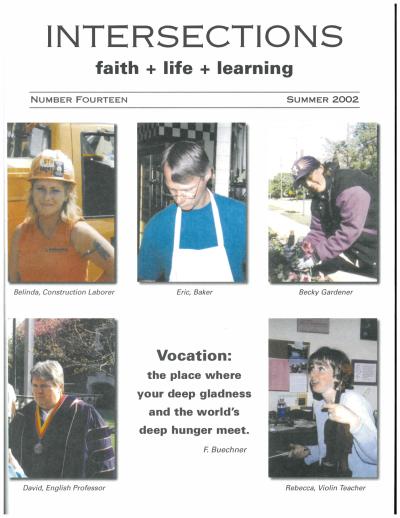
Christenson argues that whether or not the conversation is funded by the “Lilly lottery,” vocation should just be part of who we are and what we do at ELCA colleges, and proposes three low-cost conversations—among faculty (twenty dollars of wine, in vino veritas), with students throughout their four years, and with alumni—explaining why this issue is deliberately “fatter” than usual and inviting feedback on other single-topic issues.