My task here is to present a kind of operating manual to the document, Rooted and Open. To do that, I open and close with a story.
Years ago, I was on a plane from Boston back into the Bay Area. At the time, I traveled in Lutheran circles more familiar with theological education than higher education. My seatmate had just visited his son, a freshman at a prestigious East Coast university. I asked how his son liked it, and the father said he wished his son had chosen a Jesuit institution for college. I asked why. Without missing a beat, he replied: “Because he would have learned: to always give back, to be a man for others, and to find God in all things.” He knew his son would graduate with a ticket into the power elite, but he was dubious about the values that went along with that invitation. In contrast, he believed that a Jesuit institution clearly communicated its values to graduates. More than that, he was convinced that those values—always giving back, being a “man” for others, finding God in all things—were needed both in the workplace and in the world of the twenty-first century.
What are the distinctive values of a Lutheran higher education? How are those distinctive marks needed both in the workplace and the world today more than ever?
Marks of NECU and Our Students
In consultation with a larger working group of teaching theologians from the Network of ELCA Colleges and Universities (NECU) institutions, those are the questions the writing team of Rooted and Open tried to address. As we thought and talked and argued together, we cultivated a stereoscopic vision: with one eye, looking for the deep roots of a lively theological tradition, with the other, looking at the challenges and opportunities of the present moment.
What are the distinctive values or “marks” of Lutheran higher education? Think of these common markings as being inscribed into the bodies and minds and hearts of our students, as well as the people who teach them, work with them, and administer the institutions that hold the network in place.
Identifying these marks is an effort always in process; it participates in the spirit of reform (semper reformanda) that characterizes this particular movement within Christianity. The late Tom Christenson came up with three “marks” of Lutheran higher education: giftedness, vocation, and that vaunted freedom from and freedom for (Christensen 72-80). I weighed in with five “charisms”: semper reformanda, a spirit of critical inquiry that grows out of the notion of freedom, regarding the other as “neighbor,” vocational discernment, and a concern for justice that draws on Luther’s notion of the priesthood of all believers (Stortz 102-113). Darrell Jodock identifies six distinguishing “features”: giftedness, an engaged God, wisdom, epistemological humility, the value of community, and service and community leadership (Jodock 86-97). Though crafted for different times and contexts, notice the resonance in these three constellations of charisms/features/marks.
But what might the NECU institutions say together? And how might that common witness speak into the present moment?
Rooted and Open addresses a variety of audiences and on a number of different levels. Specifically, there is the “elevator speech” that telegraphs in broadly accessible and succinct language three distinctive gifts or charisms of Lutheran higher education. The longer version then elaborates the educational priorities these gifts nurture, again, in language that does not presume “Lutheran literacy.” Finally, there’s the full version, one that roots the educational priorities in the thick, rich language for which the Lutheran intellectual tradition is known.
An early draft identified three charisms of Lutheran higher education which marked the institutions themselves. These institutions delivered:
An excellent liberal arts education,
In service to the neighbor,
So that all may flourish.
Feedback from a wider faculty working group, as well as the NECU presidents, who reviewed the draft in January 2017, prompted the drafting team to inscribe the charisms. The charisms of Lutheran Higher Education marked people, not just institutions. Accordingly, the tone of the document moved from descriptive to aspirational, even promissory. Verbs rather than nouns detailed the change. The final draft promises that graduates, educators, and the institutions themselves would be:
Called and empowered
To serve the neighbor
So that all may flourish
The change is subtle but significant, a move from institutional character to personal identity. While it is possible to discern the marks of Lutheran higher education in the programs, initiatives, and other educational priorities of each institution, these common markings find their proper place in the identities—on the bodies and minds and hearts—of its students, colleagues, and leaders.
Grounding Priorities Theologically
After articulating the marks in shortest form, the document then builds out each, first suggesting common educational priorities. Each of the institutions in the network inflect these priorities differently, depending on institutional history, student demographics, and contexts. These educational priorities could be affirmed by faculty and staff, students and administrators who may or may not be Lutheran, may or may not be Christian, may or may not even be “religious” at all. Finally, deep theological roots ground each of these priorities, and these are tended intentionally within the institution.
“Deep theological roots ground each of these priorities, and these are tended intentionally within the institution.”
In some institutions, an office of Mission and Identity may be tasked with this responsibility and privilege. In other institutions, the task may fall to campus ministry or a particular department. In still others, the work may be shared among various stake-holders of the university.
Called and Empowered
For example, the educational priorities that stem from a network marked by “an excellent liberal arts education” (as the former draft had it) can be elaborated in terms of a commitment to excellence, a grounding in the liberal arts, and a spirit of intellectual humility that values questions as much as their answers.
All of these educational priorities of an excellent liberal arts education are grounded theologically, first, in the radical mystery of a God whom the human intellect can never fully grasp, and, second, in a radical human freedom, which Luther described as “the freedom of a Christian,” a freedom from fundamentalisms of left and right and a freedom for critical inquiry.
To Serve the Neighbor
Service to the neighbor carries two educational priorities, which NECU institutions share. The first is a regard for the other as “neighbor,” which seems unremarkable until you realize how easily the other can be labeled “threat” or “stranger” or “enemy,” designations that divide. A second educational priority here is the commitment to justice and advocacy, which are the natural issue of a call (vocare) to speak out and speak up for (ad + vocare) the needs of those who cannot speak for themselves.
These educational priorities that help call our students to serve the neighbor are grounded theologically in the wild generosity of God, to which the only appropriate response is gratitude—and great joy.
So that All May Flourish
The third and final “mark” of Lutheran higher education—the flourishing of our students and their communities—directs educational priorities toward the flourishing of the whole person (body, mind, soul, and spirit) as well as the whole ‘hood or community, through the practices of radical hospitality and a hunger for diversity.
These educational priorities are grounded theologically in a God who became one of us, in order to better understand the human condition and infuse everyday life with divine mystery.
Concluding Reflections
Think of these marks—called and empowered, to serve the neighbor, so that all may flourish—as inscribed onto bodies like indelible tattoos. Our graduates are marked women and men. And people marked by Lutheran higher education are needed even and especially now.
I’ll close with a final story.
For a couple of years I participated as both a leader and a participant in the Ignatian Colleagues Program (ICP), a national program through the Association of Jesuit Colleges and Universities (see “Association”). Its directors—a mixed group of Jesuit priests and laypeople—rightly realized that if the unique “marks” of Jesuit higher education were to survive, they couldn’t depend on leadership from Jesuits alone. The founders of ICP could already see effective leadership exercised by faculty and administrators who were not Jesuit, maybe not even Catholic, possibly not even Christian, and even not religious at all.
But these potential institutional leaders were drawn to Jesuit education because of its marks, and they needed a way to articulate them to a variety of audiences and on a number of different levels.
“Our graduates are marked women and men. And people marked by Lutheran higher education are needed even and especially now.”
Rooted and Open is a way of articulating our own distinctive marks for all members of this Lutheran network. Needed now more than ever are these institutional charisms and the marks they leave on the people who teach and administer and learn on our campuses.
Works Cited
Association of Jesuit Colleges and Universities (AJCU). Ignatian Colleagues Program. Accessed 15 April 2019, https://www.ignatiancolleagues.org/
Christenson, Tom. “Learning and Teaching As an Exercise in Christian Freedom.” The Vocation of Lutheran Higher Education, edited by Jason A. Mahn, Lutheran University Press, 2016, 69-81.
Jodock, Darrell. “The Third Path, Religious Diversity, and Civil Discourse.” The Vocation of Lutheran Higher Education, edited by Jason A. Mahn, Lutheran University Press, 2016, 82-99.
Network of ELCA Colleges and Universities. “Rooted and Open: The Common Calling of the Network of ELCA Colleges and Universities.” Accessed 15 April 2019, http://download.elca.org/ELCA%20Resource%20Repository/Rooted_and_Open.pdf?_ga=2.254180808.1158413343.1555894056-509733955.1555894056
Stortz, Martha E. “Practicing Hope: The Charisms of Lutheran Higher Education,” The Vocation of Lutheran Higher Education, edited by Jason A. Mahn, Lutheran University Press, 2016, 100-116.
-
 Institutional Focus
About Rooted and Open: The Common Calling of the Network of ELCA Colleges and Universities
An institutional framing piece introducing Rooted and Open — NECU’s statement on Lutheran identity in higher education — with a roster of the faculty working group and writing team and an orientation to the essays in this special issue.
-
Institutional Focus
About the Cover and Artist
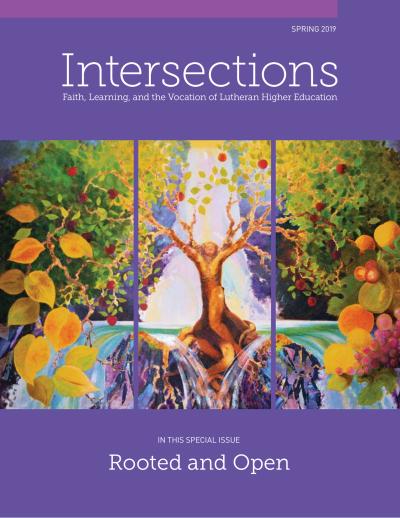
Kristen Gilje, a Bellingham, Washington artist who spent nine years as Artist in Residence at Holden Village, recounts the “Tree of Life” she painted for the Holden Village 1999 summer theme and the unexpected interpretation Lapidary Fred offered of Yggdrasol, Prometheus, the Druid Tree Spirit, and the crucifix all at once.
-
Article
Rooted and Open: Background, Purpose, and Challenges
Mark Wilhelm
Wilhelm traces Rooted and Open’s seventy-year backstory — from Conrad Bergendoff’s 1948 call for a Lutheran philosophy of education through the recovery of the vocation tradition — and describes the document’s process, purpose as a teaching and study resource, and the embodiment, contextual, and cultural challenges it implies for NECU institutions.
-
Article
In a Diverse Society, Why Should Lutheran Colleges/Universities Claim their Theological Roots?
Darrell Jodock
Jodock develops his “third path” account of the Lutheran college — neither sectarian nor non-sectarian but both rooted and open — analogizing the college to a bridge whose deck of daily activities rests on pillars of shared educational priorities, which in turn rest on theological footings; he then answers six common objections to claiming Lutheran roots and explains why those footings still matter.
-
Article
Roots and Shoots: Tending to Lutheran Higher Education
Jason A. Mahn
Mahn revisits why “education-for-vocation” has become a leitmotif for the 27 NECU schools, distinguishes institutional vocation from individuals’ religious identities and educational priorities from their theological grounding, and offers a friendly critique of Jodock’s bridge metaphor: Lutheran colleges grow in two directions like plants — deep roots and wide branches alike require constant tending.
-
Article
Deep Roots, Big Questions, Bold Goals
Colleen Windham-Hughes
Adapted from a presentation to the California Lutheran University Board of Regents, Windham-Hughes reads the title Rooted and Open as both reaching back into the Lutheran tradition and opening forward into a shared future, then unpacks the document’s “called and empowered — to serve the neighbor — so that all may flourish” through the lenses of freedom of inquiry as a third path, vocation-centered education, radical hospitality, and civil discourse oriented toward the common good.
-
Article
Rooted and Open as Resource for Expanding Opportunities on Your Own Campus
Katherine A. Tunheim, Marcia Bunge
Bunge and Tunheim describe how Gustavus Adolphus College has paired Rooted and Open with its own companion volume Rooted in Heritage, Open to the World — in board workshops, new-faculty orientation, and classroom assignments — and survey several Network-wide opportunities (the Vocation of a Lutheran College Conference, the LECNA Fellows Program, the Association of Lutheran College Faculties, the Tuition Exchange Program, and international partnerships) that give the common calling tangible institutional form.
-
Article
"Faithful Nones" and the Importance of a Rooted and Open Pedagogy
John Eggen
Drawing on a student survey from his D.Min. thesis at Midland University, Eggen identifies a distinctive subset of religious “nones” — the “faithful nones” — who reject institutional religion yet retain substantive beliefs and practices, and argues that the non-binary, third-path pedagogy commended by Rooted and Open is uniquely positioned to engage a generation that has disambiguated faith, religion, and spirituality.
-
Article
Finding Flourishing: Teaching Self-Care as Course Content
Emily Kahm
Kahm argues that teaching self-care, self-awareness, and stress-coping as explicit classroom content embodies the “radical hospitality” of Rooted and Open and supports vocational formation against a consumerist culture, then offers concrete classroom techniques — a one-to-five energy check-in, ninety-second silence exercises, and full-day spiritual practices — that can be adapted across disciplines at NECU institutions.
-
 Article
The Responsible Professional: Vocation and Economic Life
Martha E. Stortz, Tom Morgan
No. 51 · Spring 2020
Stortz and Morgan argue that the “value-added” of Lutheran higher education is a responsibility ethic — one that frames the professional as a first responder “called and empowered to serve the neighbor so that all may flourish” — and unpack the four criteria of the 1999 ELCA social statement Sufficient, Sustainable Livelihood for All as a framework for economic deliberation.
-
 Article
The "V" Word: Different Dimensions of Vocation in a Religiously Diverse Classroom
Martha E. Stortz
No. 50 · Fall 2019
Stortz responds to a sea of blank stares when she used the word “vocation” in a religiously diverse required course by offering five metaphors — place, path, relationships, lens, and story — that point to different dimensions of vocation across the world’s religions and help students articulate their callings on their own terms.
-
 Article
Both Priest and Beggar: Luther among the Poor
Martha E. Stortz
No. 46 · Fall 2017
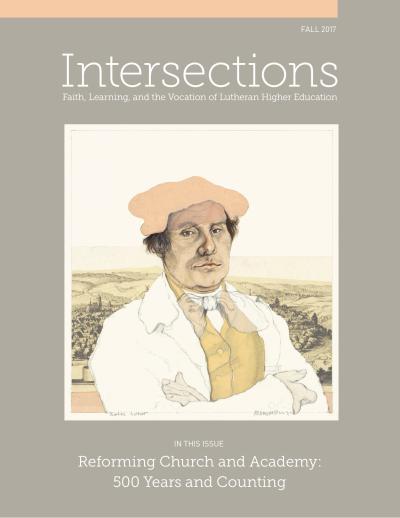
Reading Luther’s deathbed remark “We are all beggars” against his “priesthood of all believers,” Stortz argues that priest and beggar are two sides of a human reality — one that locates civic responsibility for the poor at the heart of the Reformation legacy and that pushes beyond paternalistic service toward the systemic question of justice.
-
 Article
Jonah: The Anti-Hero of Vocation
Martha E. Stortz
No. 45 · Spring 2017
In a chapel talk first given at Augsburg College’s Vocation 2.0 series in September 2016, Stortz reads the prophet Jonah as the great anti-hero of vocation — one who tries to outrun God’s call to the great city of Nineveh — and argues that, in a season of urban violence and divisive election-year rhetoric, the story is less about public calling than about being called by the publics in our midst.
-
 Article
Why Interfaith Work is Not a Luxury: Lutherans as Neighboring Neighbors
Martha E. Stortz
No. 44 · Fall 2016
Stortz argues that interfaith work is not a luxury but a constitutive commitment of Lutheran higher education — institutions she describes as both “faith-based and interfaith-dependent.” Reading the parable of the Good Samaritan as both an intra-faith and inter-faith encounter, she offers a four-fold matrix of theological reflection, spiritual engagement, social action, and everyday experience as portals into the work of being neighbor.
-
 Book Review
The Courage to Change: Creating New Hearts with Palmer and Zajonc
Martha E. Stortz
No. 39 · Spring 2014
Stortz reads Parker Palmer and Arthur Zajonc’s The Heart of Higher Education from the landscape of Lent and notes that the book’s strategies all target students, not their professors. Drawing on her own Faculty Formation Group at Pacific Lutheran Theological Seminary and the Ignatian Colleagues Program at Jesuit institutions, she asks what a Lutheran analogue might look like that would form the educators who teach for transformation.
-
 Article
You Don't Seem Angry: Methodological Confessions Of A Lutheran Lay-Woman
L. DeAne Lagerquist
No. 5 · Summer 1998
Lagerquist, opening from a colleague’s 1981 observation about her M.A. thesis on four female abolitionists, traces her path from feminist historian and battered women’s shelter advocate through the University of Chicago’s obsession with method to a more self-conscious account of her own. The method grows out of four Lutheran themes—original sin (caution and humility), the eighth commandment against bearing false witness (generosity and forgiveness), the neighbor as “little Christ” (cooperative interpretation), and vocation (interpretation as calling, located alongside feeding the hungry and visiting the lonely)—and shapes her ongoing work on a history of Lutherans in the United States with a plot about learning to live with diversity.
-
Book Review
Post-Secular Religion on Campus: Conversing with Jacobsen and Jacobsen
L. DeAne Lagerquist
No. 39 · Spring 2014
Lagerquist guides readers through Douglas and Rhonda Hustedt Jacobsen’s No Longer Invisible: Religion in University Education and its companion volumes, unpacking the authors’ three-act story of campus religion (Protestant, Privatized, Pluriform), their three-by-two framework of historic/public/personal religion in belief and behavior, and the six questions they pose for campus conversations. She lifts up interfaith etiquette and vocation as especially fruitful zones for Lutheran campuses.
-
 Reflection
Currents
Jaime Schillinger
No. 25 · Spring 2007
Preached in St. Olaf chapel on March 29, 2005, Schillinger reads three “currents” pulling on her hearers—Minnesota spring, the academic year’s final stretch, and Holy Week’s passion and resurrection—against poetic voices from ee cummings, Gerard Manley Hopkins, and Edna St. Vincent Millay, before turning to the Song of Songs to suggest that this nexus calls students into the rhythms of love, awakened desire, and an elusive, unresolved promise that animates academic, spiritual, and vocational search alike.
-
 Editorial
From the Publisher
Mark Wilhelm
No. 40 · Fall 2014
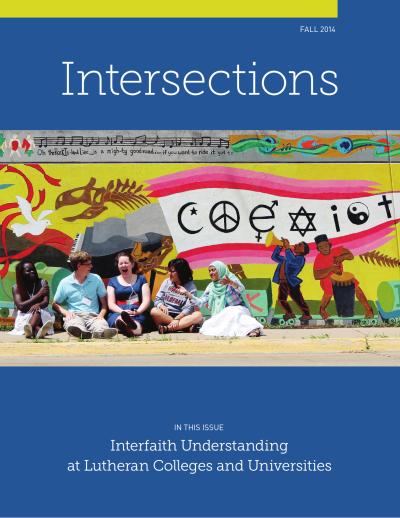
Wilhelm draws a parallel between the rediscovery of vocation and the rediscovery of interfaith understanding in Lutheran higher education, arguing that previously under-emphasized aspects of the Lutheran tradition point us to interfaith work and that an authentic Lutheran college or university will make interfaith understanding a feature of its mission.
-
 Reflection
Truth, Reconciliation, and Redemption in South Africa
Brian Forry Wallace
No. 13 · Winter 2002
Wallace, a 24-year veteran political science professor at Capital University, recounts five weeks of post-apartheid peace-building travel-study with students living south of Cape Town—visiting townships, schools, day-care centers, a children’s AIDS hospital, Robben Island, and Nelson Mandela’s cell—and offers vivid sketches of his student companions Amy, Brian, Meghan, Karrie, Patrick, Meredith, Cheryl, Corin, Debbie, April, and Audra. He concludes that these students—atheists and agnostics and Buddhists and Methodists and Baptists, headed for social work, nursing, teaching, ministry, and parenthood—embody vocation by responding to a voice that calls them out of themselves to be present and to heal in this world, and that they are his link to the redemption of a lost and broken soul.
-
 Article
Preaching in Christ Chapel on Yom HaShoah: Reflections on Interfaith Relations at a Lutheran College
Sarah Ruble
No. 53 · Spring 2021
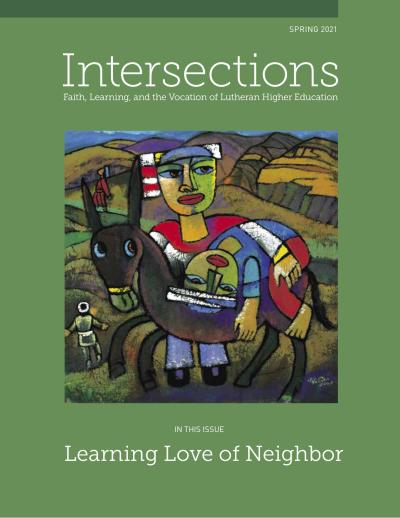
Ruble shares her 2019 Holocaust Remembrance Day homily preached before the cross in Christ Chapel at Gustavus Adolphus, then reflects on whether “professional Christians” on Lutheran campuses might practice a non-mutual, witnessed confession before colleagues of other traditions as a check on Christian self-deceit.