Let us begin with the title. “Rooted” refers to the Lutheran tradition—to the sources and foundations of a particular approach to higher education and its role in the world. “Open” refers to the bold posture of receptivity to “insights from other religious and secular traditions.” This means that the effort to find and articulate a common calling reaches back into history, is continually opening forward into shared future, and in every moment invites both connection and commitment to Lutheran higher education. This approach is predicated upon an understanding of a God who is big enough for all human questions. The approach also demands that big questions about the world and human beings be pursued from the perspectives of all disciplines, and that the truths that are found are offered for the good of the whole.
“Asking questions that are big in a variety of ways is required if our graduates are to become equipped to tend the human heart and meet the needs of the wider world.”
Asking questions that are big in a variety of ways is required if our graduates are to become equipped to tend the human heart and meet the needs of the wider world. Big questions also turn back to put the questioners in question. They ask, with poet Mary Oliver, “What is it you plan to do with your one wild and precious life?” They are questions that ask not only, “What are you going to do?,” but also, “Who are you going to be?” Though the roots of this education are specifically in the Lutheran tradition of higher education, the bigness of the questions extends the roots into the foundation of the world and the human condition.
Why ask such big questions? The document asserts three primary reasons for asking big questions:
- Big questions shape character, transforming through education our students into the kinds of people we want our graduates to be.
- Big questions reach deeply into the human heart and the call of conscience to help students connect their education with their vocational discernment, the ways they might give their training, their gifts, and their critical thinking to the world.
- Big questions build religious literacy, which consists of the capacity to receive the gifts from multiple religious and non-religious traditions and the skills to convene those multiple perspectives for the sake of common good. The big questions asked in Lutheran higher education are aimed not just toward what students are good at, for their own sake, but also toward what passions students can apply to purposes in the world.
To work on these questions, multiple forms of truth must be present at the table and in the classroom for study, examination, and conversation.
Rooted and Open boldly proclaims: “The world needs our graduates, graduates who are intellectually acute, humbly open to others, vocationally wise, morally astute, and religiously sensitive.” Not every institution of higher education has this as its goal, and not every graduate has these qualities. Perhaps not all graduates of Lutheran colleges and universities have these qualities, and yet it remains our bold goal to attend to all students in multiple ways, nourishing their sense of self in community as well as their intellect so they are prepared to contribute their energies and attentions to the world in which they live. Even as the Lutheran colleges and universities join together to make a statement of common calling, the outward face of each to the world is different, having its own context and witness.
“Rooted and Open boldly proclaims: ‘The world needs our graduates, graduates who are intellectually acute, humbly open to others, vocationally wise, morally astute, and religiously sensitive.’”
According to the most compact formulation of our common calling, students from all our colleges and universities are:
Called and empowered
To serve the neighbor
So that all may flourish
Each phrase has deep roots in the Lutheran tradition and an openness to the reach and the scope of our world today.
Called and Empowered
From the beginning, Lutheran reformers promoted freedom of inquiry and meaningful work—with access to education for all children, regardless of gender or socio-economic state. Our institutions are proud of that deep root and what it set out to accomplish in the sixteenth century. This root continues to call and empower Lutheran colleges and universities to consider what freedom of inquiry and access to education look like in the twenty-first century. An approach to higher education rooted in the Lutheran tradition prioritizes the liberal arts, “prepar[ing] students for roles they cannot yet envision and a future as yet unknown.” To be sure, Lutheran colleges and universities offer courses that are familiar across higher education and follow disciplines that are well-established. And yet, our curricula and co-curricula are not limited to how-to knowledge or we’ve-always-done-it-this-way experiences that are known, specific, and ready to apply right now. Instead, the aim throughout is the cultivation of critical thinking, embodied in questions such as: “How will it be?” “How can we?” “What if?” Critical thinking skills help now and can be called upon later in life and career, even when discipline-specific knowledge has changed dramatically.
“An approach to higher education rooted in the Lutheran tradition prioritizes the liberal arts, ‘prepar[ing] students for roles they cannot yet envision and a future as yet unknown.’”
Freedom of inquiry in Lutheran higher education is frequently referred to as a “third path” in higher education, drawing upon the work of Darrell Jodock. A first path in higher education assumes the separation of religion and education. It asks participants to check their religion at the door and not consider any religious forms of truth. A second path in higher education is sectarian, which advances a particular view of truth and draws that view of truth through all curricular and co-curricular activities. Lutheran higher education navigates a third path, where participants are permitted to talk about forms of religious truth alongside other forms of truth in and out of the classroom and where no one religious truth commands obedience or privilege (Jodock 13-14). This third path includes “investigation of religion in public academic spaces, rather than restricting religion to the private, personal realm” (Network). This means that all students at Lutheran colleges and universities, whether personally religious or not, will have some facility in talking about forms of religious truth—how religious truth can be approached and what it can offer to public conversation.
To Serve the Neighbor
Meaningful work from the perspective of Martin Luther and the Lutheran tradition of higher education reaches beyond a paycheck and personal satisfaction because it contributes to the world and serves the neighbor. At its best, students at Lutheran colleges and universities can both see the neighbor and the neighbor’s needs and be the neighbor; they can be receptive to the gifts of neighbors as well as mindful of their needs. Education with the neighbor in mind situates every self within the ecology of the whole. Of necessity this education is vocation-centered, asking not just what students do but why they do it and for whom. In the words of Rooted and Open, “Vocation-centered education equips students to understand how the world, human beings, and communities function.” This understanding of vocation is not individual or singular. It is not focused on the one right career path or betterment of self alone. Though Lutheran higher education is invested in helping students identify what makes their hearts sing, that concern is never allowed to turn inward for the sake of the student alone. Instead, the singing of the heart searches for harmony, unity, and counterpoint with the neighbor. Vocation-centered education is rooted in community and opens its fruits to community. It is oriented to cooperative relationships and meaningful work that can be of use in broader society.
“Though Lutheran higher education is invested in helping students identify what makes their hearts sing, that concern is never allowed to turn inward for the sake of the student alone. Instead, the singing of the heart searches for harmony, unity, and counterpoint with the neighbor.”
So that All may Flourish
Lutheran higher education aims at the whole person and toward just communities. Both of these aims are indicators of radical hospitality. Students are, of course, welcomed in their intellectual acuity, yet they are also welcomed and encouraged to flourish in all of the other ways they are involved in campus life and contribute to the community. Campuses are not social clubs. Rather, they are collectives working toward and trying to embody just communities that are principled and focused on the values that unite them. Rooted and Open puts it this way:
In their appreciation and cultivation of diversity in its many forms, Lutheran colleges and universities welcome all and learn from all. They practice civil discourse; they encourage inter-religious dialogue and cooperation. Denying conflict between faith and learning, they seek to draw on the resources of both to address human problems. Their hope is that, in so doing, students will feel called to reduce suffering and to improve the quality of life and the well-being of creation. Lutheran colleges and universities educate for lives of meaning, purpose, and responsible service.
The principles in this quotation imply practices in community that must continually be made new. How might our practices of welcome change as we encounter new people to welcome? How might we learn from their practices of welcome? What parts of God and the world do our neighbors see that we do not see? Can we get to the place where we take turns welcoming each other?
As we consider the importance of welcoming all, it is also important to clarify what we mean by “civil discourse.” The words “civil” and “civility” are sometimes invoked with placidity, which forces a coolness or a niceness onto difficult aspects of living together. In this way, to be civil can sometimes mean to preserve order above all other concerns, which leaves in place dominant ideas and power structures. That is not the sort of civil discourse intended here. What is intended by “civil discourse” in this document is commitment to common life and conviction that the approach to liberal arts rooted in the Lutheran tradition of higher education is relevant to today’s concerns. Graduates from Lutheran colleges and universities are prepared to think with their neighbors about the pressing issues of the day and expected to contribute what they have learned for the sake of the common good.
The vision of the common good advanced at our institutions precedes and exceeds what is offered specifically from Lutheran traditions. Early Lutheran reformers, many of them professors at institutions with long histories, were motivated in their reforms by visions of the common good that they inherited. Successive generations of Lutheran higher education have also inherited visions of the common good from many different perspectives, both religious and secular. Lutheran colleges and universities today serve as meeting places for people from many different areas of life to exchange academic and applied knowledge in dialogue and to activate both cooperatively.
“Graduates from Lutheran colleges and universities are prepared to think with their neighbors about the pressing issues of the day and expected to contribute what they have learned for the sake of the common good.”
In these dialogues, the gifts of faith and reason are both essential, and each is incomplete without the other. Held together in cooperation and productive tension, both faith and reason aim toward the shared goal of reducing suffering and improving the quality of life for all of creation. Aiming toward big, audacious goals together gives the work at and beyond Lutheran colleges and universities meaning and purpose. Educators practice responsible service and strive to call responsible service forward into the paths our graduates take in the wider world. This calling is big! Alone, we cannot do it, which is why we invoke a common calling and pledge to walk in it together.
I close with three questions to ponder as you read and reflect on the document:
- How would you name your own rootedness and openness? How might you draw from your own rootedness and openness for this moment of your life and work?
- Where does your personal sense of calling intersect with the common calling of NECU institutions? How does your personal sense of calling overlap with your own institution’s calling?
- How does your reception of the common calling shift your thinking on your vocation or the vocation of your institution? On what you or your institution should stop doing? On what you or your institution might begin to do?
Works Cited
Oliver, Mary “The Summer Day” in New and Selected Poems. Boston: Beacon Press, 1992.
Jodock, Darrell. “Gift and Calling in Lutheran Higher Education.” Intersections 34 (Fall 2011): 10-16.
Network of ELCA Colleges and Universities. “Rooted and Open: The Common Calling of the Network of ELCA Colleges and Universities.” Accessed 15 April 2019, http://download.elca.org/ELCA%20Resource%20Repository/Rooted_and_Open.pdf?_ga=2.254180808.1158413343.1555894056-509733955.1555894056
-
 Institutional Focus
About Rooted and Open: The Common Calling of the Network of ELCA Colleges and Universities
An institutional framing piece introducing Rooted and Open — NECU’s statement on Lutheran identity in higher education — with a roster of the faculty working group and writing team and an orientation to the essays in this special issue.
-
Institutional Focus
About the Cover and Artist
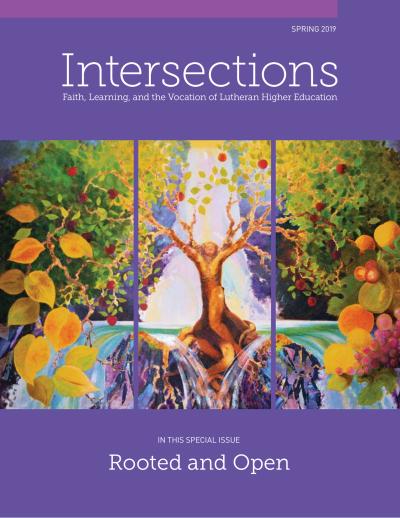
Kristen Gilje, a Bellingham, Washington artist who spent nine years as Artist in Residence at Holden Village, recounts the “Tree of Life” she painted for the Holden Village 1999 summer theme and the unexpected interpretation Lapidary Fred offered of Yggdrasol, Prometheus, the Druid Tree Spirit, and the crucifix all at once.
-
Article
Rooted and Open: Background, Purpose, and Challenges
Mark Wilhelm
Wilhelm traces Rooted and Open’s seventy-year backstory — from Conrad Bergendoff’s 1948 call for a Lutheran philosophy of education through the recovery of the vocation tradition — and describes the document’s process, purpose as a teaching and study resource, and the embodiment, contextual, and cultural challenges it implies for NECU institutions.
-
Article
In a Diverse Society, Why Should Lutheran Colleges/Universities Claim their Theological Roots?
Darrell Jodock
Jodock develops his “third path” account of the Lutheran college — neither sectarian nor non-sectarian but both rooted and open — analogizing the college to a bridge whose deck of daily activities rests on pillars of shared educational priorities, which in turn rest on theological footings; he then answers six common objections to claiming Lutheran roots and explains why those footings still matter.
-
Article
Roots and Shoots: Tending to Lutheran Higher Education
Jason A. Mahn
Mahn revisits why “education-for-vocation” has become a leitmotif for the 27 NECU schools, distinguishes institutional vocation from individuals’ religious identities and educational priorities from their theological grounding, and offers a friendly critique of Jodock’s bridge metaphor: Lutheran colleges grow in two directions like plants — deep roots and wide branches alike require constant tending.
-
Article
Marked by Lutheran Higher Education
Martha E. Stortz
Stortz offers an “operating manual” to Rooted and Open by tracing how the writing team moved from descriptive marks of the institutions to aspirational verbs that mark people — “called and empowered, to serve the neighbor, so that all may flourish” — and shows how each mark generates educational priorities theologically grounded in the radical mystery of God, the wild generosity of God, and the God who became one of us.
-
Article
Rooted and Open as Resource for Expanding Opportunities on Your Own Campus
Katherine A. Tunheim, Marcia Bunge
Bunge and Tunheim describe how Gustavus Adolphus College has paired Rooted and Open with its own companion volume Rooted in Heritage, Open to the World — in board workshops, new-faculty orientation, and classroom assignments — and survey several Network-wide opportunities (the Vocation of a Lutheran College Conference, the LECNA Fellows Program, the Association of Lutheran College Faculties, the Tuition Exchange Program, and international partnerships) that give the common calling tangible institutional form.
-
Article
"Faithful Nones" and the Importance of a Rooted and Open Pedagogy
John Eggen
Drawing on a student survey from his D.Min. thesis at Midland University, Eggen identifies a distinctive subset of religious “nones” — the “faithful nones” — who reject institutional religion yet retain substantive beliefs and practices, and argues that the non-binary, third-path pedagogy commended by Rooted and Open is uniquely positioned to engage a generation that has disambiguated faith, religion, and spirituality.
-
Article
Finding Flourishing: Teaching Self-Care as Course Content
Emily Kahm
Kahm argues that teaching self-care, self-awareness, and stress-coping as explicit classroom content embodies the “radical hospitality” of Rooted and Open and supports vocational formation against a consumerist culture, then offers concrete classroom techniques — a one-to-five energy check-in, ninety-second silence exercises, and full-day spiritual practices — that can be adapted across disciplines at NECU institutions.
-
 Editorial
From the Publisher & Editor
Colleen Windham-Hughes, Lamont Anthony Wells
No. 63 · Spring 2026
6 min audio
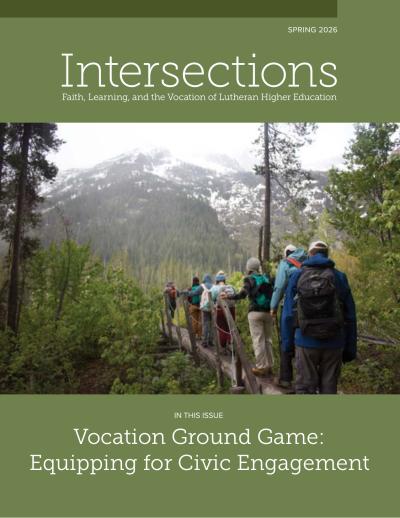
Wells and Windham-Hughes frame vocation as “ground game” — the practical, public living-out of faith through civic engagement — and introduce the issue’s focus on how Lutheran higher education equips students to repair the world.
-
 Editorial
From the Editor
Colleen Windham-Hughes
No. 62 · Fall 2025
5 min audio
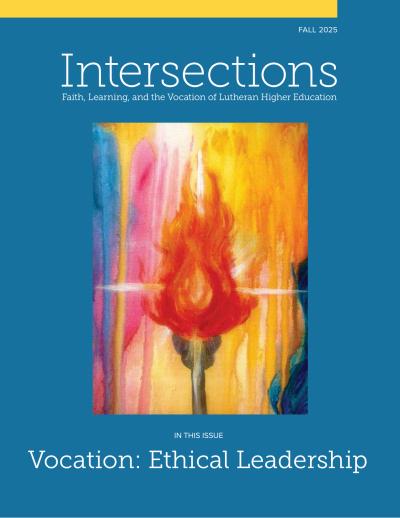
Windham-Hughes plays on the shared Latin root of “education” and “seduction” (ducere, to lead) to warn against the No-saying seductions of giving up or condemnation, and to call educators to the riskier Yes of showing up to build third-space communities of truth-telling and hope.
-
 Editorial
From the Editor
Colleen Windham-Hughes
No. 61 · Spring 2025
5 min audio
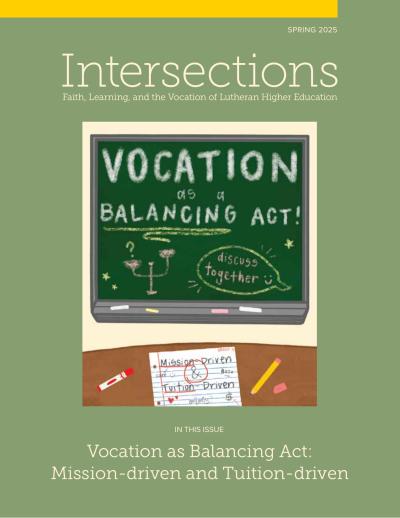
Windham-Hughes uses Fred Rogers’ neighborhood as a living embodiment of a Lutheran understanding of vocation — seeing dignity in each person, offering one’s gifts generously, and trusting that the well-being of the neighborhood is intrinsically connected to the well-being of every neighbor.
-
Institutional Focus
So That All May Belong: Lutheran Roots for Diversity, Equity, Inclusion, and Justice
Altheia Richardson, Angie Hambrick, Caryn Riswold, Colleen Windham-Hughes, Deanna Thompson, Marcia Bunge, Robert Clay
No. 61 · Spring 2025
22 min audio
The full NECU statement grounds DEIJ work in Luther’s 16th-century reforms and Lutheran theological claims about the image of God, equal dignity, and the limits of human knowing — offering definitions, Lutheran roots, and calls to action for diversity, equity, inclusion, and justice, with belonging as the outcome of DEIJ at work.
-
Institutional Focus
Scriptures That Inspire Work for Diversity, Equity, Inclusion, and Justice
Altheia Richardson, Angie Hambrick, Caryn Riswold, Colleen Windham-Hughes, Deanna Thompson, Marcia Bunge, Robert Clay
No. 61 · Spring 2025
9 min audio
A companion list of biblical verses — from Genesis 1:27 and Galatians 3:28 to Micah 6:8 and Luke 4:18-19 — that grounded NECU’s drafting of So That All May Belong, organized by the four DEIJ commitments and offered as an invitation to share other texts that ground and sustain the work.
-
Institutional Focus
So That All May Belong: Lutheran Roots for Diversity, Equity, Inclusion, and Justice [abridged]
Altheia Richardson, Angie Hambrick, Caryn Riswold, Colleen Windham-Hughes, Deanna Thompson, Marcia Bunge, Robert Clay
No. 61 · Spring 2025
8 min audio
A condensed version of the NECU statement that consolidates Lutheran theological grounding for DEIJ and a single combined call to action for Lutheran colleges and universities — offered as a shareable summary alongside the complete document.
-
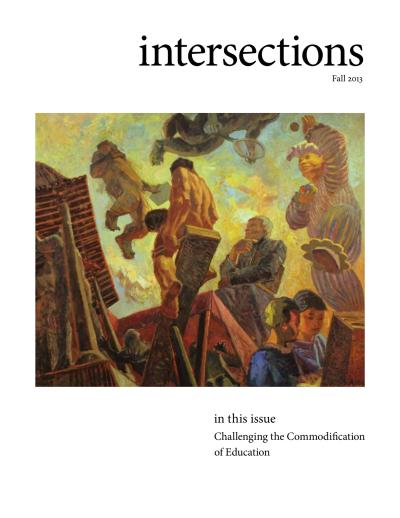 Article
The Value of Evoking Vocation and the Vocation of Evoking Value
Mark Schwehn
No. 38 · Fall 2013
Schwehn answers Michael Staton’s call to “disaggregate” the components of a college degree by insisting that Lutheran education is integral and whole. Working through Bruce Kimball’s history of liberal education, Cardinal Newman, and Leon Kass on Athens and Jerusalem, he argues that Lutherans should defend liberal learning on instrumental grounds and offers the figure of the “local genius”—exemplified by his Valparaiso colleague John Strietelmeier—as the form of human excellence that Lutheran colleges uniquely cultivate.
-
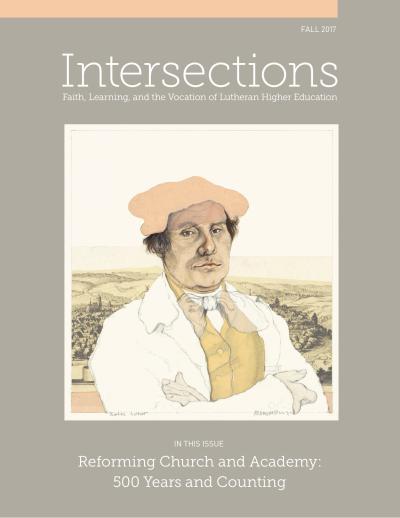 Article
Reforming Our Visions of City Nature
Lea F. Schweitz
No. 46 · Fall 2017
Through a Chicago story of Canada geese at North Pond, Schweitz takes up two Reformation-era ways of reading the “Book of Nature” — Konrad Rosbach’s moral readings and Philip Melanchthon’s scientific ones — and proposes a third: Luther’s sacramental principle that the finite is capable of the infinite, worn as “reading glasses” for an urban planet.
-
Editorial
From the Editor
Colleen Windham-Hughes
No. 62 · Fall 2025
5 min audio
Windham-Hughes plays on the shared Latin root of “education” and “seduction” (ducere, to lead) to warn against the No-saying seductions of giving up or condemnation, and to call educators to the riskier Yes of showing up to build third-space communities of truth-telling and hope.
-
 Article
Engaging the Local Community: Why Bother?
Mary S. Carlsen
No. 27 · Spring 2008
Carlsen traces the often adversarial history of town-gown relations from the medieval universities through the Battle of St. Scholastica Day to the “ivory tower” pattern of American higher education, then argues that Lutheran colleges should engage their local communities for practical, educational, ecological, moral, and theological reasons. Drawing on her work in social work education at St. Olaf and on Ira Harkavy, Ernest Boyer, and the ELCA’s “Our Calling in Education,” she offers a recipe for engagement that is Passionate, Ethical (Needed, Welcomed, Mutual, Long-term, Attentive to diversity, Strengths-based, Respectful), and Reflective.
-
 Article
Vocation and the Vocation of a Lutheran College (Cows, Colleges and Contentment)
Stanley Olson
No. 24 · Fall 2006
Drawing on a childhood image of contented cows on Lutheran-owned farmland in Northfield, Olson—Executive Director of the ELCA Vocation and Education unit—asks whether Lutheran colleges are content because they draw nourishment from the Lutheran tradition, or merely because they happen to be standing on Lutheran soil. He proposes the mantra “Because of Christ, the world; because of the world, vocation; because of vocation, education,” and traces what each clause demands of the colleges and universities of the ELCA.
-
 Editorial
From the Editor
Tom Christenson
No. 6 · Winter 1999
Christenson explains that three of the five papers from the 1998 Wittenberg Vocation of a Lutheran College conference appear here (with Robert Scholz and Cheryl Ney to follow in the next issue), passes on Andy Sheppard’s “Books for Belarus” appeal from Southwestern College, and reflects on Douglas John Hall’s The End of Christendom and the Future of Christianity—its claim that disengagement from cultural dominance is the prerequisite for faithful re-engagement, and its retrieval of Christ’s metaphors of “a little salt, a little yeast, a little light” as a possible session topic for a future VLC Conference.