The themes identified by Walter Bouman in “What is the Lutheran Tradition?” at the “Vocation of a Lutheran College Conference II” helped me further define my role as a faculty member in a Lutheran institution. The Lutheran tradition has greatly influenced the person I have become during my lifetime.
My Lutheran Influence.
I was baptized, confirmed, and married in the Lutheran Church. Because I lived across the street from the church for most of my childhood, I played with the pastor’s children and had good vantage point for watching all of the activities that took place at the church—both happy and sad.
When I left for college in 1973, I felt much more comfortable attending a small Lutheran college than a state university. Hence, I was delighted to receive an Aid Association for Lutherans Scholarship that helped bridge the money gap created by my desire to attend a more expensive Lutheran college. The BSN I received from St. Olaf College prepared me well for my new role as a professional nurse. However, after I graduated and began my career, I realized that I had received a very special education that provided me with much more than the credentials needed to practice as a nurse. I also had developed the skills needed to succeed in life, cope with difficult circumstances, and enjoy the fine arts.
After listening to Dr. Bouman, I suddenly realized why teaching at a Lutheran institution feels so “right” for me and why it is something that should not be lost as we move into the next century.
I practiced nursing for a few years before beginning a nursing education career that has now spanned eighteen years. I spent thirteen of those years as a faculty member at four non-church-related colleges and universities. It wasn’t until I began my fifth teaching position at Midland Lutheran College five years ago, that I finally found a special place as a faculty member. It was almost like coming home. After listening to Dr. Bouman, I suddenly realized why teaching at a Lutheran institution feels so “right” for me and why it is something that should not be lost as we move into the next century.
Dr. Bouman’s address helped me to see that helping students understand and cope with what it means to be human is what we do so well at Lutheran institutions of higher learning. The foundation for this success may be in the liberal arts course work, but it is also depicted in the day-to-day interactions that faculty have with students and other faculty. I can best illustrate this with three examples: the role of a member of the faculty organization, the role as a teacher, and the role as a nurse and teacher.
Role as Member of Faculty Organization.
First, I will address my role as a member of the faculty organization. I recently chaired an ad-hoc committee that developed a faculty mentoring program for Midland Lutheran College. Although we could identify key points under the areas of curricular, teaching, social, and political roles of faculty, the committee struggled with how to explain and foster the spiritual role as we oriented the mentors for the program. Dr. Bouman’s presentation helped me solidify what the committee meant by the spiritual role. Dr. Bouman’s assertion that the five themes are the way that Lutherans are involved in the argument about what it means to be human was a wonderful starting point. The mentoring committee used Dr. Bouman’s assertion to orient the mentors and it seems to have worked well. I make this conclusion based on the initial (first two months) success of the mentoring program and the recent funding for the program from the Lilly Foundation.
The mentors and mentees have developed relationships built on caring and support that have reached across disciplines to create a greater sense of community. For example, when one of the mentors learned of the recent death of a mentee’s father, he called the faculty member’s mentor. The assigned mentor immediately went to find the mentee. He was standing at the front of the classroom writing on the chalkboard. The moment he saw the mentor, he left the class and went into the hallway. The mentor hugged the mentee. That hug expressed more than words could at that moment. Helping the mentee through the loss of a family member is an example of how faculty interact with other faculty in dealing with human emotions such as grief or joy.
Role as a Teacher.
All faculty, novice or expert, in liberal arts or professional disciplines, have a responsibility to facilitate the idea of what it means to be human with all students. Grief, joy, patience, sorrow, and suffering are just examples of feelings and behaviors that can be explored in literature, nursing, business, music, journalism, chemistry, religion, and etc. classes. Only the approach used to examine these human feelings will differ with the class content being studied.
In college, students struggle with life situations and decisions. When given the opportunity, I have found that they enjoy discussing these events, decisions, and emotions because they have experienced many of them. As a teacher facilitates discussion of a musical performance or literature composition, it is easy to have students relate personal anecdotes that support the musical or literary message. Ethical questions can be addressed in business, journalism, nursing, and science courses.
Certainly, exploring what it means to be human in the classroom corresponds with the five themes outlined by Bouman. First of all, human feelings and behaviors were described in the Bible. Multiple references for study in the Bible can be found for those behaviors and feelings listed above. For example, grief is cited in Job 17:7; Proverbs 17:21; Jeremiah 8:18; Isaiah 53:4; and 2 Corinthians 7:9. Some of the citations concerning joy can be found in Psalms 4:7, 47:1, 51:2, 105:43, and 119:11; Isaiah 24:11, 35:10, 55:12, and 61:7; Matthew 2:10, 13:44, and 28:8; Acts 8:8; and John 3:29, 15:11, and 16:20. Matthew 18:26, Luke 8:15; Romans 8:25; and Hebrews 6:12 contain discussion of patience. Sorrow is cited in Proverbs 10:1; Ecclesiastes 7:3; Isaiah 35:10 and 53:3; Jeremiah 31:13 and 45:3; and John 16:20. Suffering appears in Romans 5:3; 2 Timothy 1:9; Hebrews 2:10; and 1 Peter 4:13. Citations of pride are found in Proverbs 16:18; Isaiah 2:11; Jeremiah 13:17; and Amos 6:8.
Secondly, the feelings and behaviors that humans experience are catholic in that they have been passed from generation to generation. Despite our human feelings and behaviors and their related struggles, we are saved by faith in God through his grace which ties us to Dr. Bouman’s third point that Lutheranism is evangelical. Fourth, human feelings and behaviors are experienced with celebration of the sacraments. Whenever the Holy Eucharist or Holy Baptism are celebrated, we continue to experience what it means to be human and know that God is doing something through the human action of saying words, eating bread, drinking wine, or washing someone with water. Finally, to study what it means to be human is related to the fifth theme which Dr. Bouman states is world-affirming. This theme encompasses marriage as opposed to celibacy as well as the concept of vocation as a parent, spouse, farmer, teacher, laborer, or clergy being of equal importance for responsibility and accountability are required in each case. Hence, these themes can also be tied into various classroom discussions.
Role as Nurse and Teacher.
In nursing, helping students to understand what it means to be human is relatively easy because nurses experience humanness each day—the loneliness experienced by nursing home residents, the fear experienced by the hungry and homeless, the joy experienced by new parents, the grief experienced by the terminally ill, the loss experienced by one who has lost a leg, a breast or a loved one. Hence, in the classroom these situations and how to provide care and comfort are discussed. Also, ethical issues are frequently encountered. For example, how much care should a person who cannot pay for services receive? What kind of treatment should the 90 year old patient whose kidneys have failed receive? Finally, nurses have to look at a patient’s cultural practices and religious beliefs and provide care accordingly. Students may pray with patients or offer to get the chaplain when providing care.
During my years of teaching, I have observed that nursing students display tremendous growth and maturity as they progress through college.
As a nurse educator it is also important to deal with the student’s feelings and behaviors—joy with successfully performing a procedure for the first time, grief experienced when preparing a dead client for the mortuary, sorrow experienced when disposing of an aborted fetus, and disappointment with the grade received on an examination.
Conclusion.
During my years of teaching, I have observed that nursing students display tremendous growth and maturity as they progress through college. Perhaps the basis for this is that nursing students frequently encounter a variety of human emotions and behaviors. Hence, they regularly examine what it means to be human. I cannot think of a better setting for that experience than a Lutheran institution of higher education. No wonder I feel at home and am able to define my faculty role better! Thank you, Dr. Bouman!
-
 Editorial
From the Publisher
James M. Unglaube
Unglaube reports on the second annual Vocation of a Lutheran College conference of August 1996, where Walter Bouman of Trinity Lutheran Seminary addressed “What is Lutheran; What is the Lutheran Tradition” (biblical, catholic, evangelical, sacramental, world-affirming—the world “received, enjoyed, served as God’s Gift”). He previews presentations by Wendy McCredie of Texas Lutheran and Baird Tipson of Wittenberg on how the Lutheran tradition is embodied in its colleges, and Bob Vogel’s challenge in “Coherence—And Now what?” that the tradition comes to life in how faculty give expression to their beliefs and values in the classroom and with colleagues.
-
Editorial
From the Editor
Tom Christenson
Christenson opens with an invitation for reader submissions to balance the conference-paper format of the first two issues, then asks how college and universities can turn students positively toward learning. Drawing on Aristotle’s claim that study is loved for its own sake (which students greet with disbelieving laughter) and Neil Postman’s The End of Education, he argues that students lack narratives within which learning makes sense and proposes four Lutheran mega-narratives—stewardship of creation, the freedom of the Christian, the sacramental presence of the transcendent in the concrete and ordinary, and vocation—that could inspire learning at the 28 ELCA colleges and universities.
-
Article
Lutheran Tradition: Five Continuing Themes
Walter R. Bouman
Bouman of Trinity Lutheran Seminary identifies five themes central to the Lutheran theological tradition (understood through Alasdair MacIntyre’s account of tradition as “an historically extended, socially embodied argument”): biblical (a non-oppressive authority for the Bible rooted in the gospel rather than in scholastic inerrancy, against the backdrop of Luther’s 1517 challenge to Tetzel and the post-Enlightenment marginalization of theology); catholic (continuity with the Book of Concord and the three ancient creeds, with Luther’s “Christology from below” recovering a Jewish rather than Hellenistic understanding of God, revived by Tillich, Pannenberg, Forde, and Jenson); evangelical (justification by faith as the answer to mortality’s radical question); sacramental (Word, Eucharist, and Baptism as Christ’s presence from the future of God’s consummated Reign); and world-affirming (creation as gift, vocation as God’s work in every calling, and stewardship of the ecological crisis).
-
Response
“My Wife, We Have Not Come to the End of All Our Trials, but a Measureless Labor Yet”: The Lutheran Argument in Colleges
Steven Paulson
Paulson of Concordia College responds to Bouman by invoking Penelope’s unreasonable patience for Odysseus and asking whether Bouman’s five “principles” deliver the “continuities of conflict” that MacIntyre’s account of a living tradition demands. He argues that the proper Lutheran “continuity of conflict” is the praxis of proclamation—Christ crucified as “a stumbling block to Jews and folly to Gentiles”—which is given outside the institution’s walls and which colleges and universities, as socially embodied arguments, “can’t like” because it places truth beyond their control. The Lutheran problem, he concludes, is not the Enlightenment or Post-Modernism but the “old Adam,” the Odysseus still unsure of his identity.
-
Response
Disputatio Pro Quo? The Search for Lutheran Education
Jon-David Hague, Kimberly Hague
Kimberly and Jon-David Hague—both Luther College graduates completing graduate studies at Berkeley and Boston University respectively—respond to Bouman by offering Luther’s curriculum reform at Wittenberg University in the spring of 1518, only months after the 95 theses, as a model of the Lutheran voice in higher education. Inspired by humanistic principles, Luther introduced lectures on classical authors and the first instruction in Greek and Hebrew, giving students the tools to encounter scripture directly rather than receive dictated doctrine. The spirit of that reform—providing students with every possible tool while acknowledging that an instructor’s perspective is neither ultimate authority nor final word—remains useful for the search for Lutheran academia today.
-
Response
“You Shall Know the Truth, and the Truth Will Set You Free”: A Scientist’s Response
Ben Huddle
Huddle of Roanoke College proposes adding a sixth theme to Bouman’s five—the scientific method—as a tool for knowing the Truth not available to Luther but central to twentieth- and twenty-first-century learning. Diagramming the continuous cycle of observations, laws, theories, and predictions, he argues that scientists must be ethical and that scholars in other fields must understand the scientific method (lest environmentalists ignore the Second Law of Thermodynamics). A Lutheran college, he concludes, should treasure both the religious and the scientific tradition: stifling either loses meaning or significance, and the Lutheran tradition is therefore biblical, catholic, evangelical, sacramental, scientific, and world-affirming.
-
Response
On the Outside Looking Out: A Personal and Social Psychological Response
Chuck Huff
Huff of St. Olaf—a self-described “Metho-Bap-terian” from the South educated at Bob Jones University—offers a personal response to Bouman’s themes (welcoming the rejection of biblical inerrancy, the distinction between gospel and scripture in the homosexuality debate, the gospel-in-the-creeds reading that releases him from Hellenistic conundrums, and the recasting of justification by faith as meaning rather than insurance policy) and a social-psychological response in which a planned study of campus social networks at St. Olaf was discontinued when preliminary interviews revealed that everyone—storied Lutherans, secular faculty, feminists, fundamentalists—felt like outsiders. Continuing the tradition requires constructing a conversation that is thoughtful, fair, inclusive, charitable, focussed, and still true to the tradition.
-
Poem
Two Poems: The Advent Carol / The Madonna of Dohany Street
Brian Forry Wallace
Two poems by Brian Forry Wallace of Capital University: “The Advent Carol,” a litany of the babies who were not adored—the Jewish baby shot with a Luger, the Black child hanged from a tree, the female messiah tossed into a river, the Tutsi infant cut by machetes, the Japanese newborn incinerated by atom bombs, the Chinese baby crushed by Japanese bombs, the aborted Mary’s child—ending with the baby “whom we do not understand, cannot feed, whom we kill”; and “The Madonna of Dohany Street,” on a Holocaust photograph in a Budapest museum of a dead mother and her dead Christ-child daughter in the former ghetto, in which annunciation, nativity, adoration, and crucifixion are seen together in a single instant.
-
Institutional Focus
Embodying the Tradition: The Case of Wittenberg University
Baird Tipson
Tipson, President of Wittenberg University, locates Wittenberg in the “American” strain of Ohio Lutheranism founded in 1845 under Ezra Keller (a Pennsylvania College and Gettysburg Seminary graduate and disciple of Samuel Simon Schmucker), with English-language preaching, financial support from the pan-Protestant New England Society, Presbyterians on the Board, and an Episcopalian teaching Latin. He names two ongoing challenges—remaining authentically Lutheran while welcoming a pluralistic student body (just under a quarter are Lutheran in a primary service area that is 5% Lutheran), and making the tradition clear and compelling to non-Lutheran or lukewarm Lutheran students—and presents the five things every Wittenberg graduate should be able to do (respond to the human condition; recognize, define, and solve problems; develop a sense of vocation; assume servant-leadership; take moral responsibility) as authentic expressions of the Gospel and of the university’s ELCA relationship.
-
 Article
Vocation and the Vocation of a Lutheran College (Cows, Colleges and Contentment)
Stanley Olson
No. 24 · Fall 2006
Drawing on a childhood image of contented cows on Lutheran-owned farmland in Northfield, Olson—Executive Director of the ELCA Vocation and Education unit—asks whether Lutheran colleges are content because they draw nourishment from the Lutheran tradition, or merely because they happen to be standing on Lutheran soil. He proposes the mantra “Because of Christ, the world; because of the world, vocation; because of vocation, education,” and traces what each clause demands of the colleges and universities of the ELCA.
-
 Article
Women Presidents in Higher Education: How They Experience Their Calling
Aimee Goldschmidt, Gary McLean, Katherine A. Tunheim
No. 42 · Fall 2015
Drawing on in-depth interviews with fifteen women college presidents and a transformative-learning-theory framework, Tunheim, McLean, and Goldschmidt trace a three-stage journey — identifying, interpreting, and pursuing the call — and ask what the language of vocation contributes to the preparation and mentoring of women leaders in higher education.
-
 Editorial
From the Editor
Robert D. Haak
No. 23 · Summer 2006
Haak previews the issue’s four essays by Marcia Bunge, Paul Dovre, Samuel Torvend, and Cheryl Budlong — each engaging the ELCA Task Force on Education’s study document and first draft of the social statement on Lutheran education — and invites readers to bring their distinctive voices as professional educators at Lutheran institutions into the conversation before the October 15 deadline. He also invites submissions to Intersections and directs readers to LauraOMelia@augustana.edu to be added to the direct mailing list.
-
 Editorial
From the Publisher
Lamont Anthony Wells
No. 61 · Spring 2025
5 min audio
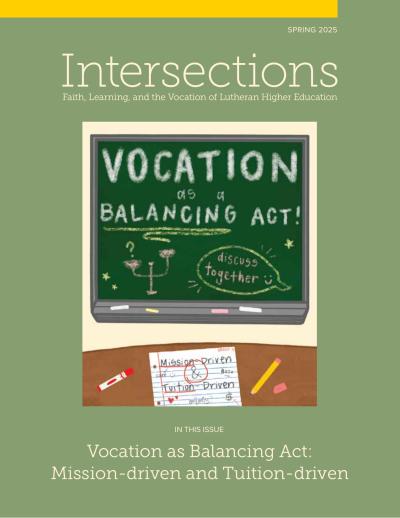
Wells introduces So That All May Belong: Lutheran Roots for Diversity, Equity, Inclusion, and Justice as a theological and institutional articulation of NECU’s commitments, and previews four accompanying essays that frame vocation as a societal responsibility rooted in justice and not solely an individual pursuit.
-
 Article
What I Have Learned: Maybe Plato Was Right
Richard Ylvisaker
No. 4 · Winter 1998
Inaugurating the new “What I Have Learned” column, Ylvisaker reflects on a career of teaching philosophy at Luther College and offers four hard-won “preliminary examples” in which Plato turned out to be more right than fashionable criticism allowed: (1) communities are not necessarily better off by becoming more diverse—diversity needs a unity of purpose if it is to enrich rather than fragment; (2) politics, to be more than a struggle for power by competing interests, must rest on a moral basis that transcends those interests; (3) the much-derided body-soul dualism contains a measure of truth about the cognitive and moral limitations of embodied life; and, deepest of all, (4) reason itself depends on a community of discourse in which doctrinaire pronouncement gives way to disciplined inquiry. Athens and Jerusalem, he concludes, should meet at the college of the church.
-
 Article
Private University, Public Witness: Life in the "None Zone"
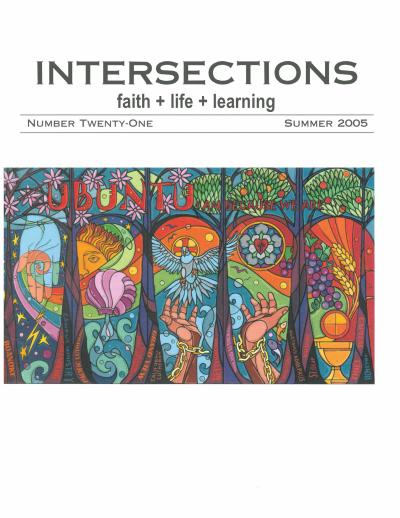
Loren J. Anderson
No. 21 · Summer 2005
Drawing on sixteen years at Concordia College in Moorhead and twelve at Pacific Lutheran University, Anderson contrasts the Lutheran heartland with the Pacific Northwest’s “None Zone”—Patricia Killen and Mark Silk’s name for the country’s least churched region—and argues that a faithful Lutheran witness is possible in this changing context. He proposes five callings for the colleges—an academic program shaped by both educational philosophy and Lutheran theology, vibrant campus communities of faith and learning, inclusiveness and ecumenical outreach, global vision, and vocational exploration—and closes by sketching PLU’s shift toward “partnership” congregations and a new Center of Religion, Culture and Society in the Western United States.