Last year when I attended the Vocation of a Lutheran College Conference I was struck by the intense ethnic identity of our sister colleges. I’m afraid I had no idea that it was possible to go to the “wrong” Augustana depending on whether one was Swedish or Norwegian in ancestry. I was impressed to learn that events in Scandinavia that occurred hundreds of years ago were still remembered and celebrated in the American Midwest. As a white Southerner I had often been impatient with fellow Southerners who meant only one war by “the war” and that was only 130 years ago. Apparently that’s recent by some cultural reckonings.
In the South there are only two main ethnic groups, one composed of descendants of Northern Western Europeans who intermarried decades ago to produce the generic White Southerner and the other composed of descendants of African ancestors. At Newberry College there is little sense of the German roots of our college despite a yearly “Founders Day.” By 1856, our founding date, there was probably little German identity anyway. Today the sole remnant of the Germany past is the term “Dutch Fork” for the geographic area that includes Newberry. “Dutch” is a corruption of “Deutsche,” meaning German, a reminder of the German settlers of the area. Currently ethnic diversity at Newberry consists of varieties of White Protestants, varieties of African-American Protestants and a few Roman Catholics. The college is 83% Caucasian and 16% African-American. Self-identified Lutherans comprise 22% of the student body, exceeded only by Baptists with 29%.
Just as I was impressed by the awareness of ethnic connections last year, I was intrigued by the revelation in a group discussion that California Lutheran, a relatively new college, was busy discovering, if not inventing, “traditions” such as the celebration of St. Lucia. All this evidence of striving for identity, celebrating traditions, etc. caused me to reflect on Newberry and its identity. What held its constituencies together? At the time I could only think of one tradition: the yearly battle for the Bronze Derby, a ludicrous trophy (literally an old hat permanently encased in metal) awarded the victor in the annual football game with Presbyterian College, an institution 20 miles up the interstate. Somehow this did not resonate with the spiritual uplift of a St. Olaf or St. Lucia. Nevertheless, if asked what holds us together one quick and maybe even accurate answer might be the football team. After all, on game days it seems that most of the male student population is suited up on the sidelines. I once counted 100 of them and Newberry only has 700 students total. Newberry has the distinction of being the smallest college in the NCAA to participate in football. Of course as one of my irreverent colleagues has noted, it isn’t clear to all of us that this is a distinction to be pursued.
This year as I was forced to think seriously for this conference about the issue of the Lutheran core and factors of diversity and fragmentation, we were in fact going through a year of crisis at Newberry. Cultural diversity or differences in ethnic cultural background are not the only sources for fragmentation. Fragmentation can result from differentiation. Differentiation is normally positive, specialization of function and role is necessary for institutions. Colleges can’t be run entirely by the faculty, much as some would probably want. Colleges need a financial office, student development office, fund-raising office, a president’s office. But differentiation requires effective communication among the constituent parts for the whole institution to work smoothly. At Newberry there developed fractures, splits, and divisions. I thought I’d discuss this a little because it seems to me that there must have been some central core beliefs or commitment that unified people through the difficult months. After looking at a brief case history of fragmentation due to differentiation, I will turn to broader issues of ethnic diversity and fragmentation.
I. The Newberry Year
According to published media reports and accounts of various participants, in October of 1998 the five member executive committee of the Board of Trustees of Newberry College voted unanimously to ask the President of the College to resign. They were concerned about financial issues and management style. The President rallied support and at a special meeting of the full Board he retained his job when 9 of 16 board members voted to endorse him. That meeting took place on Friday before Halloween. The next Monday morning the President fired the Vice President for Academic Affairs and forced the resignations of the Vice President for Business Affairs and the Vice President for Institutional Advancement. That afternoon the President explained to the assembled Chairs of the academic departments that he couldn’t trust the vice presidents and that they had violated policy by meeting without his authorization with members of the board of trustees.
As Chair of Faculty Council I invited faculty to an impromptu meeting to discuss events and possibly formulate some response. The reaction of the majority of the faculty seemed to be stunned disbelief. Some were physically ill. The only vice president not fired was the brand new president for Student Development. He had just replaced a Vice President who resigned in the spring. The Vice President for Academic Affairs who was fired had only been in the position since July when the previous Vice President for Academic Affairs “decided to return to teaching.” By faculty count there had been a turnover of five vice presidents within six months. With the appointment of an interim VP for Academic Affairs, we were dealing with the third such VP in four months.
The Chair of the Board of Trustees met with the Faculty Council. He told us that after a recent long meeting with the president he hoped issues could be straightened out. The Board appointed committees on finances and management to work with the President. But apparently some factors could not be resolved. Four members of the Board of Trustees, including the Chair and the Treasurer, resigned before the next Board meeting in December.
Through all this depressing and frightening year there was a group of faculty who conferred often and shared concerns. We were from different disciplines and different religious backgrounds. But we shared a vision of the college and what it should be about. The president had tried to portray the Executive Committee action as part of an effort to loosen or break the ties of the college to the ELCA. Board members have denied this and there does not seem to be any evidence that such a change was seriously contemplated. Faculty members, which include ordained ELCA clergy, children and siblings of ELCA clergy, would I’m sure have resisted any such change. Although occasionally some have grumbled about the amount of financial support from the ELCA, faculty members have long supported efforts to heighten the visibility of the college to its supporting synods and urged recruiting students from ELCA congregations. For many faculty the real concerns with the President came from a divergence in vision of the college that had little if anything to do with our Lutheran connections. That was a long running, but low-key difference of opinion about the mission of the college as a liberal arts college. This perceived difference is one that we should have discussed together and perhaps we could have learned from each other. The faculty realizes that the President of a college must worry about the bottom line. The economic realities are that parents DO want to know what their children will get from going to college. They DO ask what can my child do with that major. They DO expect a marketable degree. But the faculty persists in believing that college is preparation for LIFE, not an entry-level job.
This particular split at Newberry is symbolized I think by the new major the President brought with him when he came in 1995. I believe this is related to the theme for this year’s conference as well. When the curriculum becomes more diverse in order to attract students to pay the bills, what then becomes of the college’s Lutheran identity?
At the President’s urging, Newberry added an invented major called Veterinary Technology, becoming the only 4-year institution in the Southeast with such a degree. It turns out there are good reasons for this. The same degree without all the fuss of 4-year private college tuition and core curriculum courses can be obtained 100 miles away at a 2-year technical college. This year the accrediting team of veterinarians in fact encouraged Newberry to forget this 4-year stuff and just offer the degree in a one-year certificate program. For faculty who like to think they’re engaged in the life of the mind and preparing students for graduate work, this smacked entirely too much of technical school.
Yet, in writing this paper and reflecting on the faculty distaste for “vet tech” and other attempts that the faculty see as the slippery slope toward turning Newberry into a “technical school,” I come up against the notion that after all “vocation” is such a key Lutheran concept. Why isn’t it valuable to prepare students to help God’s creatures by training them to be veterinary assistants? Does it matter that the same course of study is apparently available via correspondence according to a recent cable TV ad? Should a college pick and choose which vocations are more worthy of a liberal arts education? Here’s maybe where a discussion of what a Lutheran college is about and how it differs from a Lutheran technical school should occur.
At any rate I found myself consulting Pam Jolicoeur’s paper from last year’s conference, reprinted in the winter 1999 issue of Intersections. She noted, “I think that Lutheran colleges should be vocational schools in both senses of the word. On the one hand, we must prepare students for meaningful work and not eschew that effort as something that is beneath us, as liberal arts colleges, or is someone else’s job. (as well) Lutheran colleges should instill in students a sense that they have an obligation to make a meaningful contribution to the world around them.” (24)
This seems to have wandered pretty far afield. But it comes around again to what holds faculty or other constituencies together. I think in the case of Newberry College it was our abiding concern for students, for educating in the “liberating arts” as Tom Christenson puts it. But I also came to realize from my conversations with staff, with board members, with students, that there are several constituencies in a college. They each have their special role, but they must work together, and they all must have the mission of the college as their goal—the mission of preparing students for service to the world.
In April the President announced that he would be retiring early, on June 1. A long and difficult academic year ended with public good manners. The epistle for the baccalaureate service I found particularly appropriate. St. Paul understood differentiation and the need for unity. From I Corinthians, chapter 12:
For just as the body is one and has many members and all the members of the body though many, are one body, so it is with Christ. For by one Spirit we were all baptized into one body Jews or Greeks, slaves or free and all were made to drink of one Spirit. For the body does not consist of one member but of many. If the foot should say, “Because I am not a hand, I do not belong to the body,” that would not make it any less a part of the body. And if the ear should say, “Because I am not an eye, I do not belong to the body,” that would not make it any less a part of the body. If the whole body were an eye, where would be the hearing? If the whole body were an ear, where would be the sense of smell? But as it is, God arranged the organs in the body, each one of them, as he chose. If all were a single organ, where would the body be? As it is, there are many parts, yet one body. The eye cannot say to the hand, “I have no need of you,” nor again the head to the feet, “I have no need of you.” On the contrary the parts of the body which seem to be weaker are indispensable, and those parts of the body which we think less honorable we invest with the greater honor, and our unpresentable parts are treated with greater modesty, which our more presentable parts do not require. But God has so adjusted the body, giving the greater honor to the inferior part, that there may be no discord in the body, but that the members may have the same care for one another. If one member suffers, all suffer together; if one member is honored, all rejoice together. (12–26)
I don’t think I can improve on Paul. This seems to be the prescription for a healthy institution no matter what it is. It celebrates differences but they all work together for a single purpose. It means to me in this case that a college is not the president, it is not the faculty, it is not the board, or the students, or the alumni, or the big donors… it is all those members of the body.
II. Ethnic/Cultural Diversity and Identity
Sociologists usually encounter concern with ethnic diversity in terms of pluralism and conflict and how to reduce inter-group conflict, how to produce inter-group co-operation. In adapting this concern to the conference theme, I envision it as how to maintain a cohesive college in times of increasing diversity.
Ernest Simmons in his book Lutheran Higher Education affirms the value of diversity. “The Lutheran model of higher education affirms the importance of diversity and the need to dialogue with multiple points of view. This means that all people are important and contribute to the character of a community of inquiry.” (8) He continues, “Diversity within the bounds of a common commitment to connecting faith and learning is not only desirable but sought out, for it can yield creative adaptations that assist mutual survival.” (8) This stress on the positive aspects of diversity is sorely needed in a year that saw people perish for their differences. In Kosovo the celebration of ethnic identity has meant centuries of bloodshed, revenge, retaliation. At Columbine High School the formation of cliques, of in-groups and out-groups, resulted in another tragic pattern of retaliation.
The fact is that humans do choose to spend more time with people with whom they feel comfortable. People generally choose friends on the basis of similar interests and ease of interaction. Ease of interaction is of course facilitated by sharing a common language, a large base of shared knowledge, and shared values. It is in fact difficult to enjoy the company of someone who disagrees with us on what we consider to be vital issues. It is “nice” to encourage dialogue and dialectic but outside the classroom it is awkward and unlikely. High schools, colleges, and work places will always produce cliques—groups of like-minded individuals.
Migration patterns, marriage and breeding patterns, geographic boundaries have produced a world population that is diverse in physical appearance, religious and cultural practices. The question is how to maintain cooperation and harmony among diverse groups, whatever the basis for the group formation.
It seems to me that there are three basic ways to approach this dilemma of diversity and integrity. One came to me as I sat on my back deck observing the diversity of wildlife in the backyard.
Approach One: Feed Them All To Reduce Conflict
Our bird feeders attract chickadees, cardinals, titmice, painted buntings and blue jays but also squirrels and raccoons. I used to see my mission as feeding the birds and protecting them from the predatory raids of the larger animals. But lately I’ve adopted a different strategy. Watching different kinds of birds and the individual squirrels and raccoons I noted the obvious application of a sociological proposition. There are different groups in our backyard and they all want the same scarce resource; sunflower seeds. In human groups and animals competition for the same resource leads to conflict, and if there is a power differential, like physical size, the more powerful will dominate the less powerful, limit access to the desired goodies, and discriminate against the less powerful. But an important variable in this theory of ethnic hierarchy (adapted from Donald Noel) is the competition for scarce and valuable resources. If everyone does not want the same thing or it is not scarce, this should reduce or eliminate competition, conflict and perhaps discrimination. So, in my backyard universe, I adopted a policy of simply “feed them all.” I try to provide enough sunflower seeds for all the animals. This has reduced my stress level and resulted in lots of fat birds and tubby squirrels.
One approach then to diversity, if the aim is to reduce conflict, while maintaining diversity, is to feed everyone or in more elegant phrasing nourish everyone. In the college example this would mean providing everyone with a good substantial liberal arts diet. Surely among the reasons our students choose small church-related colleges is the close and nourishing attention of dedicated faculty who provide stimulating food for thought and the basis for a meaningful post-college life.
Before this metaphor gives us all indigestion, however, I have to point out that providing enough for everyone or even meeting everyone’s demands, needs, desires really only reduces conflict. It does not produce co-operation or integrity out of fragmentation. For that I’d like to turn to another sociological/social psychological proposition: to reduce prejudice and discrimination, research has indicated that the most effective method is to bring individuals together, on an equal basis, to work together to reach a common goal (See for instance studies cited by John E. Farley in Majority-Minority Relations 37–41).
Approach Two: Use The 3 A's To Reduce Differences
Coming together for a common purpose, or at least, a common shared experience, can be met in several ways at the Lutheran College. For students, surviving the core curriculum together, working on group research together for a class presentation, doing service learning and sharing the experience in reflections sessions should all result in more understanding of the essential things students all have in common. Working together as equals reduces stereotypes, makes us aware of our common humanity. College campuses in fact are the ideal labs for inter-group cooperation working together as an athletic team, sharing the intensity of one’s academic major, relying on the artistic talents of others to produce a successful musical or theatrical performance. These three A’s—academics, athletics, and the arts—all bring people together for a common purpose or interest. Ethnic background is not relevant to the task at hand. Achievement and ability are.
Note that in this approach the intent is to reduce differences. This approach seeks common ground. Rather than an emphasis on respecting, recognizing, and encouraging cultural, religious and ethnic differences, it tries to create a common identity: a college athlete, a college student, a college alumnus.
This focus on the common or the community is not really the current politically correct ideology. The current ideology seems to be “cultural diversity” recognition of groups, protection of heritage, pride in ancestry, etc. This is of course an important and necessary corrective to counter the historical and global myopia of evaluating other’s culture in light of one’s own. It recognizes the value and validity of other cultures and aims at according equality to others.
But this philosophy, which sociologists call “pluralism,” has within it potential problems, which I have already mentioned. The pluralist ideal is a society where separate groups are maintained as a source of identity and pride but all the groups are equal in access to economic, political and social rewards. However, the effort to maintain separate groups requires reduced interaction with those outside the in-group and this separatism fosters stereotypes, prejudices, and ultimately perhaps hostility.
A few societies have consciously adopted an official policy of pluralism with constitutions that recognized different religious and language groups. Ironically, when I began teaching race and ethnic relations some 25 years ago the two “successful” examples of pluralism that were cited were Lebanon and Yugoslavia. Today there are none.
Adalberto Aguirre, Jr. and Jonathan H. Turner make this point strongly in their book on American Ethnicity. “Some celebrate ethnic diversity, but it should be noted that no large-scale society with highly diverse and entrenched ethnic sub-populations has been stable.” (224) They cite a list that includes Yugoslavia, Northern Ireland, hostilities in the Middle East, tensions between Indians and Pakistanis to “illustrate that when ethnicity runs deep, conflict becomes intense.” (224) Aguirre and Turner claim that “ethnic pluralism must revolve around relatively weak ethnic identification or otherwise it becomes a focal point for social disintegration.” (224).
In speaking of the U.S. they raise the issue of some middle way between diversity on the one hand and rigid conformity to the Anglo cultural core on the other. No society, they claim, has “remained integrated when ethnic identifications are strong, the cultural core has eroded and ethnic conflicts are frequent.” (225) A possible solution they propose is to incorporate new elements into the cultural core, elements from the diverse groups that compose the American population. A unique American cultural core combined with strong anti-discrimination laws might provide the basis for a stable society that tolerates some weak ethnic identification.
Although intense ethnic identification and diversity have led to fragmentation and tragedy, some degree of ethnic identification and pluralism are facts of life in the U.S. This has been true throughout our history and will remain so for the foreseeable future.
Approach Three: Recognize and Benefit From Diversity
The third approach I suggest is to welcome diversity in some respects to maintain and benefit from diversity. This is akin to the college model advocated by Simmons, i.e. “an open and free exchange of perspectives” (70). Indeed he later claims that the “need for multiple voices of discourse and exchange is a hallmark of the Lutheran dialectic” (77).
This approach celebrates diversity not out of some vague “feel good” idea that “variety is good” but because it has positive and verifiable benefits. The workplace we’re told is welcoming diversity as a positive thing and they’re right. People from different backgrounds bring different perspectives to bear after all that’s the model for this conference each year. The hope is that our thinking will jump out of its rut and produce creative and novel ideas.
An optimistic perspective on the increasing emphasis on pluralism in the U.S. is offered by John Farley in his text on racial and ethnic minorities. He claims that there is “growing evidence that over the long run a more diverse work group is more effective, because it can offer a wider variety of ideas and ways of dealing with issues and problems and because it can often better address the needs of an equally diverse base of potential customers and clients.” (415) This seems to be one of those sociology as common sense ideas that so bedevils my field. However although this may be intuitively obvious to some, it is just as intuitively obvious to others that people from different backgrounds would NOT be able to work together. So let’s look at some research.
Farley cites findings by Watson, Kumar, and Michaelsen that compared homogeneous work groups with diverse work groups. They found that the diverse groups had more trouble working together initially but as time went on they became more productive than the homogeneous groups. According to the researchers, the diverse groups were more successful because they were better at considering different viewpoints and coming up with possible responses. (415)
I find this research very encouraging. It returns to where I started—people are more comfortable with people they think are similar. This makes for easy interaction at first with people who are similar and more difficult interaction with people who perceive each other as different. But with effort, people can find common ground to make interaction work. And in working and cooperating on a common task, they overcome initial misunderstanding and stereotypes. Best of all, their diversity ultimately is positive—it produces more flexibility, more options, more ways of looking at a problem.
This suggests that Simmons may be correct when he claims that “diversity can yield creative adaptations that assist mutual survival.” (8) The commitment of our Lutheran colleges to creating community out of diversity while welcoming the contributions of all our constituencies is a complex task. But the alternatives would seem to be stagnation on the one hand and conflict on the other. The Lutheran center that holds is the emphasis on open dialogue. Beyond that, my nomination for a central purpose to unite students, faculty and staff is the belief that we are all preparing the next generation for service to the world.
Works Cited
Aguirre, Adalberto and Jonathan H. Turner. 1995. American Ethnicity: The Dynamics and Consequences of Discrimination. McGraw-Hill, Inc.
Christenson, Tom. 1999. “Learning and Teaching as an Exercise in Christian Freedom.” Intersections 6:3–11.
Farley, John E. 1995. Majority-Minority Relations. Prentice-Hall, Inc.
Jolicouer, Pamela M. 1999. “Finding the Words: The Trouble of Being Lutheran University.” Intersections 6:20–25.
Simmons, Ernest L. 1998. Lutheran Higher Education: An Introduction for Faculty. Augsburg Fortress.
-
 Editorial
From the Publisher
Arne Selbyg
Selbyg reflects on the origins of Intersections—begun out of concern that the philosophy and theology behind Lutheran higher education could be lost to retirements and other preoccupations—and credits Paul Dovre of Concordia and Robert Sorensen of the ELCA Division for Higher Education and Schools as key figures behind the resumption of the debate. He points to three recent books (Ernest Simmons’s Lutheran Higher Education, Paul Contino and David Morgan’s The Lutheran Reader, and Pamela Schwandt’s Called to Serve) and to the new Lutheran Academy for Scholars in Higher Education, and previews the next “Vocation of a Lutheran College” conference at Dana College in August on what differentiates Lutheran colleges within American higher education.
-
Editorial
From the Editor
Tom Christenson
Christenson marks the eighth edition of Intersections, expresses gratitude to the ELCA Division for Higher Education and Schools and especially to the soon-retiring Bob Sorenson for backing the journal, the Vocation of a Lutheran College Conferences, and the Lutheran Academy of Scholars, and introduces an issue that gathers analyses and arguments from both insiders to Lutheran theology and outsiders, from veterans of the institutions and recent arrivals—voices that together remind us that what is and what ought to be need to inform each other.
-
Article
Integrity and Fragmentation: Can the Lutheran Center Hold?
Robert Benne
Benne answers the conference’s question pessimistically—“the Lutheran center cannot hold in many, if not most of our colleges, because it was never there in an articulated form in the first place”—and distinguishes “Christ of culture” colleges like the Midland Lutheran of his youth (Lutheran by ethno-religious ethos rather than by articulated theology) from James Burtchaell’s “confessional colleges” that operated from a theologically distilled Lutheran humanism. Drawing on Alasdair MacIntyre and Mark Schwehn’s First Things essay on Christian universities, he sketches what a Lutheran center looks like (unity, universality, integrity, a tradition of thought) and how its distortion—reducing the Gospel to justification and ceding everything else to autonomous reason—splits Christ and culture as dangerously as the German church separated Gospel and politics. For colleges that have lost their center, he proposes an “intentional, robust pluralism” that guarantees a Lutheran voice in every department and an “affirmative action for Christians” in hiring.
-
Article
From Pietism to Paradox: The Development of a Lutheran Philosophy of Education
Philip Nordquist
Nordquist traces a four-decade personal and institutional journey from the “Protestant triumphalism” and aggressive moralism of S. C. Eastvold’s 1950s Pacific Lutheran through the 1960 Ditmanson–Hong–Quanbeck volume The Christian Faith and the Liberal Arts, Gordon Lathrop’s 1972 PLU donor address grounding the university in two-kingdoms theology, the ALC’s 1975 Concordia workshop with Bill Narum, Bob Bertram, Harris Kaasa, and Sydney Ahlstrom’s case for the “critical” tradition over the scholastic and pietistic, the 1976 LCA statement distinguishing “Christian” from “church-related” education, and Richard Hughes’s 1997 Carthage address. He concludes that dialectical (two kingdoms) theology, Christian humanism alongside professional studies (the New American College model), Luther’s commitment to universal compulsory education, environmental and civic responsibility, and academic freedom together constitute the bequest of the Reformation—“Christ and culture in paradox” remains the best approach to education he knows.
-
Article
Diversity, Integrity, and Lutheran Colleges
Florence D. Amamoto
Amamoto—a sansei Jodo Shin Shu Buddhist who is “an inside outsider” at Gustavus Adolphus—argues that diversity and integrity belong together in Lutheran higher education, perhaps in a way unmatched by other church-related traditions. She affirms the importance of Gustavus’s 60% Lutheran student body and vibrant Christ Chapel under Richard Elvee and Brian Johnson while warning that numbers and chapel are not enough, draws on Tom Christenson, Patricia Gurin, Sylvia Hurtado, Anthony Carnevale, Martha Nussbaum, W. E. B. DuBois (the deaths of Matthew Shepard and Isaiah Shoels), Richard Hughes’s reading of finitum capax infiniti, Richard Solberg, and Mark Schwehn’s mutual hospitality model, and concludes that the real enemy is not diversity but indifference—and that Lutheran finitude grounds a theological commitment to keeping diversity and identity in creative conversation.
-
Poem
Things That Renew Hope
Sig Royspern
Inspired by Andrew Greeley’s Religion as Poetry, which defines religion as hope-renewing experiences and the stories, symbols, rituals, and images that preserve them, Rauspern offers a list-poem of small renewals of hope: lovers kissing in the street, the first snowfall of each year, compost and spring sprouts and Jewish humor, kids’ summer mischief, a mother nursing her baby on the bus, small jazz ensembles, two old men reconciling without remembering why, an unscheduled gift, the blues, a child taking him by the hand, and a gray-haired man who threw his cellular phone in the river.
-
Reflection
A View From the Other Side
Daisybelle Thomas-Quinney
Thomas-Quinney—an ordained Church of God minister and adjunct in Religion at Thiel College—offers “a view from the other side” as a non-Lutheran African American “outsider and novice”: her bittersweet 1995 arrival at Thiel, her swift discovery (alongside one African American secretary, one Hispanic professor, and thirty-eight African American students recruited largely as athletes) of a “chilly” campus unprepared to nurture the very minority students it had recruited, her examination of Thiel’s 1875 founding and the Augsburg Confession Article IV right-hand/left-hand kingdoms, the parables of mustard seed and yeast from Matthew 13, and Bishop James Crumbly’s 1985 LCA manual Inclusiveness and Diversity: Gifts of God. Drawing on Bruce Reichenbach, Samuel Hazo, and Josephine D. Davis’s Coloring the Halls of Ivy, she concludes that the Lutheran center cannot hold “as is” but has “great possibility” when the mission statement is actually followed.
-
 Article
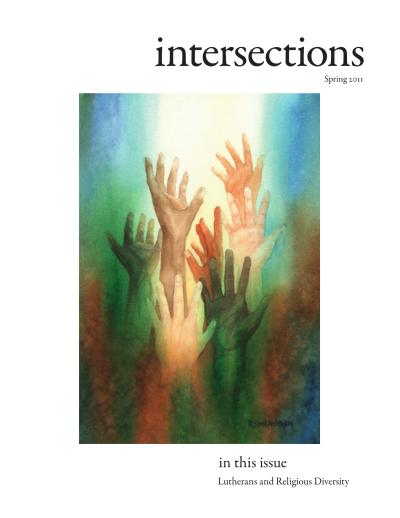
The New (con)Texts of Jewish-Christian Engagement
Karla R. Suomala
No. 33 · Spring 2011
Suomala surveys four contemporary contexts of Jewish-Christian engagement on American college campuses — campus populations, Jewish studies curricula, the changing nature of Jewish identity among Millennials, and the shift from formal Jewish-Christian dialogue toward broader religious pluralism — and argues that at Lutheran colleges this success story can serve as a model for engaging the other religious neighbors who increasingly form part of our society.
-
 Article
Lutheran Identity, Academic Integrity, and Religious Diversity
Storm Bailey
No. 25 · Spring 2007
Bailey argues that one might rightly say of a college “that’s a pretty good school because it’s religious,” defending the proposition under three headings: academic and curricular virtues, free inquiry, and religious diversity. Drawing on Mark Schwehn’s Exiles from Eden, Richard Hughes on the Lutheran tradition’s “most potent theological resources” for the life of the mind, Parker Palmer, Lendol Calder, Mill’s On Liberty, Newman’s Idea of a University, and the AAUP’s 1940 Statement, he proposes a “critical mass” alternative in which the Lutheran commitment to truth-seeking and self-critique itself requires—rather than tolerates—a religiously diverse faculty whose opposing voices are needed for the mission to flourish.
-
 Article
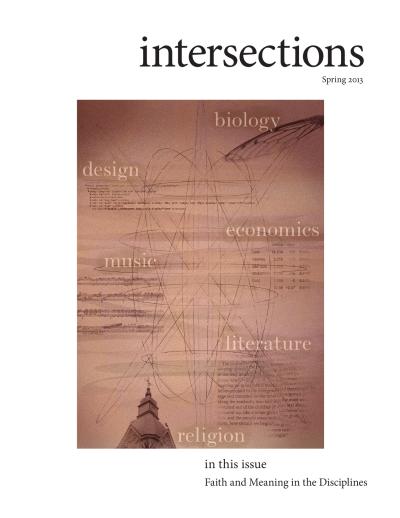
Calling Economists
Lynn Hunnicutt
No. 37 · Spring 2013
Reading Luther’s Whether Soldiers, Too, Can Be Saved alongside Adam Smith’s Theory of Moral Sentiments and Wealth of Nations, Hunnicutt asks whether economists, too, can be saved—and whether economics can host a serious conversation about vocation. She traces her own move from Utah State to Pacific Lutheran University and its Wild Hope Center for Vocation, and turns to Deirdre McCloskey and George DeMartino as economists whose work makes room for vocation and the common good within the discipline.
-
 Article
Reforming Our Visions of City Nature
Lea F. Schweitz
No. 46 · Fall 2017
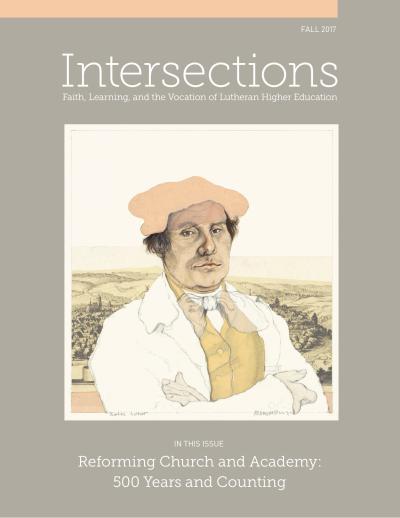
Through a Chicago story of Canada geese at North Pond, Schweitz takes up two Reformation-era ways of reading the “Book of Nature” — Konrad Rosbach’s moral readings and Philip Melanchthon’s scientific ones — and proposes a third: Luther’s sacramental principle that the finite is capable of the infinite, worn as “reading glasses” for an urban planet.
-
 Article
Vocation and Dharma throughout Life's Stages: A Hindu Perspective
Vidya Thirumurthy
No. 47 · Spring 2018
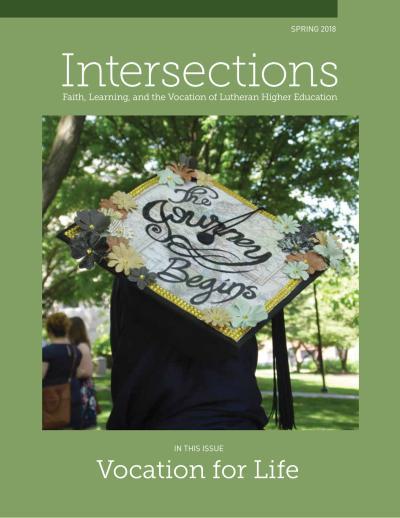
Thirumurthy traces her own attempt as a Hindu faculty member at Pacific Lutheran University to grasp the Lutheran concept of vocation, finding in the Bhagavad Gita’s teaching on dharma — duty fulfilled without expectation of reward — an equivalent that, like vocation, varies across the four stages of life and calls individuals to transform others through selfless service.
-
Editorial
Guest Editor
Madeleine Forell Marshall
No. 25 · Spring 2007
Marshall introduces the four papers in this issue from the 70th annual meeting of the Association of Lutheran College Faculties, held at California Lutheran University in October 2006 on the theme “Identity and Diversity in the Lutheran College.” She notes a geographic pattern—the two East Coast contributors (Balmer and Bailey) defend Christian liberal arts against perceived suspicion, while the two Westerners (Marichal and Brubaker) treat Lutheran identity as advantage and diversity as a Lutheran given—and announces the 2007 ALCF meeting at Newberry College on “Beyond ‘Whatever’: Values Based Learning in Lutheran Higher Education.”