In a Diverse Society, Why Should Lutheran Colleges/Universities Claim their Theological Roots?
Intersections No. 49 · Spring 2019
The individual histories of ELCA colleges and universities vary considerably, but in general we can say that 60 to 70 years ago what it meant to be a Lutheran college was pretty clear. Virtually all students were Lutherans, and the faculty and senior staff were either alumni or graduates of similar institutions. They were familiar with the Lutheran tradition and had been socialized into understanding what it meant to be a Lutheran college. Today, for the most part, the core faculty who once carried and interpreted the tradition have retired. National searches mean that many faculty and senior staff arrive on campus with no idea what it means to be a Lutheran and little idea what it means to be a Lutheran college.
As it is asked today, the question of what it means to be a Lutheran college is a product of diversification. Diversification is, of course, not a bad thing. On the contrary, it has enriched our schools. However, what this development does is to leave us with a task: to explain to ourselves and others how we can claim to be Lutheran while at the same time being diverse—that is, while welcoming to campus those who do not share this tradition.
One impediment to this explanation is that so many people think there are only two options. Either a private college is sectarian, or it is non-sectarian. Either it is rooted in a particular tradition or it values a diversity of constituents, but not both.
Using the broadest possible strokes, Rooted and Open suggests that Lutheran colleges follow neither of these default models. Instead they pursue a third path.
“Rooted and Open suggests that Lutheran colleges follow neither of these default models. Instead they pursue a third path.”
Rooted and Open
To review briefly, a sectarian college aims at religious uniformity—by requiring faculty and staff to sign a statement of belief, for example, or be members of a particular church or adhere to certain religion-specific standards of behavior. Such a college is closely tied to its sponsoring faith community. There may be some religious diversity in the student body, but it is not acknowledged. Thus the college does not need to struggle with religious diversity. Such a college is good at nurturing religious identity but a bit cut off from the larger society. It is rooted but not inclusive, rooted but not open. It is an enclave.
The second default model is non-sectarian. A non-sectarian college has severed its connection to the faith community that started it. It accommodates religious diversity in the same way as the surrounding society—by regarding religion to be a private matter. Thus it too does not need to struggle with religious diversity. It merely follows an established pattern worked out in society at large. Such a college is inclusive or open, but not rooted. It is a microcosm of the larger society.
A college that is both Lutheran and diverse follows a third path—one that is both rooted and open. It is rooted in the sense that it continues to take seriously its Lutheran heritage. And it is inclusive or open in the sense of welcoming into its midst faculty, staff, and students of various religious backgrounds and inviting them to participate in the kind of inter-religious and intercultural dialogue that benefits everyone. It expects that such dialogue and learning will not only expand a person’s understanding of another religion but also deepen that person’s understanding and appreciation of his or her own. A number of studies of diversity have shown that mere exposure is not enough. When dealing with religious or racial or social differences, exposure alone can actually heighten misunderstandings. Engagement is needed. So, when a third-path college takes religion seriously and encourages respectful, inter-religious dialogue, it is preparing students for the multi-religious world in which they will live and work. To repeat, one way a third-path college is open or inclusive is that it welcomes diversity. Another way it is open or inclusive is that it seeks to serve the wider society, not just the church that sponsors it. Its goal is to graduate students with a robust sense of vocation, with a mature idea of the common good, and with a readiness to reach across the social, political, and religious barriers that currently prevent our society from advancing the common good. A third-path college is like a well dug deep to nourish the entire community.
“A third-path college is like a well dug deep to nourish the entire community.”
As I have said, many people, on and off campus, assume that there are only two models. In their eyes, a college should be one or the other. A Lutheran college or university that values the third path will need to explain it and its advantages—and do so in all sorts of settings.
One small caveat. In my experience, some older alumni are attracted to the sectarian model, because they want their alma mater to be a safe and nurturing place, as they remember it when it was less diverse. But I do not think our Lutheran colleges were ever intentionally sectarian. Some of them were accidentally so, because of the recruitment patterns of that day. For a Lutheran college to be intentionally sectarian today would be an innovation that is, in my opinion, out of tune with basic themes in Lutheran theology.1 Other alumni want our colleges to be more non-sectarian, because they look back on their college experience as too provincial. This is an understandable reaction, but it does not recognize the potential for change within the third-path model. In my opinion, adopting the non-sectarian option would abandon the distinctiveness of a Lutheran college and diminish what it can offer our society.
The Threefold Work of a Third Path College
The third path involves three distinguishable components of a college’s identity and work. The first element encompasses all the activities that occur on a college campus—everything that happens in a college’s classrooms, dormitories, athletic fields, laboratories, library, chapel, etc. I like to imagine that a third-path college is like a large bridge with a deck wide enough and long enough to host all these activities.
The second element consists of shared educational priorities. These are the priorities that influence a college’s decision-making and show up in its activities. On my bridge analogy, these are the pillars that hold up the deck. So, for example, one educational priority at Lutheran colleges is academic excellence. Another is hospitality—creating a safe place in which to be challenged and to learn. I went to a Lutheran college 350 miles away from home, did not know a single person there, and had received no preparation for what to expect. The first week was a complete blur of confusion as I showed up for this or for that. When I sat down with my musical instrument for an audition, the band director must have sensed my confusion, because he said, “Remember, Darrell, here you are among friends.” The fact that 59 years later I still remember what he said is an indication of how important it was to me and of how typical it was of my overall experience at the college. In many settings hospitality is a virtue, yes, but it also can be an educational value. It can create a safe space within which to consider new alternatives. John Haught has observed that a quest for truth can be derailed by a need for acceptance (Haught 99). The experience of hospitality can free students to pursue the truth and to challenge some of their assumptions.
The third element involves the theological values that color, inform, and anchor the educational priorities. These are the footings that support the pillars of the bridge. Taken individually, the educational priorities may not be distinctive, but they become so when shaped and informed by Lutheran values. Thus, in a Lutheran setting, academic excellence is not only a way to ready students for success in their career and not only a way to move the college as a whole to a higher ranking in the college guidebooks; it is primarily a way to serve others. Solid ideas, based on good information, will help us all make better decisions about how to assist our neighbors and the larger community. In addition to good intentions, good deeds require that we understand what is needed and what will work. Bad ideas and misinformation sooner or later bring harm to the community or to other individuals. Just think of what damage has resulted from a bad idea such as racial hierarchies (once thought to have a scientific basis) or from misinformation about people in another religion or another nation or another part of the world.
Likewise, when hospitality is undergirded by a theology of God’s unconditional acceptance (Haught 99-105), which is a core emphasis in Lutheran theology, it then becomes “radical hospitality.” Radical hospitality can break through the limits imposed by society as a whole. This happened in the 1930s when, at the highest point of anti-Semitism in our nation’s history, some Lutheran colleges welcomed Jews. It happened in the 1940s when some Lutheran colleges welcomed Japanese-Americans from the internment camps. And it continues to happen when undocumented immigrants from Guatemala and refugees from Somalia and Syria and elsewhere are welcomed. An individual faculty or staff member is expected to understand and appreciate the theological values of the college but not necessarily subscribe to them on a personal, religious level.
“This distinction between educational priorities and theological values is crucial if a college is to follow a third path.”
This distinction between educational priorities and theological values is crucial if a college is to follow a third path. A sectarian college moves directly from its religious principles to its decision-making. It does not make this distinction. A non-sectarian college has abandoned its theological footings. It also does not make this distinction.
Responding to Objections
So, why does it matter whether a Lutheran college continues to take its Lutheran footings seriously?
Let me first consider some possible objections.
Some persons fear that claiming a college’s religious roots will put it under the authority of the church. Though this does occur in some places and can cause many headaches, it is simply not the way things work in the ELCA.
It would be possible to suspect that claiming the Lutheran tradition involves endorsing something ready-made—something that was defined and packaged in the past. But this is not the case, because the Lutheran tradition is dynamic, living, and changing. It is constantly being re-formed at the intersection of its theological principles and the contemporary context. It retrieves neglected elements of Luther’s thought and rejects others. The tradition has been revitalized and reshaped by reaching back behind the movements that shaped our colleges in their early years (such as Lutheran Orthodoxy or Pietism) to Luther himself. For example, a return to Luther’s deep appreciation for ongoing creation—an appreciation largely lost from view a hundred years ago—has nourished discussions of science and faith. Likewise, an examination of Luther’s understanding of the “two kingdoms” has replaced the distorted teaching that influenced the passivity of churches in Nazi Germany and, to some extent, churches in the United States. The result has been a renewed, more dynamic understanding of political ethics that supports engagement and resistance rather than quietism. Similarly, a return to some of Luther’s principles has opened a way to support inter-religious dialogue (see “ELCA Consultative”). And, currently, a renewed attention to Luther’s many proposals for reforming the society of his day has suggested helpful ways to engage today’s society (see Lindberg and Wee).
A third possible worry would be that when a college claims its Lutheran roots, it somehow limits freedom of inquiry. This is simply not the case. Nothing is cordoned off. For Luther, every cherished idea needed to be examined to see whether it was true and whether it helped people or harmed them. The decisions made by church authorities were not exempt. Theology was not exempt. And even his most cherished Bible was not exempt. All of this is true because the tradition is all about freedom. Its concern is how human freedom is to be deepened and empowered, not how it is to be curtailed.
A fourth possible objection is to worry about associating with the misdeeds of the Christian church. This is a significant concern, because far too many regretful things have been done in the name of Christianity. We can think of the Crusades, the slave trade, religious wars, and so on. We can think of individuals who have been harmed when religion has been used as a bludgeon—whether by parents or clergy or public officials. But, because these actions are distortions of the religion, Lutheran Christianity has the resources to challenge and change them—as has happened again and again—whether with Luther opposing a crusade or Christians opposing the slave trade or clergy participating in the civil rights movement or Lutherans during the last 50 years revising their view of Judaism. A college needs to teach discernment—the ability to distinguish between the beneficial forms of a movement and its detrimental forms. The theological values that anchor a Lutheran college equip us to undertake this discernment with regard to the Christian tradition. Once learned there, this skill can be applied to other movements. But learning to discern is not enough, a Lutheran college should also seek to model a generous, humane, and thoughtful version of Christianity in its chapel services, student religious groups, and elsewhere.
A fifth possible objection comes from a discomfort with religious particularity. On some visceral level, this discomfort is evident among many who are involved in higher education. I suspect that it may be a legacy of the Enlightenment. But whatever its source, this discomfort is real and often surfaces in campus conversations. However, one thing we have learned from post-modernism is that in human affairs, anything that claims universality simply masks some form of particularity. So the issue today turns out not to be particularity itself. The challenge is to distinguish between those forms of particularity that are closed and those that are open: open to other insights, interested in finding their place in the whole, and ready to self-critically enrich the broader community. Claiming the Lutheran tradition is not to say that this is the only way to run a college. It is to say that this is one valuable way alongside other valuable ways. Higher education as a whole is enriched by the kind of institutional diversity that includes the distinctive contributions of Lutheran colleges and universities.
“The challenge is to distinguish between those forms of particularity that are closed and those that are open: open to other insights, interested in finding their place in the whole, and ready to self-critically enrich the broader community.”
A sixth possible objection arises from a worry that claiming its Lutheran roots will make non-Lutherans feel like outsiders at a Lutheran college. I do not deny that this can happen. Sometimes it happens when too much theological jargon is used, so we need to articulate the Lutheran principles in fresh ways—as Rooted and Open attempts to do. And sometimes it results from a misunderstanding or misapplication of the relation between the footings and the pillars, the theological values and the educational priorities. Once this distinction is understood and the educational priorities and theological values are explained, what I hear back is “I’m a Roman Catholic” or “I’m a Buddhist” or “I’m a Muslim” or “I’m a Jew,” and “if these are the educational priorities supported by the Lutheran tradition, I want to support them, because these priorities are worthwhile and not found at every school.” Because a Lutheran college or university follows a third path, because its educational priorities can be shared by persons in differing religious traditions, and because the Lutheran values that undergird its educational priorities support inclusiveness, non-Lutherans should not feel like outsiders. The more these matters are discussed and the more everyone is equipped to participate in the discussion, the less anyone will feel left out. To cite but one example, I vividly recall a discussion of a possible grant application when a Roman Catholic faculty member at a Lutheran college made a beautiful argument why a Lutheran college should develop a program that fostered civil discourse. He understood the pillars and footings well enough to formulate a sound rationale for undertaking the envisioned project.2
Let me note in passing that I do not think there is any way around the reality that in a Lutheran college or university, the Lutheran tradition has a position of institutional influence not accorded other religious traditions. I don’t see any way around this, short of becoming a non-sectarian school and losing the benefits of a third path. As will be evident below, I regard this institutional influence to be educationally beneficial. It is neither oppressive nor coercive.
Why Lutheran Footings Matter
So, let me return to the question: why does it matter whether a Lutheran college takes its Lutheran footings seriously?
One important reason is this: claiming a college’s Lutheran footings deepens the educational enterprise. One purpose of a Lutheran education is cultivating wisdom—that is, an understanding of humans and communities, how they work, and what they need to be whole and healthy. This requires going beyond gaining knowledge (as important as it is) to probe the implications of this knowledge. How can it be used to benefit the neighbor and the wider community? It also requires a community of discourse. Individuals can attain knowledge on their own, but the give and take of a community is necessary in order to benefit from multiple perspectives and to attain some appreciation for the complexity of the problem and the best way to address it. If one also gives attention to the Lutheran understanding of humans as a complex mixture of a capacity for good and a capacity for evil, the conversation about the implications of something learned will go still deeper. Or, to cite another example, students with a lively sense of vocation are likely to be more engaged with their studies than others who are merely trying to please their parents or receive a credential with a minimum amount of effort. When rightly understood, there is nothing in the Lutheran tradition that gets in the way of freedom and learning. In fact, the opposite is true: the tradition fosters freedom and learning.
Why does it matter? Because claiming a college’s Lutheran footings equips members of its community to serve our larger society. So, for example, for quite different reasons, both a sectarian and a non-sectarian college ignore religious diversity, but to the degree that a Lutheran college or university takes both religion and inter-religious understanding seriously, it will help reduce the fear of other religions and the inter-religious conflict in our world. It will equip graduates to live and work in a pluralistic society. To take another example: the Lutheran tradition puts a priority on the importance of a healthy community. This is an antidote to the excessive individualism in our society (among people of both the right and the left) that tends to erode our social fabric and undermines cooperation for the common good.
Why does claiming a college’s Lutheran footings matter? Because it anchors the college’s educational priorities. To return to my image, the footings anchor the pillars, which in turn determine what happens on the deck of the bridge. In order for a college to serve society, a certain amount of independence from that society is needed. Then it can identify the dangers or weaknesses as well as the strengths and virtues of the larger community and send out graduates ready to tackle its deficiencies and preserve its strengths. One might think that the Enlightenment values that have informed higher education would be enough to sustain this independence, but the last 150 years have shown that this is not the case. In the face of political pressure, the universities of the world have too easily been co-opted by an ideology—be it Marxist-Stalinist, fascist, or something else. Lutheran footings can provide an anchor that militates against succumbing to a powerful social, political, or economic ideology.
“Taking a college’s Lutheran footings seriously keeps alive a dynamic connection with the past and a lively hope for the future. By contrast, American society, as a product of the Enlightenment, has tended to dismiss the past as ignorant and superstitious.”
Why does it matter? Because taking a college’s Lutheran footings seriously keeps alive a dynamic connection with the past and a lively hope for the future. By contrast, American society, as a product of the Enlightenment, has tended to dismiss the past as ignorant and superstitious. It has instead been, in the words of one commentator, “officially optimistic” (Hall 43-59). But recent developments have challenged this optimism. For many, the future now looks ominous and no longer under their control. They see there a mushroom-shaped cloud, a silent spring, limited resources, economic vulnerability, and seemingly intractable racial and economic injustices. Cut off from the past, frightened by the future, and trapped in the present, Americans exhibit a great deal of ongoing anxiety, which slows down learning, amplifies fears, and seeks a quick fix (Steinke 8-9).
When Luther wrote to the city councils of Germany, urging them to establish schools for all young men and women, he emphasized that these schools would explore societies of the past and determine what went right and what went wrong in order to generate the wisdom needed to lead a community or a household (Luther 368-69). The Lutheran tradition values the past without being constrained by it. And it expects God’s work of fostering shalom3 in the world to nourish hope, even in the face of the darkest storm clouds. It is hard to overemphasize how important it is to expand our sense of the world into the past and into the future in order to understand our place in it, to find a shared sense of meaning and purpose, and to overcome the anxiety that otherwise polarizes and paralyzes our society. As Rabbi Greenberg has said, “hope is a dream which is committed to the discipline of becoming a fact” (Greenberg 8). It overcomes paralysis and unleashes human agency.
For all of these reasons, I think it is important that our colleges and universities continue to honor their theological footings, follow the third-path model, explain what it means, and foster an ongoing conversation about its implications.
Endnotes
1. One of my colleagues, whose field is American church history, once commented that Gustavus “never was a Christian college,” in the way that term is used by sectarian colleges today. As soon as Gustavus moved to its present location, it offered programs designed to attract local students who were not Lutheran, in addition to recruiting the children of Swedish-American immigrants. Its founder, Eric Norelius, also insisted that classes be taught in English in order to prepare its Swedish-American students for participation in American society.
2. In conversations with faculty members who are Christian but not Lutheran and faculty members who practice a religion other than Christianity, I have discovered that talk about the “Lutheran identity” of a college makes them feel like outsiders, whereas the language of “educational priorities and theological values” is more inviting and inclusive. “Identity,” they explain, feels like something one is born into, whereas an adult can choose to endorse “values” and “priorities.”
3. There are many images of shalom in the Bible. They lead me to define shalom as whole healthy relationships among humans, between God and humans, and between humans and the rest of creation.
Works Cited
ELCA Consultative Panel on Lutheran-Jewish Relations. “Jewish Relations.” Accessed 15 April 2019, https://www.elca.org/Faith/Ecumenical-and-Inter-Religious-Relations/Inter-Religious-Relations/Jewish-Relations
Greenberg, Irving. “Judaism and Christianity: Their Respective Roles in the Strategy of Redemption.” Visions of the Other: Jewish and Christian Theologians Assess the Dialogue, edited by Eugene Fisher, Paulist Press, 1994.
Hall, Douglas John. Lighten Our Darkness: Toward an Indigenous Theology of the Cross. Westminster, 1976.
Haught, John. What is God? How to Think about the Divine. Paulist Press, 1986.
Lindberg, Carter and Paul Wee, eds. The Forgotten Luther: Reclaiming the Social-Economic Dimension of the Reformation. Lutheran University Press, 2016.
Luther, Martin. “To the Councilmen of All Cities in Germany That They Establish and Maintain Christian Schools,” Luther’s Works (American Edition), volume 45. Muhlenberg, 1962. 347-78.
Network of ELCA Colleges and Universities. “Rooted and Open: The Common Calling of the Network of ELCA Colleges and Universities.” Accessed 15 April 2019, http://download.elca.org/ELCA%20Resource%20Repository/Rooted_and_Open.pdf?_ga=2.254180808.1158413343.1555894056-509733955.1555894056
Steinke, Peter. Congregational Leadership in Anxious Times. The Alban Institute, 2006.
-
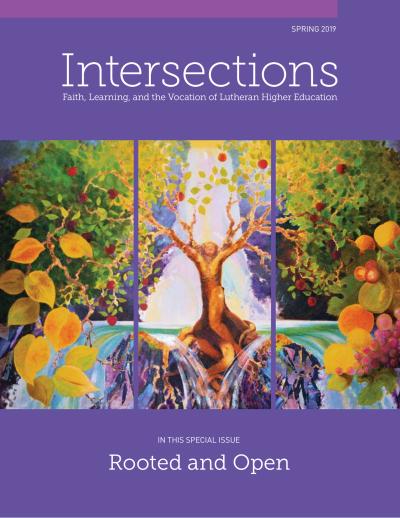 Institutional Focus
About Rooted and Open: The Common Calling of the Network of ELCA Colleges and Universities
An institutional framing piece introducing Rooted and Open — NECU’s statement on Lutheran identity in higher education — with a roster of the faculty working group and writing team and an orientation to the essays in this special issue.
-
Institutional Focus
About the Cover and Artist
Kristen Gilje, a Bellingham, Washington artist who spent nine years as Artist in Residence at Holden Village, recounts the “Tree of Life” she painted for the Holden Village 1999 summer theme and the unexpected interpretation Lapidary Fred offered of Yggdrasol, Prometheus, the Druid Tree Spirit, and the crucifix all at once.
-
Article
Rooted and Open: Background, Purpose, and Challenges
Mark Wilhelm
Wilhelm traces Rooted and Open’s seventy-year backstory — from Conrad Bergendoff’s 1948 call for a Lutheran philosophy of education through the recovery of the vocation tradition — and describes the document’s process, purpose as a teaching and study resource, and the embodiment, contextual, and cultural challenges it implies for NECU institutions.
-
Article
Roots and Shoots: Tending to Lutheran Higher Education
Jason A. Mahn
Mahn revisits why “education-for-vocation” has become a leitmotif for the 27 NECU schools, distinguishes institutional vocation from individuals’ religious identities and educational priorities from their theological grounding, and offers a friendly critique of Jodock’s bridge metaphor: Lutheran colleges grow in two directions like plants — deep roots and wide branches alike require constant tending.
-
Article
Marked by Lutheran Higher Education
Martha E. Stortz
Stortz offers an “operating manual” to Rooted and Open by tracing how the writing team moved from descriptive marks of the institutions to aspirational verbs that mark people — “called and empowered, to serve the neighbor, so that all may flourish” — and shows how each mark generates educational priorities theologically grounded in the radical mystery of God, the wild generosity of God, and the God who became one of us.
-
Article
Deep Roots, Big Questions, Bold Goals
Colleen Windham-Hughes
Adapted from a presentation to the California Lutheran University Board of Regents, Windham-Hughes reads the title Rooted and Open as both reaching back into the Lutheran tradition and opening forward into a shared future, then unpacks the document’s “called and empowered — to serve the neighbor — so that all may flourish” through the lenses of freedom of inquiry as a third path, vocation-centered education, radical hospitality, and civil discourse oriented toward the common good.
-
Article
Rooted and Open as Resource for Expanding Opportunities on Your Own Campus
Katherine A. Tunheim, Marcia Bunge
Bunge and Tunheim describe how Gustavus Adolphus College has paired Rooted and Open with its own companion volume Rooted in Heritage, Open to the World — in board workshops, new-faculty orientation, and classroom assignments — and survey several Network-wide opportunities (the Vocation of a Lutheran College Conference, the LECNA Fellows Program, the Association of Lutheran College Faculties, the Tuition Exchange Program, and international partnerships) that give the common calling tangible institutional form.
-
Article
"Faithful Nones" and the Importance of a Rooted and Open Pedagogy
John Eggen
Drawing on a student survey from his D.Min. thesis at Midland University, Eggen identifies a distinctive subset of religious “nones” — the “faithful nones” — who reject institutional religion yet retain substantive beliefs and practices, and argues that the non-binary, third-path pedagogy commended by Rooted and Open is uniquely positioned to engage a generation that has disambiguated faith, religion, and spirituality.
-
Article
Finding Flourishing: Teaching Self-Care as Course Content
Emily Kahm
Kahm argues that teaching self-care, self-awareness, and stress-coping as explicit classroom content embodies the “radical hospitality” of Rooted and Open and supports vocational formation against a consumerist culture, then offers concrete classroom techniques — a one-to-five energy check-in, ninety-second silence exercises, and full-day spiritual practices — that can be adapted across disciplines at NECU institutions.
-
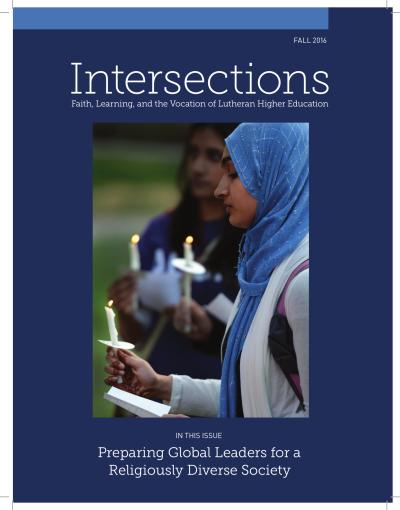 Article
Religious Diversity and the Vocation of a Lutheran College
Darrell Jodock
No. 44 · Fall 2016
Jodock argues that a college which takes its Lutheran values seriously is well positioned to foster inter-religious relations along a “third path” that is both religiously rooted and inclusive. He traces the relational and communal character of Lutheran theology, develops a Lutheran understanding of deeper freedom, the theology of limits, and human complexity, and shows how a down-to-earth image of God offers theological resources for overcoming the anxiety and fear that block interfaith engagement.
-
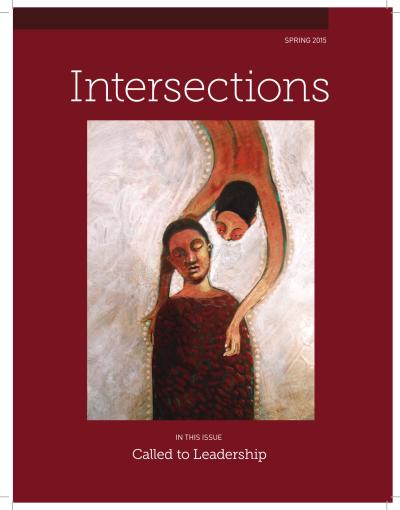 Article
Vocational Leadership
Darrell Jodock
No. 41 · Spring 2015
Jodock proposes “vocational leadership” as a name for a distinctive educational value at the heart of a Lutheran college — one that seeks to benefit the neighbor and the community, inspires and invites others to participate in that service, and is institutionally anchored in the Lutheran concept of vocation. He unpacks twelve facets of vocational leadership and ties them to Luther’s own leadership around indulgences, public schooling, and beggary.
-
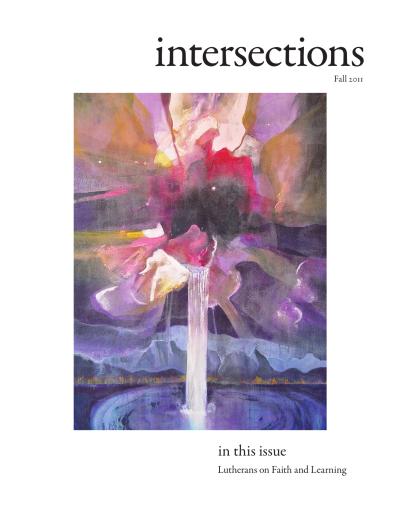 Article
Gift and Calling: A Lutheran Perspective on Higher Education
Darrell Jodock
No. 34 · Fall 2011
Jodock argues that a Lutheran perspective on higher education rests on three underlying ideas—that we are gifted (a giftedness that calls forth wonder, awe, gratitude, a sense of humor, and vocation as response to neighbor); that the Lutheran tradition affirms a particular kind of God who is down-to-earth and at work in the world for justice and human wholeness; and that a Lutheran “third path” can be both rooted in the tradition and inclusive of others. He draws out ten implications for higher education, from wonder as the heart of religion through liberal learning oriented toward the freedom of its members.
-
Reflection
Fumbling Toward Integrity: A Sermon on Mark 8:34-38, Pastor Kaj Munk, and Father Maximilian Kolbe
Darrell Jodock
No. 34 · Fall 2011
Preached at the 2007 ELCA Convocation of Teaching Theologians at Lenoir-Rhyne College, Jodock holds up two World War II martyrs—Polish Franciscan Father Maximilian Kolbe, who took the place of a condemned father in Auschwitz’s starvation bunker, and Danish pastor-playwright Kaj Munk, who was shot by the Nazis after helping save 97 percent of Denmark’s Jews—as mirrors for our own priorities. Drawing on the rescuer characteristics identified by Samuel and Pearl Oliner (agency, moral independence, universalistic caring, a history of care-giving) and on Jesus’s words in Mark 8:34-38, Jodock asks how we who routinely opt out at the first sign of opposition might fumble toward integrity in our own time.
-
 Article
Vocation of the Lutheran College and Religious Diversity
Darrell Jodock
No. 33 · Spring 2011
Jodock describes a “third path” for Lutheran colleges that is both rooted in the Lutheran tradition and inclusive of religious diversity — an alternative to sectarian and non-sectarian default models — and identifies six interlocking features of the Lutheran tradition (giftedness, an engaged God, wisdom, caution about claims to know, community, and an emphasis on service and community leadership) that shape how such a college engages interreligious dialogue and civil discourse.
-
 Article
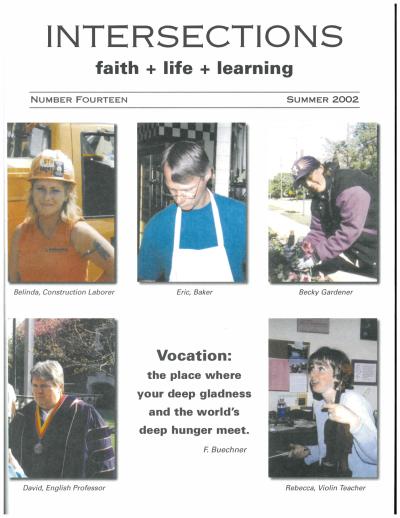
Vocational Discernment: A Comprehensive College Program
Darrell Jodock
No. 14 · Summer 2002
Jodock, whose Gustavus Adolphus was one of twenty colleges to receive a Lilly “Theological Exploration of Vocation” grant in 2000, defines vocation not as occupation but as a self-understanding that nests the self in community. Reading Robert Putnam’s Bowling Alone on the collapse of secondary communities alongside Luther’s ethic of community benefit and five Lutheran principles (graciousness, Christian freedom, community, God active in the world, the theology of the cross), he walks through Gustavus’s three-level design—a definition of vocation open to other faith traditions, “middle principles” drawn from Sharon Parks’s Common Fire, and a long menu of programs coordinated by a new Center for Vocational Reflection—hoping that, in the language of Holocaust studies, graduates will be “resisters” and “rescuers” rather than bystanders.
-
 Article
The Vocation of Intersections on its Twentieth Birthday
Jason A. Mahn, Robert D. Haak, Tom Christenson
No. 43 · Spring 2016
The three editors of Intersections — Bob Haak, Jason Mahn, and Tom Christenson (in spirit, following his death in 2013) — trace the twenty-year vocation of the journal itself: its 1996 birth at Capital University; its coming-of-age years of debate over institutional markers, two-kingdoms theology, and Lutheran identity; the ascendancy of “education for vocation” as the central marker of Lutheran higher education; and its ongoing identity in relation to a changing ELCA and to the broader cultural conversation about purpose, wholeness, and the vocation of higher education.
-
 Editorial
From the Publisher
Arne Selbyg
No. 7 · Summer 1999
Selbyg celebrates the popularity of the previous issue—the first to draw on papers from the annual “Vocation of a Lutheran College” conference—and announces a new Lutheran Brotherhood Foundation grant that will fund the inaugural Lutheran Academy of Scholars in Higher Education, a two-week seminar at Harvard led by Ronald Thiemann on “Finding Our Voice: Christian Faith and Critical Vision.”
-
 Article
Lutheran Higher Education and the Public Intellectual
Ernest L. Simmons
No. 26 · Fall 2007
Simmons argues that college faculty and administrators are, like it or not, public intellectuals, and that Lutheran higher education’s dialectical understanding of Christ and culture is well suited to support four functions of the public intellectual: articulating constructive critique of received social explanation (especially the “collage identity” described by Renate Schacht); presenting a transcendent theological perspective through the theology of the cross that takes seriously God’s hiddeness, the presence of ambiguity, and the reality of suffering; pursuing the common good amid the demise of the “commons” through H. Richard Niebuhr’s “Christ and Culture in Paradox”; and educating for citizenship through Christian vocation by connecting the practical and existential dimensions of the question “Why are you here?”
-
 Article
Building a Third Space in the Age of AI: A Conversation with Dr. Walter Earl Fluker
Elizabeth Kubek
No. 62 · Fall 2025
11 min audio
Prompted by AI chatbots being marketed to students as a safer alternative to messy human relationships, Kubek interviews Fluker on how Howard Thurman’s vision of common consciousness, somaesthetics, and nature-rooted learning offers educators a “third space” alternative to AI’s hall of mirrors.
-
 Article
Leading Students to Distinguish Between Career and Vocation: Reflections from a Lutheran Law School
Steven C. Bahls
No. 20 · Fall 2004
Bahls, writing as former dean of the Capital University Law School, argues that most law students and many legal educators confuse vocation with career—asking “what kind of lawyer do you want to be?” rather than “who do I want to be?” Drawing on John O. Mudd’s five attributes of a well-prepared lawyer and Susan Daicoff’s empirical research on lawyer dissatisfaction and the “amoral professional role,” he turns to Ernest L. Simmons’s and Darrel Jodock’s articulations of Luther’s understanding of vocation and proposes five steps—reflection, assessment, vision, integrative thinking, and reassessment—along with explicit leadership from law school deans, engagement of career services offices, and leadership within the profession (illustrated by Capital’s joint venture with the Columbus Bar Association).
-
 Editorial
From the Editor
Tom Christenson
No. 17 · Summer 2003
Christenson introduces the four essays by participants in the first Lutheran Academy of Scholars as fruit of the “genuine conversation” that emerges when specialists set aside their lecturers’ podiums to speak as human beings, and welcomes the issue’s additional “Intersections first”—a response to a response to a review—continuing the conversation between Baird Tipson and Robert Benne about the paradigm of Lutheran higher education.