Kristen Gilje (www.kristengilje.com)
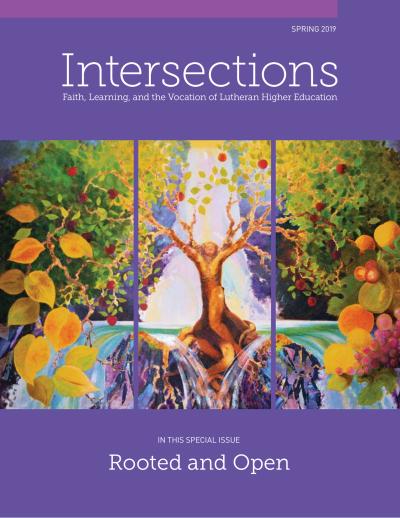
Tree of Life
Acrylic on Masonite panels, 8’ x 12’
Theme painting for Holden Village Summer Program 1999
Kristen Gilje is a full-time artist who works in her Bellingham, Washington studio on art commissions for sacred spaces. She makes large colorful works on silk for seasonal use, which can be seen in churches from coast to coast. Kristen spent nine years as Artist in Residence at Holden Village, a Lutheran retreat center near Chelan, Washington, where she learned the value of making art for and with a worshiping community. A 1978 graduate from St. Olaf College, her senior concentration was entitled “Art as Expression of the Holy.” Kristen has been combining ideas about art and theology in her work ever since. She says the following about Tree of Life:
I am fortunate to have worked as Artist in Residence for several years at Holden Village. Part of my work there was to create art to support each summer’s theme. Revelation 22:1-2 was the theme chosen for Summer 1999:
Then the angel showed me the river of the water of life, bright as crystal, flowing from the throne of God and of the Lamb through the middle of the street of the city. On either side of the river is the tree of life with its twelve kinds of fruit, producing its fruit each month; and the leaves of the tree are for the healing of the nations. (NRSV)
It is a vision of God’s reign of peace and justice, of abundance and beauty. My task was to illustrate this scripture to help us visually understand what this text might mean for us, and how it might guide our actions and thoughts as children of God.
The most beautiful interpretation of this painting I heard while working on it. My studio was set up on the stage in the gymnasium we used as our Village Center. The painting was about half done. Out of nowhere a voice rang out, “Oh Wow! That’s Yggdrasol!!!” It was someone I knew only as Lapidary Fred.
“What?” said I.
“That’s Yggdrasol,” he said again.
“Who’s that?” I queried.
“Yggdrasol is the Norse Tree of Life, the oldest and first tree,” he said. “It’s also Prometheus, who was tied to a tree so the ravens could pluck out his eyes! And it is the Druid Tree Spirit. And of course it is a crucifix.”
With a crazed look in his eyes Fred noted the faint halo over the head of the figure, and continued, “And don’t you ever think that a halo is simply a reflection of the glory of God upon the head. The saints used to gather up energy from the ground, given to the earth by God to make abundance for the good of all.” He pointed to the waterfall, the “river of the water of life,” then the roots of the tree-figure. Then he spread his arms, imitating the figure, pointed to the fruits and the leaves, and continued: “The saints glowed from this God-given life energy moving through them! The person has just said thank you to God for this wonderful system. God has just said, ‘You’re welcome,’ and they are sharing a moment of love.”
Fred helped me verbalized the great beauty I found in the biblical text. God’s creation is indeed a sacred and loving gift from God, where God is present “even in the tiniest leaf” as Martin Luther put it. How does this perspective of nature change our actions? How can this vision change our societies to be more equitable, providing abundance and flourishing for all? I’ll leave that to you to think about.
-
 Institutional Focus
About Rooted and Open: The Common Calling of the Network of ELCA Colleges and Universities
An institutional framing piece introducing Rooted and Open — NECU’s statement on Lutheran identity in higher education — with a roster of the faculty working group and writing team and an orientation to the essays in this special issue.
-
Article
Rooted and Open: Background, Purpose, and Challenges
Mark Wilhelm
Wilhelm traces Rooted and Open’s seventy-year backstory — from Conrad Bergendoff’s 1948 call for a Lutheran philosophy of education through the recovery of the vocation tradition — and describes the document’s process, purpose as a teaching and study resource, and the embodiment, contextual, and cultural challenges it implies for NECU institutions.
-
Article
In a Diverse Society, Why Should Lutheran Colleges/Universities Claim their Theological Roots?
Darrell Jodock
Jodock develops his “third path” account of the Lutheran college — neither sectarian nor non-sectarian but both rooted and open — analogizing the college to a bridge whose deck of daily activities rests on pillars of shared educational priorities, which in turn rest on theological footings; he then answers six common objections to claiming Lutheran roots and explains why those footings still matter.
-
Article
Roots and Shoots: Tending to Lutheran Higher Education
Jason A. Mahn
Mahn revisits why “education-for-vocation” has become a leitmotif for the 27 NECU schools, distinguishes institutional vocation from individuals’ religious identities and educational priorities from their theological grounding, and offers a friendly critique of Jodock’s bridge metaphor: Lutheran colleges grow in two directions like plants — deep roots and wide branches alike require constant tending.
-
Article
Marked by Lutheran Higher Education
Martha E. Stortz
Stortz offers an “operating manual” to Rooted and Open by tracing how the writing team moved from descriptive marks of the institutions to aspirational verbs that mark people — “called and empowered, to serve the neighbor, so that all may flourish” — and shows how each mark generates educational priorities theologically grounded in the radical mystery of God, the wild generosity of God, and the God who became one of us.
-
Article
Deep Roots, Big Questions, Bold Goals
Colleen Windham-Hughes
Adapted from a presentation to the California Lutheran University Board of Regents, Windham-Hughes reads the title Rooted and Open as both reaching back into the Lutheran tradition and opening forward into a shared future, then unpacks the document’s “called and empowered — to serve the neighbor — so that all may flourish” through the lenses of freedom of inquiry as a third path, vocation-centered education, radical hospitality, and civil discourse oriented toward the common good.
-
Article
Rooted and Open as Resource for Expanding Opportunities on Your Own Campus
Katherine A. Tunheim, Marcia Bunge
Bunge and Tunheim describe how Gustavus Adolphus College has paired Rooted and Open with its own companion volume Rooted in Heritage, Open to the World — in board workshops, new-faculty orientation, and classroom assignments — and survey several Network-wide opportunities (the Vocation of a Lutheran College Conference, the LECNA Fellows Program, the Association of Lutheran College Faculties, the Tuition Exchange Program, and international partnerships) that give the common calling tangible institutional form.
-
Article
"Faithful Nones" and the Importance of a Rooted and Open Pedagogy
John Eggen
Drawing on a student survey from his D.Min. thesis at Midland University, Eggen identifies a distinctive subset of religious “nones” — the “faithful nones” — who reject institutional religion yet retain substantive beliefs and practices, and argues that the non-binary, third-path pedagogy commended by Rooted and Open is uniquely positioned to engage a generation that has disambiguated faith, religion, and spirituality.
-
Article
Finding Flourishing: Teaching Self-Care as Course Content
Emily Kahm
Kahm argues that teaching self-care, self-awareness, and stress-coping as explicit classroom content embodies the “radical hospitality” of Rooted and Open and supports vocational formation against a consumerist culture, then offers concrete classroom techniques — a one-to-five energy check-in, ninety-second silence exercises, and full-day spiritual practices — that can be adapted across disciplines at NECU institutions.
-
 Editorial
From the Editor
Robert D. Haak
No. 24 · Fall 2006
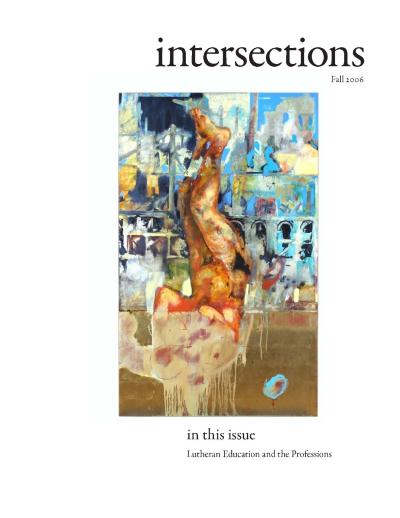
Haak introduces the issue’s essays by Stanley N. Olson, Kathryn L. Johnson, Gail Summer, Lake Lambert, and Steven C. Bahls; argues that on Lutheran campuses, professional programs in business, education, and nursing are not “second-class citizens” but integral to the institution’s vocation; cites Olson’s mantra (“Because of Christ, the world; because of the world, vocation; because of vocation, education”); and thanks Matt Marohl for assisting with the editing.
-
 Editorial
From the Publisher
Arne Selbyg
No. 22 · Spring 2006
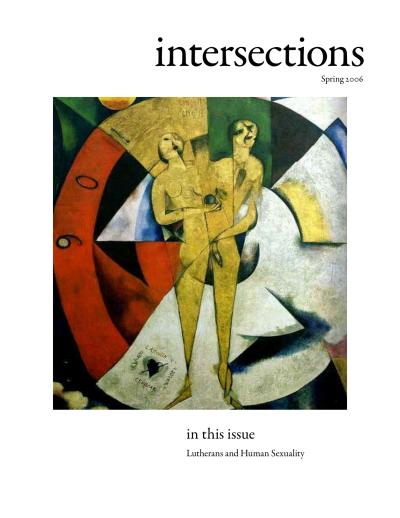
Selbyg notes that both the ELCA and Intersections have undergone major changes this year—the Division for Higher Education and Schools is gone, replaced by the Educational Partnerships and Institutions group within the Vocation and Education unit, and the journal has a new editor (Robert Haak), a new home at Augustana College, a new printer, and a new design. He commends the issue’s focus on human sexuality and points readers to the first draft of Our Calling in Education.
-
 Editorial
From the Editor
Jason A. Mahn
No. 38 · Fall 2013
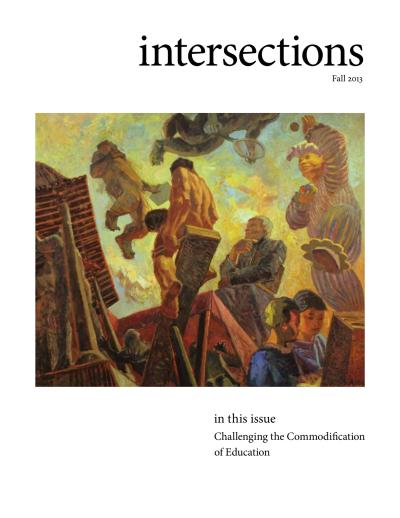
Mahn reads Michael Sandel’s What Money Can’t Buy alongside Larry Rasmussen and Martha Nussbaum to ask how Lutheran schools can articulate the “value added” of vocation without commodifying it, and previews the 2013 Vocation of a Lutheran College conference papers, Patricia Lull’s sermon, and Ann Hill Duin and Eric Childers’ Project DAVID essay that make up the issue.
-
 Institutional Focus
So That All May Flourish Study Guide
No. 57 · Spring 2023
A chapter-by-chapter study guide to So That All May Flourish (Fortress Press 2023), a new volume by NECU authors that develops the central tenet of “Rooted and Open” and offers discussion questions for use in orientation programs, classes, workshops, task forces, and professional development settings.
-
 Article
You Don't Seem Angry: Methodological Confessions Of A Lutheran Lay-Woman
L. DeAne Lagerquist
No. 5 · Summer 1998
Lagerquist, opening from a colleague’s 1981 observation about her M.A. thesis on four female abolitionists, traces her path from feminist historian and battered women’s shelter advocate through the University of Chicago’s obsession with method to a more self-conscious account of her own. The method grows out of four Lutheran themes—original sin (caution and humility), the eighth commandment against bearing false witness (generosity and forgiveness), the neighbor as “little Christ” (cooperative interpretation), and vocation (interpretation as calling, located alongside feeding the hungry and visiting the lonely)—and shapes her ongoing work on a history of Lutherans in the United States with a plot about learning to live with diversity.
-
 Response
A Call for Creative Education
Wendy McCredie
No. 3 · Summer 1997
McCredie of Texas Lutheran responds to Reichenbach by reframing the four ideas embedded in his claim that “the entire college community should be knowledgeably committed to the college’s mission”—community, knowledge, commitment, mission—and argues that the Lutheran tradition’s unwillingness to be separate from the world should lead us to educate the public about the Lutheran tradition rather than interrogate prospective employees about their faith. She questions whether agreement on “Christian values” is possible (or even Lutheran), and reads Reichenbach’s “creative education” as the dialectical tension between gospel and law, God’s love and our human limits, that members of communities related to the Lutheran church are uniquely positioned to inhabit.