The Network of ELCA Colleges and Universities (NECU) issued Rooted and Open in January 2018 to express—in the words of its subtitle—NECU’s “common calling.” This essay briefly records Rooted and Open’s provenance. It also sketches even more briefly the document’s intended purpose and the challenges implied by the document.
Backstory
The project that became Rooted and Open has its origins in discussions among leaders of Lutheran higher education that began in the mid-twentieth century. These occasional discussions focused on the identity and mission of Lutheran colleges and universities. They were part of a larger conversation that sought to understand the role of Christian higher education in the wake of the scientific method’s replacement of Christian doctrine as the unifying principle of higher education in North Atlantic culture. The transition from Christian doctrine to the scientific method had been underway in higher education in the United States since the mid-nineteenth century. But by mid-twentieth century, the change was largely complete, and Lutheran higher education leaders began to grapple with the implications of the change for the identity and mission of their institutions.1
Other social, economic, and cultural changes in the American Lutheran community and American society conspired with the shift in higher education’s unifying principle to complicate the new, changed reality facing leaders of Lutheran colleges and universities.2 But the primary issue facing Lutheran leaders was an academic one, namely, the replacement of Christian doctrine with the scientific method as the academic core of higher education. Given the shift, what was the role of religion at a college or university? How was the mission of higher education still a part of the mission of the Lutheran church?
“How was the mission of higher education still a part of the mission of the Lutheran church?”
Conrad Bergendoff, president in mid-twentieth century at Augustana College in Rock Island, Illinois, seems to have been the first to challenge the Lutheran higher education community to address this fundamental question. Speaking at a meeting of a group known as the Association of Lutheran College Faculties in 1948, Bergendoff “issued a call for a Lutheran philosophy of education.” Bergendoff issued his call and asked, “In what ways are we unique?” (Narum 135).3 This challenge initiated a fifty-year search for a convincing response.
Lutheran church leaders framed the search to develop a Lutheran philosophy of education as a search for the proper integration of religion and learning or—to use the more common phrase—faith and reason. The argument was that, even though discovery of knowledge through the scientific method may be the central purpose of learning, the scientific method cannot discover the meaning of knowledge or the wise practices for the application of knowledge. Such understanding and wisdom are to be found by applying values drawn from Lutheran theology to higher education. They argued that a college or university in the Lutheran intellectual tradition will explore and apply such values in its curriculum and co-curriculum.
Continuing informal and occasional discussion among Lutheran higher education leaders slowly began a deeper dive into Lutheran theology to demonstrate how it serves as a source of values for educating students. By the 1970s, the annual meetings of the Lutheran Educational Conference of North America began regularly hearing from leading Lutheran theologians on this theme. The theological sources for values such as freedom of inquiry, creativity, questioning of received practices, giftedness of existence, and living out one’s vocational began to be identified. The work of mining the Lutheran theological tradition came to be widely accepted as the principle path toward defining the mission of Lutheran higher education and articulating a Lutheran philosophy of education, although by the late twentieth century the phrase used by Bergendoff to label the project had been forgotten.
By 1989, Martin Marty, the preeminent Lutheran church historian, reflected the now commonplace agenda for Lutheran higher education. At a symposium on the mission of the new Evangelical Lutheran Church in America’s colleges and universities, Marty could say that the founding of the ELCA provided an occasion for the “conscious recovery” of the theological tradition that birthed Lutheran higher education and that this conscious recovery was “essential” (Marty 14).
Through the 1990s and 2000s, the progress toward a more complete recovery of the tradition moved ahead through the work of faculty such as Tom Christensen (Capital University), DeAne Lagerquist (St. Olaf College), Ernie Simmons (Concordia College) and Darrell Jodock (Muhlenberg College and Gustavus Adolphus College). In this period, a three-pronged infrastructure consisting of an annual conference (The Vocation of a Lutheran College), a journal (Intersections), and a higher education leadership development program (Thrivent Fellows) was established. Each supported the articulation of the recovered values of Lutheran higher education as derived from Lutheran theology, and each expressed a renewed focus on the implications of the Lutheran concept of vocation as a vital lens for expressing the mission of Lutheran higher education.
“Rooted and Open is NECU’s statement of a Lutheran philosophy of education, answering Bergendoff’s challenge seventy years after it was posed.”
Rooted and Open expresses the vocation or common calling of the Network of ELCA Colleges and Universities by drawing upon the outcomes of the explorations described above into Lutheran theology and its implications for Lutheran higher education. It is NECU’s statement of a Lutheran philosophy of education, answering Bergendoff’s challenge seventy years after it was posed.
Process and Purpose
As the new Network of ELCA Colleges and Universities was being organized, the presidents of NECU institutions asked for assistance in articulating Lutheran identity in higher education. In response to their request, an effort was initiated that resulted in the publishing of Rooted and Open.
A faculty working group was convened in late 2016 to prepare a draft statement for the presidents’ consideration. The draft was presented to a conference of NECU presidents and others in Chicago at the Lutheran Center on June 16, 2017. A writing team drawn from the faculty working group revised the document in fall 2017 based on comments and advice received during the June conference. Members of the writing team were Darrell Jodock (Gustavus Adolphus College, emeritus), Jason Mahn (Augustana College), Martha Stortz (Augsburg University), and Mark Wilhelm, (NECU).
The Executive Committee received the writing team’s revision at the Committee’s meeting on November 17, 2017. At that meeting, it was agreed to further revise the document. Those revisions were made by Darrel Colson (President, Wartburg College), and final editing was done by Mark Wilhelm in light of comments by other members of the Executive Committee to Colson’s revision. The text was slightly edited again during NECU’s annual meeting on January 4, 2018, prior the Board of Directors’ unanimous vote to endorse the document at the same meeting.
The members of the Board of Directors of NECU are the presidents of NECU institutions. The Board of Directors received Rooted and Open at its annual meeting on January 4, 2018, with the following resolution:
Be it resolved that the Board of Directors endorses Rooted and Open as an expression of the common calling and shared values of the Network of ELCA Colleges and Universities; and be it further resolved, that Rooted and Open is commended to the colleges and universities of the Network for their use.
And so, in addition to assisting presidents with the task of articulating a vision for Lutheran higher education, Rooted and Open is intended as a teaching and study document for NECU colleges and universities.
“It is hoped that those who live and work at Lutheran institutions will come to appreciate the sources in Lutheran theology for these widely-held educational values and the distinctive emphases that the Lutheran tradition gives to these values.”
It is important to note that Rooted and Open is not a juridical document. Member institutions are not required to adopt it as a policy statement. It is also not a statement that employees of NECU institutions must sign. Faculty and administrators in Lutheran need not affirm the theology behind the values for higher education as described in Rooted and Open. Faculty, administrators, and governance board members should, however, be able to articulate the values that guide Lutheran higher education. Faculty, administrators, and board members should also come to understand the theological sources of these values for Lutheran higher education as described in Rooted and Open. Other educational traditions, which educate for understanding and not just for the transmission of knowledge, share similar values, but it is hoped that those who live and work at Lutheran institutions will come to appreciate the sources in Lutheran theology for these widely-held educational values and the distinctive emphases that the Lutheran tradition gives to these values.
NECU hopes that Rooted and Open will become a valued resource for continuing study of and conversation about what it means to part of Lutheran higher education. Such study and conversation could help reverse an unfortunate, longstanding reality in our community of colleges and universities. This reality has been best expressed by Richard Solberg, the historian of Lutheran higher education, when he commented twenty years ago that Lutheran higher education had failed in America to live out the educational ideals “implicit in its own theology” (Solberg 80).
By engaging in conversations about Rooted and Open, faculty, administrators, and governance board members can reverse the reality named by Solberg as they begin to:
- Understand the Lutheran intellectual tradition’s commitment to educate the whole person and the roots of this type of education in Lutheran theology.
- Explore Rooted and Open’s assertion that the identity of a Lutheran college or university is an institutional calling, independent of the religious identity of individuals who study or work there.
- Appreciate that students at a Lutheran college or university are “called and empowered, to serve the neighbor, so that all may flourish.”
Challenges
Although Rooted and Open summarizes well the implications of core theological concepts for the values that should inform Lutheran higher education, it also implies certain challenges facing NECU institutions.
First, there is the challenge of embodying an institutional vocation. It is certainly true that the calling of a Lutheran college or university is an institutional calling, independent of the personal religious affiliation of those at the college or university. But ideas and commitments must be embodied. If few or no persons at a Lutheran institution are comfortable with or interested in the core ideas and practices that should drive the institution’s identity and mission, clearly the institutional calling will become nominal, at best. A regular program of in-house faculty and staff development about the institution’s calling must be maintained if the identity and mission are to remain alive. ELCA colleges and universities are, however, currently not robustly equipped for universal involvement of faculty and staff in such development programs.
“It is certainly true that the calling of a Lutheran college or university is an institutional calling, independent of the personal religious affiliation of those at the college or university. But ideas and commitments must be embodied.”
Second, the larger context of Lutheran higher education complicates its mission. Rooted and Open ignores that American society, the American academy, and the Lutheran church itself have frequently shared the assumption that a religious identity for a college or university will tie the institution to parochial religious interests. Tactics are not in place for effectively overcoming the social, academic, and ecclesiastical cultural biases about religion and higher education that all faculty and administrators bring to campus.
Perhaps the presence and use of Rooted and Open will provide enough impetus to steer us past these challenges. It is certainly a good start!
Endnotes
1. On the shift to the scientific method, see Roberts and Turner, The Sacred and the Secular University. The Bible college movement arose in this era as a response to and repudiation of the rise of the scientific method. On this movement, see Brereton, Training God’s Army.
2. Principle among these other changes were the abandonment of ethnic separatist culture in American Lutheranism and the ending of the culturally-expected separation of students in American higher education (and the legal segregation of many African American students) into colleges and universities divided by class, race, gender, ethnicity and other socio-cultural factors. See Wilhelm, “The Vocation Movement.”
3. One should note that Bergendoff undoubtedly used the word “unique” in the colloquial sense of “distinctive.”
Works Cited
Brereton, Virginia Lieson. Training God’s Army: The American Bible School, 1880-1940. Bloomington: Indiana UP, 2000.
Marty, Martin E. “The Mission of the ELCA Colleges and Universities: An Historical Perspective,” in The Mission of the Evangelical Lutheran Church in America Colleges and Universities. Division for Education, ELCA: Proceedings of The Joseph A. Sittler Symposium, August 12-14, 1989.
Network of ELCA Colleges and Universities. “Rooted and Open: The Common Calling of the Network of ELCA Colleges and Universities.” Accessed 15 April 2019, http://download.elca.org/ELCA%20Resource%20Repository/Rooted_and_Open.pdf?_ga=2.254180808.1158413343.1555894056-509733955.1555894056
Narum, William H. K. “Appendix A: Retrospect on the Discussion of a Philosophy of Christian Higher Education Since 1948,” in The Church-Related College in an Age of Pluralism: The Quest for a Viable Saga, edited by Richard Baepler, et al. Association of Lutheran College Faculties, October 1977.
Roberts, Jon H. and James Turner. The Sacred and the Secular University. Princeton UP, 2000.
Solberg, Richard W. “What Can the Lutheran Tradition Contribute to Christian Higher Education,” in Models for Christian Higher Education: Strategies for Survival and Success in the Twenty-First Century, edited by Richard T. Hughes and William B. Adrian, Eerdmans, 1997.
Wilhelm, Mark. “The Vocation Movement in Lutheran Higher Education,” in The Vocation of Lutheran Higher Education, edited by Jason A. Mahn, Lutheran University Press, 2016.
-
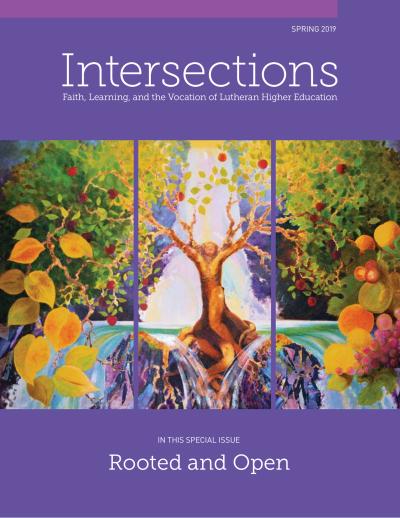 Institutional Focus
About Rooted and Open: The Common Calling of the Network of ELCA Colleges and Universities
An institutional framing piece introducing Rooted and Open — NECU’s statement on Lutheran identity in higher education — with a roster of the faculty working group and writing team and an orientation to the essays in this special issue.
-
Institutional Focus
About the Cover and Artist
Kristen Gilje, a Bellingham, Washington artist who spent nine years as Artist in Residence at Holden Village, recounts the “Tree of Life” she painted for the Holden Village 1999 summer theme and the unexpected interpretation Lapidary Fred offered of Yggdrasol, Prometheus, the Druid Tree Spirit, and the crucifix all at once.
-
Article
In a Diverse Society, Why Should Lutheran Colleges/Universities Claim their Theological Roots?
Darrell Jodock
Jodock develops his “third path” account of the Lutheran college — neither sectarian nor non-sectarian but both rooted and open — analogizing the college to a bridge whose deck of daily activities rests on pillars of shared educational priorities, which in turn rest on theological footings; he then answers six common objections to claiming Lutheran roots and explains why those footings still matter.
-
Article
Roots and Shoots: Tending to Lutheran Higher Education
Jason A. Mahn
Mahn revisits why “education-for-vocation” has become a leitmotif for the 27 NECU schools, distinguishes institutional vocation from individuals’ religious identities and educational priorities from their theological grounding, and offers a friendly critique of Jodock’s bridge metaphor: Lutheran colleges grow in two directions like plants — deep roots and wide branches alike require constant tending.
-
Article
Marked by Lutheran Higher Education
Martha E. Stortz
Stortz offers an “operating manual” to Rooted and Open by tracing how the writing team moved from descriptive marks of the institutions to aspirational verbs that mark people — “called and empowered, to serve the neighbor, so that all may flourish” — and shows how each mark generates educational priorities theologically grounded in the radical mystery of God, the wild generosity of God, and the God who became one of us.
-
Article
Deep Roots, Big Questions, Bold Goals
Colleen Windham-Hughes
Adapted from a presentation to the California Lutheran University Board of Regents, Windham-Hughes reads the title Rooted and Open as both reaching back into the Lutheran tradition and opening forward into a shared future, then unpacks the document’s “called and empowered — to serve the neighbor — so that all may flourish” through the lenses of freedom of inquiry as a third path, vocation-centered education, radical hospitality, and civil discourse oriented toward the common good.
-
Article
Rooted and Open as Resource for Expanding Opportunities on Your Own Campus
Katherine A. Tunheim, Marcia Bunge
Bunge and Tunheim describe how Gustavus Adolphus College has paired Rooted and Open with its own companion volume Rooted in Heritage, Open to the World — in board workshops, new-faculty orientation, and classroom assignments — and survey several Network-wide opportunities (the Vocation of a Lutheran College Conference, the LECNA Fellows Program, the Association of Lutheran College Faculties, the Tuition Exchange Program, and international partnerships) that give the common calling tangible institutional form.
-
Article
"Faithful Nones" and the Importance of a Rooted and Open Pedagogy
John Eggen
Drawing on a student survey from his D.Min. thesis at Midland University, Eggen identifies a distinctive subset of religious “nones” — the “faithful nones” — who reject institutional religion yet retain substantive beliefs and practices, and argues that the non-binary, third-path pedagogy commended by Rooted and Open is uniquely positioned to engage a generation that has disambiguated faith, religion, and spirituality.
-
Article
Finding Flourishing: Teaching Self-Care as Course Content
Emily Kahm
Kahm argues that teaching self-care, self-awareness, and stress-coping as explicit classroom content embodies the “radical hospitality” of Rooted and Open and supports vocational formation against a consumerist culture, then offers concrete classroom techniques — a one-to-five energy check-in, ninety-second silence exercises, and full-day spiritual practices — that can be adapted across disciplines at NECU institutions.
-
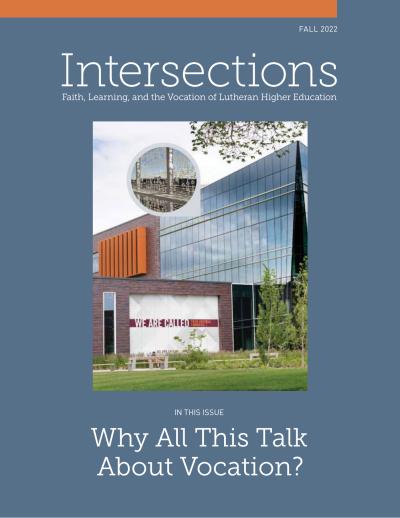 Article
Why All This Talk About Understanding the Mission of NECU Member Institutions as a Vocation?
Mark Wilhelm
No. 56 · Fall 2022
In his valedictory keynote, retiring NECU Executive Director Mark Wilhelm argues that Lutheran higher education is, properly understood, vocation-based education — outlining four core practices recovered over the past fifty years and naming the constructive and corrective work still to be done, including a fuller embrace of DEIJ and of the diverse vocations of NECU’s 27 institutions.
-
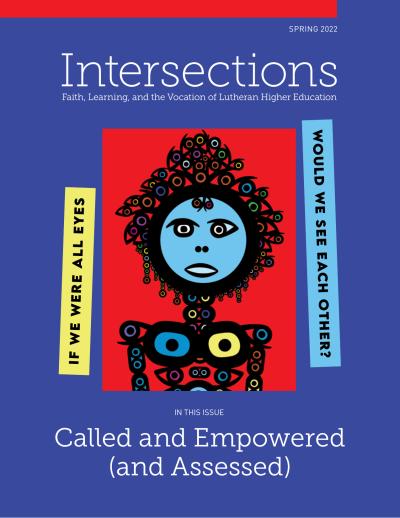 Editorial
From the Publisher
Mark Wilhelm
No. 55 · Spring 2022
Wilhelm announces his planned retirement on January 31, 2023, after serving as the founding executive director of the Network of ELCA Colleges and Universities, and gives thanks for the privilege of helping NECU articulate a shared vision for Lutheran higher education in twenty-first-century North America.
-
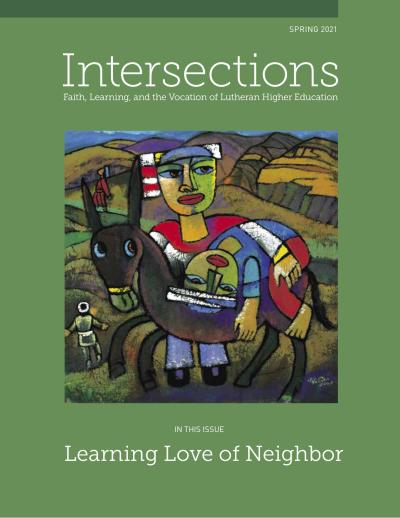 Editorial
From the Publisher
Mark Wilhelm
No. 53 · Spring 2021
Wilhelm reflects on an NPR report of teenagers’ pandemic diaries and the fraught Christian history of struggling to live out Jesus’s ethic of love, framing the issue as a record of NECU institutions working out how to act for the common good through the pandemic of 2020–2021.
-
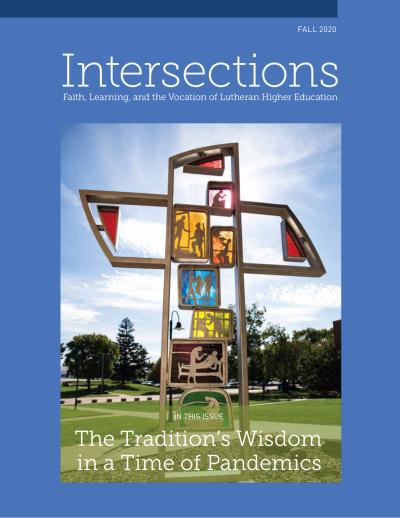 Editorial
From the Publisher
Mark Wilhelm
No. 52 · Fall 2020
Wilhelm argues that the “hackneyed” expressions of higher education — “you are not just a number,” “the college experience,” “risen to the challenge” — tell the simple truth about NECU institutions even as the Covid-19 pandemic has pushed budgets, employees, and campus life to the breaking point.
-
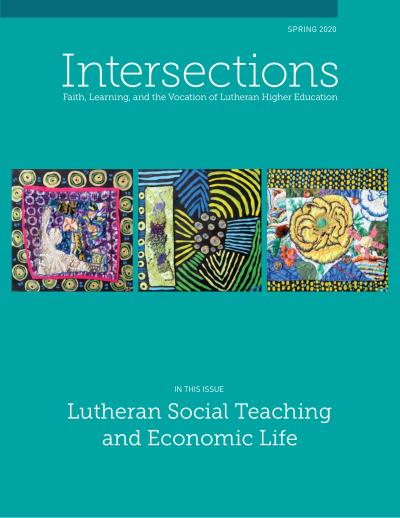 Editorial
From the Publisher
Mark Wilhelm
No. 51 · Spring 2020
Wilhelm frames the issue by tracing how Lutheran educational ideals — once a primary source of contemporary higher education — were masked in the United States, and introduces a NECU initiative that uses the case of business ethics to explore Lutheran social teaching as an academic resource.
-
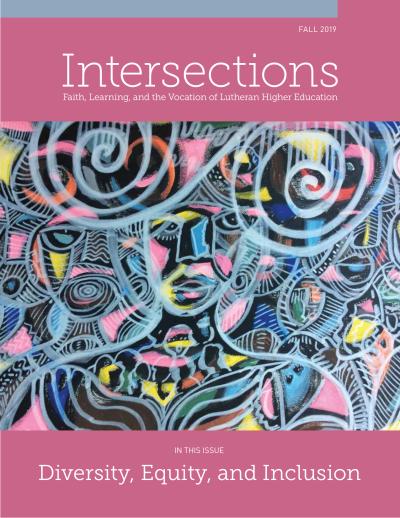 Editorial
From the Publisher
Mark Wilhelm
No. 50 · Fall 2019
Wilhelm frames the issue by noting that a federal court’s vindication of Harvard’s race-conscious admissions process is a win for higher education’s commitments to diversity, equity, and inclusion — and argues that for Lutheran higher education, the commitment to diversity is an old and foundational claim, rooted in Christianity’s openness to all and reflected in the four diverse gospels of the New Testament.
-
Article
Activism, Justice, and the Danger of Silence
Dezi Gillon
No. 52 · Fall 2020
In conversation with Jason Mahn, Augustana College alumnux Dezi Gillon traces the call to action they felt as a Black student organizing for Black Lives Matter on a predominately white campus — through seminary, art, spirituality, and restorative justice work — and warns white professors that staying silent “actually speaks volumes.”
-
Article
Finding Purpose in Chaos: Reflection In and Beyond the Public Health Classroom
Lena R. Hann
No. 52 · Fall 2020
When the pandemic hit her new public health professionalism course, Hann recalibrated her teaching from the “how” of professional preparation to the “why” of vocational reflection — and recounts how Augustana public health students and alumni found purpose in the chaos through food banks, disaster response, palliative care, and research on health inequities.
-
 Article
From Pietism to Paradox: The Development of a Lutheran Philosophy of Education
Philip Nordquist
No. 8 · Winter 2000
Nordquist traces a four-decade personal and institutional journey from the “Protestant triumphalism” and aggressive moralism of S. C. Eastvold’s 1950s Pacific Lutheran through the 1960 Ditmanson–Hong–Quanbeck volume The Christian Faith and the Liberal Arts, Gordon Lathrop’s 1972 PLU donor address grounding the university in two-kingdoms theology, the ALC’s 1975 Concordia workshop with Bill Narum, Bob Bertram, Harris Kaasa, and Sydney Ahlstrom’s case for the “critical” tradition over the scholastic and pietistic, the 1976 LCA statement distinguishing “Christian” from “church-related” education, and Richard Hughes’s 1997 Carthage address. He concludes that dialectical (two kingdoms) theology, Christian humanism alongside professional studies (the New American College model), Luther’s commitment to universal compulsory education, environmental and civic responsibility, and academic freedom together constitute the bequest of the Reformation—“Christ and culture in paradox” remains the best approach to education he knows.
-
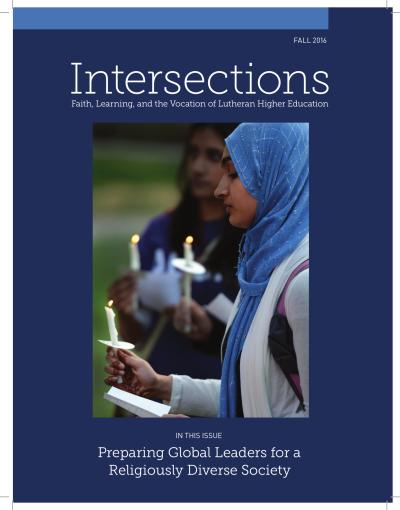 Article
Negotiating Legitimate and Conflicting Values
Eboo Patel, Katie Bringman Baxter, Mark S. Hanson
No. 44 · Fall 2016
In a closing-day conversation at the 2016 Vocation of a Lutheran College Conference, Mark Hanson and Eboo Patel — moderated by Katie Bringman Baxter of Interfaith Youth Core — share case studies in which legitimate religious values come into tension with one another, and make the case that Lutheran colleges should teach interfaith leadership through the hard cases rather than the easy ones.
-
 Editorial
From the Editor
Robert D. Haak
No. 24 · Fall 2006
Haak introduces the issue’s essays by Stanley N. Olson, Kathryn L. Johnson, Gail Summer, Lake Lambert, and Steven C. Bahls; argues that on Lutheran campuses, professional programs in business, education, and nursing are not “second-class citizens” but integral to the institution’s vocation; cites Olson’s mantra (“Because of Christ, the world; because of the world, vocation; because of vocation, education”); and thanks Matt Marohl for assisting with the editing.
-
 Article
“A Decolonizing Conversation”: Indigenous Engagement at Luther College at the University of Regina
Marc Jerry, Sarah Dymund
No. 58 · Fall 2023
Jerry and Dymund describe Luther College at the University of Regina’s response to Canada’s Truth and Reconciliation Commission — Land Acknowledgments, a Starblanket ceremony, the Project of Heart, an Elder in Residence, and the unedited video conversation with Elder Lorna Standingready that anchored their 2023 VLHE keynote.