Rooted and Open as Resource for Expanding Opportunities on Your Own Campus
Intersections No. 49 · Spring 2019
Approximately 1000 colleges and universities in the United States are religiously-affiliated, and 26 of them are affiliated with the Evangelical Lutheran Church in America (ELCA). The ELCA’s Network of Colleges and Universities (NECU)—which also includes Luther College at the University of Regina, Saskatchewan, Canada—spans the coasts, from California Lutheran and Pacific Lutheran in the West to Gettysburg and Muhlenberg in the East and 22 in-between. NECU schools are also connected with many other institutions of Lutheran higher education worldwide. Although in the past Lutheranism was primarily centered in Germany and northern Europe, today Lutherans are found across the globe. The fastest growing Lutheran church in the world today is in Ethiopia, and the majority of citizens in Namibia, as in the Nordic countries, self-identify as Lutherans. The list of the ten largest Lutheran church bodies in the world includes not only Germany, Finland, and the Scandinavian countries but also Tanzania, Ethiopia, Madagascar, and Indonesia.
Although all 27 colleges and universities are part of NECU and the vast network of Lutheran higher education worldwide, each one has its own distinctive and distinguished characteristics shaped by its particular history and leaders. Each began humbly by German or Scandinavian immigrants who highly valued Lutheran commitments to universal education, the liberal arts, and contributing to the common good. Finlandia was established by Finns; Grandview by Danes; Augustana (Rock Island), Gustavus Adolphus College, and Bethany by Swedes; and the rest by Germans and Norwegians. The ethnic beginnings of these institutions, their original geographic locations, and a vast array of characters and events all played a role in shaping their particular missions and signature strengths.
All of the NECU schools have long welcomed individuals from diverse secular and religious backgrounds and worldviews, and students, faculty, and staff often raise important questions about both the particular characteristics and shared Lutheran affiliation of their institution. They wonder, for example: What does the Lutheran affiliation mean? What does it mean for our institution or our students? Do I have the freedom to study or teach what I like? What is the ELCA? How does the college’s affiliation with the ELCA influence this institution’s current programs and future plans? What precisely is NECU? Why should I care?
Each institution has resources to help answer questions related to its particular mission, and NECU has now provided a document about the Network’s shared commitments, Rooted and Open: The Common Calling of the Network of ELCA Colleges and Universities. This document states that our common calling is to “equip graduates who are called and empowered to serve the neighbor so that all may flourish,” and it outlines shared educational commitments of the Network and its roots in the Lutheran intellectual tradition. The document helps readers understand why all NECU institutions are committed to the following: providing an excellent education rooted in the liberal arts; supporting academic freedom; attending to moral and spiritual life and the whole person; welcoming all students; and helping them discern and hone their unique gifts and talents so that they can serve others, seek justice, and contribute to the common good. Even as it highlights the “common calling” and shared commitments of the Network, the document honors the “particular callings” and distinctive histories, values, and gifts of each institution. Thus, the document provides a helpful framework for appreciating the value of Lutheran higher education as well as sparking discussion about the particular strengths of each institution.
“Even as it highlights the ‘common calling’ and shared commitments of the Network, the document honors the ‘particular callings’ and distinctive histories, values, and gifts of each institution.”
When coupled with resources from particular institutions, Rooted and Open provides an introduction to NECU and a valuable spring board for deeper conversations about an institution’s distinctive characteristics, Lutheran affiliation, and the benefits of NECU for faculty, staff, and students. One resource developed at our college prior to Rooted and Open that serves as a fitting complement to it is a book (aptly!) entitled, Rooted in Heritage, Open to the World: Reflections on the Distinctive Character of Gustavus Adolphus College. The volume aims to provide a multifaceted introduction to the particular mission, values, and heritage that help make Gustavus a distinctive place of learning. The book includes an introduction to the College’s Lutheran heritage and 33 short chapters written by members of the staff and professors from various disciplines. Contributors speak about their experiences at Gustavus and offer examples and stories of their own appreciation of the College’s distinctive characteristics and Lutheran heritage. These short chapters are divided into five main parts: Religious Diversity at a Lutheran College; Core Values Inside and Outside the Classroom; Distinctive Pursuits Rooted in Our Heritage; National and International Connections Facilitated by Our Lutheran Affiliation; and Poetry, People, and Sense of Place. The book also includes an appendix with selected primary texts by Martin Luther on education, vocation, and love of neighbor.
This book has been used by faculty, staff, students in a variety of settings to strengthen the understanding of and appreciation for the College and its Lutheran affiliation. For example, selections from the book have been discussed on various occasions for new members of the faculty and for faculty workshops. The book is also given to new members of the College’s advancement team, which helps them connect to Gustavus and alumni. A professor who teaches a seminar for first-year students on interreligious understanding and cooperation assigns the introduction and the book’s section on Religious Diversity at a Lutheran College. Chapters in this section are written by professors who self-identify as Buddhist, Jewish, Muslim, agnostic, Catholic, Lutheran, and Evangelical, and they all offer their perspectives on what they find rewarding and sometimes challenging about teaching at a college with a Lutheran heritage. Another professor uses the book in a course on “Lutheranism and Lutheran Diversity Worldwide.” The book helps students, who come from diverse secular and religious backgrounds, to appreciate the unique Lutheran heritage of the college and how this heritage shapes its core values. Donors and alumni have also appreciated reading the book because it includes many stories about people and events who helped make Gustavus an excellent liberal arts college and welcoming place of learning.
The Gustavus Adolphus College Board of Trustees recently met to discuss the introduction to this book and NECU’s Rooted and Open. President Rebecca Bergman asked the editor, Marcia Bunge, to lead a brief workshop on these resources with members of the Board and the President’s cabinet. Participants read these two resources prior to the workshop, prompting a rich discussion about shared gifts of Lutheran higher education and the distinctive strengths of Gustavus. Since the resources clearly describe the Lutheran concept of vocation and other important Lutheran theological ideas that undergird the mission of ELCA colleges and universities, the discussion helped participants also to share and enrich their language for future discussions about the College. Furthermore, taking time to appreciate the robust Lutheran concept of vocation helped participants better understand a “vocation–centered” education that equips students to address the needs of the world.
“Since the resources clearly describe the Lutheran concept of vocation and other important Lutheran theological ideas that undergird the mission of ELCA colleges and universities, the discussion helped participants also to share and enrich their language for future discussions about the College.”
Participants also shared elements of their own vocational journeys. Sharing brief stories with one another brought home the significance of Luther’s concept of vocation and deepened relationships. At the conclusion of the workshop, participants remarked how proud they felt about the institution’s 156-year history and its Swedish Lutheran heritage. They reported that by becoming more informed about the College’s Lutheran roots they felt excited about its signature strengths and motivated to work together for its future.
Whether or not discussions of NECU’s Rooted and Open are coupled with resources about an institution’s particular mission, any introduction to the document provides an excellent occasion to highlight several benefits and opportunities NECU offers faculty, staff, and students. Some of these include attending conferences and educational events, developing partnerships, and building relationships with others in similar capacities across the 27 NECU institutions. The following events and programs are just a few of the opportunities in which individuals can participate:
First, the Vocation of a Lutheran College Conference is a three-day, annual national event that brings together faculty and staff members of NECU institutions to explore the distinctive roles we play in higher education. The conference is open to all faculty and staff, and the majority of expenses are paid for five representatives per campus.
Second, LECNA Fellows Program provides a year-long executive leadership development program targeted to grow future higher education leaders for ELCA colleges and universities. Participants are selected and funded by institutional presidents and cabinets.
Third, The Association of Lutheran College Faculties provides opportunities for sharing research, pedagogy, and fellowship among the faculty and staff of colleges affiliated with Lutheran denominations and for Lutherans teaching in colleges and universities not associated with the church. The association hosts an annual conference on various themes of interest to faculty and staff, and all are welcome to attend.
Finally, Tuition Exchange Program offers the children of faculty and staff who work at an ELCA college or university a significant tuition benefit if they attend another ELCA institution or other approved liberal arts institutions across the country.
Professional partnerships can also develop between departments from various colleges that can be beneficial not only to our students but also to faculty and staff. Kathi Tunheim, Professor of Management and current Vice President of Mission, Strategy and Innovation at Gustavus, for example, partnered with the Dean of the Offutt Business School at Concordia College (Moorhead, Minnesota) to create a “Global Entrepreneurship in India” semester for business students at both schools. These students intern at both non-government organizations (NGOs) and for-profit corporations to compare and contrast the missions of these organizations.
Through similar relationships, St. Olaf professors reached out to the Economics and Management Department at Gustavus when they began their Ole Cup Competition, requesting a faculty judge from Gustavus. As a result, members of the faculty at Gustavus were inspired to create their own entrepreneurial competition. Many Gustavus alumni have engaged with the College and mentored our students, which has been extremely beneficial. Finally, during Tunheim’s recent sabbatical, she visited three ELCA colleges and studied their experiential learning, study away, and faculty development practices. Her research energized her teaching and benefited the Economics and Management Department’s strategic thinking and planning. These are just a few examples of benefits of being a member of NECU. As costs for all institutions rise, these partnerships provide valuable opportunities for sharing expertise, ideas, and resources.
Another substantial benefit of the Network is that it brings ELCA colleges and universities into fruitful relationships with a vast network of Lutheran institutions nationally and internationally. Many ELCA colleges and universities have long-standing connections, for example, with highly respected agencies such as Lutheran Social Service, Lutheran Disaster Relief, Lutheran World Relief, Lutheran Immigration and Refugee Service, Lutheran Youth Core, Lutheran Volunteer Core, and Young Adults in Global Mission. These and other Lutheran institutions routinely hire students graduating from ELCA colleges and universities, and their alum often hold leadership positions in them. As part of NECU, faculty and students have also benefited from relationships to Lutheran churches and organizations in many parts of the world. Gustavus, for example, has strong ties to Lutheran institutions in Sweden, Norway, Germany, Tanzania, Ethiopia, and South Africa. Through such relationships, Gustavus students, faculty, or staff who travel abroad to these parts of the world for J-term courses, concert tours, or research are frequently hosted by Lutheran congregations and agencies.
“Across the landscape of higher education NECU is quite unique in that its 27 colleges and universities sometimes compete against each other for students, yet they support each other in their missions, identity, and academic excellence.”
Across the landscape of higher education NECU is quite unique in that its 27 colleges and universities sometimes compete against each other for students, yet they support each other in their missions, identity, and academic excellence. The late Ernest Boyer, president of the Carnegie Foundation for the Advancement of Teaching, once praised these ELCA institutions as rare places in today’s world of higher education. He said, “Such schools had found the ability to probe both the deep places of the mind and the deep longings of the spirit” (Simmons 18). Boyer’s claim is a remarkable compliment, and it highlights the unique nature of this collaboration to share ideas and nurture relationships for the benefit of the common good.
Works Cited
Bunge, Marcia J., ed. Rooted in Heritage, Open to the World: Reflections on the Distinctive Character of Gustavus Adolphus College. Lutheran University Press, 2017.
Network of ELCA Colleges and Universities. “Rooted and Open: The Common Calling of the Network of ELCA Colleges and Universities.” Accessed 15 April 2019, http://download.elca.org/ELCA%20Resource%20Repository/Rooted_and_Open.pdf?_ga=2.254180808.1158413343.1555894056-509733955.1555894056
Simmons, Ernest. Lutheran Higher Education: An Introduction. Augsburg Fortress, 1998.
-
 Institutional Focus
About Rooted and Open: The Common Calling of the Network of ELCA Colleges and Universities
An institutional framing piece introducing Rooted and Open — NECU’s statement on Lutheran identity in higher education — with a roster of the faculty working group and writing team and an orientation to the essays in this special issue.
-
Institutional Focus
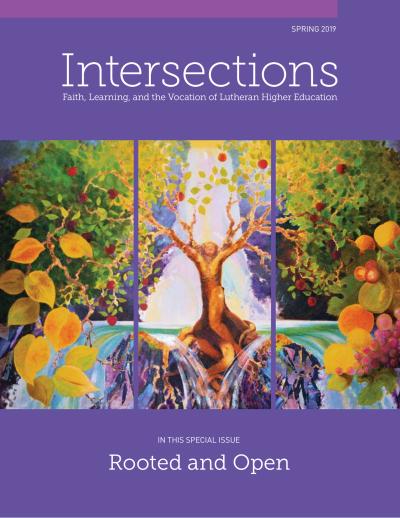
About the Cover and Artist
Kristen Gilje, a Bellingham, Washington artist who spent nine years as Artist in Residence at Holden Village, recounts the “Tree of Life” she painted for the Holden Village 1999 summer theme and the unexpected interpretation Lapidary Fred offered of Yggdrasol, Prometheus, the Druid Tree Spirit, and the crucifix all at once.
-
Article
Rooted and Open: Background, Purpose, and Challenges
Mark Wilhelm
Wilhelm traces Rooted and Open’s seventy-year backstory — from Conrad Bergendoff’s 1948 call for a Lutheran philosophy of education through the recovery of the vocation tradition — and describes the document’s process, purpose as a teaching and study resource, and the embodiment, contextual, and cultural challenges it implies for NECU institutions.
-
Article
In a Diverse Society, Why Should Lutheran Colleges/Universities Claim their Theological Roots?
Darrell Jodock
Jodock develops his “third path” account of the Lutheran college — neither sectarian nor non-sectarian but both rooted and open — analogizing the college to a bridge whose deck of daily activities rests on pillars of shared educational priorities, which in turn rest on theological footings; he then answers six common objections to claiming Lutheran roots and explains why those footings still matter.
-
Article
Roots and Shoots: Tending to Lutheran Higher Education
Jason A. Mahn
Mahn revisits why “education-for-vocation” has become a leitmotif for the 27 NECU schools, distinguishes institutional vocation from individuals’ religious identities and educational priorities from their theological grounding, and offers a friendly critique of Jodock’s bridge metaphor: Lutheran colleges grow in two directions like plants — deep roots and wide branches alike require constant tending.
-
Article
Marked by Lutheran Higher Education
Martha E. Stortz
Stortz offers an “operating manual” to Rooted and Open by tracing how the writing team moved from descriptive marks of the institutions to aspirational verbs that mark people — “called and empowered, to serve the neighbor, so that all may flourish” — and shows how each mark generates educational priorities theologically grounded in the radical mystery of God, the wild generosity of God, and the God who became one of us.
-
Article
Deep Roots, Big Questions, Bold Goals
Colleen Windham-Hughes
Adapted from a presentation to the California Lutheran University Board of Regents, Windham-Hughes reads the title Rooted and Open as both reaching back into the Lutheran tradition and opening forward into a shared future, then unpacks the document’s “called and empowered — to serve the neighbor — so that all may flourish” through the lenses of freedom of inquiry as a third path, vocation-centered education, radical hospitality, and civil discourse oriented toward the common good.
-
Article
"Faithful Nones" and the Importance of a Rooted and Open Pedagogy
John Eggen
Drawing on a student survey from his D.Min. thesis at Midland University, Eggen identifies a distinctive subset of religious “nones” — the “faithful nones” — who reject institutional religion yet retain substantive beliefs and practices, and argues that the non-binary, third-path pedagogy commended by Rooted and Open is uniquely positioned to engage a generation that has disambiguated faith, religion, and spirituality.
-
Article
Finding Flourishing: Teaching Self-Care as Course Content
Emily Kahm
Kahm argues that teaching self-care, self-awareness, and stress-coping as explicit classroom content embodies the “radical hospitality” of Rooted and Open and supports vocational formation against a consumerist culture, then offers concrete classroom techniques — a one-to-five energy check-in, ninety-second silence exercises, and full-day spiritual practices — that can be adapted across disciplines at NECU institutions.
-
 Institutional Focus
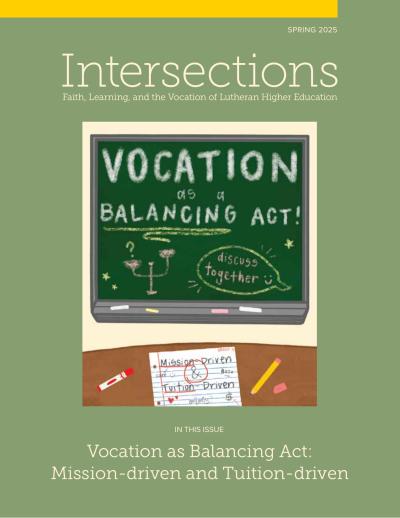
So That All May Belong: Lutheran Roots for Diversity, Equity, Inclusion, and Justice
Altheia Richardson, Angie Hambrick, Caryn Riswold, Colleen Windham-Hughes, Deanna Thompson, Marcia Bunge, Robert Clay
No. 61 · Spring 2025
22 min audio
The full NECU statement grounds DEIJ work in Luther’s 16th-century reforms and Lutheran theological claims about the image of God, equal dignity, and the limits of human knowing — offering definitions, Lutheran roots, and calls to action for diversity, equity, inclusion, and justice, with belonging as the outcome of DEIJ at work.
-
Institutional Focus
Scriptures That Inspire Work for Diversity, Equity, Inclusion, and Justice
Altheia Richardson, Angie Hambrick, Caryn Riswold, Colleen Windham-Hughes, Deanna Thompson, Marcia Bunge, Robert Clay
No. 61 · Spring 2025
9 min audio
A companion list of biblical verses — from Genesis 1:27 and Galatians 3:28 to Micah 6:8 and Luke 4:18-19 — that grounded NECU’s drafting of So That All May Belong, organized by the four DEIJ commitments and offered as an invitation to share other texts that ground and sustain the work.
-
Institutional Focus
So That All May Belong: Lutheran Roots for Diversity, Equity, Inclusion, and Justice [abridged]
Altheia Richardson, Angie Hambrick, Caryn Riswold, Colleen Windham-Hughes, Deanna Thompson, Marcia Bunge, Robert Clay
No. 61 · Spring 2025
8 min audio
A condensed version of the NECU statement that consolidates Lutheran theological grounding for DEIJ and a single combined call to action for Lutheran colleges and universities — offered as a shareable summary alongside the complete document.
-
 Article
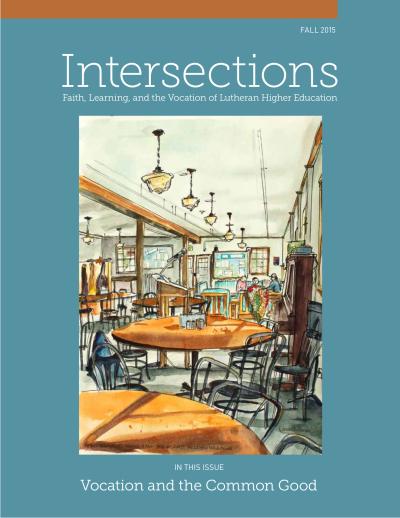
Women Presidents in Higher Education: How They Experience Their Calling
Aimee Goldschmidt, Gary McLean, Katherine A. Tunheim
No. 42 · Fall 2015
Drawing on in-depth interviews with fifteen women college presidents and a transformative-learning-theory framework, Tunheim, McLean, and Goldschmidt trace a three-stage journey — identifying, interpreting, and pursuing the call — and ask what the language of vocation contributes to the preparation and mentoring of women leaders in higher education.
-
 Article
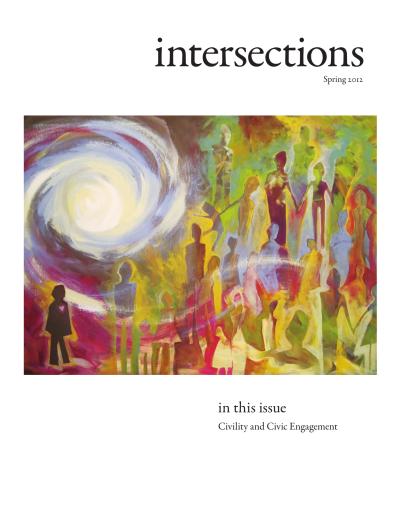
Practical Approaches for Lutheran Colleges to Engage Civil Society
Katherine A. Tunheim
No. 35 · Spring 2012
Tunheim distinguishes a college’s mission from its vocation—a calling from the community—and offers four examples of Lutheran colleges “dancing with their neighbors”: Augsburg’s engagement with the Cedar Riverside Neighborhood, her Gustavus students’ work with the St. Peter Soccer Club, St. Olaf football players in the All-Star After-School Program in Northfield, and Concordia students filling sandbags during the 2009 Red River flood. She presses Lutheran educators to ask the troubling questions that prepare students to lead with ethics rather than merely with money.
-
 Article
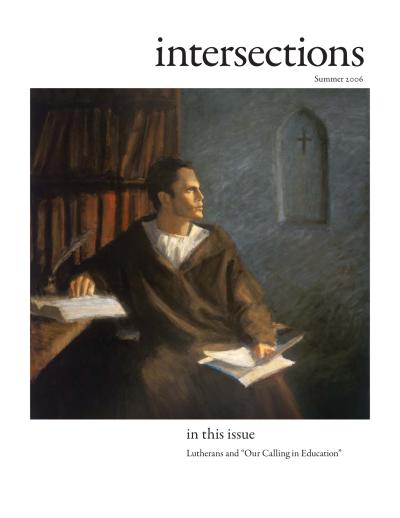
"Our Calling in Education": Working Together to Generate a Strong Social Statement on Public Schools, Lutheran Schools and Colleges, and the Faith Formation of Children and Young People
Marcia Bunge
No. 23 · Summer 2006
Bunge, Professor of Theology and Humanities at Christ College, Valparaiso University, makes two claims about the ELCA’s forthcoming social statement on education: first, that it should be built on a robust Lutheran understanding of vocation, addressing four common misconceptions (vocation as occupation, as self-fulfillment, as ordained ministry, and as “vo-tech”) and recovering the breadth of Luther’s teaching; and second, that the statement should narrow its focus to three urgent areas affecting children and young people — public schools, Lutheran schools and colleges, and faith formation — rather than addressing the full lifespan of education in equal depth.
-
 Reflection
Vocation
Matt Peterson
No. 10 · Fall 2000
In a chapel homily, St. Olaf student Matt Peterson quotes former St. Olaf professor Howard Hong’s 1955 Our Church and the World—“the tragedy is that we seem to have lost the full grasp of the Christian vocation”—to argue that vocation, from the Latin vocare, is centrally a call into daily communion with God and into continually becoming Christian, not the title of a successful career marked by GPA, win-loss records, honorary degrees, or net worth. Drawing on Anthony Bloom on prayer that must be lived, he indicts the dread of Monday, the “come hell or high water” demand for production, and the “faith community” that we take on faith.
-
 Editorial
From the Editor: Why All This Talk About Vocation?
Colleen Windham-Hughes
No. 56 · Fall 2022
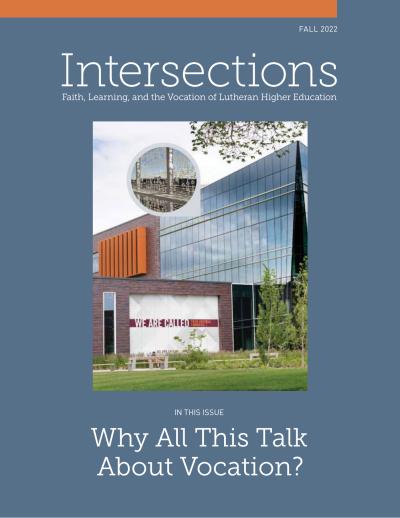
Windham-Hughes introduces the Fall 2022 issue built around Mark Wilhelm’s keynote “Why all this talk about vocation?” and previews five panel responses, two first-time conference reflections, and companion pieces on Womanist theology — framing vocation as a call not to privilege but to constructive and corrective work that undoes unjust systems.
-
 Article
Vocational Discernment: A Comprehensive College Program
Darrell Jodock
No. 14 · Summer 2002
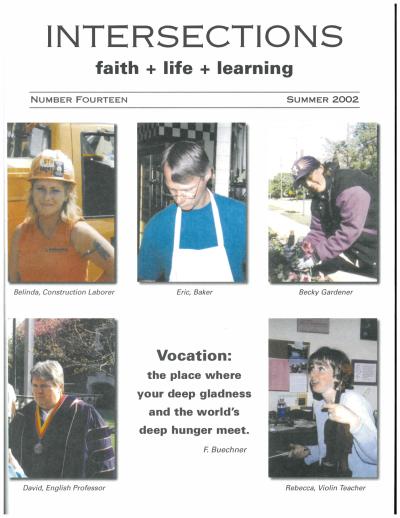
Jodock, whose Gustavus Adolphus was one of twenty colleges to receive a Lilly “Theological Exploration of Vocation” grant in 2000, defines vocation not as occupation but as a self-understanding that nests the self in community. Reading Robert Putnam’s Bowling Alone on the collapse of secondary communities alongside Luther’s ethic of community benefit and five Lutheran principles (graciousness, Christian freedom, community, God active in the world, the theology of the cross), he walks through Gustavus’s three-level design—a definition of vocation open to other faith traditions, “middle principles” drawn from Sharon Parks’s Common Fire, and a long menu of programs coordinated by a new Center for Vocational Reflection—hoping that, in the language of Holocaust studies, graduates will be “resisters” and “rescuers” rather than bystanders.
-
 Editorial
From the Editor
Robert D. Haak
No. 27 · Spring 2008
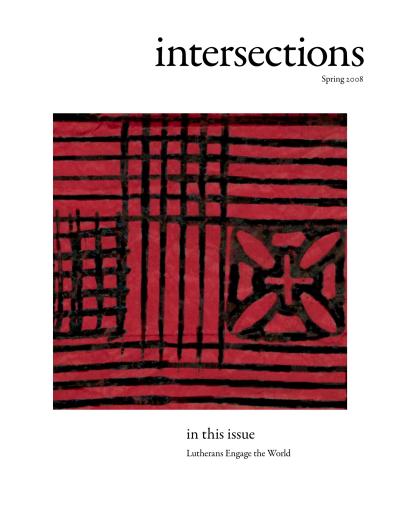
Haak frames the issue around the question of why Lutherans engage the world rather than retreat from it, locating the answer in the doctrines of creation and incarnation, and introduces essays by Erwin on globalism, Carlsen on local community engagement, Marty on multiple callings, and Mattes on the Grundtvigian heritage at Grand View. He also bids farewell to publisher Arne Selbyg, noting the fittingness of the Adinkra (“farewell”) cloth on the cover of this final issue under Selbyg’s leadership.
-
 Article
Civic Engagement and Faith Perspectives
William O'Brochta
No. 63 · Spring 2026
15 min audio
Guest editor William O’Brochta introduces the section by overviewing the ELCA’s call to civic engagement, recapping the Fall 2025 Civic Engagement and Faith Perspectives conference at Texas Lutheran University, and previewing the participant essays that follow.
-
 Article
Luther, the Catechisms, and Intellectual Disability
Courtney Wilder
No. 47 · Spring 2018
Wilder confronts Luther’s deeply troubling response to a child with disabilities at Dessau, then mines his Small and Large Catechisms for a Lutheran theology of inclusion — reading the Third Article of the Creed, the petitions of the Lord’s Prayer, and the sacrament of baptism as resources that affirm the full humanity of people with intellectual disabilities as faithful children of God.