This is getting real.
I’m up well before dawn after a handful of hours of restless sleep. Last night, Facebook Messenger lit up with rumors of a first case of COVID-19 in our small city. One cryptic message from our neighbor D., who often knows things before they are public, specified that the boys and I should not, under any circumstances, play pickup basketball this afternoon, which we had done a week ago, the last day that my college’s rec center was open. No sooner had my spouse, Laura, read me the message than I began to connect and create dots: I think the wife of the player who likes to drive the lane works in the emergency room. Did he contract it through her? Did either of my sons, Asa and Gabe, guard him? Did they use enough hand sanitizer between games? Could they die?
A subsequent text from our neighbor clarified that she just didn’t want us having any contact with anyone; basketball was only an example. No need to dwell on the questions above—minus the last one, which kindled my anxiety long after we said goodnight to the boys.
Today is the fourth Sunday of Lent. The gospel lesson is the story of the man born blind, whom an un-beckoned Jesus hastens to heal as the disciples debate over who is to blame for his condition. My family will have “family church” at 10:30 this morning over chorizo egg bake, which I promised to the boys last night. Sitting under a warm blanket on the couch, watching the sky spit sleety snow, my contemplations and writing this morning feel especially like prayer, or at least like the difficult (non-)action of paying attention, which Simone Weil identifies as the essence of prayer.
We will abide by the Illinois Governor’s executive order to “stay at home,” one of five statewide decrees at present. “Shelter in place” is no longer being used for these orders, given that the phrase conjures frightening images of active shooters and classroom lockdowns in many people’s minds—especially those of Gen X, who have trained for school shootings since they were in kindergarten. For me, though, to shelter seems much more accurate to the purposeful action asked of us. Deriving from the word shield, to shelter is to take guard—and more so, to protect those who need guarding, as in providing lodging for the homeless poor or taking in stray animals. My putting egg bake in the oven, and Laura’s designing word games for the kids, and our planning of hikes with our dog Gracie at Sylvan Island, each make shelter for our family. The difficulty is how to shield those who are not already under our roof. Whom else will I be called on to shelter? What can hospitality look like across property lines?
“Deriving from the word shield, to shelter is to take guard—and more so, to protect those who need guarding.”
Two days ago, I received an email from E., a recent graduate from my college and former student in my upper-level seminar, “Suffering, Death, and Endurance,” who moved to Boston to look for jobs and attend to his mental health. Students like E. make me proud to teach at a Lutheran liberal arts school. He identifies as nonreligious, but would visit during my office hours to discuss faith and hope and spiritual wellness. He wrote his final paper in the “Suffering” class on the theodicy of hip-hop music, which first turned me on to the prophetic and profane musical artist, Brother Ali. I dare not tally the teaching versus the learning that I give/receive from students like E.
He reported last week that the streets and squares of Boston have been disconcertingly quiet, like the calm before a storm. “Still, it’s not all bad,” he writes. “People are settling into their new norm. I’m starting to get involved with the mutual aid networks popping up across the country. It’s wonderful to see how much people are willing to share, both in knowledge and resources. I’m grateful for social media allowing us to stay connected while remaining distant.” He says he’s been organizing people in his Sommerville neighborhood, ensuring that channels of communication remain open. And then, with characteristic humility, E. asks me for advice about how to talk with people about the pandemic itself. He confesses, “I’m not sure how to talk about this moment in time we’re living through. I want to be a source of stability, but I don’t want to be more than what I am.”
There’s so much here to comment on, including all the ways that E. is enacting neighbor love much more creatively than I am. I am particularly struck by the wisdom of not wanting to be more than he is. He could have said that he didn’t want to overextend himself or that he didn’t want to do more than he could effectively do. But his language is about personhood and character, not activities and tasks.
He’s writing about his sense of calling, that understanding of oneself and one’s necessary limits that must be carefully discerned and then courageously lived out in service to others. While many idealistic young adults bravely want to change the world in whatever ways they dream up, E. has intuited the more discerning insight of American author and activist Parker Palmer—namely, that pretending you are something you’re not is a recipe for resentment, then fatigue, and then cynicism. We must rather, in Palmer’s words, “accept that our lives are dependent on an inexorable cycle of seasons, on a play of powers that we can conspire with but never control.” Accepting those God-given limits alongside our God-given gifts can be painful. We inevitably “run headlong into a culture that insists, against all evidence, that we can make whatever kind of life we want, whenever we want it. Deeper still, we run headlong into our own egos, which want desperately to believe that we are always in charge” (97).
“E. is discerning his deepest self, and its responsive and purposeful work in the world, even as he keeps one eye open for an ambush of his ego.”
E. is discerning his deepest self, and its responsive and purposeful work in the world, even as he keeps one eye open for an ambush of his ego. I am proud of him, and wrote back saying as much.
The networks of church-related higher education in which I am a part have, over the last few decades, doubled-down on their central missions to educate for vocation. From vocare (calling) and vox (voice), vocation is something one hears (usually metaphorically) and then responds to—or not. Many identify the ultimate Caller as God, who uses the voices of human and nonhuman creatures to beckon a person toward work for the flourishing of all creation. Others hear the call as originating from particular people and places who call out for help and compassion. Either way, undergoing education for a life of vocation provides a very different understanding of higher education than the leading consumerist model. Students don’t only pay for college to get a degree that gets them opportunities to advance their chosen careers. They also—and more importantly—accept the invitation to carefully listen for and critically understand what the world most needs, and then develop skills by which they can capably and confidently respond. While many if not most students come to college primarily to get a good paying job (and there’s nothing wrong with that), among them are students such as E., many of them first generation college students and others with a strong sense of appreciation for this opportunity, who have a handle on their gifts and passions and are ready to leverage each for the flourishing of the common good.
Language about neighbor love is easily translated into the idiom of purposeful callings. Lutheran higher education follows its namesake, Martin Luther, in equating vocation with love and service to the neighbor. Whereas before the sixteenth century “godly work” had been the work of the professionally religious or explicitly religious work (such as taking a pilgrimage), Luther redirected such work away from the desperate attempt to please God and towards the free, creative, and even joyful effort to work on behalf of the neighbor. As Luther put it 500 years ago in “The Freedom of a Christian”:
No one needs even one of these works to attain righteousness and salvation. For this reason, in all of one’s works a person should in this context be shaped by and contemplate this thought alone: to serve and benefit others in everything that may be done, having nothing else in view except the need and advantage of the neighbor. (520, my emphasis)
When the old self, the ego, is upended by the unearned gift of divine love, it then—and for this reason—can finally see what the neighbor actually needs and will do what it can to respond. Luther assumed that the transformative turn-around happens in baptism, whose waters drown a person’s pious perfectionism, together with her doubt and despair. For most today, death of ego and the rebirth of a summoned life probably only come from brushes with actual death. Being made to face our mortality—for example, by sheltering in place, glimpsing the vulnerability of your family, or getting sick yourself—can sometimes kill the self-reliance to which many of us otherwise so fanatically cling. Self-reliance is replaced by the gift of grace, which then redoubles as gracious attention to others.
“When the old self, the ego, is upended by the unearned gift of divine love, it then—and for this reason—can finally see what the neighbor actually needs and will do what it can to respond.”
My colleague from our music department, M., also reached out by email last week. She is a wise leader within this year’s “Education-for-Vocation” faculty seminar. She wrote to me of that key vocational discernment question that David Brooks asks, and which we had discussed a few weeks before: “To what am I being summoned?” Then referencing the worldwide pandemic: “If this is not a moment of summoning, I don’t know what is.”
Works Cited
Brooks, David. “The Summoned Self,” New York Times, August 2, 2010. Accessed 1 April, 2021, https://www.nytimes.com/2010/08/03/opinion/03brooks.html
Luther, Martin. “The Freedom of a Christian (1520).” In The Annotated Luther Study Edition. Edited by Timothy J. Wengert. Fortress, 2016.
Palmer, Parker. Let Your Life Speak. Jossey-Bass, 1999.
Weil, Simone. “Attention and Will.” In Gravity and Grace. Translated by Emma Craufurd. Routledge, 1952.
-
 Editorial
From the Publisher
Mark Wilhelm
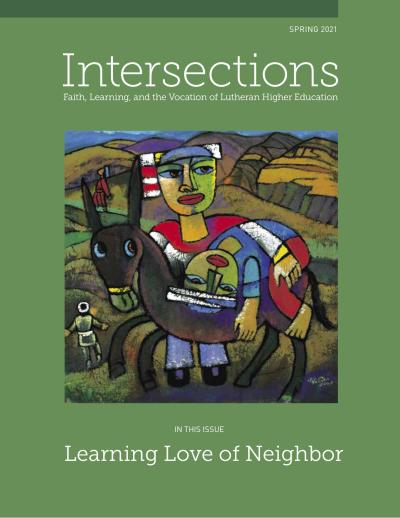
Wilhelm reflects on an NPR report of teenagers’ pandemic diaries and the fraught Christian history of struggling to live out Jesus’s ethic of love, framing the issue as a record of NECU institutions working out how to act for the common good through the pandemic of 2020–2021.
-
Article
Teaching as an Expression of a Love Ethic
Abbylynn Helgevold
Drawing on Kierkegaard’s Works of Love and Kevin Gannon’s teaching manifesto, Helgevold describes how an ethic of upbuilding love—love that presupposes goodness in students—reshapes inclusive pedagogy at Wartburg College, from syllabus language to how she addresses plagiarism and attendance.
-
Reflection
Keeping Close from a Distance: Pandemic Reflections of a Library Coordinator
Carla Flengeris
Flengeris reflects on a year of running Luther College’s library at the University of Regina from her basement and mourns the loss of the hourly walks through the stacks—the “roving reference” that, she realizes, were never disruptions to her work but were the work itself.
-
Article
Preaching in Christ Chapel on Yom HaShoah: Reflections on Interfaith Relations at a Lutheran College
Sarah Ruble
Ruble shares her 2019 Holocaust Remembrance Day homily preached before the cross in Christ Chapel at Gustavus Adolphus, then reflects on whether “professional Christians” on Lutheran campuses might practice a non-mutual, witnessed confession before colleagues of other traditions as a check on Christian self-deceit.
-
Article
Down and Out: First Year Students Encounter Lutheran Theology
Lindsey Leonard
Leonard describes how Wartburg’s IS 101 first-year seminar wove the Dalai Lama, Paul Kingsnorth, Chimamanda Ngozi Adichie, and Mary Robinson’s Climate Justice into the Fall 2020 reader so the “COVID class” could encounter Lutheran theology’s call to serve the neighbor across the pandemics of disease, racism, and climate change.
-
Article
(Re)Defining Vocation: Gladly Challenging a Vocational Giant
Andrew Tucker
Tucker challenges Frederick Buechner’s famous definition of vocation as “where your deep gladness and the world’s deep hunger meet,” arguing that gladness reflects a privileged perspective and proposing instead that vocation be defined as “any meaningful, life-giving work you do for the world.”
-
Article
Vocation Outside of Career: Discovering Purpose through Comics
María Evelia Emerson
Emerson recounts building an Augustana Vocational Discernment course around G. Willow Wilson’s Ms. Marvel series, using Kamala Khan’s juggling of family, friendship, faith, and superhero identity to help sophomores see vocation as not what they do for a living but how they want to live.
-
Article
Leadership in a Pandemic: Grace-Filled Lessons in Unprecedented Times
Marc Jerry
Reflecting on his first year as president of Luther College at the University of Regina, Jerry argues that the best preparation for leading through a long crisis was not his economics or strategy training but seminary and pastoral formation—and that NECU institutions are called to a post-pandemic ministry of kindness, grace, and community.
-
Book Review
Unconventional Wisdom and Talking about God: A Review of Beckstrom’s Leading Lutheran Higher Education in a Secular Age
Ann Rosendale
Rosendale reviews Brian Beckstrom’s Leading Lutheran Higher Education in a Secular Age, recommending its diagnosis of the gap between espoused and perceived Lutheran identity at ELCA schools and its prescription—Trinitarian Missiological Ecclesiology and a campus-wide willingness to talk explicitly about God.
-
 Article
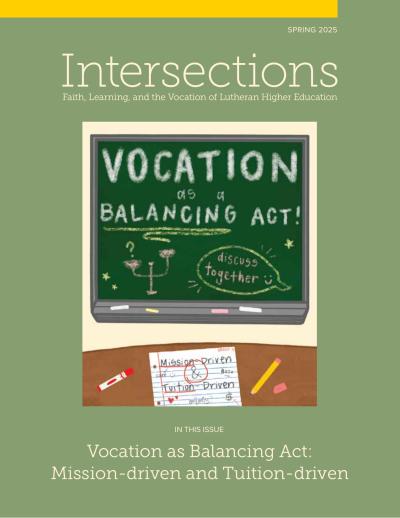
Vocation at Full Stretch: Reflections on Follow Your Bliss and Other Lies about Calling and its Use among College Students
Jason A. Mahn
No. 61 · Spring 2025
43 min audio
Mahn engages Bonnie Miller-McLemore’s Follow Your Bliss and Other Lies about Calling as required reading in a sophomore religion course, showing how her categories of missed, blocked, conflicted, fractured, unexpected, and relinquished callings empower young adults to perceive embodied, unplanned, and often painful dimensions of life as essential parts of vocation — and help close the gap between mission-driven and tuition-driven realities.
-
 Article
On Recruiting Diverse Students, Rooted in Mission
Eric Rowell, Jason A. Mahn
No. 59 · Spring 2024
Jason Mahn interviews Eric Rowell, Assistant Director of Admissions and Diversity Outreach at Augustana College, about how recruiting students from a wide variety of backgrounds — rooted in Augustana’s Lutheran commitment to vocation and educating across difference — remains essentially unchanged in the wake of the Supreme Court’s 2023 decisions on affirmative action.
-
 Editorial
From the Outgoing Editor
Jason A. Mahn
No. 55 · Spring 2022
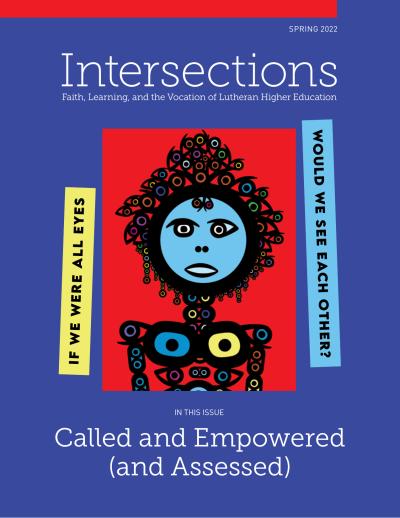
Mahn closes out a decade of editing Intersections, passes the duties to Colleen Windham-Hughes, gives thanks to Mark Wilhelm and Augustana College, and introduces an issue largely drawn from comments by Lutheran faculty, staff, and administrators at the 2022 NetVUE national gathering.
-
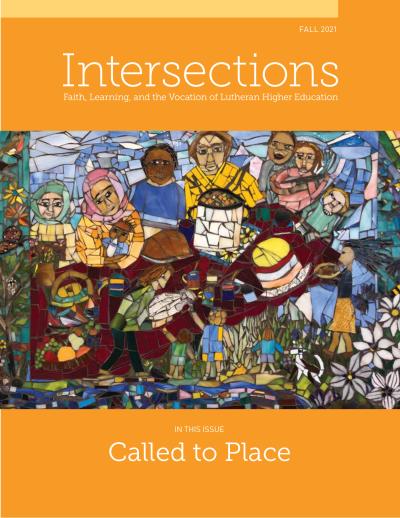 Editorial
From the Editor
Jason A. Mahn
No. 54 · Fall 2021
Mahn introduces the “Called to Place” theme of the 2021 VLHE Conference, arguing that Lutheran higher education’s emphasis on vocation must be grounded in particular geographies and embodied communities — for, as Wallace Stegner put it, “If you don’t know where you are, you don’t know who you are.”
-
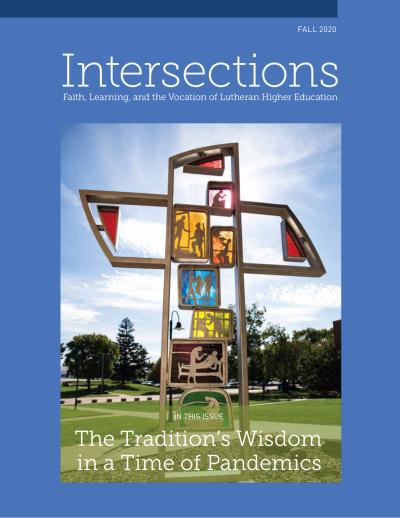 Editorial
From the Editor
Jason A. Mahn
No. 52 · Fall 2020
Mahn narrates a year of crisscrossing pandemics — Covid-19, economic collapse, partisan politics, and the long pandemic of white supremacy revealed anew by the murder of George Floyd — and argues that Lutheran liberal arts schools, by educating for vocation, are uniquely poised to help students respond with character and capable callings.
-
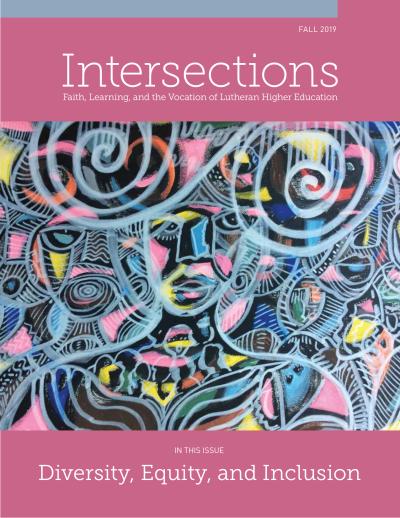 Editorial
From the Editor
Jason A. Mahn
No. 50 · Fall 2019
Mahn opens with Lenny Duncan’s observation that the ELCA is 96 percent white — the whitest denomination in the U.S. — and asks how teachers and administrators at historically, predominantly, and persistently white institutions can turn from white privilege and white supremacy toward spaces where people of color thrive and white people are re-formed into antiracist allies.
-
 Article
Reclaiming Grundtvig at Grand View College
Mark C. Mattes
No. 27 · Spring 2008
Mattes traces the Grundtvigian heritage of Grand View College — the only North American institution founded by Grundtvigian Danes — from its origins in the 1880s split between Pietist Inner Mission and Grundtvigian Danish Lutherans through its golden years of folk dancing, gymnastics, and the weekly lecture, to the demographic and curricular changes of the 1950s through 1990s. He describes recent tangible initiatives, including the Grand View College Reader, Imaging the Journey, and the 2007 Strategic Planning Commission’s “Faith Foundations” statement, that seek to recover the “Human first, then Christian” mantra of Grand View’s ancestors for a generation of students whose “ship” has had not only its planks but its very model replaced.
-
Institutional Focus
So That All May Belong: Lutheran Roots for Diversity, Equity, Inclusion, and Justice
Altheia Richardson, Angie Hambrick, Caryn Riswold, Colleen Windham-Hughes, Deanna Thompson, Marcia Bunge, Robert Clay
No. 61 · Spring 2025
22 min audio
The full NECU statement grounds DEIJ work in Luther’s 16th-century reforms and Lutheran theological claims about the image of God, equal dignity, and the limits of human knowing — offering definitions, Lutheran roots, and calls to action for diversity, equity, inclusion, and justice, with belonging as the outcome of DEIJ at work.
-
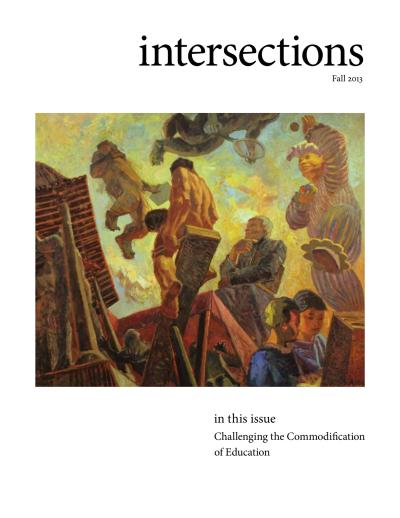 Editorial
From the Editor
Jason A. Mahn
No. 38 · Fall 2013
Mahn reads Michael Sandel’s What Money Can’t Buy alongside Larry Rasmussen and Martha Nussbaum to ask how Lutheran schools can articulate the “value added” of vocation without commodifying it, and previews the 2013 Vocation of a Lutheran College conference papers, Patricia Lull’s sermon, and Ann Hill Duin and Eric Childers’ Project DAVID essay that make up the issue.
-
 Article
Necessary Disruptions: Centering Vocation in the Common Good
Erin VanLaningham
No. 57 · Spring 2023
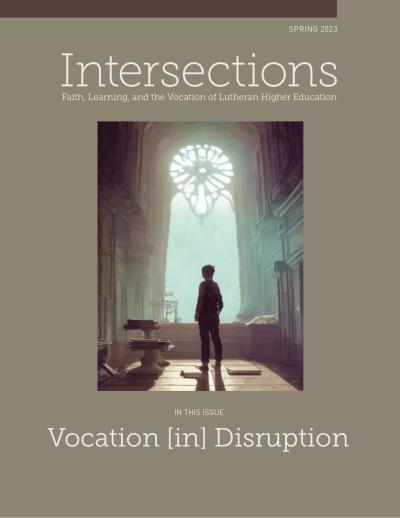
VanLaningham previews the forthcoming NetVUE volume Called Beyond Our Selves: Vocation and the Common Good, arguing that vocation, common, and good all need to be disrupted and expanded so that students might arrive at a wider sense of individual purpose and collective well-being.
-
 Editorial
From the Editor
Tom Christenson
No. 20 · Fall 2004
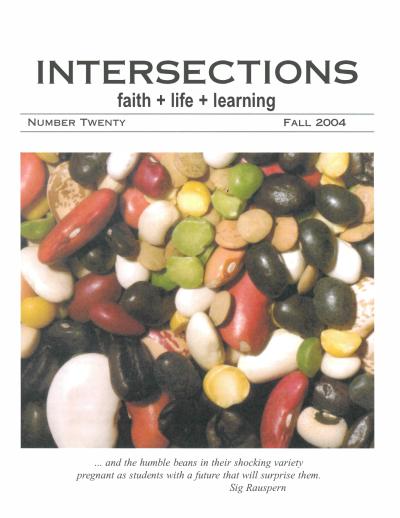
Christenson introduces an issue featuring “young and old, angry and encouraging, prophetic and hopeful” voices unified by the assumption that Christians engaged in thinking and educating will ask hard questions: how to raise concerns about militarism and the new American “imperialism,” what a Lutheran law school will say about training a new generation of attorneys, and what Lutheran colleges communicate to undergrads about vocation. Such faithful criticism, he argues, is part of who Lutheran institutions are.
-
 Article
A Response to Paul Santmire: The Lutheran Liberal Arts College and Care for the Earth
Arthur A. Preisinger
No. 4 · Winter 1998
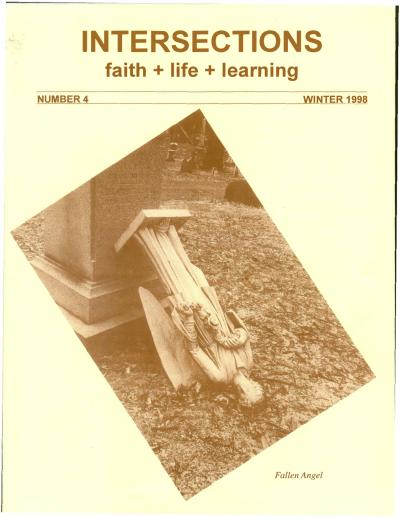
Preisinger commends much of Paul Santmire’s earlier essay—the critique of the “back-to-nature” cult, the call for a holistic environmental ethos, the suggestion of a cosmic liturgical praxis—but takes issue with Santmire’s reading of classical Lutheran social ethics. He argues that the two kingdoms doctrine was not a systematic Lutheran treatise (the term itself became common only in the 1930s), that the doctrine’s misuse by some twentieth-century German theologians does not condemn its proper use, and that the South African Council of Churches actually deployed the doctrine (correctly interpreted) against apartheid. Drawing on Karl Hertz, Ulrich Duchrow, Tom Strieter, and F. Edward Cranz, Preisinger defends the doctrine as complementary duality—left hand and right hand of God, governances to be distinguished but never separated—and concludes with Bill Lazareth that the skeletons in the Lutheran closet are not Luther but departures from Luther.