One Thursday night a few years back, the Christensen Scholars of Augsburg College went on pilgrimage to the rare books room at Luther Seminary, St. Paul, Minnesota.1 At the entrance is a glass-enclosed case holding a copy of Luther’s death mask, along with casts taken of his hands. Even in death Luther’s right hand clutches an invisible quill or stylus. A prolific writer, Luther’s hand simply grew around his craft: it froze with arthritis and over-use in a locked, crabbed position. The left hand, in contrast, rests free, open and unbent.
Those masks, one of Luther’s face, the others of his hands, are the horizon for this talk. For the words that allegedly came out of Luther’s mouth just before his face set in death confounded the people gathered around his deathbed, no less than they confound us today. He observed before dying: “We are all beggars.”
Now the gathered mourners were there not simply to accompany Luther on this, his last earthly journey, but also—and perhaps even mostly—to see how the Reformer would die. If he died in agony and regret, it would bode ill for the whole movement of reform. But if he died in peace and equanimity, the movement would have some divine sanction. Imagine the pressure!
Luther exits his earthly home with this cryptic remark on his lips: “We are all beggars.”
Now, it must not be forgotten: this came from a man who in his prime had written quite viciously against beggars—and Luther knew how to load acid into that stylus. In 1510, Luther penned a preface to the ever-popular “Book of Vagabonds,” the Liber Vagatorum, where he complained about being fooled by “vagabonds and blabbermouths.” Later, Luther’s reforms toppled the medieval economy of salvation, to which beggars were essential. Beggars afforded an important opportunity for doing a “good work” that might earn anyone who ministered to them a few points on their divine report card. As far as Luther was concerned, beggars played not so much on people’s sympathy, but on their fear of hell and longing for redemption. He had little good to say about them.
But now, in his last breaths, to say: “We are all beggars.” Was this some kind of deathbed conversion? What could he possibly mean?
It’s worth noting what Luther did not say. He did not leave people with the observation he’d often made: “we are all saints and sinners.” Nor did he say what he’d so often written in that clenched, crabbed hand: “We are all priests….” For Luther had also written long and hard about “the priesthood of all believers.” No, in his dying moments, he did not leave people with a blanket ordination, which would have been appropriate. He left us with what seems like a blanket curse: “we are all beggars.”
We’ll never know what Luther’s intent was—but I want to suggest that maybe being a beggar is the other side of being a priest, just as being a saint is the other side of being a sinner. In Luther’s profoundly dialectical mind, not only are we both saint and sinner, simul justus et peccator, but also both priest and beggar, simul sacerdos et pauper. Priest and beggar: two sides of a human reality. What does this mean?
In his New American Blues: A Journey Through Poverty to Democracy, a thick analysis of the third world in this country, journalist Earl Shorris observes: “Martin Luther practically invented the idea of welfare” (Shorris 205). Luther’s reforms may have toppled a medieval economy of salvation, but that was only for the “haves.” For the “have nots,” it meant they suddenly didn’t eat. The medieval church, precisely through its priests, had long played a crucial role in poor relief. Priests dispensed alms; at great tables outside cathedrals, priests gathered food and other goods for the poor; through countless masses, priests amassed funds and then disseminated them to those in need. Dismantling the Roman Church meant eliminating services on which the disadvantaged depended. What would take their place? More insistently, who would take their place?
Priest and beggar: two sides of a human reality. What does this mean?
Whether he anticipated it or not, Luther created a welfare crisis of enormous proportions. He came up with an interesting solution: he authorized a transfer of responsibility for poor relief from churches to local communities: the towns, the villages, the cities that increasingly comprised a public square. But the language he used to authorize that transfer was the language of “priesthood of all believers.”
“Priesthood of all believers:” we in the Lutheran tribe are too used to using this language to affirm individual vocation and to confirm a latent anti-clericalism, anti-hierarchicalism; we too easily ignore Luther’s original call to civic engagement. Behind the language of the universal “priesthood of all believers” is the call to care for the poor.
Behind the language of the universal ‘priesthood of all believers’ is the call to care for the poor.
Writing to the German nobility in 1520, Luther extends to the princes the title “priests,” and it is precisely in that context that he charges them with the task of caring for the poor. “No one,” Luther writes, “ought to go begging among Christians….Every town and village should know and be acquainted with its poor.” This is what the priest would have known; this is what the priest would have done.
Not only princes are priests. When citizens of the town of Leisnig wrote to Luther for counsel on how they might care for the poor in their midst, Luther reminds them of the common calling as “priests.” With that call comes a civic responsibility: care for the poor. Because they are priests, all citizens should contribute to a common chest, which is then managed by an overseer whose duty it is “to know all the poor and inform the city council…of what they need.” This is what a priest would have known; this is what a priest would have done.
I recall a conversation with a Syrian Orthodox Catholic businessman whom I met several years ago. With emphatic certainty, he spoke of his own village priest. That man knew the poor; that man knew what they needed. “That’s just what a priest does,” he shrugged, as if stating the obvious.
If we’re all priests, that’s just what we all do as well. Caring for the poor is part of our civic responsibility. That’s one side of the equation: priests.
But what about the other: we are also all beggars. What could Luther possibly have meant? He didn’t get much chance to elaborate this side of the equation.
Maybe, in dying, he realized how quickly fortunes turn. “Haves” could morph overnight into “have nots.” After all, Luther had never referred to the poor as “out there;” they were always “among us.” Indeed, they could at any moment “be us.” Was he worried about Katie, his wife, and their children? Would they all be suddenly beggars, themselves dependent on the mercy of other priests exercising their calling?
Maybe, in dying, he suddenly realized the limits of his own provisional attempts to create a working welfare system—and the dangers of paternalism and patronization lurking behind “serving the neighbor.” Service alone would never ask the systemic question of justice: why are these particular neighbors so consistently having this particular need?
Maybe, in dying, Luther saw that he could never beg with that right hand, clenched forever around an invisible stylus. And in that, he was like so many other “haves” whose hands clutched forever what they held dear. They were possessed by their possessions, unable to reach out to anyone for anything.
Maybe, in dying, he suddenly realized the limits of his own provisional attempts to create a working welfare system–and the dangers of paternalism and patronization lurking behind ‘serving the neighbor.’
Or did Luther, in dying, understand with sudden insight how far his own solution was from the example of Jesus, who was himself more beggar than priest. Again and again, he’s called a “friend of tax collectors and sinners,” and according to the Miss Manners of the Ancient World, you were friends with the people you ate and drank with—and the people you ate and drank with were your friends. “Sinner” in that society meant “poor,” those who could not pay their taxes to the religious authorities. With this simple gesture of table fellowship, Jesus moved welfare from giving food to the poor to eating and drinking with them. Jesus became one of them.
I like to think the latter was the case, and that, in dying, Luther rather realized the power of the beggar, whose hand is not clenched around anything, but open, always open—and free to reach out for the hand of the neighbor.
Priest and beggar, beggar and priest: this is Luther’s last insight into civic engagement.
Endnotes
1. I delivered a version of this essay on November 20, 2013 as a Heritage Day Series chapel talk.
Works Cited
Shorris, Earl. New American Blues: A Journey Through Poverty to Democracy. New York: W.W. Norton, 1997.
-
 Editorial
From the Publisher
Mark Wilhelm
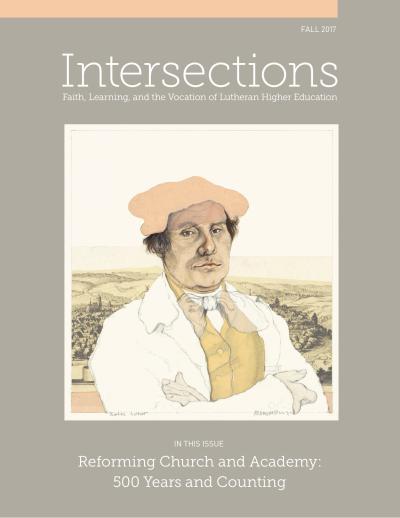
Wilhelm reflects on how NECU’s focused work on Lutheran identity in higher education — including the forthcoming document Rooted and Open: Our Common Institutional Calling — turns out to be a fitting commemoration of the five-hundredth anniversary of the Lutheran Reformation, even though it did not arise from anniversary planning.
-
Editorial
From the Editor
Jason A. Mahn
Mahn returns to Luther’s opening thesis on whole-life repentance to argue that the deepest critique of the indulgence economy — and of our own American meritocracy — is the very assumption that grace and human striving can be measured, exchanged, and earned.
-
Article
Why Martin Luther and the Reformation Matter 500 Years Later
Kathryn A. Kleinhans
Adapted from a 2017 address to Wartburg College’s entering class, Kleinhans surveys Luther’s lasting impact in vocation, education, social service, and the necessary work of repentance — closing with the Lutheran World Federation’s Windhoek assembly and the Reformation World Exhibition’s call to live reform forward into the next 500 years.
-
Article
Celebrating the Reformation: The Lutheran Foundation of a Called Life
Mark D. Tranvik
Tranvik traces vocation from the monastic impulse through Luther’s rejection of the monk’s vow as the only true calling, and translates the “called life” for twenty-first-century Lutheran colleges — institutions that see students as made in the image of God, enlist the whole community in discernment, and make room for faith and its convictions.
-
Article
Reforming Our Visions of City Nature
Lea F. Schweitz
Through a Chicago story of Canada geese at North Pond, Schweitz takes up two Reformation-era ways of reading the “Book of Nature” — Konrad Rosbach’s moral readings and Philip Melanchthon’s scientific ones — and proposes a third: Luther’s sacramental principle that the finite is capable of the infinite, worn as “reading glasses” for an urban planet.
-
Article
In the Beginning of the Reformation Was the Word
George Connell
Drawing on a Concordia faculty pilgrimage to German Luther sites, Connell appropriates John’s prologue to frame the Reformation as a movement about words — the printed page, the university classroom, the Marburg confession, the Wartburg translation, Bach’s music, and the dining-room conversations of Table Talk — while soberly noting that words can wound as well as heal.
-
Article
Luther's Sutra: An Indian, Subaltern (Dalit) Perspective
Surekha Nelavala
Nelavala traces how Luther’s “sutra” — grace alone, faith alone, scripture alone, Christ alone — reached the mud hut of her Dalit grandparents in rural India, transforming three generations, and then reads the parable of the vineyard laborers from a subaltern perspective in which grace for all is the heart of God’s alternative kingdom.
-
Article
Reforming Lutheran Higher Education: Ecclesiological Reflection and Theological Leadership
Brian Beckstrom
Beckstrom diagnoses an “identity crisis” at ELCA colleges and universities rooted in inherited Enlightenment assumptions and a thin functional ecclesiology, and proposes that a Trinitarian, perichoretic understanding of God offers an ecclesiological foundation that holds together unity and diversity in a pluralistic, post-Christian context.
-
 Article
The Responsible Professional: Vocation and Economic Life
Martha E. Stortz, Tom Morgan
No. 51 · Spring 2020
Stortz and Morgan argue that the “value-added” of Lutheran higher education is a responsibility ethic — one that frames the professional as a first responder “called and empowered to serve the neighbor so that all may flourish” — and unpack the four criteria of the 1999 ELCA social statement Sufficient, Sustainable Livelihood for All as a framework for economic deliberation.
-
 Article
The "V" Word: Different Dimensions of Vocation in a Religiously Diverse Classroom
Martha E. Stortz
No. 50 · Fall 2019
Stortz responds to a sea of blank stares when she used the word “vocation” in a religiously diverse required course by offering five metaphors — place, path, relationships, lens, and story — that point to different dimensions of vocation across the world’s religions and help students articulate their callings on their own terms.
-
 Article
Marked by Lutheran Higher Education
Martha E. Stortz
No. 49 · Spring 2019
Stortz offers an “operating manual” to Rooted and Open by tracing how the writing team moved from descriptive marks of the institutions to aspirational verbs that mark people — “called and empowered, to serve the neighbor, so that all may flourish” — and shows how each mark generates educational priorities theologically grounded in the radical mystery of God, the wild generosity of God, and the God who became one of us.
-
 Article
Jonah: The Anti-Hero of Vocation
Martha E. Stortz
No. 45 · Spring 2017
In a chapel talk first given at Augsburg College’s Vocation 2.0 series in September 2016, Stortz reads the prophet Jonah as the great anti-hero of vocation — one who tries to outrun God’s call to the great city of Nineveh — and argues that, in a season of urban violence and divisive election-year rhetoric, the story is less about public calling than about being called by the publics in our midst.
-
 Article
Why Interfaith Work is Not a Luxury: Lutherans as Neighboring Neighbors
Martha E. Stortz
No. 44 · Fall 2016
Stortz argues that interfaith work is not a luxury but a constitutive commitment of Lutheran higher education — institutions she describes as both “faith-based and interfaith-dependent.” Reading the parable of the Good Samaritan as both an intra-faith and inter-faith encounter, she offers a four-fold matrix of theological reflection, spiritual engagement, social action, and everyday experience as portals into the work of being neighbor.
-
 Book Review
The Courage to Change: Creating New Hearts with Palmer and Zajonc
Martha E. Stortz
No. 39 · Spring 2014
Stortz reads Parker Palmer and Arthur Zajonc’s The Heart of Higher Education from the landscape of Lent and notes that the book’s strategies all target students, not their professors. Drawing on her own Faculty Formation Group at Pacific Lutheran Theological Seminary and the Ignatian Colleagues Program at Jesuit institutions, she asks what a Lutheran analogue might look like that would form the educators who teach for transformation.
-
 Article
The Lutheran Liberal Arts College and Care for the Earth
H. Paul Santmire
No. 3 · Summer 1997
Santmire, author of The Travail of Nature, proposes three mandates for the Lutheran liberal arts college: take responsibility for spiritual particularity by confronting the ambiguities of the classical Christian tradition (Lynn White’s charge against anthropocentric Christianity vs. the Franciscan ecological tradition from Irenaeus through Luther) and of classical Lutheran social ethics (the Two Kingdoms, Romans 13, the Third Reich, Bonhoeffer); promote responsible cultural criticism (against Thoreau’s sociopathic anti-urban suburbanism); and promote a holistic environmental ethos through an interdisciplinary core curriculum with ecology as the queen of the sciences, a community that liberates the social imagination (Mumford, Marcuse), a cosmic Liturgical praxis rooted in the Colossians 1:15–20 hymn to the cosmic Christ, and an academy that models ecological responsibility.
-
 Article
Committed to Paradox
Caryn Riswold
No. 60 · Fall 2024
Riswold lifts up paradox — saint and sinner, lord and servant, Rooted and Open — as a distinctive Lutheran root that lets institutions honor the complicated truth of who their students are and embrace the messy, ever-reforming work of access and accessibility as a theology of the cross.
-
 Book Review
Alister McGrath: Glimpsing the Divine: The Search for Meaning in the Universe
Don Braxton
No. 14 · Summer 2002
Braxton reviews Alister McGrath’s Glimpsing the Divine (Eerdmans, 2002), commending its twelve articulate, lavishly photographed meditations as a fine introduction to Western spirituality but criticizing its conservative neo-Barthian confessionalism, its Eurocentric treatment of non-Western traditions as “taillights” to Christianity’s “headlights,” its one-sided host-guest engagement with the natural sciences, and its metaphysical dualism. In a section added for ministerial readers, he contrasts McGrath’s self-contained confessionalism with H. Richard Niebuhr’s call to respond to all things as if to God’s actions upon us, and argues that in an era of rival fundamentalisms exclusivity must become a thing of the past.
-
Book Review
Types, Methods, and Sagas in Lutheran Higher Education: Learning from Childers
Lake Lambert
No. 39 · Spring 2014
Lambert situates Eric Childers’ College Identity Sagas within the older tradition of the 1977 Association of Lutheran College Faculties volume The Church-Related College in an Age of Pluralism, working through Burton Clark’s “saga” and Robert Benne’s typology of church-related colleges. He commends Childers’ socio-scientific approach while questioning whether a typology can do justice to institutions that resist easy classification.
-
Institutional Focus
A List of ELCA Social Teaching and Policy Documents
No. 51 · Spring 2020
A reference list, as of September 2019, of the ELCA’s twelve social statements, fourteen social messages, and over 150 social policy resolutions — with Spanish translations where available.
-
 Editorial
From the Publisher
Mark Wilhelm
No. 32 · Spring 2010
Wilhelm invites readers to enjoy or revisit the presentations from the 2009 Vocation of a Lutheran College Conference, then reflects on the Higher Learning Commission’s denial of Dana College’s request to transfer accreditation to a for-profit purchaser—an event that effectively ended Dana’s sale and prompted ELCA colleges and universities to welcome Dana students and faculty—and argues that the irreversible entry of for-profit operators into liberal arts education gives the Lutheran community further reason to continue the conversation about the vocation of a Lutheran college.