The Courage to Change: Creating New Hearts with Palmer and Zajonc
Intersections No. 39 · Spring 2014
I write from the landscape of Lent, where Christians beg for “new hearts.” The same plea rolls around at the same point in every liturgical year. Apparently, the beat of last year’s hearts goes on. Creating new hearts takes work, even for God.
Educator Parker Palmer and physicist Arthur Zajonc write from the landscape of higher education. They beg for a “new heart” in higher education; they argue that it draws its life force from educators; they propose to create new hearts through collegial conversation among educators.
The authors’ insights illumine. They practice what they preach: they are in conversation with each other throughout. More importantly, they are in conversation with an appendix of educators, showcasing experiments in integrative education at their own institutions. What objectivist pedagogy dubs “name-dropping” here emerges as the necessary complement to collegial conversation: naming one’s conversation partners. My chief critique is that too much of the book proceeds in classic academic style, defining terms, delimiting scope, identifying counter-arguments and dismissing them point by point, tackling potential challenges and dismantling them protest by protest (compare Stamm).
In this review essay, I too return to the old ways of academic peer review for a descriptive analysis of the arguments. But then, in a second, appreciative section, I lift up the authors’ insights as pieces of a new creation. Finally, I examine one of the challenges these insights raise for the hearts of educators. A rich array of strategies in the appendix target students—not their professors. If we educators are to teach for transformation and integration, how can we teach what we don’t ourselves know? More positively: what strategies might help educators experience the integration we’re asked to teach?
Descriptive Analysis: Breaking the Argument into Pieces
A book that commends conversation began with one. Long committed to holistic learning, The Fetzer Institute targeted higher education as a crucible for change. In a foreword to the book, program officer Mark Nepo identifies three elements of “transformational education”: educating the whole person by integrating the inner life with the outer life, actualizing individual and global awakening, and participating in compassionate communities. The “urban press of the future” (viii) demands transformational education, because cities are microcosms of global communities. How can higher education respond?
To address the question, The Fetzer Institute sponsored a conference in 2007, “Uncovering the Heart of Higher Education: Integrative Learning for Compassionate Action in an Interconnected World.” Two years in the planning, the conference drew over six hundred educators, administrators, student life professionals, chaplains, and students from around the world. Institutional representation ranged from high school to community colleges to four-year colleges to universities. The conference put Parker Palmer and Arthur Zajonc in conversation. This book is the issue of both conference and conversation.
The book presents three chapters by each of the authors followed by an appendix of individual institutional experiments in integrative education. However, the book begins with a shift in language from “transformational education” to “integrative education,” a step away from radical to more incremental change. Palmer’s keynote address forms the foundation for the first two chapters. Making a case for “integrative education,” he employs an old academic tactic: taking on the critics and dismantling their arguments one by one. He identifies five critiques: integrative education is a grab-bag of techniques with no philosophical foundations; it’s too messy; emotions have no place in the classroom; academic culture never rewards collaboration; and academics and spirituality don’t mix (chapters 1 and 2). Old ways die hard; the old heart beats on.
Yet, dismantling a traditional “objectivist education,” Palmer presents the philosophical infrastructure for a new model. Integrative education reflects the ontological reality that everything is connected. Further, it is an epistemological necessity, a pedagogical asset, and an ethical corrective. “The new sciences” and “the social field” challenge objectivist assumptions about the nature of being (ontology) and knowing (epistemology) that undergird traditional learning (pedagogy) and its moral purchase in the lives of students (ethics) (25, 32). “The new sciences” present the world as a web of relationships and dynamic processes rather than a machine that can be taken apart and studied. The very presence of an observer alters what’s being observed. Objectivity proves to be a myth. The scientist can never know things as they “really are”—she’s always implicated.
Similarly, “the social field” emphasizes that humans are social animals (Aristotle). Not only do we find identity in community, but our very existence depends on the flourishing of others: “I exist because of you,” as Desmond Tutu put it. Living out this interdependence intentionally and in conversation creates a whole that is greater than the sum of its parts. Individualism proves to be a myth; we are the company we keep. Whether they acknowledge it or not, the citizen-educator and citizen-student always impact a common good for better or for worse; they’re always implicated.
“Whether they acknowledge it or not, the citizen-educator and citizen-student always impact a common good for better or for worse; they’re always implicated.”
In a final chapter, Palmer returns to an argument more reflective of objectivist pedagogy. He takes on those water-cooler and coffee pot conversations among colleagues about why integrative education will never work. We’ve all heard them, and they throw water over every new idea: “I’m a scholar; not a reformer!” “Even if we wanted to do this, professors have no power!” “I’m the only one who wants to innovate; no one would join me” (131).
To counter these protests, Palmer offers a model for fostering conversation. Not surprisingly, it comes from community organizing, reflecting his training in sociology and his experience as an organizer. Adopting the work of Marshall Ganz, fellow organizer and lecturer in Public Policy at Harvard’s Kennedy School of Government, Palmer commends a narrative model for “transformative conversation.” Participants are invited to tell first “the story of self,” the story of hurts and hopes in a way that helps deepen a commitment to integrity. Then, they relate “the story of us,” a narrative that connects personal hurts and hopes to those of others. Finally, the group narrates “the story of now,” a narrative that draws the individual and collective hopes into a narrative of action in the present context (compare Ganz). Oddly, Palmer’s chief illustration of the impact of transformative conversation comes not from the academy—or the appendix!—but from politics. Camp Obama used Ganz’s strategy to energize and train volunteers for the first campaign.
Integrative Synthesis: Out of These Pieces, a New Creation
Zajonc’s interior chapters form the heart of the book. Through narrative, example, and anecdote, he demonstrates the transformative impact of integrative education. He begins with his own story. As a student at the University of Michigan in Ann Arbor, he could not reconcile his dual passions for learning, on one hand, and for civic engagement, on the other. The press of the civil rights movement and the anti-war protests beckoned him beyond the quad. Divided between activism and study, he presented his dilemma to a physics professor. The man became a model, as he shared with this torn student his own struggle to live with integrity as a scholar and a citizen. This is Zajonc’s “story of me.”
His “story of us” comes decades later, when, in 1997 with five other scientists and the Dalai Lama, he explored the intersection of Buddhist philosophy and the new physics at the His Holiness’ residence in Dharamsala, India. The experience gave Zajonc a glimpse of what genuine faculty conversation could be, and he has been on the hunt ever since.
Genuine conversation proves an elusive goal, perhaps more easily enjoyed outside the academy than within it. Perhaps the biggest barrier is not external constraint, but internal fear of stepping outside hard-won areas of expertise. Zajonc alludes to this in his cautionary words about interdisciplinary teaching: in itself, it is not necessarily integrative, but sometimes merely “juxtapositional.” Team-teaching then reduces to “tandem-teaching,” as each “expert” proffers her expertise on a common topic, with little engagement among the other experts. Students are left with multiple perspectives on a problem, but little sense of how they relate.
After he had so acutely diagnosed the balkanization within the academy, I expected a story of how a group of faculty members through genuine conversation broke out of their silos of specialization to a corporate “story of us.” But Zajonc supplied instead the story of how one psychology professor at Emory University used music in her classroom to create contemplative space for her students. It’s a great strategy for students, but what of their teachers? The sudden shift gave this reader whiplash, and left her wondering: what if faculty or departments began their deliberations with music to create a common contemplative space? Would that practice move people from “me” to “we?”
Zajonc’s “story of now” comes out of “the new sciences,” particularly new developments in physics. As noted, the method of scientific inquiry alters the phenomena under investigation; the presence of an observer changes the experiment. Try as we might, we cannot study a mirror while ignoring the image reflected back at us. The reflected image becomes part of the experiment. Further, reality is not summative, but relational. Synergies between the parts and the whole, between the observer and the phenomena observed, combine to create a world.
“Contemplative pedagogy commends the practice of attention, which demands ‘the time to look, the patience to hear what the material has to say to you, the openness to let it come to you.’”
Zajonc defers to the framework Palmer introduced to unpack the implications of this “story of now.” An ontology of being becomes an ontology of interbeing because reality is relational. An epistemology of love seeks not simply to investigate how we know other objects, but works to behold the other as a subject whose existence cannot be separated from our own. Contemplative pedagogy commends the practice of attention, which demands “the time to look, the patience to ‘hear what the material has to say to you,’ the openness to ‘let it come to you.’ Above all, one must have ‘a feeling for the organism’” (28, quoting Keller 198). Finally, what emerges is an ethics of compassion rather than an ethics of rights and duties.
Zajonc thereby puts some meat on the conceptual skeleton that Palmer develops in his initial chapters. Absent his contribution, the volume would be a call for experiential education, with little actual experience involved. It would be a call for integrating mind and heart that only scratched the surface; it would be a push for bringing theory and practice together, where no one’s hands got dirty; it would be an unimaginative call for imagination. The book begins with theory, continues with the practical reflections of a physicist, and concludes with an appendix of actual on-the-ground strategies. That old heart beats strong.
Beyond Conversation
Language runs in a straight line; experience doesn’t. Neither does integrative education. What would the book be like that began, not in the ionosphere with conceptual frameworks and counter-arguments, but on the ground, with strategy and story? We might be moved to ask other questions: To change the heart of higher education, what strategies do we need—and for whom? Whose stories need to be told?
The strategies in the appendix, whether designed for curricular or co-curricular purposes, all target the student. There are some brilliant ones: using music to create a contemplative space for students to enter; service learning opportunities, some of them suggested by students; civic engagement projects and the undeniable contributions they make; study abroad trips that foster intercultural competence. But if changing the heart of higher education lies in changing the hearts of its educators, what strategies effect that transformation? And until we change the hearts of our educators, they teach an integrative pedagogy that they have not experienced. How can we teach what we do not know?
“To change the heart of higher education, what strategies do we need—and for whom? Whose stories need to be told?”
I’m persuaded by Palmer and Zajonc’s arguments and illustrations: we reach for a knowing that goes beyond books, articles, or pedagogical strategies. We need to know integrative education deep in our bones. But again, what are the practices of integrative education for educators? Let me give two strategies—with stories!—each with implications for Lutheran higher education.
Strategy 1: Faculty Formation Groups
As part of a follow-up grant for a Wabash Mid-Career Colloquy (2003-2005), I proposed a faculty formation group for my colleagues at Pacific Lutheran Theological Seminary. We’d long been teaching formation groups for our students. At one point, they were called “Integrative Growth Groups,” then, simply “Formation Groups.” But every faculty taught one, and none of us had ever been in one. We’d had several new hires; we were in that terminal season of curricular revision; it seemed a propitious time to think together about what we were up to in these “Formation Groups.” If my follow-up grant had a thesis, it was this: faculty doing formation need to be in formation themselves. All I had to do is figure out what that looked like.
We committed to meeting for a catered dinner every month throughout the academic year. Each time, one of us would open with a “best practice” we’d used in our own student Formation Group. Then, two faculty would present “vocational autobiographies,” short 2000-3000 word papers we circulated in advance that explored how we’d been called to our craft, what the challenges were over the course of our calling, what called us still. We closed with a common meal.
A few brief observations: First, the opening “best practices” often took as much time as the discussion of the vocational autobiographies. Doing as a faculty the spiritual practices we’d used in our student Formation Groups proved enormously illuminating. We not only built a catalogue of practices for use with our student groups, but we also worshiped together in ways that simply didn’t happen during our community liturgies. To borrow the language of Palmer and Zajonc, we created a common contemplative space that informed the discussion that followed.
Second, the vocational autobiographies were stunning. We packed so much care and imagination into them, I wondered if we were all hungry for the invitation to write in this more expressive genre. We learned something new about colleagues we’d been teaching alongside for years. I can only conclude that teachers who love teaching also love writing and talking about why they love teaching.
Third, the fact that faculty too were required to attend Formation Group earned us “street cred” among the students. They were, of course, enormously curious about what went on in the Faculty Formation Group, but they also took more seriously their own participation in the whole process of formation. We were all working toward that elusive goal of “integration.” Whatever it was, we were all in it together.
Fourth, the meal was important. It was as extravagant as budget could support and imagination could conjure. But eating together, we stepped out of business and into conviviality.
Finally, along with the work of curricular revision we undertook at our regularly scheduled faculty meetings, we faculty reached a point where we were no longer talking about “my course in the curriculum” but “this course in our curriculum.” When we noticed the shift in language, we were all caught up short. We’d broken through from “the story of me” to “the story of us,” to use the language of transformational narrative. It was a holy moment.
Transferability to Lutheran Higher Education
A strategy like this would transplant easily into the soil of Lutheran higher education. For starters, whatever their religious background, faculty at a Lutheran institution are used to talking about teaching as calling rather than simply as a career or a platform for scholarship. It would be easy to gather a group of colleagues across the disciplines and around the college and ask each to prepare a brief piece on how they see their craft: what called them to teaching, what challenges they encounter along the way, what holds them still.
As for the spirituality component, I know that many of my colleagues at Augsburg College do this in their classrooms, without calling it a “best practice” and without thinking of it as “creating contemplative space.” What are the centering practices we do with our students that we might profitably share with our colleagues?
Cap the whole discussion with a catered meal, and you have a Faculty Formation Group. Palmer and Zajonc bring together the sciences and the humanities. At St. Olaf College, Kaethe Schwehn and DeAne Lagerquist brought together faculty and administrators from across the liberal arts institution to write a series of essays on their callings (see Schwehn), even if the authors worked largely on their own. At my institution, the synergy sparks between the liberal arts and the professional studies faculty. We are giving each other a new language for thinking about what a “practical liberal education” looks like in the twenty-first century.
Strategy 2: The Ignatian Colleagues Program
Several educators working in Jesuit institutions, lay and religious, young and old, got together a few years ago to wrestle with a pressing issue: how could they pass on the charisms of Jesuit education to a generation of faculty, staff, and administrators who would certainly not all be Jesuit, probably not even Roman Catholic, possibly not even Christian? With the encouragement of the Association of Jesuit Colleagues and Universities (AJCU), an association of the 28 Jesuit colleges and universities in the United States, they formed the Ignatian Colleagues Program (ICP), directed by Ed Peck and run out of John Carroll University (see “About the ICP”).
The Ignatian Colleagues Program is basically boot camp for up-and-coming new administrators and faculty leaders at Jesuit colleges and universities, taking them through mini-Jesuit novitiate. Each institution sends a cohort of faculty, staff, and administrators to an opening cohort, where they are introduced to the charisms of Jesuit education and form learning communities that are mixed by institution and discipline. These learning communities spend a semester doing on-line course work in the history of Jesuit education and meeting periodically by Skype or conference call to check in and discuss assignments.
The next phase of the program involves an immersion trip to El Salvador or Nicaragua that is undertaken as pilgrimage and engaged according to an “action-reflection” model. (For connections between immersion trips and the ancient practice of pilgrimage, see Fullam.) The president of the Jesuit University of San Francisco, Fr. Stephen Privett, identifies the importance of the immersion experience this way: “The underlying question of higher education today should be: ‘How does what our institutions are doing with 1 percent of the world who are our students affect the other 99 percent? What is our role in helping our students be humanly in this world?’” (Privett).
The next phase of ICP involves doing an eight day retreat at a Jesuit retreat center. The retreat typically focuses on the life of Jesus as outlined in The Spiritual Exercises of Ignatius Loyola, founder of the Society of Jesus, but the program adapts to the individual spiritual orientation. I asked the Muslim director of the nursing program at Seattle University what she did on her retreat, and she replied: “I was happy to learn about the life of Jesus.” A Jew teaching in the business department at Regis University said he worked with his director on the life of Moses. Basically, the flexible format of the Exercises draws on the senses to invite people to imagine themselves into the life of Jesus, seeing the sights, smelling the smells, and so forth. The entire experience encourages busy faculty, staff, and administrators to find a practice of prayer that works for them.
Finally, people from the same institution join together for an action project that engages with a particular issue they’ve identified on campus. A group of colleagues at Xavier University in Cincinnati put together a dictionary for new faculty and staff, “Do You Speak Ignatian?” The book used wit and humor to introduce newcomers to the distinctive way of speaking about Jesuit mission and identity. Another group at Boston College formed a Task Force for High Financial Need Students called the Montserrat Project.
Each cohort runs for eighteen months; participants are selected and sponsored by their colleges and universities. Each new cohort is mentored by on-campus faculty and staff from prior cohorts. Not all of the 28 Jesuit colleges and universities in the United States participate, but those that do have developed a critical mass of faculty, staff, and administrators who understand and value Jesuit mission, even though they do not necessarily share the Jesuit and Catholic identity.
Transferability to Lutheran Higher Education
The separation of mission and identity seems important to faith-based institutions. Faculty and staff can share the mission of an institution without sharing—or feeling like they have to share—the identity (VanZanten). What are the charisms of Lutheran higher education? How do we pass them on to educators who may not be Lutheran—indeed, may not even be Christian?
At the 2009 Vocation of a Lutheran College conference, I identified what seemed to me four important charisms of Lutheran higher education: a commitment to flexible, responsive institutions by virtue of our response to be “always in the process of reforming” (semper reformanda); a spirit of critical inquiry grounded in the freedom of a Christian; the call to see the other as neighbor, not stranger, enemy, or Other; and finally, entrance into a world of need as a “priest” within a “priesthood of all believers”—with the primary role of a priest as caring for the poor (Stortz). What I did not present was a program for inviting a new generation of Lutheran faculty, staff, and administrators into this unique way of thinking about mission. What might that invitation look like? What would be the Lutheran analogue to the Ignatian Colleagues Program?
“What are the charisms of Lutheran higher education? How do we pass them on to educators who may not be Lutheran—indeed, may not even be Christian?”
We have some of the key pieces already in place: an annual Vocation of a Lutheran College (VOLC) program targeting key faculty, staff, and administrators that studies a variety of pressing issues through multi-disciplinary perspectives; a cohort of teaching theologians that meets annually, exploring at times the same issues as the VOLC from a distinctively Lutheran theological perspective; and the Lutheran Education Conference of North America (LECNA), a consortium of 40 colleges and universities in the United States and Canada, similar to the Association of Jesuit Colleges and Universities (AJCU). We lack neither the opportunities and venues nor the resources.
Possibly we lack only the imagination—and the desire for new hearts. But, again, how will we pass on our charisms to a new millennium that so desperately needs them?
Works Cited
“About the ICP.” Accessed 1 March 2014, http://ignatiancolleagues.org/
“Do You Speak Ignatian? A Glossay of Terms Used in Ignatian and Jesuit Circles.” Accessed 1 March 2014, http://www.xavier.edu/jesuitresource/ignatian-resources/do-you-speak-ignatian.cfm
Fullam, Lisa A. and Martha Stortz. “The Progress of Pilgrimage.” Accessed 1 March 2014, http://www.theprogressofpilgrimage.blogspot.com
Ganz, Marshall. “Telling Your Public Story: Self, Us, Now.” Acccesed 1 March, 2014, http://www.wholecommunities.org/pdf/Public%20Story%20Worksheet07Ganz.pdf
Ignatius Loyola, “The Spiritual Exercises.” Ignatius of Loyola: The Spiritual Exercises and Selected Works: The Classics of Western Spirituality. Ed. George E. Ganss. New York: Paulist, 1991. 113-214.
Keller, Evelyn Fox. A Feeling for the Organism: The Life and Work of Barbara McClintock. New York: Freeman, 1983.
Palmer, Parker J. and Arthur Zajonc, The Heart of Higher Education: A Call for Renewal, Transforming the Academy through Collegial Conversations. San Francisco: Jossey-Bass, 2010.
Privett, Stephen A. “Travel Abroad is as Eye-Opening for Administrators as it is for Students,” The Chronicle of Higher Education (May 28, 2009). Accessed 1 March, 2014, http://chronicle.com/article/Travel-Abroad-Is-as/44418/
Schwehn, Kaethe and L. DeAne Lagerquist, Claiming our Callings: Toward a New Understanding of Vocation in the Liberal Arts. Oxford: Oxford University Press, 2014.
Stamm, Liesa. Rev. of The Heart of Higher Education, by Parker Parker and Arther Zajonc. Journal of College and Character 12:1 (February 2011).
Stortz, Martha E. “Practicing Hope: The Charisms of Lutheran Higher Education.” Intersections 32 (Spring 2010): 9-15.
VanZanten, Susan. Joining the Mission: A Guide for (Mainly) New College Faculty. Grand Rapids MI: Eerdmans, 2011.
-
 Editorial
From the Publisher
Mark Wilhelm
Wilhelm interrogates the widely used phrase “the model is broken,” arguing that it blames the victim, masks the demographic and public-funding pressures actually facing ELCA higher education, and distracts from the work of modifying—rather than discarding—a model of educating the whole person that has successfully adjusted across the centuries.
-
Editorial
From the Editor
Jason A. Mahn
Mahn reports on the working group “People of Wondrous Ability: Introducing Faculty and Staff to Lutheran Higher Education,” shares creative ways campuses are introducing colleagues to the charisms of the Lutheran tradition, and frames the issue as a set of reflective reviews that move from national trends to homegrown conversations about the state of college.
-
Book Review
The Religious Genealogy of College: Interrogating the Ambivalence of Delbanco's College
George Connell
Connell reads Andrew Delbanco’s College: What It Was, Is, and Should Be alongside Concordia’s Vision Statement for the Humanities and Martha Nussbaum’s Not for Profit, tracing Delbanco’s ambivalent engagement with the religious origins of American college. He asks whether Delbanco’s “college idea” can survive cut off from the religious rootstock that nourished it, and proposes that church-related colleges may serve best not as a “usable past” but as a “usable present.”
-
Book Review
A College Degree or a College Experience? Reflecting on Selingo's College (Un)Bound
Laurie Brill
Brill reads Jeff Selingo’s College (Un)Bound from inside the Lutheran Educational Conference of North America, drawing on LECNA’s alumni research with Hardwick-Day and on Brandon Busteed’s Gallup data to argue that, in an age of competency-based degrees and college-as-commodity, Lutheran colleges must speak more clearly about the transformational, vocational impact of a college experience that develops the whole person.
-
Book Review
Types, Methods, and Sagas in Lutheran Higher Education: Learning from Childers
Lake Lambert
Lambert situates Eric Childers’ College Identity Sagas within the older tradition of the 1977 Association of Lutheran College Faculties volume The Church-Related College in an Age of Pluralism, working through Burton Clark’s “saga” and Robert Benne’s typology of church-related colleges. He commends Childers’ socio-scientific approach while questioning whether a typology can do justice to institutions that resist easy classification.
-
Book Review
Post-Secular Religion on Campus: Conversing with Jacobsen and Jacobsen
L. DeAne Lagerquist
Lagerquist guides readers through Douglas and Rhonda Hustedt Jacobsen’s No Longer Invisible: Religion in University Education and its companion volumes, unpacking the authors’ three-act story of campus religion (Protestant, Privatized, Pluriform), their three-by-two framework of historic/public/personal religion in belief and behavior, and the six questions they pose for campus conversations. She lifts up interfaith etiquette and vocation as especially fruitful zones for Lutheran campuses.
-
Book Review
The Prophetic Vocation and the Nature(s) of College: Reimagining College with Jim Farrell
Peder Jothen
Jothen reads the late Jim Farrell’s The Nature of College as a prophetic critique of the dual nature(s) of college—its socio-cultural “normal” and its ecological habitat—and argues that Farrell’s call to model an “Anthropocene Responsibility” resonates with the prophetic dimension of Lutheran higher education. He proposes a re-imagined “About St. Olaf” that names vocation, ecological dependence, and personal involvement as the operative goods of college.
-
Book Review
Learning Across Campus: Hearing Bok's Call to Conversation
David Ratke
Ratke reads Derek Bok’s Our Underachieving Colleges from Lenoir-Rhyne and argues that Bok’s call to think holistically about undergraduate education and to dialogue across disciplinary boundaries names the work already underway at ELCA colleges. He weighs faculty attitudes, the role of skills in the core curriculum and the major, and the importance of the extracurriculum for student formation.
-
Book Review
The Information Deluge: Navigating the Digital Age with Recent Scholars
Virginia Connell
From the reference desk at Concordia’s Carl B. Ylvisaker Library, Connell navigates Ann Blair’s Too Much to Know, Nicholas Carr’s The Shallows, Viktor Mayer-Schönberger’s Delete, and Howard Gardner and Katie Davis’ The App Generation, then describes information-literacy work at Concordia—primary-source assignments, Omeka and TimelineJS exhibits—that helps students move from app-dependent to app-enabled in the Lutheran tradition of reform.
-
 Article
The Responsible Professional: Vocation and Economic Life
Martha E. Stortz, Tom Morgan
No. 51 · Spring 2020
Stortz and Morgan argue that the “value-added” of Lutheran higher education is a responsibility ethic — one that frames the professional as a first responder “called and empowered to serve the neighbor so that all may flourish” — and unpack the four criteria of the 1999 ELCA social statement Sufficient, Sustainable Livelihood for All as a framework for economic deliberation.
-
 Article
The "V" Word: Different Dimensions of Vocation in a Religiously Diverse Classroom
Martha E. Stortz
No. 50 · Fall 2019
Stortz responds to a sea of blank stares when she used the word “vocation” in a religiously diverse required course by offering five metaphors — place, path, relationships, lens, and story — that point to different dimensions of vocation across the world’s religions and help students articulate their callings on their own terms.
-
 Article
Marked by Lutheran Higher Education
Martha E. Stortz
No. 49 · Spring 2019
Stortz offers an “operating manual” to Rooted and Open by tracing how the writing team moved from descriptive marks of the institutions to aspirational verbs that mark people — “called and empowered, to serve the neighbor, so that all may flourish” — and shows how each mark generates educational priorities theologically grounded in the radical mystery of God, the wild generosity of God, and the God who became one of us.
-
 Article
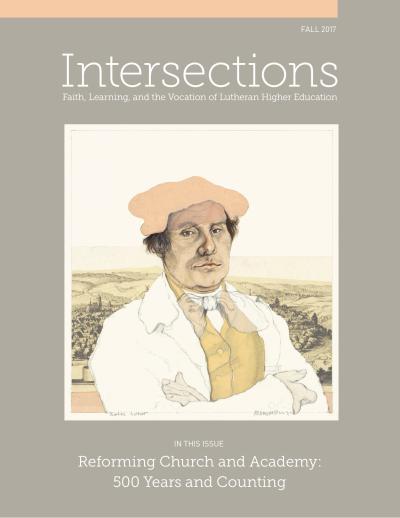
Both Priest and Beggar: Luther among the Poor
Martha E. Stortz
No. 46 · Fall 2017
Reading Luther’s deathbed remark “We are all beggars” against his “priesthood of all believers,” Stortz argues that priest and beggar are two sides of a human reality — one that locates civic responsibility for the poor at the heart of the Reformation legacy and that pushes beyond paternalistic service toward the systemic question of justice.
-
 Article
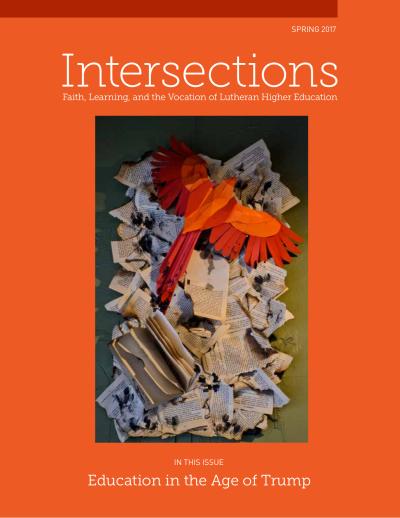
Jonah: The Anti-Hero of Vocation
Martha E. Stortz
No. 45 · Spring 2017
In a chapel talk first given at Augsburg College’s Vocation 2.0 series in September 2016, Stortz reads the prophet Jonah as the great anti-hero of vocation — one who tries to outrun God’s call to the great city of Nineveh — and argues that, in a season of urban violence and divisive election-year rhetoric, the story is less about public calling than about being called by the publics in our midst.
-
 Article
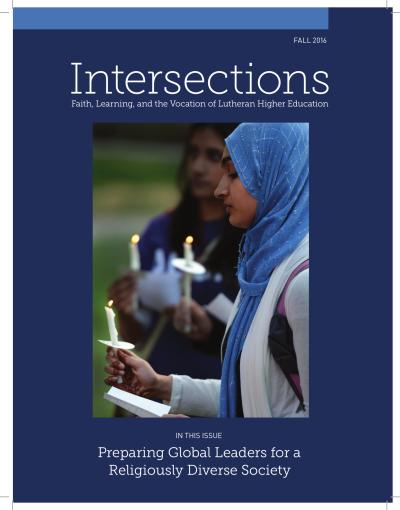
Why Interfaith Work is Not a Luxury: Lutherans as Neighboring Neighbors
Martha E. Stortz
No. 44 · Fall 2016
Stortz argues that interfaith work is not a luxury but a constitutive commitment of Lutheran higher education — institutions she describes as both “faith-based and interfaith-dependent.” Reading the parable of the Good Samaritan as both an intra-faith and inter-faith encounter, she offers a four-fold matrix of theological reflection, spiritual engagement, social action, and everyday experience as portals into the work of being neighbor.
-
 Editorial
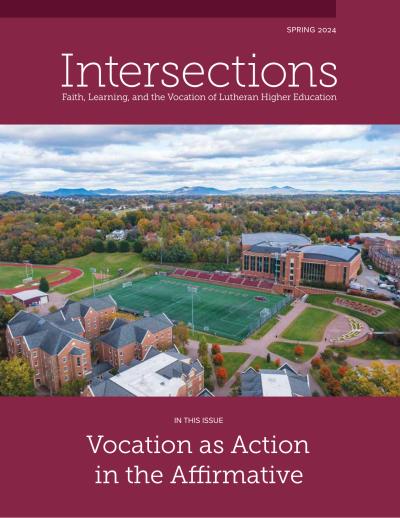
From the Publisher: Navigating Affirmative Action, DEI Policies, and Lutheran Vocational Identity
Lamont Anthony Wells
No. 59 · Spring 2024
Wells surveys the converging pressures on NECU institutions — the unsettled landscape of affirmative action, political and academic scrutiny of DEI work, and the preservation of distinctively Lutheran vocational identity — and previews how the issue draws on affirmative practices, sociological viewpoints, and theological responses to navigate a path forward.
-
 Editorial
From the Publisher & Editor
Colleen Windham-Hughes, Lamont Anthony Wells
No. 63 · Spring 2026
6 min audio
Wells and Windham-Hughes frame vocation as “ground game” — the practical, public living-out of faith through civic engagement — and introduce the issue’s focus on how Lutheran higher education equips students to repair the world.
-
Article
The Promise and Peril of the Interfaith Classroom
Matthew Maruggi
No. 44 · Fall 2016
Maruggi draws on his years teaching in the Augsburg religion department to identify three pairs of seeming opposites — dialogue and debate, safety and risk, commonality and particularity — that, held in creative tension, nurture a vibrant interfaith classroom where pluralism is actively engaged rather than merely present.
-
 Article
A Lutheran Call for Educator Flourishing
Krista E. Hughes
No. 58 · Fall 2023
Hughes argues that without educator flourishing there is no student flourishing, traces how an exploitative “passion tax” can distort vocation, and offers seven Lutheran “third-way” value pairings — including Metrics/Grace, Efficiency/Kairos, and DEI/Priesthood of All Believers — to reframe institutional success at NECU campuses.
-
 Article
Why Interfaith Understanding is Integral to the Lutheran Tradition
Jason A. Mahn
No. 40 · Fall 2014
Mahn returns to the root of the Lutheran tradition — church, theology, and pedagogy — to argue that interfaith encounter is not the vanishing point of Lutheran identity but central to it, beginning with confession of Luther’s anti-Judaic legacy, working through the typology of exclusivism / inclusivism / pluralism, and showing how the kenotic Christ and the theologian of the cross open Lutherans to authentic encounter with religious others.
-
 Article
Reclaiming Grundtvig at Grand View College
Mark C. Mattes
No. 27 · Spring 2008
Mattes traces the Grundtvigian heritage of Grand View College — the only North American institution founded by Grundtvigian Danes — from its origins in the 1880s split between Pietist Inner Mission and Grundtvigian Danish Lutherans through its golden years of folk dancing, gymnastics, and the weekly lecture, to the demographic and curricular changes of the 1950s through 1990s. He describes recent tangible initiatives, including the Grand View College Reader, Imaging the Journey, and the 2007 Strategic Planning Commission’s “Faith Foundations” statement, that seek to recover the “Human first, then Christian” mantra of Grand View’s ancestors for a generation of students whose “ship” has had not only its planks but its very model replaced.