The following essay was originally given as a chapel talk on September 16, 2016 at Augsburg College in Minneapolis as part of a series called Vocation 2.0. Here vocation becomes a civic calling, a summons to be public, to be in public, and to participate in public life. This talk looks back on a season of violence in cities across the country: the Dallas police shootings in July 7, 2016, escalating murder rates in the city of Chicago, and, closer to home, the deaths of Jamar Clark in North Minneapolis on November 15, 2016 and Philando Castile in Falcon Heights, Minnesota on July 6, 2016. Now, in the wake of a divisive presidential election, violent rhetoric enters the public square, polluting cities with hate speech and hate crimes. Ever relevant is Jonah, the reluctant urban prophet, whose story underscores the importance of the city to the people—and the many animals!—in them, but also, and especially, to God.
In this series on Vocation 2.0, Jonah seems an odd subject. After all, Jonah may be the great anti-hero of vocation. He’s also the person we need to pay attention to even—and especially—now.
God calls Jonah; Jonah runs in the opposite direction. God asks him, a good and upright Jewish man, to “Go to great city of Nineveh and tell them to end their wicked ways.” Now, to a Jew Nineveh lay in enemy territory; it was in the country of the Assyrians. Nineveh was the Paris, the Mexico City, the Shanghai of the ancient world, an “exceedingly large city,” a city of “a hundred and twenty thousand people—and many animals,” a city it takes “three days to walk across.”
Maybe Jonah thinks this calling is beneath his pay grade. Maybe he crosses borders with difficulty. Maybe his passport has expired. But he’s quite certain the God of Israel should not bother with the Ninevites and Assyrians, because they’re not part of the “chosen tribe.” They don’t worship the God of Abraham and Sarah and Hagar, Isaac and Rebekah, and Jacob and Rachel and Leah. So Jonah boards a ship heading across a different sea. He thinks he can outrun God’s call.
A huge storm comes up and threatens to sink the ship. The sailors row mightily against the waves, then determine some god among their passengers is angry. The question is: whose? Only under pressure does Jonah say who he is, whom he worships, and why this God might be a bit upset with him. He recommends the sailors pitch him overboard.
“So Jonah boards a ship heading across a different sea. He thinks he can outrun God’s call.”
The sailors do not worship Jonah’s God, the God of Abraham, Isaac, and Jacob, but they strive to save their entire cargo. They struggle valiantly against the wind and the waves. But finally, and only as a last resort, they do as Jonah urged and throw him into an angry sea. Immediately, the waters calm, and the sailors give thanks to Jonah’s God. Meanwhile, under a sea grown suddenly quiet, Jonah is gobbled up by a great fish.
From the belly of a whale Jonah pleads to his God for deliverance, promising to do anything he’s asked. It’s a beautiful prayer—and heartfelt. Distress has a way of focusing devotion. The great fish spits Jonah out onto dry land.
God has other plans for Jonah.
Again, the call comes to Jonah: “Go to the people of Nineveh and tell them to end their wicked ways.” And this time, Jonah does as he promised from the belly of the whale. He goes to the great city of Nineveh; he walks around the city for three days, preaching repentance.
And lo! It works. The king decrees a city-wide fast, and the people comply; the king decrees that all the people—and all the many animals, put on sackcloth, and they wrap up like hot dogs. The king decrees wailing, lament, and loud expressions of repentance, and there’s lots of noise.
And now we come to the crucial passage:
When God saw what they did, how they turned from their evil ways, God changed his mind about the calamity that he had said he would bring upon them; and he did not do it.
But this was very displeasing to Jonah, and he became angry. He prayed to the LORD and said, “O LORD! Is not this what I said while I was still in my own country? That is why I fled to Tarshish at the beginning; for I knew that you are a gracious God and merciful, slow to anger, and abounding in steadfast love, and ready to relent from punishing. And now, O LORD, please take my life from me, for it is better for me to die than to live.” And the LORD said, “Is it right for you to be angry?”
Then Jonah went out of the city and sat down east of the city, and made a booth for himself there. He sat under it in the shade, waiting to see what would become of the city. The LORD God appointed a bush, and made it come up over Jonah, to give shade over his head, to save him from his discomfort; so Jonah was very happy about the bush. But when dawn came up the next day, God appointed a worm that attacked the bush, so that it withered. When the sun rose, God prepared a sultry east wind, and the sun beat down on the head of Jonah so that he was faint and asked that he might die. He said, “It is better for me to die than to live.” But God said to Jonah, “Is it right for you to be angry about the bush?” And he said, “Yes, angry enough to die.” Then the LORD said, “You are concerned about the bush, for which you did not labor and which you did not grow; it came into being in a night and perished in a night. And should I not be concerned about Nineveh, that great city, in which there are more than a hundred and twenty thousand persons who do not know their right hand from their left, and also many animals?” (Jonah 3:10-4:11)
Gone are the sailors and the big waves; gone the king and his urgent decrees; gone all the people and the many animals bound in sackcloth. The story ends with only three characters left standing: the great city of Nineveh, God, and Jonah. There’s a worm-eaten bush, but that’s only a pedagogical device. What could this odd trio—a city of 120,000 people and many animals!, a God who changes his mind, and the anti-hero of vocation—possibly have to tell us about Vocation 2.0?
“Cities were places where trade bustled, arts flourished, and people of all origins and colors and gods forged a common life. Yes, it was messy and yes, it was contentious.”
First, the great city of Nineveh. It’s the whole reason for the story in the first place. In the end, Jonah is not even the hero of his own story; the great city of Nineveh is. For in the ancient world, great cities mattered. Cities were places where trade bustled, arts flourished, and people of all origins and colors and gods forged a common life. Yes, it was messy and yes, it was contentious. Yes, violence erupted, but on those rare occasions when it worked, great cities sparked human hope and divine delight. Great cities mattered, and all the lives in them—black and white, yellow and red, four-pawed and two-legged. Talk about public calling; this is the public to which God calls Jonah.
Now, let’s turn to God. Nineveh is not only the public to which God calls Jonah. Nineveh is the public that calls God. This great city commands divine attention. When God regards the conversion of the great city, God’s own heart softens. Nineveh’s repentance converts God, daring God to display in it the full sweep of divine mercy. For in the end, God’s mercy always outruns God’s judgment.
And then finally, there’s Jonah, that anti-hero of vocation. He wants God to be merciful to him and to his tribe—and judge everyone else. He’d rather die than believe in a God whose mercy extends into enemy territory.
So Jonah tries not only to outrun his own calling, he even tries to outrun the plot line of his own story, attempting to close it out in an overseas escape, in an angry sea, in the belly of a whale, and finally, in an outright appeal to God to end his life.
And do you know what? That’s OK: the story is not about Jonah anyway. He’s not going to lose his identity; he’ll just lose the privilege of having God all to himself. He’s not going to lose his life, he’ll just lose his story. But if he can stand it, he’ll gain a dazzling display of divine compassion.
Because in the end, the story of Jonah is not a story about Jonah, his gifts, his calling at all. It’s a story about the vastness of God’s mercy—and the futility of trying to dictate it or even resist it. It’s not a story about public calling. It’s a story about being called by the publics in our midst. It’s not a story about a hero at all, but a story about the compassion of God for a great city—and the dare to be similarly moved.
“The story of Jonah is not a story about Jonah, his gifts, his calling at all. It’s a story about the vastness of God’s mercy—and the futility of trying to dictate it or even resist it.”
Vocation 2.0? Maybe we need a new operating system for the human heart, an operating system that opens us to the great cities in our midst. Think of Ferguson, Baltimore, Dallas, Chicago, North Minneapolis, Falcon Heights.
May we all be called by the cries of the great cities in our midst.
-
 Editorial
From the Publisher
Mark Wilhelm
Wilhelm describes how ELCA colleges and universities have shifted the definition of Lutheran higher education away from institutional markers toward alignment with educational values drawn from the Lutheran intellectual tradition — and previews a NECU-convened faculty working group whose recommendations will go to the ELCA college presidents at their June 2017 conference on Lutheran identity.
-
Editorial
From the Editor
Jason A. Mahn
Mahn introduces “Education in the Age of Trump” by recounting a difficult academic year on his own campus — the Augustana “chalking” incident, a Latinx Unidos rally, and post-election conversations with marginalized students and quietly conservative Trump supporters alike — and frames the issue’s essays as careful (re)imaginings of the vocation of Lutheran higher education in an anxious political climate.
-
Article
Higher Education in the Age of Trump
Daniel B. Braaten
Braaten surveys what the Trump administration has and has not done on higher education — from the selection of Betsy DeVos and a rumored Falwell-led task force to the travel ban and expanded deportation priorities — and argues that Lutheran colleges, guided by the ELCA’s social message on immigration, have a special obligation to consider what they will do to protect their most vulnerable students.
-
Article
Resistance in the Age of Trump: An Interview with Ivonne Wallace Fuentes
Jason A. Mahn, M. Ivonne Wallace Fuentes
In conversation with Jason Mahn, Roanoke College historian Ivonne Wallace Fuentes describes how she launched a local chapter of Indivisible after the 2016 election, how the skills of teaching and historical research carry over into grassroots advocacy, and how her sense of vocation (vocare) has become intertwined with the work of advocacy (advocare).
-
Article
Religion in the Age of Trump
Daniel A. Morris
Morris reads the 81% evangelical vote for Donald Trump through two historical theses: that evangelicals’ once-coherent story about Godly participation in political life has fallen apart, and that their long-running tendency to exclude others — once aimed at Black Americans and Catholics — has now turned decisively against Muslims. He argues that scholars of religion and politics have a responsibility to tell these stories well, and that appeals to classroom objectivity can no longer be a luxury.
-
Article
Room at the Table: Reflections on Identity and Inclusion from a Lutheran-Friendly Muslim
Rose Aslan
Aslan reflects on her experience as a Muslim professor of Islamic studies at California Lutheran University — teaching “Introduction to Christianity” from her strengths in the Abrahamic religions, preaching an Eid khutba in a Lutheran chapel, and conversing with the university’s convocators — and proposes “Lutheran-friendly Muslim” as a way of being host and guest at once in a pluralistic Lutheran institution.
-
Article
Why Did the Chicken Cross the Road? A Homily on Liminality and Vocation
Lori Brandt Hale
Drawing on Wes Moore’s The Other Wes Moore, Warren St. John’s Outcasts United, Victor Turner’s anthropology of liminality, and Dietrich Bonhoeffer’s poem “Who Am I?”, Hale considers how Hmong, Muslim, Latinx, LGBTQ+, non-traditional, and other students live in “double liminal” spaces — and asks whether liminality might itself be a place of transformation in conversations about vocation.
-
Poem
Poetry: After Months of Clouds, the Sun; First Bird
Farah Marklevits
Two poems by Augustana writing instructor Farah Marklevits: “After Months of Clouds, the Sun” calls the reader up from a desk of doom-scrolling addiction and into breeze and light, while “First Bird,” epigraphed by Emily Dickinson, watches a robin flit through mid-January Midwestern loam as a phenological fairy tale of dread and the urge to live.
-
 Article
The Responsible Professional: Vocation and Economic Life
Martha E. Stortz, Tom Morgan
No. 51 · Spring 2020
Stortz and Morgan argue that the “value-added” of Lutheran higher education is a responsibility ethic — one that frames the professional as a first responder “called and empowered to serve the neighbor so that all may flourish” — and unpack the four criteria of the 1999 ELCA social statement Sufficient, Sustainable Livelihood for All as a framework for economic deliberation.
-
 Article
The "V" Word: Different Dimensions of Vocation in a Religiously Diverse Classroom
Martha E. Stortz
No. 50 · Fall 2019
Stortz responds to a sea of blank stares when she used the word “vocation” in a religiously diverse required course by offering five metaphors — place, path, relationships, lens, and story — that point to different dimensions of vocation across the world’s religions and help students articulate their callings on their own terms.
-
 Article
Marked by Lutheran Higher Education
Martha E. Stortz
No. 49 · Spring 2019
Stortz offers an “operating manual” to Rooted and Open by tracing how the writing team moved from descriptive marks of the institutions to aspirational verbs that mark people — “called and empowered, to serve the neighbor, so that all may flourish” — and shows how each mark generates educational priorities theologically grounded in the radical mystery of God, the wild generosity of God, and the God who became one of us.
-
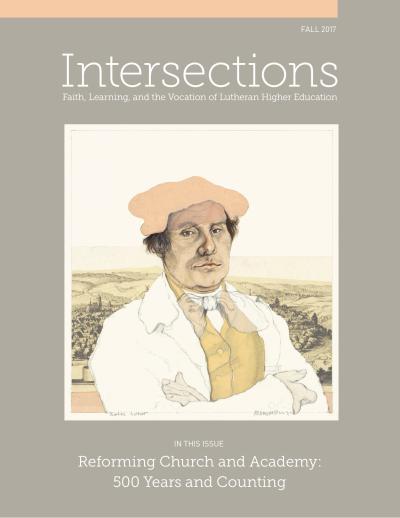 Article
Both Priest and Beggar: Luther among the Poor
Martha E. Stortz
No. 46 · Fall 2017
Reading Luther’s deathbed remark “We are all beggars” against his “priesthood of all believers,” Stortz argues that priest and beggar are two sides of a human reality — one that locates civic responsibility for the poor at the heart of the Reformation legacy and that pushes beyond paternalistic service toward the systemic question of justice.
-
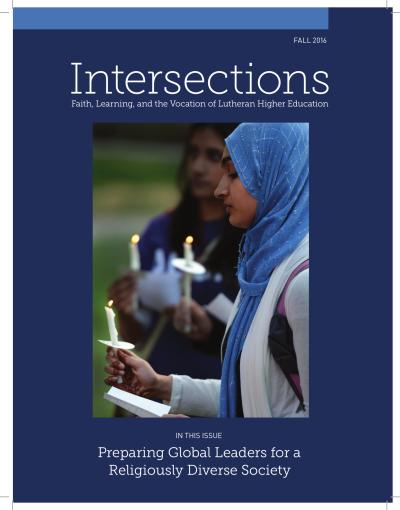 Article
Why Interfaith Work is Not a Luxury: Lutherans as Neighboring Neighbors
Martha E. Stortz
No. 44 · Fall 2016
Stortz argues that interfaith work is not a luxury but a constitutive commitment of Lutheran higher education — institutions she describes as both “faith-based and interfaith-dependent.” Reading the parable of the Good Samaritan as both an intra-faith and inter-faith encounter, she offers a four-fold matrix of theological reflection, spiritual engagement, social action, and everyday experience as portals into the work of being neighbor.
-
 Book Review
The Courage to Change: Creating New Hearts with Palmer and Zajonc
Martha E. Stortz
No. 39 · Spring 2014
Stortz reads Parker Palmer and Arthur Zajonc’s The Heart of Higher Education from the landscape of Lent and notes that the book’s strategies all target students, not their professors. Drawing on her own Faculty Formation Group at Pacific Lutheran Theological Seminary and the Ignatian Colleagues Program at Jesuit institutions, she asks what a Lutheran analogue might look like that would form the educators who teach for transformation.
-
 Editorial
From the Editor
Robert D. Haak
No. 22 · Spring 2006
Haak introduces himself as the new editor inheriting the journal from Tom Christenson and frames the issue around the question of what ELCA colleges might contribute to conversations about human sexuality. He summarizes the contributions of Yeager, Benne, Williams, Bussie, and Nack, and shares previously uncollected National Study of Youth and Religion data on the sexual attitudes and behaviors of Lutheran teens—including that 25% of regularly-attending ELCA teens report the church has done nothing to help them with their sexuality.
-
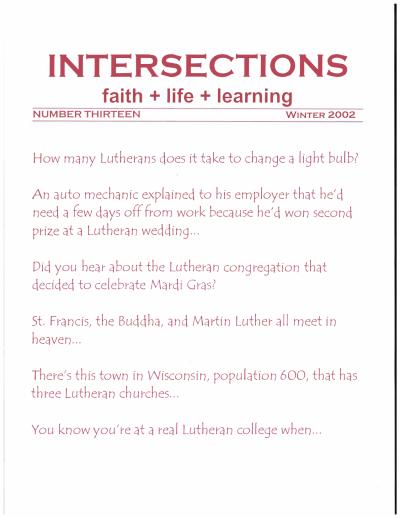 Article
Freedom, Humor, and Community: A Lutheran Vision for Higher Education
Darrell Jodock
No. 13 · Winter 2002
Jodock’s inaugural lecture for the Bernhardson chair at Gustavus Adolphus develops three interlocking themes drawn from the Lutheran tradition as a deeper grounding for the liberal arts college than contemporary American assumptions. A sense of humor rests on Luther’s discovery that God takes the initiative—Luther could call himself a beggar, joke about the epistle of James, and credit Wittenberg beer for the Reformation—and underwrites the freedom of inquiry that John Updike traces to Grace Lutheran Sunday School in Shillington. Community, grounded in Augsburg Confession VII and Luther’s 1524 letter to the German city councils, makes the college a community of discourse pursuing wisdom rather than “the same old blockheads.” Freedom is both “freedom from” and “freedom for,” illustrated by Nechama Tec’s Polish Holocaust rescuers and by Jodock’s Holocaust-class corporate role-play in which students voted to build a factory in a death camp rather than risk losing their board seats—a vivid case for educating toward “a passion for justice.”
-
 Reflection
VLHE—Wednesday Morning Sacred Pause
Ann Rosendale
No. 62 · Fall 2025
8 min audio
Rosendale draws on Esther 4:14 and the Lutheran practice of holding death and resurrection together — with “and” as the hardest word — to argue that the calling of Lutheran higher education for “just such a time as this” requires us to remember and name out loud that ours are places where God is at work.
-
Article
The Challenge of Inclusion in the Ethics Classroom
Faith Wambura Ngunjiri
No. 51 · Spring 2020
Ngunjiri, the only Black woman tenured faculty member at Concordia College, reflects on her students’ resistant and resonant responses to MLK Day programming on “Not Racist: A White Moderate Myth” — and on what it takes to make the ethics classroom a place where students can “BREW”: Becoming Responsibly Engaged in the World.
-
Article
Celebrating the Reformation: The Lutheran Foundation of a Called Life
Mark D. Tranvik
No. 46 · Fall 2017
Tranvik traces vocation from the monastic impulse through Luther’s rejection of the monk’s vow as the only true calling, and translates the “called life” for twenty-first-century Lutheran colleges — institutions that see students as made in the image of God, enlist the whole community in discernment, and make room for faith and its convictions.
-
 Editorial
From the Editor
Jason A. Mahn
No. 35 · Spring 2012
Mahn introduces five essays from the 2011 Vocation of a Lutheran College Conference at Augsburg, framing how Torvend, Anderson, Svennungsen, Tunheim, and Pribbenow press Lutheran colleges to turn outward—recovering the public character of Luther’s gospel, forming students for moral deliberation, investing in the infrastructure of civic renewal, and pursuing justice and education “off the main road.”