Forming the Division for Access, Equity & Belonging at Susquehanna University
Amy Davis
Susquehanna University
Dena Salerno
Susquehanna University
María L. O. Muñoz
Susquehanna University
Nina Mandel
Susquehanna University
Scott Kershner
Susquehanna University
Intersections No. 59 · Spring 2024
In 2024, Susquehanna University turns 166 years old. The longevity of the institution is anchored in the ideal of access and opportunity even as the recipients and delivery of such access and opportunity has shifted over this century and a half. Access to education was a fundamental value for Susquehanna University from its founding and continues to shape our thinking and institutional commitments. Susquehanna’s founder, The Rev. Benjamin Kurtz, approached the village of Selinsgrove (located on the Susquehanna River forty-five miles north of Harrisburg) and found it willing to offer land and support in exchange for the education of its sons and daughters. Bolstered by local boosters, the Missionary Institute was founded (1858) to provide a free education to equip young men of limited means who wanted to become preachers.
Susquehanna Female College was founded simultaneously but incorporated separately. The two were combined in 1898 and adopted the name Susquehanna University. The institution served students who would enter the ministry as well as secular professions. In this, they were representative of the time in which they were founded. It was not until 1928 that the faculty voted to eliminate the granting of graduate degrees and the seminary closed in 1933. Only the baccalaureate-granting College of Liberal Arts, the heart of the institution, remained.
The theological concept of vocation was a central pillar of the Protestant Reformation in Europe (1517). In the Medieval Catholic Church, the concept of vocation was restricted to “ecclesiastical professionals,” priests, monks and nuns serving the church. Martin Luther democratized vocation, rooting it in the calling of all the faithful to serve God and neighbor in daily life. Such an understanding of vocation emphasized faith that was active in lives of love and humble service. The vocation of the priest is no more or less holy than that of a baker or housekeeper. Service to God was demonstrated by supporting the life, health and flourishing of one’s fellow human beings. As Luther’s central ideas are often summarized, “God does not need your good works, but your neighbor does.” From its founding, Susquehanna was animated by this Lutheran sense of vocation to be of service to the world. Whether in the creation of the Missionary Institute to train young men of modest means for lives in the pastorate, to the creation of the Womens’ College and the Classical Institute, the institution that would be incorporated as Susquehanna University was animated by a faith that sought to make a difference in the world by removing barriers to educational access. Many barriers remained, but these ideals continue to be central institutional values as we assess how to increase access and remove barriers today.
“In locating Susquehanna University within the broader history of affirmative action, providing opportunity and access to higher education, has and must remain central to its mission.”
In locating Susquehanna University within the broader history of affirmative action, providing opportunity and access to higher education, has and must remain central to its mission. The commitment to provide education to the children of the Susquehanna Valley’s farming community and women during the second half of the 19th and early 20th centuries, to students of color (African American students in particular) during the mid-20th century, reflect the legacy of Susquehanna’s mission to provide access to education. It is still unclear as to why Susquehanna University was one of the last institutions of higher education in the United States to graduate African American students. The Black History of Susquehanna University (BHSU), an institutional project headed by interim chief inclusion and diversity officer, Dr. María L. O. Muñoz, seeks to not only understand this part of its history, but also tell the histories of Susquehanna University through the lens of Black faculty, staff, and alumni.
While there is no evidence that Susquehanna ever institutionalized affirmative action policies in the student admissions process, in 1969, the Central Pennsylvania Synod voted to support efforts by Susquehanna University and Gettysburg College to recruit Black faculty and other personnel.1 Some efforts continued into the next decades. According to Donald Housley, President Joel Cunningham appointed Philip Winger as an affirmative action officer in 1987, with respect to faculty and staff hiring. The method for how the hiring process was carried out is described as one where if an insufficient number of candidates from a minoritized population were in the hiring pool, such a search was to be halted. Beyond that, there is little discussion as to what that process entailed.2
A few years later, just as Susquehanna completed its 150th year, Lisa Scott arrived at Susquehanna as the inaugural Chief Diversity Officer (CDO) in 2009. In 2014, she was appointed Vice President for Student Engagement and Success, and the CDO role remained vacant until Michael Dixon was hired as Chief Inclusion and Diversity Officer in 2019. According to current President, Jonathan Green, who was inaugurated in Fall 2017, he found an institution that was decentralized in terms of diversity and inclusion with departments and offices duplicating efforts. During one meeting in 2017/2018, several faculty and staff were discussing their efforts in the classroom and in the co-curricular; with faculty and staff, and students. It became clear to President Green that the work was disaggregated and not institutionalized. He recognized the need for change but viewed the absence of a Chief Diversity Officer as a barrier to building a division that would support faculty, staff, and students in a holistic approach to diversity, equity, inclusion, and justice work.3 Once Michael Dixon arrived to serve as the Chief Inclusion and Diversity Officer (CIDO) during Fall 2019, the onset of the Covid-19 pandemic after March 2020, delayed the development of the office that came to be named the Division for Inclusive Excellence until 2022.
Under Dixon’s guidance, the Division of Inclusive Excellence (DIE) was launched in January 2022. It combined the Center for Diversity & Inclusion, Office of Jewish Life, and Office of Religious & Spiritual Life under the leadership of the CIDO. In August 2023, DIE was renamed to Division for Access, Equity & Belonging (DAEB) with the Center for Diversity & Inclusion (CDI) and the Center for Spirituality & Meaning (CSM) as dual offices that anchor the work of equity and belonging.
While the institution’s chaplains have always been ordained Lutheran ministers, the chaplaincy was charged with supporting and advancing religious diversity within the pluralistic campus community. These commitments took a significant step forward with the hiring of a full-time director of Jewish life in 2009, and the designation of a university-owned house as a center for Jewish community life. This change signaled an awareness that Jewish identity can be both religious and ethnic/cultural. Students who identify as Jewish remain a significant minority in terms of numbers on campus, but many who do identify are interested in connecting with Jewish life in a more holistic way, beyond religious affiliation. Working in tandem with the chaplain, the Director of Jewish Life not only greatly enhanced the experience of Jewish students but advocated for the importance of religious diversity broadly within the institution. Prior to this, support for Jewish students relied on the volunteerism of a small number of Jewish faculty and staff. In addition, during the 2010s, religious life at Susquehanna came to focus increasingly on interfaith engagement. This focus on religious diversity set the stage for Religious & Spiritual Life, and Jewish Life being part of the newly created Division for Access, Equity & Belonging. In another step toward deepening our commitments to religious and spiritual diversity and the support of all students in an increasingly pluralistic campus, Religious & Spiritual, and Jewish Life came together in the summer of 2023, to form the Center for Spirituality & Meaning.
Collectively, DAEB is principally responsible for the strategic direction and vision for diversity, equity, inclusion, belonging, and justice at Susquehanna University. While the recently created DAEB “houses” both intercultural centers, it is simultaneously a space for potential inconsistencies around institutional vision, strategy, and resources in the equity work at SU. A large part of equity work is a clear articulation of the disparate representation, experiences, and outcomes for minoritized communities, captured in consistent data and punctuated by narratives on climate. Because effective equity efforts aim to allocate resources and opportunities as needed to create equal outcomes for all, a division dedicated to these efforts should be guided by a clear and transparent assessment of such a distribution across the institution. These will go a long way in the shift in organizational culture and help grow intercultural competence.
“Collectively, DAEB is principally responsible for the strategic direction and vision for diversity, equity, inclusion, belonging, and justice at Susquehanna University. While the recently created DAEB ‘houses’ both intercultural centers, it is simultaneously a space for potential inconsistencies around institutional vision, strategy, and resources in the equity work at SU.”
The DAEB is poised to begin this assessment work and is also positioned more broadly to influence DEI efforts across the institution. Whereas in former iterations, DEI work was under the purview of Student Life and confined to student-facing programs, the DAEB has the latitude to assess and develop SU’s infrastructure through faculty/staff initiatives. The DAEB, for example, piloted and maintains a faculty/staff professional development series, the Building Inclusive Excellence Curriculum (BIEC), to expand intercultural knowledge and opportunities for critical dialogue around social justice issues. Additionally, the division, in collaboration with the Faculty Affairs Committee and Human Resources, has implemented a robust equity search advocate process and training to bolster equitable search practices and address the systemic barriers which disparately impact hiring people from underrepresented communities. Philosophically, the expansion into embedded DEI work as a holistic endeavor denotes progress and reflects the long-term vision of the institution. In these ways, the division’s work follows the philosophy behind affirmative action in providing opportunities for access in the faculty and staff realm.
However, the centralization of DEI efforts can also preserve the status quo when the division that guides these efforts may not be sufficiently funded and empowered. If Susquehanna is to address and manage the demographic cliff (decline in overall number of university aged young people) and the demographic shift (rising number of eligible university aged people from minoritized communities), it must continue to provide adequate funds to create the infrastructure and spaces to support both recruitment and retention. To that end, when charting a long-term institutional business strategy, DEI work must be taken into consideration in a way that is “measurably and sustainably embedded into its every dimension.”4 Similarly, a fully empowered DAEB can better influence cultural change when the division is positioned and recognized as field experts who can guide the policy development that undergirds effective equity efforts. The creation of an equity search advocate process, for example, without the ability to enforce its implementation as policy, can create the illusion of equitable practices without having significant impact. Susquehanna University has created space for this essential DEI work, and spaces that are intentional, resourced, and centered can be a precursor to a community of belonging.
The present priorities of collegiate diversity, equity, and inclusion work have shifted alongside social, cultural, and political landscapes. While increasing access is still an essential commitment of diversity and inclusion, the question of how to foster belonging, specifically for minoritized populations, rises to the top as a central concern and focus. Even with increasing numbers in representation, minoritized groups continue to report inequitable experiences, and gaps in retention and achievement at the national level remain.
At Susquehanna University, the question of belonging has most recently informed programming strategies and efforts to institute inclusive procedures and policy. Building affinity spaces, increasing coalition across different minoritized populations, and implementing best-practices such as peer mentorship in programming have proven effective for our campus. When we consider our context as a small, rural, liberal-arts institution in central Pennsylvania with little representation of historically excluded groups in the community at large, space becomes a key component of the conversations around crafting a sense of belonging.
“Building affinity spaces, increasing coalition across different minoritized populations, and implementing best-practices such as peer mentorship in programming have proven effective for our campus.”
For over a decade, the campus hosted only one space aimed at providing a space of belonging for minoritized groups. Nevertheless, as students of color and LGBTQ+ populations have grown significantly, the space could no longer adequately serve this purpose. At the height of the pandemic, the Center for Diversity and Inclusion transformed a conference room into the Diversity Empowerment Nest (DEN), which is now used as a meeting space for nearly every diversity student organization and is open to all students for use. In addition, in 2020, Indigenous students successfully proposed a tribute circle to honor the Susquehannock people as original inhabitants of our campus. And in 2023, we established an LGBTQ+ Resource Center out of an existing space thereby retrofitting our campus to meet the evolving needs of our student body. Mentioned above, the Hillel House has a successful Shabbat dinner on Friday evenings which are attended by all members of the SU community, regardless of religious or ethnic identity.
While the creation of these spaces responded to newly emerging needs or previously underserved communities, we have also developed representational projects in response to bias and discrimination. After an act of vandalism in March 2023, our campus commissioned a local muralist to develop a representational piece of art to be placed on our campus center building. The leadership for this project stemmed from a newly formed group of student diversity organization presidents. Once disaggregated, the individual communities represented in this coalition comprise a smaller fraction of the student body population; together, their constituencies form a formidable solidarity bloc. Leading students in understanding their shared experiences, values, and goals as minoritized communities has allowed for a burgeoning strength in voice and action.
“In addition to showing up at one another’s events, releasing shared messages, and planning collaborative programming, these groups also do the challenging work of negotiating calendars and resources in an equitable and progressive manner.”
In addition to showing up at one another’s events, releasing shared messages, and planning collaborative programming, these groups also do the challenging work of negotiating calendars and resources in an equitable and progressive manner. Besides increased collaboration, there is improved advocacy around issues of safety and security. As the DAEB moves from programming to policy considerations and procedural improvements, we are looking to protect divine nine organizations through policy and to implement a more rigorous bias process on our campus. We must also continue to examine budget lines as they serve as moral documents and speak to the institution’s commitment to the work of not only providing access but also advancing the underlying tenet of affirmative action, access, by also further developing and enhancing retention measures to best serve the campus community.
The Division for Access, Equity & Belonging at Susquehanna University has come a long way since its formation in early 2022. We also recognize that there is still much to do. This work represents a legacy of access rooted in our Lutheran origins. To advance in this present moment, we might continue to draw from the lessons of the past. While access was central to the inception of Susquehanna University, those efforts were bifurcated along gender lines and completely excluded Black Americans for many decades. We must deeply examine where separation and exclusion continue as we move toward a new definition and practice of access, equity, and belonging in our current context. Our new centralized division, which boasts new physical spaces and initiatives, must also continue to receive needed resources and address policy revisions to continue this commitment to access.
Endnotes
1. Standard-Speaker, Hazleton, Pennsylvania, June 13, 1969.
2. Donald D. Housley, Susquehanna University, 1858-2000: A Goodly Heritage (Selinsgrove: Susquehanna University Press, 2007), 559.
3. Interview with Jonathan Green by María L. O. Muñoz, January 2024.
4. Shaun Harper, “12 Ways CEOs And Companies Fail Chief Diversity Officers,” Forbes Magazine, February 14, 2023. https://www.forbes.com/sites/shaunharper/2023/02/14/12-ways-ceos-and-companies-fail-chief-diversity-officers/?sh=c4785d1125be
-
 Editorial
From the Editor: Vocation as Action in the Affirmative
Colleen Windham-Hughes
Windham-Hughes frames vocation as practicing “at the borders of our incompetence” — every small yes to the callings we experience, every effort made in the direction of life, is action in the affirmative — and previews the issue’s essays on diversity, transformation, AI, championship team culture, and dreaming big within and beyond our limitations.
-
Editorial
From the Publisher: Navigating Affirmative Action, DEI Policies, and Lutheran Vocational Identity
Lamont Anthony Wells
Wells surveys the converging pressures on NECU institutions — the unsettled landscape of affirmative action, political and academic scrutiny of DEI work, and the preservation of distinctively Lutheran vocational identity — and previews how the issue draws on affirmative practices, sociological viewpoints, and theological responses to navigate a path forward.
-
Article
On Recruiting Diverse Students, Rooted in Mission
Eric Rowell, Jason A. Mahn
Jason Mahn interviews Eric Rowell, Assistant Director of Admissions and Diversity Outreach at Augustana College, about how recruiting students from a wide variety of backgrounds — rooted in Augustana’s Lutheran commitment to vocation and educating across difference — remains essentially unchanged in the wake of the Supreme Court’s 2023 decisions on affirmative action.
-
Article
What Our Lutheran Heritage Entails for Lutheran Colleges and Affirmative Action
Mark Ellingsen
Ellingsen argues that the Lutheran Two-Kingdom Ethic — far from leading to political reaction — supports the church-relatedness of ELCA colleges and obligates them to keep affirmative action alive, even reading a Chief Justice Roberts “loophole” in Students for Fair Admissions v. Harvard as an open door for Black community partnerships, ELCA congregations, and Lutheran colleges to act in the affirmative.
-
Reflection
On the Power of Transformation and Becoming Human
Ken Yanai Flores
Flores, a Cal Lutheran sophomore, reflects on personal and institutional transformation as the slow work of shedding the armor of trauma responses, engaging discomfort rather than turning away, and trusting that the work of becoming more human — more empathetic, knowledgeable, and free — will be reflected in our institutions as well.
-
Article
The Critical Role of Lutheran Higher Education in the Age of Artificial Intelligence
Jose Marichal, Maya Goehner, Tyler Haug
A Cal Lutheran political science professor and two of his students draw on Rooted and Open to argue that Lutheran higher education is uniquely positioned to stake out a middle path between AI utopianism and AI doom — cultivating a “healthy sense of human limit,” resisting data colonialism, and forming students to see the neighbor rather than the enemy as the world becomes increasingly synthetic.
-
Article
Team Culture is Key to Success: Learning from Student-Athletes
Colleen Windham-Hughes
On a December weekend in “Championship City” Salem, Virginia, both California Lutheran’s Women’s Soccer Team and St. Olaf College’s Men’s Soccer Team won NCAA Division III national titles. Windham-Hughes talks with coaches, faculty mentors, and student-athletes about how off-the-field team culture — built on trust, relationships, and shared why — translates onto the pitch and into liberal arts and sciences education.
-
Article
Low-Hanging Fruit, Moonshots, and Coffee: Dreaming Big Within and Beyond Our Limitations
Jeremy Myers
Myers shares the process used by Augsburg’s Christensen Center for Vocation to help teams move from a shared experience to next steps — an Ignatian-rooted Awareness Examen followed by naming low-hanging fruit, moonshots, and the coffee conversations that build the coalition to make it all happen.
-
 Editorial
From the Publisher
Arne Selbyg
No. 10 · Fall 2000
Selbyg explains that, while Intersections usually publishes papers from the annual Vocation of a Lutheran College conferences, this issue gathers presentations from a St. Olaf 125th-anniversary conference—a companion to the volume Called to Serve edited by Pamela Schwandt—because the theology and educational perspectives behind them apply to any Lutheran college and clarify what makes ELCA church-related colleges excellent institutions for students of any faith.
-
 Article
Radical Hospitality on Haunted Grounds: Anti-Racism in Lutheran Higher Education
Krista E. Hughes
No. 52 · Fall 2020
Writing from Newberry College’s campus on land once home to the Cherokee and within a day’s drive of Mother Emanuel A.M.E., Hughes argues that NECU’s call to “practice radical hospitality” demands that predominately white institutions open themselves to the hauntings of racism — pursuing belonging rather than mere welcome, and risking kenotic transformation of institutional identity itself.
-
 Article
Lutheran Heritage Across the Curriculum: Reflections from a Faculty/Staff Development Seminar
Cynthia Bane, Fred Waldstein, Kathryn A. Kleinhans, Penni Pier
No. 26 · Fall 2007
Four Wartburg College colleagues share fruits of the 2006 Lilly-funded “Discovering and Claiming Our Callings” faculty/staff development seminar in Wittenberg, Eisenach, and Neuendettelsau. Kleinhans frames the curriculum and books used; Bane (psychology) finds Lutheran convictions about the value of humans, the affirmation of creation, and the universality of sin congruent with her discipline; Pier (communication arts) reads Luther as a model of dialectical rhetoric that gives educators permission to challenge students with uncomfortable ideas; and Waldstein (political science) reflects on the paradox of humility and self-confidence in Luther and on the Luther-Melanchthon collaboration as a model for the seminar group’s own work.
-
 Editorial
From the Editor
Tom Christenson
No. 4 · Winter 1998
Christenson thanks the departing Jim Unglaube, recommends Ronald A. Wells’s Keeping Faith: Embracing the Tensions in Christian Higher Education (Eerdmans) as both an interesting collection of essays and a model worth imitating at ELCA institutions, previews the issue’s pieces by Richard Hughes, Carl Skrade and Spencer Porter, Gregory Clark, and Karla Bohmbach, and introduces three new features of the journal: “What I Have Learned” (an essay by a senior or emeritus faculty member, inaugurated by Richard Ylvisaker), “Reviews” (initiated by Karla Bohmbach), and a “Bulletin Board” for cross-campus announcements.
-
 Editorial
From the Publisher
James M. Unglaube
No. 1 · Summer 1996
Unglaube welcomes readers to the inaugural issue of Intersections, crediting Editor Tom Christenson and Capital University, and announces the new annual Vocation of a Lutheran College Conference whose continuing dialogue the journal exists to enhance. He gives thanks to the Lilly Endowment for a sizable grant supporting the 1996 conference, campus dialogues, and the birth of the publication.
-
 Article
A Church, the Human Condition, and the Fissured Face of Peace
D. M. Yeager
No. 22 · Spring 2006
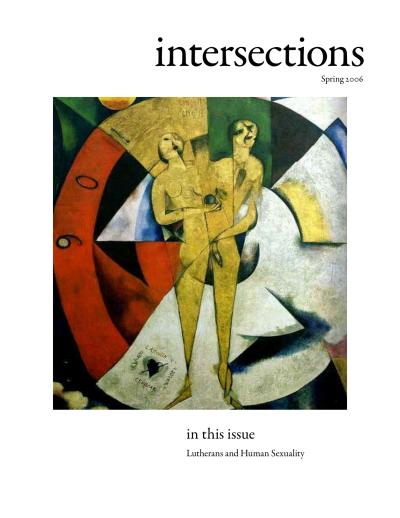
Yeager, a member of the ELCA Task Force for Studies on Sexuality, reflects on lessons for the church’s educational mission in the wake of the 2005 Churchwide Assembly. Drawing on Macquarrie’s The Concept of Peace, Polanyi on the personal coefficient of knowledge, Hannah Arendt’s The Human Condition, and responses to the task force report from Roy Harrisville III and Larry Rasmussen, she proposes “the fissured face of peace”—peace as the absence of hostility rather than disagreement—and maps how Arendt’s five conditions of human existence (life, earth, natality, mortality, worldliness, plurality) might shape Lutheran colleges’ curricula in history, epistemology, and the sociology of knowledge so that graduates can disagree without hostility and embrace the slow work of reformation.