Buford, Thomas O. In Search of a Calling: The College’s Role in Shaping Identity. Macon, GA: Mercer University Press, 1995.
The term “calling” has long been a favorite among Lutheran educators. And though its precise meaning invites debate—indeed, perhaps partly because of that very fact—it continues to be utilized even today in efforts to formulate and refine what it means to be a Lutheran college or university. In such ongoing efforts Thomas O. Buford’s In Search of a Calling: The College’s Role in Shaping Identity would seem to be a promising participant, not least because it makes use of the term “calling” in its title. What, more precisely, does this book offer towards our thinking about tasks, challenges, and promises facing Lutheran colleges and universities as they move into the twenty-first century?
Like others who have also been writing about higher education (e.g., Mark Schwehn, Page Smith, Bruce Wilshire), the author asserts that colleges and universities are in trouble. What sets Buford’s work apart, though, is both his perspective as a philosopher and his assessment that the fundamental cause of this trouble is a crisis of meaning among students.
One of the first tasks Buford sets for himself is determining the causes of this meaning-crisis; his strategy is to examine the historical background in, through, and against which American higher education has developed. Here the concept of “calling” is central, giving shape and focus to the discussion. In the process, Buford also more specifically identifies and explicates what he sees as two aspects of calling. One involves the spiritual, religious, or moral identity of a person (all three terms are variously used). It refers, fundamentally, to that which God has ordained one to do; its roots are in the Hebrew Bible; and it is strongly communitarian. The second has to do with the so-called practical identity of a person. This aspect is much more individualistic; its roots are in the Renaissance; and it centers on the humanists’ assertion that individuals have the right and ability to determine their own lives, to discern their particular gifts, talents, and interests and then choose a life and career based on them.
For Buford, both aspects of calling are necessary in order to achieve full personhood. The crisis facing students is that these two are deemed irreconcilable and so have been largely split asunder by the educational system. Moreover, the practical aspect—under the influence of our technological society—has been given priority, with the concomitant neglect of the moral or theological one. Buford seeks both to reconnect and balance the two sides.
In order to do so, Buford revisits the two historical traditions—the biblical and the Renaissance humanist—that, according to him, have fundamentally shaped the moral/theological and practical aspects of calling. His goal is to find some common ground by which he can reconcile the two traditions—and the two aspects—into some sort of coherent whole. Thus, in looking again at the Renaissance humanist tradition, he “corrects” for its rampant individualism, stressing the social and cultural contexts within which an individual’s choices and decisions are made and shaped. (His position here is actually akin to a type of postmodernism called affirmative (Rosenau), as well as feminist theoretical work focused on the concept of positionality (Alcoff).) In other words, while retaining a degree of individualism in the Renaissance humanist tradition, Buford balances it by also arguing for its somewhat contingent nature.
In Buford’s re-examination of the biblical tradition, he rethinks the meaning of imago dei, the idea that we are created in the image of God. Traditionally, according to Buford, “image of God” has meant “copy of God,” with that which is copied being, most notably, God’s rationality. For humans to be copies, though, implies considerable limitations, for it is then God, understood as the original, who determines human identities. Buford suggests instead that the imago dei in humans be understood not as a copy, but rather as a representation. He further suggests that what is most fundamentally represented about God in humanity is not rationality, but rather imagination. Since imagination implies a certain amount of freedom, human individuality and a certain degree of independence is maintained. Thus, while retaining the biblical assertion that human identity is grounded in God, a certain space—the space of the imagination—is opened up for human initiative and free play.
In Buford’s reconstructions the humanist and biblical traditions come together insofar as they both allow for human freedom, while also both placing limits on that same freedom. One’s calling, then, is to be worked out within the horizon of this tension between freedom and limitation. According to Buford, the task of colleges is to encourage the students’ creative use of their imaginations, helping them to exercise a “new” freedom that they have in college to develop their own life stories (i.e., their “callings”), over against the stories about themselves which they have inherited from their parents, hometowns, friends, schools, and/or churches. Equally, however, it is the duty of colleges to support, indeed, make known, the limitations that exist for students as they begin to take advantage of the possibilities in imaginatively re-writing their stories (i.e., “finding their callings”).
Buford’s book is extremely beneficial in tracing out the broad historical contexts that inform the ideals and interests of the present-day system of American higher education. And he teases out well the complicated intertwining relationships of the biblical and Renaissance humanist traditions—particularly their somewhat distinct perspectives on calling. His breadth is also impressive, for though his professional training is in philosophy, he also makes forays into such diverse fields as biblical studies (in an exegesis of Genesis 1–2), Christian theology (while considering Augustine’s view of personhood), educational psychology (in a review of William Perry’s theory of the developmental stages of students), and business management (in order to summarize and critique the reengineering system proposed by Michael Hammer and James Champy). What is both puzzling and problematic, however, is his final chapter, in which his practical recommendations to colleges are presented.
Although he has earlier affirmed the need to work for a balance between freedom and limitation, his focus here is much more on the idea of maintaining limitations than enhancing freedoms. And, regarding the maintenance of limitations, he identifies two main interrelated obstacles that need to be countered: the canon and multiculturalism. His discussion of the canon is rather puzzling. On the one hand, he pleads for an open canon, because going back to the fixed canon of earlier generations is neither feasible nor desirable (p. 185). On the other hand, he is extremely wary of special-interest groups (i.e., multiculturalists, supporters of women’s rights), which he views as desiring to take over the canon in order to impose their own political agenda onto everyone else. The solution he offers, instead, is to refer back, and utilize again, the biblical and Renaissance humanist traditions, after both have been appropriately reconstructed to suit present-day needs and circumstances. (Buford is not forthcoming on the specifics of what this reconstruction might look like.) His justification for the reappropriation of these two traditions is that they would make the most sense to our students, given their backgrounds.
The problems here are several-fold. First, Buford caricatures so-called special-interest groups. Far from wishing to “take over,” most such groups see themselves, instead, as working to redress an identified imbalance in the canon, wherein its interests, concerns, and viewpoints are weighted towards a relatively narrow band of persons (i.e., white, male, educated, middle-to upper-class, heterosexual). Second, even though he admits that the ideals of the Bible and the Renaissance are no better or worse than those of any other traditions, his appeal to them as the best option (even if they are reconstructed), leads one to suspect—whatever his disclaimers—that he desires a return to an earlier, narrowly-defined, and fixed canon.
The most serious problem, though, seems to be his argument that these two traditions are to be preferred because they would be the most familiar, and thus the easiest, for students. Regarding their familiarity, Buford consistently operates with the notion that every student on campus is equally invested in and/or sympathetic to—not to say knowledgeable of—the ideals of the Bible and the Renaissance. He simply assumes the existence of a homogeneous student body, one in which all students have the same backgrounds and share equally in the same historical/cultural contexts. But that has never been quite the reality in American colleges, whatever the “myth” has been, and is even less so today.
But even if college students are most familiar with the Renaissance and biblical traditions, should we as educators necessarily just accommodate ourselves to their familiarity? Easy is not always the best. One of the reasons Buford gives for concentrating on the Biblical and Renaissance traditions centers on the limited nature of a college’s resources. “To expect an American college to teach every culture and language that students demand, as if those students will live out their calling in those cultures, is beyond the capability of the college…” (p. 190). I am not gainsaying the challenge facing colleges in educating our students in a way that informs them and fosters in them an appreciation of the multiple cultures of the world in which they live. It is a task that requires all the imagination and effort we can possibly marshal. It is, nevertheless, necessary. Our world is becoming ever smaller; the interconnections across political and social boundaries are becoming increasingly numerous and marked. Despite Buford’s disclaimer, it is, in fact, highly likely that a significant number of our students will live out their callings in a culture far different from the one in which they were raised!
We, as educators, need to think harder, and even more imaginatively than Buford advocates, in order to see our way to an education for our students that will satisfy the demands of the 21st century.
Works Cited
Alcoff, Linda. “Cultural Feminism versus Post-Structuralism: The Identity Crisis in Feminist Theory.” In Feminist Theory in Practice and Process, ed. Micheline R. Malson, Jean F. O’Barr, and Mary Wyer, 305–12. Chicago: University of Chicago Press, 1989.
Rosenau, Pauline Marie. Post-Modernism and the Social Sciences: Insights, Inroads, and Intrusions. Princeton, NJ: Princeton University Press, 1992.
-
 Editorial
The Vocation of a Lutheran College: Some Transitional Thoughts
James M. Unglaube
Unglaube offers final reflections on thirty years in Lutheran higher education as he leaves the ELCA Division for Higher Education and Schools to join Carthage College, his alma mater. He recalls colleague Richard Solberg’s influence, the closing of Upsala College in 1995, the Higher Education and Namibia program shared with Naomi Linnell, the growth of endowments from $70 million to $1 billion in 25 years, and the Vocation of a Lutheran College project he credits Paul Dovre with inspiring. He likens the twenty-eight ELCA colleges to flowers on a rose bush—same Lutheran tradition, each blossom different—requiring constant nurture if the partnership between church and college is to thrive.
-
Editorial
From the Editor
Tom Christenson
Christenson thanks the departing Jim Unglaube, recommends Ronald A. Wells’s Keeping Faith: Embracing the Tensions in Christian Higher Education (Eerdmans) as both an interesting collection of essays and a model worth imitating at ELCA institutions, previews the issue’s pieces by Richard Hughes, Carl Skrade and Spencer Porter, Gregory Clark, and Karla Bohmbach, and introduces three new features of the journal: “What I Have Learned” (an essay by a senior or emeritus faculty member, inaugurated by Richard Ylvisaker), “Reviews” (initiated by Karla Bohmbach), and a “Bulletin Board” for cross-campus announcements.
-
Article
Our Place in Church-Related Higher Education in the United States
Richard Hughes
Adapting his 1997 Vocation of a Lutheran College Conference address, Hughes asks how the Lutheran heritage can sustain the life of the mind in church-related higher education. He compares Reformed, Mennonite, and Catholic traditions in turn—the Reformed integration of faith and learning around a Christian worldview, the Mennonite priority of discipleship over cognition, and the Catholic sacramental affirmation of the secular as bridge—before arguing that the Lutheran heritage’s particular gifts (justification by grace, theology of the cross, two kingdoms, paradoxical sensibility, vocation, and openness to ambiguity) uniquely support rigorous inquiry, genuine pluralistic conversation, and critical analysis. Drawing on Arthur Holmes, John Howard Yoder, Mark Schwehn, Alasdair MacIntyre, and Lutheran writers including Bob Benne and Tom Christenson, Hughes contends that Lutheran finitude grounds an unusually open and self-critical academic posture.
-
Article
The Skeptical Theologian's Dictionary
Carl Skrade, Spencer Porter
Porter and Skrade offer selections from a mock-lexicon of theological terms: answer, church, faith, God, grace, hope, justification, love, prayer, sin, soul, and theology, among others. Each entry begins with a standard definition and then unsettles it—answer reminds the reader that in theology and poetry the questions matter more than their answers; church alternates between “the mystical Body of Christ” and ordinary human gatherings whose machinery often obscures the gospel; God is the One whose name we are told not to take in vain and yet whose name we keep using; prayer is communion with God yet often degenerates into a list of demands. The form’s irony exposes the gap between the language of theology and its lived realities—a sober, witty corrective for Lutheran classrooms and chapels alike.
-
Article
The University in the City of God: Beyond Dialectics and Rhetoric
Gregory A. Clark
Clark, drawing on Alasdair MacIntyre’s Three Rival Versions of Moral Enquiry, distinguishes the preliberal, liberal, and postliberal university and argues that the liberal university’s pretense of dialectical neutrality has masked a particular rhetoric of its own. Following John Milbank’s Theology and Social Theory, he holds that every philosophy and institution is finally a rhetoric and that the church’s task is not to win on the secular university’s terms but to proclaim and embody an alternative city. The Christian college, then, should give up the apologetic pose of meeting secular reason halfway and instead practice the rhetoric of the gospel: a proclamation of Jesus, an enactment of Christian friendship and peace, and a willingness to be vulnerable to the violence of the world as Jesus was vulnerable to his own. Clark commends this stance to colleges related to the church.
-
Article
A God of Peace and Love? Reflections From a Biblical Scholar
Karla G. Bohmbach
Bohmbach responds to Gregory Clark’s call to proclaim Jesus on Lutheran campuses with biblical-scholar reservations. Israel’s sacred texts also include the herem ban, the conquest narratives, and a God who fights for Israel; the Christian canon includes the apocalyptic violence of Revelation. To proclaim Jesus is therefore to proclaim a particular and contested figure within a tradition that has its own internal violence—not a generic God of peace and love. Bohmbach asks what it would mean for staff, administrators, and teachers on a college campus to take seriously the Jesus who made himself vulnerable to the violence of his world, even to the point of suffering for it, and whether Lutheran colleges are prepared for such a vocation.
-
Article
What I Have Learned: Maybe Plato Was Right
Richard Ylvisaker
Inaugurating the new “What I Have Learned” column, Ylvisaker reflects on a career of teaching philosophy at Luther College and offers four hard-won “preliminary examples” in which Plato turned out to be more right than fashionable criticism allowed: (1) communities are not necessarily better off by becoming more diverse—diversity needs a unity of purpose if it is to enrich rather than fragment; (2) politics, to be more than a struggle for power by competing interests, must rest on a moral basis that transcends those interests; (3) the much-derided body-soul dualism contains a measure of truth about the cognitive and moral limitations of embodied life; and, deepest of all, (4) reason itself depends on a community of discourse in which doctrinaire pronouncement gives way to disciplined inquiry. Athens and Jerusalem, he concludes, should meet at the college of the church.
-
Article
A Response to Paul Santmire: The Lutheran Liberal Arts College and Care for the Earth
Arthur A. Preisinger
Preisinger commends much of Paul Santmire’s earlier essay—the critique of the “back-to-nature” cult, the call for a holistic environmental ethos, the suggestion of a cosmic liturgical praxis—but takes issue with Santmire’s reading of classical Lutheran social ethics. He argues that the two kingdoms doctrine was not a systematic Lutheran treatise (the term itself became common only in the 1930s), that the doctrine’s misuse by some twentieth-century German theologians does not condemn its proper use, and that the South African Council of Churches actually deployed the doctrine (correctly interpreted) against apartheid. Drawing on Karl Hertz, Ulrich Duchrow, Tom Strieter, and F. Edward Cranz, Preisinger defends the doctrine as complementary duality—left hand and right hand of God, governances to be distinguished but never separated—and concludes with Bill Lazareth that the skeletons in the Lutheran closet are not Luther but departures from Luther.
-
Article
A Response to Paul Santmire
Don Braxton
Braxton appreciates the dialectical structure of Santmire’s mandates—“skeletons in our closets and riches in our own vaults”—and reads it as a faithful expression of the Lutheran tradition of Paul, Augustine, and Luther. He argues that Santmire is on target in warning against premature flight to non-Christian traditions for environmental wisdom (theoretical sensitivity does not translate into ecological behavior in practice), and that classical Lutheran social ethics has too often been quietistic. But Lutheran ethics at its best is dialectical, not dualistic—recognizing the interpenetration of church and world, Law and Gospel, eschatological Kingdom and present realities, as in Hegel, Ritschl, Bonhoeffer, Reinhold Niebuhr, and Larry Rasmussen. Braxton commends environmental responsibility, social criticism of unsustainable practices, and a liturgical practice of resistance to instrumentalism as appropriate next steps for Lutheran liberal arts colleges, especially Capital University.
-
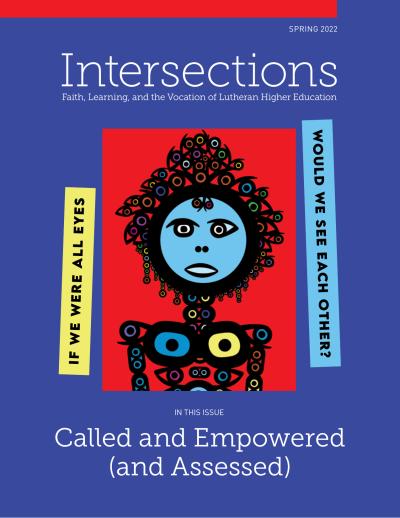 Institutional Focus
Serving and Building Community at Concordia College
Larry Papenfuss
No. 55 · Spring 2022
Papenfuss, director of the Dovre Center for Faith and Learning, frames eight ways Concordia College serves the world by building community — from quality teaching and liberating liberal learning to interfaith cooperation and modeling “diversity with particularity” as a Lutheran “third path” institution.
-
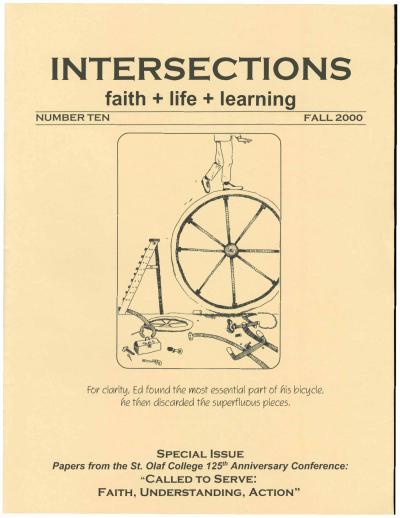 Editorial
From the Publisher
Arne Selbyg
No. 10 · Fall 2000
Selbyg explains that, while Intersections usually publishes papers from the annual Vocation of a Lutheran College conferences, this issue gathers presentations from a St. Olaf 125th-anniversary conference—a companion to the volume Called to Serve edited by Pamela Schwandt—because the theology and educational perspectives behind them apply to any Lutheran college and clarify what makes ELCA church-related colleges excellent institutions for students of any faith.
-
 Editorial
From the Publisher
James M. Unglaube
No. 2 · Winter 1997
Unglaube reports on the second annual Vocation of a Lutheran College conference of August 1996, where Walter Bouman of Trinity Lutheran Seminary addressed “What is Lutheran; What is the Lutheran Tradition” (biblical, catholic, evangelical, sacramental, world-affirming—the world “received, enjoyed, served as God’s Gift”). He previews presentations by Wendy McCredie of Texas Lutheran and Baird Tipson of Wittenberg on how the Lutheran tradition is embodied in its colleges, and Bob Vogel’s challenge in “Coherence—And Now what?” that the tradition comes to life in how faculty give expression to their beliefs and values in the classroom and with colleagues.
-
 Article
Fostering Moral Imagination and Inclusivity: The Role of Ethical Leadership in ELCA Colleges and Universities Amid Societal Challenges
Lamont Anthony Wells
No. 62 · Fall 2025
12 min audio
Wells argues that “moral imagination” — the capacity to envision ethical alternatives, empathize across difference, and respond creatively to injustice — is the heart of ethical leadership in NECU institutions, and that anchoring leadership in this principle positions Lutheran higher education to cultivate socially responsible citizens.
-
 Editorial
From the Editor
Jason A. Mahn
No. 35 · Spring 2012
Mahn introduces five essays from the 2011 Vocation of a Lutheran College Conference at Augsburg, framing how Torvend, Anderson, Svennungsen, Tunheim, and Pribbenow press Lutheran colleges to turn outward—recovering the public character of Luther’s gospel, forming students for moral deliberation, investing in the infrastructure of civic renewal, and pursuing justice and education “off the main road.”
-
 Editorial
Guest Editorial: Moral Deliberation in NECU Classrooms
Ernest L. Simmons
No. 51 · Spring 2020
Simmons introduces the guiding question of the NECU working group: could the ELCA’s twelve social statements and thirteen social messages — expressions of Lutheran social teaching originally formulated for congregational use — turn campuses into “academic communities of moral deliberation”?