Why Interfaith Work is Not a Luxury: Lutherans as Neighboring Neighbors
Intersections No. 44 · Fall 2016
Augsburg College’s campus is under construction. To the west contractors dig the foundation for a new Center for Science, Business, and Religion. There’s all the equipment that marks a construction site: chain link fences, streets blocked off, sidewalks re-routed, and signs that state the obvious: “Construction Zone: Hard Hats Required.”
What’s obvious in the new science center may not be so obvious in interfaith work. It too is a construction zone. The work is messy and ongoing, and on-site crew needs to have patience, resilience, and focus. Hard hats are less helpful here than warm hearts, ready hands, and sturdy spirits.
Let’s roll up our sleeves and get to work.
What sign marks this construction site? Beware of pronouns. They are the equipment of language, but they warrant careful use. Quite simply, you don’t dig a foundation with a spade. You don’t hang a picture with jackhammer. Any task needs the appropriate tool. Diversity training encourages pronoun awareness. This is a concern on all of our campuses for people who identify as transgender. Not everyone is comfortable with he/she or him/her or his/hers. Other alternatives are more appropriate: ze, hir, hirs. Interfaith work encourages pronoun awareness of a difference sort: It cautions use of what I want to call a “Presumptive We,” the assumption of a community that not everyone feels a part of. In addition, it cautions use of an “Othering You,” one that designates an outside group, one that may not have realized a border was even there.
I remember the comment by Audre Lorde to Adrienne Rich, both poets, essayists, and activists, the first African American and the second Caucasian American: “Your white women’s feminism doesn’t include me!” (Lorde 36-39). When I read this, I heard the echo of Sojourner Truth’s words to the (largely Caucasian) Women’s Convention in 1851: “And ain’t I a feminist?”
Why Interfaith is Not a Luxury
For Lutheran institutions, interfaith work is not a luxury.1 It’s more than an add-on, a new program, a certificate, or new major.
Let me state two reasons for this claim at the outset.
The first reason interfaith work is not a luxury is embedded in the tradition itself. The Lutheran movement is always in the process of reforming (semper reformanda). Lutherans may pretend this applies to everything or everyone else, but more deeply it applies to this expression of Christianity itself. Lutheranism is a movement that acknowledges that, when truth comes as a person (incarnation), not as a set of sacred texts or a Book of Confessions, the important thing is to “Follow That Person.” And people move around. Sacred texts and Confessions point to this person and can track where that person last showed up, but should not displace that person and cannot predict where and how that person will show up again. After all, as one of my late great former colleagues put it: “What was born in the manger at Bethlehem was a baby, not a book.” So: the first reason why, for Lutherans, interfaith work is not a luxury is that very spirit of reform itself.
The Lutheran tribe in particular remains chastened by the obvious biblical fact that those who considered themselves on the innermost circle of this person simultaneously were the ones who remained most clueless about him. Too often, the disciples seemed not understand who Jesus was at all.
Who did? People of other faith traditions—and no faith tradition at all. People who were “other” to that crowd of disciples around Jesus. People who were the “you” to the inner circle of “we” disciples. These “others” include:
- A Samaritan woman at the well, who knows she has met “the Messiah” (John 4:29)
- A Roman centurion, who declares Jesus to be “God’s son,” something the disciples have missed (Mark 15:39)
- A Syro-Phoenician woman, who knows Jesus can heal her daughter (Mark 7:24-30, Matt 15:21-28)
- Even “demons,” spirits from the spirit world, who suddenly saw what they were up against—and were terrified (cf., Mark 1:24).
The “outsiders” understood Jesus better than the “insiders.”
A second reason why interfaith work is not a luxury is a deeply embedded epistemological humility, which is a fancy word for humility when it comes to knowing things with any degree of absolute certainty. In fact, Lutherans are quite certain they don’t have all the answers. That makes—or ought to make—them humble, open to, and dependent upon the knowledge of those outside the tribe. All of this conspires to engender a kind of epistemological humility.
“Lutherans are quite certain they don’t have all the answers. That makes—or ought to make—them humble, open to, and dependent upon the knowledge of those outside the tribe.”
There’s a tendency among Lutherans to talk about “militant modesty,” but mere modesty qualifies as “humility-lite,” and it comes packaged with insincere self-deprecation or “cheap apology.” “Cheap apology” is as inauthentic as “cheap grace.”
Real humility is the deep awareness that the truth I see is not the only truth there is. Others may have a different angle of vision on the truth. Epistemological humility does not mean I see nothing. Rather, it acknowledges that I cannot see everything. It affirms that I see something; it encourages me to speak the truth of what I see, so that everyone looking may have a better view.
Tariq Ramadan, Muslim scholar and philosopher, uses the luminous metaphor of “windows” to talk about points of view:
We all observe the world through our own windows. A window is a viewpoint over a horizon, a framework, a piece of glass that is always tinted to some extent, and it has its orientation and its limitations: all this, together, imparts its color and qualities to the surrounding landscape. We have to begin humbly, by admitting that we have nothing more than points of view, in the literal sense, and that they shape our ideas, our perceptions and our imagination. Coming to terms with the relativity of our gaze does not imply that we have to doubt everything and can be sure of nothing. It might mean quite the opposite, and the outcome might be a non-arrogant confidence, and a healthy, energetic and creative curiosity about the infinite number of windows from which we all observe the same world. (Ramadan x)
Epistemological humility demands a double awareness, an appreciation for the vantage one has, but a lively curiosity about what someone else might see from their window. After all, everyone looks out onto the same landscape or ocean, as Ramadan extends the metaphor.
It’s like theater-in-the-round, where the audience is seated in a circle around a round stage. The players play the play, but they act throughout to different parts of the audience. From where you’re sitting, a spectator can’t always see the players’ faces. Sometimes she watches their backs, as they act to those across from her. But she can always see the faces of the people sitting on the other side of the stage, and she “watches” the action of the play as it registers on their faces. She depends on their reactions to catch a fuller sense of the play. That’s another analogy for epistemological humility.
And so the second reason why interfaith work is not a luxury for Lutherans is this deeply ingrained epistemological humility. Lutherans know they have some, but not all of the answers. They depend on others for a fuller picture.
For Lutherans, interfaith work is not a luxury. It is part of the mission and identity of each one of our institutions. Each institution will live it out in very different ways, because each institution serves different contexts and each institution bears distinctive gifts. But all of the institutions in this ecology of Lutheran higher education share a commitment to see the other as neighbor, to be neighbor to the other, and to live in our various contexts as if they were neighborhoods or a “commons.”
My task in the remainder of this essay is to write about the neighbor in a way that makes it strange to those in this room who find it familiar, to make it familiar to those in this room who find it strange, and to underscore for all of “us” that this focus on “neighbor” is one of the very distinctive gifts or “charisms” of being an institution of Lutheran higher education (Stortz).
After all, whatever our religious, philosophical, or humanistic affiliation and whatever days we mark—Ramadan, Passover, Easter, or the solstices—we are all seated at different windows in this landscape of Lutheran higher education. Here is what needs to happen:
- Because interfaith work is not a luxury, I want to speak of Lutheran institutions as faith-based and interfaith-dependent.
- I want to explore what this thing called “neighbor” more experientially, emphasizing in particular that “neighbor” is a countercultural way to regard oneself and the other in a world that has a lot of ways to do that, some paternalistic, others downright sinister.
- Finally, I want to probe what it means for interfaith institutions to engage as neighbors for the common good of the neighborhood, offering a four-fold matrix for action that consists of theological reflection, spiritual engagement, everyday experience, and social action.
Faith-Based and Interfaith-Dependent
In one of his signature theological insights, Darrell Jodock characterized Lutheran colleges and universities as institutions of a “third path.” They carve a path between sectarian institutions on one hand and secular institutions on the other (Jodock 1-2).
Sectarian institutions study religion as an intellectual project, but more importantly promote the faith and practice of a particular faith. Think of Zaytuna College in Berkeley, California, which is the first Muslim liberal arts college in the United States. Think of Wheaton College in Illinois, which presents itself as a “Christ-centered” college. Think of Hebrew Union College, with campuses around the country, whose mission an “academic, spiritual, and professional development center for Reformed Judaism.” Sectarian institutions are interested in the studying about religion, generally, but more important, promoting the faith and practice of that particular religion.
Secular institutions study about religion as intellectual project, essential to meaning-making, but cannot discuss why religion matters, because that gets into divisive issues of faith and practice. Think of the University of Minnesota, which has a mission statement that boldly invites students to “Dare to discover!” The institution can’t really talk about who’s doing the daring, why it matters—or for whom or by whom students are dared to discover anything. Secular institutions study about religion, but bracket its practice as a faith.
There’s a place for both of these kinds of institutions, sectarian and secular; it just isn’t the landscape of Lutheran higher education. As Darrell Jodock points out, Lutheran colleges and universities occupy a middle ground or point to a “third path,” because these institutions are faith-based, not faith-promoting, as the sectarian institutions are. They are faith-based, not faith-denying or faith-bracketing, as secular institutions must be. Because faith-based institutions ground themselves in a rich, thick faith tradition, they can both honor the critical study of religion and respect its practice as a faith.
“Lutheran institutions dare to be both faith-based and interfaith-dependent. They engage in the critical study of religion, while respecting its practice as a faith. They simultaneously understand that they need the presence and insights of people from other faith and non-faith traditions.”
Here’s where I want to extend Jodock’s understanding of Lutheran institutions as faith-based. Because interfaith work is not a luxury, Lutheran institutions dare to be both faith-based and interfaith-dependent. They engage in the critical study of religion, while respecting its practice as a faith. They simultaneously understand that they need the presence and insights of people from other faith and non-faith traditions. Only then can they have a fuller, bigger picture of how the world works.
Here are several illustrations:
Our interfaith team at Augsburg is in conversation with colleagues at Bethel University here in the Twin Cities, which is a sectarian institution founded by Swedish Baptist immigrants. Students and faculty sign a statement pledging to become better Christians. Bethel’s admissions officers were approached by parents in the growing Muslim community here: “We’d love to send our children to your school. We love your values, your no-alcohol campus, and your mission. But we want our kids to become better Muslims, not better Christians.” At Bethel University, there’s no compromise on the commitment to makes its students better Christians. Bethel is a sturdily faith-promoting institution, and the faith it promotes is Christianity.
These Muslim parents send their girls to St. Kate’s, an all-female, faith-based institution in St. Paul, which, as a faith-based institution, encourages rigorous study of religion, while respecting its practice as a faith. Or to Augsburg, which, as a faith-based and interfaith-dependent institution, does all of the above and needs practitioners of other faiths and non-faiths to be the institution it is called to be. As an institution in Lutheran higher education, Augsburg’s vocation as a faith-based institution is always in the process of reform and is graced with a keen epistemological humility makes it not only faith-based but interfaith-dependent.
A second example demonstrates how the calling to be faith-based and interfaith-dependent impacts the entire campus community, not just students. Florence Amamoto, professor of English at Gustavus Adolphus College, wrote: “I know from experience that being Buddhist at a Lutheran College has not only taught me more about Lutheranism but has deepened my knowledge of and my faith in my own religion.”2 Amamoto didn’t have to bracket her Buddhism to be at a Lutheran college. Because she was at an interfaith-dependent institution, both its content and its practice were valued—and not only valued, but needed.
At these faith-based and interfaith-dependent institutions, students, faculty, and staff are encouraged to articulate what they believe and are encouraged to practice in whatever ways appropriate.
“Students, faculty, and staff can be part of the mission, without sharing the identity of the tradition that drives it.”
In summary, in the landscape of higher education, there are sectarian or faith-promoting institutions, secular or faith-bracketing institutions, and “third path” or faith-based institutions. I would argue that Lutheran higher education offers a fourth alternative, because that ecology is both faith-based and interfaith-dependent.
These faith-based and interfaith-dependent institutions live at a busy intersection of mission, identity, and privilege. A rich, thick faith tradition shapes a mission that attracts faculty, students, and staff of various religious and non-religious (and philosophical) traditions. They don’t require that everyone share the institution’s founding religious identity, so long as people can support the mission that identity drives. That means that students, faculty, and staff can be part of the mission, without sharing the identity of the tradition that drives it. The distinction between mission and identity supports a vibrant diversity these faith-based and interfaith-dependent institutions need (VanZanten 1-11).
To be truthful, however, this distinction between mission and identity sounds a lot neater in the abstract than in the lived reality. Many of these Lutheran colleges and universities once had a much more sectarian or faith-promoting ethos. For example, Augsburg College was founded as a seminary, in the Haugean Pietist tradition. Its mission was to train pastors for the urban peasants who immigrated to Minneapolis to work in lumberyards and grain mills along the Mississippi. A shared background and immigrant experience, a shared language and culture, created commonality. That commonality, accentuated in a strange land, confers a certain privilege on those who spoke that language and shared that culture, background, and experience.
As the college diversified, that privilege got challenged. And loss of privilege registers as loss of identity. There’s a lot of talk around this institution, driven by fear and a deep sense of loss: “We’re losing our Lutheran identity.” And the response is not always as compassionate as it might be: “No, you’re losing your Lutheran privilege.” Loss of privilege needs to be acknowledged.3
People who were part of that common language, background, and culture suddenly feel as if they are, not strangers in a strange land, to borrow Robert Heinlein’s title, but strangers in a land that has become strange, but was once as familiar as the back of their hands. They become again immigrants in what used to be their own backyard. Loss of privilege is a real loss and needs to be mourned.
But loss of privilege should not be confused with loss of identity. More importantly, it is an opportunity to learn new languages and re-articulate identity in nothing more—and nothing less—than a common space. That common space is the neighborhood. Only the combined efforts of the neighbors in the neighborhood can make it work.
“Loss of privilege should not be confused with loss of identity.”
I stumbled upon a vivid example of this in my prior calling as professor at a Lutheran seminary that was part of the Graduate Theological Union, an ecumenical and increasingly interfaith consortium in Berkeley, California. I had a doctoral student from the Center for Jewish Studies enroll in my introductory course in Christian history. She “outed” herself the first day. We all did. In the class were Lutherans, Methodists, Episcopalians, Jesuits, Unitarians of various stripes, seekers, people hanging onto a faith tradition with their fingernails, and people who’d already let go—and found a place to land. In other words, the class didn’t have the privilege of a common language or experience or background. We didn’t have access to the assumptions, even the prejudices, that bind groups together sociologically. We had to build a common teaching and learning space, a neighborhood.
My preparation for class intensified. To my chagrin, I discovered I’d always assumed the apostle Paul had read the entire corpus of Martin Luther’s works before sitting down to scrawl his letter to the Galatians! I had to go back to the original text and context. After all, Paul had been a rabbi, so I met the apostle anew. I scoured my lecture notes for anything that might be taken as “anti-Semitic,” “anti-Catholic,” or presumptively Trinitarian. We identified any leakage in class, respectfully, civilly, but firmly. Together we built a common space. Together we shared that common space for the fifteen weeks of the course, a temporary neighborhood, but a neighborhood nonetheless.
We “neighbored” one another into that space. We relinquished privilege that in some cases we hadn’t known we had. In that space identities became more truthfully and generously defined.
Let me close out this section by reiterating something I hear on all of our campuses: Lutheran institutions pursue interfaith work, not in spite of the fact that they are based in a particular religious tradition, but because they are based in a particular religious tradition. Let me add only this: Lutherans pursue this interfaith work because we are based in this particular religious tradition, one that is always in the process of reforming and one that is graced with a robust sense of epistemological humility.
Neighboring Neighbors
One of the gifts of that tradition is being and seeing the neighbor.4 In a world where people are strangers, avatars, pop-ups to one another, but more dangerously, threat or enemy to one another, being neighbors is a revolutionary insight.
American citizens see this very much in their current political landscape, regardless of whether they affiliate “Republican” or “Democratic,” regardless of whom they supported in the 2016 election. Fear dominates rhetoric in the public square. Where a politics of the commons regards the “other” as neighbor, a politics of fear regards the “other” as threat.
“In a world where people are strangers, avatars, pop-ups to one another, but more dangerously, threat or enemy to one another, being neighbors is a revolutionary insight.”
At the vocation conference, where I first presented these comments, I invited participants to move from merely talking about neighbors to actually being neighbors one to another. I reminded them that, for the space of the conference, they all shared a common neighborhood, which was the space of the Augsburg College campus under construction. Smaller groups also all shared the space of a round table, which offered a tiny theater in the round.
I offered a text from my own tradition, Luke 10:25-37, “The Parable of the Good Samaritan,” rather than adopting or colonizing a story from another. The text tells a story, but on closer examination, it is a story that contains two stories. One is the story of an intra-faith encounter, that is, an encounter between two different expressions of the same faith. The other is the story of an inter-faith encounter, that is, an encounter between two different faiths.
Taken together, these stories display what it means to be a neighbor to someone and to see a neighbor in someone. Let’s unpack that.
The chapter heading printed in my study bible calls both stories “The parable of the Good Samaritan,” a title that attends to the dominant story about a Samaritan. But at the top of my study bible, I’ve penciled in another title alongside that one: “Out-lawyering a lawyer,” a title that attends to the peripheral story about Jesus and a lawyer. It’s in attending to that peripheral story that the reader’s notions about “neighbor” are suddenly deconstructed—or placed under construction.
The Good Samaritan
The first story narrates the sad tale of a man who was robbed, beaten, and left for dead by the side of a road. He’s probably been stripped of any clothing that would have identified him as a “we” or a “they.” A priest and Levite pass him by. In fact, contact with anybody’s bodily fluids and would have defiled them and prevented them from doing their jobs.
A Samaritan stops to help—and Samaritans were not friends to the Jews, but “enemies.” Their country bordered Judea; they worshiped other gods. So the notion of a good Samaritan would have been a contradiction in terms to a good Jew. This particular Samaritan would have been a stranger, a visitor, even a migrant. The dominant story catches out of his country and out of his comfort zone
The Samaritan is the one who binds up the man’s wounds, transports him to an inn, pays the innkeeper for his care, and promises to check back. End of story.
It’s not a very satisfying story; it rates about a C+. Missing are a lot of important details: How does the story end? Did the innkeeper pocket the money and kick the sick man out as soon as the Samaritan was out of sight? Did the Samaritan come back? Did the man recover? What happened to the priest and Levite?
But that dominant story is nestled in a second story, a peripheral story, at least as important:
Out-Lawyering a Lawyer
That second, enframing story goes like this: Trying to “test” Jesus, a lawyer poses a question: “What must I do to inherit eternal life?” Jesus responds with a question of his own, always a good move with someone setting a verbal trap: “What’s in the law?” The lawyer responds with the Shema: “You shall love the Lord with all your heart and with all your soul and with all your strength and with all your mind; and your neighbor as yourself.” It’s the chief prayer of Judaism, not Roman law. Because Jesus is also a Jew, the conversation between the two is an intra-faith encounter.
In effect, Jesus says: “Right answer!” He’s gotten the lawyer to answer his own question. But then the lawyer pushes back: “And who is my neighbor?”
And this time, Jesus responds to the lawyer’s question with the parable and a final question: “Which one of these three, do you think, was a neighbor to the man who fell into the hands of robbers?” The lawyer responds, “The one who showed him mercy.” Jesus replies, “Go and do likewise.”
“Instead of getting an answer to the question ‘Who is my neighbor?’ he’s forced to ask himself the question: ‘Am I a neighbor?’”
The exchange leaves the lawyer with a mirror image of the question he posed. Instead of getting an answer to the question “Who is my neighbor?” he’s forced to ask himself the question: “Am I a neighbor?”
Jesus asks the only question worth asking, then and now. That old scaffolding for that old joke—“There are two kinds of people in the world”—exposes the need to render the world into “we” and “they,” “us” and “them.” The lawyer wants to police the border between “neighbor” and “not-neighbor.” He’s not exceptional in this regard. Christian or non-Christian, Muslim or infidel (kafir), Jew or Gentile (goy), seeking or found, fideist, atheist, or faitheist.5
Against all division, the two stories assert that there is only one kind of people in the world, neighbors. The point is to see everyone as “neighbor” and to be “neighbor” oneself.
But what exactly does it mean to see everyone as “neighbor?” What does it mean to be “neighbor?” And how are all these neighbors going to live together in the neighborhoods they variously inhabit?
Let me make a few points about the revolutionary import of being a “neighbor” and sharing a common neighborhood. Along the way, I’ll share some stories from the neighborhood I know best, Augsburg College.
First Revolutionary Insight
Neighborhood is not the language of family, a community bound by blood, where, if you don’t have the right bloodline, usually on your father’s side, you don’t belong. Nor is it the language of friendship, a community bound by loves and preferences. Here, if you don’t have the right taste in clothes or music or pizza or sports teams, you don’t belong.
It’s also not the language of “enemy,” a community bound tightly together by hatred. If you don’t hate the same people I do, you’d better watch your back.
Finally, it’s not the language of “stranger,” language that erodes community like an acid, creating a place where no one belongs.
Instead, regarding the other as neighbor describes a community bound together by place, nothing more—and nothing less. Neighbors share a common neighborhood.
Sharing anything is by definition messy. It’s like living in a construction zone. Here on Augsburg’s campus, Campus Ministry and Student Affairs have been trying to find an on-campus space for Muslim students, faculty, and staff. They settled on Harbo Chapel, which was a quiet location with good space—but riveted into the wall was a crucifix with the body of a dying Jesus fixed to it. Initially, a sheet was provided, so that Muslims could cover the crucifix when they prayed. One summer, facilities built a box around the crucifix, with a door on the front that could open or close.
“Regarding the other as neighbor describes a community bound together by place, nothing more—and nothing less. Neighbors share a common neighborhood.”
A few weeks into the school year, one of the janitors came up to me and asked: “Why did you put Jesus in a box?” Only then did I learn that some of our janitorial staff, largely Ethiopian and Eritrean Christian, had been using Harbo Chapel during their breaks for prayer. Clearly, the operative definition of “neighbor” and “neighborhood” had been too narrow. It got blown open.
Second Revolutionary Insight
Neighbors share relationship that is involuntary. You don’t choose your neighbors—and they don’t choose you. It’s a relationship over which no one has much choice. But sharing a common space, however messy, issues in common projects for the good of the neighborhood.
Another story from Augsburg and our neighborhood: Graphic arts professor Chris Houltberg engaged his class in designing signage for some of the local Somali-American-owned businesses here in Cedar-Riverside. The project traded on reciprocal needs. The students needed to practice their craft; the business community needed signs.
“Sharing a common space, however messy, issues in common projects for the good of the neighborhood.”
Students learned a new palette of colors that would be inviting, designs that would “pop” for this population. It was a new aesthetic. They designed a stylized, forest-green tree. But upon completion, the business community decided the tree looked too much like a cross. That literally meant back to the drawing board. Houltberg concluded: “My students learned more from that first failure than they would have from a first success.”6
Here, common space brought together people who did not choose one another, but could gather around a common project for the betterment of the community.
Third Revolutionary Insight
Neighborliness presumes a radical equality. After all, the lawyer cites scriptural counsel to “love your neighbor as yourself”—not more than or less than yourself. Self-love then is the condition for neighbor-love; self-love is the qualifier of neighbor-love. In the context of the two stories, both loves are ordered by love of God. That primary love keeps the all parties from playing God.
The radical equality of neighborliness cuts through privilege. The neighbor-to-neighbor relationship is not a hierarchical relationship of patron-to-client, employer-to-employee, parent-to-child, or teacher-to-student. A neighbor-to-neighbor relationship confers equal status on both parties.
An example: The Augsburg college football team assembles every August for practice, and August in Minnesota is typically steamy and hot. Coaches set out cattle troughs full of cold water, just so players can cool down after strenuous play. One summer Ramadan began during the month of August. Muslim players couldn’t eat from sunrise to sundown, but they showed up for practice with all the non-Muslim students. In solidarity with their teammates, the non-Muslim students elected to fast with their teammates for a few days, both to accompany them in their practice and to experience what they were experiencing.
And for the space of a few days, the whole team was on a level playing field. For the space of a few days, the whole team became not just teammates, some fueled and some running on empty, but neighbors.
Final Revolutionary Insight
The neighbor is defined not by ethnic background or homeland or gender or race or what spices waft out of their kitchen at 5 p.m. The real neighbor is defined by how she acts. As the stories demonstrate, the one who acts with “mercy” is the “neighbor.”
Actually, the word “neighbor” is more a verb than a noun. In the dominant story, a Samaritan “neighbors” the beaten man in concrete actions, binding his wounds, carrying him on his own mule, checking him into an inn, and paying for his care. The Samaritan embodies compassion; he doesn’t merely talk about it.
But the story of the good Samaritan also “neighbors” the lawyer, in effect showing him how to be a better Jew. And Jesus, in telling the story, “neighbors” the lawyer, demonstrating compassion to a man who starts out trying to trick him. Instead, Jesus engages the lawyer, talking to him directly, rather than about him to his disciples.
That kind of face-to-face encounter can be messy. That’s why a key practice of compassion is forgiveness.
A final story from my neighborhood: Several years ago, Eboo Patel came to speak about interfaith work at the college’s opening convocation, and the date scheduled was at the beginning Rosh Hashanah. Neither IFYC nor the planning team noticed the conflict. My Jewish colleagues noticed—and they were rightly and deeply offended. It was one more example of Christian privilege, made more egregious since the topic was interfaith understanding.
I had lunch with Barbara Lehmann, my Jewish friend and colleague in social work, one day soon after the conflict surfaced. We were both too upset to eat anything. I asked for and received her forgiveness. But first I had to hear the hurt. And it was hurt. Offense would have been easier to handle, but naming and hearing the hurt cut each of us more deeply.
Barbara forgave me. Forgiveness after all, is a central practice to each of our traditions, but to actually enact it is a great grace. In forgiving me, she taught me to be a better Christian. In forgiving me, we could move from that injury back into the neighborhood. After all, there was work to do.
Four Strategies for Interfaith Encounter
What does it take to live in the neighborhood? If it takes a village to raise a child, it takes a neighborhood to do interfaith work. It’s a campus-wide commitment; it’s a curricular and co-curricular enterprise.
Four strategies of interfaith encounter—theological reflection, spiritual engagement, social action, and everyday experience—provide portals into interfaith work. People enter through the door most comfortable to them, but once inside, they can move into other dimensions.7
Theological Reflection
The first strategy is a head-trip. Interfaith work begins with knowing and being able to talk about one’s values and belief (knowledge of or from). On that foundation, it scaffolds knowledge about other religious traditions or stances.
Faith-based and interfaith-dependent Lutheran institutions prize critical thinking. The vaunted “freedom of a Christian” is deeply a freedom from academic fundamentalisms of the left and the right and a freedom for critical inquiry.
What is more, this commitment to theological reflection expresses itself in curricular and in co-curricular ways. The robust religion departments in the Lutheran ecology of higher education present religion not simply as an historical or cultural phenomenon but also as an expression of the need to make sense of the human condition, human community, and the mystery at its heart. They encourage students to build lives of meaning and purpose oriented around what they believe. They encourage students to think about their futures as something to be carefully “planned” as well as something to which they are deeply “called” (Brooks).
Courses across the disciples teach the content, skills, and sensibilities of the interfaith studies to prepare students for a professional world that increasingly calls for interfaith competence. For example, an international business graduate headed for work in Southeast Asia needs to know how Buddhism, Islam, and the colonial legacies of Christianity inflect business practice. Should her company host international guests, she will need to be alert to what to serve them and how to accommodate their needs.
“Courses across the disciples teach the content, skills, and sensibilities of the interfaith studies to prepare students for a professional world that increasingly calls for interfaith competence.”
In addition, theological reflection takes place throughout the institution in planned events and spontaneous town hall meetings. Symposia engage the entire community in conversation and moral deliberation. On this campus, a pop-up forum during the occupation of Tahrir Square in 2011 packed the house, because so many in the community were connected to countries experiencing the “Arab Spring.”
Spiritual Engagement
Spiritual engagement acknowledges that interfaith work engages the heart as well as the head. In honoring the practice of faith as well as the study of religion, these faith-based and interfaith-dependent Lutheran institutions offer time and space to worship.
And worship is very particular, in ways that are both gracious and tricky. “Spiritual engagement” does not mean more “interfaith” worship services, which are hard to choreograph and even harder to execute with integrity. It does mean wrestling with the human needs to worship, to find Sabbath, and to stand in the presence of mystery. It does mean finding ways to be observant that neither balkanize the campus, on one hand, nor serve up inter-religious mush, on the other.
“These faith-based and interfaith-dependent Lutheran institutions offer time and space to worship.”
In his much-cited commencement to Kenyon College in 2005, the late writer David Foster Wallace identifies meaning-making as a deep-seated human need:
There is no such thing as not worshiping. Everybody worships. The only choice we get is what to worship. And an outstanding reason for choosing some sort of God or spiritual-type thing to worship—be it J.C. or Allah, be it Yahweh or the Wiccan mother-goddess or the Four Noble Truths or some infrangible set of ethical principles—is that pretty much anything else you worship will eat you alive. If you worship money and things—if they are where you tap real meaning in life—then you will never have enough. Never feel you have enough. It’s the truth. Worship your own body and beauty and sexual allure and you will always feel ugly, and when time and age start showing, you will die a million deaths before they finally plant you. (Wallace 7)
If humans are hard-wired to worship, how can these faith-based and interfaith-dependent institutions help students discern what gods they will attend? How can a college education point them to what gives life, rather than what “will eat you alive?” What wisdom can be gleaned from other religious, philosophical, and humanist positions? These are lively questions on all of our campuses, and they’re important to keep wrestling with. In this ecology of Lutheran higher education, we have not only the privilege of asking them, but the responsibility to live them.
Social Action
Social action offers the opportunity for hands-on engagement. Lutheran higher education does not only point toward a career, but to a calling, and that call comes from the neighbor. Service learning and community engagement sites offer opportunities to work in the immediate neighborhood in ways that enhance learning and meet need. Social action also offers unique opportunities to “neighbor” across religious difference, whether those differences surface from the site or within the learning community.
Social action has long been a primary focus of Eboo Patel and the Interfaith Youth Core. Early on, Patel realized that religious diversity was left out of campus conversations on diversity. At the same time, he saw young people perpetrating a lot of religious violence. He felt called to address the situation:
Every time we read about a young person who kills in the name of God, we should recognize that an institution painstakingly recruited and trained that young person. And that institution is doing the same for thousands, maybe hundreds of thousands of others like him. In other words, these religious extremists have invested in their youth programs. If we had invested in our youth programs, could we have gotten to those young people first? (Patel 149)
Patel resolved to found a youth organization that would give young people across faith and non-faith traditions a common project to work on together. In the course of working together, they’d come to know and discuss religious differences among them, as well as learn more about the religious backgrounds of the communities in which they worked.
All of our campuses have service learning and community engagement sites in the neighborhoods surrounding campus. These experiences offer practice in seeing and being neighbor, as well as encounter with people from other faith traditions. They serve as an important portal into interfaith work.
Everyday Experience
Interfaith work places head, heart, and hands in the world of everyday experience. The need for religious literacy and interfaith competence asserts itself everywhere—in the newsfeed, on social media, in the locker room, on the dorm floor. A walk across campus offers ordinary encounters with religious diversity. If, as Diana Eck emphasizes, diversity is a fact, but pluralism is an achievement, how will college graduates have the knowledge, skills, and sensibilities to work for pluralism in a religiously diverse world (Eck 191)?
“The need for religious literacy and interfaith competence asserts itself everywhere—in the newsfeed, on social media, in the locker room, on the dorm floor.”
If they have attended a Lutheran college or university, there’s a good chance they will. Because they are faith-based and interfaith-dependent, these institutions cultivate various strategies for interfaith work: theological reflection, spiritual engagement, social action, and everyday experience. Although the four strategies stand together, each person enters interfaith work through a different portal. For some, working at a campus soup kitchen prods reflection on the religious practice behind different dietary needs. For others, thinking through the various dimensions of the Orlando massacre on June 12, 2016 fuels action for justice. For still others, listening Rami Nashashibi describe his return to Islam prompts reflection on their own faith journey. For still others, reading Chris Stedman’s Faitheist gives a paradigm for a thoughtful and informed belief stance.
Everyone’s point-of-entry into interfaith work will be unique, but every campus offers developed strategies in each of these areas for further exploration. As Lutheran institutions, we not only can open these doors—we have to. The Lutheran tradition demands interfaith work, and our common future needs it.
Conclusion
Interfaith work is not a luxury for these faith-based and interfaith-dependent institutions, both because of their historical identity and because of their immediate present. Inter-religious literacy is part of being a responsible global citizen in the twenty-first century.
This work may always be a construction zone, but we engage it as neighbors, because we share the planet. We were created to care for it and, in the process, come to know one another: “O mankind, we have created you male and female, and appointed you races and tribes, that you may know one another” (The Quran, Al-Hujurat 49:13). As always, the practice of compassion is not the end of the story, but just the beginning.
Go and do likewise.
Endnotes
1. The language comes from Audre Lorde’s classic essay, “Poetry is Not a Luxury,” from Sister Outsider, 36-39.
2. Cited in Mark Wilhelm’s preface to the Intersections (Fall 2014) issue on “Interfaith Understanding at Lutheran Colleges and Universities,” 4. He thanks Jason Mahn, editor of Intersections and professor of religion at Augustana College (Rock Island) for bringing the article to his attention. I thank them both.
3. See the work that Caryn Riswold, blogger for Patheos and Professor of Religion, Gender, and Women’s Studies at Illinois College in Jacksonville IL, has done on Christian privilege (Riswold, “Teaching the College ‘Nones’”) see also Goren, “Recognizing Christian Privilege.”
4. I identified four “charisms” or gifts of Lutheran higher education: nimble, flexible institutions through the commitment to ongoing reformation (semper reformanda); critical inquiry through Christian freedom; a commitment to the poor through the priesthood of all believers; and regarding the other as neighbor (Stortz). Jason Mahn has similarly named distinctive “tensions” in Luther higher education: between religious formation and interfaith, between suspicion and trust, and between vocation as a theological insight and vocation as practice (Mahn). However they are named, the “gifts” of this distinctive approach to learning are needed now more than ever.
5. The word “faitheist” was coined by Chris Stedman in his spiritual memoir Faitheist. It describes the common ground between atheists and religious people (see Stedman).
6. Oral presentation by Chris Houltberg for a panel on “Faculty Experiences in Somali Community Engagement,” February 14, 2012 at Augsburg College.
7. The framework comes from Scott Alexander, Islamicist at Catholic Theological Union, in his article “Knowing and Loving Our Neighbors of Other Faiths.”
Works Cited
Alexander, Scott. “Knowing and Loving Our Neighbors of Other Faiths.” In On Our Way, edited by Dorothy Bass and Susan R. Briehl, 149-67. Nashville: Upper Room Books, 2010.
Amamoto, Florence. “Integrity, Diversity, and Lutheran Colleges.” Intersections 8 (Winter 2000): 16-22.
Brooks, David. “The Summoned Self.” The New York Times. August 2, 2010. Accessed 1 November 2016, http://www.nytimes.com/2010/08/03/opinion/03brooks.html
Eck, Diana. Encountering God: A Spiritual Journey from Bozeman to Banaras. Boston: Beacon, 2003.
Goren, Rabbi Seth. “Recognizing Christian Privilege.” Sojourners Magazine, July, 2013.
Jodock, Darrell. “The Third Path: Gustavus Adolphus College and The Lutheran Tradition.” Presentation to the Board of Trustees at Gustavus Adolphus College. October, 2002. Accessed 1 November 2016, https://gustavus.edu/faith/pdf/Third_Path_Article.pdf
Lorde, Audre. “Poetry is Not a Luxury.” In Sister Outsider. 36-39. New York: Ten Speed Press, 2007.
Mahn, Jason A. “Why Interfaith Understanding is Integral to the Lutheran Tradition.” Intersections 40 (Fall 2014): 7-16.
Millis, Diane and Amy Zalk Larson. Journey Conversations Project. Minneapolis: Journey Conversations Project. 2012.
Nashashibi, Rami with Krista Tippett. “Krista Tippett and Her Friends.” The Chautauqua Institute, July 16, 2012. Accessed 1 November 2016, https://www.youtube.com/watch?v=mCSyQVwv9wc
Patel, Eboo. Acts of Faith. Boston: Beacon, 2007.
Ramadan, Tariq. The Quest For Meaning: Developing a Philosophy of Pluralism. New York: Penguin, 2010.
Riswold, Caryn. “Teaching the College ‘Nones’: Christian Privilege and the Religion Professor.” Teaching Theology and Religion 18:2 (April 2015): 133-48.
Stedman, Chris. Faitheist: How an Atheist Found Common Ground with the Religious. Boston: Beacon, 2012.
Stortz, Martha E. “Practicing Hope: The Charisms of Lutheran Higher Education.” Intersections 32 (Spring 2010): 9-15.
VanZanten, Susan. Joining the Mission: A Guide for (Mainly) New College Faculty. Grand Rapids, MI: Eerdmans, 2011.
Wallace, David Foster. “This is Water.” Accessed 1 November 2016, http://www.metastatic.org/text/This%20is%20Water.pdf
-
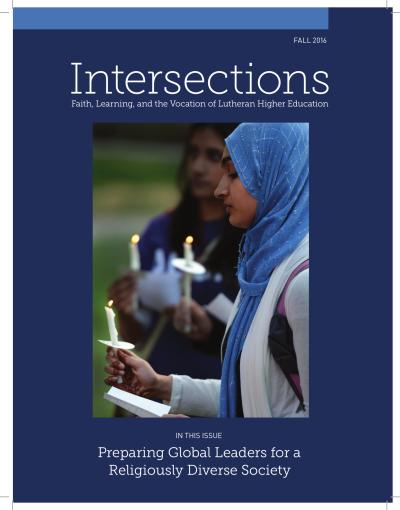 Editorial
From the Publisher and Editor
Jason A. Mahn, Mark Wilhelm
Writing weeks after the 2016 presidential election, Wilhelm and Mahn frame interfaith engagement as the urgent and ongoing work of ELCA colleges and universities, recap NECU’s growing commitments to inter-religious leadership, and introduce essays first delivered at the summer 2016 Vocation of a Lutheran College Conference under the theme “Preparing Global Leaders for a Religiously Diverse Society.”
-
Article
Laboratories for Living in a Diverse World
Elizabeth Eaton
Presiding Bishop Elizabeth Eaton argues that ELCA colleges and universities are called to be laboratories for living in a religiously diverse world. Reflecting on the decline of Christian privilege, the ELCA’s ecumenical and inter-religious work, and her own experience addressing the Islamic Society of North America, she offers three questions about partnerships, formation, and institutions as platforms for new collaborations.
-
Article
The Promise and Peril of the Interfaith Classroom
Matthew Maruggi
Maruggi draws on his years teaching in the Augsburg religion department to identify three pairs of seeming opposites — dialogue and debate, safety and risk, commonality and particularity — that, held in creative tension, nurture a vibrant interfaith classroom where pluralism is actively engaged rather than merely present.
-
Article
Religious Diversity and the Vocation of a Lutheran College
Darrell Jodock
Jodock argues that a college which takes its Lutheran values seriously is well positioned to foster inter-religious relations along a “third path” that is both religiously rooted and inclusive. He traces the relational and communal character of Lutheran theology, develops a Lutheran understanding of deeper freedom, the theology of limits, and human complexity, and shows how a down-to-earth image of God offers theological resources for overcoming the anxiety and fear that block interfaith engagement.
-
Article
Risky Speech–Gifted Friendships
Sonja Hagander
Augsburg College Pastor Sonja Hagander reflects on pastoral care across faith traditions — from a campus chapel service after the 2008 murder of Muslim student Achmednur Ali, to her decade-long friendship with Jewish colleague Barbara Lehmann — and reads the Gospel of John as a roadmap for interfaith friendships marked by love, free speech, public space, and a willingness to risk being changed.
-
Reflection
Mapping Interfaith Encounters
Callista Isabelle
Muhlenberg College Chaplain Callista Isabelle uses a student-designed subway map of religious and spiritual communities as an image for interfaith engagement — one that invites students to leave their “home” stations, encounter common ground and respectful disagreement, and explore the major intersections where religion meets science, environment, and mental health.
-
Article
Negotiating Legitimate and Conflicting Values
Eboo Patel, Katie Bringman Baxter, Mark S. Hanson
In a closing-day conversation at the 2016 Vocation of a Lutheran College Conference, Mark Hanson and Eboo Patel — moderated by Katie Bringman Baxter of Interfaith Youth Core — share case studies in which legitimate religious values come into tension with one another, and make the case that Lutheran colleges should teach interfaith leadership through the hard cases rather than the easy ones.
-
Institutional Focus
Interfaith Campus Organizing at California Lutheran University
Allison Bermann, Mehak Sachdev
California Lutheran University students Allison Bermann and Mehak Sachdev describe how interfaith participation at CLU grew from a grassroots movement into a sustained, integrated part of campus identity — with an intern program, Interfaith Allies, co-curricular events from Diwali dinners to Hunger Banquets, and a classroom practice of storytelling that opens the required Introduction to Christianity course to students of every faith and none.
-
 Article
The Responsible Professional: Vocation and Economic Life
Martha E. Stortz, Tom Morgan
No. 51 · Spring 2020
Stortz and Morgan argue that the “value-added” of Lutheran higher education is a responsibility ethic — one that frames the professional as a first responder “called and empowered to serve the neighbor so that all may flourish” — and unpack the four criteria of the 1999 ELCA social statement Sufficient, Sustainable Livelihood for All as a framework for economic deliberation.
-
 Article
The "V" Word: Different Dimensions of Vocation in a Religiously Diverse Classroom
Martha E. Stortz
No. 50 · Fall 2019
Stortz responds to a sea of blank stares when she used the word “vocation” in a religiously diverse required course by offering five metaphors — place, path, relationships, lens, and story — that point to different dimensions of vocation across the world’s religions and help students articulate their callings on their own terms.
-
 Article
Marked by Lutheran Higher Education
Martha E. Stortz
No. 49 · Spring 2019
Stortz offers an “operating manual” to Rooted and Open by tracing how the writing team moved from descriptive marks of the institutions to aspirational verbs that mark people — “called and empowered, to serve the neighbor, so that all may flourish” — and shows how each mark generates educational priorities theologically grounded in the radical mystery of God, the wild generosity of God, and the God who became one of us.
-
 Article
Both Priest and Beggar: Luther among the Poor
Martha E. Stortz
No. 46 · Fall 2017
Reading Luther’s deathbed remark “We are all beggars” against his “priesthood of all believers,” Stortz argues that priest and beggar are two sides of a human reality — one that locates civic responsibility for the poor at the heart of the Reformation legacy and that pushes beyond paternalistic service toward the systemic question of justice.
-
 Article
Jonah: The Anti-Hero of Vocation
Martha E. Stortz
No. 45 · Spring 2017
In a chapel talk first given at Augsburg College’s Vocation 2.0 series in September 2016, Stortz reads the prophet Jonah as the great anti-hero of vocation — one who tries to outrun God’s call to the great city of Nineveh — and argues that, in a season of urban violence and divisive election-year rhetoric, the story is less about public calling than about being called by the publics in our midst.
-
 Book Review
The Courage to Change: Creating New Hearts with Palmer and Zajonc
Martha E. Stortz
No. 39 · Spring 2014
Stortz reads Parker Palmer and Arthur Zajonc’s The Heart of Higher Education from the landscape of Lent and notes that the book’s strategies all target students, not their professors. Drawing on her own Faculty Formation Group at Pacific Lutheran Theological Seminary and the Ignatian Colleagues Program at Jesuit institutions, she asks what a Lutheran analogue might look like that would form the educators who teach for transformation.
-
 Editorial
From the Editor
Robert D. Haak
No. 26 · Fall 2007
Haak introduces the issue with the question of whether “our Lutheranism” should have any discernible effect on how we operate as Lutheran colleges, and proposes a working list of “Lutheran” values that characterize our institutions — complexity, real evil, suffering as part of human experience, the centrality of discourse, transcendent values, attention to place, institutional self-criticism, and unity over division — inviting campuses to extend the conversation begun by Simmons, O’Hara, and the Wartburg colleagues.
-
 Editorial
From the Editor
Jason A. Mahn
No. 37 · Spring 2013
Mahn introduces the issue’s six essays as parallel attempts—from poetry, economics, choral music, biology, religion, and Lutheran higher education—to resist our culture’s fact-value split, and uses Augustana’s Fritiof Fryxell, a 1922 biology and English graduate who began teaching just as the Scopes Trial ignited, to illustrate how church-related colleges have long held faith and disciplinary inquiry together.
-
 Article
Mission and Hiring in the Christian College
Bruce Reichenbach
No. 3 · Summer 1997
Reichenbach of Augsburg argues that the Christian or Church-related college’s mission to educate the whole person from a perspective of Christian faith and values can only succeed through intentional hiring of a “critical mass” of faculty, administrators, and staff committed to that mission (following George Marsden and the 1960s Danforth Commission), supplemented by on-going faculty development. He defends an inclusive community-with-diversity, a freedom-and-commitment tension grounded in Alasdair MacIntyre’s account of tradition, and the legality of preferential religious hiring under Title VII of the Civil Rights Act and the relevant case law (Tilton, Hunt, Roemer, Blanton, Grove City, Amos).
-
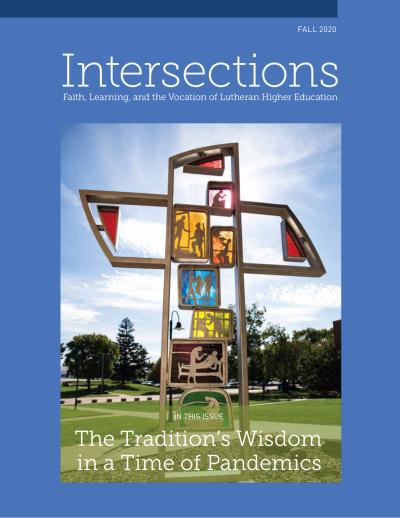 Article
Learning from Luther on Covid-19
Carl Hughes
No. 52 · Fall 2020
Reading Martin Luther’s 1527 treatise “Whether One May Flee from a Deadly Plague,” Hughes finds practical and spiritual guidance for a pandemic age: serve the neighbor, follow medical experts, honor those whose vocations put them at risk, and trust that even when we fail, God will not abandon the community.
-
 Article
Beyond Deep Gladness: Coming to Terms with Vocations We Don’t Choose
Deanna Thompson
No. 58 · Fall 2023
Thompson, living with incurable cancer, expands Frederick Buechner’s definition of vocation to make room for deep sadness — drawing on Arthur Frank, Shelly Rambo, Beverly Wallace, and Ross Gay to argue that practices of lament, including the public lament of Friday Flowers at St. Olaf, open space for gladness, joy, and even flourishing to emerge.
-
Book Review
The Information Deluge: Navigating the Digital Age with Recent Scholars
Virginia Connell
No. 39 · Spring 2014
From the reference desk at Concordia’s Carl B. Ylvisaker Library, Connell navigates Ann Blair’s Too Much to Know, Nicholas Carr’s The Shallows, Viktor Mayer-Schönberger’s Delete, and Howard Gardner and Katie Davis’ The App Generation, then describes information-literacy work at Concordia—primary-source assignments, Omeka and TimelineJS exhibits—that helps students move from app-dependent to app-enabled in the Lutheran tradition of reform.