Several years ago, on a night flight from somewhere to somewhere else, I sat next to a man who was returning from a visit to his son in a prestigious East Coast school. We fell into a conversation as deep as the hour was late. It turned out that this man had gone to a Jesuit college. I have some familiarity with the Jesuit network, so when we started playing Jesuit Geography, we had a lot of “hits.” His son, however, hadn’t wanted to go to a Jesuit college, and that made him sad. I asked why: what was he afraid his son had lost?
And without missing a beat, he said: “Going to a Jesuit College taught me three things: 1) Be a man for others; 2) Find God in all things; and 3) Always give back.”
What impressed me so powerfully was how quick and how unconsidered his response was. This was more than something he did; this was who he was. His Jesuit education shaped his identity in indelible ways.1
What would someone answer who had attended a Lutheran institution—perhaps even yours? How would that shape him or her? And would the answer be as ready? It seems to me someone who’d been the product of Lutheran Higher Education could say many similar things to someone who’d been through Jesuit Higher Education. After all, though one came from Protestant Saxony and the other from the Catholic Basque region of Spain, Luther (1483-1546) and Ignatius (1491-1556) were contemporaries one of another.
Translating Ignatian into Lutheran would be surprisingly easy:
“Be a person for others” would translate to “seeing the face of Christ in the neighbor” and “being the face of Christ to the neighbor.” “Find God in all things” reflects Luther’s insistence that the finite is capable of the infinite and his rapt attention to the ordinary graces. “Always give back” corresponds to the signal emphasis on vocation.
The translation can be done. But is this really who we are? More pressing, Is this really who we need to be, to meet adequately the challenges of this culture of fear? Finally, is this our unique gift? What’s the piece that Lutherans bring to the table, that piece of higher education that is distinctive to us? And if we don’t bring it, no one else will.
I want to talk about the charisms of Lutheran higher education, so at the outset I need to tell you what I mean by charism. Quite simply charism is theological language for gift. Only this kind of “gift” is not something that you purchase, wrap, and give to someone else. Charism is not commodity; rather, it comes not from what you can afford but from who you are. So when I ask about Lutheran higher education, I’m talking about identity. Who are Lutherans, and what are the distinctive gifts they bring to higher education simply by being who we are?
Let me illustrate with a very ordinary analogy: Invited to a family picnic, I asked what I could bring to the table, and my sister-in-law said: “Just bring yourself. That’s what we need most.” Actually, considering the Byzantine emotional politics of my late husband’s family, she was more right than she knew. I brought a lot simply by not having been raised in that madness: I was part of another complex set of dynamics. By virtue of that very identity, I did nothing to create but had been shaped in for decades, I brought leaven to this gathering, just by virtue of being who I was. It’s a very pedestrian, but very apt analogy.
Again the question: What do Lutherans bring to the table, that no one else can? And if we don’t bring it, it won’t be there—or it won’t be there in quite the same way.
I want to explore four charisms:
- In a setting where stability is prized, we present flexible, responsive institutions by virtue of our response to be “always in the process of reforming”—semper reformanda.
- In an academy of competing ideologies, we embody a spirit of critical inquiry, thanks to the spirit of Christian freedom.
- In a world of strangers—even enemies, we regard the other as neighbor.
- Finally, we enter a world of poverty as a priesthood of all believers.
I want to survey the landscape of each of these charisms in three ways: why it’s there; what it means institutionally; where it challenges a culture of fear.
Semper reformanda: Flexible, responsive institutions
First charism: Lutherans are part of a tradition that sees itself as always in the process of becoming, i.e., ever-reforming or semper reformanda. The reason why is that we simultaneously have one foot planted firmly in the Gospel and one planted firmly in the world. Let’s look at more carefully at that stance.
One foot planted firmly in the Gospel—and by Gospel I don’t mean “book.” At their best, Lutherans inhabit the middle ground between biblical literalism and biblical irrelevance.2 “Gospel” telegraphs the “good news” that God became one of us in the person of Christ Jesus. God knows life on the planet intimately—and we’d err in limiting that involvement with just the human species. The apostle Paul got the scope of divine concern right: it was not just “the whole human species” but “the whole creation has been groaning in labor pains until now.” (Rom. 8:22).3
The impact of incarnation continues, as we simultaneously have one foot firmly planted in the world, where we look for traces of God’s ongoing activity with us and for us. Hauntingly, fourth-century North African theologian Augustine of Hippo called these “vestiges of the Trinity,” vestigiae trinitatis. (de trinitate, 12.11.16) The Latin is even more concrete: “footprints” of the Trinity.
One foot planted firmly in the Gospel, one foot planted firmly in the world: this stance, this sense of being bi-locational, as George Lindbeck puts it, calls for a kind of stereoscopic vision, where we are prompted by the Gospel to listen for God’s word to us now, in this moment, and we are simultaneously looking into the world for traces of God’s presence.
Of course, there are footprints of a lot of things in the world: how do we know when we find one that is a “footprint” of the presence of God?
Certainly, this calls for some discernment, and that’s where the Gospel comes in. If it comports with the Spirit of God in Christ Jesus, we can call it a good spirit. If it doesn’t, it’s bad. The apostle Paul named the “fruit” of that Spirit: “love, joy, peace, patience, kindness, generosity, faithfulness, gentleness, self-control” (Gal. 5:22). And textual scholars confirm these habits of the heart that contour relationships with God (love, joy, peace), the other (patience, kindness, generosity), and the self (faithfulness, gentleness, self-control). So if these dispositions are manifest, we’ve got a “footprint” of the presence of God. Because the Creator walked the earth with the creation, these footprints are everywhere.
“This means that colleges depend on a certain critical mass of non-Lutheran faculty, staff and students.”
The charism of being a community that is ever-reforming invites—even demands—a kind of institutional vigilance for insights that lie beyond our own tight-knit Lutheran tribe. Biblical accounts issue a cautionary word: the closest were the clueless. That is, those who considered themselves “closest” to Jesus, those in his inner circle, were also—alas!—the most clueless about his true identity and his real purpose. Pointedly and all too often, the outsiders were the ones who “got” it: a Samaritan woman in John’s gospel (John 4), a centurion at the end of Mark’s (Mark 15:39), again, in John’s, a blind man begging (John 9:8)—and the demons always know precisely who Jesus is, when the disciples were expecting someone else. These stories constitute a caveat to the “insiders.” We need to keep our noses outside the tent, sniffing the wind for signs of God’s presence.
This means that colleges depend on a certain critical mass of non-Lutheran faculty, staff, and students who bring the world into the Quad. This is tougher in a seminary context, where Lutheran identity has a different purchase. Seminaries have to be a kind of confessional “hot-house,” often doing a fair amount of remedial catechetics or confessional calisthenics, so that we train church leaders flexible enough to stand both in the Gospel and in the world.
Practicing being semper reformanda, always in the process of reform, keeps our institutions flexible and nimble, alert to crosscurrents in the culture. It counsels institutions to let form follow function and be bold in editing out structures that stagnate or no longer pulse with mission.
Some examples: look at the way Lutheran institutions of higher education adapt to context. Pacific Lutheran University finds itself in a region that professor Patricia Killen evocatively calls the “none” zone: more people here identify their religious affiliation as “none” than any other part of the country. It sustains a vibrant campus ministry that has developed a kind of “perfect pitch” for a student body that runs the gamut from cradle Lutherans to seekers. Jewish students find a home in East Coast Lutheran colleges and universities, in part because one doesn’t have to hide or apologize for belief. It fits seamlessly within the fabric of academic excellence. I think particularly of the Institute for Jewish-Christian Understanding at Muhlenberg College. DeAne Lagerquist told me about the Centennial Statement St. Olaf put out for its 100th anniversary. When twenty-five years later, the college put out another, some people protested: “Wasn’t the centennial statement good enough?!” Yes—and it was good enough for then.4 Whether it was good for now was another story. Semper reformanda!
Institutions change at a glacial pace—even, in an era of global warming!—but particularly in a culture of fear. Above all things, a culture of fear fears change. It registers change as loss, whether loss of identity—or loss of spine. Yet, I think it is precisely our identity as a tradition always in the process of reforming that keeps our institutions flexible and our structures pliant, like green wood that bends in a stiff wind.
The freedom of a Christian
In an academy often torn by competing ideologies, Lutheran higher education embodies a spirit of critical inquiry. This is the Lutheran spirit of both/and, or simul/et…, expressed most powerfully in Luther’s understanding of the human person, i.e., that we are both saint and sinner, both justus and peccator. This insight turns out to be not only a pretty accurate description of human nature, but a good way of navigating the strong ideological currents that course through the academy and the culture as a whole.5 These often register as binary opposites, brooking no rapprochement, forcing students and colleagues to choose sides. Because only one of them is “right.”
Lutheran institutions tend to be suspicious of ideological absolutisms. That gives us a fighting chance of breaking through some of the most controversial issues of our time. Think of the abortion debate, which divides into irreconcilable differences between “pro-life” and “pro-choice.” The very positions suggest that the opposition is either “anti-life” or “anti-choice,” a way of setting up debate that paralyzes discussion. I remember walking into a room where I was supposed to address the topic. The rage was palpable, but beneath it was pure fear. As we talked, the anger dissipated somewhat, and we could explore the underlying fear. We discovered that maybe the fear was the same: fear for children, that their potential was being snuffed out, by the practice of abortion, by poverty, by shame of illegitimacy, by the costs of medical care and child-rearing, by cultural practices that were as abortifacient as the practice of abortion itself, practices that subtly discriminate against children and unwed mothers. It was a much more complicated issues that being “for” or “against.” The freedom of a Christian invites people to move behind anger to underlying fear.6
Further, this Lutheran habit of the heart holds seeming opposites in a creative and dynamic tension. It imagines both poles to have at least some purchase on the truth and be connected with an “and,” not an “or.” Something can be both “cost-effective” and “missional.” Or “traditional” and “innovating.” Moreover, this freedom to shake loose from shackling opposition breaks through to the possibility of a third way, a via media, a path as yet unseen, which might lead all parties out of their entrenched oppositions.
Finally, this charism admits that, as the apostle Paul put it, “we see in a mirror, dimly...” (1 Cor. 13:12). We don’t yet have that promised, eschatological “face-to-face” view. This side of heaven the best we can hope for are “partial truths,” as anthropologist James Clifford puts it. He relates the story of a Cree Indian in Canada summoned to testify at a trial. When asked to the “the truth, the whole truth, and nothing but the truth,” he paused, then responded: “I can only tell you what I know.” (Clifford and Marcus 8) This charism signals humility, openness to a spectrum of options, and a refusal to cling to only one.
A culture of fear fears humility, despising it as weakness. Everything is agonistic, and only one side is right—and everything and everyone else is dangerously, fatally wrong.
Meeting the other as “neighbor”
The third charism in Lutheran higher education concerns our bearing toward the “other.” Coming out of a monastic context, Luther was used to more familial forms of address, particularly male ones. His fellow Augustinian monks would have been “brothers,” his superiors would have been “fathers.” Further, drawing on patristic language, those called to religious life understood themselves as “friends of God,” placing themselves in that privileged, preferential, inner circle of those closest to mystery itself. Late medieval monastics knew a library of literature dedicated to “spiritual friendship,”7 and Luther would have been familiar with all of this.
We have to see Luther’s designation of the other, not as friend, or brother or father, but as neighbor, then, as intentional. His training in the Hebrew Bible stood him in good stead, for neighbor surfaces frequently in the Levitical codes as the primary way the people of God organize their lives in community. With Luther “neighbor” re-emerges as the primary way of regarding another person, possibly even another way of regarding another element of God’s creation. (Ziemke)
This is a powerful shift away from the blood that binds families together and the preference that links friends. Let me talk briefly about the latter. We choose our friends, and think of the bases on which we do so: similar likes and dislikes, shared hobbies or sports, the same backgrounds. Preference grounds friendship. Not so with neighbors: from difference and out of diversity, we simply share a common space. And because of that proximity, we have to make it work. Neighbors share a public space, a civic space, and Luther’s language points to membership in a larger community than either the bonds of a family or a circle of friends.
“... we bear the face of Christ to the neighbor.”
Moreover, Luther develops this Christologically, that is, he gives the neighbor the face of Christ. Again and again, he emphasizes that we bear the face of Christ to the neighbor; the neighbor bears the face of Christ to us. Think of alternative possibilities: one could bear the face of judgment to the neighbor, the face of censure, the face of fear, the face of invisibility. Or see all of these aspects in the face of your neighbor. But to see Christ’s there—and to bear it yourself!
Colleges in particular bring this kind of diversity together around a common space, the campus. When you think of the central quadrangle, people come quite literally from all four compass points and across a spectrum of diversities to share a common space. It’s got to work, and the sort of citizenship that develops among these diverse neighbors creates a vibrant campus life. On this campus, we sit next to the largest Somalian Starbucks outside of Somalia. It sits in the midst of a growing Muslim community. In the final presentation, we’ll hear how this institution has responded to its Muslim neighbors around a shared loss.
In contrast, a culture of fear regards all others as threat, even as enemy. In fact, a culture of fear creates enemies—even when they are not there. Examine the aftermath of 9/11: the enormous sympathy for the United States in the immediate wake of the Twin Towers’ collapse, and how a “War on Terror” squandered that good will, producing more terrorists than it apprehended.8 Or consider the immigration debates, which present the other as “alien,” intentionally hinting at extra-terrestrial origins. Or worse, an “illegal alien,” as if people could be legal or illegal. Neighbor-regard recasts the debate in terms of near- and distant neighbors, asking about an extended civic responsibility to those with whom we share a common space, the border zone. It casts a new angle of vision on the debate. (Spohn and O’Neill)
Priesthood of all believers in a world of poverty
For Luther, the language of a “priesthood of all believers” had civic import, a resonance which is hard to hear today. For Luther, “priesthood” did not so much confirm the various vocations, as give everyone an additional job description in the public realm. It conferred on all people the duties and responsibilities of the office of priest. Chief among those duties was care for the poor.
In his provocative New American Blues: A Journey through Poverty to Democracy, Earl Shorris observes: “Martin Luther practically invented the idea of welfare.” (205) He had to.
The sixteenth-century Reformation was simultaneously a reformation in social welfare. Institutions responsible for care of the poor were dismantled. What would take their place? Parish priests called to minister to the poor were displaced by married pastors with families of their own to feed. Who would then feed the hungry? Against the horizon of these social realities, the slogan “priesthood of all believers” had a different valence. Priests in the universal priesthood were commissioned by baptism to take on the duties and responsibilities of the clergy, one of which was to care for the poor. (Cf. Lindberg; Torvent; Stortz)
Reading the Reformation as a reformation in support services, one sees Luther’s sensitivity to the plight of the poor. His inaugural treatise, the 95 Theses, repeatedly names the poor. Luther’s signal strategy, community chests for collecting alms, receives hefty theological argument. Luther even addresses the root causes of poverty, naming greed and avarice as chief culprits. In his catechetical writing on the Ten Commandments, Luther characteristically turns the negative “thou shalt not” commandments into positive “thou shalt” commandments, thereby increasing their range. “Thou shalt not kill” becomes a positive injunction: “Feed the hungry.” Failing to do so “kills” God’s creatures and violates God’s command.9
I remember a conversation with a Syrian Orthodox Catholic businessman several years ago. He was describing the duties of the village priest. High on that list was priest’s responsibility “to know the poor,” he said emphatically. “This is who a priest is supposed to be; this is what a priest is supposed to do.” Luther would have completely agreed—only he passed that identity and that knowledge onto the community. Poverty becomes a civic concern.
How do institutions of higher education live into this charism to be “priests” in the “priesthood of all believers?”10 As Lutheran institutions, this is a part of who we are. Catholic social teachings talk about a “preferential option for the poor,” and they urge believers to make choices that comport with a decision to be in solidarity. I’ve always admired that commitment: it’s a decision for action. This is what Catholics ought to do.
Yet, advocacy for and with the poor ought to cut more deeply for Lutherans: it’s not so much what we do; it’s who we are. It’s not so much a decision for action, as a fact of identity. If we are priests, this who we are. I think this is an element of our identity that is under-explored, not just in colleges and universities, but in congregations, synods, and churchwide offices.
How can we live out this part of our charism? How can an institution be priest?
Colleges and universities have various ways of doing this: service learning, cross-cultural experiences, immersions. These involve various combinations of being and doing: with service learning probably highest on the “doing” spectrum and immersion as highest on the simply “being with” spectrum.
I can’t look at all of these, but I want to look at immersion, partly because it’s concern for being with the neighbor, not simply doing something for the neighbor, and partly to honor the institution at which we find ourselves, Augsburg College. Augsburg’s Center for Global Education has long been at the forefront of immersions trips. Immersion programs differ from service learning projects in their focus on being rather than doing. Students go to live with, eat with, sleep with, people in the two-thirds world. Immersion programs place their primary focus not on building wells, teaching in schools, or running shelters. The mode is receptive rather than productive. Director Orv Gingerich spoke of the distinction: “We encourage people to go as receivers. We want to disabuse students of the feeling that they always have something to give. We want them to receive instead.”11 And what do they receive?
They come to know the reality of the 1.8 billion people in the world who struggle daily to simply stay alive. They come to know the poor. When faculty, staff, and administrators participate in the experience of immersion, it becomes part of institutional culture. Again, a local example, this one from the University of San Francisco, where President Stephen Privett has been taking his leadership team to sites in the two-thirds world for seven years. They have visited El Salvador, Tijuana, and Nicaragua, visiting sites, hearing presentations by experts, members of the local communities, people affected by the issues they wanted to explore. In Tijuana, they addressed immigration issues; in El Salvador, the role of Jesuit university that had been an institution of resistance during the Sandanista government; in Nicaragua, the presence of grinding poverty in a garbage dump outside the nation’s capital. Each evening after they reflected together over a glass of wine what they had seen and how it impacted concretely the university to which they would return.
In a recent article in The Chronicle of Higher Education, Privett observed: “I do not expect that such experiences will lead immediately to new programs and significant changes in the university requirements or policies....What I do hope is that university leaders will develop an increased sensitivity to the heartbreaking struggles of the 1.89 billion people whose daily struggle is simply to stay alive.” As far as this university is concerned, global poverty is the context of higher education, whether it be Jesuit, Lutheran, or private.
A culture of fear plays immersion trips and service learning experiences against the backdrop of a mentality of scarcity—particularly in a recession! It regards such experiences as wasteful and unnecessary, though the team at the University of San Francisco found they cost less than an administrative retreat at a fancy conference center. A culture of fear would argue: clean up your own backyard. Yet, when we do, we find that the fences have been moved out significantly from where we thought they were. We may have built them at the end of the campus property line, or border of the state of Minnesota. Or the border between the United States and Mexico or Canada. We discover our backyard extends now to Pakistan. Or Tegucigalpa or Cairo. Immersion trips emerge as a concrete practice of hope in a culture of fear. They become seminaries wherein an institution learns to be “priest.”
This is what it means to “know the poor”—and in so knowing discover a neighbor who bears the face of Christ.
Practicing hope in a culture of fear
I’ve tried to identify four charisms of Lutheran higher education, gifts we bring to the table simply by virtue of who we are:
In a setting where stability is prized, we present flexible, responsive institutions; in an academy of competing ideologies, we embody a spirit of critical inquiry; in a world of strangers—even enemies—we regard the other as neighbor; finally, we enter a world of poverty as a priesthood of all believers.
These are not the only charisms, but these seem to be the charisms needed now. I don’t want to present them as gifts that we used to have or gifts that we ought to have, but rather gifts that we have, more sharply put: the gift or charism of who we are. In ways that are both non-nostalgic and non-apologetic, we simply need to be who we are.
The world needs these qualities, primarily because the world needs hope. The kind of hope our institutions offer is unique. We all hope for certain outcomes: x number of students in the entering class or x amount of dollars in the endowment. Yet, particularly in times of fear, people don’t know what to hope for. That’s when a different kind of hope surfaces: hope in something. For Christians, Muslims, and Jews, this hope in something is uniquely a hope in Someone, whether Allah or Elohim or Christ, and we find that hope in spite of ourselves. Hope in Someone is powerfully and paradoxically that Someone’s presence in us and for us. As the author of the epistle to the Colossians put it, “Christ in you, the hope of glory” (Col. 1:27).
This kind of hope does not look forward to possible outcomes, it reaches back to what is real. And what is real? Poverty is real; so is freedom, the neighbor, the solidity of the work we do together—at times imperfect, the daily graces that swarm every moment we haven’t already scheduled or fretted away. This hope in what is real anchors us in rough seas. Like any good captain we find that when the storm intensifies, we simply cast a deeper anchor.
It’s like the child I watched at the pool this summer. He was terrified of the water; he couldn’t even stand to get wet. But he leapt in his father’s arms, suddenly bold, suddenly a swimmer. He knew he could count on his father catching him. And that certainty grounded his hope.
That’s what we bring to the table: hope, the fruit of our charisms.
End Notes
1. For a thorough, non-nostalgic study of what Jesuit education is all about, see Traub. I am deeply appreciative of what Robert Benne has done in his thoughtful survey of higher education, and James T. Burtchaell’s work in his massive book, The Dying of the Light. And their accounts seem both anxious and nostalgic, longing for a time which may never have existed.
2. The author of the Gospel of John saw the danger of biblical literalism early on: “You search the scriptures, because you think that in them you have eternal life; and it is they that bear witness to me; yet you refuse to come to me that you may have life” (John 5:39-40).
3. That incarnation continues through a community of believers who continue to participate in the mystery, incorporating themselves into the body of Christ through baptism and incorporating the body of Christ into themselves through the Lord’s Supper. It is a mutual interpenetration.
4. Conversation with L. DeAne Lagerquist, July 28, 2009.
5. My academy of reference was the University of Chicago—Divinity School, a place which proudly proclaimed itself as a “school for the study of religion,” but certainly made it tough on believers. Religion was a subject of study, not a love affair with the divine. We tended to reduce it to study of texts, ignoring the practices that breathed life into those texts. But then this is what academics do best, right: read texts. It was a study that was supposed to be objective, impartial, and at a distance. God and things divine were objects of investigation, not subjects of reverence. So we reverenced other things. I remember during my tenure, Karl Rahner was “the” theologian, and I remember one of my teachers commenting that the Divinity School must have sounded like a frog pond, with everyone running around burping up “Rahner, Rahner, Rahner!” Other gods joined him, Michel Foucault, Emmanuel Levinas. We could reverence these folks—but not God.
6. I develop this argument further in my “letter” in Tickle.
7. Cf. Brown, particularly his chapter on saints as “friends of God;” Aelred, Spiritual Friendship.
8. The opposite of fear is not gung-ho, guts-out courage. Many times, courage only repackages fear, as T.S. Eliot wisely observed: “Neither fear nor courage saves us” (30). Courage is only fear with a bad make-up job, industrial strength mascara that runs like a faucet when you cry—or when you bleed.
In order for courage to function it needs enemies; it feeds on enemies. As we negotiate a culture of fear, don’t be merely courageous, like Don Quixote thrusting our lances at windmills. Be leaders who bear a face of compassion. The opposite of fear is not courage but trust, which is translated into theological terms as faith. Faith regards the other, not as enemy but as near- or distant neighbor. For a Lutheran, all the world’s a neighbor—and we get to turn that into powerful political and social capital.
9. Luther does this consistently in his explanation of the Ten Commandments in “The Small Catechism (1529).” (342-44)
10. John B. Bennett and Elizabeth A. Dreyer explore the ways institutions have a spirituality in their article, “Spiritualities of—Not at—the University.” (Traub 113-32) They observe that most academics “have yet to attend to the spiritualities of our own academic callings and communities” (113). Lutheran institutions wouldn’t call it “spirituality,” but they have definitely explored their roles in terms of “calling” and “vocation.”
11. Conversation with Orval Gingerich on July 7, 2009. While Augburg’s CGE focuses on immersion trips for students, Jesuit higher education has developed a program focusing on immersion trips for administrators. Directed by Ed Peck and run out of John Carroll University in Ohio, the Ignatian Colleagues Program has a five-fold approach, involving an orientation, an online learning component, a retreat on Ignatius’ Spiritual Exercises, an international immersion experience, and a final capstone. See their explanation: www.ignatiancolleagues.org. Peck and Gingerich collaborate on parts of the immersion component.
Works Cited
Aelred of Rievaulx. Spiritual Friendship. Trans. Mary Eugenia Laker. Washington DC: Cistercian, 1974.
Benne, Robert. Quality with Soul: How Six Premier Colleges and Universities Keep Faith with Their Religious Traditions. Grand Rapids: Eerdmans, 2001.
Brown, Peter. The Making of Late Antiquity. Cambridge: Harvard UP, 1978.
Burtchaell, James T. The Dying of the Light: The Disengagement of Colleges and Universities from their Christian Churches. Grand Rapids: Eerdmans, 1998.
Clifford, James and George E. Marcus. eds. Writing Culture. Berkeley: U of California Press, 1986.
Eliot, T. S. “Gerontion.” Collected Poems, 1909—1962. New York: Harcourt, Brace & World, 1963. 29-31.
Killen, Patricia. Religion and Public Life in the Pacific Northwest: The None Zone. Lanham, MD: Altamira, 2004.
Lindbeck, George. “Martin Luther and the Rabbinic Mind.” Understanding the Rabbinic Mind: Essays on the Hermeneutic of Max Kadushin. Ed. Peter Ochs. Atlanta: Scholars, 1990. 114-64.
Lindberg, Carter. Beyond Charity: Reformation Initiatives for the Poor. Minneapolis: Fortress, 1993.
Luther, Martin. “The Small Catechism (1529).” Ed. and trans. Theodore G. Tappert. The Book of Concord. Philadelphia: Fortress, 1959. 337—57.
Privett, Stephen A. “Travel Abroad is as Eye-Opening for Administrators as It Is for Students.” The Chronicle of Higher Education, Section: Commentary, May 28, 2009. <http://chronicle.com/weekly/v55/i38/38privett.htm> Accessed 7/6/2009
Shorris, Earl. New American Blues: A Journey through Poverty to Democracy. Boston: Norton, 1996.
Spohn, William C. and William O’Neill. “Rights of Passage: The Ethics of Immigration and Refugee Policy.” Theological Studies 59 (1998): 84-106.
Stortz, Martha Ellen. “‘Practicing What it Means’: Welfare Reform and the Lord’s Supper.” Currents in Theology and Mission 26:1 (February 1999): 19-32.
Tickle, Phyllis, ed. Confessing Conscience: Churched Women on Abortion. Nashville: Abingdon, 1990.
Torvent, Samuel. Luther and the Hungry Poor: Gathered Fragments. Minneapolis: Fortress, 2008.
Traub, George W., ed. A Jesuit Education Reader: Contemporary Writings on the Jesuit Mission in Education, Principles, the Issue of Catholic Identity, Practical Applications of the Ignatian Way, and More. Chicago: Loyola, 2008.
Ziemke, Donald C. Love for the Neighbor in Luther’s Theology: The Development of His Thought, 1512-1529. Minneapolis: Augsburg, 1963.
-
 Editorial
From the Publisher
Mark Wilhelm
Wilhelm invites readers to enjoy or revisit the presentations from the 2009 Vocation of a Lutheran College Conference, then reflects on the Higher Learning Commission’s denial of Dana College’s request to transfer accreditation to a for-profit purchaser—an event that effectively ended Dana’s sale and prompted ELCA colleges and universities to welcome Dana students and faculty—and argues that the irreversible entry of for-profit operators into liberal arts education gives the Lutheran community further reason to continue the conversation about the vocation of a Lutheran college.
-
Article
Living at the Intersection of Fear and Hope
Mark S. Hanson
Hanson draws on his January 2009 ELCA/ELCIC visit to Jordan, Israel, and Palestine—a Hebron Quran that did not burn, fifth graders dancing at the Hope School, a conversation with King Abdullah II—to frame the vocation of Lutheran higher education at the intersection of fear and hope. Engaging Brueggemann, Sittler, Buechner, Auden, Strandjord, Douglas John Hall, W. Robert Connor, Lewis Mudge, and Cynthia Moe-Lobeda, he argues that Lutheran colleges are called to critical inquiry that does not collapse into a hermeneutic of suspicion, to a “thinking faith” that resists religious fundamentalism, and to communities of discernment that work for the common good.
-
Article
Hope in the Face of Ecological Decline
Jason Peters
Peters reads our ecological crisis—a campus “Birth Control Tree,” feminized fish, population, climate, water, and soil—through Alexander Pope, William Blake, Søren Kierkegaard, and C. S. Lewis’s The Abolition of Man, and argues that the modern project of mastering nature has made despair (the unconscious form Kierkegaard named) our condition. He calls for three reorientations: practical (assigning value to domestic arts and place over disciplinary specialization), philosophical (dismantling the Baconian/Machiavellian/Cartesian project of control), and theological (recovering the Church’s rejection of Gnosticism so that grace comes to us by means of nature, not in contempt of it).
-
Article
Hope in a Period of Economic Decline
Rebecca Judge
Judge reads the 2008-2009 recession against the panic-free 1982 downturn and argues that this panic comes from the genuine surprise of a generation that had been told—by George Will and others—that business cycles had been tamed by deregulation, globalization, and Greenspan. Drawing on Luther’s “Trade and Usury” and Large Catechism, Paul Tillich, Stephen Marglin, Karl Polanyi, and Larry Summers, she critiques the “crude utilitarianism” of Homo economicus and benefit-cost analysis, finding hope in the possibility that this recession will renew a national conversation about moral obligation to neighbor in a market whose “raging bull” has broken out of its squeeze chute.
-
Article
An Apostolate of Hope
David L. Tiede
Tiede argues that the vocation of a Lutheran college is to be “an apostolate of hope” oriented by three metrics of our time: 12,000 (the Dow), 350 (parts per million of CO2), and $1.25 (the daily income of 1.4 billion people in extreme poverty). Drawing on Darrell Jodock’s “third path” for church-related colleges, Larry Rasmussen’s Batalden lectures, Mark Tranvik, Douglas John Hall, Bill McKibben, Stephen Privett, Peter Singer, and Augsburg’s Center for Global Education, he proposes that justification by faith, critical pluralism, stewardship of God’s earth, and love and justice for our students together prepare wise leaders to renew the future.
-
Article
"Annoying the Student With Her Rights:" Human Life Coram Hominibus; Reflections on Vocation, Hope, and Politics
Caryn Riswold
Riswold takes a student’s course-evaluation complaint that she had been “annoyed with her rights” about voting as the entry point for reflection on fear of change, mistrust of difference, and right-wing extremist violence—Poplawski, Von Brunn, Roeder, and the Sotomayor hearings. Drawing on Gerhard Ebeling’s reading of Luther’s fourfold relationality (coram Deo, mundo, meipso, hominibus), Brian Gerrish, Alister McGrath, Gustaf Wingren, Philip Hefner, Mary Rose O’Reilley, and bell hooks, she argues that the vocation of the Lutheran college is precisely to “annoy students with their rights” by forming them for socially responsible voice grounded in faith active in love.
-
Reflection
The Neglected Miracle of Pentecost
Susan M. O'Shaughnessy
O’Shaughnessy, in a homily delivered at Concordia College in 2008, reads the Pentecost narrative of Acts 2 through Maria Lugones and Elizabeth Spelman’s 1983 critique of white feminism’s cultural imperialism. She argues that the miracle is not the disciples’ speaking but the immigrant Jews’ hearing—and that the writer of Acts withholds the content of what was said precisely to teach disciples that people of privilege know less than the foreigner, the immigrant, the oppressed, the woman, the child, and must learn to listen in new languages before they can speak.
-
 Article
The Responsible Professional: Vocation and Economic Life
Martha E. Stortz, Tom Morgan
No. 51 · Spring 2020
Stortz and Morgan argue that the “value-added” of Lutheran higher education is a responsibility ethic — one that frames the professional as a first responder “called and empowered to serve the neighbor so that all may flourish” — and unpack the four criteria of the 1999 ELCA social statement Sufficient, Sustainable Livelihood for All as a framework for economic deliberation.
-
 Article
The "V" Word: Different Dimensions of Vocation in a Religiously Diverse Classroom
Martha E. Stortz
No. 50 · Fall 2019
Stortz responds to a sea of blank stares when she used the word “vocation” in a religiously diverse required course by offering five metaphors — place, path, relationships, lens, and story — that point to different dimensions of vocation across the world’s religions and help students articulate their callings on their own terms.
-
 Article
Marked by Lutheran Higher Education
Martha E. Stortz
No. 49 · Spring 2019
Stortz offers an “operating manual” to Rooted and Open by tracing how the writing team moved from descriptive marks of the institutions to aspirational verbs that mark people — “called and empowered, to serve the neighbor, so that all may flourish” — and shows how each mark generates educational priorities theologically grounded in the radical mystery of God, the wild generosity of God, and the God who became one of us.
-
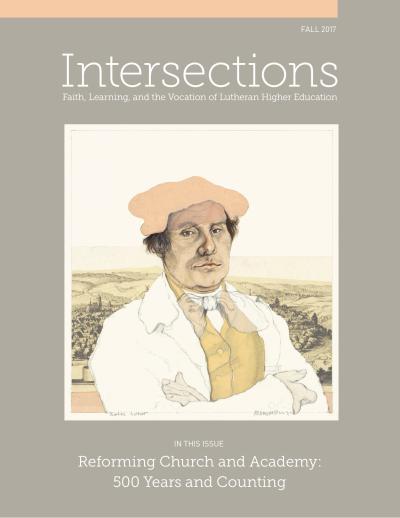 Article
Both Priest and Beggar: Luther among the Poor
Martha E. Stortz
No. 46 · Fall 2017
Reading Luther’s deathbed remark “We are all beggars” against his “priesthood of all believers,” Stortz argues that priest and beggar are two sides of a human reality — one that locates civic responsibility for the poor at the heart of the Reformation legacy and that pushes beyond paternalistic service toward the systemic question of justice.
-
 Article
Jonah: The Anti-Hero of Vocation
Martha E. Stortz
No. 45 · Spring 2017
In a chapel talk first given at Augsburg College’s Vocation 2.0 series in September 2016, Stortz reads the prophet Jonah as the great anti-hero of vocation — one who tries to outrun God’s call to the great city of Nineveh — and argues that, in a season of urban violence and divisive election-year rhetoric, the story is less about public calling than about being called by the publics in our midst.
-
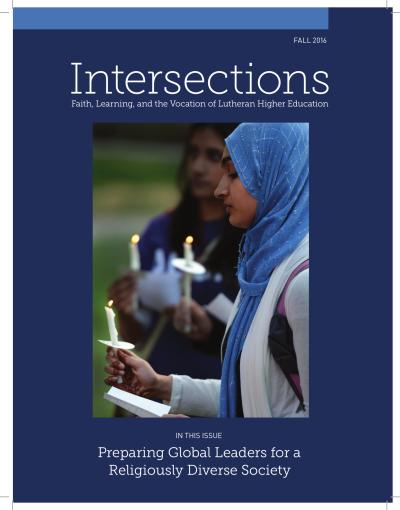 Article
Why Interfaith Work is Not a Luxury: Lutherans as Neighboring Neighbors
Martha E. Stortz
No. 44 · Fall 2016
Stortz argues that interfaith work is not a luxury but a constitutive commitment of Lutheran higher education — institutions she describes as both “faith-based and interfaith-dependent.” Reading the parable of the Good Samaritan as both an intra-faith and inter-faith encounter, she offers a four-fold matrix of theological reflection, spiritual engagement, social action, and everyday experience as portals into the work of being neighbor.
-
 Reflection
Finding Words That Matter (Proverbs 1:20-21; 4:10-13)
Harvard Stevens Jr.
No. 21 · Summer 2005
In a brief homiletic reflection on Proverbs, Stevens addresses Lutheran educators as “merchants of wisdom” competing with a crowded contemporary marketplace of internet, cable TV, and rap music alongside “Hedonism 101,” “Advanced Voyeurism,” and “Pure Escapism.” Recounting an evening with a Carthage student poetry club, he shares the poem wisdom whispered to him there and offers thanks for the high calling to teach “words that matter.”
-
 Article
Called for Life — Affirming Vocational Discernment
Richard L. Torgerson
No. 31 · Winter 2010
Torgerson introduces the “Called for Life” project, a three-year, $278,437 Lilly Endowment-funded collaboration among Luther, Augsburg, and Augustana that—in partnership with Luther Seminary’s Centered Life initiative and Wilder Research—rigorously assessed the effectiveness of campus vocation programs, examining whether students’ exposure to and understanding of calling had increased, and what program elements were most effective in shaping discernment.
-
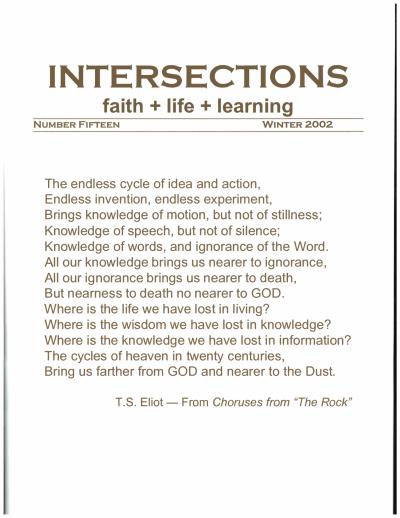 Article
The Marks of an ELCA College: One Bishop's Reflections
Stanley Olson
No. 15 · Winter 2002
Olson, speaking as a bishop and “Harness Boy” whose job is to keep the church’s connections working, replaces his original four-noun outline (fealty, ingenuity, insouciance, focus) with eight marks the ELCA should be able to observe in its colleges: intentional Lutheran identity, significant Lutheran presence, Christian faith at every table, freedom of inquiry, coaching toward vocation, gravity and grace, nurtured community, and excellence by its own standards. Drawing on his survey of all twenty-eight ELCA college mission statements (two tables) and on Darrell Jodock and Mark Edwards, he argues that the Lutheran connection must be made explicit in mission, marketing, and faculty searches, and closes with six reciprocal expectations the colleges should hold of the ELCA—commissioner, mature parent, supporter of adventurous teenagers, advocate, steward of graduates, and a church faithful to its own Lutheran mission.
-
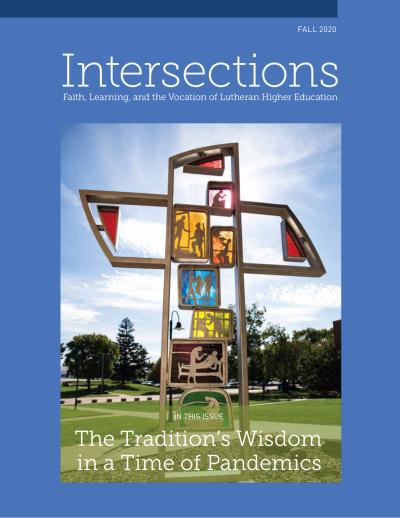 Editorial
From the Editor
Jason A. Mahn
No. 52 · Fall 2020
Mahn narrates a year of crisscrossing pandemics — Covid-19, economic collapse, partisan politics, and the long pandemic of white supremacy revealed anew by the murder of George Floyd — and argues that Lutheran liberal arts schools, by educating for vocation, are uniquely poised to help students respond with character and capable callings.
-
 Article
An Aristotelian Twist to Faith and Learning
Gregg Muilenberg
No. 3 · Summer 1997
Muilenburg, chair of Philosophy at Concordia, surveys the four traditional models for faith and reason—conflict, independence, dialogue, and integration—and argues that the Lutheran dialogical model is insufficient for wholeness. Drawing on the post-foundationalist epistemology of perspective and Aristotle’s account of knowing as desire-driven action, he proposes that faith is an ultimate value (an assessment belief of the form ‘x is better than y’), that learning is desire-directed action, and that the core of Christian education is the education of Christian desire—requiring both reflection and commitment, both integration and diversity.
-
 Institutional Focus
So That All May Flourish Study Guide
No. 57 · Spring 2023
A chapter-by-chapter study guide to So That All May Flourish (Fortress Press 2023), a new volume by NECU authors that develops the central tenet of “Rooted and Open” and offers discussion questions for use in orientation programs, classes, workshops, task forces, and professional development settings.