Were you to listen to me repeatedly, it would become evident that I care very deeply about the Lutheran identity of the colleges related to the ELCA. I want to describe that identity in such a way that it reflects the best of the tradition but even more that it serves the colleges well, serves society well, and serves the church well. I think the case for higher education based on Lutheran principles can be compelling—compelling because these principles correspond so clearly with the best of what a college or university aspires to be.
Why do I care so much about it? I admit that one reason is what it has meant in my own life. I say, “admit,” because it would be possible for such reasoning to devolve into sheer nostalgia—not wanting to give up on something that was valuable in another era without regard for its value today. Why do I care? Another reason is its value for others—what I have seen it mean for countless students and graduates over the years. But more important than either of these is what I think an identity built on this tradition has to offer to society. Nothing that this tradition does is completely distinctive, but it mixes the ingredients in a distinctive way to produce a formative college-wide discourse about community service and leadership, about faith and learning, about intellectual caution and moral courage, about rootedness and openness, about suffering and hope, about freedom and responsibility, and about creatureliness and the presence of the divine.
Let us begin with the question: What makes a college Lutheran? Is it the number of students who belong to that denomination? Or the number of faculty who are active in Lutheran congregations? Or the number and size of contributions that come from the Lutheran church and/or Lutheran sources? Without discounting the potential importance of any of these, I’d like to suggest that what makes a university Lutheran is the prominence of Lutheran principles in its mission statement and the degree to which its programs, its decisions, and the priorities of its faculty and staff are informed by those principles.
These principles may come to expression in a variety of ways. Because each school has its own history, its own type of student body, its own regional setting, the vocabulary used may vary. What I want to do here is to discuss ideas bestowed on us by the tradition and explore how they can inform the mission of a university or college. That is, I’m not suggesting language for a mission statement, but identifying underlying ideas.
My remarks will have four sections. Three will identify such underlying ideas, and the fourth will discuss their implications for higher education. Throughout the article I will try to convey these undergirding ideas in non-traditional terminology. I ask your patience because there will be quite a lot to be said before we reach the application to higher education.
Humans as Gifted
The most basic of these underlying ideas is that we are gifted. Our existence, our abilities, our possessions, our relationship with God—all these are gifts that we have received. I have tried on occasion to think of one thing about who I am that is not a gift. Whenever I have done this, I have failed to find one.
Consider some of the gifts in my own life. There was, for example, parental influence that taught me how to work and how to manage time (in the spring and the fall, I went to school three days a week and worked on my parents’ farm three days a week. I knew I had to keep my grades up if I were to continue to do that, so I got done in three days what others had five to finish). There was parental influence that valued learning. (For one thing, my father had quit school in the tenth grade, and I heard him talking others into staying in school, for another he valued ideas and talked about them, for yet another my mother would sit with us and listen to us recite our lessons before we went to sleep. By the way, going to school for seven years after college was a puzzle to some of the neighbors. They would ask my father, “What is he going to be when he is done with school?” My father’s favorite reply was “An old man!!”) There was parental influence that taught me how to manage money. There was modeling—numerous parental examples of community involvement and frequent conversations about communal responsibility. There was parental mentoring—asking challenging questions and giving me the freedom to figure out my own answers. There were dedicated and encouraging elementary teachers and caring high school teachers. There was an unusually rich array of college professors who inspired and challenged and functioned as role models. There was a Danforth Foundation that opened the doors to a profession that was not yet on my radar screen and provided vocational as well as financial support for six years of graduate school. There have been mentors galore from neighbors who cared about me when I was a child, throughout my school years and into my adult life. Whatever I know about Judaism, for example, came from the generosity and patience of a rabbi who answered question after question. My pastor while I was in grade school and high school was an educated and wise man who modeled a kind of piety and theology that never needed to be undone, no matter how far my education has progressed. There were the people who built and sustained the educational institutions I attended. There were the people who contributed in so many ways to the quality of life in the communities where I have lived. The list can go on and on and on. If any of us is inclined to take credit for something one has done, I challenge that person to think more deeply. Why were you able to do that? In the answer, we discover a deeper giftedness.
Acknowledging that we are gifted is contrary to any notion of entitlement, so commonplace in our society, and it is contrary to any notion that the goal of life is to bring it under our own control. By definition, we cannot control the generosity of another. We can only respond to it.
Responses to this Giftedness
First, acknowledging giftedness leads to wonder, awe, and gratitude. Though these are not words that Luther himself used, I think they capture much of what he had to say about human life. Wonder is a stance toward the universe. That anything exists and that you and I exist are reasons for wonder. The intricacy and the majesty and the beauty of the universe are all sources of wonder. That there is benevolence in the universe is amazing. The length of time that it took before life emerged and the exactitude of the conditions necessary in order for conscious life to appear (explicit in the anthropic principle) are amazing. The presence both of regularity and novelty in the universe is an occasion for wonder, as is the self-creating character of the universe that these make possible.
Second, acknowledging giftedness leads to a sense of humor. I mean by a “sense of humor” not taking something too seriously. That is, if our status in the universe does not depend on us but on the gifts that we have received, then nothing we can control is of ultimate seriousness. Yes, we have work to do, but one does not need to take one’s status in society too seriously. One does not need to take one’s reputation or one’s moral achievements, or even one’s own theology too seriously. The result is a sense of humor about oneself and others and even those things that matter most in life.
Third, acknowledging giftedness leads to service and the ability to respond to others. If my status as a human being were to depend on my own accomplishments, then life would be pretty grim. Every failure would be a catastrophe. I would be on a treadmill with a need for one success after another, and every new situation would be a threat. My energy would be focused inward on myself. But if I acknowledge my giftedness, I am free to listen and free to become absorbed in the needs of others.
The word the Lutheran tradition gives to this other-directedness is vocation or calling. Every person is called to serve the larger community. Whatever a person’s occupation, this is his or her vocation.
Giftedness calls forth Wisdom
In order to serve well, a human being needs wisdom. What I mean by wisdom is the capacity to understand how human beings work. Wisdom is not just the possession of knowledge but the good judgment how to use it. Wisdom understands what makes for a fully human life. It understands what effect a possible action that I contemplate will have on another human. It understands how communities function—how they can be influenced in such a way as to enhance the quality of life for their members. Giftedness opens the door to service. In order to serve effectively, such wisdom is important.
Martin Luther put a lot of confidence in wisdom. In the scriptures he found some general principles of behavior, but he produced no detailed list of do’s and don’ts. He placed his confidence instead in human wisdom and recommended that we use it to figure out how to serve our neighbors and the community. Unlike his contemporary, John Calvin, he found no blueprint in the scriptures for how to organize a government and what laws to put in place. Here too he appealed to wisdom. Humans were to use it to decide how to govern and what laws to enact—wisdom regarding what would benefit this particular community in this particular situation. Moreover, he did not want rulers just to apply laws; he recommended that they use their wisdom so that their enforcement was neither too strict nor too lenient.
If I may anticipate section four, the goal for any educational endeavor based on a Lutheran outlook is to enhance wisdom. Wisdom is, of course, not the same as learning. An unlearned person can exhibit a great deal of wisdom. And learned people can be, as my father was wont to call them, “educated fools.” But, everything being equal, education enhances wisdom. Luther put it this way, as he argued in favor of the creation of schools in his own day for both young women and young men:
If children were instructed and trained in schools [as opposed to being trained only by their parents—a practice that would achieve a certain “outward respectability” but underneath leave them “nothing but the same old blockheads”], or wherever learned and well-trained schoolmasters and schoolmistresses were available to teach the languages, the other arts, and history, they would then hear of the doings and sayings of the entire world, and how things went with various cities, kingdoms, princes, men, and women. Thus, they could in a short time set before themselves as in a mirror the character, life, counsels, and purposes—successful and unsuccessful—of the whole world from the beginning; on the basis of which they could then draw the proper inferences and in the fear of God take their own place in the stream of human events. In addition, they could gain from history the knowledge and understanding of what to seek and what to avoid in this outward life, and be able to advise and direct others accordingly. (“To the Councilmen” 368–69).
Knowing “what to seek and what to avoid”—that’s wisdom. Luther expects it to come from education. Being able to “advise and direct others accordingly”—that’s leadership, and Luther expects it, too, to come from education.
So far I have not been identifying the source of our giftedness. Looked at in one way, it can have multiple sources—other human beings, various institutions, the universe, and so on. But viewed through Lutheran eyes, our giftedness has one source, namely, God. This is explicit in Luther’s explanation to each of the three articles of the Apostles Creed, as found in the Small Catechism. The idea here is that every human being and every creature who gifts us is a channel or agent of God. In his explanation to the first commandment in the Large Catechism, Luther says,
So, we receive our blessings not from them [neighbors, parents, authorities], but from God through them. Creatures are only the hands, channels, and means through which God bestows all blessings . . . . Therefore, this way of receiving good through God’s creatures is not to be disdained, nor are we arrogantly to seek other ways and means than God has commanded, for that would be not receiving our blessings from God but seeking them from ourselves. (“Large Catechism” 368)
This notion that gifts come to us from God through others has a corollary—and this is that God’s gifts reach others through us. Not only are others the channels and means whereby we receive gifts, but we are called to be the channels and means whereby gifts reach others. Our giftedness yields a task, a calling.
A Down to Earth God
We come to a second underlying idea—namely, that the Lutheran tradition affirms a particular kind of God—a God who is down to earth and involved, a God who is at work behind the scenes creating justice for all and fostering human wholeness or peace. Luther appealed to the first chapter of Luke for his vision of God’s behind-the-scenes activity. God scatters the proud, brings down the powerful from their thrones, lifts up the lowly, fills the hungry with good things, and send the rich away empty (Luke 1:51–53). This is not a God who causes everything to happen that happens, because much that happens is not God’s will. This is a God who struggles with injustice and struggles with human pigheadedness. This is a God who co-experiences human suffering and even knows the kind of failure that comes when in their freedom humans use their divinely given power for destructive ends. This is a God whose faithfulness is manifest in the regularity of the natural world and whose love is evident in the novelty and freedom of its creatures.
Such a God does not stand above, directing the world, nor does this God micromanage every piece of the world but instead works within it. Everything and anything can be a mask of God’s presence and God’s activity, and this includes any discipline or area of study.
The presence of such a God provides hope—hope because this is not a God-forsaken world, hope because whatever we do for justice and peace we are not working alone, hope because we are part of a larger story that does not come to an end with a defeat, no matter how significant it may seem to be. It is a hope that can look evil and disappointment in the eye and still go on. As Yitz Greenberg has said, hope is a dream with the discipline to bring it into being—a discipline that extends over lifetimes and generations and even centuries. In one of my first-term seminars, we studied some new religious movements. One of those is Jonestown. Many of you will remember the shocking news of 900 plus persons committing suicide in the jungles of Guyana. One question is what went wrong. I think the most central factor was a loss of any sense of transcendence. Most of the participants were persons who had experienced the worst of American society and had willingly cut their ties with it. They could not go back. Their only hope was this one community. The same was true of their leader, Jim Jones. Neither he nor they had any sense of being part of a larger movement. When they were told this one community was in danger, hope disappeared, and death seemed the only alternative. The presence of hope is the antidote to such a fate.
The ultimate goal is to mend the world—to borrow a phrase from the Jewish tradition—so that (using biblical imagery) the lion can lie down with the lamb, swords can be beaten into plowshares and spears into pruning hooks, every tear be wiped away, and everyone have God’s instruction written in their hearts. For the world to be mended, humans need to participate, because in their freedom they can either foster or undermine the achievement of this goal. Our task is to be “created co-creators” (to use a phrase borrowed from Phil Hefner)—“created,” meaning “not God” and “co-creators,” meaning we too have responsibility for the care of the world.
The Two Ways of God and Lutheranism's Third Path
The third underlying idea is a distinction between two modes of God’s activity. God is active in all of creation, creating the conditions for life to exist, and God is at the same time active in bringing people to faith. The first mode of activity aims at justice and at the human dignity of all, and it works through social structures that may at times be coercive. For example, it may require the threat of a ticket to keep me from disregarding the stop sign and harming someone in another car, or it may take the threat of arrest to keep someone from lining his or her own pockets at the expense of another. Here God may do an “alien work” involving restraint and coercion. The second mode of activity aims at restoring a God-human relationship. It utilizes love and mercy and forgiveness and aims at transforming individuals and never involves coercion. If this distinction between two modes of divine activity is collapsed, then confusion reigns in society. And if the distinction is made into a separation, then there is no check on totalitarianism. Again to anticipate section four, if the distinction is abandoned, the primary role of the college or university related to a church becomes propagating the faith. But if the distinction is maintained, then it has two overlapping purposes that remain in tension with one another: one is to prepare wise, engaged leaders ready to make service to the larger community their priority. The other is to hold up the importance of religion and to provide opportunities for faith to be deepened and to come to maturity. If the distinction is maintained, then a college can be both rooted and inclusive, rooted in the Lutheran tradition and yet inclusive of others.
I have sometimes talked about being both rooted and inclusive as a “third path.”2 What I mean by that is that there are two “default positions” readily available in American society for institutions with religious roots. The first default position is the sectarian. It conceives of an institution as an enclave, a place set apart where people of one religious persuasion can gather. Such an enclave can be very useful in forming identity and in providing mutual support. But it is cut off from the larger society. The second default position is non-sectarian. It aims to include within itself the full range of diversity that exists in the surrounding culture. Rather than an enclave it is a microcosm that mirrors society. This position has advantages as well, because it offers such easy access. People can cross the line from the outside to the inside without noticing much difference. But here too there is a cost. The cost is the loss of rootedness, a loss of depth, because the expectation is for each group to weaken or suspend its loyalties so as not to be obtrusive. The “third path,” the one I find consistent with a Lutheran outlook, is both rooted and inclusive. This approach digs deep roots and draws nourishment and inspiration from a religious tradition, but it does so in such a way as to stay engaged with the larger society, to be welcoming of diversity, and to take seriously inter-religious dialogue.
Implications for Higher Education
So, what does this all mean for education? Allow me a series of observations.
First, since the heart of religion is wonder, awe, and gratitude rather than a particular set of beliefs, this sense of giftedness operates on a different plane than does learning. Not only is there no direct conflict between religion and learning, but much of our learning grows out of wonder and circles around to reinforce it.
Consider science. John Polkinghorne, a theoretical physicist, says the following:
Like every worthwhile activity, science has its weary routine and the frustrations that come from lines of inquiry that eventually prove fruitless. At the end of the day, the wastepaper basket of a theoretical physicist is likely to contain a lot of crumpled pieces of paper. Why then do we do it? The payoff for all our labor is the sense of wonder at the beautiful order revealed through our investigation…. There is a profound character to the structure revealed, which often greatly exceeds our puny prior expectations. (Polkinghorne 42)
If Polkinghorne is right, wonder is a motivating factor for a scientist. One way this comes to expression is in the weight placed on elegance as a criterion in mathematics and in science.
Consider artistic creation. Much of it grows out of a wonder and an awe that is not expressible in words—or alternatively out of a reflection on the human condition in light of such wonder and awe. Think of great painting and sculpture. Think of great music. Think of dance. Think even of great poetry and literature, which may use words but use them to express what cannot be said directly.
If A.N. Whitehead was correct, then all beauty—beauty in literature and music, elegance in science and mathematics, beauty in religion and philosophy—is a harmony of novelty and order. It is an endeavor to express and encompass both the regularity and the freedom exhibited by life in this universe. It may be more or less intense, depending on how much diversity is included in the harmony. The quest for more intense forms of beauty is one expression of wonder, and this quest is at work in higher education and in religion.
Consider worship as an expression of wonder, awe, and gratitude, utilizing symbols and music and art and architecture and poetry and storytelling and dance to foster memory and hope and to foster a sense of one’s place in a mysterious but strangely benevolent universe.
Or consider the importance of wonder for ethics. If I wonder at the inexhaustible depth of another person, I am not likely to abuse that person. If I wonder at the intricacy and complexity of an ancient forest, I am not likely to destroy that forest or to value it only as a source of lumber and economic benefit. An important component in morality is wonder at the connectedness of everything that is. In the end, I cannot harm another person or another part of the created world without also harming myself.
So our first observation is this: wonder, awe, and gratitude are basic to inspired learning and are in turn reinforced by the best learning.
Second, a college or university built on a sense of giftedness has a purpose—fostering wisdom for the good of the community as a whole. We have already discussed this point, so let me simply add a comment or two. The conviction of an institution that follows the “third path” is that one finds in the best of the Lutheran, Christian, biblical tradition insights that foster genuine wisdom—insights that contradict the more superficial messages rampant in our society. And the conviction is that affirming one form of rootedness does not close off access to other forms of depth. A community nourished by Lutheran, Christian, biblical roots is also able to draw upon other avenues of depth. I have never met anyone who is engaged in inter-religious dialogue who has not felt as if that experience opened up new, hitherto unnoticed, dimensions of his or her own tradition. Far from destroying the rootedness, inter-religious dialogue enriches and deepens it. Access to other traditions comes not through denying one’s own roots but through affirming them and then allowing them to be enriched and challenged.
Third, a college or university built on a sense of giftedness exhibits freedom of inquiry because nothing is above critique and because the most careful thought is needed in order to serve people well. Not only does it exhibit freedom of inquiry, but that freedom itself has a purpose. The purpose is to discover truth, in the clear understanding that other people will be well served only if the truth is available. In other words, freedom of inquiry is but one side of the coin; on the other side one finds the pursuit of excellence, the pursuit of truth—and both sides are for the sake of the larger community.
Underlying this point is a basic observation—namely that ideas do matter. A good idea benefits others. A bad idea causes injury. It was, after all, an idea of manifest destiny that prompted settlers to push the Native Americans off their land, and much later it was a better idea of racial integration that created the civil rights movement. It was an idea of collectivization that caused Stalin to starve to death a million or more Ukrainian peasants during the 1930s. An idea regarding the size of government has caused forty-some million Americans to be without health insurance. Ideas have consequences. Freedom of inquiry is not an end in itself but a way of guaranteeing that ideas are subject to the kind of scrutiny they need in order to serve others.
Fourth, a college or university built on a sense of giftedness requires a community of discourse. Were the college oriented only to transmitting knowledge, a community would not be essential, but if the goal is wisdom, then community deliberation is crucial. If wisdom has to do with understanding other humans and understanding communities, then wisdom can be found only in human interaction and in careful reflection about such human interaction. It can be found only as persons ponder together what the learning of their disciplines means when applied to the achievement of dignity, justice, and peace. It can be found only as people with multiple insights and perspectives deliberate together.
Those of us in academia often hear a great deal about the value of diversity, and, yes, it is important, but it is not very important in itself. What is important is engagement with each other. Indeed, one of the unexpected things that Sharon Parks and her colleagues discovered in their study of a hundred persons deeply engaged in community service was the presence of a “common thread” mentioned by everyone. “The single most important pattern we have found in the lives of people committed to the common good is what we have come to call a constructive, enlarging engagement with the other” (Daloz et al. 54, 63). The divide, which made someone else “other,” could be ethnic or racial. It could be a disability or mental illness or imprisonment or poverty. “But whatever its particular form, the encounter [which often was not a single experience] challenged some earlier boundary and opened the way to a larger sense of self and world” (65–66). As a result, the people in this study had come to feel a connection with the other; “they felt that the ‘other’ experienced some fundamental aspect of life in the same way as they did” (67). For a college or a university the key is to establish the kind of community in which a constructive, enlarging engagement with the other can occur (either on or off campus—e.g. a good study abroad program can put students and faculty in contact with the harsh reality of third-world life) and its deliberations be enhanced as a result.
Fifth, a college or university community built on a sense of giftedness will be cautious about its intellectual claims, while at the same time valuing those claims as potential contributions to human well being. It may proclaim those ideas widely and loudly but always with a sense that they can be challenged and never with a sense that they have exhausted the subject. Such a college or university will be wary of ideologies and receptive to paradoxes that point beyond ideas to something still deeper, still more complex, and still not well understood.
Sixth, a college or university built on a sense of giftedness will set aside time for worship, that is, for a celebration of wonder, awe, and gratitude and a vision for the future—for a celebration of those things that give vitality to the rest of the enterprise and are easily overlooked if not identified and celebrated.
Seventh, a college or university built on a sense of giftedness will itself have a vocation. It will find ways to serve the larger community, whether through the use of its facilities or through the expertise of its faculty and staff or through the involvement of its students.
In this regard I would like to call attention to one sort of service that is important for a church-related college today. It is not the only one that is important or even the most important, but it is one that needs attention. I am thinking about the need in the church for help with deepening the vocation of believers in their daily lives. In order for church members to be equipped to live their faith seven days a week, they need both instruction in the Christian tradition and assistance negotiating the decisions they need to make at the intersections of their lives—the intersection of faith and business, the intersection of faith and politics, the intersection of faith and family life, the intersection of faith and ecology, and so on. No other institution has the resources that a church-related university has for helping congregations support and clarify the role of Christians in the world. As I say, this is only one form of community service, but is one that the church desperately needs. It needs this, because there are so many centripetal forces that keep pulling congregations inward, just as there are so many centripetal forces that pull colleges inward. The church needs this help because the social location of the church has changed so that clergy can no longer be its public spokespersons. Everything depends now on the credibility and witness of ordinary Christians in their daily lives. They are the face of the church—the only one most people ever see. I hold up this one form of community service, not only because it is needed, but also because it can strengthen the ties between the church and its colleges. If our colleges become valuable resources for the adults in congregations, as well as for their children, the church-college connection will remain vibrant and healthy. Only then will colleges enjoy a partnership in which church and college benefit each other. The well-known Methodist theologian, John Cobb, gave a talk three or four years ago entitled, “Can the Church Think Again?” A positive answer depends on finding ways for the church colleges and the church to work together.
Eighth, a college or university built on a sense of giftedness will be free to explore the religious implications of everything it does. Unlike secular institutions, such colleges and universities can explore the importance of religion and of inter-religious understanding in a setting where that exploration is intimately related to learning and to informed ethical reflection. Given the level of discourse about religion that occurs in public life (most notably on television radio, but even in that form of public life found in our universities), society needs this kind of exploration.
Ninth, a college or university built on a sense of giftedness will foster liberal learning—that is, learning oriented toward the freedom of its members—freedom from prejudice and ignorance and bigotry and freedom for courageous moral action and service to the larger community. What matters for the liberal arts is not just learning but the affect of that learning on the lives of learners. The latter needs to be explored with as much seriousness as the former. Why? Because the job of church-related higher education is to foster wisdom and wise community service, not just learning.
Tenth, a college or university built on a sense of giftedness will empower for service—by providing chances to speak, to write, to serve, and to lead. It will supply models and opportunities and a support community for practicing service and practicing leadership.
Conclusion
We live in a “cut flower” civilization, running on borrowed social patterns and borrowed values with little ability to nourish or replenish them. Just as our society uses up and discards natural resources, so it keeps using up social capital without replenishing it. This happens in part because our civilization is cut off from depth. It is cut off, first of all, from the past and the future. The Enlightenment, so formative in our national consciousness, broke ties with the past, portraying it as a time of ignorance and superstition and portraying contemporary experience as the source of insight and progress. It produced optimism, but such optimism was ended by a mushroom-shaped cloud and an ecological crisis, which closed off the future. The possibility of self-destruction has made the future so frightening that people avoid thinking about it and seem unable to comprehend the changes that need to be made. So we are trapped in the present. Secondly, our civilization is cut off from depth because it has unraveled strong community ties and considered religious faith subjective and private and therefore irrelevant.
I’d like to suggest that a college or university that builds on the Lutheran tradition has access to depth—both the depth of the past stretching off through generations all the way back to Moses and beyond and the depth of a giftedness that makes room for mystery and for wonder, awe, and gratitude. It also has a vision for the future—a vision of justice and wholeness. Any such college or university with access to depth has a source of nourishment for its intellectual pursuit, a source of nourishment for its vocational discernment, and a source of nourishment for its ethical convictions. What better way is there to serve the larger society than by confronting its shallowness and modeling a constructive alternative?
Endnotes
1. This paper was initially given at the Kenneth H. Sauer Luther Symposium, Wittenberg University, Oct. 24, 2005.
2. See, for example, Darrell Jodock, “Vocation of the Lutheran College and Religious Diversity,” Intersections 33 (Spring 2011), 5–6.
Works Cited
Daloz, Laurent A., Cheryl H. Keen, James P. Keen, and Sharon D. Parks. Common Fire: Leading Lives of Commitment in a Complex World. Boston: Beacon, 1996.
Luther, Martin. “To the Councilmen of the All Cities in Germany That They Establish and Maintain Christian Schools.” Luther’s Works, Vol. 45. Philadelphia: Muhlenberg, 1962. 347–78.
____. “The Large Catechism.” The Book of Concord. Ed. Theodore Tappert. Philadelphia: Muhlenberg, 1959. 337–56.
Polkinghorne, John. Serious Talk: Science and Religion in Dialogue. Harrisburg, PA: Trinity Press International, 1995.
-
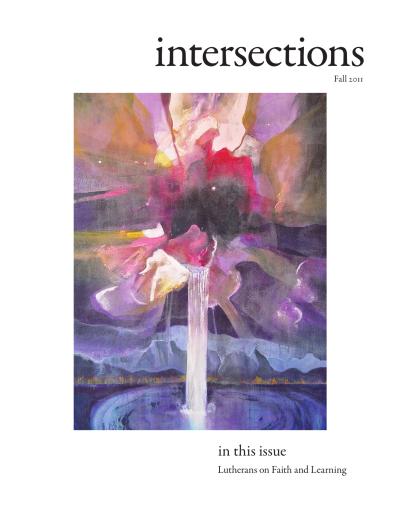 Editorial
From the Publisher
Mark Wilhelm
Wilhelm bids farewell to Robert D. Haak, who is leaving the editorship of Intersections and the Augustana College Center for Vocational Reflection for a chief-academic-officer post at Hiram College in Ohio, and welcomes Jason A. Mahn as the incoming editor. He celebrates Haak’s tireless work to integrate the Lutheran concept of vocation into the practices and rhetoric of Augustana and ELCA higher education through six years of Intersections, and frames the journal as a vital tool for sustaining the conversation about education in a Lutheran key—even at colleges and universities where most students, faculty, and staff are not Lutheran themselves.
-
Editorial
From the Outgoing and Incoming Editors
Jason A. Mahn, Robert D. Haak
Outgoing editor Robert D. Haak reflects on a six-year run inheriting Intersections from founder Tom Christenson, the “powerful voices” that have driven the conversation (Dovre, Jodock, Christenson, Simmons, Morgan, Olsen, Wilhelm) and the newer ones now entering (Mahn, Bussie); incoming editor Jason A. Mahn, picked up from the airport in Bob’s pickup truck five years ago, names central issues that “Lutherans on Faith and Learning” engages and previews essays by Dovre, Jodock, McDonald, Hill, Turnbull, and Jodock again.
-
Article
A Lutheran Learning Paradigm
Paul J. Dovre
Drawing on Hughes and Adrian’s Models of Christian Higher Education and on Ernest Simmons, Darrell Jodock, Tom Christenson, Robert Benne, and Richard Hughes, Dovre sketches a Lutheran learning paradigm shaped by four deep narratives—the biblical, the confessional, the theological, and the vocational—and traces their implications for curriculum (the study of scripture, theology, and vocation), for the religion faculty’s college-wide responsibility, and for pedagogy (moral deliberation, dialectic, paradox, the engagement of faith and the secular disciplines).
-
Poem
Endtimes
Dave Hill
A four-stanza meditation on the “last perfect day” when an unblemished Sun makes the cool Ocean roll—and on the relation of each questing mind to the Deep, of each frail mortal to the pulse of the Sea at the edge of the grave. “Let it die full of Life! Let its murmurs and sighs / Give the drama a meaning. Let it not, Lord, die dead.”
-
Article
Lutheran Colleges, the Lutheran Tradition, and the Future of Service-Learning
Joseph McDonald
McDonald, who has used service-learning since the early 1990s and now directs the Values Based Learning Program at Newberry College, traces the service-learning movement from its 1960s socio-political pioneers (Nadinne Cruz, Ira Harkavy) through its institutionalization as classroom pedagogy and citizenship education (Stanton, Giles, and Cruz; Edward Zlotkowski; Jane Addams’s Hull House and John Dewey). He argues that three strengths of the Lutheran tradition—robust reflection as a community of discourse, Christian vocation as service infused in all roles, and the capacity to negotiate tension and paradox—uniquely equip Lutheran colleges to hold the pedagogical and socio-political dimensions of service-learning together, recovering the energy of the pioneers without sacrificing classroom rigor.
-
Reflection
Dreaming God's Dream: A Sermon on Isaiah 56:1-2, 6-8
Stephan K. Turnbull
Preached at the 2008 “Savvy with Substance” Convocation of the ELCA at Central Lutheran Church, Minneapolis, this sermon by parish pastor Stephan K. Turnbull (First Lutheran Church, White Bear Lake) sets the small dreams of pastors and academics—balanced budgets, peaceful congregations, coherent midterm papers—over against the prophet’s dream in Isaiah 56 of a God who gathers all nations to a house of prayer for all peoples. Turnbull calls educators, preachers, and church leaders to articulate God’s dream of getting the world back through the dying of Jesus the Messiah and the resurrection’s first fruits of new creation.
-
Reflection
Fumbling Toward Integrity: A Sermon on Mark 8:34-38, Pastor Kaj Munk, and Father Maximilian Kolbe
Darrell Jodock
Preached at the 2007 ELCA Convocation of Teaching Theologians at Lenoir-Rhyne College, Jodock holds up two World War II martyrs—Polish Franciscan Father Maximilian Kolbe, who took the place of a condemned father in Auschwitz’s starvation bunker, and Danish pastor-playwright Kaj Munk, who was shot by the Nazis after helping save 97 percent of Denmark’s Jews—as mirrors for our own priorities. Drawing on the rescuer characteristics identified by Samuel and Pearl Oliner (agency, moral independence, universalistic caring, a history of care-giving) and on Jesus’s words in Mark 8:34-38, Jodock asks how we who routinely opt out at the first sign of opposition might fumble toward integrity in our own time.
-
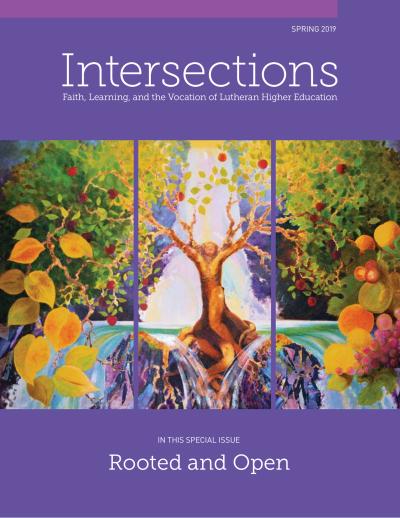 Article
In a Diverse Society, Why Should Lutheran Colleges/Universities Claim their Theological Roots?
Darrell Jodock
No. 49 · Spring 2019
Jodock develops his “third path” account of the Lutheran college — neither sectarian nor non-sectarian but both rooted and open — analogizing the college to a bridge whose deck of daily activities rests on pillars of shared educational priorities, which in turn rest on theological footings; he then answers six common objections to claiming Lutheran roots and explains why those footings still matter.
-
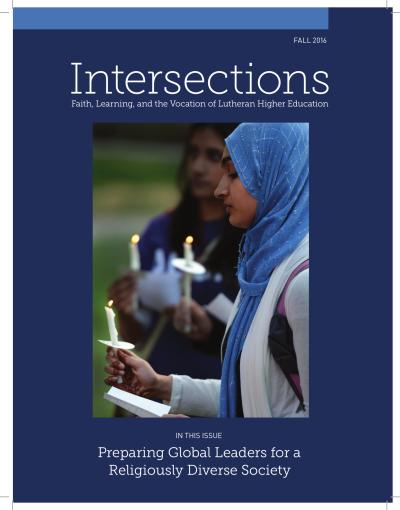 Article
Religious Diversity and the Vocation of a Lutheran College
Darrell Jodock
No. 44 · Fall 2016
Jodock argues that a college which takes its Lutheran values seriously is well positioned to foster inter-religious relations along a “third path” that is both religiously rooted and inclusive. He traces the relational and communal character of Lutheran theology, develops a Lutheran understanding of deeper freedom, the theology of limits, and human complexity, and shows how a down-to-earth image of God offers theological resources for overcoming the anxiety and fear that block interfaith engagement.
-
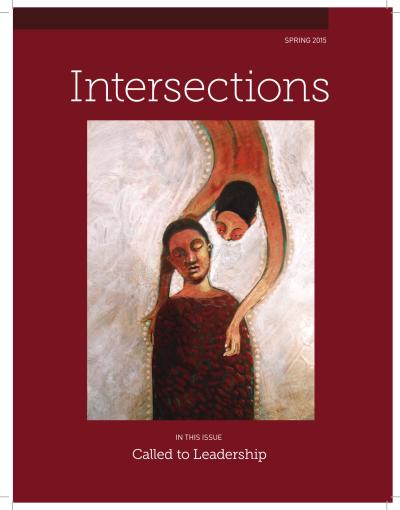 Article
Vocational Leadership
Darrell Jodock
No. 41 · Spring 2015
Jodock proposes “vocational leadership” as a name for a distinctive educational value at the heart of a Lutheran college — one that seeks to benefit the neighbor and the community, inspires and invites others to participate in that service, and is institutionally anchored in the Lutheran concept of vocation. He unpacks twelve facets of vocational leadership and ties them to Luther’s own leadership around indulgences, public schooling, and beggary.
-
 Article
Vocation of the Lutheran College and Religious Diversity
Darrell Jodock
No. 33 · Spring 2011
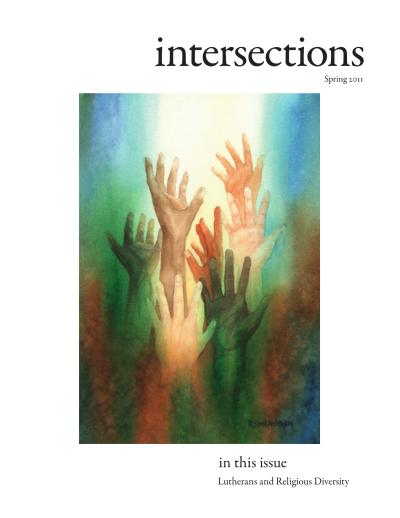
Jodock describes a “third path” for Lutheran colleges that is both rooted in the Lutheran tradition and inclusive of religious diversity — an alternative to sectarian and non-sectarian default models — and identifies six interlocking features of the Lutheran tradition (giftedness, an engaged God, wisdom, caution about claims to know, community, and an emphasis on service and community leadership) that shape how such a college engages interreligious dialogue and civil discourse.
-
 Article
Vocational Discernment: A Comprehensive College Program
Darrell Jodock
No. 14 · Summer 2002
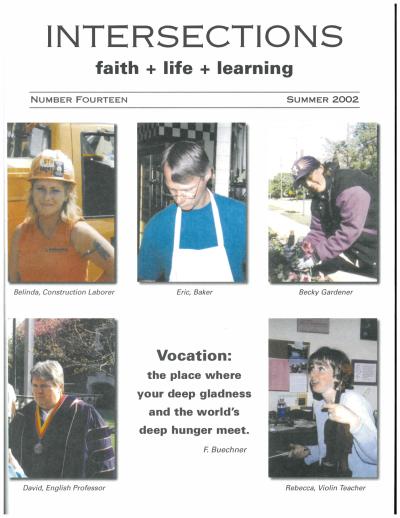
Jodock, whose Gustavus Adolphus was one of twenty colleges to receive a Lilly “Theological Exploration of Vocation” grant in 2000, defines vocation not as occupation but as a self-understanding that nests the self in community. Reading Robert Putnam’s Bowling Alone on the collapse of secondary communities alongside Luther’s ethic of community benefit and five Lutheran principles (graciousness, Christian freedom, community, God active in the world, the theology of the cross), he walks through Gustavus’s three-level design—a definition of vocation open to other faith traditions, “middle principles” drawn from Sharon Parks’s Common Fire, and a long menu of programs coordinated by a new Center for Vocational Reflection—hoping that, in the language of Holocaust studies, graduates will be “resisters” and “rescuers” rather than bystanders.
-
 Article
Freedom, Humor, and Community: A Lutheran Vision for Higher Education
Darrell Jodock
No. 13 · Winter 2002
Jodock’s inaugural lecture for the Bernhardson chair at Gustavus Adolphus develops three interlocking themes drawn from the Lutheran tradition as a deeper grounding for the liberal arts college than contemporary American assumptions. A sense of humor rests on Luther’s discovery that God takes the initiative—Luther could call himself a beggar, joke about the epistle of James, and credit Wittenberg beer for the Reformation—and underwrites the freedom of inquiry that John Updike traces to Grace Lutheran Sunday School in Shillington. Community, grounded in Augsburg Confession VII and Luther’s 1524 letter to the German city councils, makes the college a community of discourse pursuing wisdom rather than “the same old blockheads.” Freedom is both “freedom from” and “freedom for,” illustrated by Nechama Tec’s Polish Holocaust rescuers and by Jodock’s Holocaust-class corporate role-play in which students voted to build a factory in a death camp rather than risk losing their board seats—a vivid case for educating toward “a passion for justice.”
-
 Article
Building on a Firm Foundation: ELCA Inter-Religious Relations
Kathryn M. Lohre
No. 40 · Fall 2014
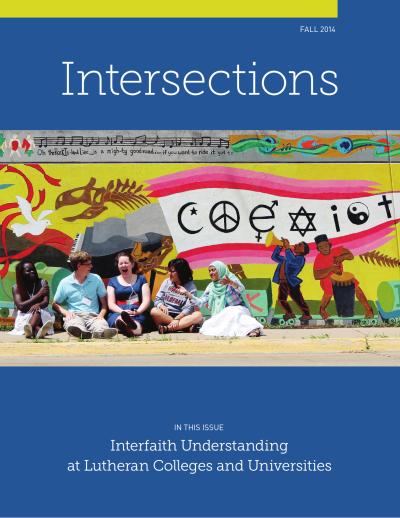
Lohre traces the ELCA’s twenty-year arc of inter-religious work — from the 1994 Declaration to the Jewish Community and the Lutheran-Jewish Consultative Panel, through the post-9/11 Lutheran-Muslim Panel and the Shoulder to Shoulder Campaign, to fledgling dialogue with Sikhs and the dharmic traditions — and frames Lutheran inter-religious engagement as the strengthening, not the dilution, of Lutheran vocation.
-
 Editorial
From the Editor
Tom Christenson
No. 3 · Summer 1997
Christenson explains that this issue breaks from the first two issues’ single-focus pattern to feature three principal papers on the environment, the education of desire, and hiring and personnel policies, plus two poems and a piece of reflective bemusement. He then commends George Marsden’s The Outrageous Idea of Christian Scholarship (Oxford, 1997) and challenges Lutheran scholars to articulate how the particulars of their faith inform their scholarship—in conversation with Calvinist work like Nicholas Wolterstorff’s Reason Within the Bounds of Religion and Art in Action—rather than remaining silently complicit in the view that faith has no place in the academy.
-
 Reflection
“Miracles are no longer required”—Life Writing as a Healing Tool
Barbara Reul
No. 57 · Spring 2023
A music historian and cancer survivor chronicles how a uterine cancer diagnosis in the early months of the COVID-19 pandemic disrupted her vocation as a university professor, and how writing two open-access memoirs became an unexpected tool for healing body, mind, and soul.
-
 Article
Welcome Strangers
Gregg Muilenberg
No. 15 · Winter 2002
Muilenberg, a non-Lutheran philosopher at Concordia, argues that self-consciously Lutheran colleges cannot make non-Lutheran faculty feel welcome through “institutional fit” rhetoric (he cites Concordia’s own hiring boilerplate) because identity must be sustained and developed, not preserved like a pickle. Drawing on Nikos Kazantzakis’s Report to Greco and the three marks of the “profoundly religious person”—commitment to the truth, to the power of the spirit, and to metousiosis through myth—he proposes that faith and reason are best understood as an unending struggle into which strangers must be invited as valuable and active participants, safeguarded by the strongest possible affirmation of academic freedom (citing Martha Nussbaum on Notre Dame and BYU).
-
Reflection
Discerning Vocation: Personal Recollections
Tom Christenson
No. 14 · Summer 2002
Christenson recalls growing up two blocks from Concordia College, Moorhead, where his father—known to students as “Doc”—was the steam engineer, and afternoon wanderings past walrus-moustached biologists, Harpo-Marx-haired theologians, and a math professor who wrote proofs with one hand and erased them with the other. He came to see the campus as “an asylum for child-like minds building towers of intellectual blocks and then knocking them down,” and traces his philosophical bent back to a high school physics teacher who, asked why Bernoulli’s principle was true, finally growled, “Christenson, you’re nothing but a damn philosopher.”
-
 Article
Sexuality over the Lifespan—Social Trends Pose Moral Dilemmas for Communities of Faith
Adina Nack
No. 22 · Spring 2006
Nack, a sociologist who presented to the ELCA Task Force for Studies on Sexuality, surveys empirical research on three life-stages flagged by the Task Force as particularly contested—premarital sexuality among adolescents and young adults, sexuality after divorce and within single parenting, and sexuality in late adulthood. Drawing on the Alan Guttmacher Institute, the Office of the Surgeon General, AARP, National Council on the Aging, and the World Health Organization’s 2002 definition of sexual health, she closes each section with questions about the church’s role in education, blessing of committed nonmarital relationships, and dismantling stereotypes about aging and sexuality.