Just Communities: From Liberal Arts in Prison to Racial Healing over Zoom
Intersections No. 54 · Fall 2021
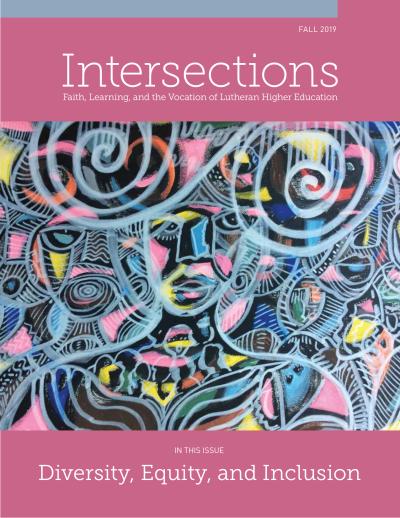
Augustana College is situated in the Quad Cities Area, which is composed of roughly 400,000 citizens on both sides of the Mississippi River. The Quad Cities is the only bend where the Mississippi flows east to west instead of north to south. The people who live Rock Island, Moline, and East Moline (all on the Illinois side), and in Davenport and Bettendorf (in Iowa to our north) are a diverse group—racially, ethnically, and religiously, with a Hindu Temple, two Sikh temples, a new Reform-Conservative blended Jewish synagogue, two masjids (mosques), and a Greek Orthodox church, as well as many Protestant and Catholic congregations. (Just how these five cities add up to the Quad Cities is a matter of local debate.)
Our beautiful 130-acre campus straddles our local watershed—known simply as “the slough”—and cuts across “the official boundary line of the Treaty of St. Louis of 1816, which is one in a series of multiple treaties the United States used to claim land from Native Americans that started in 1804” (Carmine 2). Roughly thirty-eight percent of our students are racial and ethnic minorities, which includes both domestic students of color and international students.
I arrived at Augustana College in March 2018 to fill the role of the college’s first vice president for diversity, equity and inclusion and chief diversity officer. I was attracted to the college for its social justice faith commitment. I was impressed with Augustana’s DEI efforts that led to creating this cabinet level position. The college had had a history of responding to student needs—although some of those responses were more reactionary than proactive. Also, Augustana was quite introspective in its preparation for a vice president and chief diversity officer. The college developed an inventory of DEI efforts over the past decade or more and included DEI as one of the pillars in the strategic plan. Augustana had laid important groundwork to foster a fertile environment for inclusion and diversity.
In our articulated commitment to social justice—one of the “Five Faith Commitments of Augustana College”—we describe “the development of a campus community that seeks justice, loves kindness, and acts with love and humility.” We describe the commitment further in terms of “making our campus and the wider world a more livable place for all persons by loving and serving the neighbor and by acting against injustice and intolerance.”
While describing our social justice commitment, we note that “we prioritize engagement in the Quad Cities community, which is for us a focus for our concern and learning.” We are currently taking strides to extend the DEI work done on campus into the Quad Cities, for the benefit of its citizens beside Augustana students and educators. In fact, one of our current strategic goals is to exercise leadership in the Quad Cities.
Although these and other articulations of our “church-relatedness” or our Lutheran institutional vocation were in place a dozen years before I joined the institution, Augustana needed someone to shepherd our commitment to diversity, equity, and inclusion in particular, and to help the campus move from a reactive position to a proactive stance in terms of racial reckoning. We are now advancing the work of institutional change—and this change inevitably and intentionally extends to justice-work within the larger communities.
The social justice commitment certainly drew me here, but that commitment does not stand alone; it is nestled among four other “faith commitments”—those of interfaith engagement, spiritual exploration, reasoned examination of faith, and vocational discernment. Each is complementary to the others. Together, they embody the institution’s missional aims for education of our students and commitment to partner with the Quad Cities community. We offer our educational gifts and seek to create just communities within our surrounding neighborhoods, while also learning from and with community members through various strong partnerships. In these ways, Augustana College is a resource within the community.
For the rest of this essay, I want to exemplify how issues of DEI on campus interface with our understanding of place and working for justice in the surrounding communities. I will share an overview of two efforts that were launched within the past couple years. The brief overview will not do either of them justice, but I do hope it provides a lens through which you can see how our commitment to social justice is lived out on campus and in the surrounding community.
Prison Education
The Augustana Prison Education Program (APEP) launched with a full schedule of credit-bearing liberal arts courses for ten degree-seeking incarcerated students in the present academic year (Fall 2021). Funded by the Austin E. Knowlton Foundation, the program is a partnership between Augustana College, the Illinois Department of Corrections, and the East Moline Correctional Center (which is perched above the Mississippi River 8 miles to our east). This new initiative is spearheaded by executive director, Dr. Sharon Varallo.
The for-credit, BA-seeking degree program arose from an initiative begun a number of years ago. In 2018, Sharon and Jason Mahn were contacted by a chaplain at the neighboring Monmouth College, inviting our institution to take part in a “Graduated Release Initiative” (GRI)—a study by New York University tracking the effects of college-level courses and other support on rates of recidivism. Sharon took on the task of organizing teaching at East Moline Correctional Center through that program, and she, Jason, and a colleague from the sociology department course taught courses ranging from analyzing the American Dream, to applying the neuroscience of learning, to a course on vocational reflection called, “Lives that Matter.” While much of this was the quiet work of a handful of teachers, it dramatically expanded Augustana’s reach into a part of the Quad Cities community that is cut off from the rest of us.
Sharon tells me now that, already then, she had hoped “to put prison education on the radar of Augustana College as one way we serve out our mission by building bridges from the campus to prison and criminal justice organizations in Illinois and across the country.” The Education Justice Project (EJP), a unit of the University of Illinois at Urbana-Champaign, as well as the Bard Prison Initiative (BPI) through Bard College in New York, quickly became models and conversation partners.
The early forays into prison education (and some informal book clubs with the incarcerated students once the GRI program had concluded), together with guidance from EJP and BPI, led Sharon to shepherd the creation and implementation of APEP—a four-year degree program. The first cohort of students applied by writing responses to literary and nonfiction passages and by answering interview questions about the life of their minds (and spirits). Twenty qualified students were chosen for admittance, but with COVID precautions, ten were able to matriculate. They are currently enrolled in four classes—completing 14 of the 123 credits needed for graduation (see Faggart for interviews with some students).
For Augustana educators, there are profound professional development benefits of teaching in this program. For APEP students, we hope the benefits are even more profound (and indeed, they tell their instructors so nearly daily). The prison is benefited by meeting its goal of providing substantive services to the incarcerated population to help them prepare for community reintegration. While many Americans may be aware of research that supports the efficacy of education on dramatic reductions in recidivism and dramatically higher likelihood of securing meaningful long-term employment, they may be less aware of the large positive ripple effects of that education on children of incarcerated parents.
From all “sides,” teaching-in-prison is a justice issue. In the aftermath of the passage of the 1994 crime bill, most of the existing college programs across the nation were forced to close, going from an estimated high of 772 higher ed in prison programs in the early 1990s to 8 in 1997. The nonpartisan Prison Policy Initiative reported that in 2005, there were “about a dozen” prison college-degree programs, four of them in New York State (Sawyer). There is a real need to provide access to formal education for those in the system if they are going to improve their chances for being accepted into American communities, which includes healed relationships and sustained, meaningful employment. And, of course, the shutting of educational doors has disproportionately disadvantaged Black, Indigenous and People of Color (BIPOC).
As Sharon explained to ten nervous, excited and apprehensive students on the first day of student orientation in the APEP classroom: “We look for great students all over the country. We [Augustana educators] are here because you [the incarcerated students] have great talent and potential, and it is our mission to help prepare students for lives of ‘leadership and service in a diverse and changing world’ wherever they might be.” As Sharon later explained to me:
This work matters, and doing it well matters as we live out the mission to go to places of deep need. The goal is to build a bridge that is authentically an Augustana bridge, one that is true to the Augustana mission. We have to be the ones to cross that bridge.
Racial Healing
In June 2018, a group of Augustana faculty and staff, along with a member of the local chamber of commerce, participated in the Truth, Racial Healing and Transformation (TRHT) Institute sponsored by the Association of American Colleges and Universities and hosted by Villanova University. We participated in this conference to learn racial healing practices and to consider having a Truth, Racial Healing and Transformation campus center here at Augustana. TRHT Campus Centers are designed “to prepare the next generation of strategic leaders and critical thinkers to break down racial hierarchies and dismantle the belief in the hierarchy of human value” (AACU). It is a national, “community-based initiative that seeks to address the historical and contemporary entanglements of race and racism within our communities. Each TRHT Campus Center prioritizes inclusive, community-based healing activities that seek to change collective community narratives and broaden the understanding of our diverse experiences” (AACU)
Having learned from sessions and collaborations at Villanova (including participation in our own “racial healing circles”), the DEI office now includes the following vision statement:
To develop a systematic, strategic, and sustainable approach to dismantling racism and other hierarchies of human value throughout the Augustana College community and across the Quad Cities region; to bring people to the table and commit to staying at the table doing the work of reconciling our differences and committing to teach and model this for others.
The dual pandemics of COVID-19 and widespread racial violence that spanned 2020 provided the opportunity for Augustana to address more explicitly issues of race, disparate treatment, racialized bias, discrimination, and violence—specifically on and toward Black and Brown people.
The Office of Diversity, Equity and Inclusion outlined a campus plan of actions for the 2020-21 academic year that would increase awareness and knowledge of these issues and offer skill development to empower the campus community and promote social change. As part of the larger “Know Justice Know Peace” initiative, we hosted a number of Racial Healing conversations, through which we engaged about 500 current students, employees, community members, and alumni in explicit conversations about race.
The on-campus sessions for students and employees sustained open and vulnerable conversations (even over Zoom!) using prompts that unveil early racial awarenesses, identity-formation, and current challenges. Two alumni from Augustana—one Black and one white—agreed to host similar racial healing circles for alumni, and all of us were surprised at the number of alumni who attended and the gratitude they expressed. Commenting on Augustana as a predominantly white institution, one older alumni stated that she was finally given a chance to participate in the political movements of the 60s. (Better late than never!)
We also invited predominantly white, predominantly Black, and multiracial churches in the Quad Cities Area to a series of related conversations. Here, we used the 1619 Project podcast to unpack the history of race in America and the resultant systemic inequalities that exist and continue to produce racial ignorance, intolerance, and violence.
Community engagement also included training for local and regional law enforcement and public safety officials on strategies for building trust within Black and Brown communities. The training was approved through the Illinois Law Enforcement Training and Standards Board. It was an important way of shifting the power dynamic and bridging the gap between law enforcement and community members by increasing awareness and knowledge; it also acknowledged the inherent tensions between the police and those policed, whether based on perception or realities. Attendees earned continuing education credits for participating.
Toward the end of the 2020-21 academic year, President Steve and Jane Bahls founded the Presidential Racial Justice and Equity Fund, which encourages students to initiate future projects on campus or within the Quad Cities community in order to support similar equity and racial justice work.
Conclusion
Augustana College lives out its Lutheranness and commitment to social justice through intentional efforts at inclusion and community engagement for the purpose of addressing current social ills. Those social ills are rooted in the discriminatory and exclusionary past of our nation, communities, social institutions—including higher education—and subsequently, of our college. We commit to continue to address contemporary social issues by understanding the deep history of racism and other systemic injustices which have shaped our sense of place. Our understanding of justice acknowledges the need to create policies and practices that produce equitable access to opportunities, power, social goods and services. We must proactively promote these policies in order to eliminate disparities among and between our local community and nation.
Thus, our commitment to social justice demands that we confront current issues that arise from historic sins. But we also work with them—and with our community partners—with courage, hope, and a deep hunger to become communities of peace and justice.
Works Cited
AACU (American Association of Colleges and Universities). “Truth, Racial Healing & Transformation (TRHT) Campus Centers.” Accessed 1 Nov. 2021, https://www.aacu.org/trht-campus-centers.
Augustana College, “Five Faith Commitments.” Accessed 1 November, 2021, https://tinyurl.com/mrw4j25e
Carmine, Amedeo. “Augustana College’s Indian Boundary Line Marker.” Student Paper. RELG 362: “Race, Ethnicity, and Religion,” Augustana College. May, 20, 2020. Accessed 1 November 2021, https://tinyurl.com/3pamp3dy
Bard Prison Initiative. Accessed 1 Nov. 2021, https://bpi.bard.edu/
Education Justice Project. Accessed 1 Nov. 2021, https://educationjustice.net/about/
Faggart, Talya. “Augustana Prison Education Program launches at East Moline Correctional Center.” KWQC News, October 4, 2021. Accessed 1 Nov. 2021, https://tinyurl.com/4vs2ahbk
Sawyer, Wendy. “SInce You Asked: How Did the 1994 Crime Bill Affect Prison College Programs?” Prison Policy Initiatives. Accessed 1 Nov. 2021, https://www.prisonpolicy.org/blog/2019/08/22/college-in-prison/
“The 1619 Project.” New York Times Magazine. Accessed 1 Nov. 2021, https://tinyurl.com/4war287b
-
 Editorial
From the Editor
Jason A. Mahn
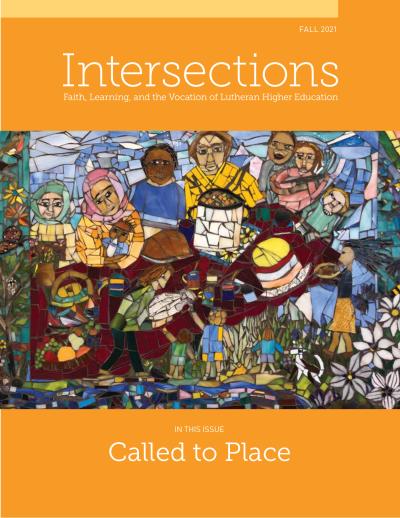
Mahn introduces the “Called to Place” theme of the 2021 VLHE Conference, arguing that Lutheran higher education’s emphasis on vocation must be grounded in particular geographies and embodied communities — for, as Wallace Stegner put it, “If you don’t know where you are, you don’t know who you are.”
-
Article
Where Your Feet are Standing: Institutional Engagement and Place
Melissa Maxwell-Doherty
Maxwell-Doherty draws on Cal Lutheran’s Hispanic-Serving Institution designation and its location on Chumash, Fernandino Tataviam, and Ohlone lands to ask how the university’s mission might shift if it depended on where its students are standing — not just where the institution sits.
-
Article
Community-Building On Campus and Beyond
Krista E. Hughes
Hughes describes Newberry College’s effort to build a “culture of community” that mirrors South Carolina’s demographics while reckoning with the institution’s founding ties to slavery — and names the challenges and promising city-college collaborations that shape this ongoing work.
-
Reflection
Caught in a Place Between Caesar and God
Darrel D. Colson
Colson reflects on his anguish, as Wartburg’s president, over an Iowa law that prevents him from requiring student COVID-19 vaccinations — reading Luther’s “Whether One May Flee From a Deadly Plague” alongside the conflict between obeying the law and serving neighbor.
-
Article
Hospitality to the Wild
Laura M. Hartman
Drawing on research with a Wild Ones Native Landscaping chapter and Marilyn Matevia’s ethic of “creature comfort,” Hartman argues that Christian hospitality must extend to non-human animals and plants — and asks whether college campuses can foster not just human diversity but biodiversity.
-
Article
Return to Purpose: Learning in an Age of Collapse
Ahmed Afzaal
Afzaal argues that the cascading crises facing higher education are not temporary glitches but symptoms of planetary and civilizational collapse — and that colleges must embrace “double-loop” learning and return to a shared sense of purpose if they are to help humanity descend gradually rather than catastrophically.
-
 Editorial
From the Editor
Robert D. Haak
No. 27 · Spring 2008
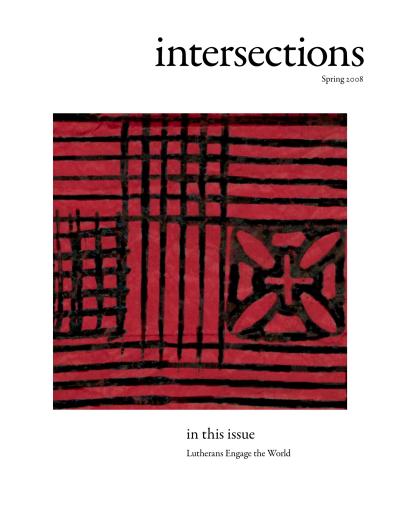
Haak frames the issue around the question of why Lutherans engage the world rather than retreat from it, locating the answer in the doctrines of creation and incarnation, and introduces essays by Erwin on globalism, Carlsen on local community engagement, Marty on multiple callings, and Mattes on the Grundtvigian heritage at Grand View. He also bids farewell to publisher Arne Selbyg, noting the fittingness of the Adinkra (“farewell”) cloth on the cover of this final issue under Selbyg’s leadership.
-
 Article
Vocational Discernment: A Comprehensive College Program
Darrell Jodock
No. 14 · Summer 2002
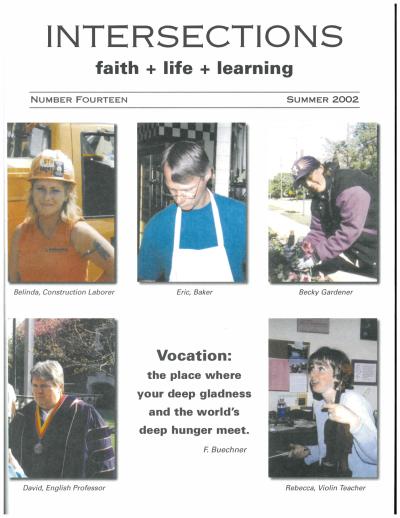
Jodock, whose Gustavus Adolphus was one of twenty colleges to receive a Lilly “Theological Exploration of Vocation” grant in 2000, defines vocation not as occupation but as a self-understanding that nests the self in community. Reading Robert Putnam’s Bowling Alone on the collapse of secondary communities alongside Luther’s ethic of community benefit and five Lutheran principles (graciousness, Christian freedom, community, God active in the world, the theology of the cross), he walks through Gustavus’s three-level design—a definition of vocation open to other faith traditions, “middle principles” drawn from Sharon Parks’s Common Fire, and a long menu of programs coordinated by a new Center for Vocational Reflection—hoping that, in the language of Holocaust studies, graduates will be “resisters” and “rescuers” rather than bystanders.
-
 Reflection
The Neglected Miracle of Pentecost
Susan M. O'Shaughnessy
No. 32 · Spring 2010
O’Shaughnessy, in a homily delivered at Concordia College in 2008, reads the Pentecost narrative of Acts 2 through Maria Lugones and Elizabeth Spelman’s 1983 critique of white feminism’s cultural imperialism. She argues that the miracle is not the disciples’ speaking but the immigrant Jews’ hearing—and that the writer of Acts withholds the content of what was said precisely to teach disciples that people of privilege know less than the foreigner, the immigrant, the oppressed, the woman, the child, and must learn to listen in new languages before they can speak.
-
 Editorial
From the Editor
Colleen Windham-Hughes
No. 62 · Fall 2025
5 min audio
Windham-Hughes plays on the shared Latin root of “education” and “seduction” (ducere, to lead) to warn against the No-saying seductions of giving up or condemnation, and to call educators to the riskier Yes of showing up to build third-space communities of truth-telling and hope.
-
 Editorial
From the Editor
Tom Christenson
No. 18 · Fall 2003
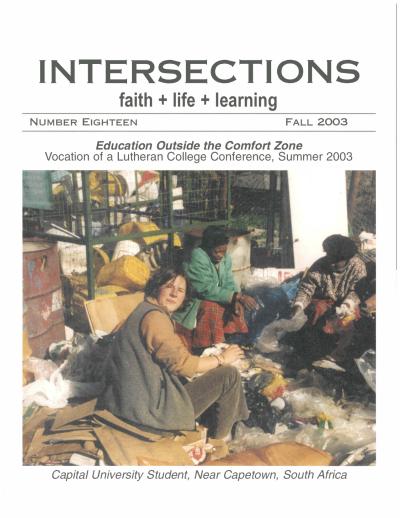
Christenson draws on a ten-year alumni survey at Capital University showing that students most often credit practica, internships, travel-study, and service-learning—not classroom hours—as the places they best learned the university’s stated outcomes, and introduces this issue’s papers from the Summer 2003 Vocation of a Lutheran College Conference on education and global outreach.
-
 Article
Changes
W. Robert Sorensen
No. 21 · Summer 2005
Writing as former executive director of the Division for Higher Education and Schools, Sorensen places the DHES within the threefold movement of Luther’s Reformation—university, church, and individual piety—and recounts how the Division cohered its work with colleges, universities, campus ministries, and schools around Joseph Sittler’s definition of education as “movement into a larger world.” Drawing on Huston Smith’s “primordial tradition,” the Namibian student program, work in India and Palestine, and the Bergendoff series of publications, he raises a twofold concern about the proposed merger of DHES into a Division for Vocation and Education: whether the new structure will signal the core significance of education in the heritage and life of the church, and whether it can carry forward the effectiveness and scope of DHES’ work.