Fumbling Toward Integrity: A Sermon on Mark 8:34-38, Pastor Kaj Munk, and Father Maximilian Kolbe
Intersections No. 34 · Fall 2011
This weekend, in our discussions of bio-ethics, we are struggling with many important questions. What does it mean to live as created co-creators? In a fallen world, what does it mean to live in the image of God? What priorities should govern the life of a believer?
Today, following the suggestion of our worship leader, Chaplain Andrew Weisner, we remember two martyrs—one from Poland, Father Maximilian Kolbe, and the other from Denmark, Pastor Kaj Munk. Both were in their 40s when they died at the hands of the Nazis.
Why recall their lives? To honor them? Doing so may be appropriate, but it will not be our purpose. In order to imitate them? Not really, because the circumstances of their lives are not identical to ours. Why then? We recall their lives so they can serve as a mirror. As we look carefully at the priorities of their lives, we can see more clearly the priorities actually at work in our own.
There are, to be sure, religious fanatics who are impetuous and bold. But most of us in this room are not fanatics. The operating priorities in our lives are more likely caution and deliberation. Such qualities are not themselves a problem, but they can so easily be tangled with others. Then caution becomes timidity, and a lack of information becomes an excuse for inaction.
To all of us Maximilian Kolbe is particularly relevant because he was a theologian. What interested him most was the renewal of faith among the people of his nation. He got involved in religious publishing both in Poland and in Japan and started a religious community in Poland that eventually grew to 800. When war came in 1939, his community took in 2,000 refugees, two-thirds of whom were Jewish. As you may recall, the Nazis attacked more than Poland’s army. They attacked the nation itself, killing or incarcerating the political and intellectual and religious leaders. In 1941 Father Kolbe was offered German citizenship, refused, was arrested, and imprisoned. In May he was sent to Auschwitz. At this early stage only about 10% of those in Auschwitz were Jews, but the Jews and the priests received the worst treatment. He was beaten by the guards, at one point so badly that he was left for dead. But the calm and non-vindictive way he handled his harsh treatment made an impression on his fellow inmates.
The Nazis practiced “collective retaliation.” To discourage opposition, they executed ten prisoners for every one who escaped. Late in July a prisoner managed to get out. Every remaining inmate was made to stand in roll call for hours. Then officer Fritsch started to select the ten who would die. When he reached prisoner #5659 the man broke down and wailed “my poor wife, my poor children.” At that point prisoner #16670 stepped forward. “What do you want?” asked Fritsch. “I want to take his place.” “Why do you want to do that?” Kolbe chose his words carefully, citing the Nazi principle that “the sick and weak must be liquidated” and continuing, “I am an old man, sir [he was 47!], and good for nothing. My life is no longer any use to anyone.” “Who are you?” “A priest.” To his assistant, Fritsch said, “Scratch out 5659 and write in 16670” (Royal 194).2 As a result prisoner #5659 would survive and live for another fifty years. But what awaited Kolbe and the nine others was the starvation bunker—an underground cell with no food and no water. It was a dreadful way to die. The only attention they received was one visit a day to remove the dead. Kolbe invited the men to pray and sing hymns. At the end of two weeks, he was still alive. After an injection with carbonic acid, he died on August 14, 1941, the day before I was born.
Would we step forward to take another’s place? If not, why not? What are the priorities at work in our lives? A need for approval? A paralyzing fear? The impression that what we are doing is too important to be interrupted? A lack of confidence in Jesus’ promise that the person who loses his life for the sake of the gospel will save it?
Those who have studied the rescuers (that is, those who risked their lives to hide or assist the victims of Nazi racism) have identified several characteristics not found in the bystanders.3 Father Kolbe shared those characteristics. The first is a sense of agency—the conviction that one can do something to make a difference, no matter how small. What about us? Do we see ourselves as victims or as persons who can make a difference? The second characteristic is moral independence—the capacity to make a moral judgment and undertake a moral act that is out of step with the surrounding society. What about us? When is the last time we stifled an ethical reservation or recommendation when no one else said anything? The third feature is a universalistic sense of caring—caring for people in need, whatever their nationality or religion. Where does our caring reach its limits? At the edge of the responsible elements of society? At the edge of our country? At the edge of its legal residents? At the edge of “the West”? At the edge of Christianity? The fourth characteristic is a history of care-giving. In no case was the decision to risk one’s life to hide another the first instance of care-giving. The best predictor of our response in a potential crisis is what we are doing now. The question is: what sort of pattern of care-giving is evident in our lives?
Kaj Munk was the pastor of a village church and a playwright. These were not two callings but one. “In all his plays,” one observer has commented, “he was continuously preaching” (Keigwin 18). His plays were so popular that he considered resigning from his pastoral responsibilities to devote himself to writing, but the members of his parish valued his ministry so much that they petitioned for him to stay and arranged for an assistant to take over some of his tasks.
In his early years he flirted with an admiration for strong men. But Mussolini’s campaign in Ethiopia and Hitler’s actions against the Jews ended that. After the Nazis took control of Denmark in 1940 and as he encouraged resistance, the themes with which he had wrestled throughout his adulthood came into play—themes such as truth and falsehood, faith and unbelief, courage and caution.
In a sermon on “Christ and John the Baptist” that was later printed and circulated, he said:
There are people who believe that truth can be salted down. That it can be pickled, to be taken from the jar and used when convenient.
They are mistaken. Truth can not be pickled. It is found only in living form, and it must be used the moment it appears. If not used then it dies and decays, and it soon becomes destructive. The most dangerous of all lies is dead truth. (Munk 11)
When I read this I sense that truth is a way of life, and I wonder: How often have I said—“Not now. There’ll be a more opportune time to live or speak the truth.” But there never is.
When discussing John’s decision to denounce Herod’s adultery, Munk continues:
His majesty, naturally, did not argue with John. He ordered handcuffs. Thus it has always been. Truth has the word at its command; error has sword and chains. And error continues to delude itself, even to believe it is the stronger of the two. (14)
One wonders about our obsession with success—whether in sports or the use of our military power or our own careers. Why do we exhibit such a fascination with power rather than with moral strength?
Once in prison, John is left alone while Herod continues just as he had before. Munk comments:
The people manifested their cowardice by tamely leaving their hero to languish in prison—as reward for his faithfulness. They cheered the truth lustily so long as there was no price to pay. But when the truth became costly they were discreetly silent—and left John to pay the price. (15)
This seems to describe an almost-universal affliction in our society—a readiness to cheer the truth so long as it is not costly. Let someone else figure out how to end the bloodshed in Iraq. Let someone else reduce CO2 without expecting us to curtail our use of non-renewal energy. We object to paying higher gasoline taxes, but then wring our hands when a bridge goes down. We endorse justice but ignore the pay scale for housekeepers or secretaries in our own institutions.
In the fall of 1943, the Nazis begin their unsuccessful endeavor to round up the Danish Jews. Munk, along with others, helped create the resistance movement that eventually saved 97% of Denmark’s Jews. Several of his sermons were circulated underground. Late in 1943 Munk was arrested and then released. In January, on orders from Berlin, he was picked up, shot through the head, and dumped by the side of the road. Forty-five years of age, he left a widow and five young children.
In another of his sermons, “God and Caesar,” preached before the Nazi roundup, he described what he thought should happen:
It has been made our duty as Christians to render unto Caesar the things that belong to him, and we have obeyed the command….
The Emperor may ask much of us: our money, our labor, our health, the best years of our youth, our lives.
But if he demanded that we should call black white, tyranny liberty, violence justice, we should answer: “It is written, Thou shalt have no other gods but me.”…
Let him come with his lions and his tigers, with his gallows and his stakes…. We conquer by our death. We must obey God before man. (34–35)
Calling violence justice. Does that sound familiar in a nation that for years has fought what, by traditional Christian standards, is an unjust war? Calling tyranny liberty—do these words also sound familiar in a nation fudging the definition of torture? As we look into the mirror of Munk’s life, we ask: what about the lived priorities of our lives? Have we behaved as if truth could be pickled and stored for another day? Have we stepped back while the faithful endured the consequences of questioning Herod? Have we objected when violence is called justice and tyranny is called liberty? How, I ask myself, could I ever possibly become a martyr if I routinely opt out so early in the process—in the face of even minimal opposition? My seminary roommate was martyred a dozen years after he returned to his native Ethiopia. Was that entirely a matter of differing circumstances, I wonder, or did authentic Christian priorities show forth more clearly in his life, making him all the more dangerous?
The lives of Kolbe and Munk are like mirrors held up for our own self-examination.
Our Gospel text also holds up a mirror. Just prior to it comes the turning point in Mark’s Gospel—Jesus’ discussion with his disciples. “Who do people say that I am?” Some say John the Baptist. Some Elijah. Some one of the prophets. “But who do you say that I am?” “You are the Messiah.” Each of these answers has a different implication for the priorities of a follower. As Jesus sets his face to go to Jerusalem, he begins to point out the priorities for those who call him Messiah.
In today’s text, he says to the crowds—yes, to the crowds, because this message is for all his followers, not just the few: “If any want to become my followers, let them deny themselves and take up their cross, and follow me. For those who want to save their life will lose it, and those who lose their life for my sake, and for the sake of the gospel, will save it” (Mark 8:34–38). All those who expected a political Messiah would be disappointed. Following Jesus was not to be a life of triumph but a life of suffering. All those who expected a spiritual Messiah would be disappointed. Following Jesus was not to be a life of quiet peace and tranquility. All those who expected an avenging Messiah would be disappointed. Following Jesus will not offer an escape from every tragedy or conflict on this side of the eschaton.
Like the lives of Kolbe and Munk, this text is a mirror. It is an invitation to consider our own priorities and our own expectations.
But there is an underlying question: why should we bother to look into the mirror? Why trouble ourselves? Why not follow the all-too-common American pattern of allowing ourselves to be distracted? Because nestled in this text is also a promise: that a full and meaningful life is a gift—a gift from the one who set his face to go to Jerusalem. Every time we taste the inner joy of living the truth, of standing up for another, of finding a way to serve, of bypassing our fretful preoccupation with lesser things, we know—yes, we know—that our calling is the avenue to a richer, fuller life.
The promise to Kolbe, the promise to Munk, and the promise to you is that in all of this fumbling toward integrity you will surely find life—not because of your searching but because it is finding you. Abundant life is being given to you. And that gift frees you to risk all. For such a splendid gift, let us rejoice and be glad. Amen.
Endnotes
1. This sermon was delivered at the ELCA Convocation of Teaching Theologians, Lenoir-Rhyne College, Aug. 13, 2007.
2. Robert Royal is here drawing upon Serguis C. Lorit, The Last Days of Maximilian Kolbe (New York: New City Press, 1988), 16–20.
3. See, for example, Samuel Oliner and Pearl Oliner, The Altruistic Personality: Rescuers of Jews in Nazi Europe (New York: Free Press, 1988) and Nechama Tec, When Light Pierced the Darkness: Christian Rescue of Jews in Nazi-Occupied Poland (New York: Oxford UP, 1986).
Works Cited
Keigwin, R. P. “Introduction” to Kaj Munk, Five Plays. New York: The American Scandinavian Foundation, 1964.
Munk, Kaj. Four Sermons. Trans. John M. Jensen. Blair, NE: Lutheran Publishing House, 1944.
Royal, Robert. The Catholic Martyrs of the Twentieth Century. New York: Crossroad, 2000.
-
 Editorial
From the Publisher
Mark Wilhelm
Wilhelm bids farewell to Robert D. Haak, who is leaving the editorship of Intersections and the Augustana College Center for Vocational Reflection for a chief-academic-officer post at Hiram College in Ohio, and welcomes Jason A. Mahn as the incoming editor. He celebrates Haak’s tireless work to integrate the Lutheran concept of vocation into the practices and rhetoric of Augustana and ELCA higher education through six years of Intersections, and frames the journal as a vital tool for sustaining the conversation about education in a Lutheran key—even at colleges and universities where most students, faculty, and staff are not Lutheran themselves.
-
Editorial
From the Outgoing and Incoming Editors
Jason A. Mahn, Robert D. Haak
Outgoing editor Robert D. Haak reflects on a six-year run inheriting Intersections from founder Tom Christenson, the “powerful voices” that have driven the conversation (Dovre, Jodock, Christenson, Simmons, Morgan, Olsen, Wilhelm) and the newer ones now entering (Mahn, Bussie); incoming editor Jason A. Mahn, picked up from the airport in Bob’s pickup truck five years ago, names central issues that “Lutherans on Faith and Learning” engages and previews essays by Dovre, Jodock, McDonald, Hill, Turnbull, and Jodock again.
-
Article
A Lutheran Learning Paradigm
Paul J. Dovre
Drawing on Hughes and Adrian’s Models of Christian Higher Education and on Ernest Simmons, Darrell Jodock, Tom Christenson, Robert Benne, and Richard Hughes, Dovre sketches a Lutheran learning paradigm shaped by four deep narratives—the biblical, the confessional, the theological, and the vocational—and traces their implications for curriculum (the study of scripture, theology, and vocation), for the religion faculty’s college-wide responsibility, and for pedagogy (moral deliberation, dialectic, paradox, the engagement of faith and the secular disciplines).
-
Poem
Endtimes
Dave Hill
A four-stanza meditation on the “last perfect day” when an unblemished Sun makes the cool Ocean roll—and on the relation of each questing mind to the Deep, of each frail mortal to the pulse of the Sea at the edge of the grave. “Let it die full of Life! Let its murmurs and sighs / Give the drama a meaning. Let it not, Lord, die dead.”
-
Article
Gift and Calling: A Lutheran Perspective on Higher Education
Darrell Jodock
Jodock argues that a Lutheran perspective on higher education rests on three underlying ideas—that we are gifted (a giftedness that calls forth wonder, awe, gratitude, a sense of humor, and vocation as response to neighbor); that the Lutheran tradition affirms a particular kind of God who is down-to-earth and at work in the world for justice and human wholeness; and that a Lutheran “third path” can be both rooted in the tradition and inclusive of others. He draws out ten implications for higher education, from wonder as the heart of religion through liberal learning oriented toward the freedom of its members.
-
Article
Lutheran Colleges, the Lutheran Tradition, and the Future of Service-Learning
Joseph McDonald
McDonald, who has used service-learning since the early 1990s and now directs the Values Based Learning Program at Newberry College, traces the service-learning movement from its 1960s socio-political pioneers (Nadinne Cruz, Ira Harkavy) through its institutionalization as classroom pedagogy and citizenship education (Stanton, Giles, and Cruz; Edward Zlotkowski; Jane Addams’s Hull House and John Dewey). He argues that three strengths of the Lutheran tradition—robust reflection as a community of discourse, Christian vocation as service infused in all roles, and the capacity to negotiate tension and paradox—uniquely equip Lutheran colleges to hold the pedagogical and socio-political dimensions of service-learning together, recovering the energy of the pioneers without sacrificing classroom rigor.
-
Reflection
Dreaming God's Dream: A Sermon on Isaiah 56:1-2, 6-8
Stephan K. Turnbull
Preached at the 2008 “Savvy with Substance” Convocation of the ELCA at Central Lutheran Church, Minneapolis, this sermon by parish pastor Stephan K. Turnbull (First Lutheran Church, White Bear Lake) sets the small dreams of pastors and academics—balanced budgets, peaceful congregations, coherent midterm papers—over against the prophet’s dream in Isaiah 56 of a God who gathers all nations to a house of prayer for all peoples. Turnbull calls educators, preachers, and church leaders to articulate God’s dream of getting the world back through the dying of Jesus the Messiah and the resurrection’s first fruits of new creation.
-
 Article
In a Diverse Society, Why Should Lutheran Colleges/Universities Claim their Theological Roots?
Darrell Jodock
No. 49 · Spring 2019
Jodock develops his “third path” account of the Lutheran college — neither sectarian nor non-sectarian but both rooted and open — analogizing the college to a bridge whose deck of daily activities rests on pillars of shared educational priorities, which in turn rest on theological footings; he then answers six common objections to claiming Lutheran roots and explains why those footings still matter.
-
 Article
Religious Diversity and the Vocation of a Lutheran College
Darrell Jodock
No. 44 · Fall 2016
Jodock argues that a college which takes its Lutheran values seriously is well positioned to foster inter-religious relations along a “third path” that is both religiously rooted and inclusive. He traces the relational and communal character of Lutheran theology, develops a Lutheran understanding of deeper freedom, the theology of limits, and human complexity, and shows how a down-to-earth image of God offers theological resources for overcoming the anxiety and fear that block interfaith engagement.
-
 Article
Vocational Leadership
Darrell Jodock
No. 41 · Spring 2015
Jodock proposes “vocational leadership” as a name for a distinctive educational value at the heart of a Lutheran college — one that seeks to benefit the neighbor and the community, inspires and invites others to participate in that service, and is institutionally anchored in the Lutheran concept of vocation. He unpacks twelve facets of vocational leadership and ties them to Luther’s own leadership around indulgences, public schooling, and beggary.
-
 Article
Vocation of the Lutheran College and Religious Diversity
Darrell Jodock
No. 33 · Spring 2011
Jodock describes a “third path” for Lutheran colleges that is both rooted in the Lutheran tradition and inclusive of religious diversity — an alternative to sectarian and non-sectarian default models — and identifies six interlocking features of the Lutheran tradition (giftedness, an engaged God, wisdom, caution about claims to know, community, and an emphasis on service and community leadership) that shape how such a college engages interreligious dialogue and civil discourse.
-
 Article
Vocational Discernment: A Comprehensive College Program
Darrell Jodock
No. 14 · Summer 2002
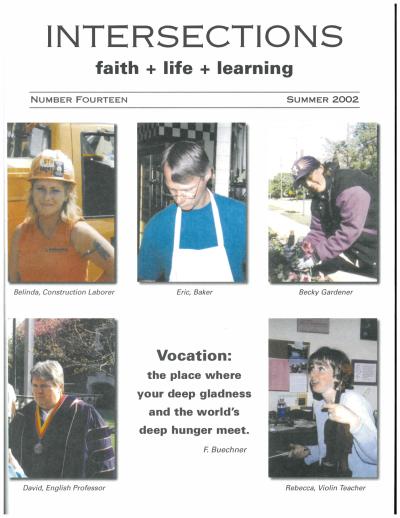
Jodock, whose Gustavus Adolphus was one of twenty colleges to receive a Lilly “Theological Exploration of Vocation” grant in 2000, defines vocation not as occupation but as a self-understanding that nests the self in community. Reading Robert Putnam’s Bowling Alone on the collapse of secondary communities alongside Luther’s ethic of community benefit and five Lutheran principles (graciousness, Christian freedom, community, God active in the world, the theology of the cross), he walks through Gustavus’s three-level design—a definition of vocation open to other faith traditions, “middle principles” drawn from Sharon Parks’s Common Fire, and a long menu of programs coordinated by a new Center for Vocational Reflection—hoping that, in the language of Holocaust studies, graduates will be “resisters” and “rescuers” rather than bystanders.
-
 Article
Freedom, Humor, and Community: A Lutheran Vision for Higher Education
Darrell Jodock
No. 13 · Winter 2002
Jodock’s inaugural lecture for the Bernhardson chair at Gustavus Adolphus develops three interlocking themes drawn from the Lutheran tradition as a deeper grounding for the liberal arts college than contemporary American assumptions. A sense of humor rests on Luther’s discovery that God takes the initiative—Luther could call himself a beggar, joke about the epistle of James, and credit Wittenberg beer for the Reformation—and underwrites the freedom of inquiry that John Updike traces to Grace Lutheran Sunday School in Shillington. Community, grounded in Augsburg Confession VII and Luther’s 1524 letter to the German city councils, makes the college a community of discourse pursuing wisdom rather than “the same old blockheads.” Freedom is both “freedom from” and “freedom for,” illustrated by Nechama Tec’s Polish Holocaust rescuers and by Jodock’s Holocaust-class corporate role-play in which students voted to build a factory in a death camp rather than risk losing their board seats—a vivid case for educating toward “a passion for justice.”
-
 Reflection
Calling and Learning: On Losing and Then Finding Myself
Rachel Hammond
No. 9 · Summer 2000
Hammond, a Capital University junior who spent two semesters studying in Guayaquil, Ecuador, recounts watching the sucre collapse from 10,500 to 29,000 per dollar between September and January, the overthrow of President Jamil Mahuad, the freezing of bank accounts over $4,000, the threatened eruption of the volcano at Baños, and her work at an orphanage that needed only $6.81 to feed a child for a month—and calls her fellow students, in light of Elie Wiesel’s warning that indifference is the enemy, to recognize their education as a gift and a responsibility to speak for those who cannot speak for themselves.
-
 Article
An Aristotelian Twist to Faith and Learning
Gregg Muilenberg
No. 3 · Summer 1997
Muilenburg, chair of Philosophy at Concordia, surveys the four traditional models for faith and reason—conflict, independence, dialogue, and integration—and argues that the Lutheran dialogical model is insufficient for wholeness. Drawing on the post-foundationalist epistemology of perspective and Aristotle’s account of knowing as desire-driven action, he proposes that faith is an ultimate value (an assessment belief of the form ‘x is better than y’), that learning is desire-directed action, and that the core of Christian education is the education of Christian desire—requiring both reflection and commitment, both integration and diversity.
-
 Reflection
VLHE—Wednesday Morning Sacred Pause
Ann Rosendale
No. 62 · Fall 2025
8 min audio
Rosendale draws on Esther 4:14 and the Lutheran practice of holding death and resurrection together — with “and” as the hardest word — to argue that the calling of Lutheran higher education for “just such a time as this” requires us to remember and name out loud that ours are places where God is at work.
-
 Editorial
From the Editor: Why All This Talk About Vocation?
Colleen Windham-Hughes
No. 56 · Fall 2022
Windham-Hughes introduces the Fall 2022 issue built around Mark Wilhelm’s keynote “Why all this talk about vocation?” and previews five panel responses, two first-time conference reflections, and companion pieces on Womanist theology — framing vocation as a call not to privilege but to constructive and corrective work that undoes unjust systems.
-
Article
Risky Speech–Gifted Friendships
Sonja Hagander
No. 44 · Fall 2016
Augsburg College Pastor Sonja Hagander reflects on pastoral care across faith traditions — from a campus chapel service after the 2008 murder of Muslim student Achmednur Ali, to her decade-long friendship with Jewish colleague Barbara Lehmann — and reads the Gospel of John as a roadmap for interfaith friendships marked by love, free speech, public space, and a willingness to risk being changed.
-
 Editorial
From the Editor
Jason A. Mahn
No. 48 · Fall 2018
Mahn recounts how a participant’s probing questions at the 2018 Vocation of a Lutheran College Conference turned “civil discourse” from an innocuous theme into a contested one — and previews essays that variously urge listening and common ground, or speaking truthfully even when those words sound angry.