My job in this article is twofold—to remind us of the basics of Lutheran theology and to begin to build on those basics in responding to religious diversity in our colleges. So, if what I am saying sounds familiar, I will not be disappointed and I hope you will not be either. Simply regard it to be a reminder or a restate- ment of what you already know and an endeavor to establish a common base for the other articles in this issue. If what I am saying is new and unfamiliar to you, then I hope it will serve to invite you into the conversation and equip you for it.
The Third Path
I begin with an image of the third path. When it comes to private colleges in this country, there are two well-known default posi- tions. Each has value, so I describe in order to distinguish, not to criticize. The first I call “sectarian.” The sectarian institution is deeply rooted in one denominational and/or one religious tradi- tion, but it is not inclusive. It expects a good deal of homogeneity. If it’s Baptist (let’s say), it will give preference to hiring faculty and staff and admitting students that are Baptist. Sometimes the expectations are more informal, at other times they are formu- lated into written statements that faculty and staff are expected to sign when they are appointed. The sectarian college is an enclave. It primarily serves the church and is good at nurturing students in its own religious tradition. But a pretty clear line separates it from the rest of society, and this line tends to isolate it and make full participation in the surrounding world difficult. With regard to religious diversity, it has no problem, simply because religious diversity does not exist or is not acknowledged. It is excluded from the on-campus conversation. Seventy-five or one hundred years ago, many of our ELCA colleges were more homogenous than they are now, but the homogeneity was often driven more by ethnicity or language than by religious principle. Even so, many alumni and friends of our colleges often expect them to be more sectarian than they are.
The second default model is “non-sectarian.” A non-sectar- ian institution is religiously inclusive; it is a microcosm of the surrounding society. Unlike the sectarian institution, the line of demarcation between the college and the larger society is easily crossed. It has as much religious diversity as the society around it. But it is not rooted. Every religious group has equal status, and the college endeavors to have policies that are neutral. As a result, its communal religious identity is superfi- cial—that is, its principles are borrowed from the surrounding culture rather than from a religious tradition. With regard to religious diversity, it too has no problem, but for quite different reasons. Its implicit message is that religion is not important enough to be part of the communal life of the college. Religion becomes a private matter, so there is no reason to wrestle with religious differences.
Somewhat ironically, though the intention is clearly positive, this non-sectarian approach can have quite a different result. Built as it is on the notion of tolerance, it can result in new forms of intolerance. This can happen when each religious group, lack- ing interaction with the others and reacting against the commu- nal devaluing of religion, can begin to see itself as the bastion of truth. Then a new balkanization can occur as each group within the college becomes an embattled enclave. Instead of fostering cohesion, the result can be even more rigid divisions.
Often, having in mind the more positive aspects of a non- sectarian college, some voices within our colleges and some voices from without expect us to become non-sectarian, in part because the model is familiar and in part because some assume it is the only alternative to being sectarian.
In our society, a Lutheran college that takes its own tradi- tion seriously does not fit either of those default models. It follows a third path. It is rooted because it takes the Lutheran tradition seriously and draws nourishment from it, and it is inclusive in at least two senses: (a) welcoming into its student body, faculty, and staff persons of diverse religious backgrounds and (b) seeking to serve the larger community. Instead of an enclave or a microcosm, it is a well that is dug deep to nour- ish the whole community. One difficulty of the third path is that it is hard to explain. It does not fit either default model. Another of the difficulties is that it leaves us with an unre- solved question and an unfinished task: how is a college that is rooted in the Lutheran tradition to deal with religious diver- sity? How can it be both rooted and inclusive?
Two Orienting Observations
I begin by observing that we are talking here about the identity and vocation of the college, about a communal identity and not a sum of individual identities. For a college to be Lutheran, not everyone in the community needs to be Lutheran or Christian. I like to think of it this way—if everyone in the college shares a vision of what the college is trying to do, this vision informs the teaching and decision-making at the school even if only some members of the community have their personal roots sunk deeply in Lutheran soil while others do not. Or, to appeal to an analogy, if a student who is not sure if he or she believes in God goes to India and comes back so moved by the plight of people there as to make helping them a priority, and another student who is a committed believer goes to India and comes back with the same priority, and both benefit from good mentoring, the two may well wind up doing the same kind of project. In either case, in some modest way the poor in India are likely to be helped. The difference is that the second student will believe that the call has come from God through the deep human need of our neighbors in India while the first student will believe that the call has come directly from the deep human need. The second is likely to be more deeply rooted than the first; hence the two may well differ in their vocational resiliency and may also differ in other ways. But on the level of ethical action, their initial results may be the same: namely, the poor get help. Or, at the risk of overkill, allow me one more analogy. The piers that support a bridge hold up a roadway that is usually wider than the piers themselves. So, too, Lutheran roots nourish a college community that is much more inclusive than building on a denominational identity would seem to suggest.
Having made this observation, allow me to make a second. A community that values the deep wells of its own religious tradi- tion is more likely to value other kinds of depth. A religiously rooted college that follows the third path is more likely to value the rootedness of a Muslim or a Buddhist or a Jew than is a non-sectarian college that dismisses the importance of religion. I do not mean that the religious differences will disappear. No, precisely the opposite, the differences will remain. But what I do want to say is that a person deeply rooted in one tradition is more likely to respect the importance of religion in the life of the deeply rooted member of another religion. If they talk at some length about their religious views, their differences will not be ignored or denied, but a different kind of kinship will emerge. If all goes well, each will be enriched by the conversation, and each will appreci- ate new elements in his/her own faith. This is possible because each religious tradition (and specifically the Lutheran tradition) brings with it an awareness of the deep mystery of the divine. This mystery cannot be captured fully in any one set of words or any one set of symbols. A believer need not endorse the words of another tradition in order to understand that one’s own words are insufficient and one still has more to learn.
Interreligious Dialogue and Civil Discourse
With this longish introduction, I’d like to try to identify some features of the Lutheran tradition that influence how a Lutheran college begins to think about interreligious relations and civil discourse—the two topics that are front and center in all the articles of this issue. Before doing that, however, the introduction will be extended one more time. I need to clarify what I mean by interreligious dialogue and by civil discourse, so let me provide some descriptors:
A person engaged in good inter-religious dialogue (a) com- pares the “best” of one religion to the “best” of another, not the best to the worst, (b) interprets the other religion “in such a way that an informed adherent of that religion would agree with the description,” (c) enters the dialogue “ready to learn something new” and “see the world differently,” and (d) stays clear of merely fitting an idea from the other religion into the framework of one’s own, as if the other religion were but a pale reflection of one’s own, when in fact the pieces there are put together quite differently (Jodock 131-32).
A person engaged in civil discourse seeks “common ground”— that is, areas where values overlap—and does so regarding any issue of importance, including the more contentious ones such as immigration, global warming, war, abortion, same-sex relations, etc. Indeed, the conversation needs also to tackle disagreements about the relative importance of these and other issues. Some guidelines for such civil discourse include the following: (a) “those who claim the right to dissent should assume the respon- sibility to debate.” (b) “Those who claim the right to criticize should assume the responsibility to comprehend.” (c) “Those who claim the right to influence should accept the responsibility not to inflame.” (d) “Those who claim the right to participate should accept the responsibility to persuade” (Hunter 239).
The Lutheran Tradition
Now, what features of the Lutheran tradition influence how a college thinks about interreligious dialogue and civil discourse? I’d like to consider six; as we will see, they are interlocking.
Feature #1: Giftedness
According to the Lutheran tradition, being right with God and having dignity as a human are free gifts, for which there are no prerequisites. It is as if we were orphans and totally out of the blue came adoptive parents who say, “From this point on, as far as we are concerned, you are our child, no matter what.” We would have no idea why we were selected or why the adopted parents are taking this step. All of the initiative and all of the energy for the relationship would be coming from the parents. And we would see that this was happening not only to us but to others as well. Being adopted means being adopted into a family with siblings. The tradition says that being right with God and having dignity are both founded on God’s evaluation, not ours.
What results from being gifted is a trustworthy relationship, which militates against fear and anxiety. I am convinced that fear and a pervasive anxiety are contributing to the polarization and the harsh rhetoric in our society. This anxiety has more than one cause, but among them is the deep, inarticulate worry that our way of life is not economically, environmentally, or politically sustain- able. Anxiety gets in the way of civil discourse. According to Peter Steinke, the consequences of anxiety include the following: (a) it “decreases our capacity to learn,” (b) it “stiffens our position over against another’s,” (c) it “prompts a desire for a quick fix,” (d) it “leads to an array of defensive behaviors,” and (e) it “creates imagi- native gridlock (not being able to think of alternatives, options, or new perspectives)” (8-9). He calls for non-anxious leaders who keep the mission of the group front and center. This is as clear a priority for college faculty and staff as for neighborhoods and the nation as a whole. Over 200 times we find in the Bible reassur- ance: “Fear not” or “Do not be afraid.” An outlook rooted in grati- tude and a trustworthy relationship with the divine goes a long ways toward permitting civil discourse, because it enhances our capacity to listen and to imagine less polarized possibilities. And an outlook rooted in gratitude and a trustworthy relationship goes a long way toward freeing us up for interreligious dialogue. Why? (a) Because we cannot know the limits of God’s free gift. If there are no prerequisites, I cannot establish any boundaries. (b) Because the identity of a gifted person is not threatened by persons whose outlooks differ. And (c) because, as Luther made clear, we cannot know how anyone else is related to God. He was thinking about people who were nominally Christians, but the same would apply to people in other religions. To hear that a person is Jewish tells me little about that person’s relationship with God any more than learning a person is Christian tells me much about that per- son’s level of commitment or relationship with God. We all know or know of Christians whose spiritual stature is so significant that it would be acknowledged by anyone. At the same time we all know or know of Christians whose narrowness and legal- ism make us observe, with Sam Shoemaker, that they appear to have been starched and ironed before being washed.1 If so, we should not be surprised to find a similar diversity within other communities of faith. Some draw sustenance from their religion for enriching lives while others use their religion to intimidate, demean, or attack others. Recognizing multiple uses of religion leads to dialogue rather than predetermined generalized judgments.
If one’s standing before God is a free gift, what is the role of faith? According to the Lutheran tradition, faith is an acknowl- edgment of what God has done and will do in one’s life. To return to the analogy used earlier, faith is acknowledging one’s adoption. Faith does not come first; it tags along after God has been at work. Acknowledging that one is part of the family into which one has been adopted does not effect the adoption. That’s already occurred. And it does not affect the parents’ love. That’s an ongoing gift. What faith does do is to influence the self-understanding of the child or the self-understanding of the person adopted by God.
Notice that this understanding of faith puts the Lutheran tradition at odds with much of mainline Protestantism in the United States where the understanding is “if you have faith, then you’ll be right with God.” This common understanding changes the nature of faith, makes it a pre-requisite, and establishes boundaries that a free gift does not. That is, if faith is a prerequi- site, then I can tell who is not right with God. In fact, this view is a contemporary form of exactly what caused Luther problems.2 It leaves God passive and expects the initiative to come from the human being. For Luther this view was completely backwards and completely unworkable.
The point here is that the legacy of being freely gifted provides the kind of security and freedom that encourages civil discourse and interreligious dialogue. If I have no control over my adop- tion into a family or a community, am confident that the person adopting me will love me no matter what, and base my dignity as a human on this giftedness, then I have nothing to defend and nothing to fear. I can listen to those who disagree and search for common ground. I can keep my eye on the goal rather than over- reacting to others. In addition to providing this kind of security and freedom, the legacy of being freely gifted also provides the basis for treating others with generosity—for becoming a chan- nel of generosity toward others.
Feature #2: The Whole World Gifted by an Engaged God
What we have already said about free gifting can only be under- stood when it is seen to be part of the larger reality of God’s generosity toward the whole world. Unlike other traditions that see God as “up there,” orchestrating and micromanaging the world in accordance with an already worked-out plan, the Lutheran tradition finds God “down here,” amid the ordinary, amid the suffering and the chaos as well as the order and beauty, deeply involved in delivering good gifts to anyone and everyone through the agency of other humans and other creatures. Many Americans, I sense, feel as if civil discourse and interreligious dialogue are concessions. Things really should be black and white. Either a religious concept is right or it is not—so why talk about it? In contrast, the Lutheran tradition’s vision of a down-to-earth God views deliberation as an essential feature of God’s work among us. God works through deliberation and its complexity and messiness to invite us forward into deeper insights and a new perspective. On this view, God empowers but does not control. God has a goal (the kind of wholeness and peace reflected in the word “shalom”) but not a detailed plan of how to get there. For humans, the result is a remarkable freedom and a remarkable capacity for creativity, which they can use for good or for ill. The tradition affirms that all humans are invited to use that freedom and creativity to serve the goal of shalom.
One of the things this means is that everyone has a voca- tion—everyone has a calling to serve the neighbor and the community, in and through one’s parenting, occupation, and contributions as a citizen. And part of the mission of a Lutheran college is to invite and challenge everyone to develop a robust sense of vocation. One evening a group sat around a dining room table. They were all parents with children at the “best” schools in the country—Williams, Swarthmore, Carleton, Macalester. All were disappointed. This prompted a search for an explanation, the result of which was an agreement that what was missing in their children’s experience at these schools was a campus-wide conversation about vocation. I like to describe vocation this way—it is (a) a sense of the self as not an isolated unit but nested in a larger community, and (b) a deep sense that one’s highest ethical priority is to serve that larger community (a community with ever-widening circles—from neighborhood to nation, to all of humanity, to all the creatures in our biosphere). What is distinctive about the Lutheran view is that vocation comes from outside, from the needs of the neighbor and the community rather than from an emphasis on one’s own gifts and interior priorities (though these are by no means irrelevant). Earlier this summer, during a workshop on vocation for faculty at Gustavus, one of our sessions was led by three colleagues—a Jew, a Muslim, and a Buddhist—each of whom explained how his or her own religious outlook supported a robust sense of vocation. Because of the breadth of the Lutheran concept of God’s activity in the world—or, we could say, God’s ongoing creation—their ability to do this is not surprising. All are gifted and all are called.
Notice what has happened here. Our focus has been on the kind and quality of relationships. Doctrines and beliefs have their place and their importance, but they are not central. From the very beginning, the Lutheran tradition has relied on paradoxes—placing side by side two seemingly contradictory statements as a way of pointing beyond the statements to some deeper reality. (The believer is free lord of all subject to none and the believer is the dutiful servant of all, subject to all. The believer is simultaneously right with God and a sinner. God is both hidden and revealed. In 1912 some American Lutherans decided that both predestination and free will were right. The list could go on.) If doctrines were central, the rootedness of the college would have quite different consequences and the dynamics of interreligious relations would be far different.
Feature #3: Wisdom
The Lutheran tradition prizes wisdom. Let us return to the con- cept of freedom. What acknowledging one’s giftedness does is to set a person free—free from the endless treadmill of trying to prove oneself through success at this or that and free for service to others. Here as elsewhere we run into terminological difficul- ties, because Americans commonly mean by “freedom” what I would call “freedom of choice”—that is, the absence of coer- cion when deciding whether to have a hamburger or a chicken sandwich. The Lutheran tradition affirms freedom of choice,3 but what it typically means by freedom is something far deeper. For example, when society is caught up in a mass hysteria and a group is being feared and/or blamed for what is wrong, risking all to stand with a member of that group is an expression of this deeper “freedom for.” Such an action takes courage and a strong ethical commitment to the neighbor, and it also takes a deeply rooted freedom from anxiety and fear.
Now back to wisdom. If humans are free, how are they to know how to act? Luther provides no blueprint—either for the individual or for society as a whole. There are no detailed do’s and don’ts. There is no prescribed plan for how to organize a society. Decisions are to be guided, not by rules, but by wisdom. We can define wisdom as understanding humans and what makes for a rich and full life and understanding communities and what makes for justice and peace. Wisdom is not the exclusive province of one religion, but it can be enhanced by the life-affirming instruction found in the Bible. Similarly, there are enough educated fools around for us to know that wisdom is not automatically the result of education, but it can be enhanced by good learning. When Luther wrote to the city councils in Germany, recommending that they establish schools for both young men and young women, his chief argument was that the study of human history and what has gone well and what has gone wrong throughout the ages would enhance the wisdom of Germany’s citizens so that they could lead the community and lead their households (368-69).
The ultimate goal of Lutheran higher education is not learn- ing and is not even critical thinking, as important as these are. It is the enhancement of wisdom. Learning and critical thinking both contribute to this goal but they are not ends in themselves. The cultivation of wisdom is the central contribution that education can make to society.
This means that education is inherently communal. I can learn new data on my own, but wisdom requires the give and take of multiple perspectives. Wisdom comes from insight gath- ered in community. In order to discover wisdom, civil discourse is needed. Moreover, in order to discover wisdom, interreligious dialogue is valuable. It helps us examine the most basic of human questions about meaning and purpose, drawing upon the mul- tiple insights of major religious traditions and thereby deepening our understanding of what it means to be human.
I should add that wisdom is never objective or neutral. It is always self-engaging. So, the pursuit of wisdom does not require us to abandon beliefs that hold up under scrutiny; the pursuit of wisdom is rather a form of deep listening that helps us refine those beliefs and figure out what our neighbors and our community need so that we can determine where to put our energies. And what is the standard? The measuring stick is very pragmatic: whatever actions benefit the neighbor and the community are good. Whatever actions do not are bad. What matters is not one’s own virtue, not one’s good intentions, not some ideology about small or big governments; what matters are the consequences. Does someone get fed or housed or educated or experience the dignity of work or have access to health care? Do relationships get mended? Is justice achieved? Is shalom fostered? What matters are the consequences.
Feature #4: Caution regarding Claims to Know
Luther was upset about the scholastic theologians of his day who would use isolated statements from the Bible or the theologi- cal tradition as premises upon which to build arguments that would supposedly answer questions not addressed in revela- tion. In other words, they would use syllogisms to “fill in the spaces” between fundamental truths. Luther saw more than one problem with this approach, but the one that concerns us for the moment is that it overstepped the capacities of human knowl- edge. The problem was not the endeavor to learn more. The prob- lem was the claims made about the results of those arguments. John Haught, a fine Roman Catholic theologian, has used the term “inexhaustibility” to describe human knowing (11-13). In science, for example, there is always something more to know. Scientists once claimed that atoms were the smallest particles, until they learned there were still smaller ones. They expected to find that the genes were in control of human development, but soon it became clear that other chemicals and processes turn genes on and off. No matter how much we learn about the world, there is still more to learn, and that something more does not just add to our knowledge, it often changes the whole paradigm. Similarly our knowledge of another person is inexhaustible. And so is our knowledge of God. Acknowledging this inexhaustibil- ity is a reason for caution. From Luther’s perspective who would have expected God’s clearest self-revelation to be a carpenter from a remote corner of the world who identified with suffering and was executed as a criminal? Who would have expected that discipleship involves a call to “suffer with” rather than to escape suffering, a call to acknowledge the reality of suffering rather than to deny it? There are too many surprises for our claims to have much weight. For Luther, revelation shows us God, God’s attitude toward us, and God’s overall purposes, but it does not answer many other questions. Why is there suffering in the first place? What exactly is God doing at this moment? There are questions for which we have no definitive answers. The lack of full answers leaves room for freedom and the use of wisdom.
And this reminder of limits and endorsement of caution about our claims to know has a corollary: we also need to be cautious about what we do with those claims. When a person adopts bad ideas, someone gets hurt. It was, for example, a bad idea that prompted Stalin to starve out three million Ukrainians when they resisted collectivization. It was a bad idea that regarded Aryans to be superior and Jews to be a threat, and this bad idea caused untold hardship during the Holocaust. It was a bad idea to cut down ancient forests and to dump toxic gases into the air without thought to the consequences. If we cannot fully understand God, cannot fully understand humans, and cannot fully understand nature, then acting as if we did know is likely to harm someone or something else.
If a person listens carefully to the political rhetoric of today, one is shocked by the audacity of the claims to know what society needs or does not need. A little caution or intellectual humility would go a long way toward opening the door to civil discourse and the search for common ground.
And if a person listens to some of the religious rhetoric of today, one is similarly shocked. How can one claim to know the timetable of the future? The only way is to use the method of the scholastics to take ideas from scattered parts of the Bible and fill in the blanks. How can one claim to know that God punished Prime Minister Sharon for his withdrawal of settlers from Gaza? The only way is to assume, not only that God is a micromanager, but also that we can know what God is thinking.
A more cautious set of religious claims—not cautious in one’s confidence of being gifted, but cautious in one’s claims to know—allows for significant religious dialogue, where mutual learning takes place.
Feature #5: A High Value on Community
I have already talked about the centrality of relationships and the quality of relationships. In this tradition, humans are under- stood to be shaped and formed by their relationships. When my wife and I were engaged, people who knew me well commented that I seemed different. Who I was and how I responded to things was influenced by this new relationship. Relationships either enhance our humanity or cause it to shrivel. God graces us through others. So a healthy person is always simultaneously a giver and a recipient. To see oneself as part of a community is to acknowledge this mutuality—to acknowledge that I receive from others and that others can receive from me.
Once again here we run into something that is both counter- cultural and at odds with much religious practice in America. Our society generally regards humans to be isolated units, fully capable of discerning for themselves what it means to live the good life. On this view, hooking up with others is merely a matter of convenience. In contrast, the Lutheran tradition sees relationships as constitutive of selfhood. Luther was influenced by the biblical view that existing without relationships is best described as “death”—the person is breathing in and breathing out but is, for all practical purposes, dead. The Lutheran tradition is at odds with American individualism.
Some time ago I attended a talent show put on as part of the 125th anniversary of my home town. In that setting I listened to half a dozen gospel tunes. Some of the musicians were excellent, and on one level I even enjoyed the songs, but the lyrics were troubling—me, me, me in one song after another—a little about God and a lot about me. As I say, the Lutheran tradition is in this regard out of step, not only with American culture, but also with American religiosity, in that it sees the individual not as isolated but nested in a community. If being “spiritual but not religious” means trying to be a Christian by oneself, then the Lutheran tradition is at odds with this contemporary trend as well. If the goal of religious life is to practice shalom, then participating in a community of faith is essential.
When I ask students to define the word “community,” very often they describe it as a group of people with shared interests. I do not know whether that is a valid use of “community,” but it is not what I am talking about here. “Community” is rather the mutual interaction of people who differ—people with different occupations, priorities, and temperaments—all working together for the common good.
The community of faith may have shared commitments, but, as Paul discovered in Corinth, it also has a good deal of diversity, held together by a common mission to mend the world. And the larger community has even greater diversity. To understand the larger community as a community is not to seek to reduce diversity but to utilize that diversity in service to the common good—that is, to help mend the world and move it toward shalom.
We’ve already mentioned some consequences of this emphasis on community:
everyone has a calling to serve the community
participation in community is a crucial part of any education that aims at wisdom
when it can be harnessed by civil discourse aimed at common ground, diversity is an asset to the educational mission of a college
when religious diversity results in inter-religious dialogue, religious diversity can also be an asset to a college that is both rooted and inclusive.
Clearly, this emphasis on community includes both the priority of the community of faith and the priority of serving the larger community.
Feature #6: An Emphasis on Service and Community Leadership
As I hope I have already made clear, the overarching goal in Lutheran education is to equip people for service to the commu- nity. However much Luther himself emphasized the God-human relationship, he also worked to establish community chests to end begging, provide for those in need, especially children and the elderly, and provide low-interest loans to shop owners. He advocated schools for all young people. He opposed hoarding that would profit at the expense of others. He encouraged the princes and peasants to negotiate rather than go to war. He advocated changes in the rules governing marriage. He opposed a crusade against the Muslims. And, if we turn to Lutherans in America, they constitute about 3% of the population and yet are responsible for the largest social service network in the country, operate one of the two largest refugee resettlement services, and support an international relief and development service with such a high reputation that after the tsunami in Japan major secular journals suggested it was one of the best places to send donations.
An education that equips people for service to the commu- nity also equips for leadership. Vocation is my own sense of call. Leadership is helping others discern and put into action their calling. Leadership is not just being in charge or occupying a position of authority but rather the capacity to see what a com- munity needs, to convince others that it’s important, to decide on a course of action, and to get people working together toward that goal. So long as one has some vision of the whole, anyone can lead and can lead from any position in the group. Leadership comes in diverse forms—whether discerning the need or coming up with a plan or getting people on board, whether working behind the scenes or serving as a public spokesperson. What a community leader needs is a sense of vocation and a sense of agency (that is, a sense that he/she can make a difference). At a time when many feel helpless, Lutheran higher education needs to nurture a more robust sense of agency. Because the goal is service to the community, Lutheran higher education focuses on both vocation and leadership.
If leadership is to be community leadership or transformative leadership, then our college graduates need to be able to engage in civil discourse and be able to work with persons of other religions.
A Commitment to Christianity and Inter-religious Dialogue Go Together
Some may ask: what is Darrell up to? Has he relativized Christian claims? Not at all, because my endeavor is to reclaim the Lutheran tradition of God’s ongoing creation alongside the more familiar strains of redemption. Not at all, because the only way we can move the world toward shalom is to emphasize both systemic change and personal transformation. I believe that the personal transformation that Christians have emphasized is crucial. But American society has privatized and individual- ized that part of Christianity to the point of distortion, and in so doing it has neglected the priority of justice and wholeness in society. This ongoing creation and this quest for shalom are the larger framework within which personal transformation takes on meaning. Only because God is at work mending the whole world, do I have hope. And personal transformation is part of this hope. It enhances the “freedom for” we need in order to participate in this mending.
The message of our adoption by God is foundational for those of us who are members of that faith community; whether it makes a difference to the world depends on what kind of Christians we are.
Even though God’s free gifting and God’s goal of shalom make all the difference to me, I can still invite those who do not share my enthusiasm for these ideas to join me in mending the world. I can remind them that they did not choose to be born, that they did not construct the natural landscape they value, that they did not build the roads or discover the medical procedures that enhance their lives and make possible their accomplishments. In other words, I can remind them that a sober assessing of their own lives rules out a sense of entitlement and supports a life of gratitude. I can remind them of their connectedness with all that is and what this means for their exercise of freedom. I can remind them how limited is the control we seem to seek and how much in this world arouses a sense of wonder, and I can remind them how important wonder is for creativity in science and music and art and every other discipline. I do not have to prove that their religious convictions are wrong and I certainly do not need to abandon my Christian faith to do this inviting. I can invite them into a sense of gratitude, vocation, wonder, and connectedness, and encourage a vision of shalom. These have the capacity to enable religions and other groups of humans to work together and to be a unifying force instead of a dividing one.
Religious Diversity and the Lutheran Identity of a College
And next some may ask, if all of this is true, why should a non-Christian care about the college’s rootedness? Because it is precisely this rootedness that has secured a place for the non- Christian’s full participation in the community. That is, the Lutheran tradition has invited not only the person but also the person with his/her religious convictions to participate fully in the community. And I trust that religiously based invitations are more likely to endure in the midst of countervailing forces than are culturally based invitations. As the Hillel director at Muhlenberg College once told me, “I tell Jewish parents that this is a good place to send their children, not despite the fact that it is Lutheran, but because it is Lutheran.” I admit that at times the Lutheran vocabulary and outlook in a Lutheran college may make a non-Christian feel like a visitor, but the choices are these: a sectarian college where the feeling is still more intense and full participation is limited, a non-sectarian college where, in the final analysis, no one’s religious commitments are welcome, or a college that follows the third path, where the living tradition of the col- lege supports one’s presence and participation. I think the third path is the one worth taking and the one that supports both civil discourse and interreligious understanding.
Endnotes
From a speech given at Luther Seminary, St. Paul, MN, some- where between 1962 and 1966.
He had learned the theology of Gabriel Biel, which said that God had established a path to salvation, but the individual needed to take the initiative and take the first steps on that pathway. Then God would supply what was needed to complete the journey.
With regard to everything except initiating the God-human relationship. There God takes the first step.
Works Cited
Haught, John. What is God? How to Think about the Divine. New York: Paulist, 1986.
Hunter, James. Before the Shooting Begins: Searching for Democracy in America’s Culture War. New York: Free Press, 1994.
Jodock, Darrell. “Christians and Jews in the Context of World Religions,” Covenantal Conversations: Christians in Dialogue with Jews and Judaism, ed. Darrell Jodock. Minneapolis: Fortress, 2008. 129-45.
Luther, Martin. “To the Councilmen of All Cities in Germany That They Establish and Maintain Christian Schools,” Luther’s Works (American Edition), volume 45. Philadelphia: Muhlenberg, 1962. 347-78.
Steinke, Peter. Congregational Leadership in Anxious Times: Being Calm and Courageous No Matter What. Herndon, VA: Alban Institute, 2006.
-
 Editorial
From the Publisher
Mark Wilhelm
Wilhelm notes that while the ELCA’s vocation in higher education remains vibrant, the landscape of churchwide leadership has shifted dramatically with the dissolution of the Vocation and Education unit, and expresses appreciation for the faculty and staff at ELCA colleges and universities who have stepped up to sustain the network during this time of transition.
-
Editorial
From the Editor
Robert D. Haak
Haak frames the issue by asking how Lutheran colleges and universities understand the changing landscape of religious identification on their campuses, and argues that Lutheran theological commitments — including the work of the Spirit and the Incarnation — call institutions to create places where the voice of “the other” is heard and valued.
-
Article
The State of Civil Discourse on Campus and in Society
Terence S. Morrow
Morrow examines the troubled state of civil discourse in the United States and on college campuses, drawing on three deep traditions — the liberal arts, Lutheranism, and the Anglo-American legal tradition — to argue that Lutheran colleges can serve students and society by acknowledging the tensions inherent in civil discourse and helping students navigate them, and surveys promising campus programs at St. Thomas, Tufts, Loyola, and Harvard.
-
Article
The New (con)Texts of Jewish-Christian Engagement
Karla R. Suomala
Suomala surveys four contemporary contexts of Jewish-Christian engagement on American college campuses — campus populations, Jewish studies curricula, the changing nature of Jewish identity among Millennials, and the shift from formal Jewish-Christian dialogue toward broader religious pluralism — and argues that at Lutheran colleges this success story can serve as a model for engaging the other religious neighbors who increasingly form part of our society.
-
Article
The Breadth and the Depth: Dimensions of Christian-Muslim Relations at Educational Institutions of the ELCA
Mark N. Swanson
Swanson reflects on the spatial metaphors of depth and breadth that shape Lutheran higher education and argues that the study of Islam and real conversation between Christians and Muslims can contribute to both the broadening of horizons and the deepening of faith, drawing on his experience at the Lutheran School of Theology at Chicago and pointing to hospitality as a Christian practice in which depth and breadth come together.
-
Article
Reconciled Diversity: Reflections on our Calling to Embrace our Religious Neighbors
Jacqueline Bussie
Bussie offers three concrete recommendations for cultivating reconciled religious diversity on Lutheran campuses — Lutheran listening and the telling of stories, engendering encounters with religious neighbors through curriculum and bridge-building events, and choosing empathy and collaboration over evangelism and creed — arguing that what students fear most in encounters with the religious “other” is the loss of their own identity and distinctiveness, and that we can show them how loyalty to one’s own tradition and reverence for different traditions can coexist.
-
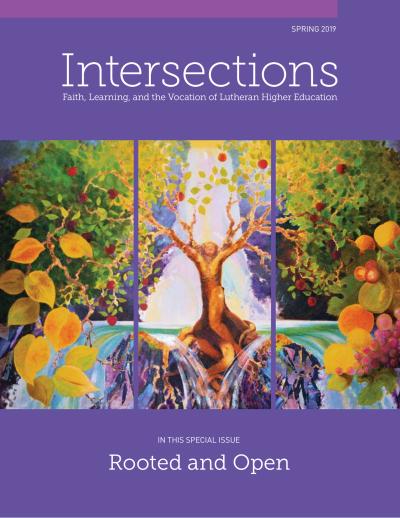 Article
In a Diverse Society, Why Should Lutheran Colleges/Universities Claim their Theological Roots?
Darrell Jodock
No. 49 · Spring 2019
Jodock develops his “third path” account of the Lutheran college — neither sectarian nor non-sectarian but both rooted and open — analogizing the college to a bridge whose deck of daily activities rests on pillars of shared educational priorities, which in turn rest on theological footings; he then answers six common objections to claiming Lutheran roots and explains why those footings still matter.
-
 Article
Religious Diversity and the Vocation of a Lutheran College
Darrell Jodock
No. 44 · Fall 2016
Jodock argues that a college which takes its Lutheran values seriously is well positioned to foster inter-religious relations along a “third path” that is both religiously rooted and inclusive. He traces the relational and communal character of Lutheran theology, develops a Lutheran understanding of deeper freedom, the theology of limits, and human complexity, and shows how a down-to-earth image of God offers theological resources for overcoming the anxiety and fear that block interfaith engagement.
-
 Article
Vocational Leadership
Darrell Jodock
No. 41 · Spring 2015
Jodock proposes “vocational leadership” as a name for a distinctive educational value at the heart of a Lutheran college — one that seeks to benefit the neighbor and the community, inspires and invites others to participate in that service, and is institutionally anchored in the Lutheran concept of vocation. He unpacks twelve facets of vocational leadership and ties them to Luther’s own leadership around indulgences, public schooling, and beggary.
-
 Article
Gift and Calling: A Lutheran Perspective on Higher Education
Darrell Jodock
No. 34 · Fall 2011
Jodock argues that a Lutheran perspective on higher education rests on three underlying ideas—that we are gifted (a giftedness that calls forth wonder, awe, gratitude, a sense of humor, and vocation as response to neighbor); that the Lutheran tradition affirms a particular kind of God who is down-to-earth and at work in the world for justice and human wholeness; and that a Lutheran “third path” can be both rooted in the tradition and inclusive of others. He draws out ten implications for higher education, from wonder as the heart of religion through liberal learning oriented toward the freedom of its members.
-
Reflection
Fumbling Toward Integrity: A Sermon on Mark 8:34-38, Pastor Kaj Munk, and Father Maximilian Kolbe
Darrell Jodock
No. 34 · Fall 2011
Preached at the 2007 ELCA Convocation of Teaching Theologians at Lenoir-Rhyne College, Jodock holds up two World War II martyrs—Polish Franciscan Father Maximilian Kolbe, who took the place of a condemned father in Auschwitz’s starvation bunker, and Danish pastor-playwright Kaj Munk, who was shot by the Nazis after helping save 97 percent of Denmark’s Jews—as mirrors for our own priorities. Drawing on the rescuer characteristics identified by Samuel and Pearl Oliner (agency, moral independence, universalistic caring, a history of care-giving) and on Jesus’s words in Mark 8:34-38, Jodock asks how we who routinely opt out at the first sign of opposition might fumble toward integrity in our own time.
-
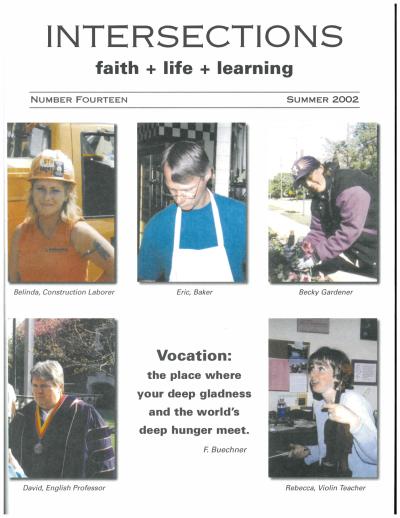 Article
Vocational Discernment: A Comprehensive College Program
Darrell Jodock
No. 14 · Summer 2002
Jodock, whose Gustavus Adolphus was one of twenty colleges to receive a Lilly “Theological Exploration of Vocation” grant in 2000, defines vocation not as occupation but as a self-understanding that nests the self in community. Reading Robert Putnam’s Bowling Alone on the collapse of secondary communities alongside Luther’s ethic of community benefit and five Lutheran principles (graciousness, Christian freedom, community, God active in the world, the theology of the cross), he walks through Gustavus’s three-level design—a definition of vocation open to other faith traditions, “middle principles” drawn from Sharon Parks’s Common Fire, and a long menu of programs coordinated by a new Center for Vocational Reflection—hoping that, in the language of Holocaust studies, graduates will be “resisters” and “rescuers” rather than bystanders.
-
 Article
Practical Approaches for Lutheran Colleges to Engage Civil Society
Katherine A. Tunheim
No. 35 · Spring 2012
Tunheim distinguishes a college’s mission from its vocation—a calling from the community—and offers four examples of Lutheran colleges “dancing with their neighbors”: Augsburg’s engagement with the Cedar Riverside Neighborhood, her Gustavus students’ work with the St. Peter Soccer Club, St. Olaf football players in the All-Star After-School Program in Northfield, and Concordia students filling sandbags during the 2009 Red River flood. She presses Lutheran educators to ask the troubling questions that prepare students to lead with ethics rather than merely with money.
-
 Institutional Focus
A List of ELCA Social Teaching and Policy Documents
No. 51 · Spring 2020
A reference list, as of September 2019, of the ELCA’s twelve social statements, fourteen social messages, and over 150 social policy resolutions — with Spanish translations where available.
-
 Reflection
A View From the Other Side
Daisybelle Thomas-Quinney
No. 8 · Winter 2000
Thomas-Quinney—an ordained Church of God minister and adjunct in Religion at Thiel College—offers “a view from the other side” as a non-Lutheran African American “outsider and novice”: her bittersweet 1995 arrival at Thiel, her swift discovery (alongside one African American secretary, one Hispanic professor, and thirty-eight African American students recruited largely as athletes) of a “chilly” campus unprepared to nurture the very minority students it had recruited, her examination of Thiel’s 1875 founding and the Augsburg Confession Article IV right-hand/left-hand kingdoms, the parables of mustard seed and yeast from Matthew 13, and Bishop James Crumbly’s 1985 LCA manual Inclusiveness and Diversity: Gifts of God. Drawing on Bruce Reichenbach, Samuel Hazo, and Josephine D. Davis’s Coloring the Halls of Ivy, she concludes that the Lutheran center cannot hold “as is” but has “great possibility” when the mission statement is actually followed.
-
 Editorial
From the Publisher
Arne Selbyg
No. 16 · Winter 2003
Selbyg reports that “vocation” is surely among the top three words in Intersections’s history and congratulates nine ELCA institutions—Augsburg, Augustana (Rock Island), Concordia (Moorhead), Gustavus Adolphus, Luther, Pacific Lutheran, St. Olaf, Valparaiso, and Wartburg—on receiving roughly two-million-dollar Lilly Endowment grants for the “Programs for the Theological Exploration of Vocation,” while reminding readers that for Lutherans the priesthood of all believers means callings to be accountants, nurses, police officers, and home makers count as fully as callings into ministry.
-
 Article
One Life, Many Callings: Vocation Across the Lifespan
Katherine Turpin
No. 47 · Spring 2018
Turpin, drawing on the collaborative research behind Calling All Years Good, traces how vocational discernment shifts through adolescence, younger adulthood, middle adulthood, late adulthood, and older adulthood — arguing that focusing vocation on entry into the workforce limits the capacity of intergenerational college communities to wrestle with calling throughout life.
-
 Editorial
From the Editor
Robert D. Haak
No. 24 · Fall 2006
Haak introduces the issue’s essays by Stanley N. Olson, Kathryn L. Johnson, Gail Summer, Lake Lambert, and Steven C. Bahls; argues that on Lutheran campuses, professional programs in business, education, and nursing are not “second-class citizens” but integral to the institution’s vocation; cites Olson’s mantra (“Because of Christ, the world; because of the world, vocation; because of vocation, education”); and thanks Matt Marohl for assisting with the editing.