The 2014 Vocation of a Lutheran College Conference explored one aspect of a Lutheran approach to higher education, an aspect with no agreed-upon name. I propose that we call this educational value “vocational leadership.” It is “vocational” because it seeks to benefit the neighbor and the community. It is “leadership” because it inspires and invites others to participate in that service, usually because the project takes more than two hands. And I propose that fostering vocational leadership in its faculty members, staff members, and students is a priority for a Lutheran college. Persons with a variety of religious commitments can endorse and support this endeavor, but it is institutionally anchored in the Lutheran concept of vocation. This anchoring stabilizes the college’s commitment to vocational leadership, enriches its meaning, and gives the concept a distinctive coloring. Members of the college community can understand and appreciate this anchoring without themselves becoming Lutheran.
Understanding a Lutheran College
Before I discuss vocational leadership, allow me to describe the larger framework within which it is situated. The religious identity of a Lutheran college has three elements: activities (classes, dormitory life, athletics, theater, choir, the dining service, etc), educational values (which inform policies and decisions), and anchoring theological principles. I will begin by using two images to help discern the relationship among these three.
First, we can think of the college as a large bridge held up by concrete pillars. All the activities occur on its expansive deck. Students usually spend four years moving across the bridge. The deck is held up by pillars (that is, by shared educational values), and the pillars are in turn anchored by footings (that is, Lutheran theological principles). The distinction between pillars and footings, or between educational values and theological principles, is crucial for what I want to say. The educational values include, for example, the practice of radical hospitality (or creating a safe place to learn by practicing generous interpersonal relations), opening the door to a deeper freedom, inspiring a robust sense of vocation (understood in its broader or ethical sense), fostering vocational leadership, cultivating wisdom, fostering a sense of agency, pursuing excellence for the sake of the wider community, valuing music and the arts, recognizing the role of mystery, practicing epistemological humility (or caution about claims to know), valuing civil discourse, and welcoming interreligious dialogue. We will not be able to explain or explore these educational values here; I list them simply as examples of what I identify as educational values. Similarly I will not explain or explore the theological principles that anchor those educational values, but here are some examples: the centrality of the gospel (that is, the good news of God’s remarkable generosity); a down-to-earth, active image of God working in and through humans; a “theology of the cross” (a principle quite specific to this tradition) that recognizes the limits of what we can know about God and is ready to live with unanswered questions while at the same time pursuing knowledge; an understanding of vocation as a religious call; a sacramental sense of the presence of God amid the ordinary; a profound sense of “freedom from” and “freedom for” as a consequence of experiencing God’s generosity; and a relational, communal, and paradoxical understanding of Christianity.
The second image is of a third path. Some colleges are sectarian. They follow a path that expects religious uniformity. They are an enclave, religiously rooted but not inclusive. Other colleges are non-sectarian and so follow a second path. They have severed their ties with a religious tradition and are a microcosm of American society, inclusive but not religiously rooted. A Lutheran college follows a third path as it seeks to be both rooted and inclusive—rooted and anchored in an open and intelligent version of Lutheran principles and inclusive in the sense of welcoming into its midst persons of other religious traditions for dialogue and mutual learning and in the sense of serving the wider community, not just the church that sponsors it. If we return to the image of a bridge, the non-sectarian college has no functioning religious footings, while the sectarian college collapses its footings and principles so that its theological teachings directly affect what happens on the deck. A college that follows the third path makes a distinction between educational values and theological principles (between pillars and footings) in order that it can be both rooted and inclusive.
“A college that follows the third path makes a distinction between educational values and theological principles (between pillars and footings) in order that it can be both rooted and inclusive.”
While we are still discussing the larger framework for vocational leadership, let us add a word about the footing that anchors it: the theological principle of vocation as a religious call. (Note that I am here discussing the footing, not the shared educational value.) In the religious arena vocation is motivated by gratitude for the gifts received from a generous God. It assumes that God cares about the wellbeing of others. And it calls individuals to serve the community in all areas of their lives. As the Scriptures are understood in this tradition, they invite believers to imagine ways to benefit the community without serving as a detailed rule book. Believers have freedom to decide how to serve. For Luther, the exercise of this freedom needs to be guided by wisdom. Such wisdom is an understanding of people and communities—how they function and what they need in order to experience wholeness. He thinks we learn wisdom by examining human societies in the past to see what went right and what went wrong (Luther 368-69) and by examining the history of the people of God. Wisdom benefits from increased knowledge, but it is more than knowledge. It is a kind of art—the art of knowing what a community needs, the art of knowing how much change is possible without creating a backlash, the art of knowing how to value people and at the same time adjust for their failures, the art of being present with people and empowering them without controlling them, and the art of knowing how to inspire people to do what is right and just. Wisdom is what guides the decision-making of free persons as they serve their neighbors and the community. An essential ingredient is the capacity to listen—to make sure that we understand the specific needs of this particular group of neighbors at this particular time. As we listen, we stand beside our neighbor rather than assuming a position of superior insight, thinking we know in advance what the neighbor needs. Whenever possible, vocation thus involves a “doing with” more than a “doing for.”
This theological principle anchors at least two educational values. The first is fostering a robust sense of vocation. When understood as an educational principle, vocation means seeing the self as nested in a larger community (indeed, an ever large community, from family to neighborhood to city, to state, to humanity, to the earth as a whole) and regarding service to that community to be the highest ethical principle. By “robust,” I mean a sense of vocation deep enough not only to support but also to challenge our occupations, not only to support but also to challenge our political involvements, not only to support but to challenge our parenting, and so forth. Ethical humanists, Muslims, Jews, Christians, and others can adopt this educational value. The second educational value is central to the present essay: fostering vocational leadership.
Twelve Facets of Vocational Leadership
Let me try to unpack this concept. My procedure will be to turn the concept this way and that and identify twelve facets of vocational leadership. They will appear in the form of a list, but they are all part of the same concept. Because vocational leadership applies to our own role in our college and because the mission of the college is to equip students to become vocational leaders in society as a whole, I will apply the concept both to the college and the wider community.
First facet: If vocation is about what I do, then vocational leadership involves inspiring, inviting, and organizing others to serve the neighbor and the community. Vocational leaders undertake tasks that require the cooperation and involvement of others. Note that in a Lutheran college both vocation and vocational leadership are less from the inside out than from the outside in. They are relational concepts, not forms of expressive individualism. They are not so much about following one’s passions or one’s own interests (though these may come into play) as they are about responding to the deep needs of those around us and allowing those needs to shape our ethical priorities.
“‘Leadership’ often refers to the role of ‘designated leaders’—to persons elected or appointed to chair a committee, to persons with titles such as supervisor, director, dean, provost, vice president, president, and the like. But, any person, any member of a community, including a designated leader, can be a vocational leader.”
Second facet: Vocational leadership uses the word “leadership” differently from the way it is normally used. For example, “leadership” often refers to the role of “designated leaders”—to persons elected or appointed to chair a committee, to persons with titles such as supervisor, director, dean, provost, vice president, president, and the like. But, any person, any member of a community, including a designated leader, can be a vocational leader. To cite a second example, “leadership” is sometimes equated with “command and control.” The leader decides, the leader speaks, and others obey. But, vocational leadership is not about “command and control.” Still another example: “leadership” is often associated with certain personality traits, so that charismatic individuals are considered to be “born leaders.” Leadership is then what some people have and others lack. But a person does not need to be “charismatic” in order to be a vocational leader. Vocational leadership is open to anyone from anywhere in the social system.
Third facet: The goal of vocational leadership is creative, beneficial change. Its effectiveness has to do with what gets accomplished and whether it benefits the larger whole. The focus is more on results than on the status or attributes of any of the persons involved.
Fourth facet: In contradistinction to a sense of helplessness or victimization, vocational leadership involves a sense of agency—an expectation that I can make a difference, even if I am not in a position to solve the whole problem. Thus, vocational leadership has a paradoxical understanding of power. It is more about empowering than about accumulating power, but it does not avoid utilizing non-coercive forms of power. Everyone has some sort of power (being educated is one form, as is community respect, charisma, wealth, a healthy support system, etc.), and vocational leadership can use all these forms of distributed power for the sake of the neighbor and the community.
Fifth facet: Vocational leadership involves what Ronald Heifetz calls “moving to the balcony”—that is, stepping back to view the whole in order to help decide what kind of change is beneficial. Heifetz says, “Imagine you are on a dance floor, swept up in the dance, an active participant in a complex scene. There are some things about the dance that you will only know by actually dancing. But if you move to the balcony for a while, you can see things that you can never discover on the dance floor—the larger pattern of interactions of which you are a part. You can gain perspective and can make new choices” (qtd by Parks 50). Or, if we want to return to my image of the college, vocational leadership involves getting off the deck of the bridge where we carry out our day-to-day job and stepping back to see the whole—to observe the larger pattern of interactions of which our work is a part and to understand the pillars and footings that support the identity and mission of the college. Not only does a person need to see the whole, one needs to imagine what the whole could become so that it would serve its purpose even more fully than it currently does.
Simon Sinek has a Ted Talk in which he draws three circles. The inner circle is “why.” The next circle is “how,” and the outer circle is “what.” His argument is that people are not persuaded by technical details about the “what.” In order to persuade, one needs to move from the “why” outward (Sinek). If he is correct, then an essential part of going to the balcony or stepping back to see the bridge is identifying the purpose of it all. Why does this college do what it does? What values and principles are at work? And how could these values and principles be more perfectly embedded in the “how” and the “what” of this college?
Sixth facet: Vocational leadership values a person’s colleagues enough not to manipulate. It works best when it can draw on relationships of trust. Here another educational value of a Lutheran college comes into play—namely that generous interpersonal relations create a safe place within which challenging deliberations can take place, genuine education can occur, and creative, beneficial changes can be undertaken.
Seventh facet: Vocational leadership involves a variety of tasks. Sometimes an individual does only one and supports colleagues as they undertake the others. Sometimes an individual does more than one. The following gives some idea of the variety:
The first task is listening. This is crucial if a person is to serve. But it is surprising how often this step is skipped—especially when dealing with people on the other side of a social, political, ethnic, or religious boundary. (In a college setting, one such social boundary is often between the faculty and the administrative staff.)
Another task is identifying the need—identifying as clearly as possible the underlying problem that deserves attention. This sometimes requires more careful consideration than we would expect. How a need is described can make a good deal of difference in what comes next. For example, back in the 1960s the John Birch Society identified the problem as the infiltration of Communists into American churches and other institutions. Not only was this almost entirely inaccurate, but it had the effect of fostering suspicions and dividing communities, and thus weakening American society rather than fulfilling its original purpose of strengthening it. A faulty description led to a faulty proposal, which in turn led to results that were counterproductive.
“Generous interpersonal relations create a safe place within which challenging deliberations can take place, genuine education can occur, and creative, beneficial changes can be undertaken.”
Given our current political environment, it probably is worth adding that vocational leadership should focus its attention on specific people and not merely implement an ideology. Competing ideologies polarize and paralyze. So long as vocational leaders pay attention to specific people and specific needs, different outlooks and social philosophies tend not to get in the way of constructive cooperation. In fact, they can contribute to a deeper perception of the multiple aspects of what is under discussion.
Another task is to inform others in the community about the need and to invite them to care about it. We should not underestimate the power of “naming.” All of us are capable of ignoring needs in our community and in fact do so quite regularly. We can, as John Steinbeck says, “know a thing and still not believe it” (399). To name a need is to bring it into the light. The vocational leader persuades others in the community that the problem exists and that it needs attention.
Another task is to imagine alternative ways to respond to the identified need and, usually in consultation with others, decide what plan is the most likely to be of benefit. This too often requires careful work, because the proposal should take into account the interests of others in the community. The closer it can come to a “win-win,” the more stable its results will be. That is, if the proposal benefits one group at the expense of another, the long-term consequences can threaten or undermine whatever has been accomplished. (We see this in Iraq where the Prime Minister has taken steps to benefit the Shi’ite portion of the population at the expense of the Sunnis and Kurds. The results have not been good.) Here as elsewhere, collaboration is important. The person formulating the proposal benefits from trying it out with other stakeholders and listening carefully to their response.
“We Americans have a tendency to think that a need is merely a problem to be fixed. This assumes that the problem can be isolated, but we live in social systems where everything is connected to the system as a whole.”
Perhaps we should add one more comment about this task of formulating a proposal. We Americans have a tendency to think that a need is merely a problem to be fixed. This assumes that the problem can be isolated, but we live in social systems where everything is connected to the system as a whole. The shockingly high numbers of mass incarceration of non-violent offenders in the United States serves as an example. Un-awareness, vindictiveness, poverty, race, sentencing laws, economics—all these and more need to be addressed in order to adequately address the complex problem. Deciding what sort of proposal will be of the greatest benefit is not easy, but it is a crucial step.
Yet another task is to marshal support for the proposal. This may mean seeking a commitment of time and energy. It may mean seeking financial backing.
Another task is to serve as a spokesperson for the project, explaining it to those who do not participate in its implementation.
Finally, another task is to organize those who work on the project, designing strategies, defining tasks, training participants, and dealing with unforeseen difficulties.
Eighth facet: Vocational leadership involves keeping one’s eye on the goal of providing help. Without this, things may easily go astray. Personality conflicts may become an impediment. Or the project may degenerate into “us” vs. “them”—“we” being the enlightened champions of right and “they” being its recalcitrant enemies. In systems theory, a leader whose attention is focused on the goal is said to exhibit a “non-anxious presence,” which avoids being caught up in the fears and reactions that the proposed changes may arouse (see Steinke 31-45). This does not mean ignoring the fears nor adopting a bull-headed determination to succeed no matter what, but it does mean a persistent yet flexible focus on the defined need and the importance of helping meet that need. Another way to name this aspect of vocational leadership is the importance of avoiding the “hidden issues” which may get in the way. Throughout any process of getting something accomplished, one or more “hidden issues” are usually at work. These are factors that operate “under the table” while the project is “on the table.” Pre-existing rivalries may be a hidden issue. Or, because, as someone has said, most people do not fear change but instead fear loss, the fear of loss may be a hidden issue. Concern about who gets credit may be a hidden issue. The list is very long. These hidden issues need to be acknowledged and confronted so that attention can return to the main task rather than being diverted in confusing ways.
Ninth facet: Vocational leadership involves risk. None of us is wise enough to anticipate exactly what will happen as we work with others to serve the community. The effort may fail. Or, even if it succeeds, the effort may have unexpected negative consequences. No one can provide a set of instructions for exactly how to solve the problem.
Closely related but not quite the same, vocational leadership also involves admitting failures—both personal failures and failures having to do with the proposed project—in such a way as to be able to learn from them. We have already emphasized the role of wisdom. Such wisdom comes from acting and reflecting. It comes from acknowledging failures rather than denying them or blaming them on someone else. Wisdom enhances vocational leadership.
Tenth facet: Vocational leadership often involves helping a designated leader do his or her job. Perhaps we could say it involves being a good follower—an engaged, constructive follower. This may mean voicing support for a proposal that is likely to help the college or the neighborhood, even it does not benefit me. Or it may mean helping the designated leader understand what is going wrong and recommending changes in how a proposal is being advanced. The temptation is to take a different route and practice what a friend of mine calls “magical thinking”—that is, expecting the designated leader to be able single-handedly to improve things and then becoming so profoundly disappointed when this does not happen as to blame that person and become either a disengaged complainer or an outright opponent.
“Vocational leadership often involves helping a designated leader do his or her job.”
Eleventh facet: Faculty and staff do not arrive at our colleges with training in vocational leadership. A faculty member, for example, typically has just escaped from graduate school, where he or she navigated a highly structured, very individualized program. The new faculty member likely has been encouraged to think about a career as an individualized project. Seldom has that person had much experience with vocational leadership or been encouraged to think about it. Nor do faculty members easily understand the way communities operate or discern the role they each are currently playing in the dynamics of their college community. Going to the balcony to understand the college as a whole does not come naturally. Unfortunately, falling into turf wars is much easier. Similarly, staff members often come from work environments in which they have experienced a “command and control” style of management. They have not been encouraged to see themselves as vocational leaders. Once hired, few opportunities are provided to help them understand how a college community works. All of this suggests that fostering vocational leadership needs some attention among the faculty and staff on our college campuses, so that the college can function better and students can be equipped for vocational leadership in the communities and workplaces where they will live and work.
Twelfth facet: Students likewise do not typically arrive at our colleges with training in vocational leadership. Yes, they may have been the captain of a football team or president of the student council, but this often involved fulfilling specified tasks rather than identifying problems and solutions or going up to the balcony. Just as medical schools teach by mentoring students as they practice medicine, so we need to find ways to mentor students in vocational leadership.
Vocational Leadership and Martin Luther
Let me try to build my case for vocational leadership in another way, by discussing Martin Luther. Most of us know the story of his religious struggles and the years of study and reflection that transpired before he found a breakthrough, discerning God’s generosity and God’s active role vis-à-vis humans. Less well known is his vocational leadership. The Reformation would never have started had he not been concerned about the effects of indulgences on the lives of his parishioners and others. It was concern about the wellbeing of the community that prompted him to draft the 95 Theses and call for a debate regarding the proper role of indulgences. The 95 Theses sought to name the problem and suggest a solution. The goal was to return to a more limited understanding of their role and to disconnect them from the fund-raising efforts of Leo X. The debates he proposed were a way of enlisting support from the ecclesiastical, theological, and academic community. His eye was on the whole, not just his parish or his university.
Similarly, Luther could have considered it beyond his responsibility as a theologian to worry about elementary education, but he nonetheless wrote an open letter to the city councils throughout Germany, urging them to provide schools for young men and young women at public expense. He recognized a need and tried to organize support for the project. Similarly again, he could have been content with the accepted idea that society needed beggars in order for others to give alms, but he imagined an alternative, a society without beggars, and worked with others to organize community chests that would provide support to the elderly, to orphans, and to others who would otherwise be forced to beg. In each of these instances and others he was exercising vocational leadership of the sort that I have been trying to describe. He had no “designated authority” that placed schools and begging in his portfolio of occupational responsibilities. Sensing a need, he “moved out” into areas that affected the society as a whole.
The Importance of Vocational Leadership
Why is vocational leadership important? Let me provide three answers, in ascending order of importance:
One answer is that communal leadership is part of the DNA of the Lutheran tradition. It is the logical extension of the priesthood of all believers and a religious sense of vocation. As already noted, it was practiced already by Luther himself. It is no accident that Lutherans in the United States (though only 3 percent of the population) are known for their network of social service agencies—a network larger than any other in the country. Lutherans expect God to work behind the scenes and to work through humans and other creatures to foster wholeness and justice and peace. God’s work is to mend the world, and the way God does this is by calling humans to serve the neighbor—through vocation and through vocational leadership.
A second answer is that our colleges need people who are practiced at vocational leadership. A college is a learning community in which most of the significant creativity comes from the bottom up rather than from the top down. Vocational leadership is an antidote to individualism and careerism and to a “silo mentality” among departments that undermine the strength of a college community and its ability to respond creatively to the contemporary challenges higher education is facing.
“Vocational leadership is an antidote to individualism and careerism and to a ‘silo mentality’ among departments that undermine the strength of a college community.”
A third, more significant answer is that our society needs people who are practiced at vocational leadership. In his article “Bowling Alone” and the book by the same name, Robert Putnam has tracked the way civil engagement has declined over the last sixty years. Concomitant with that decline has been a decline in trust and a decline in our social capital. Our society needs people who are both engaged and prepared to provide the kind of leadership we have been discussing. Educating vocational leaders is a crucial part of the vocation of a Lutheran college.
Works Cited
Luther, Martin. “To the Councilmen of All Cities in Germany That They Establish and Maintain Christian Schools,” Luther’s Works (American Edition), volume 45. Philadelphia: Muhlenberg, 1962.
Parks, Sharon. Leadership Can be Taught. Boston: Harvard Business School Press, 2005.
Putnam, Robert D. “Bowling Alone: America’s Declining Social Capital.” Journal of Democracy 6.1 (Jan. 1995): 65-78.
———. Bowling Alone: The Collapse and Revival of American Community. New York: Simon and Schuster, 2000.
Sinek, Simon. “How Great Leaders Inspire Action.” Accessed 1 January 2015, www.ted.com/talks/simon_sinek_how_great_leaders_inspire_action
Steinbeck, John. East of Eden. New York: Bantam, 1952.
Steinke, Peter. Congregational Leadership in Anxious Times. Herndon, VA: Alban Institute, 2006.
-
 Editorial
From the Publisher
Mark Wilhelm
Wilhelm celebrates the leadership of ELCA colleges and universities within American higher education — from presidential service in major higher-education agencies to recognized leadership in global education and interfaith understanding — and lifts up the health of the ELCA network of schools as a church-related community that maintains shared identity while living as good citizens of the larger academy.
-
Editorial
From the Editor
Jason A. Mahn
Mahn introduces the “Called to Leadership” issue by worrying that training for leadership has become so ubiquitous in higher education as to be nearly meaningless, and recovers Luther’s sense of leadership as service — a calling to be a “slave” whose learning, power, and wisdom belong to the unlearned, the oppressed, and the foolish — as the shared mission of Lutheran colleges to train servant-leaders.
-
Article
Sharing Leadership within Colleges and Universities
Leanne Neilson
Building on Jodock’s framework, Neilson applies vocational leadership to the unique work environment of higher education — mission statements, faculty governance, the slow pace of consensus, and the sometimes uneasy relationships between faculty and staff — and asks how leaders, followers, and team players can create an atmosphere of mutual empowerment on Lutheran college campuses.
-
Article
Mentoring in the Academy: Of Gurus, Coaches, and Sponsors
Faith Wambura Ngunjiri
Ngunjiri urges faculty, staff, and administrators in faith-based institutions to assemble a “personal board of directors” of mentors — connectors, sponsors, taskmasters, motivators, dreamers, sages, and proofers — and reflects on how race and gender complicate mentoring in predominantly white, male-led ELCA institutions, where women and minorities must reach out to build the “cloud of witnesses” they need to thrive.
-
Article
The Dangers of "Vocation" for Students Thinking about Career
Carl Hughes
Hughes warns that Lutherans too often use “vocation” as a theologically glorified synonym for a fulfilling career — a misuse that constricts God’s call to our jobs and excludes minimum-wage workers, caregivers, and others from the dignity of calling. Recovering Luther’s expansive understanding, he argues that vocation refers first to people, not professions, and must always be bigger than any one aspect of our lives.
-
Article
Women in Leadership: Obstacles, Opportunities, and Entry Points
Susan Hasseler
Drawing on two focus-group conversations with female faculty and academic administrators at Augustana College (Sioux Falls), Hasseler traces four obstacle/opportunity themes for women in academic leadership — valuing the intellectual work of leadership, religious and cultural interpretations of gender roles, caregiving realities, and embracing a strong voice — and proposes deliberate next steps for cultivating inclusive excellence on ELCA campuses.
-
Article
Superheroes and Origin Stories: Tools to Discover and Claim One's Callings
TJ Warren
Warren argues that the “Hero’s Journey” — Joseph Campbell’s monomyth with its ordinary world, call to adventure, mentors, and return with the elixir — offers a powerful pedagogical tool for helping college students discover their origin stories and claim their callings. Drawing on Superman, Wonder Woman, and Rosa Parks alike, he invites educators to mentor students into becoming the heroes of their own lives.
-
Article
Leading from Within: Peer-Learning Consultations to Explore Our Callings and Campus Capacities for Leadership
Chris Johnson
Johnson reframes vocational leadership as “soul work” that calls for the deep mind as much as the conscious one, and offers two practices — deep listening and a modified Quaker clearness consultation — as ways for campus colleagues to listen one another into existence. Drawing on Sharon Daloz Parks, Marshall Ganz, Parker Palmer, and Mary Rose O’Reilley, he invites readers to map their stories of self, us, and now.
-
Book Review
Old and New Ideas of the Liberal Arts: A Review of Claiming Our Callings
David Crowe, Katie Hanson
Crowe and Hanson review Claiming Our Callings: Toward a New Understanding of Vocation in the Liberal Arts (Oxford 2014), a collection of thirteen essays by St. Olaf faculty edited by Kaethe Schwehn and L. DeAne Lagerquist. They commend the book’s thoughtful, sincere engagement with consumerism, sustainability, Buddhist meditation, and Lutheran-Bonhoefferian theology — and recommend it for any liberal arts campus pulled between idealistic mission and career-minded pressure.
-
 Article
In a Diverse Society, Why Should Lutheran Colleges/Universities Claim their Theological Roots?
Darrell Jodock
No. 49 · Spring 2019
Jodock develops his “third path” account of the Lutheran college — neither sectarian nor non-sectarian but both rooted and open — analogizing the college to a bridge whose deck of daily activities rests on pillars of shared educational priorities, which in turn rest on theological footings; he then answers six common objections to claiming Lutheran roots and explains why those footings still matter.
-
 Article
Religious Diversity and the Vocation of a Lutheran College
Darrell Jodock
No. 44 · Fall 2016
Jodock argues that a college which takes its Lutheran values seriously is well positioned to foster inter-religious relations along a “third path” that is both religiously rooted and inclusive. He traces the relational and communal character of Lutheran theology, develops a Lutheran understanding of deeper freedom, the theology of limits, and human complexity, and shows how a down-to-earth image of God offers theological resources for overcoming the anxiety and fear that block interfaith engagement.
-
 Article
Gift and Calling: A Lutheran Perspective on Higher Education
Darrell Jodock
No. 34 · Fall 2011
Jodock argues that a Lutheran perspective on higher education rests on three underlying ideas—that we are gifted (a giftedness that calls forth wonder, awe, gratitude, a sense of humor, and vocation as response to neighbor); that the Lutheran tradition affirms a particular kind of God who is down-to-earth and at work in the world for justice and human wholeness; and that a Lutheran “third path” can be both rooted in the tradition and inclusive of others. He draws out ten implications for higher education, from wonder as the heart of religion through liberal learning oriented toward the freedom of its members.
-
Reflection
Fumbling Toward Integrity: A Sermon on Mark 8:34-38, Pastor Kaj Munk, and Father Maximilian Kolbe
Darrell Jodock
No. 34 · Fall 2011
Preached at the 2007 ELCA Convocation of Teaching Theologians at Lenoir-Rhyne College, Jodock holds up two World War II martyrs—Polish Franciscan Father Maximilian Kolbe, who took the place of a condemned father in Auschwitz’s starvation bunker, and Danish pastor-playwright Kaj Munk, who was shot by the Nazis after helping save 97 percent of Denmark’s Jews—as mirrors for our own priorities. Drawing on the rescuer characteristics identified by Samuel and Pearl Oliner (agency, moral independence, universalistic caring, a history of care-giving) and on Jesus’s words in Mark 8:34-38, Jodock asks how we who routinely opt out at the first sign of opposition might fumble toward integrity in our own time.
-
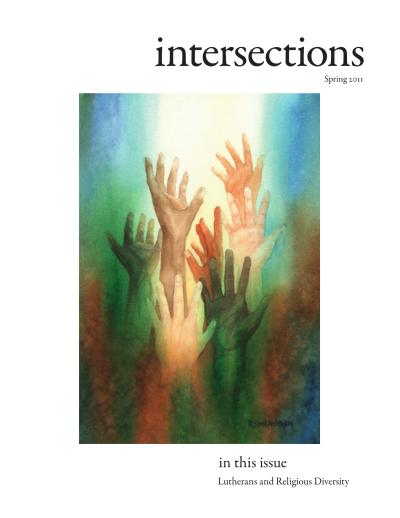 Article
Vocation of the Lutheran College and Religious Diversity
Darrell Jodock
No. 33 · Spring 2011
Jodock describes a “third path” for Lutheran colleges that is both rooted in the Lutheran tradition and inclusive of religious diversity — an alternative to sectarian and non-sectarian default models — and identifies six interlocking features of the Lutheran tradition (giftedness, an engaged God, wisdom, caution about claims to know, community, and an emphasis on service and community leadership) that shape how such a college engages interreligious dialogue and civil discourse.
-
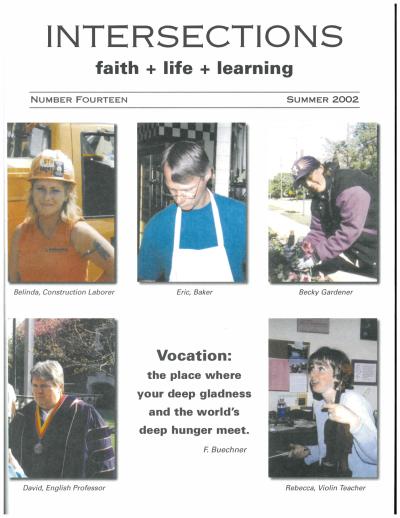 Article
Vocational Discernment: A Comprehensive College Program
Darrell Jodock
No. 14 · Summer 2002
Jodock, whose Gustavus Adolphus was one of twenty colleges to receive a Lilly “Theological Exploration of Vocation” grant in 2000, defines vocation not as occupation but as a self-understanding that nests the self in community. Reading Robert Putnam’s Bowling Alone on the collapse of secondary communities alongside Luther’s ethic of community benefit and five Lutheran principles (graciousness, Christian freedom, community, God active in the world, the theology of the cross), he walks through Gustavus’s three-level design—a definition of vocation open to other faith traditions, “middle principles” drawn from Sharon Parks’s Common Fire, and a long menu of programs coordinated by a new Center for Vocational Reflection—hoping that, in the language of Holocaust studies, graduates will be “resisters” and “rescuers” rather than bystanders.
-
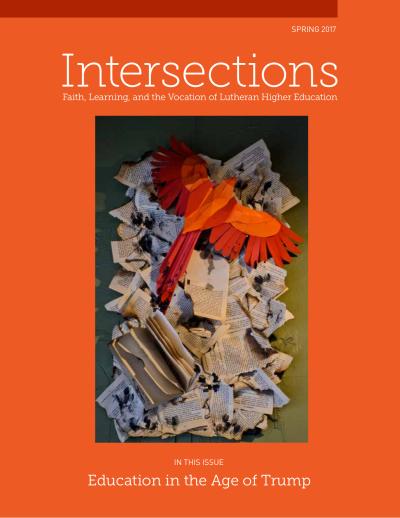 Article
Religion in the Age of Trump
Daniel A. Morris
No. 45 · Spring 2017
Morris reads the 81% evangelical vote for Donald Trump through two historical theses: that evangelicals’ once-coherent story about Godly participation in political life has fallen apart, and that their long-running tendency to exclude others — once aimed at Black Americans and Catholics — has now turned decisively against Muslims. He argues that scholars of religion and politics have a responsibility to tell these stories well, and that appeals to classroom objectivity can no longer be a luxury.
-
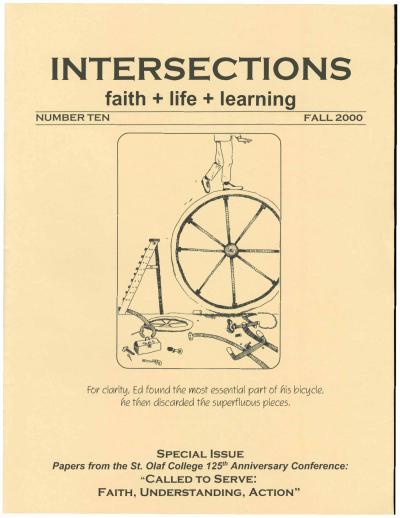 Article
Toward an Adequate Theology of Christian Higher Education
Robert Benne
No. 10 · Fall 2000
Drawing on his forthcoming Eerdmans volume Quality With Soul—Thriving Ventures in Christian Higher Education, which studies St. Olaf, Valparaiso, Notre Dame, Baylor, Wheaton, and Calvin, Benne argues that these schools have kept their souls because a critical mass of boards, administrators, faculty, and students treat the Christian account as comprehensive, unsurpassable, and central. He critiques four inadequate theologies of Christian higher education—pietism, liberal theology (Whitehead, Henry Nelson Weiman, the “values” turn, and accommodation to diversity and multiculturalism), “First Article” approaches (including Merrill Cunninggim’s Methodist version and a Lutheran two-kingdoms quietism), and reactionary/triumphalist theology—and contrasts the Catholic (Notre Dame), Reformed (Calvin, Wheaton, Baylor), and Lutheran (St. Olaf, Valpo) ways of relating faith and learning, calling Lutherans to recover “Christ and culture in paradox” as serious extended conversation rather than as a lazy excuse.
-
 Article
Ethical Leadership: Rooted, Open, Generative, and Mindful
John Arthur Nunes
No. 62 · Fall 2025
25 min audio
As he prepares to teach an Ethical Leadership First Year Seminar at California Lutheran, Nunes organizes his pedagogy around three mutually-reinforcing “turns” — inward, outward, and intellectual — grounded in Luther’s mandatum dei and larvae dei, Bonhoeffer’s estates, and Howard Thurman’s call to hear “the sound of the genuine” in oneself.
-
 Article
The Vocation of a Lutheran College
L. DeAne Lagerquist
No. 12 · Summer 2001
Lagerquist places the twenty-eight ELCA-affiliated colleges in the context of American higher education from Harvard (1636) through the “old time college,” the post-Civil-War research university, and the postwar expansion—drawing on Christopher Lucas, Philip Schaff’s Neo-Lutheran/moderate/Old Lutheran categorization, Sydney Ahlstrom’s scholastic/pietistic/critical currents, Luther’s appeal to the German nobility, Lewis Hyde’s gift economy, and Alasdair MacIntyre’s After Virtue. She proposes five characteristic practices (the school as learning community, study of Bible and Christian tradition, participation in the arts as makers and audience, application of learning in service, and on-campus Christian worship) grounded in Lutheran teaching about grace, image-and-fall, gratitude, and revelation through created “masks,” and four virtues these practices engender in graduates—loving gratitude, faithful wisdom, bold freedom, and hopeful humility.
-
 Reflection
Ecotones of Faith
Tracy Paschke-Johannes
No. 61 · Spring 2025
7 min audio
Paschke-Johannes draws on the ecological metaphor of the ecotone — the life-teeming transitional space between two ecosystems — to claim that we are not called to minister in the world of the past or one fifty years hence, but to nurture the kairos moments God is creating in the freshwater-to-saltwater present.
-
 Article
'In, With, and Under:' The Tradition and the Teaching of Christian Ethics
Pamela K. Brubaker
No. 17 · Summer 2003
Brubaker describes how she teaches Introduction to Christian Ethics at California Lutheran University—a religiously diverse classroom where about 30% of students are Lutheran, 30% Roman Catholic, and many are “unchurched”—as a community of moral discourse rooted in the Lutheran dialectic of faith and reason. Drawing on Larry Rasmussen and Bruce Birch, Elizabeth Bettenhausen, Roger Crook, and Robert Benne’s typology of “Hot and Cool Connections” between church and politics, she walks through her course’s units on human sexuality, economic life, and war and peace—including the Bomb Shelter simulation, a mock Disney stockholders meeting on sweatshops, and a Congressional hearing on the School of the Americas—to show how ELCA social statements function as case studies in critical inquiry and education for citizenship.