Wittenberg University represents a strain within American Lutheranism that has been out of fashion among Lutherans almost since the moment of our founding. I see that we’ve now become out of fashion in the broader Christian academic community, too, at least among those academics like George Marsden who call for a resurgence of the Christian university. But I will assert in this presentation that we represent an important and viable model of a college of the church, albeit not the only important and viable model. I will suggest further that we face two particular challenges in the near and longer terms. Our success or failure in meeting these challenges will bode well or ill for the future of all the colleges of the Evangelical Lutheran Church in America.
Wittenberg was founded in 1845 by the “American” faction of Ohio Lutherans. The decades before the Civil War saw colleges spring up in little towns all across the Midwest. If only because purely “secular” education was unthinkable to most Americans, almost every one of these new colleges was related to some Christian denomination. The very name “denomination” raised questions in the minds of some Lutherans; it suggested that every Christian group, or at least every Protestant Christian group, was expressing the same essential Christian truth in its particular fashion. The names “Presbyterian,” “Congregational,” “Methodist,” or “Lutheran” denominated, named the ecclesiastical tradition in which that truth was embodied, but all preached a similar - and presumably authentic - Gospel. Not a few Ohio Lutherans looked beyond the walls of their churches and saw more Law than Gospel: a strange mixture of moralism and revivalistic fervor. But Wittenberg’s founders saw their future in, not apart from, this strange American culture. Though German in origin, they had been agitating for preaching in the English language and for at least some instruction in English rather than German in the newly founded Lutheran seminary at Columbus. They called as Wittenberg’s first president the Rev. Ezra Keller, a Pennsylvania College and Seminary at Gettysburg graduate and a disciple of Samuel Simon Schmucker. Keller emphasized personal piety, avoided elaborate ritual, and placed far more importance on an experience of conversion in adolescence or adulthood than on whatever new birth might have occurred to infants in baptism. He led a revival on campus in 1847, eight students were converted.
In practice as well as in spirit, Wittenberg was ecumenical. The new college accepted financial support from the New England Society for the Promotion of Collegiate and Theological Education in the West, a pan-Protestant agency which had been organized to support any denominational college so long as it maintained the sort of classical curriculum found at older institutions like Yale and Brown. Non-Lutherans were welcome as students, even as seminary students. There were Presbyterians on the Board of Directors, and an Episcopalian taught Latin. Wittenberg’s founders were already exchanging pulpits and sharing communion with members of other Protestant denominations.
I would argue that from its founding, Wittenberg’s brand of Lutheran higher education stemmed from two complementary sets of convictions. The first set was theological: that the Gospel preached on Wittenberg’s campus should emphasize personal piety, the need to demonstrate a living faith through good works, preferably done in service to the community, and the importance of extending the right hand of fellowship to like-minded Christians in other denominations. The second set we would call cultural: the men and women who founded and supported Wittenberg believed that they and their children would take their place in a generally Christian but denominationally pluralistic “American” society, rather than in an ethnically-defined subculture within that society. Wittenberg aimed to provide a broad, liberal education that would produce not only pastors but leaders in the secular world: in the government, in commerce, and in the other learned professions of the larger American society.
This presentation is not a history of Wittenberg, so I will not follow the twists and turns of these two sets of convictions for the next 150 years. Doctrines developed, as John Henry Newman would say. There was change, and there was compromise. But as a newcomer to Wittenberg, I would make two observations.
First, we retain a theological commitment not entirely different from that of our founders. A large percentage of our students, probably most, do not arrive on campus firm in the conviction that they were born again in baptism. For those students, the college years represent an opportunity to question the values of their childhood and to develop a set of values that will shape their adult lives. To a degree that is deeply upsetting to any disciple of Karl Barth, they see themselves as religious consumers, ready to choose that set of convictions that “feels right” to them. This is a personal rather than a liturgical quest; a minority of our students will be at Weaver Chapel or at one of the congregations in town on an average Sunday morning. Like Ezra Keller, when I address the student body I look out not at a worshiping community but at a group of seekers still largely ignorant of the power of the Gospel. [I must add that while I have preached a few times, no one appears to have been converted. But I did witness a bona fide revival in our chapel last fall, at a concert by our gospel choir, where two of our students did respond to the altar call. Ezra Keller must have smiled!]
If the original student body was diverse by contemporary standards, so is our present student body, both religiously and ethnically. Just under a quarter are Lutheran. Before those of you from deeper in the Midwest chortle at that small number, I hasten to add that the percentage of Lutherans in the population of our primary service area is about 5%, Affirmative action for Lutheran applicants is alive and well at Wittenberg, but we also recruit Lutheran students aggressively!
The founders’ conviction that authentic faith spills over into service to the larger community is also alive and well today. By faculty action, each of our students spends a minimum of thirty hours doing community service in Springfield in order to receive a diploma. We intend to make service a habit for our students and to impress upon them that personal convictions cannot be divorced from commitments to others.
We still share Luther’s conviction that a broad general education in the liberal arts is the best intellectual preparation for leadership in church and community. We recruit faculty members with the strongest possible credentials in their disciplines and welcome teacher/scholars of all religious persuasions - and of none - so long as they are committed to our liberal arts mission and respect our relationship to the ELCA. Ninety years ago, in June 1906, the Board of Directors adopted the following statement:
In the Collegiate and Academic departments of Wittenberg College, the following is and has been the policy of Wittenberg College: no denominational test is imposed in the choice of trustees, officers, or teachers, or in the admission of students, nor are distinctly denominational tenets or doctrines taught to the students.
We require our faculty members not only to be effective classroom teachers but also to be actively engaged in the pursuit of knowledge in their academic disciplines. Faculty control the curriculum. They require every graduate to gain an understanding of how central questions of reality, knowledge, and value are pursued, and they make effort to explore in every course the ethical dimensions of their subject matter.
Finally, we are still ecumenical in the sense that, all other things being equal, we would rather have a student or faculty member who is a committed Methodist than a lukewarm Lutheran, and we feel we have succeeded, not failed, if a Muslim or Jewish student leaves here even more firmly committed to her tradition. We want there to be no mistake about where we stand: worship in Weaver Chapel uses the Lutheran Book of Worship, our campus pastors are ordained Lutherans, and, at least in my poor judgment, they preach the Gospel rather than the Law. But though the Lutheran tradition is privileged; other traditions are encouraged and given a sympathetic hearing. We Lutherans need constant exposure to other expressions of the Gospel and to those traditions that challenge our claims to final truth.
To continue to be an institution of higher education authentically related to the ELCA, we face two critical challenges. . . how to remain authentically Lutheran while respecting and welcoming a pluralistic student body. . . [and] making our tradition clear and compelling to the large majority of our students who are non-Lutheran or lukewarm Lutherans. . .
Let me be clear about what this means in practice. We do not have first-and second-class citizens, religiously speaking, on this campus. We assume that Presbyterians, Baptists, Methodists, Catholics, and members of other Christian denominations are “us,” not “them”; that their expressions of the Gospel, like ours, are legitimate if incomplete. We do not wish they were Lutheran; we celebrate their contributions as fellow-Christians from whom we Lutherans have much to learn. Like Ezra Keller, we believe that the Gospel transcends denominational boundaries and that Christians of all persuasions need to work in concert to leaven the world with Gospel yeast.
Second, we retain what I termed our founders’ cultural convictions: we remain committed to help our graduates succeed in the larger culture rather than a committed Christian subculture. I am not particularly proud of it, but it is probably the case that our Lutheran students are no more enthusiastic about organized religion than our non-Lutheran students. On the other hand, we want all our students to understand a Christian’s obligation to live out her faith in the larger society as well as in the community of committed Christians.
So much for what we have been and what we are. What of the future challenges I spoke of? To continue to be an institution of higher education authentically related to the ELCA, we face two critical challenges. The first is one Wittenberg has faced from the outset: how to remain authentically Lutheran while respecting and welcoming a pluralistic student body and preparing that student body to succeed in a pluralistic world?
As a liberal arts college, we could argue that we are authentically “Lutheran” by striving to offer the best possible liberal education. But then we would be no different from Kenyon or Grinnell or many other fine liberal arts colleges. Still, it has not always been obvious how we should go beyond excellence in the liberal arts to define ourselves as Lutheran. Our President and University Pastor must be Lutheran. A majority of our Board members must be Lutheran, including at least six active pastors. We state forthrightly and proudly on all our publications that we are a university related to the ELCA.
More important than these, to my way of thinking, our organized worship is authentically Lutheran. There is a visible ministry of Word and Sacrament in the center of our campus. We maintain a continuing relationship with the bishops of the six synods in our region and wherever possible with pastors in those synods. I should add, though, that none of the bishops I have talked to has a clear sense of how Wittenberg can best serve the ELCA in the late twentieth century. I am convinced that the burden lies upon us to propose viable models of church relationship for the twenty-first century.
That brings me to the second challenge, which I find absolutely critical: making our tradition clear and compelling to the large majority of our students who are non-Lutheran or lukewarm Lutherans. I am not necessarily talking about evangelism here, but neither am I talking simply about objective, accurate, understanding of what we Lutherans are about. To me, this is where the truth claims of the academy and the truth claims of the Gospel legitimately meet. Our deepest commitments reflect themselves in the goals we set for ourselves as a university. I believe that if we can articulate those goals in clear, understandable - and that means non-theological - language, our students will not only come to share them but can be drawn through them to the source of their vitality, the Gospel itself. I have been engaged throughout this past year with a group of faculty members, members of our Board, and other administrators to revise Wittenberg’s strategic plan. We determined that there are five fundamental things that every Wittenberg student should be able to do upon graduation. All five stem, in my judgment, from our Lutheran roots.
The first two reflect our, and Luther’s, commitment to the liberal arts. We want every graduate to respond with understanding to the depth and complexity of the human condition, and we want every graduate to be able to recognize, define, and solve problems from a number of different intellectual perspectives. Future leaders need to be able to define issues, put them in context, take appropriate steps to develop responses and solutions, and persuade others of the validity of those responses and solutions. As I suggested above, these are authentically Lutheran but held in common with many fine non-Lutheran institutions.
The final three are all given their force by our relationship to the church; without our grounding in the Gospel, we would express them differently and carry them out differently. We intend that our graduates develop a sense of vocation. We mean to help them see their professional lives as opportunities to serve their neighbors and their communities rather than simply as a means to a comfortable life-style. We urge them to accept the responsibility of giving back some of what they have been privileged to receive.
We expect our graduates to be prepared to assume leadership when opportunity arises. Leadership is a slippery word; too often our students associate it with respect, status, power. But Jesus speaks of a different kind of leadership than that of the Gentiles who “lord it over” their followers; Wittenberg means to produce leaders who are “servants in society.” [Statement of Mission, 1977]
Finally, we expect our graduates to be ready to take moral responsibility in their personal relationships, within their various communities, and toward the natural environment. We will not impose our moral standards on our students, but we will make it clear what those standards are, and we challenge our students to confront those standards as they firm up their own convictions.
Developing a sense of vocation, preparing for the kind of leadership that serves rather than lords over, taking moral responsibility, these are all authentic expressions, I would argue, of the Gospel as well as of our specifically Lutheran convictions. Together with our academic expectations, they create a compelling mission in which faculty members of every religious persuasion will be able to share. If they lack a certain theological clarity, we hope they make up for it in casting a wider net for the serious enquirer. They sound and resound the chords of service, constructive social change, cooperation, and self-sacrifice. They are not the cross, but I would argue that they are a valid preparation for the cross, and an authentic embodiment of our relationship to the Evangelical Lutheran Church of America.
-
 Editorial
From the Publisher
James M. Unglaube
Unglaube reports on the second annual Vocation of a Lutheran College conference of August 1996, where Walter Bouman of Trinity Lutheran Seminary addressed “What is Lutheran; What is the Lutheran Tradition” (biblical, catholic, evangelical, sacramental, world-affirming—the world “received, enjoyed, served as God’s Gift”). He previews presentations by Wendy McCredie of Texas Lutheran and Baird Tipson of Wittenberg on how the Lutheran tradition is embodied in its colleges, and Bob Vogel’s challenge in “Coherence—And Now what?” that the tradition comes to life in how faculty give expression to their beliefs and values in the classroom and with colleagues.
-
Editorial
From the Editor
Tom Christenson
Christenson opens with an invitation for reader submissions to balance the conference-paper format of the first two issues, then asks how college and universities can turn students positively toward learning. Drawing on Aristotle’s claim that study is loved for its own sake (which students greet with disbelieving laughter) and Neil Postman’s The End of Education, he argues that students lack narratives within which learning makes sense and proposes four Lutheran mega-narratives—stewardship of creation, the freedom of the Christian, the sacramental presence of the transcendent in the concrete and ordinary, and vocation—that could inspire learning at the 28 ELCA colleges and universities.
-
Article
Lutheran Tradition: Five Continuing Themes
Walter R. Bouman
Bouman of Trinity Lutheran Seminary identifies five themes central to the Lutheran theological tradition (understood through Alasdair MacIntyre’s account of tradition as “an historically extended, socially embodied argument”): biblical (a non-oppressive authority for the Bible rooted in the gospel rather than in scholastic inerrancy, against the backdrop of Luther’s 1517 challenge to Tetzel and the post-Enlightenment marginalization of theology); catholic (continuity with the Book of Concord and the three ancient creeds, with Luther’s “Christology from below” recovering a Jewish rather than Hellenistic understanding of God, revived by Tillich, Pannenberg, Forde, and Jenson); evangelical (justification by faith as the answer to mortality’s radical question); sacramental (Word, Eucharist, and Baptism as Christ’s presence from the future of God’s consummated Reign); and world-affirming (creation as gift, vocation as God’s work in every calling, and stewardship of the ecological crisis).
-
Response
“My Wife, We Have Not Come to the End of All Our Trials, but a Measureless Labor Yet”: The Lutheran Argument in Colleges
Steven Paulson
Paulson of Concordia College responds to Bouman by invoking Penelope’s unreasonable patience for Odysseus and asking whether Bouman’s five “principles” deliver the “continuities of conflict” that MacIntyre’s account of a living tradition demands. He argues that the proper Lutheran “continuity of conflict” is the praxis of proclamation—Christ crucified as “a stumbling block to Jews and folly to Gentiles”—which is given outside the institution’s walls and which colleges and universities, as socially embodied arguments, “can’t like” because it places truth beyond their control. The Lutheran problem, he concludes, is not the Enlightenment or Post-Modernism but the “old Adam,” the Odysseus still unsure of his identity.
-
Response
Disputatio Pro Quo? The Search for Lutheran Education
Jon-David Hague, Kimberly Hague
Kimberly and Jon-David Hague—both Luther College graduates completing graduate studies at Berkeley and Boston University respectively—respond to Bouman by offering Luther’s curriculum reform at Wittenberg University in the spring of 1518, only months after the 95 theses, as a model of the Lutheran voice in higher education. Inspired by humanistic principles, Luther introduced lectures on classical authors and the first instruction in Greek and Hebrew, giving students the tools to encounter scripture directly rather than receive dictated doctrine. The spirit of that reform—providing students with every possible tool while acknowledging that an instructor’s perspective is neither ultimate authority nor final word—remains useful for the search for Lutheran academia today.
-
Response
Feeling at Home: Dimensions of Faculty Life
Jane Hokanson Hawks
Hawks of Midland Lutheran College responds to Bouman by reflecting on her path from a Lutheran childhood through the BSN at St. Olaf and thirteen years at four non-church-related institutions to her present home at Midland, where teaching at a Lutheran institution finally feels “right.” Bouman’s framing of the five themes as the Lutheran argument about what it means to be human helped her ad-hoc committee articulate the spiritual role in Midland’s new faculty mentoring program (recently funded by the Lilly Foundation), and grounds her work as a nurse educator confronting the daily humanness of grief, joy, ethical dilemmas, and care across cultural and religious difference.
-
Response
“You Shall Know the Truth, and the Truth Will Set You Free”: A Scientist’s Response
Ben Huddle
Huddle of Roanoke College proposes adding a sixth theme to Bouman’s five—the scientific method—as a tool for knowing the Truth not available to Luther but central to twentieth- and twenty-first-century learning. Diagramming the continuous cycle of observations, laws, theories, and predictions, he argues that scientists must be ethical and that scholars in other fields must understand the scientific method (lest environmentalists ignore the Second Law of Thermodynamics). A Lutheran college, he concludes, should treasure both the religious and the scientific tradition: stifling either loses meaning or significance, and the Lutheran tradition is therefore biblical, catholic, evangelical, sacramental, scientific, and world-affirming.
-
Response
On the Outside Looking Out: A Personal and Social Psychological Response
Chuck Huff
Huff of St. Olaf—a self-described “Metho-Bap-terian” from the South educated at Bob Jones University—offers a personal response to Bouman’s themes (welcoming the rejection of biblical inerrancy, the distinction between gospel and scripture in the homosexuality debate, the gospel-in-the-creeds reading that releases him from Hellenistic conundrums, and the recasting of justification by faith as meaning rather than insurance policy) and a social-psychological response in which a planned study of campus social networks at St. Olaf was discontinued when preliminary interviews revealed that everyone—storied Lutherans, secular faculty, feminists, fundamentalists—felt like outsiders. Continuing the tradition requires constructing a conversation that is thoughtful, fair, inclusive, charitable, focussed, and still true to the tradition.
-
Poem
Two Poems: The Advent Carol / The Madonna of Dohany Street
Brian Forry Wallace
Two poems by Brian Forry Wallace of Capital University: “The Advent Carol,” a litany of the babies who were not adored—the Jewish baby shot with a Luger, the Black child hanged from a tree, the female messiah tossed into a river, the Tutsi infant cut by machetes, the Japanese newborn incinerated by atom bombs, the Chinese baby crushed by Japanese bombs, the aborted Mary’s child—ending with the baby “whom we do not understand, cannot feed, whom we kill”; and “The Madonna of Dohany Street,” on a Holocaust photograph in a Budapest museum of a dead mother and her dead Christ-child daughter in the former ghetto, in which annunciation, nativity, adoration, and crucifixion are seen together in a single instant.
-
 Article
Sustaining Sustainability
Baird Tipson
No. 36 · Fall 2012
Tipson—former Provost of Gettysburg College, President of Wittenberg University, and President of Washington College—reads Romans 12:2 (“be not conformed to this world…”) against Victor Ferrall’s Liberal Arts at the Brink and the contemporary financial reality of small Lutheran colleges. He tells three case-study stories from Washington College’s Center for the Environment and Society—the Chino Farms partnership, the Chesapeake Semester, and the acquisition of the work boat Callinectes—to show how presidents must engage “the world” to secure resources for sustainability work without being conformed to it.
-
 Response
Response to Robert Benne
Baird Tipson
No. 17 · Summer 2003
Tipson responds to Robert Benne’s comments in the previous issue about his review essay of The Future of Religious Colleges, affirming their fundamental agreement that the Enlightenment epistemology dominant in higher education poses the most serious threat to the vitality of Lutheran colleges. Using the example of lecturing on early Mormon history and the Book of Mormon, he concedes that the methodological “solvent” of Enlightenment historiography acts on Christian as well as Mormon faith claims, and concludes that while H. Richard Niebuhr’s “inner” and “outer” history and Walter Brueggemann’s approach in The Theology of the Old Testament are comforting to believers, they do not offer an epistemology that can stand alongside the Enlightenment model in evaluating truth claims in the academy.
-
 Book Review
Paul Dovre, ed.: The Future of Religious Colleges
Baird Tipson
No. 15 · Winter 2002
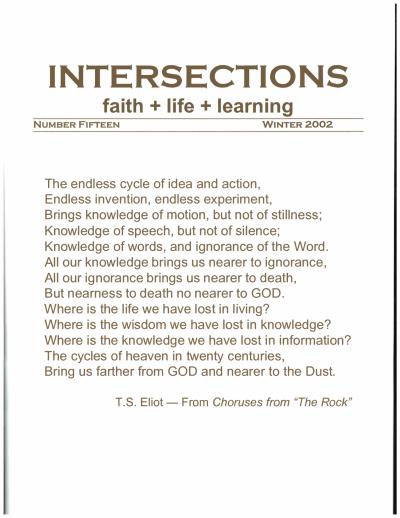
Tipson, president of Wittenberg University, reviews Paul Dovre’s edited proceedings of the October 2000 Harvard Conference on the Future of Religious Colleges (Eerdmans, 2002), summarizing essays by Douglas Sloan on the failure of the “two-realm theory of truth,” George Marsden on faith-shaped scholarship, DeAne Lagerquist, Father David O’Connell, Mark Noll, Robert Benne, Mark Roche on Notre Dame, Joel Carpenter on neo-Calvinist Kuyperianism, and Mark Schwehn on a Lutheran “college-related church” and the centrality of vocation. Against Benne’s suggestion that only two or three robustly Lutheran colleges can be sustained, Tipson defends a less robust but still authentically Lutheran model embodied at places like Wittenberg, Gettysburg, and Roanoke, arguing for the enlightenment commitment to subjecting all truth claims to rigorous criticism and for hiring Marsden-style faith-shaped scholars rather than counting Lutheran heads.
-
 Article
Finding Flourishing: Teaching Self-Care as Course Content
Emily Kahm
No. 49 · Spring 2019
Kahm argues that teaching self-care, self-awareness, and stress-coping as explicit classroom content embodies the “radical hospitality” of Rooted and Open and supports vocational formation against a consumerist culture, then offers concrete classroom techniques — a one-to-five energy check-in, ninety-second silence exercises, and full-day spiritual practices — that can be adapted across disciplines at NECU institutions.
-
 Article
Practicing Hope: The Charisms of Lutheran Higher Education
Martha E. Stortz
No. 32 · Spring 2010
Stortz names four charisms—theological gifts of identity rather than commodities—that Lutheran higher education brings to a culture of fear: semper reformanda as flexible, responsive institutions; the freedom of a Christian as simul justus et peccator critical inquiry that holds opposites in creative tension; regard for the other as “neighbor” rather than friend or alien; and the priesthood of all believers as a public, civic calling to know the poor. Drawing on Augustine, George Lindbeck, Patricia Killen, James Clifford, Earl Shorris, Carter Lindberg, and Augsburg’s Center for Global Education, she argues that immersion trips, neighbor-regard, and welfare reform witness that the gift Lutherans bring is hope grounded in Christ in you, the hope of glory.
-
 Editorial
From the Publisher
Arne Selbyg
No. 10 · Fall 2000
Selbyg explains that, while Intersections usually publishes papers from the annual Vocation of a Lutheran College conferences, this issue gathers presentations from a St. Olaf 125th-anniversary conference—a companion to the volume Called to Serve edited by Pamela Schwandt—because the theology and educational perspectives behind them apply to any Lutheran college and clarify what makes ELCA church-related colleges excellent institutions for students of any faith.
-
 Reflection
Truth, Reconciliation, and Redemption in South Africa
Brian Forry Wallace
No. 13 · Winter 2002
Wallace, a 24-year veteran political science professor at Capital University, recounts five weeks of post-apartheid peace-building travel-study with students living south of Cape Town—visiting townships, schools, day-care centers, a children’s AIDS hospital, Robben Island, and Nelson Mandela’s cell—and offers vivid sketches of his student companions Amy, Brian, Meghan, Karrie, Patrick, Meredith, Cheryl, Corin, Debbie, April, and Audra. He concludes that these students—atheists and agnostics and Buddhists and Methodists and Baptists, headed for social work, nursing, teaching, ministry, and parenthood—embody vocation by responding to a voice that calls them out of themselves to be present and to heal in this world, and that they are his link to the redemption of a lost and broken soul.
-
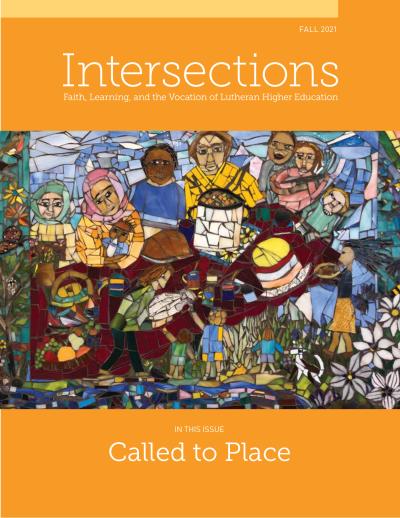 Article
Return to Purpose: Learning in an Age of Collapse
Ahmed Afzaal
No. 54 · Fall 2021
Afzaal argues that the cascading crises facing higher education are not temporary glitches but symptoms of planetary and civilizational collapse — and that colleges must embrace “double-loop” learning and return to a shared sense of purpose if they are to help humanity descend gradually rather than catastrophically.
-
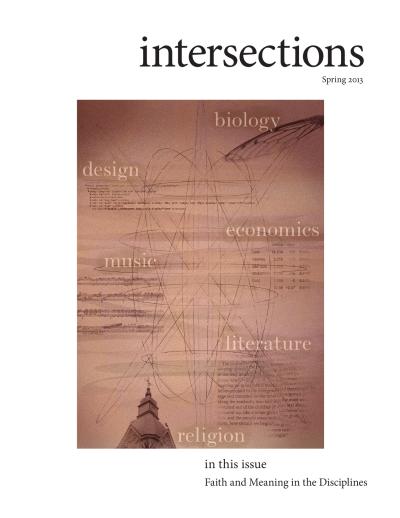 Article
Professing Religion
John D. Barbour
No. 37 · Spring 2013
Barbour reflects on the vocation of a Professor of Religion at St. Olaf College, asking when and how a teacher should disclose personal faith in the classroom. Drawing on his graduate teachers Anthony C. Yu and Langdon Gilkey, and on Augustine’s Confessions, Dorothy Day, Malcolm X, C. S. Lewis, and Kathleen Norris, he argues that teaching autobiography invites teaching autobiographically—and that professing religion is finally a matter of how one believes, not just what.