Darrell Jodock
Professor Emeritus
Gustavus Adolphus College
Published Articles
-
 Article
In a Diverse Society, Why Should Lutheran Colleges/Universities Claim their Theological Roots?
Darrell Jodock
No. 49 · Spring 2019
Jodock develops his “third path” account of the Lutheran college — neither sectarian nor non-sectarian but both rooted and open — analogizing the college to a bridge whose deck of daily activities rests on pillars of shared educational priorities, which in turn rest on theological footings; he then answers six common objections to claiming Lutheran roots and explains why those footings still matter.
-
 Article
Religious Diversity and the Vocation of a Lutheran College
Darrell Jodock
No. 44 · Fall 2016
Jodock argues that a college which takes its Lutheran values seriously is well positioned to foster inter-religious relations along a “third path” that is both religiously rooted and inclusive. He traces the relational and communal character of Lutheran theology, develops a Lutheran understanding of deeper freedom, the theology of limits, and human complexity, and shows how a down-to-earth image of God offers theological resources for overcoming the anxiety and fear that block interfaith engagement.
-
 Article
Vocational Leadership
Darrell Jodock
No. 41 · Spring 2015
Jodock proposes “vocational leadership” as a name for a distinctive educational value at the heart of a Lutheran college — one that seeks to benefit the neighbor and the community, inspires and invites others to participate in that service, and is institutionally anchored in the Lutheran concept of vocation. He unpacks twelve facets of vocational leadership and ties them to Luther’s own leadership around indulgences, public schooling, and beggary.
-
 Article
Gift and Calling: A Lutheran Perspective on Higher Education
Darrell Jodock
No. 34 · Fall 2011
Jodock argues that a Lutheran perspective on higher education rests on three underlying ideas—that we are gifted (a giftedness that calls forth wonder, awe, gratitude, a sense of humor, and vocation as response to neighbor); that the Lutheran tradition affirms a particular kind of God who is down-to-earth and at work in the world for justice and human wholeness; and that a Lutheran “third path” can be both rooted in the tradition and inclusive of others. He draws out ten implications for higher education, from wonder as the heart of religion through liberal learning oriented toward the freedom of its members.
-
Reflection
Fumbling Toward Integrity: A Sermon on Mark 8:34-38, Pastor Kaj Munk, and Father Maximilian Kolbe
Darrell Jodock
No. 34 · Fall 2011
Preached at the 2007 ELCA Convocation of Teaching Theologians at Lenoir-Rhyne College, Jodock holds up two World War II martyrs—Polish Franciscan Father Maximilian Kolbe, who took the place of a condemned father in Auschwitz’s starvation bunker, and Danish pastor-playwright Kaj Munk, who was shot by the Nazis after helping save 97 percent of Denmark’s Jews—as mirrors for our own priorities. Drawing on the rescuer characteristics identified by Samuel and Pearl Oliner (agency, moral independence, universalistic caring, a history of care-giving) and on Jesus’s words in Mark 8:34-38, Jodock asks how we who routinely opt out at the first sign of opposition might fumble toward integrity in our own time.
-
 Article
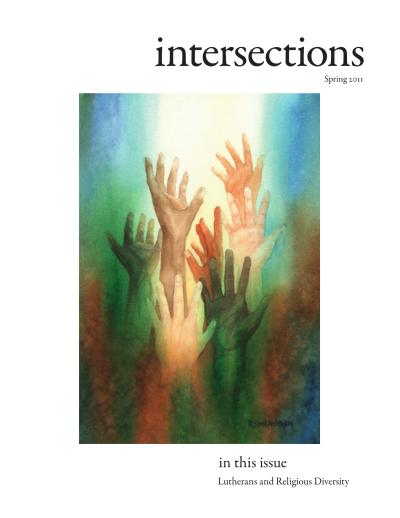
Vocation of the Lutheran College and Religious Diversity
Darrell Jodock
No. 33 · Spring 2011
Jodock describes a “third path” for Lutheran colleges that is both rooted in the Lutheran tradition and inclusive of religious diversity — an alternative to sectarian and non-sectarian default models — and identifies six interlocking features of the Lutheran tradition (giftedness, an engaged God, wisdom, caution about claims to know, community, and an emphasis on service and community leadership) that shape how such a college engages interreligious dialogue and civil discourse.
-
 Article
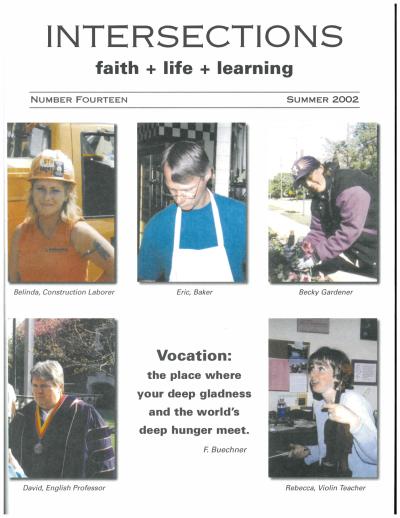
Vocational Discernment: A Comprehensive College Program
Darrell Jodock
No. 14 · Summer 2002
Jodock, whose Gustavus Adolphus was one of twenty colleges to receive a Lilly “Theological Exploration of Vocation” grant in 2000, defines vocation not as occupation but as a self-understanding that nests the self in community. Reading Robert Putnam’s Bowling Alone on the collapse of secondary communities alongside Luther’s ethic of community benefit and five Lutheran principles (graciousness, Christian freedom, community, God active in the world, the theology of the cross), he walks through Gustavus’s three-level design—a definition of vocation open to other faith traditions, “middle principles” drawn from Sharon Parks’s Common Fire, and a long menu of programs coordinated by a new Center for Vocational Reflection—hoping that, in the language of Holocaust studies, graduates will be “resisters” and “rescuers” rather than bystanders.
-
 Article
Freedom, Humor, and Community: A Lutheran Vision for Higher Education
Darrell Jodock
No. 13 · Winter 2002
Jodock’s inaugural lecture for the Bernhardson chair at Gustavus Adolphus develops three interlocking themes drawn from the Lutheran tradition as a deeper grounding for the liberal arts college than contemporary American assumptions. A sense of humor rests on Luther’s discovery that God takes the initiative—Luther could call himself a beggar, joke about the epistle of James, and credit Wittenberg beer for the Reformation—and underwrites the freedom of inquiry that John Updike traces to Grace Lutheran Sunday School in Shillington. Community, grounded in Augsburg Confession VII and Luther’s 1524 letter to the German city councils, makes the college a community of discourse pursuing wisdom rather than “the same old blockheads.” Freedom is both “freedom from” and “freedom for,” illustrated by Nechama Tec’s Polish Holocaust rescuers and by Jodock’s Holocaust-class corporate role-play in which students voted to build a factory in a death camp rather than risk losing their board seats—a vivid case for educating toward “a passion for justice.”